
Key Takeaways
- Generative search extracts individual sentences rather than full pages, so each claim must stand alone, be specific, and sit next to a source a retrieval system can verify 6.
- Rebuild briefs around the primary user question, a list of 5 to 12 required claims, and a required source type per claim, which forces sourcing before drafting.
- Open every H2 with the direct answer, followed by evidence and nuance, because retrieval systems pull the first sentences under a heading more often than any other text.
- Design sections that survive extraction by using self-contained paragraphs, specific headings, and sentences that carry meaning without pronouns or references to surrounding context 4.
- Write each statistic with the figure, unit, time frame, and population inline, so retrieval systems can quote the sentence whole without losing its qualifiers.
- Cite for recall and precision rather than volume: one source per claim, placed next to it, chosen for direct support rather than topical adjacency 5.
- Use plain-language structure, including active voice, informative headings, and short sections, because these features determine how cleanly a passage can be parsed and quoted 8.
- Ship schema markup that mirrors visible content exactly, since mismatched FAQ, Article, or author fields create attribution problems retrieval systems penalize 4.
- Run production as a claim-level loop across brief, draft, QA, and publish, sending failing citation checks back to the brief row rather than patching at the end 11.
- Drop AI detectors as a publication gate because NIST pilot testing found wide variation across detectors and generators, and replace them with source verification checks 10.
- Maintain a per-page provenance record with claim list, source URLs, reviewer approvals, AI-assistance notes, and archived sources, so any claim can be traced quickly 11.
- In regulated verticals, substantiate every objective claim and testimonial before publication, cutting or softening sentences that lack competent evidence rather than hedging the language 1.
The claim, not the page, is now the unit of optimization
A Stanford HAI audit of four generative search engines across 1,450 queries found that roughly 50% of generated statements had no supporting citation at all, and only about 75% of the citations that were provided actually supported the statement they accompanied 6. This pattern indicates that generative systems pull sentences, not entire pages, and frequently pair them with weak or mismatched evidence.
This behavior reshapes what SEO writers are actually optimizing. A 1,200-word service page is no longer the atomic unit a retrieval system grades. Instead, the atomic unit is the individual claim inside that page, lifted from its paragraph, judged on whether it answers the query, and attached to a source the system can verify. Pages still need to rank, be crawlable, and earn snippet eligibility, but the sentences within them now compete independently for citation.
The practical consequence for content teams is a tighter editorial standard. Every factual sentence should be specific enough to stand alone, sourced to something authoritative, and structured so a retrieval system can tell what it says without the surrounding paragraph. The 11 tips below work through that standard, from brief to publish.
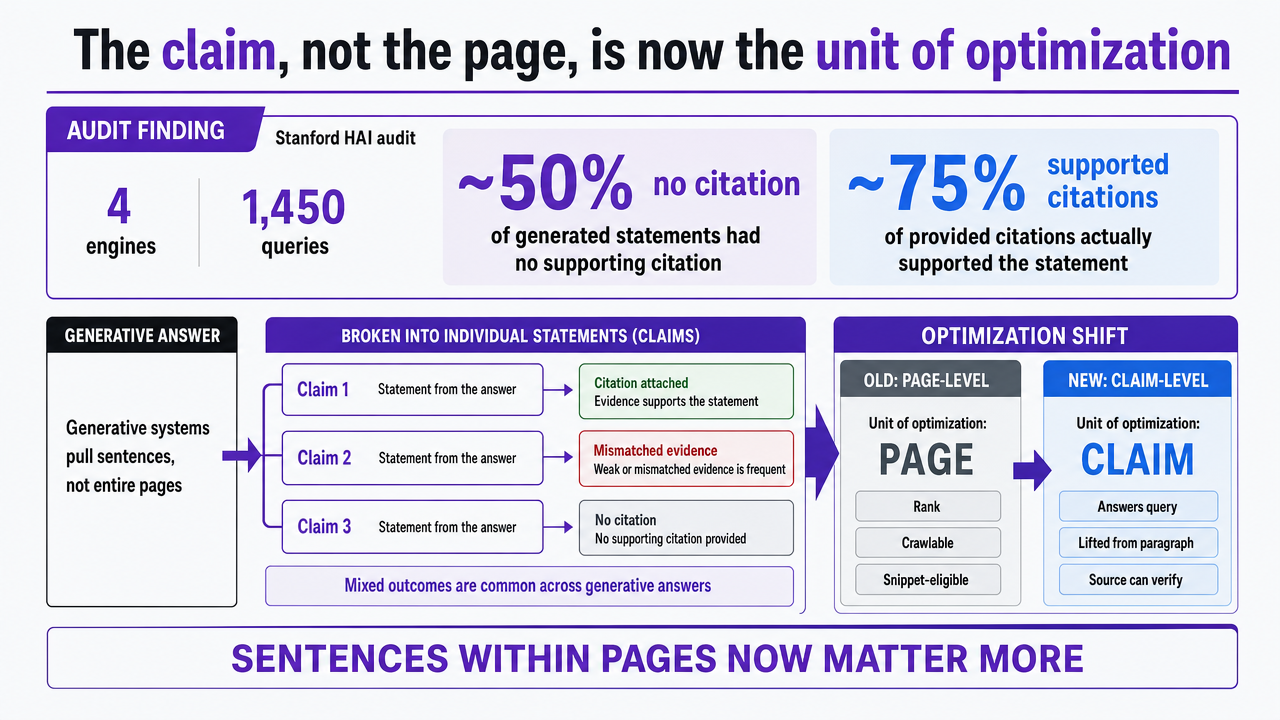 Visualize the Stanford HAI audit finding cited in the section prose about citation gaps in generative search answers
Write briefs around claims, not keywords
A keyword-first brief tells a writer what the page is about. A claim-first brief tells the writer what the page must prove. The second format is what AI search rewards, because retrieval systems pull sentences that answer a specific question with a specific source, not pages that are broadly on-topic.
Rebuild the brief template around three fields:
- The primary question the page answers, written as a user would type it.
- A list of 5 to 12 claims the page must contain to answer that question completely, each phrased as a declarative sentence with a number, date, or named entity where possible.
- A required source type for each claim: federal agency, peer-reviewed study, named vendor documentation, first-party data, or named practitioner.
The keyword still goes in the brief, but it sits under the question, not above it.
This structure forces the writer to source before drafting, not after. It also makes QA faster, because every claim in the draft maps to a row in the brief. A reviewer can check citation recall at the row level: did the writer support each required claim, and did they use the required source type? That check is the same signal generative systems apply when they decide whether a sentence is worth quoting 5.
Lead each H2 with the answer, then the evidence
Retrieval systems extract the first one or two sentences under a heading more often than any other part of the section. This makes the opening line of each H2 the highest-leverage sentence on the page. Writers trained on magazine-style leads tend to warm up the reader before answering the question. For AI search, that habit buries the quotable sentence under setup copy that never gets pulled.
The fix is a strict inversion: answer first, evidence second, nuance third. If the H2 asks how long a dental implant lasts, the opening sentence should state the range in years, with the source named in the same sentence or the next one. The second paragraph then explains why the range varies and what conditions shift it. A reviewer should be able to read only the first sentence of every H2 and get a coherent, defensible summary of the page.
This structure also improves citation precision, the measure of whether a cited source actually supports the sentence it accompanies 5. When the answer sits next to its source, there is no ambiguity about which claim the citation covers. When the answer is spread across three paragraphs, retrieval systems often grab the wrong sentence and attach the wrong source, which is one of the ways polished-looking AI answers end up materially wrong.
Build sections that survive extraction
The TREC RAG 2025 track grades retrieval-augmented answers on four layers: relevance assessment, response completeness, attribution verification, and agreement analysis 4. That framework is a useful mental model for section design, because each layer corresponds to a question a reviewer should be able to answer about any H2 on the page:
- Does this section match the query intent?
- Does it cover the full answer, not just one angle?
- Can each claim be traced to the source cited next to it?
- Do the claims agree with the sources rather than drift from them?
Sections that score on all four layers share a shape. The heading is a complete question or a specific noun phrase, not a one-word label. The opening sentence answers that heading. The body breaks into two or three self-contained paragraphs, each covering one sub-claim with its own source. A short list or table appears when the content is enumerable, because enumerated content extracts more cleanly than prose. Any numeric claim includes its unit, time frame, and population in the same sentence.
What kills extraction is dependency. Sentences that start with "this," "these," or "as noted above" lose their meaning the moment they are pulled out of the page. The same goes for claims that rely on a chart caption, a prior H2, or a footnote for context. Writers should audit every section by reading its sentences in isolation and asking whether each one still carries a defensible meaning. If a sentence collapses without its neighbors, it will not survive a retrieval pass intact.
Treat every statistic as a standalone asset
A statistic that cannot be understood without the paragraph around it is a statistic that will be misquoted or ignored. Retrieval systems grab the sentence containing the number, not the setup two paragraphs earlier that defined the population or the time window. When those qualifiers are missing from the sentence itself, the number either gets dropped as unreliable or gets attached to a different claim entirely.
The working rule is that every numeric sentence should carry four elements inline: the figure, the unit, the time frame, and the population or sample. For example, "Conversion rates on service-page redesigns improved 32% across 14 multi-location dental brands between Q1 and Q3 2024" survives extraction because a retrieval system can quote it whole and still convey what it means. The sentence also tells a reviewer exactly what source type is required to support it.
Two smaller habits reinforce the rule. Write the source name into the sentence or the one immediately after, not into a footnote marker alone. And avoid pronouns in any sentence that contains a number, because "it rose to 47%" loses its referent the moment the sentence is pulled. Treating each statistic as a self-contained asset is what makes a page quotable at the claim level rather than merely citable at the URL level 5.
Test AI-driven SEO content workflows in real time
Publish live SEO content and gauge measurable ranking impact before committing long-term.
Cite with recall and precision, not volume
Stuffing a draft with 30 outbound links does not make it more credible to a retrieval system. The relevant measures are citation recall and citation precision: whether every claim that needs a source has one, and whether each cited source actually supports the specific sentence it sits next to 5. A page can hit a high link count and still fail both tests when sources are decorative rather than evidentiary.
The editorial standard is one source per claim, placed next to the claim, and chosen for direct support rather than topical adjacency. A sentence about FDA labeling should cite the FDA page that states the rule, not a trade publication summarizing it. A sentence about a 2024 industry benchmark should cite the report that published the number, not a vendor blog that references the report. When the primary source is not available, the sentence should be softened or cut, not propped up with a weaker citation that looks authoritative at a glance.
Two checks catch most failures:
- Read each cited source and confirm it contains the exact figure or claim in the sentence.
- Remove any citation that supports the paragraph's general topic but not the specific sentence.
What remains is a page that scores on both recall and precision, which is the shape retrieval systems reward.
Use plain-language structure as a retrieval feature
Plain language is not a stylistic preference for AI search; it is a structural signal. The Federal Plain Language Guidelines call for informative headings, active voice, common words, logical organization, lists, tables, and short paragraphs 8. Those same features determine how cleanly a passage can be parsed, segmented, and quoted by a retrieval system. A page written in long nominalized paragraphs forces the model to guess at the sentence boundary of each claim. A page built from short, declarative units gives the model a clean lift.
Four writing choices do most of the work:
- Active voice puts the actor in front of the verb, so the sentence states who did what rather than what was done 8.
- Informative headings describe the claim in the section, not the topic category, so a retrieval system can match the heading to a user question.
- Lists and tables separate enumerable content into bite-sized units, which is the exact format the USDA plain-language toolkit recommends for scannable content 7.
- Short sections keep each claim close to its supporting evidence, which matters for high-stakes pages where the HHS style guide calls for clear communication the public can understand and use 3.
Plain structure does not mean stripping technical precision. A dental page can still use "osseointegration" when the term is the correct one, provided the sentence defines it inline. The rule is clarity at the sentence level, not vocabulary reduction across the page.
Add schema that matches what the page actually says
Schema markup is a translation layer between the page's visible claims and the structured data that search and retrieval systems ingest. Its value depends on fidelity: the JSON-LD must describe what the page actually states, in the words the page actually uses. Pages that ship FAQPage schema with questions the body never answers, or Article schema with an author field that does not match the visible byline, create exactly the kind of attribution mismatch that generative systems penalize at the retrieval layer 4.
Four schema types do most of the work on editorial pages:
- Article or BlogPosting for the page itself
- FAQPage for a visible Q&A block
- HowTo for a procedural section with discrete steps
- MedicalWebPage or LocalBusiness for regulated or location-specific service pages
Each entity in the markup should correspond to text a reader can see. The author in the schema should be the same author named on the page, with the same credentials. The dateModified should reflect the last substantive edit, not a template refresh.
Audit schema the same way claims are audited. Pull the page through a structured-data validator, read each field against the rendered content, and remove any entity that does not have a visible counterpart. Markup that overstates the page gets stripped or ignored.
Run the claim-level editorial loop
The production model that holds up under AI-search evaluation is a loop, not a pipeline. Each stage checks the output of the one before it against the same two measures: citation recall, which asks whether every claim that needs a source has one, and citation precision, which asks whether each cited source actually supports the specific sentence it sits next to 5. A pipeline ships drafts forward. A loop sends them back when either measure fails.
The brief stage defines the claim list and the required source type for each row. The draft stage places one claim per paragraph with its source inline. The QA stage runs the two citation checks row by row against the brief, and the publish stage records what shipped and what changed. NIST's Generative AI Profile recommends documenting the origin of generated data and maintaining detailed provenance records that include sources, timestamps, metadata, and third-party changes 11. Those four fields map directly onto the four stages: the brief captures source expectations, the draft captures the sources actually used, QA captures the reviewer and the revision history, and publish captures the timestamp and the version shipped.
Teams that run this loop find that most defects surface at QA, not at draft. The fix is to pull the failing claim back to the brief row, resource it, and rewrite the paragraph, rather than patching a citation at the end.
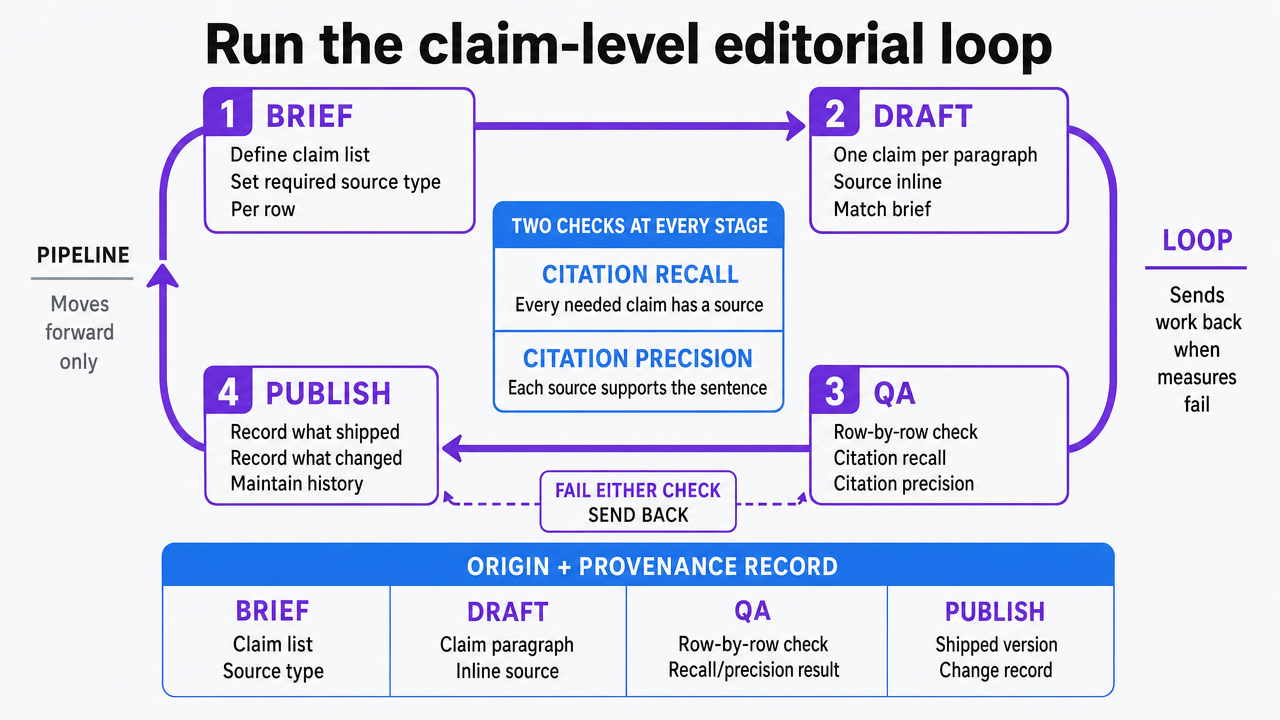 Visualize the four-stage editorial loop (brief, draft, QA, publish) and its mapping to provenance fields described in the section
Stop using AI detectors as a quality gate
AI detectors have become the default QC shortcut on many content teams: run the draft through a classifier, chase the score below some threshold, ship it. The 2024 NIST GenAI pilot study tested this assumption directly and found substantial performance variation across generators and discriminators. Some generators could deceive most discriminators, while some discriminators detected output from nearly all generators 10. This means the same paragraph can read as human on one tool and machine on another, with no editorial change in between.
That variance makes detector scores unreliable as a publication gate. A false positive sends a human-written draft back for pointless rewriting. A false negative waves through a draft that fabricated a statistic or misattributed a source, which is the actual risk AI-assisted writing introduces. The score tells a reviewer nothing about whether the claims in the draft are sourced, specific, and correctly cited.
Replace the detector check with two substantive checks that measure what matters:
- Verify each cited source contains the exact figure or claim in the sentence next to it.
- Confirm every factual sentence has a source, a specific number or named entity, and a traceable date.
A draft that passes both ships. A draft that passes a detector but fails either check does not.
Ready to Accelerate SEO Content Production Without Sacrificing Quality?
See how leading teams automate SEO writing workflows at scale—maximizing AI-driven rankings, output velocity, and brand voice consistency across every campaign. Request a tailored walkthrough for agencies and enterprise marketing leaders.
Keep an auditable provenance record for every page
Provenance is the editorial record that lets a reviewer reconstruct how a page was built: which sources informed each claim, who approved what, when AI assistance was used, and what changed between versions. NIST's Generative AI Profile recommends documenting the origin of generated data and maintaining detailed provenance records that include sources, timestamps, metadata, and third-party changes 11. For SEO content, that record is also the defense when a cited statistic is challenged, a claim is misquoted by a downstream AI system, or a regulated page is audited.
The minimum viable record per page has five fields:
- The final claim list with source URLs
- The author and reviewer names with approval timestamps
- A note on any AI assistance used in drafting or editing
- The publication date and each substantive revision date
- The source material itself preserved as PDFs or archived links in case the original moves
A shared spreadsheet or a CMS custom field works; the format matters less than the discipline of filling it before publish.
Provenance records do not prove a claim is accurate, only that it can be traced 11. That traceability is what makes a correction fast when one is needed, and what distinguishes a page that can be defended from one that cannot.
Substantiate claims in regulated verticals before publication
Health, legal, financial, and behavioral health pages carry a second standard that generic SEO advice ignores. The FTC requires adequate substantiation for objective product claims, and health-benefit or safety claims generally require competent and reliable scientific evidence 1. A sentence like "this treatment reduces anxiety in most patients" is not a copywriting choice on a behavioral health page. It is a claim that needs a cited clinical source before it ships, or it needs to be cut.
The FTC also treats testimonials and expert endorsements as claims the advertiser must be able to substantiate directly. A patient quote implying typical results must reflect typical results, or the page must clearly and conspicuously explain the atypical nature of the outcome 2. The same rule applies to case studies on a law firm page and before-and-after galleries on a dental site. If the page cannot support the implied claim with evidence, the implication itself is the violation.
Consolidate substantiation into a single pre-publish check for regulated pages. Pull every objective claim, every testimonial, and every statistic into a review row, name the required evidence type, and attach the source before the page goes live. Pages that cannot clear this row-by-row check should be softened or held, not published with hedged language that still implies the underlying claim.
Coordinate production with an AI execution platform
The ten tips above describe a tighter editorial standard. The problem for most content teams is not understanding the standard; it is running it across 40 pages a month without the brief, draft, QA, and provenance stages drifting apart. A coordinated AI execution platform is the category of tooling that holds those four stages in one approval workflow, so the claim list in the brief, the sources in the draft, the citation checks in QA, and the provenance record at publish all reference the same row.
The category sits between standalone AI writing tools, which generate drafts but leave coordination to the team, and traditional agencies, which coordinate but add briefing cycles and handoffs. Platforms in this category route each stage through human approval before the next one runs, which is the control high-stakes verticals need to meet FTC substantiation and NIST provenance expectations 11. Vectoron is one example, pairing specialist strategists for content, SEO, and related channels with a Command Center that logs sources, approvals, and revisions against each page.
The operational test for any platform in this category is whether a reviewer can open a published page and reconstruct, in under two minutes, which claim came from which source and who approved it.
If you manage multiple locations or practices
Content managers running SEO across 20, 50, or 200 locations face a different problem than single-site teams. The claim-level standard still applies, but the failure mode shifts from one weak page to the same weak page replicated across every market. A statistic that is uncited on the Phoenix location page is uncited on the other 49, and a testimonial that implies atypical results on one dental site implies the same on every site in the DSO 2.
Three controls change the math:
- Maintain a central claim library: approved sentences with sources attached, versioned by date, that location pages pull from rather than rewrite. When the source updates, every page updates.
- Lock substantiation at the template level, not the page level. Service descriptions, outcome ranges, and credential statements belong in the shared template with their sources inline, so a new location launch cannot ship without them.
- Keep provenance records per location, not just per template, so a reviewer can trace which approved claim version each market published and when 11.
The operational test is whether a single sourcing update propagates to every location page within one approval cycle, with the revision logged against each market.
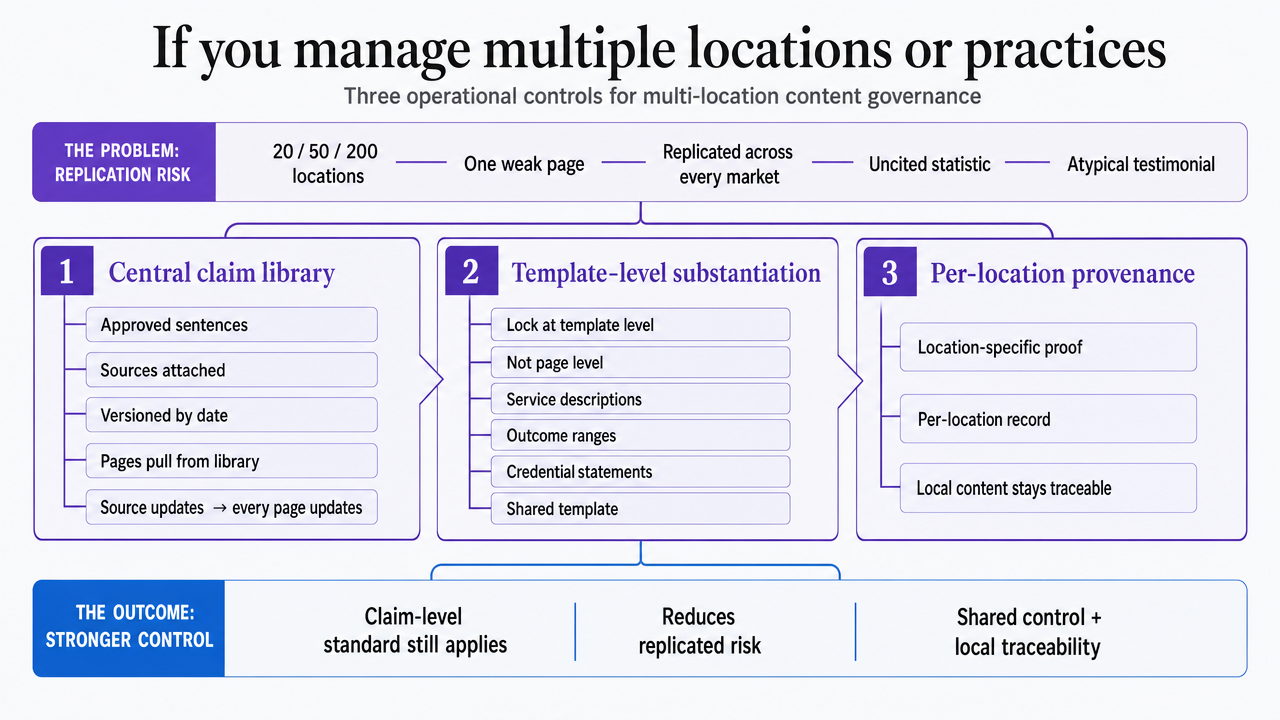 Visualize the three operational controls (central claim library, template-level substantiation, per-location provenance) described in the section for multi-location content governance
Frequently Asked Questions
References
- 1.Health Products Compliance Guidance - Federal Trade Commission.
- 2.Advertising and Marketing on the Internet: Rules of the Road.
- 3.Web Style Guide - HHS.gov.
- 4.Proceedings - Retrieval Augmented Generation (RAG) 2025.
- 5.Evaluating Verifiability in Generative Search Engine.
- 6.Generative Search Engines: Beware the Facade of Trustworthiness.
- 7.RD Plain Language 508 Toolkit.
- 8.Federal Plain Language Guidelines.
- 9.Reducing Risks Posed by Synthetic Content.
- 10.2024 NIST GenAI (Pilot Study): Text-to-Text Evaluation - Overview and Results.
- 11.Artificial Intelligence Risk Management Framework: Generative Artificial Intelligence Profile.
- 12.Reducing Risks Posed by Synthetic Content: An Overview of Technical Approaches to Digital Content.