
Key Takeaways
- Measure SEO against signed matters per 100 search-originated calls, not sessions or rankings, because the phone is where click quality actually reveals itself 1.
- Separate information-seeking queries from lawyer-seeking queries in the keyword portfolio, then concentrate production hours on comparison-stage pages tied to jurisdiction, practice area, and intake process.
- AI Overviews absorb definitional and procedural clicks but leave jurisdiction-specific and consultation-driven queries intact, so triage pages by downstream intake value rather than retreating from organic search 4.
- Spend the next dollar on call instrumentation, landing-page rewrites for already-ranking lawyer-seeking URLs, and compliance review against state bar rules and the FTC reviews rule before chasing new traffic 9, 6.
The Question Partners Should Actually Be Asking
The debate inside most firms is framed poorly. Partners ask whether SEO is still worth funding, when the better question is what fraction of search-originated calls become signed matters, and whether anyone in the firm can answer that with a number. Those are different conversations. The first invites opinion; the second forces measurement.
Organic search has not stopped producing legal clients. It has stopped producing them for firms that read traffic reports instead of intake outcomes. The Clio consumer survey, which examined how people who had ever shopped for a lawyer actually found one, documented that 68% first reached out by phone 1. That single behavior shifts where SEO quality is revealed. The click earns the chance; the call decides whether the chance was worth earning.
The analytical unit worth tracking is signed matters per 100 search-originated calls, not sessions, impressions, or keyword positions. Firms that instrument the call layer, filter unqualified intent before it reaches intake staff, and reconcile marketing spend against retained matters continue to pull cases out of organic search. Firms that optimize for traffic alone are watching their economics erode as generative summaries absorb informational queries 4.
The sections that follow build that intake-economics frame: how legal consumers reach firms from search, how to separate information seekers from lawyer seekers in a keyword portfolio, how AI Overviews change the structural math, and which compliance guardrails constrain the tactics worth running.
How Legal Consumers Actually Reach Firms From Search
Independent Search Is Still a Plurality Path
Legal consumers do not arrive at a firm through a single channel. The Clio consumer survey of people who had ever shopped for a lawyer found that 57% looked for one on their own rather than through a personal referral, with online search engines and law firm websites each cited by 17% as the channel used 1. That makes independent search the plurality path into attorney selection, but it also means roughly four in ten prospective clients still arrive through referral networks that organic traffic will never touch.
The split between search engines (17%) and lawyer websites (17%) 1carries a practical implication partners sometimes miss. Direct navigation to a firm's domain, often prompted by a referral checking credentials or a prospect returning to a name they wrote down, counts in that second bucket. SEO investment supports both routes: the ranking that captures first-touch discovery, and the branded search or direct visit that validates a name heard elsewhere. Attribution models that credit only the first-click organic session underweight the second.
Framing matters here. The Clio survey measured self-reported consumer behavior and predates generative search summaries 1. It establishes that independent online research was already the dominant acquisition path before AI Overviews changed the top of the results page, not that every organic session represents a retainable matter. Partners evaluating SEO should read the 57% figure as evidence that the channel is where buyers look, and the 17/17 split as evidence that search engines and the firm's own site are both load-bearing surfaces in that process. Cutting investment in either weakens a path that most prospective clients still travel.
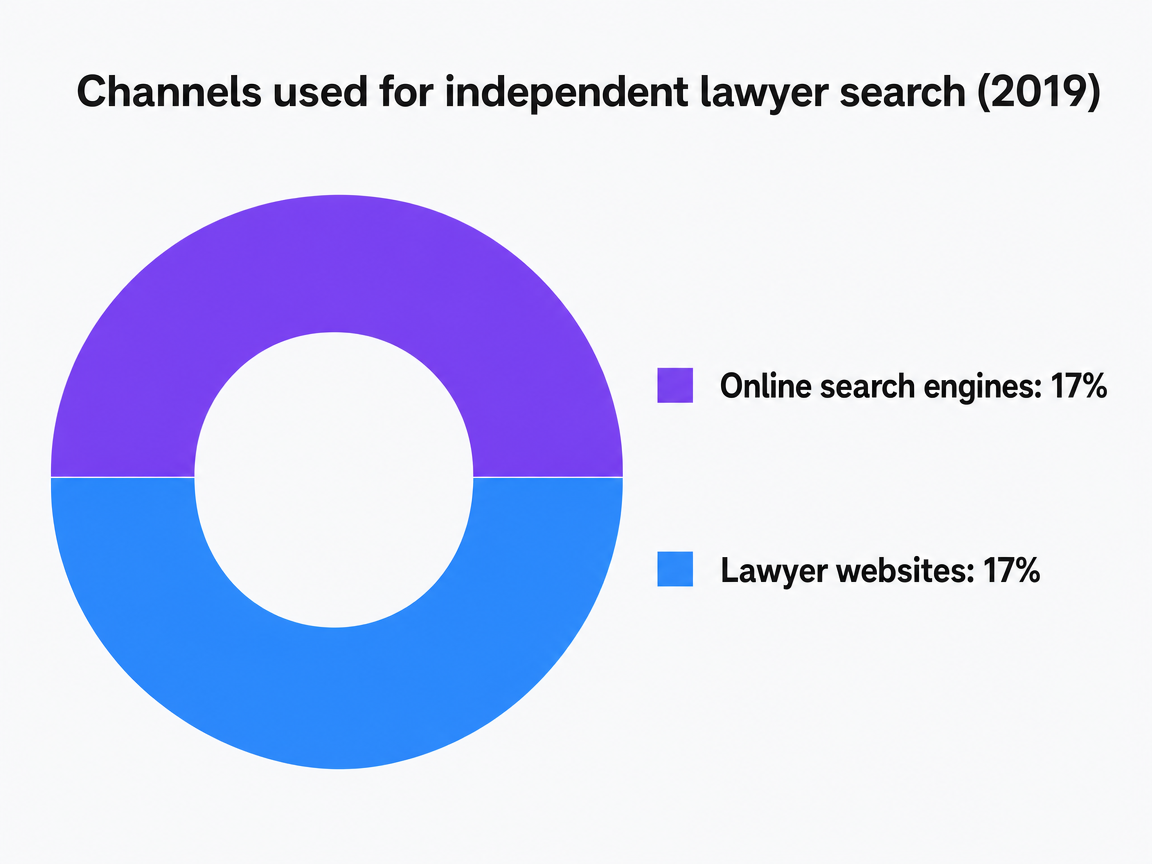 Channels used for independent lawyer search (2019)
Shows the equal reliance on search engines and direct law firm websites among consumers who searched for a lawyer independently.
The Call Is Where SEO Quality Reveals Itself
Rankings and sessions tell a firm what search engines did. The phone tells it what prospective clients did. In Clio's consumer survey, 68% of people who had shopped for a lawyer first reached out by phone 1. That single behavior shifts the measurement surface for every SEO dollar: the keyword that drives traffic is upstream of a conversation that intake staff either qualify or lose, and the firm learns which keywords matter only when calls are recorded, tagged, and reconciled against signed matters.
Most firm analytics stacks were built for the opposite assumption. Session counts, bounce rates, and form fills live in dashboards; the thirty-second conversation that determines whether a search-originated prospect becomes a consultation often lives nowhere measurable. A page can rank well, attract traffic, and generate calls that intake staff dismiss as out-of-practice-area or non-fee-generating. Without call-level data tied back to source, the SEO program looks healthy in the traffic report and anemic in the matter report.
Instrumenting the call layer solves two problems at once. It tells marketing which pages and queries produce qualified intent, and it tells intake which conversations are worth protecting with faster pickup, better scripts, and after-hours coverage. Call intelligence tooling that transcribes, scores, and tags recorded calls makes that reconciliation routine rather than quarterly. The number partners should want on a monthly dashboard is qualified calls per 100 organic sessions, segmented by landing page. Firms running that number know within weeks which content earns its keep and which ranks for traffic that converts to nothing.
Comparison Shopping Shapes What a 'Qualified' Click Means
Prospective clients rarely stop at one firm. The Clio survey reported that 57% of people who had shopped for a lawyer contacted more than one firm before deciding 1, and academic synthesis of consumer-behavior research reaches the same conclusion: searching for a lawyer is a comparison process, not a single-channel conversion 2. A click that produces a call is not a sale. It is an entry into a shortlist the prospect is actively curating against two or three competitors.
That changes what qualified traffic looks like. A visitor who read three competitor pages before landing on the firm's practice-area page arrives with sharper questions and a shorter decision window than one who clicked from a general informational query. The former is already in evaluation mode; the latter may be months from retaining anyone. SEO content that acknowledges the comparison, including fee structures, response-time commitments, jurisdictions covered, and intake process, matches the mental model prospects bring to the call.
For measurement, this means a 'qualified' search click is one that reaches a prospect already in the shortlist stage, with a matter in the firm's practice area and jurisdiction. Everything else is top-of-funnel, which still has value but should not be judged by signed-matter rate on the first visit.
Information Seekers vs. Lawyer Seekers in the Keyword Portfolio
Keyword portfolios ranked by search volume routinely overstate retainable demand. A NORC survey conducted for the State Bar of California in early 2020 found that 75% of Californians had looked for legal information online, a figure that captures everything from a parent reading about custody timelines to a tenant checking eviction notice requirements 11. The narrower behavior that actually produces revenue, searching for a lawyer or legal-aid office, drew a much smaller share of respondents. Treating the first group as the funnel entry point for a personal-injury or family practice confuses research traffic with purchase intent.
The California Justice Gap data makes the gap even sharper at the problem level. Among low-income Californians' civil legal problems, respondents went online for help with 19% of problems and looked for a lawyer for 15% of them 12. The same report found that low-income Californians received legal help for only 29% of reported problems 12, and the Legal Services Corporation's 2022 national study put the unmet-need figure at 92% of civil legal problems reported by low-income Americans 13. Online research volume reflects a population with legal questions, not a population with budgets and matters that fit a private firm's intake criteria.
The operational consequence is a sort function partners can apply to their keyword lists. Queries that describe a procedural question, a definition, a fillable form, or a self-help workflow belong in a different bucket than queries that name a lawyer, a practice area tied to a location, a fee structure, or an urgent decision. The first bucket generates sessions and brand familiarity but will not carry a signed-matter rate worth modeling. The second bucket produces the calls that intake staff actually convert, and it should receive the editorial depth, internal linking, and conversion instrumentation that marketing budgets reward.
This does not argue for abandoning informational content. Information pages earn links, feed branded search later, and often supply the context that AI summaries draw from. The argument is against pricing them as if they were lawyer-seeking traffic. A practical portfolio audit tags every ranking URL as either information-serving or lawyer-seeking, tracks tracked-call rate against each tag, and reallocates production hours when a tag's qualified-call rate falls below a threshold the firm sets. Firms that run that audit stop subsidizing content that ranks well, reads well, and sends zero cases to intake.
Test Real SEO Intake Insights on Live Calls
Experience actual case intake data to evaluate which SEO traffic converts to qualified consultations.
AI Overviews as Structural Context, Not Death Sentence
AI Overviews changed the top of the results page, not the underlying buying process. The Department of Justice's filing in United States and Plaintiff States v. Google LLC describes the feature as appearing above traditional results, with Google retrieving information from Search to generate a summary accompanied by links to the underlying sources 4. That mechanism, documented in a federal antitrust record rather than a vendor blog post, is the honest basis for discussing what has shifted. Clicks on informational queries that a two-sentence summary can satisfy are absorbed at the SERP. Clicks that require a human lawyer are not.
The queries most exposed to summarization are the ones firms least need. A searcher asking what a statute of limitations is, how a contingency fee works, or whether small claims court applies to a specific dispute can often get a usable answer without clicking anything. A searcher typing a city plus a practice area, a question tied to an active matter, or a request for a consultation is operating in a different register. Those sessions still produce clicks, and those clicks still produce calls.
The practical response is portfolio triage, not retreat. Pages built to rank for definitional queries lose downstream intake value as summaries improve, while pages built around jurisdiction, matter urgency, intake process, and attorney credentials retain their role in the comparison stage documented across the consumer-behavior literature. Firms that moved production hours from the first group to the second over the past two cycles are seeing organic calls hold or grow. Firms treating every ranked URL as equally valuable are watching the average collapse because the losses are concentrated and the wins are not.
Post-Click Conversion: What Happens Between the Click and the Call
A ranking produces a visitor. The landing page decides whether that visitor dials. The gap between those two events is where SEO programs quietly lose most of the cases their traffic reports suggest they should be winning, and it is governed less by copy craft than by the signals prospective clients use to narrow a shortlist.
A study of lawyer advertising websites in Austin, Buffalo, and Jacksonville found that 43.83% of attorney-controlled sites contained reviews or testimonials from prior clients and 39.16% highlighted past victories 3. Those two elements dominate the persuasion layer because they map directly to the questions a comparison shopper asks before picking up the phone: has this lawyer handled matters like mine, and have other people trusted them with similar problems. Pages that bury or omit both are asking visitors to make a decision without the evidence their competitors are supplying.
The sequence that converts a search click into a tracked call is narrower than most marketing dashboards suggest. A visitor lands, scans for jurisdiction and practice-area fit, looks for proof the firm has done this before, checks whether a human will answer, and then dials or leaves. Three friction points interrupt that sequence routinely:
- a landing page that reads as a brochure rather than an answer to the query that produced the click,
- a phone number that is not visible without scrolling on mobile, and
- an intake experience that routes after-hours calls to a voicemail no one monitors until morning.
Each of those failures looks identical in a sessions report and very different in a signed-matter report.
The post-click layer also determines what intake staff hear when the phone does ring. A page that establishes practice-area scope, fee structure, and jurisdiction before the call filters out the inquiries intake would otherwise spend time disqualifying. The firms pulling the most cases from organic search treat landing pages as the first qualifier, not the last impression, and measure the result in calls that intake staff can convert rather than calls they have to end politely.
An Intake-Economics Frame for SEO Spend
The Variables That Determine Cost Per Signed Matter
Cost per signed matter is the number partners should defend their SEO budget against, and it falls out of a short chain of ratios rather than a single conversion rate. The chain runs: organic sessions, tracked calls generated, qualified calls (right practice area, right jurisdiction, within scope), consultations booked, consultations held, and signed matters. Every stage has a leak rate, and the leaks compound. A program that looks healthy at the top of the funnel can produce a cost per signed matter that no partner would approve if the full chain were visible.
The sourced inputs that anchor the model are behavioral, not financial. Clio's consumer survey established that 68% of people who shopped for a lawyer first reached out by phone, and that 57% contacted more than one firm before deciding 1. The first number tells a firm where to measure; the second tells it that consultation show rate and signed rate will always be constrained by competing conversations happening in parallel. Dollar values stay as reader inputs because fee structures, matter mix, and local wage costs vary too much to generalize honestly.
| Stage | Variable | What it answers ||---|---|---|| 1 | Organic sessions | Traffic the SEO program produced || 2 | Tracked calls | Share of sessions that dialed || 3 | Qualified calls | Share of calls in practice area and jurisdiction || 4 | Consultations booked | Share of qualified calls intake converted || 5 | Consultations held | Show rate against bookings || 6 | Signed matters | Share of held consultations retained || 7 | Spend ÷ signed matters | Cost per signed matter |
Partners who run this chain monthly, by landing page, stop arguing about rankings.
If a Firm Operates Multiple Offices
The frame shifts when a firm runs more than one location. Managing partners at multi-office practices should run the same seven-stage chain per office, not as a firmwide average, because averages hide the market that is subsidizing the one that is bleeding. A single aggregate cost per signed matter can look acceptable while one office carries a qualified-call rate half the firm norm and consumes a disproportionate share of production hours.
The behavioral baseline does not change by location. The 68% phone-first contact rate and the 57% multi-firm comparison rate from the Clio survey apply to legal consumers broadly 1. What varies by office is competitive density, the mix of lawyer-seeking versus information-seeking queries in that market, intake staffing coverage, and the strength of the landing pages serving each metro. Running the chain per office surfaces which of those variables is actually responsible for a weak signed-matter rate.
| Office | Qualified calls / 100 sessions | Signed rate | Cost per signed matter ||---|---|---|---|| Office A | firm input | firm input | firm input || Office B | firm input | firm input | firm input || Office C | firm input | firm input | firm input |
When one row diverges, the fix is almost never more traffic to that market. It is a landing-page rewrite, an intake coverage change, or a decision to stop funding a geography the firm cannot staff to convert.
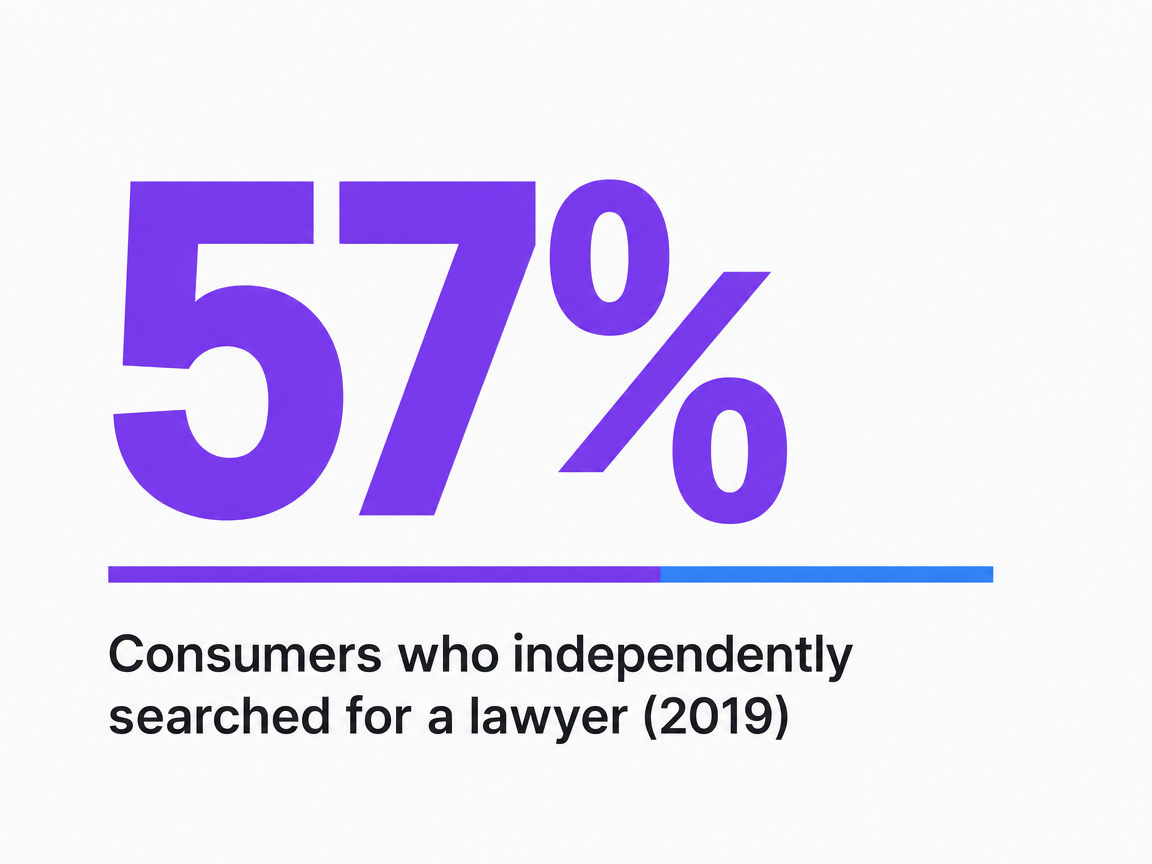 Consumers who independently searched for a lawyer (2019)
Consumers who independently searched for a lawyer (2019)
See How Leading Firms Quantify SEO Traffic’s Real Impact on Qualified Case Intake
Request a data-driven consultation to benchmark your SEO case lead quality against industry standards and identify missed conversion opportunities using advanced call intelligence.
Compliance Guardrails That Shape Legitimate SEO Tactics
Three regulatory layers constrain what firms can actually ship on an organic-search program:
- state bar advertising rules,
- the FTC's reviews and endorsements regime, and
- the general professional-conduct prohibition on misleading communications.
Treating them as a single operational checklist, rather than three separate reviews, is faster and produces fewer surprises during a page refresh cycle.
State bar guidance reaches further into SEO tactics than many partners assume. The North Carolina State Bar has stated that metatags used to influence search engines may fall within advertising restrictions, and it directs firms to identify the jurisdictions in which they are licensed and to keep website information current and accurate 5. California Rule 7.1 prohibits false or misleading communications about a lawyer or the lawyer's services, which extends to practice-area pages, local landing pages, result claims, and any FAQ copy generated at scale 9. Jurisdictional disclosure, outcome framing, and specialization language are the three places this most often breaks on fast-moving content calendars.
The FTC layer tightened in late 2024. The Consumer Reviews and Testimonials Rule, announced in August 2024 and effective October 21, 2024, prohibits buying or selling fake reviews, undisclosed insider testimonials, suppression of negative reviews, and AI-generated fake reviews, with civil penalties available for knowing violations 6, 7. The agency's Sitejabber order in November 2024 made the point concrete for AI-enabled reputation workflows: misrepresenting that ratings came from genuine customers is enforceable conduct, not a gray area 8. The FTC's broader endorsement guidance applies the same provenance and disclosure logic to testimonials and influencer content 10.
The operational version is short. Review-generation sequences should request, not script, sentiment. Testimonials from employees or affiliates need clear disclosure. AI-assisted content on practice-area pages needs a human review step that checks jurisdictional claims, result language, and specialization terms against the applicable state rule before publication.
What This Means for Where Partners Spend the Next Dollar
The next marketing dollar should move toward the stages of the funnel the firm can actually measure. That means call instrumentation before another round of content, landing-page rewrites on the pages already ranking for lawyer-seeking queries before chasing new keyword clusters, and a weekly reconciliation between tracked calls and signed matters before any decision to expand or cut budget. Firms that fund measurement first discover which pages carry the program; firms that fund volume first keep paying for traffic that intake cannot convert.
Three priorities earn the spend:
- tag every ranked URL as information-serving or lawyer-seeking, then concentrate production hours on the second group where comparison-stage prospects decide.
- close the loop between the keyword, the landing page, the recorded call, and the signed matter so cost per signed matter becomes a monthly number rather than an annual guess.
- apply the compliance checklist once, at publication, instead of discovering a Rule 7.1 or FTC review-rule problem during a refresh cycle 9, 6.
SEO still produces qualified cases. It produces them for the firms that treat the call as the conversion event, not the click. Platforms like Vectoron exist to make that reconciliation routine.
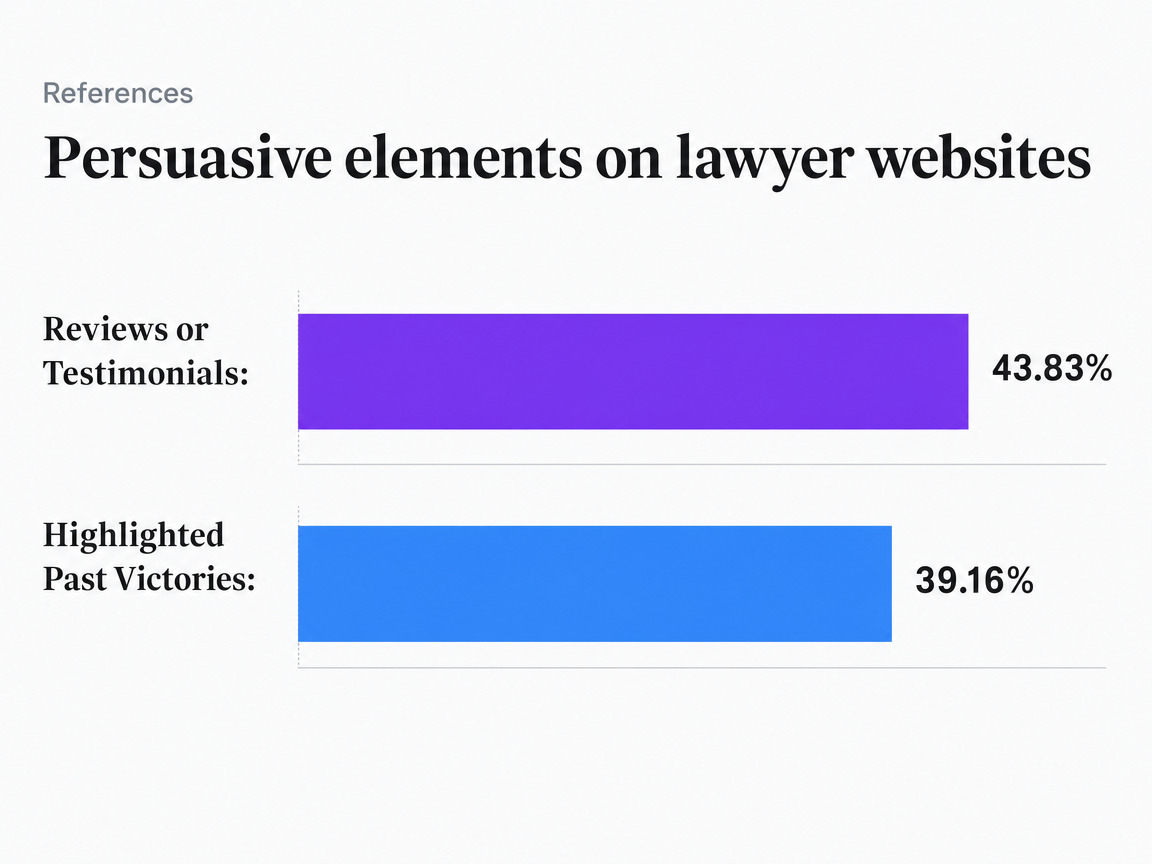 Persuasive elements on lawyer websites
This data from a study of lawyer advertising websites shows the prevalence of different types of persuasive content used to attract clients.
Frequently Asked Questions
References
- 1.Legal Trends Report 2019.
- 2.LEGAL ADVICE FROM NONLAWYERS: CONSUMER DEMAND AND THE UNAUTHORIZED PRACTICE OF LAW.
- 3.THE BEHAVIORAL ECONOMICS OF LAWYER ADVERTISING: AN EMPIRICAL ASSESSMENT.
- 4.U.S. and Plaintiff States v. Google LLC.
- 5.The Ethical Website.
- 6.Federal Trade Commission Announces Final Rule Banning Fake Reviews and Testimonials.
- 7.The Consumer Reviews and Testimonials Rule: Questions and Answers.
- 8.FTC Order Against AI-Enabled Review Platform Sitejabber Will Ensure Consumers Get Truthful, Accurate Information.
- 9.Chapter 7. Information About Legal Services.
- 10.Endorsements, Influencers, and Reviews.
- 11.Attachment B: NORC ATILS Survey Report.
- 12.California Justice Gap Survey Technical Report.
- 13.The Unmet Civil Legal Needs of Low-income Americans (2022).