Key Takeaways
- Query and page performance reporting is the baseline floor, giving strategists impressions, clicks, position, and CTR segmented by query, page, country, device, and search appearance 1.
- Index coverage and URL-level inspection answer different diagnostic questions, so collapsing them into one health score hides the exact signal an agency strategist needs to act on 2.
- Anomaly detection must follow Google's ordered drop-debugging sequence through Performance, Crawl Stats, Page indexing, and URL Inspection so triage stays consistent across analysts and clients 3.
- Joining Search Console visibility to Analytics outcomes on country, device, and landing page connects pre-click impressions to post-click behavior clients actually ask about on renewal calls 4.
- Structured data validation has to cover markup validity, rich-result eligibility, and manual-action alerts, since valid schema creates eligibility but never guarantees an enhanced appearance 7.
- Page experience auditing requires reporting field data against Google's published LCP, INP, and CLS thresholds per template and device, not aggregated site-wide scores 10.
- Mobile-first parity checks and device-segmented SERP views are mandatory because Google ranks the mobile version, making desktop-only reports a diagnostic liability 12.
- AI Overview and AI Mode visibility is now reportable through dedicated Search Generative AI performance reports launched June 3, 2026, with segmentation by URL, country, device, and date 14.
- Overlaying confirmed core and spam update dates from the Search Status Dashboard onto client charts replaces account-manager guesswork with a shared frame of reference 15.
- Snippet and SERP-feature quality analysis matters because relevance drives clicks independently of position, and competing features alongside an organic listing reshape the click opportunity 17.
What a Nine-Function Specification Replaces in the Agency Stack
Most agency SERP workflows still depend on a stitched chain of single-purpose tools: a rank tracker for positions, a crawler for technical health, a schema validator for markup, a field-data monitor for Core Web Vitals, a separate feed for confirmed Google updates, and a growing number of browser tabs for AI Overview spot-checks. The cost of that chain is not licensing. It is the analyst hours spent reconciling exports and the inconsistency that follows when every strategist builds a slightly different picture of the same account.
The nine functions in this specification are drawn directly from Google's own documentation. Each one maps to a diagnostic Google either publishes thresholds for, provides a report for, or recommends as part of a formal workflow 1, 3. Treating them as a single capability set gives a Head of SEO a defensible audit standard: a SERP analysis tool either covers all nine across every client in the book, or it leaves gaps that junior strategists will fill unevenly. The sections that follow define each function, name what it can prove, and name what it cannot.
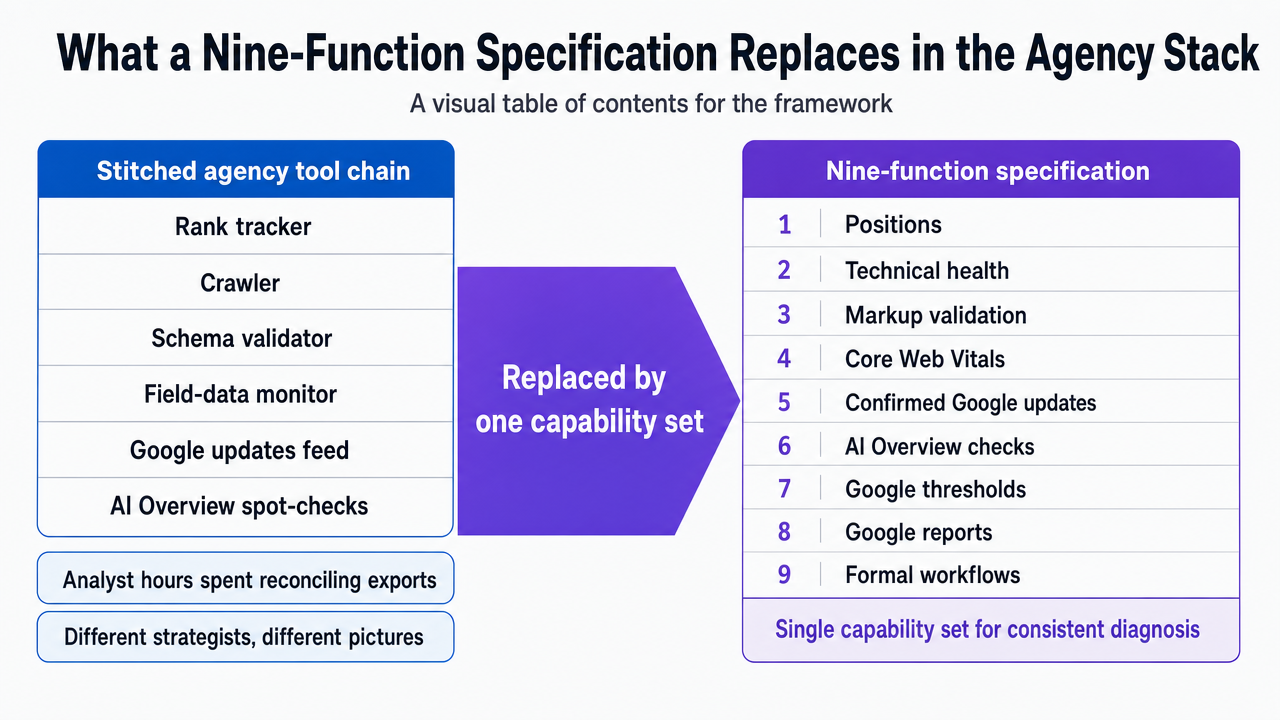 Overview infographic enumerating the nine SERP analysis functions the article specifies, giving readers a visual table of contents for the framework
Query and Page Performance as the Reporting Baseline
Query and page performance reporting is the floor, not the ceiling, of a SERP analysis tool. Google's Performance report in Search Console breaks down impressions, clicks, average position, and click-through rate by query, page, country, device, search appearance, and date 1. Any tool that cannot ingest and segment those dimensions across an agency's full book of clients is already behind the baseline Google publishes for free.
The operational test for a Head of SEO is whether the tool answers four questions on demand for every account: which queries drive impressions this period, which pages absorb those impressions, how clicks and position shift by country and device, and which search appearances are generating the visibility. Query-level and page-level views have to be joinable, not isolated tabs. A query that gained 40 percent impressions means little without knowing which page received them and whether that page is the one the strategist intended to rank.
Two limits belong next to the baseline. Google's ranking documentation describes a system of many signals evaluated across pages, passages, and context, which means a single average-position number conflates several ranking realities into one figure 5. And because results vary by location, device, and user settings, one unqualified rank reading should not be presented as the universal result for any client 6. The baseline reports visibility accurately; it does not explain it.
Index Coverage and URL-Level Diagnostics Separated From Rank
Index coverage sits in a different diagnostic lane than ranking, and a SERP analysis tool worth its license has to treat them that way. Google's Search Console reporting separates site-wide indexation signals, which flag errors, warnings, excluded pages, and valid pages with impressions, from URL-level inspection, which returns current index status, live-test results, crawl requests, and loaded resource details 2. Collapsing those two layers into a single "health score" hides the exact distinction an agency strategist needs to act on.
For a Head of SEO reviewing a thirty-account book, the tool test is whether both layers are queryable per client without opening Search Console tabs by hand. Site-wide coverage answers whether a template, a canonical rule, or a robots directive is suppressing a group of URLs. URL Inspection answers whether a specific landing page is indexed, when it was last crawled, which rendered resources Google actually loaded, and whether a recrawl request has been submitted 1. The two readings resolve different questions and should never substitute for each other in a client report.
The limit is scope: coverage status explains eligibility to appear in results, not the ranking a page earns once eligible. A page can be indexed cleanly and still lose visibility to a stronger competing result, which is why index diagnostics belong next to rank data rather than inside it.
Anomaly Detection That Follows Google's Drop-Debugging Sequence
A traffic drop is the moment an agency's tool stack either earns its license or exposes its gaps. Google publishes an ordered diagnostic sequence for exactly this scenario, and a SERP analysis tool that cannot execute it across a book of clients is forcing junior strategists to improvise under pressure. The sequence runs in a specific order:
- Open the Search Console Performance report to characterize the decline.
- Check the Crawl Stats report for corresponding spikes in failed or slow requests.
- Review the Page indexing report for coverage shifts.
- Move to URL Inspection when the decline is concentrated in an identifiable group of pages 3.
The order matters because each step narrows the hypothesis space before the next one runs. Performance data distinguishes between a query-level loss, a page-level loss, a country or device segment loss, and a search-appearance loss. Crawl Stats and Page indexing then separate serving problems from indexation problems. URL Inspection resolves the final question at the page level: what Google actually sees, when it last crawled, and whether resources rendered as intended 1, 2. A tool that jumps straight to URL Inspection or straight to rank data skips the triage that determines whether the issue is site-wide, template-wide, or page-specific.
For a Head of SEO, the operational test is whether this sequence runs the same way for every client, with the same artifacts attached to every incident ticket. Standardizing the drop-debugging workflow is how an agency keeps anomaly response consistent across thirty analysts and keeps retention conversations grounded in evidence rather than guesswork. The limit worth stating: the sequence isolates where the problem lives, not why ranking systems redistributed visibility in the first place.
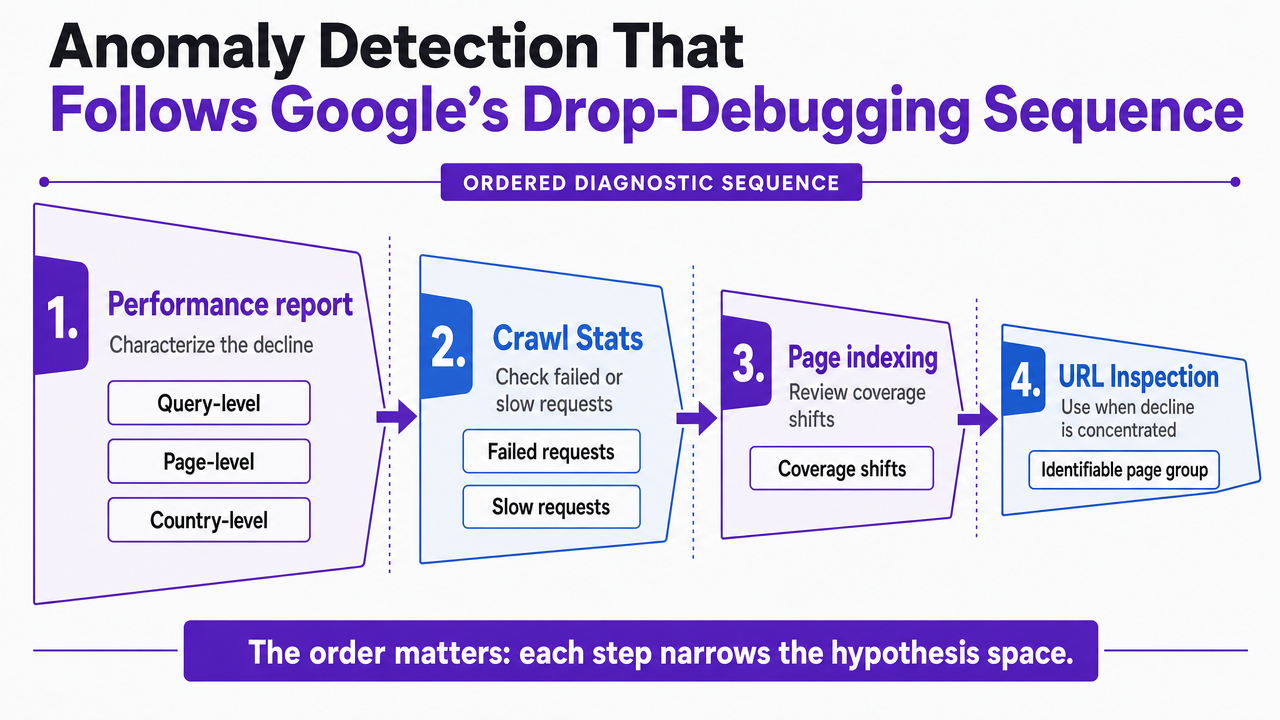 Visualize Google's ordered four-step drop-debugging workflow cited in this section so agency strategists can see the triage sequence at a glance
Joining SERP Visibility to Downstream Outcomes
Rank data and impressions describe what happens on the result page. They do not describe what happens after the click, which is the only part a client cares about on a renewal call. A SERP analysis tool that stops at the search-result stage leaves the agency to reconcile two systems by hand every reporting cycle, and that reconciliation is where account teams quietly lose hours.
Google draws the line explicitly: Search Console describes visibility and clicks at or before the result, while Analytics describes sessions, engagement, and actions after the visit 4. The two should not be expected to match on totals because they measure different stages of the same journey. The tool function worth paying for is the join itself, built on the three dimensions Google names as consistent across both systems: country, device, and landing page 4. Those three keys let a strategist line up impressions on a page in Canada on mobile with the sessions, scroll depth, and form submissions that followed from the same slice.
For agency books that exceed Search Console's standard historical window or sampling limits, Google points to BigQuery exports from both platforms as the scale path 4. That escalation matters when a Head of SEO needs multi-year trend analysis across thirty clients or wants to blend SERP data with CRM pipeline fields the UI will never expose. The limit to state plainly: a clean join explains correlation between pre-click visibility and post-click behavior, not causation. Attribution across the two stages still depends on the strategist's judgment about intent, landing-page experience, and offer quality.
Test Real-Time SERP Analysis On Live Projects
Experience hands-on SERP data insights and publish content strategies using real client scenarios during your trial.
Structured Data Validation and Eligibility Monitoring
Structured data belongs in the SERP analysis tool because its payoff lives on the result page, not inside the CMS. The function has three distinct jobs:
- validate markup against the type Google expects,
- monitor which rich-result appearances a page becomes eligible for, and
- watch for manual actions that revoke that eligibility.
Google's structured-data policy page is explicit that valid markup makes a page eligible for enhanced appearances but does not guarantee one will display, and that policy-violating markup can trigger a manual action against rich-result eligibility 7. A tool that reports only validation pass/fail without surfacing eligibility status and manual-action alerts is answering one question out of three.
Google also publishes a specific measurement protocol for deployments, which gives agencies a repeatable test rather than an opinion. The recommended sequence records baseline Performance-report data for the affected URLs, implements markup on a selected set of pages, validates the implementation, and compares performance over subsequent months 8. Running that protocol identically across every client is how a Head of SEO removes analyst discretion from schema reporting and makes before/after claims defensible on a renewal call.
Two limits need to sit in the same client-facing summary as the results. Eligibility is not ranking, and an observational before/after comparison establishes correlation rather than causation 7, 8. Reporting markup wins as guaranteed ranking lifts is where agencies lose credibility when the next quarter's data drifts.
Page Experience Auditing Against Published Thresholds
Page experience is one of the few SERP functions where Google publishes exact numbers, which means an agency tool either matches those thresholds or it is grading clients on a curve of its own invention. The three Core Web Vitals targets are explicit:
- Largest Contentful Paint within 2.5 seconds,
- Interaction to Next Paint below 200 milliseconds, and
- Cumulative Layout Shift below 0.1 10.
A tool worth standardizing on reports field data against those exact bands for every URL in a client's priority set, not an aggregated site-wide score that averages a product page with a legal footer template.
The operational test for a Head of SEO has three parts. The tool has to separate field data from laboratory diagnostics so a strategist knows whether a regression showed up for real users or only in a synthetic test. It has to segment by template and by device, because a shared header component failing INP on mobile will drag down dozens of URLs under one root cause. And it has to track the full page-experience surface Google names alongside the vitals: mobile usability, HTTPS, intrusive interstitials, and ad experience 11. Google is explicit that there is no single page-experience signal and that passing the vitals does not substitute for the broader set 11.
The limit belongs in the same client report as the pass/fail bands. Meeting the thresholds does not guarantee a ranking lift, and highly relevant content can still surface when page experience is subpar 11. Page experience is a floor condition for the result page, not a lever that moves rank on its own, and agency reporting that implies otherwise invites a credibility problem on the next quarterly review.
 Display Google's three published Core Web Vitals thresholds exactly as cited in the surrounding prose
Mobile-First Parity and Device-Segmented SERP Views
Google indexes and ranks using the mobile version of a page crawled by the smartphone agent, which makes a desktop-only rank report a diagnostic liability for any agency book that still produces one 12. The tool function worth standardizing on checks two things on every priority URL: that the mobile and desktop versions carry equivalent robots meta tags, titles, and meta descriptions, and that the primary content, structured data, and internal links present on desktop also render on the mobile template 12. Parity gaps in any of those elements mean the version Google uses for ranking is not the version the strategist is auditing.
Device segmentation on the reporting side is the other half of the function. The Performance report breaks impressions, clicks, and position out by device, and a tool that cannot separate mobile and desktop views per client is averaging two different SERPs into one misleading number 1. A query sitting at position 4 on mobile and 11 on desktop is a different conversation with a client than a blended position 7, especially when mobile intent and local pack composition diverge from the desktop result. Running parity checks and device-segmented views as a standing audit, rather than an on-request task, is how an agency keeps mobile-first indexing from quietly degrading rankings across a portfolio.
AI Overview and AI Mode Visibility as a First-Class Signal
Generative features have moved from a monitoring edge case to a reportable surface, and a SERP analysis tool that still treats them as optional is lagging the primary platform. Google's guidance states that sites appearing in AI features are included in overall Search traffic and are reported in the Performance report under the Web search type, which means AI exposure is already blended into the numbers an agency sends clients every month 13. Without a separate view, strategists cannot tell which share of a page's impressions came from a traditional blue-link listing versus a citation inside an AI Overview or an AI Mode answer.
The reporting gap closed on June 3, 2026, when Google launched dedicated Search Generative AI performance reports that cover impressions in AI Overviews and AI Mode and allow segmentation by URLs, countries, devices, and date granularity 14. The tool test for a Head of SEO is whether that segmentation flows into client dashboards automatically for every account, not just the ones a strategist remembers to check. Portfolio-wide AI visibility trends, broken out by device and market, are the baseline that lets an agency answer the question clients are already asking on renewal calls.
Two limits belong in the same client report. Impression visibility in an AI feature is not the same as a click, and Google's own announcement describes the reports as impression-focused rather than a complete conversion framework 14. And because AI exposure is folded into overall Search traffic, attributing revenue specifically to AI-feature appearances requires the SERP-to-outcome join described earlier, not an AI-only dashboard read in isolation 13.
See How Leading Agencies Optimize SERP Analysis at Scale
Connect with our team to explore AI-driven workflows designed to streamline SERP analysis, reduce manual overhead, and improve multi-client SEO outcomes—without expanding your specialist roster.
Update Annotation and Volatility Overlay
Confirmed Google updates belong on every ranking chart an agency ships to clients, because the alternative is letting account managers explain away movement with guesswork. Google's Search Status Dashboard records the exact start and end dates of core and spam updates, and the ranking-history view lists the March 2025, June 2025, August 2025 spam, and December 2025 core updates, along with the 2026 core releases that followed 15. A SERP analysis tool that pulls those dates and overlays them on client ranking, impression, and traffic charts gives a Head of SEO a shared frame of reference across the entire book.
The operational test is annotation at the account level, not a global banner. A client whose rankings dropped three days before a confirmed rollout is a different conversation than one whose decline started the day the update finished pushing. Google describes core updates as broad changes to its ranking systems released several times a year, and it publishes the ranking-updates list specifically so site owners can line their own data up against the timeline 16. Pulling that feed into client dashboards automatically is the function; manually screenshotting a Twitter post is not.
The limit has to travel with the overlay in every client report. A confirmed update date explains when the ranking landscape shifted, not whether a specific site's movement was caused by the update, a competitor's gains, or a change the client's own team shipped the same week 15. Treating correlation as proof is where agency credibility erodes over successive quarters.
Snippet and SERP-Feature Quality Analysis
Position is the easier half of the result-page story. The harder half is what sits inside the listing itself: the title, the meta description or auto-generated snippet, the breadcrumb, the sitelinks, and whichever SERP features Google decides to render alongside the organic result. A SERP analysis tool that reports rank without capturing what the user actually sees is grading an account on one axis of a two-axis problem.
An eye-tracking study of 25 participants found that viewing behavior was influenced more by position, while the decisive factor for clicking was relevance rather than position 17. The sample is small and the finding is directional, not a universal CTR curve, but the implication for agency tooling holds: snippet relevance is a lever that moves clicks independently of rank, which means every priority URL needs a periodic read on what its result currently looks like against competing listings. For a Head of SEO, the operational test is whether the tool captures snippet text, feature eligibility, and competing SERP-feature occupancy per query, not just the ordinal position. A page at rank 3 beneath a featured snippet, a video carousel, and four shopping tiles is a different click opportunity than a rank 3 result on a clean ten-blue-link page, and client reporting that collapses the two misleads the renewal conversation.
If an Agency Manages Multi-Location Portfolios
For agencies running portfolio accounts across DSO groups, home-services franchises, or senior-living operators, the nine-function specification holds but the unit of analysis changes. The client is no longer a single site with a priority URL set; it is a parent brand with 40 or 400 location pages, each one a distinct local SERP with its own pack composition, review signals, and device skew. Two capabilities move from useful to mandatory when the account shape shifts this way: schema coverage at the branch level and consolidated tooling economics that survive multiplication by location count.
LocalBusiness Schema Coverage Across Branches
LocalBusiness markup is the structured-data layer that tells Google how to interpret hours, departments, reviews, and location type for each branch, and Google recommends defining every location as its own LocalBusiness entity rather than rolling branches into a parent record 9. The tool test for a portfolio account is coverage completeness: every active location URL carries valid markup, every markup change triggers validation and a URL Inspection recrawl request, and sitemap submission reflects the current branch set 9. A dashboard that reports 94 percent schema coverage across 220 locations is naming the 13 branches where local eligibility is quietly broken, which is a different conversation with a client than a site-wide pass/fail flag.
Consolidation Economics for Portfolio Tooling
Portfolio tooling costs scale on location count, not on client count, which is why a stack assembled for single-site accounts tends to break the margin model once a DSO or franchise book enters the mix. The variables that drive the math are the ones a Head of SEO already tracks internally.
Locations per client : L
SERP checks per location per month : C
Analyst hours per audit cycle per location : H
Discrete tools in current stack : T (rank tracker, crawler, schema validator, CWV monitor, AI-visibility tracker, update feed)
Consolidated platform trial anchor : $599/mo (Vectoron)
The consolidation question is whether a single tool covers the nine functions at L × C volume without the reconciliation hours (H) that a six-tool stack (T = 6) imposes on every reporting cycle.
Auditing a Current Stack Against the Nine Functions
A defensible audit treats the nine functions as a checklist that every account passes or fails on the same evidence. The exercise is mechanical: pull a representative client, open the current tool chain, and confirm that each of the following produces an artifact a strategist can hand to a client without a second tab 1, 3, 14:
- query and page performance,
- index coverage and URL inspection,
- the ordered drop-debugging sequence,
- the Search Console to Analytics join,
- structured-data validation with eligibility monitoring,
- Core Web Vitals against published thresholds,
- mobile parity and device segmentation,
- AI Overview and AI Mode reporting, and
- confirmed-update annotation.
Gaps surface fast. The usual pattern is three functions covered well, three covered partially through analyst workarounds, and three missing entirely.
Consolidation gets considered when the reconciliation hours across those gaps exceed the licensing cost of a platform that covers all nine, which is the premise platforms like Vectoron are built on. The audit output, not the vendor pitch, decides whether the move pays back.
Frequently Asked Questions
References
- 1.How To Use Search Console.
- 2.Search Console | Google .
- 3.Debugging drops in Google Search traffic.
- 4.Using Search Console and Google Analytics Data for SEO.
- 5.A Guide to Google Search Ranking Systems.
- 6.How Does Google Determine Ranking Results.
- 7.Completeness.
- 8.Intro to How Structured Data Markup Works.
- 9.Local Business (LocalBusiness) Structured Data.
- 10.Understanding Core Web Vitals and Google search results.
- 11.Understanding page experience in Google Search results.
- 12.Mobile-first Indexing Best Practices.
- 13.AI Features and Your Website.
- 14.Introducing Search Generative AI performance reports in Search ....
- 15.History for Ranking | Google Search Status Dashboard.
- 16.Google Search's Core Updates.
- 17.We still trust in Google, but less than 10 years ago: an eye-tracking study.