
Key Takeaways
- SERP competition ranking is a three-layer cost stack: auction density driving CPC, platform layout compressing organic visibility 3, and competitor brand bids pulling 1–5% of clicks 1.
- Top-of-page is not always profit-optimal. Mid-page positions often produce higher contribution margin because CPC premiums at the top slot outrun conversion gains 7.
- Attributed revenue overstates real ROI. Scheduled holdouts expose the incrementality gap, especially on brand terms where organic listings amplify paid utility 3.5x more than the reverse 9.
- Portfolio operators should tier accounts by competition signature and attach a tier multiplier to retainers, so brand defense, layout monitoring, and position testing are priced rather than absorbed.
The Real Cost Structure Behind Every Client's Ranking Report
A ranking report tells a client where they sit. It rarely tells them what that position costs to hold, or what it earns once acquisition math is applied. For an agency running a book of 20, 50, or 100+ accounts, that gap is where margin quietly disappears.
SERP competition ranking is often reduced to a keyword-difficulty score exported from a tool. That framing hides the three cost drivers that actually move client P&Ls: how many advertisers are bidding against the client in the auction, how much of the results page the platform has reallocated to its own units and features, and how aggressively competitors are bidding on the client's brand terms. Each one distorts a different ROI metric. Advertiser density pushes CPC. Platform layout compresses organic click-through. Brand-bid crowd-out siphons defensive traffic and can cost a focal brand 1–5% of its clicks when competitors occupy paid positions 2–4 1.
The stakes are structural, not tactical. Judge Mehta's 2024 findings documented that Google's dominant query share allows the platform to raise ad prices without losing advertisers 4. That pricing power flows straight into every client's cost per acquisition. Reading a rank report without reading the auction, the layout, and the brand-defense picture around it produces confident numbers and unreliable ROI.
The rest of this piece reframes SERP competition as a portfolio-level signal agency leaders can price, allocate, and report against.
SERP Competition as a Three-Layer Cost Stack, Not a Difficulty Score
Layer One: Advertiser Crowd-Out and CPC Pressure
The first cost layer is the auction itself. Every additional serious bidder on a keyword raises the price of the click a client already needed to pay for. That is the visible part. The less visible part is what happens to brand terms once competitors decide to bid on them.
Columbia's econometric work on brand keyword auctions quantifies the leakage: competitors sitting in paid positions 2 through 4 can pull 1% to 5% of the focal brand's clicks away, and the return on defensive advertising is strongly positive once those position effects are priced in 1. A 1–5% band sounds modest until it is applied to a client's branded search volume, which is usually their highest-intent traffic. On a book of accounts, that leakage compounds every month a client refuses to fund defensive bids.
The billing mechanic reinforces the pressure. Advertisers pay only when a user clicks, so competitive intensity translates directly into higher realized cost per acquisition rather than sunk impression spend 8. Auction pricing power also concentrates. A dominant platform with superior query and user data can charge a higher price per click than a rival could sustain, because targeting quality raises the value of each click to the advertiser 6.
For an agency head reading a rank report, the operating question is not "where does the client sit?" It is "how many advertisers sit above or beside them on brand and money keywords, and what is the defensive spend required to hold the click share the client already earned?"
Layer Two: Platform-Driven Layout Compression
The second layer is the results page itself. Agencies do not compete only against other advertisers; they compete against the platform's decisions about how much of the page to sell, how much to give to its own units, and how far down the fold to push organic listings.
The 2020 DOJ complaint documented that Google's design choices demoted organic links of third-party verticals below the fold and expanded its own ad and vertical inventory, which forced advertisers to buy more search ads to remain visible 3. The complaint estimated that U.S. advertisers spend roughly $40 billion annually to place ads on Google's SERPs 3. Judge Mehta's 2024 findings then concluded that Google's query share allows the platform to raise ad prices without losing share, because advertisers have no comparable substitute audience 4. The 2025 DOJ remedies release reiterated Google's roughly 90% share of U.S. search queries as the backdrop against which every SERP layout decision is made 5.
For a client P&L, this is not politics. It is a structural cost driver that shows up in two metrics: organic click-through rate declines even when rank holds, and paid CPCs drift upward even when the advertiser's own quality score improves. An agency reporting rank alone will show a client holding position three on their money term while their organic sessions and paid CAC quietly move the wrong direction.
The operator response is to track share of visible page, not just share of rank. If a client sits at position two organically but the first screen contains ads, a shopping unit, an AI overview, and a local pack, position two is a below-the-fold result. Rank did not change. Economics did.
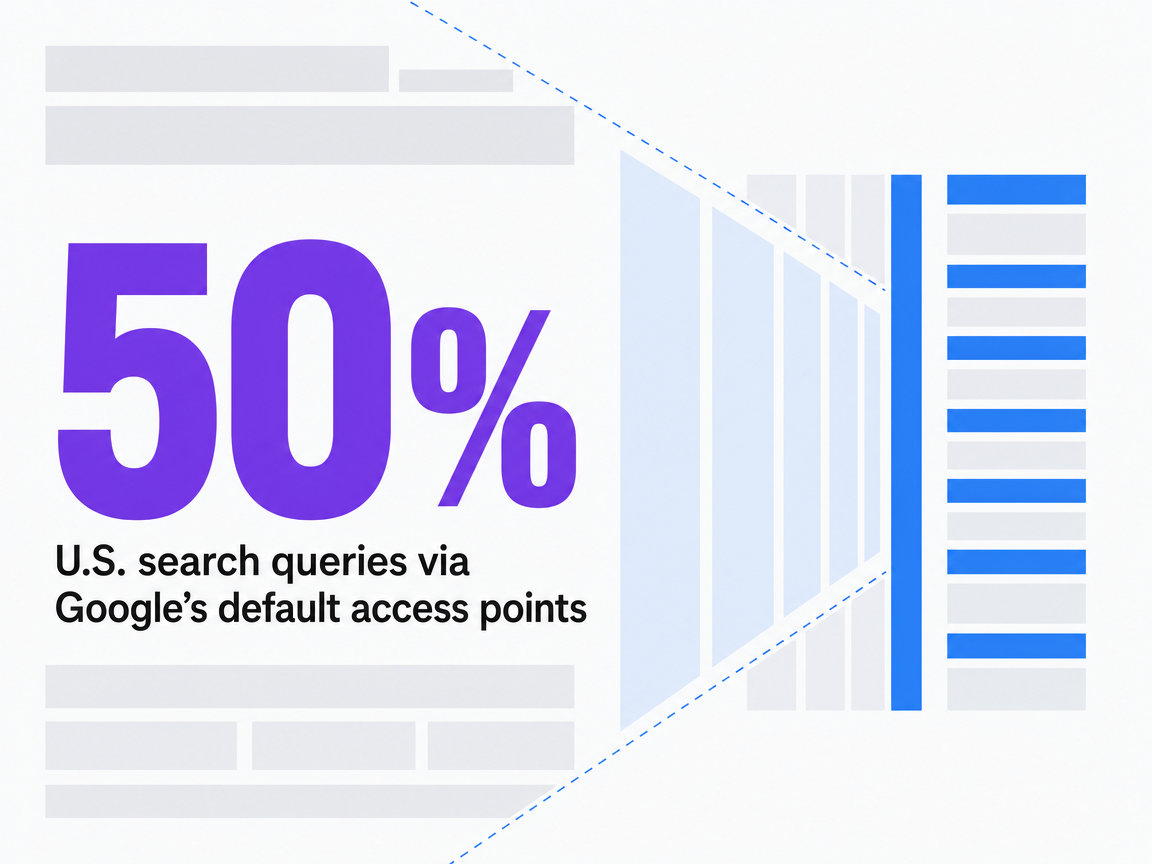 U.S. search queries via Google's default access points
U.S. search queries via Google's default access points
Layer Three: Brand-vs-Competitor Bid Dynamics
The third layer sits at the intersection of the first two: what competitors do specifically on a client's brand terms and branded SERP entries. This is where multi-location and high-consideration service clients quietly bleed margin.
Brand signals in SERP entries meaningfully steer user choice. The presence of a retailer name or brand name in a query or listing significantly shifts click behavior across organic and sponsored results 10. That is why a competitor bidding on a client's brand can convert clicks the client's brand equity earned, and why organic and paid brand listings shown together outperform either alone 9. When a competitor lands a paid slot above the client's organic brand entry, they intercept the highest-intent traffic on the page.
The equilibrium is uncomfortable. Defensive brand bidding often pencils out for the individual advertiser, yet increased competition on brand keywords also increases platform revenue, which is why the auction design tolerates it 1. Agencies should treat brand-vs-competitor bid dynamics as a discrete line item in the client's plan, monitored monthly and priced into retainer scope, rather than a paid-search afterthought handled only when a client notices a competitor's ad on their name.
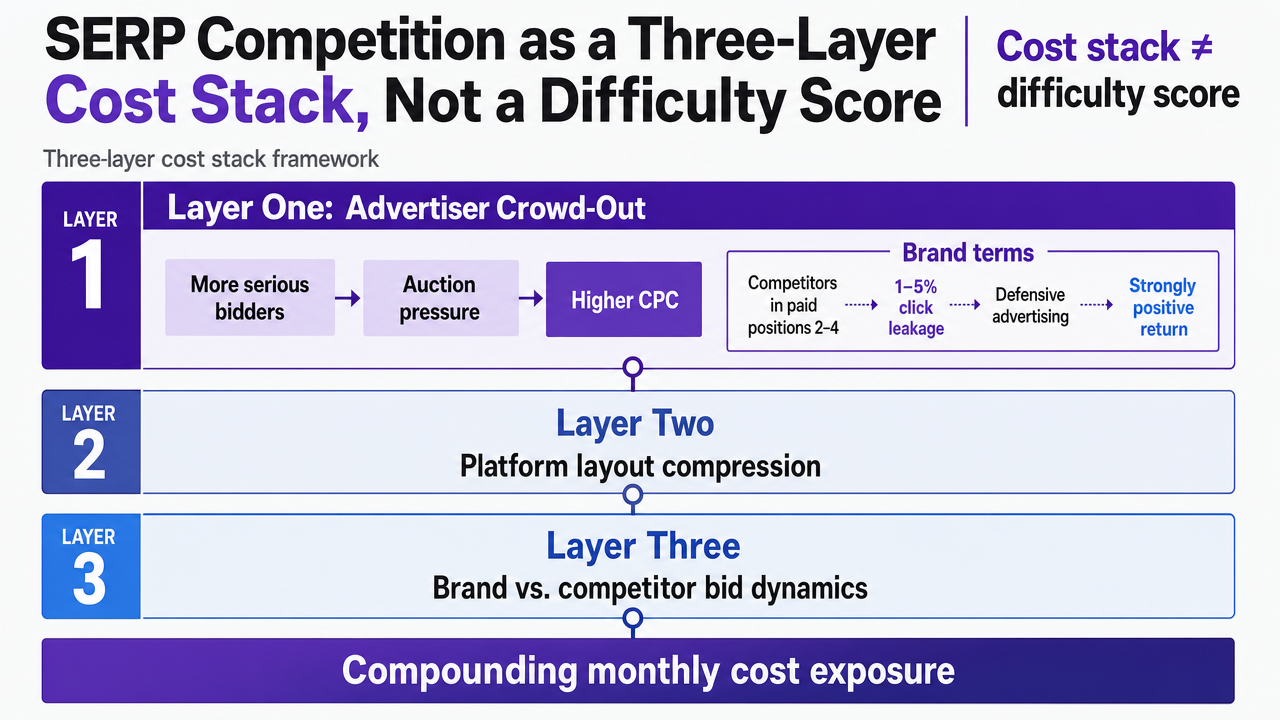 Visualize the three-layer cost stack framework introduced in this section, giving readers a scannable reference for advertiser crowd-out, platform layout compression, and brand-vs-competitor bid dynamics
Test SERP competition insights on real campaigns
Assess SERP landscape impact on client ROI using actionable, trial-driven data from your live campaigns.
Why Ranking Position Stops Predicting Margin
The Mid-Position Profit Anomaly Clients Don't Expect
Clients ask for the top slot because it feels intuitive. Higher position, more clicks, more revenue. The empirical record does not support that arithmetic once cost is included.
Ghose and Yang's analysis of sponsored search across many keywords found that profits are often higher for keywords ranked in the middle positions than for those at the very top of the results page 7. The mechanism is straightforward. The top slot draws the highest CTR, but it also draws the highest CPC, and the marginal click at the top tends to convert at a lower rate than the click one or two positions down. Mid-range positions balance a materially lower cost per click against a conversion rate that holds up well enough to produce a better return on each dollar spent 7.
The counterintuitive piece is that this pattern coexists with the rank-versus-conversion finding across channels: higher visibility improves conversion rates from both paid and organic listings, yet rank also correlates negatively with conversion rate in ways that punish the very top slot on some queries 9. The economically optimal position and the most visible position are not the same coordinate on the page.
For an agency head, this reframes a common client conversation. When a client demands position one on a high-CPC money term, the honest answer is not "we will get you there." It is "we will test which position on this term produces the best contribution margin, then bid to hold that position." That conversation only works if reporting has already trained the client to read profit per click alongside rank, rather than rank alone. Otherwise every mid-page result reads as underperformance, even when it is the highest-earning slot the client can buy.
Organic and Paid Are Not Substitutes on the P&L
A common client instinct is to treat organic gains as a reason to cut paid spend on the same terms. The joint-channel evidence argues against it.
Ghose and Yang's paired-listing analysis found asymmetric positive interdependence between organic and paid results on the same query. Organic clicks increase the utility a user gets from a paid click 3.5 times more than paid clicks increase utility from organic, meaning the presence of a strong organic listing amplifies the value of a paid listing above it far more than the reverse 9. Cutting paid on a term where the client already ranks organically walks away from the multiplier, not just the paid conversions.
Brand signals compound the effect. The presence of a retailer or brand name in a listing significantly shifts click behavior across both organic and sponsored results, so a client that owns two entries on the first screen intercepts intent that a single entry would leak to whichever competitor sits between them 10. When a competitor lands a paid slot above the client's organic brand result, that competitor is not just buying a click. They are diluting the brand signal that would have carried the click.
The operating rule is to model paid and organic as complements on any query where both channels can appear, and to price paid holdouts as the cost of protecting an organic asset the client has already paid to build.
The Incrementality Problem in Client Reporting
When Attributed Revenue Overstates Real ROI
Attribution dashboards flatter paid search. They credit the last click, not the counterfactual. The client sees revenue tied to the campaign and assumes the campaign produced it. Much of that revenue would have arrived anyway.
The clearest evidence comes from a large-scale randomized experiment on eBay's search advertising, where researchers turned campaigns off in controlled markets and measured what actually changed. The average return on investment for non-brand search advertising, once existing-customer purchases were removed from the count, was estimated at roughly negative 63% 2. The scope matters: this is one marketplace with an unusually high share of repeat buyers, a short measurement window, and non-brand terms specifically. It is not a universal number for every client vertical, and it should not be recycled that way. It does establish a principle agency reporting rarely surfaces. When a channel appears profitable in attribution but a large fraction of its converters were already loyal, the incremental lift is smaller than the report shows.
Two SERP dynamics amplify the gap. Brand keyword auctions are the first. Defensive brand bidding can look highly profitable on a dashboard because click-through and conversion rates on brand terms are strong, but a meaningful share of those clicks would have arrived through the organic brand listing sitting directly below the ad 1. The second is joint-channel interdependence. Organic clicks raise the utility of paid clicks on the same query 3.5 times more than the reverse, which means paid conversion rates on terms where the client also ranks organically are partly a measurement of organic strength 9. Both effects push attributed revenue above true incremental revenue.
The operator move is to run scheduled holdouts on brand and non-brand paid segments at least once per engagement cycle, then report incremental revenue alongside attributed revenue in every client review. The gap between the two numbers is the honest ROI conversation.
Scope Discipline When You Cite Headline Numbers to Clients
Headline statistics carry weight in client meetings, which is why they need to arrive with their scope attached. A number pulled from one experiment on one platform does not describe every client's auction.
Three disciplines keep reporting defensible.
- Name the study population when a stat is cited. The eBay finding measured a marketplace dominated by repeat purchasers over a short window 2. A dental group, a law firm, and a home services brand have different customer bases and repurchase cycles, and the incrementality gap will differ accordingly.
- Separate structural signals from vertical benchmarks. Court findings that Google's query share allows the platform to raise ad prices without losing advertisers describe the market every client operates in 4. That is context, not a client-specific forecast.
- Cite only what a source actually measured. The Columbia work on brand keyword crowd-out quantifies a 1–5% click-loss band under specific position conditions, not a universal defensive-bidding return 1.
Reporting that names its scope holds up under client scrutiny. Reporting that borrows a striking number without its conditions does not survive the first quarter it is questioned.
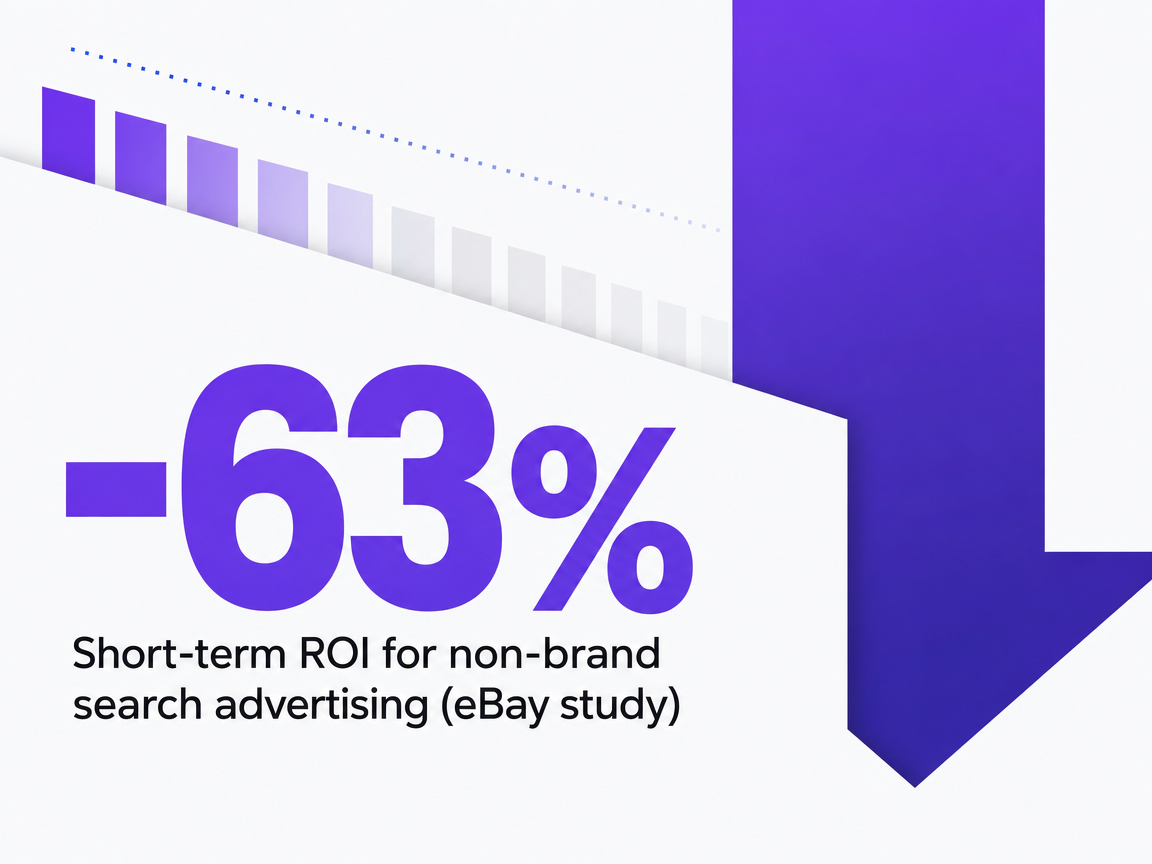 Short-term ROI for non-brand search advertising (eBay study)
Short-term ROI for non-brand search advertising (eBay study)
See How Accurate SERP Competition Analysis Drives Measurable Client ROI
Request a tailored walkthrough of AI-driven SERP competition insights and learn how data-backed ranking assessments streamline campaign prioritization and maximize returns for multi-client portfolios.
If You Manage Multiple Client Accounts: A Portfolio Operating Model
Tiering Clients by SERP Competition Signature
This section shifts scope from single-client reporting to the operator managing a book of accounts. The unit of analysis is no longer one client's rank report. It is how competition signature varies across the portfolio and what that variance costs to service.
Three sourced signals separate a low-competition account from a high-competition one:
- How far platform layout has pushed organic below the fold on money terms, a pattern documented in the DOJ complaint's account of demoted third-party organic and expanded platform inventory 3.
- How much brand-click leakage the client is absorbing to competitors in paid positions 2–4, which sits inside the 1–5% band Columbia's crowd-out modeling identified 1.
- Whether money terms behave like top-slot markets or like mid-position markets on profit per click, the counterintuitive pattern in Ghose and Yang's cross-keyword analysis 7.
| Tier | Organic layout signal | Brand crowd-out band 1 | Profit-optimal position 7 | Paid:organic split | Delivery hours / account / month |
|---|---|---|---|---|---|
| Low | Organic above the fold | <1% click loss | Top slot viable | Organic-weighted (variable X) | H |
| Mid | Organic at or near the fold | 1–3% click loss | Mid-position preferred | Balanced (variable Y) | H × 1.5 |
| High | Organic below the fold 3 | 3–5% click loss | Mid-position with defensive brand bids | Paid-weighted (variable Z) | H × 2 or higher |
The table is a tiering instrument, not a pricing sheet. Splits and hours are labeled variables because they are portfolio decisions, not sourced constants.
Pricing Engagements Against Competition Tier, Not Deliverables
Deliverable-based pricing hides the variance a portfolio actually runs on. Two accounts buying the same package of articles, technical audits, and paid management can consume very different quantities of strategist attention once their competition signature is priced in.
A high-tier account carries three cost weights a low-tier account does not:
- Brand defense on paid positions 2–4 becomes a recurring line item rather than an occasional response, because the 1–5% crowd-out band compounds every month the client leaves it unmanaged 1.
- Layout monitoring becomes continuous, because organic demotion below the fold moves CAC even when rank holds 3.
- Position testing becomes real work, because the profit-optimal slot on money terms is often mid-page rather than the top slot the client would default to buying 7.
The pricing move is to attach a competition-tier multiplier to the base retainer and quote it explicitly. Low-tier accounts pay the base. Mid-tier and high-tier accounts pay the base times a multiplier that reflects the additional strategist hours their SERP signature requires. Clients accept this when the retainer letter names the signals driving the tier, not because they enjoy paying more, but because the alternative is a flat fee that either subsidizes their competition intensity from agency margin or underdelivers on scope.
Delivery Hours per Account and the Scale Ceiling
Every agency hits a scale ceiling defined by hours per account times accounts per strategist. When high-tier accounts consume double the hours of low-tier accounts, adding clients without addressing that math forces one of two outcomes. Strategists absorb the overage until quality slips, or the agency hires a specialist per marginal account and margin compresses.
The portfolio lever is to hold strategist judgment on the tasks that require it and route the repeatable work around it. Layout monitoring, brand-defense position tracking, competitor bid detection on client brand terms, and position-profit testing all produce structured signals that a strategist reads and acts on. They do not all require a strategist to generate. Automating the signal side of that loop is what keeps the hours-per-account curve flat as tiers rise.
Platforms built for this pattern — including Vectoron — read the underlying signals, rank the recommendations, and route them for human approval before execution. The scale ceiling then stops being a function of how many strategists the agency can hire and starts being a function of how many approved decisions the existing team can make per week.
How to Report SERP Competition Ranking to Clients Without Losing Retainers
Client retention on competitive accounts turns on what the monthly report actually shows. Rank alone invites the wrong argument. Rank paired with the three cost layers behind it invites a budget conversation.
Four report elements defend the retainer:
- A share-of-visible-page reading on money terms, not just organic rank, so a client holding position two on a page pushed below the fold by expanded ad and platform inventory sees the layout math rather than a green arrow 3.
- A brand-defense panel that tracks competitor ads sitting in paid positions 2–4 on the client's brand terms and quantifies the click loss inside the documented 1–5% crowd-out band 1.
- A profit-per-click view on top money keywords that reports contribution margin at the position the client actually holds, so a mid-page result reads as an earnings decision rather than a miss 7.
- An incremental-revenue line alongside attributed revenue on paid segments, produced by scheduled holdouts, so the client sees the delta between what the dashboard credits and what the campaign actually caused.
Two habits keep the conversation honest. Cite the scope of every headline number in the same sentence it appears, and separate structural signals from client-specific forecasts. Court findings that a dominant platform can raise ad prices without losing advertisers describe the market every client operates in, not a prediction for one account 4. A retainer defended on those terms survives the quarter a client asks why a competitor's rank moved and theirs did not.
Frequently Asked Questions
References
- 1.Competition and Crowd-Out for Brand Keywords in Sponsored Search.
- 2.Consumer Heterogeneity and Paid Search Effectiveness.
- 3.United States v. Google LLC – Complaint (2020).
- 4.U.S. and Plaintiff States v. Google LLC – Findings of Fact and Conclusions of Law (2024).
- 5.Department of Justice Wins Significant Remedies Against Google.
- 6.Search, Antitrust, and the Economics of the Control of User Data.
- 7.An Empirical Analysis of Search Engine Advertising.
- 8.Trial Exhibit - UPX0010: U.S. and Plaintiff States v. Google LLC.
- 9.Analyzing the Relationship Between Organic and Sponsored Search Advertising.
- 10.Comparing Performance Metrics in Organic Search with Sponsored Search Advertising.