
Key Takeaways
- Spreadsheet-based competitor audits fail because ranking now operates at the URL level across dozens of signals, and AI Overviews create a citation layer that rank trackers do not capture 1, 2.
- Treat the URL–query pair as the unit of comparison and build feature vectors across page, domain, anchor, popularity, and AI-citation buckets to match how Google's signal families actually operate 1, 4, 14.
- Rebuild the competitor template around link graph metrics, HTTPS posture, and H3 heading semantics, since LightGBM and XGBoost studies show these outrank keyword-frequency signals as predictors 12, 13.
- Do not read rank as a proxy for page quality — a one-position gain alone produced a 10.07% CTR lift in a controlled experiment, so position effects must be separated from quality deltas 8.
- Run extractors that produce a flat feature vector per URL covering title, headings, link graph, structured data, Core Web Vitals, and HTTPS, rather than hand-annotating word counts and H2 tags 4, 13.
- Debias CTR and click-share inputs by modeling examination probability per position before scoring, and enter current rank as its own labeled feature so the model learns its effect 7, 9.
- Score competitors on semantic similarity between query intent and passage embeddings to surface missing sub-topics, since BERT-class matching lets pages outrank without lexical overlap 1, 6.
- Run a parallel AI-visibility vector capturing semantic density, information gain, schema, and entity coverage, because a page can win position four on blue links while losing the AI Overview citation to a lower-ranked competitor 2, 14.
Why spreadsheet-based competitor analysis stopped scaling
Most agency competitor audits still start the same way: a strategist opens a rank tracker, exports the top ten URLs for a target query, pastes them into a spreadsheet, and hand-annotates word counts, H2 counts, and rough backlink totals. That workflow made sense when ranking was reducible to a small set of on-page proxies. It stopped making sense once Google's own documentation confirmed that ranking operates at the page level across dozens of signals, with site-wide factors offering no guarantee that any given URL inherits domain strength 1.
The spreadsheet approach also assumes the top ten results are directly comparable. They rarely are. Google's ranking systems now blend passage-level relevance, freshness weighting, and result diversity, meaning two URLs at positions three and seven may be optimized against different sub-intents entirely 1. A side-by-side table of title tags cannot detect that.
Then there is the AI answer surface. AI Overviews pull from top web results but produce a separate competitive layer that spreadsheets do not capture at all 2. A competitor cited inside an AI Overview may not appear in the blue links a rank tracker exports, yet it is capturing query visibility the agency's client is losing.
Scaling this manual method across 40 or 80 client accounts breaks the math on analyst hours before it breaks the analysis. The rest of this article treats SERP competitor analysis as a signal-engineering problem instead.
Reframing the problem: ranking as a page-level feature vector
What Google actually says about page-level ranking
Google's own ranking systems documentation is unambiguous on a point that most agency competitor audits still ignore: ranking operates at the page level, and site-wide signals do not guarantee that any given URL on a strong domain will rank equivalently to its siblings 1. That single sentence invalidates a common shortcut — treating a competitor's high-authority domain as a rough proxy for why a specific URL is outranking a client.
The same documentation catalogs a stack of signal families that operate independently: passage ranking, freshness weighting, original content prominence, result-type diversity, and BERT-class semantic matching 1. Each of those runs at the URL level, on the query in question. A page can lose on freshness while winning on passage relevance, or vice versa.
For an automated competitor analysis system, the implication is structural. The unit of comparison is the URL–query pair, not the domain. The features extracted must span the signal families Google names, weighted per query intent. And the output must acknowledge that Search Quality Rater Guidelines evaluate needs-met and trust dimensions at the page level too, which anchors the E-E-A-T-adjacent features a scoring model needs to carry 3.
The four-bucket feature model from ranking research
The most useful engineering blueprint for an automated competitor-scoring system does not come from an SEO blog. It comes from Microsoft Research's static ranking work, which decomposes ranking features into four buckets:
- Page-level features (Page)
- Domain-level features (Domain)
- Anchor text and inlinks (Anchor)
- Popularity signals (Popularity), with actual page visit counts treated as an explicit popularity input 4
That decomposition maps cleanly onto what an agency's extractors need to produce for every competing URL in a SERP.
Inside each bucket, the concrete signals are extractable at scale. Page covers title, meta description, H1, H2/H3 structure, body semantics, internal links, and technical health. Domain covers HTTPS status, site age, and cross-site topical breadth. Anchor covers inbound link volume, anchor text distribution, and referring-domain diversity. Popularity covers behavioral proxies the agency can approximate from third-party visit estimators, with the caveat that these carry the feedback-loop risk the original paper flags 4.
A fifth bucket has to be added for 2025 SERPs: AI-answer citation signals. Semantic density, information gain, structured data coverage, and entity clarity now predict whether a URL surfaces inside an AI Overview citation, and pages engineered for those attributes show materially higher AI citation rates than non-optimized peers 14. That bucket did not exist when the original ranking research was published, but it belongs in any competitor feature vector built today.
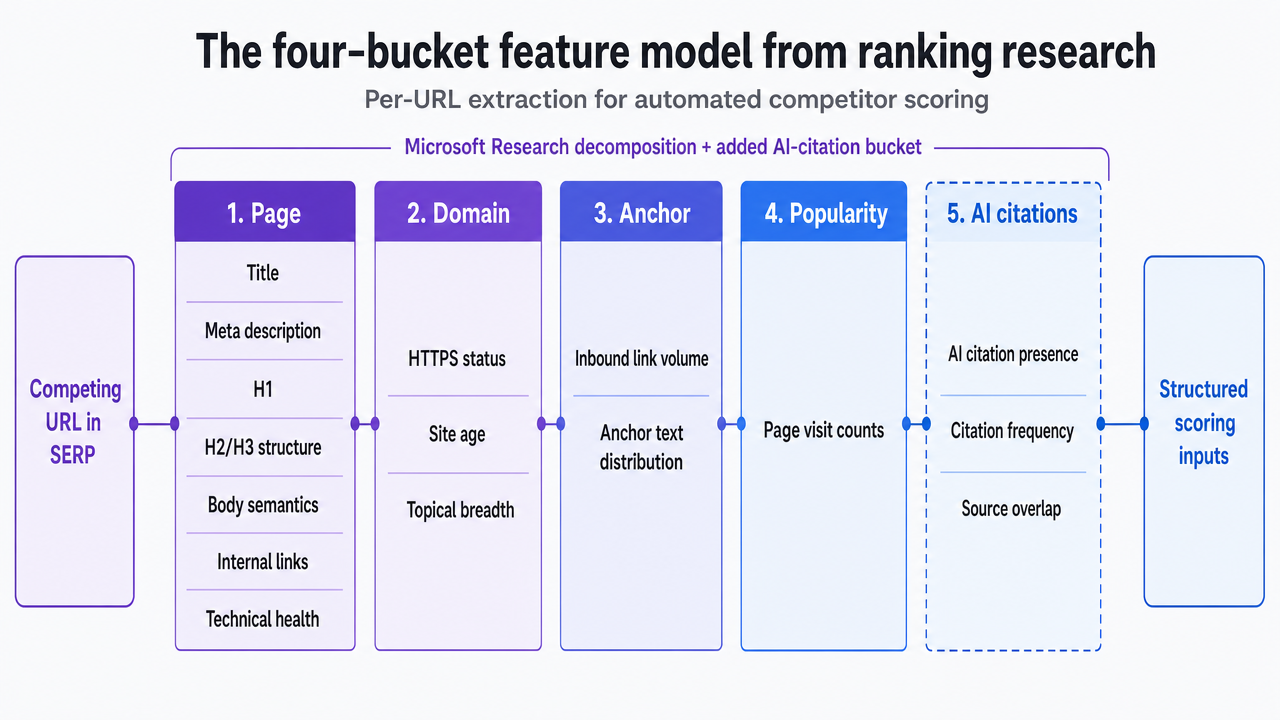 Visualize the five feature buckets an automated competitor scoring pipeline must extract per URL, directly reflecting the Microsoft Research decomposition plus the added AI-citation bucket cited in this section
What actually predicts ranking (and what doesn't)
The single most useful correction an agency can make to its competitor analysis workflow is retiring keyword frequency as a primary comparison dimension. A LightGBM feature-importance study on real SERP data in the gift industry ranked the most impactful predictors as internal and external links, security of the web domain, and length of H3 headings — while keyword-frequency signals sat among the least impactful features tested 12. That result is not an isolated finding. A second peer-reviewed study using LightGBM and XGBoost on a broader SEO feature taxonomy reached the same conclusion: link structure, domain security, and H3 heading semantics carried the predictive weight, and keyword-density measures failed to reach significance 13.
For an agency competitor audit, that reordering has direct consequences. A strategist comparing a client's page against a top-three competitor should not open with a term-frequency delta. The higher-signal comparisons are the shape of the internal link graph pointing into the URL, the diversity and volume of referring domains, whether the page is served over HTTPS with clean certificate posture, and how the H3 structure organizes sub-topics. Those are the features the models actually use to separate winners from losers.
Two caveats belong on the same page as the finding. First, the Salminen study was run in a specific vertical, and feature weights shift across query intents — commercial, informational, and local queries do not weight links and headings identically 12. Second, the broader signal ecosystem still includes site age, link portfolio quality, and query-page relevancy, which any scoring model needs to carry even when their individual weights are lower than the top three 15.
The operational takeaway: rebuild the competitor comparison template around link graph metrics, HTTPS and technical health, and heading semantics. Keyword frequency stays in the vector as a low-weight feature, not as the headline diff.
Automate SERP competitor analysis in real workflows
Run automated competitor ranking reports and publish actionable insights directly to client content during your free trial.
Separating position effects from page quality
The most common error in agency competitor reports is reading rank as a proxy for quality. A page at position three is assumed to be better than a page at position seven because it ranks higher, and the audit works backward from that assumption to reverse-engineer what makes it better. The causal evidence points the other way. Li et al., in a controlled field experiment on a major search platform, found that a one-position improvement in rank produced a 10.07% average increase in click-throughs on its own — with the underlying page held constant 8. That figure comes from an e-commerce ranking experiment where position was manipulated independently of listing content, not from broad web search, and it should not be read as a universal constant across query types or SERP layouts.
The implication is the one that matters for automated competitor analysis. Some of the visible gap between a competitor at position three and a client at position seven is a position effect, not a page-quality delta. Any scoring pipeline that treats current rank as a quality label is training itself on a biased signal.
The same distortion runs through click-through rate data. Microsoft Research's comparison of click position-bias models showed that the probability of a click is materially influenced by where a document sits on the results page, independent of its relevance 7. A survey of learning-from-user-interactions work reaches the same conclusion: click-based learning must correct for the fact that clicks are shaped by the rankings the user was shown 9.
For an agency scoring model, this means two operational rules. Rank position enters the feature vector as its own variable, not as a proxy label for quality. And any behavioral signal derived from CTR, dwell, or click share is passed through a position-bias correction before it influences the competitor score. The debiasing mechanics belong in the pipeline section that follows.
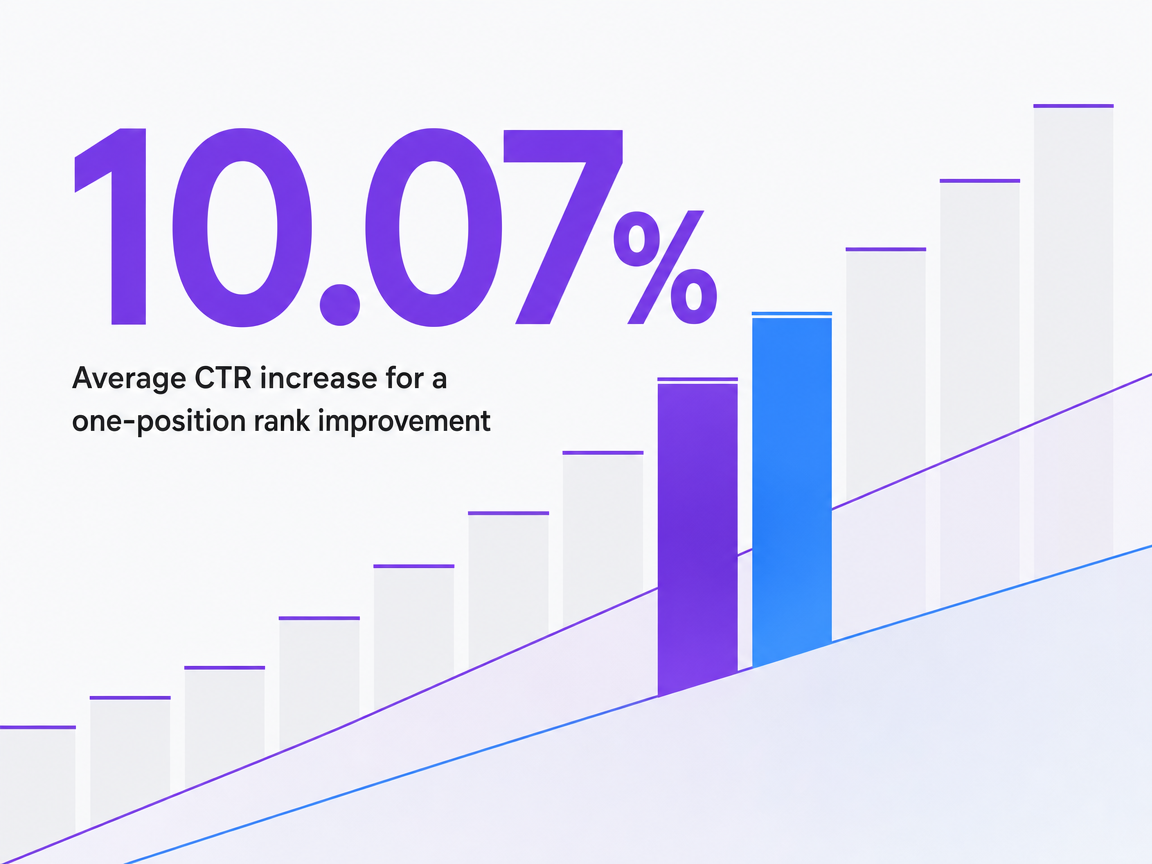 Average CTR increase for a one-position rank improvement
Average CTR increase for a one-position rank improvement
Building the automated scoring pipeline
Feature extractors: on-page, link graph, and technical signals
The pipeline starts with extractors, not scoring. For every URL that surfaces in the top ten for a target query, an agency's crawler needs to produce a structured record covering the four Microsoft Research buckets — Page, Domain, Anchor, Popularity — plus the AI-citation bucket added for 2025 SERPs 4, 14.
Page-level extractors are the densest. Title tag, meta description, H1, and H2/H3 tree with heading text and depth. Body word count, paragraph count, and a semantic outline of sub-topics covered. Internal link count and anchor distribution. Structured data types present. Core Web Vitals from a live fetch. HTTPS status and certificate posture. Peer-reviewed feature taxonomies for SEO classification confirm that title, meta, H1, and body semantics carry the on-page load, with heading structure and link signals doing more predictive work than term-frequency measures 13.
Domain-level extractors handle site age, HTTPS coverage across the property, and topical breadth inferred from a sample crawl of internal URLs. Anchor extractors pull referring-domain counts, anchor-text distribution, and diversity ratios from a link data provider. Popularity extractors approximate visit volume from a third-party estimator, carrying the feedback-loop caveat the original paper flagged 4.
The output is a flat feature vector per URL. That vector, not the URL itself, is what the scoring model reads.
Debiasing click and CTR inputs before they enter the model
Behavioral signals are the most tempting inputs to a scoring model and the most dangerous. Search Console CTR, third-party click-share estimates, and any dwell proxy all carry position bias baked into the raw numbers. Microsoft Research's comparison of click position-bias models established that click probability is materially influenced by document position, independent of the underlying page's relevance to the query 7. Feeding raw CTR into a competitor score trains the model on the ranking that already exists.
The correction is a debiasing step between raw click data and the feature vector. The learning-from-user-interactions literature converges on a shared solution: model position bias explicitly, then divide the observed click signal by the estimated examination probability for that position to recover an unbiased relevance estimate 9. Simpler propensity-weighting approaches work for agencies that lack the click volume to fit a full examination model.
Two operational rules follow. Current rank position enters the vector as its own feature, labeled clearly, so the model can learn its effect rather than absorb it into other variables. And any CTR-derived input is passed through the debiasing transform before it reaches scoring — the raw number is logged for audit, not used directly.
Semantic similarity as a competitor-diff dimension
String-matching diffs miss the point of modern ranking. Google's own documentation names BERT-class semantic matching as a core component of how queries are interpreted against passages 1. A competitor page that never uses the client's target phrase can still outrank it by covering the underlying concept more completely.
The extractor for this dimension is a sentence-embedding model applied to both the query and the candidate URL's content, segmented at the passage level. BERT-based ranking systems have been shown to design accurate query-to-content matching by scoring semantic similarity directly rather than relying on lexical overlap 6. The output is a similarity score per passage and an aggregate score per URL against the query intent.
The competitor-diff use is the operational payoff. Instead of asking which keywords a top-three competitor uses that the client does not, the pipeline asks which sub-topics the competitor covers with high semantic similarity to adjacent query intents — and where the client's page has coverage gaps in embedding space. That output is a ranked list of missing concepts, not a list of missing phrases, which is what a strategist can actually brief against.
Treating AI Overviews as a first-class competitive surface
A competitor that never appears in the top ten blue links can still dominate query visibility if its content is the one cited inside an AI Overview. Google's own documentation confirms that AI Overviews and AI Mode are integrated with core web ranking systems and are backed by top web results, which means the AI answer surface pulls from — but does not mirror — the classical results a rank tracker exports 2. Any competitor analysis workflow that stops at the ten blue links is measuring a shrinking share of the query.
The features that predict AI citation are not the same features that predict a top-three organic rank. Pages engineered for high semantic density and information gain show markedly higher AI citation rates than non-optimized peers, with entity clarity and contextual authority acting as additional differentiators 14. Structured data coverage, explicit entity references, and passage-level answerability carry weight here that they do not always carry in classical ranking.
For the scoring pipeline, this means two extractors run in parallel on every competing URL: the classical feature vector already covered, and an AI-visibility vector that captures semantic density, information gain proxies, schema types present, and entity coverage. The pipeline also needs a monitor that logs, per target query, which URLs the AI Overview cited and which entities the answer referenced.
The competitive diff changes shape as a result. A client's page can be winning at position four on the blue links while losing the citation slot inside the AI Overview to a competitor at position eight. That inversion is invisible to a rank tracker and obvious to a pipeline that treats the AI surface as its own scored layer.
Automate SERP Competitor Intelligence—No Manual Tracking Required
Discover how leading agencies are leveraging AI to monitor, benchmark, and act on competitor ranking shifts at scale—eliminating spreadsheets and enabling faster, data-driven SEO decisions across multiple clients.
Where strategist judgment still gates the output
Automation produces the feature vector. It does not produce the recommendation. The scoring pipeline can tell a strategist that a competitor at position two has denser internal linking, cleaner H3 structure, and a citation slot inside the AI Overview — but it cannot decide whether the client should chase that citation slot, restructure the page around a different sub-intent, or concede the query and reinvest elsewhere. Google's Search Quality Rater Guidelines describe needs-met and trust judgments as evaluations that humans still perform against context the model cannot see 3.
Three decisions belong with the strategist:
- Query-intent classification when the pipeline flags conflicting signals — commercial versus informational feature weights do not resolve themselves.
- The read on E-E-A-T-adjacent quality dimensions, where author credentials, source citations, and first-hand evidence require human evaluation against the client's actual expertise 3.
- The trade-off call between defending a blue-link position and restructuring for AI citation, which carries brand and conversion consequences the score cannot weigh.
The pipeline ranks the work. The strategist approves what ships.
If you manage multiple client accounts: portfolio economics of automation
The scope of this article shifts here. Everything above treats SERP competitor analysis as a per-query engineering problem. The economics only resolve at the portfolio level — across the 40, 80, or 150 client engagements an agency Head of SEO actually runs.
The manual math is unforgiving. A single competitor audit that covers ten target queries, extracts on-page and link features for the top ten URLs each, and layers in an AI Overview citation check runs a competent analyst several hours per client per audit cycle. Multiply that by client count and audit cadence, and the labor line dominates the P&L before any strategic work happens. The signals themselves are not scarce — Google's own documentation names dozens of ranking dimensions operating at the page level 1, and the broader ecosystem adds site age, link portfolio quality, and relevancy weighting on top 15. Analyst time is what is scarce.
A codified pipeline changes the ratio. Extractors run once per URL and reuse across every client whose SERP contains that URL. Debiasing transforms and semantic similarity scoring are engineered once, not re-derived per audit. The analyst hour shifts from extraction to interpretation.
The formula-driven view below uses only variables the agency supplies. No fabricated dollar figures.
| Input | Manual workflow | Codified pipeline |
|---|---|---|
| Hours per competitor audit (H) | H_manual per client | H_auto per client (extraction automated; analyst reviews scored output) |
| Audits per client per quarter (A) | A | A (typically higher — pipeline supports continuous cadence) |
| Active clients (N) | N | N |
| Analyst loaded cost per hour (C) | C | C |
| Quarterly labor cost | H_manual × A × N × C | H_auto × A × N × C |
Two variables carry the delta. H_auto is a fraction of H_manual because extraction and scoring are no longer analyst work. And the pipeline lets A increase without proportional labor growth, which is where continuous competitor intelligence — the subject of the next section — becomes economically feasible instead of aspirational.
An operating model for continuous competitor intelligence
Quarterly audits produce quarterly intelligence. The pipeline described above supports a different cadence — continuous scoring on a rolling window, triggered by SERP composition changes rather than calendar dates.
The operating model has three layers:
- A monitoring layer polls target queries on a set frequency, detects entrants and exits from the top ten, and flags AI Overview citation changes as separate events 2.
- A scoring layer re-runs the feature vector on any URL that entered, exited, or moved materially, and recomputes the competitor diff against the client's page.
- A review layer routes only the deltas that cross a threshold to a strategist, with the scoring rationale attached — link graph shifts, semantic coverage gaps, AI citation losses — so the human decision starts from an interpreted signal rather than raw SERP data 1, 14.
The economic effect is the one the portfolio math already implied. Analyst hours move from extraction to judgment, and the audit cadence stops being throttled by staffing. Platforms like Vectoron are built to run this kind of scored, approval-gated pipeline across a client portfolio without adding a specialist per fifteen accounts.
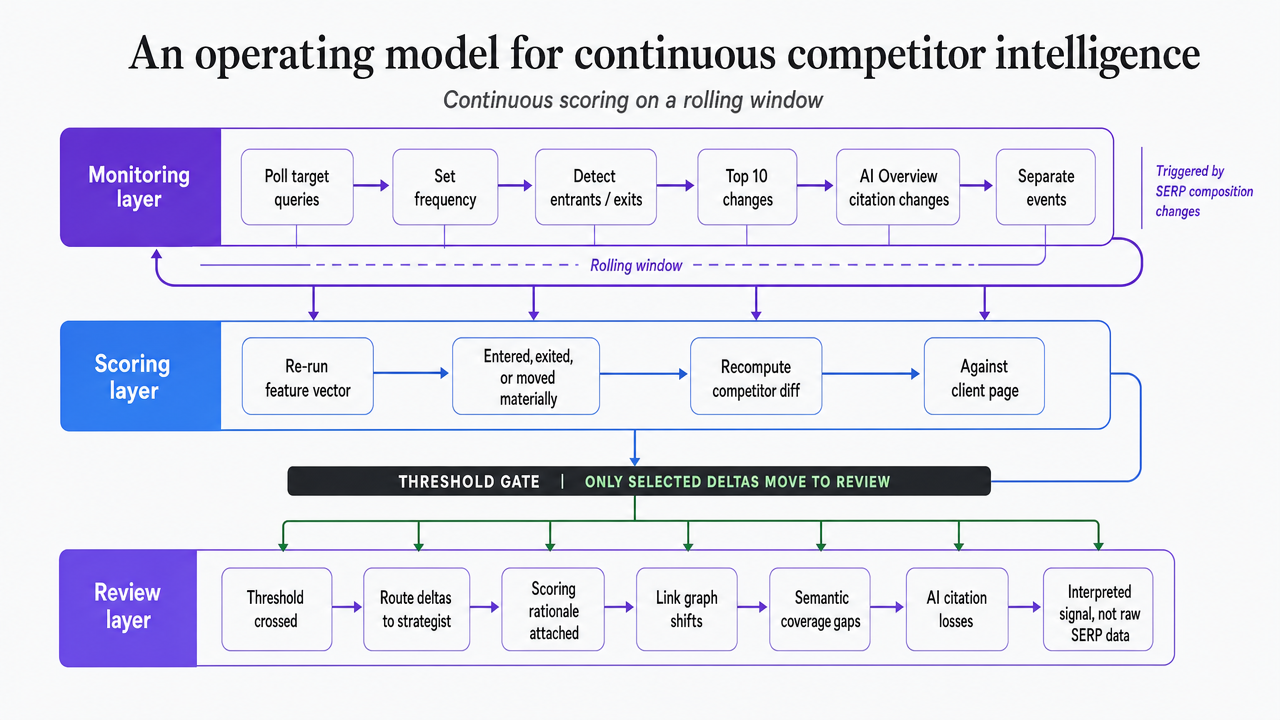 Diagram the three-layer continuous competitor intelligence operating model described in this section (monitoring, scoring, review) so the reader can see how automation and strategist judgment interlock
Frequently Asked Questions
References
- 1.A Guide to Google Search Ranking Systems.
- 2.AI Overviews and AI Mode in Search - Google Search.
- 3.Search Quality Rater Guidelines: An Overview.
- 4.Beyond PageRank: Machine Learning for Static Ranking.
- 5.A Learning Algorithm for Web Page Scoring Systems.
- 6.Development of a Ranking System for Tourist Destination Using BERT-based Semantic Search.
- 7.An experimental comparison of click position-bias models.
- 8.Examining the Impact of Ranking on Consumer Behavior and Search Engine Revenue.
- 9.Learning from User Interactions with Rankings: A Unification of the Field.
- 10.Learning to Rank.
- 11.Ranking Models and Learning to Rank: A Survey.
- 12.Using Machine Learning to Predict Ranking of Webpages in the Gift Industry.
- 13.Using Machine Learning for Web Page Classification in Search Engine Optimization.
- 14.Ranking Factors for AI Search Engines.
- 15.Machine Learning in Search Engines.