
Key Takeaways
- AccuRanker delivers daily position refreshes across large keyword sets, making it the position-accuracy layer agencies need to defend QBR ranking numbers against client spot checks.
- Semrush pairs portfolio-scale position tracking with AI Overview presence flags, letting account teams see which client queries have lost top-of-page real estate to summary surfaces.
- Ahrefs extends deep SERP history into AI Overview citation tracking, turning citation frequency into a measured metric rather than a manual audit for forecasting work.
- STAT handles enterprise keyword volumes with location and device granularity, fitting agencies whose clients demand six-figure keyword tracking and share-of-voice roll-ups at scale.
- Profound samples ChatGPT, Perplexity, and AI Overviews repeatedly, aggregating citations into frequency-based visibility scores that reflect how generative presence actually behaves 7.
- Peec AI measures how often a brand appears inside generated answers and where in the response, giving account teams a share-of-voice narrative for AI surfaces.
- Otterly.AI tracks prompt-level presence across AI answer engines, fitting category work where the prompt set is knowable and stable enough to alert on between reporting cycles.
- Vectoron acts as the workflow layer that reads visibility signals from trackers and Search Console, ranks recommendations, and routes each one for human approval before execution.
The measurement problem rank trackers were not built to solve
Rank trackers were designed for a search page with ten blue links and a stable order. That page no longer defines the result set for a growing share of queries. Google now ships a dedicated generative AI performance report inside Search Console, with impressions, pages, countries, devices, and date breakdowns for content surfaced inside AI features on Search and Discover 3. A separate reporting view for a separate surface is the clearest signal yet that AI visibility is being tracked as its own channel, not as a footnote to classic rankings.
For a Head of SEO running fifteen to a hundred client sites, that split creates a specific operational problem. Position data still drives forecasting and client accountability, but it no longer describes what a searcher actually sees when an AI Overview or AI Mode response is generated above the results 2. Academic work on generative visibility argues the measurement itself has changed shape: a single snapshot understates volatility, and stable estimates require sampling across queries and time 7. Legacy trackers were not built for that job. The eight tools below are evaluated against the surfaces agencies now have to report on, not the one they were built for.
Why classic rank tracking and AI visibility are two different jobs
Position tracking still anchors accountability and forecasting
Position data is not obsolete. It is the metric clients understand, the number that appears in monthly reports, and the input that most forecasting models were built around. A ranking movement from position 8 to position 3 on a commercial query still predicts a directional change in organic clicks, and it still gives account teams a defensible reason to ship the next brief. Portfolio-level accountability depends on that continuity: retention conversations rarely open with citation-frequency deltas inside a generative answer.
What has changed is the scope of what position tracking explains. Google's own guidance treats AI-feature eligibility as an extension of standard Search, with no additional technical requirements beyond normal indexing 1. That framing keeps classic ranking relevant as a leading indicator, but it also concedes that the click behavior downstream of a ranked page now flows through surfaces the tracker never measures directly.
AI visibility is a sampling problem, not a snapshot
A rank tracker asks a single question: where does this URL sit for this query, right now. Generative surfaces do not answer that question in a stable way. Research on measuring visibility in AI search argues that a brand's presence inside generated responses should be treated as the frequency and prominence of mentions across many samples, not a momentary check, and that statistically stable estimates require repeated observation rather than a single snapshot 7.
That reframes the measurement pipeline. Instead of one query returning one ordered list, the workflow becomes sampling frequency, query fan-out across paraphrases and related intents, citation extraction from each generated answer, and aggregation into a visibility score that behaves like a rate rather than a rank. Two consequences follow for agency operations. First, the reporting cadence has to change: weekly checks understate volatility on high-variance prompts. Second, the unit of analysis shifts from keyword to prompt cluster, because a single commercial intent can spawn dozens of phrasings that each pull different sources into the answer. Legacy trackers were architected around the first model. AI-surface tools have to be built around the second.
The surfaces a modern tracker must observe
The reporting surface list has expanded beyond the ten blue links. A modern tracker has to observe classic SERP positions, AI Overviews, AI Mode, ChatGPT citations, and Perplexity citations. Google describes AI Overviews and AI Mode as ways to get links and summaries for faster exploration, which means both surfaces mix a generated answer with source links that behave differently from organic results 2. Citations inside ChatGPT and Perplexity answers add two more surfaces that sit entirely outside Google's ecosystem and require independent sampling.
Each surface has its own coverage question. Classic SERPs still need daily position checks at scale. AI Overviews need presence detection and source attribution per query. AI Mode needs conversational-turn sampling because a single session can rewrite what the user sees. ChatGPT and Perplexity require prompt-level monitoring against models that update on their own schedule. An agency stack that only reads the first surface will produce reports that describe a shrinking share of what clients actually experience in search.
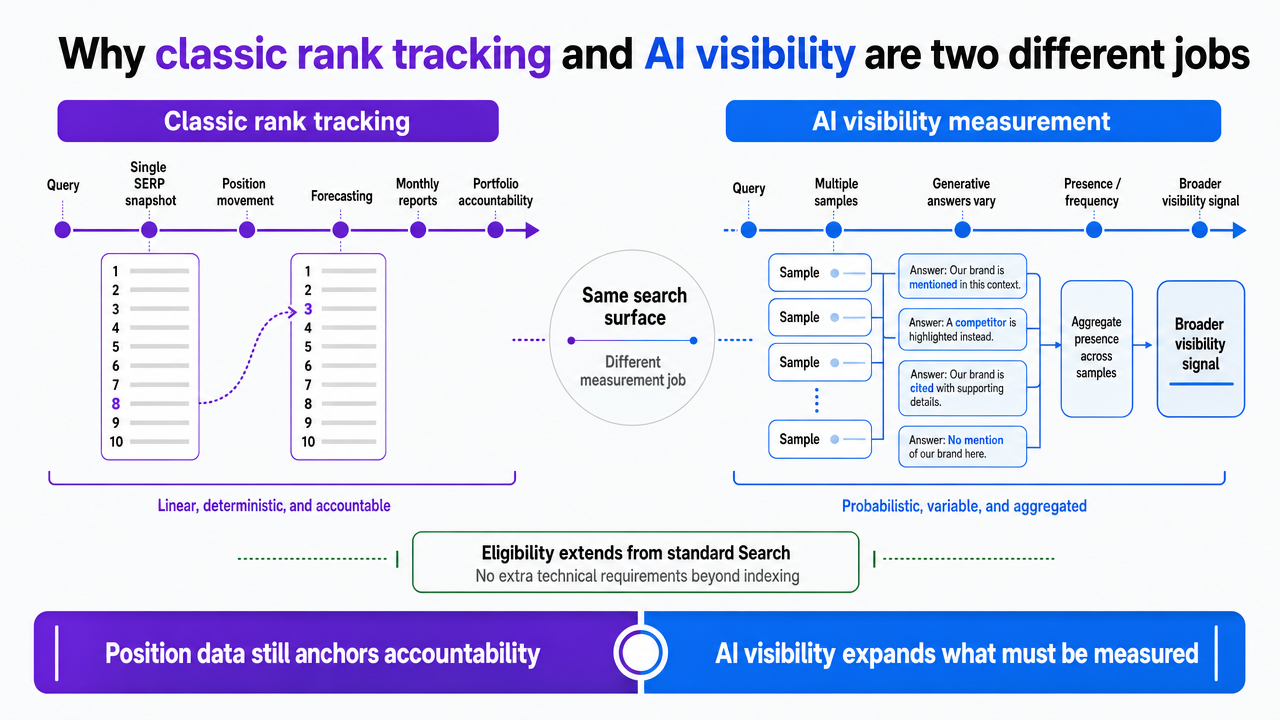 Visualize the conceptual shift from single-snapshot rank tracking to multi-sample generative visibility measurement, directly supporting the section's argument about the sampling problem
The free baseline: Google Search Console's generative AI report
Every paid tool in this evaluation should be judged against what Search Console already provides for free. Google's dedicated generative AI performance report gives site owners impressions inside AI features on Search and Discover, broken down by impressions, pages, countries, devices, and dates 3. Those five dimensions are the same primitives a Head of SEO would build a client dashboard around, and they arrive at no license cost per property.
Two operational points follow. First, the report describes impressions inside generative surfaces but leaves click attribution to be reconciled downstream. Google's own site-owner guidance directs teams to analyze AI-feature clicks through Search Console and Google Analytics rather than expecting a single unified number 1. Second, scaling that reconciliation across a portfolio of clients used to require an analyst pulling filters property by property. Google's AI-powered configuration in Search Console now applies filters, comparisons, and metric selections automatically, which shortens the per-client analysis loop 4.
The practical implication for agency operations is that GSC covers the free layer of AI-surface impression tracking. Paid tools have to justify their spend by measuring what GSC does not: prompt-level sampling, non-Google surfaces, and citation frequency inside generated answers.
Test AI-powered SERP tracking on live projects
Monitor real keyword rankings and publish actionable data-driven insights during your trial—no limitations, no sample data.
How each tool was evaluated
Each tool below was scored against four axes that reflect what a Head of SEO actually has to defend in a QBR: SERP position accuracy at portfolio scale, AI-surface coverage across AI Overviews, AI Mode, ChatGPT, and Perplexity 2, multi-client architecture (tagging, permissions, white-label reporting, API throughput), and downstream attribution to clicks and conversions once AI-feature traffic is reconciled through Search Console and Google Analytics 1.
Capabilities are described qualitatively. No pricing, accuracy percentage, or user-count figure appears unless the vendor's public documentation or a mapped source supports it. Tools that only do one job well are named for that job, not padded with features they do not ship.
Eight SERP rank trackers worth an agency evaluation
AccuRanker — daily position accuracy at portfolio scale
AccuRanker earns its slot on the strength of one job: fast, daily position refreshes across large keyword sets, with on-demand rechecks when a client asks why a term moved between Monday and Thursday. For agencies running fifteen to a hundred properties, that refresh cadence is what keeps QBR position numbers defensible against the client's own spot checks.
The multi-client architecture is built for portfolio work rather than retrofitted onto a solo-user tool. Grouping keywords by client, tagging by intent or funnel stage, and pushing daily deltas through the API into a warehouse or Looker Studio deck removes most of the manual pull work from monthly reporting. AI-surface coverage is narrower than the newer generative-first entrants, and citation tracking inside ChatGPT or Perplexity is not the tool's center of gravity. Treat AccuRanker as the position-accuracy layer of a two-layer stack, and pair it with a generative-surface tool for AI Overview and AI Mode observation 2.
Semrush — position tracking plus AI Overview presence flags
Semrush occupies the middle of the stack because it does two jobs at usable quality rather than one job at best-in-class. Position tracking covers the keyword volumes an agency needs across a portfolio, and the SERP feature detection now flags when an AI Overview appears above the classic results for a tracked query. That flag is not the same as a full generative visibility score, but it tells an account team which client queries have already lost the top-of-page position to a summary surface.
The operational value for a Head of SEO is the ability to reconcile position data with SERP feature presence inside one interface, then export both into a client report without stitching two vendors together. The gap is prompt-level sampling across non-Google surfaces: ChatGPT and Perplexity citations sit outside Semrush's native observation. Reconcile impressions on flagged AI Overview queries against the Search Console generative report to close the click-side of the story 3.
Ahrefs — SERP history and AI Overview citation tracking
Ahrefs is included for the depth of its SERP history and the extension of that history into AI Overview citation observation. Long-window position data matters for agency forecasting because it lets a strategist see how a query behaved across algorithm updates, not just this week's snapshot. The AI Overview coverage identifies which URLs get cited when a summary is present, which turns citation frequency into a tracked metric rather than a manual audit.
Where Ahrefs fits in a portfolio stack depends on what a team already owns. Agencies that use Ahrefs for backlink and site-explorer work get the rank tracking as a near-adjacent capability without a second contract. AI Mode conversational sampling and non-Google surface coverage remain thinner than the specialist generative tools. Pair Ahrefs with Search Console's dedicated generative AI performance report to see impressions inside AI features on Search and Discover alongside the citation data 3.
STAT (Similarweb) — enterprise SERP granularity for large keyword sets
STAT is the tool a Head of SEO reaches for when keyword volumes cross into six figures and the client wants location and device granularity that would break a mid-market tracker. Daily rankings at that scale, with market segmentation and share-of-voice roll-ups, is the enterprise use case STAT was built for.
The architecture assumes analyst users who work in SERP data all day: tagging, segmentation, and API export are first-class, not bolted on. That depth is also the friction point for smaller portfolios, where the same volume of granularity produces more data than a five-person account team can act on. AI-surface coverage is not the tool's positioning, so a STAT-anchored stack still needs a generative-specialist layer to observe AI Overviews, AI Mode, ChatGPT citations, and Perplexity citations 2. For enterprise-scale agencies, STAT plus a generative tool plus Search Console remains a defensible three-layer configuration.
Profound — generative answer sampling across ChatGPT, Perplexity, and AI Overviews
Profound is one of the tools built from the generative side of the split rather than retrofitted from a classic rank tracker. The core capability is sampling: repeated prompt runs against ChatGPT, Perplexity, and AI Overviews, with citation extraction and aggregation into visibility scores that behave like frequencies rather than positions. That design aligns with the academic argument that visibility inside generated responses has to be estimated statistically across many samples, not read off a single check 7.
For an agency operator, the practical value is coverage across the non-Google surfaces that legacy trackers miss and a reporting model that turns citation frequency into a comparable metric across clients. The trade is that classic SERP position tracking is not what Profound optimizes for, so the tool sits on the specialist side of a two-layer stack. Pair it with a position-accuracy tool like AccuRanker or STAT rather than asking it to cover both surfaces.
Peec AI — brand mention frequency inside generated responses
Peec AI narrows the measurement question further: how often does a brand appear inside generated answers, and in what position within the response. That frames visibility as a mention-frequency rate across sampled prompts, which is the operational form of the statistical framing in the GEO research 7.
The tool is useful for agencies whose clients care about brand-level presence inside AI answers, not just URL citations. Competitive tracking against a defined peer set gives account teams a share-of-voice narrative that translates cleanly into client reporting. Coverage across surfaces and models varies, and the tool does not aim to replace a classic position tracker. Treat Peec AI as a brand-visibility instrument that runs in parallel with a position-accuracy tool and Search Console's generative report, not as a single source for both jobs.
Otterly.AI — prompt-level visibility monitoring for AI answer engines
Otterly.AI is built around prompt-level monitoring: a client defines the prompts that matter, and the tool tracks whether the brand appears as a link, a mention, or a source across AI answer engines over time. That unit of analysis fits the shift from keyword to prompt cluster, where a single commercial intent can spawn many phrasings that each pull different sources into the answer.
For agencies, the operational fit is category work where the prompt set is knowable and stable: a legal practice area, a treatment category, a service line with defined competitor language. Alerting on prompt-level presence changes gives account teams a signal to act on between reporting cycles. Classic SERP position tracking sits outside the tool's scope, so Otterly.AI fits the specialist layer of the stack alongside Search Console's generative AI performance report 3.
Vectoron — a workflow layer that ties visibility signals to approved execution
Vectoron is not a rank tracker competing with the seven tools above on position accuracy or citation sampling. It is the workflow layer that reads visibility signals from those tools and Search Console, ranks the resulting recommendations, and routes each one for human approval before execution across content, SEO, backlinks, and adjacent channels.
For a Head of SEO managing a client portfolio, the operational question is not only what a tracker measures but what happens after the measurement lands. Google's own guidance concedes that AI-feature clicks have to be reconciled across Search Console and Google Analytics, which means visibility data becomes actionable only when it is joined to downstream signals and turned into a decision 1. Vectoron sits at that junction: specialist strategists surface ranked priorities from the visibility layer, and nothing ships without approval. It belongs in this list as the connective tissue between measurement and execution, not as a replacement for either.
A capability matrix across the four operator axes
The eight tools split cleanly when scored against the axes introduced earlier. AccuRanker and STAT lead on SERP position accuracy at portfolio scale, with STAT carrying the enterprise keyword volumes and AccuRanker holding the daily refresh discipline. Semrush and Ahrefs sit in the middle: both track position across a portfolio, and both now flag AI Overview presence or citations without owning the full generative sampling stack 2. Profound, Peec AI, and Otterly.AI invert the scorecard. Their AI-surface coverage across AI Overviews, AI Mode, ChatGPT, and Perplexity is the reason to buy them; their classic position tracking is thin or absent. None of the seven closes the downstream attribution axis on its own, because AI-feature clicks still have to be reconciled through Search Console and Google Analytics 1. Vectoron scores on multi-client workflow and attribution routing rather than measurement, which is why it fills the eighth slot instead of competing on tracking accuracy.
Get a Live Demo of Unified SERP Tracking and AI-Powered Approval Workflows
See how advanced SERP rank tracking integrates with automated content execution—enabling agencies to scale multi-channel SEO oversight without increasing headcount or losing control.
If you manage a multi-client portfolio: the economics of a two-layer stack
This section shifts scope from single-site measurement to multi-client agency operations, where cost per property and analyst hours per client determine whether a stack is defensible in a QBR against margin.
The cost drivers are predictable once the stack is drawn as two layers rather than one. A legacy configuration pays a per-domain rank tracking license across N clients, adds ad-hoc analyst time to spot-check AI Overviews and ChatGPT answers by hand, and absorbs H hours per client per month in Search Console reconciliation and deck assembly at a blended analyst rate R. A unified visibility workflow pays for the position-accuracy tool and a generative-surface specialist, but collapses the manual AI checks into sampled runs and shortens the reconciliation loop because Search Console's AI-powered configuration applies filters, comparisons, and metric selections automatically across properties 4.
| Cost driver | Legacy stack (rank tracker + manual AI checks) | Unified visibility workflow ||---|---|---|| Per-domain rank tracking license | N × license | N × license || AI-visibility tracking | Manual spot checks, unbudgeted analyst time | Specialist tool subscription, sampled runs || GSC reconciliation across N clients | N × H × R | N × (H − h) × R, where h is time saved by AI-powered configuration 4|| Reporting deck assembly | Manual per client | Templated from unified data |
The operator decision is where H × R exceeds the specialist subscription. Above that threshold, the two-layer stack pays for itself on analyst hours alone, before any retention argument.
What a rank tracker still cannot tell you
No tool in this evaluation closes the click-attribution gap on its own. Google's site-owner guidance is explicit that AI-feature clicks have to be analyzed through Search Console and Google Analytics rather than read off a single tracker view, which leaves a reconciliation step that stays with the agency regardless of vendor choice 1. A position or citation observation tells an account team where a page sits inside a surface. It does not tell them what the user did next.
Three other blind spots persist. Prompt intent behind a generative answer is inferred, not observed: the tracker sees the response, not the reasoning the user brought to the query. Content quality signals that drive AI-feature eligibility sit inside Google's helpful content framework and are only measurable through outcome proxies, not tracker fields 5. And conversational rewrites inside AI Mode can shift what a single session shows without any tracked query changing at all. Treat every rank tracker as a partial view, and build the reporting narrative around what the tracker plus GSC plus analytics can defend together.
How to structure a baseline-plus-specialist stack
A defensible stack for an agency portfolio has two layers and a workflow spine. The baseline is free: Search Console for classic position and impression data, plus the dedicated generative AI performance report for AI-feature exposure across pages, countries, devices, and dates. The specialist layer is what an agency pays for. Position accuracy at scale sits with AccuRanker or STAT, depending on keyword volume. Generative-surface sampling sits with Profound, Peec AI, or Otterly.AI, chosen by whether the client cares more about URL citations, brand mentions, or prompt-level presence.
Semrush or Ahrefs can collapse the position layer and a partial AI Overview view into one contract when portfolio size does not justify two specialists. The workflow spine ties the layers to a decision: sampled visibility signals surface ranked priorities, an account lead approves the next brief, and execution ships without a second reconciliation cycle. Build the stack in that order, and the reporting narrative stops trailing what clients already see in search.
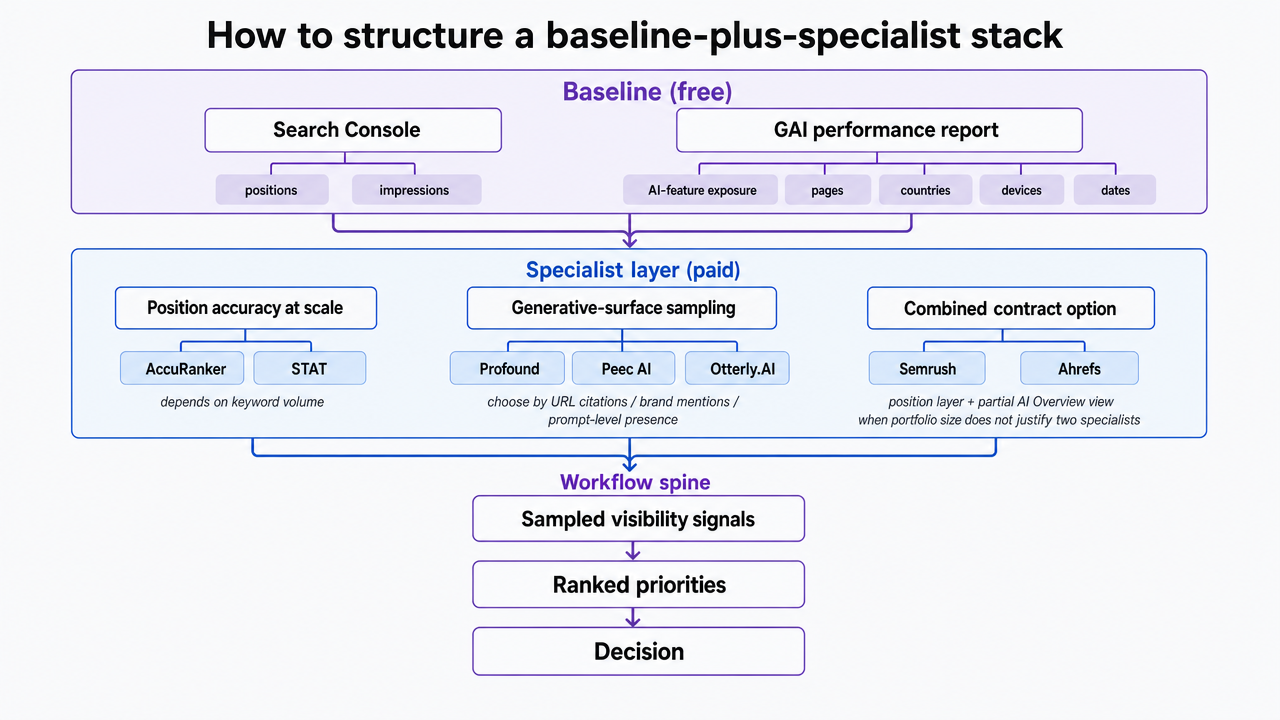 Diagram the recommended two-layer stack plus workflow spine described in the section, showing how baseline GSC, specialist tools, and workflow layer connect
Frequently Asked Questions
References
- 1.AI Features and Your Website | Google Search Central.
- 2.AI Overviews and AI Mode in Search - Google Search.
- 3.Introducing Search Generative AI performance reports in Search Console.
- 4.Streamline your Search Console analysis with the new AI-powered configuration.
- 5.Creating Helpful, Reliable, People-First Content.
- 6.Search Quality Rater Guidelines: An Overview.
- 7.Don't Measure Once: Measuring Visibility in AI Search (GEO).
- 8.Optimizing Visibility in Generative Engines.
- 9.Concepts of visibility, findability, discoverability, SEO and ASEO in digital repositories.
- 10.Google AI Overviews - Search anything, effortlessly.