
Key Takeaways
- Treat SERP tracking as an anomaly-detection layer across four correlated signals: rank position, CTR delta against expected curves, SERP feature composition, and confirmed Google events 6.
- Separate portfolio-wide turbulence from client-specific decay by overlaying dated core and spam updates on aggregate volatility, and honor Google's one-week post-rollout wait before diagnosing 5.
- Tier alert thresholds by revenue exposure and run diagnostics in a fixed order—event, CTR delta, feature change, technical or policy cause—so tickets resolve consistently regardless of analyst 2.
- Focus next on codifying triage rules and reporting artifacts that pair visibility trends with dated event overlays, which is what raises accounts per analyst and defends retention through core updates.
The shift from rank dashboard to portfolio risk layer
The agencies still treating SERP tracking as a weekly ranking screenshot are the ones losing accounts during core update windows. A Head of SEO managing 40 or 400 domains does not need another dashboard confirming that positions moved. They need a system that flags which movements matter, separates portfolio-wide turbulence from client-specific decay, and produces a defensible story before the client's CMO asks for one.
That reframing changes what a SERP tracker is for. It stops being a reporting artifact and becomes an anomaly-detection layer sitting on top of four correlated signals: rank position, click-through rate against expected curves, SERP feature presence, and confirmed Google events. Google's own guidance on core updates tells site owners to wait a full week after a rollout ends before analyzing Search Console data and comparing the right weeks 5. That instruction only works if the tracker can distinguish a rollout window from a client-specific problem in the first place.
The pressure has intensified. Search Console now surfaces hourly granularity in its 24-hour view, shrinking detection windows from weeks to hours 9. AI Overviews have been auto-expanding on select queries, pushing organic links down the page and changing what a given rank is worth 4. Rank as a standalone metric no longer explains client outcomes. Risk exposure, tracked across signals and correlated with confirmed events, does.
What a SERP tracker actually monitors in 2026
Why position alone lies about client performance
A client sitting at position two for a commercial term looks healthy on a rank report. That same position, on a query where Google now renders an AI Overview above the fold and a shopping module below it, may be delivering a fraction of the clicks the ranking suggests. The report says the account is fine. The revenue says otherwise. That gap is where retention conversations go wrong.
Device-dependent CTR research on Google organic results estimates the top-ranked listing captures roughly 9.28% of clicks, with positions two and three drawing 5.82% and 3.11% respectively 11. Those figures come from a controlled academic study of organic CTR curves and represent an expected baseline, not a promise. The point is not the exact number. The point is that any tracker treating position as a proxy for outcome is measuring the wrong variable, because expected CTR at a given rank is a modeled curve, and real client CTR is what actually pays the invoice.
The diagnostic move is to compare actual CTR against modeled CTR for each keyword by device and intent, then treat the delta as the signal 2. A client ranking two with a CTR half its expected curve is decaying under the ranking, not above it. Position held. Traffic did not. That distinction is what separates a Head of SEO who can defend an account through a bad quarter from one who cannot.
The four correlated signals: rank, CTR delta, SERP features, and confirmed events
Modern SERP tracking runs on four signals that only mean something when read together.
- Rank position is the first and least informative. It answers where the listing sits, not what that seat is worth. On its own it produces the false positives that eat analyst hours: a keyword drops from three to five, an alert fires, someone opens a ticket, and the query turns out to be a low-impression outlier already trending back.
- CTR delta is the second signal. Actual CTR compared against a modeled curve for the keyword's position, device split, and intent tells the analyst whether the ranking is being monetized or hollowed out 1, 2. A stable rank with a widening negative delta is a stronger warning than a two-position drop with CTR holding to curve.
- The third signal is SERP feature presence. AI Overviews, shopping units, local packs, and sitelinks change what a rank is worth in real time, and Google has been auto-expanding AI Overviews on select queries in ways that push organic links well down the page 4. A tracker that logs feature composition per keyword, dated, lets an analyst see whether a client's CTR loss coincided with a new module appearing rather than any change the client made.
- The fourth signal is confirmed Google events. Correlating rank and CTR movement against dated core updates, spam updates, and system changes recorded on Google's ranking status history separates portfolio-wide turbulence from client-specific decay 6. When the same volatility hits 60% of accounts in a portfolio during a confirmed rollout, the diagnosis writes itself. When it hits one account outside a rollout window, the diagnosis is entirely different. Neither conclusion is available from rank data alone.
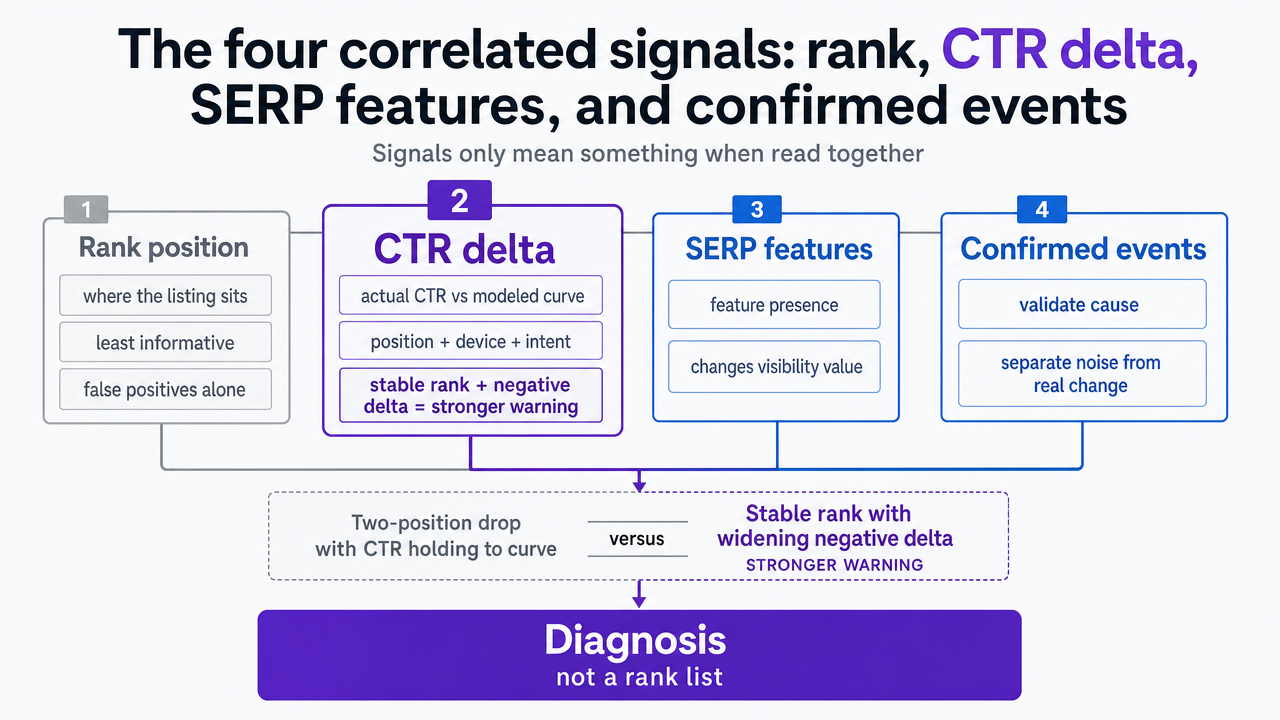 Visualize the four correlated monitoring signals described in this section as a framework diagram, reinforcing how they combine to produce a diagnosis rather than a rank list
Why detection windows shrank to hours
The old cadence assumed a weekly review was fast enough. Search Console's 24-hour view now surfaces hourly granularity across Search, Discover, and Google News, meaning the underlying data supports detection windows measured in hours rather than days 9. Client expectations have moved to match. A CMO who saw a competitor's post-mortem on an AI Overview rollout on Monday will ask her agency what changed by Tuesday morning.
That compression changes what a SERP tracker has to do operationally. Daily rank pulls remain necessary but no longer sufficient. Anomaly detection needs to run against hourly impression and click data for high-revenue keywords, with thresholds tuned to filter noise on low-volume terms so alerts stay actionable. The alternative is a stream of pages that page an on-call analyst for movements inside the normal band, which produces the exact fatigue that lets a real incident sit unread for 36 hours.
Speed only pays off when it feeds a triage protocol. Detecting a drop three days earlier is worth analyst hours only if the next step is codified, which is the subject of the following section.
Monitor client SERP shifts in real time
Experience live SERP tracking and publish actionable performance insights for client SEO during your trial.
Reading algorithm turbulence versus client-specific decay
Mapping 2026 ranking events against portfolio volatility
A single year of confirmed Google activity shows why event correlation cannot be a manual exercise. Google's ranking status history recorded a February 2026 Discover update, a March 2026 core update, a May 2026 core update, and a June 2026 spam update, all with dated start and end windows 6. Four confirmed rollout periods in the first half of a year, each stretching over multiple days, means that a portfolio of 40 to 200 domains is almost never operating outside the shadow of a recent or active Google change.
The operational consequence is straightforward. When rank and CTR volatility spike across 50% or more of a portfolio inside one of those windows, the working hypothesis is turbulence, not client decay. When the same signals fire on a single account outside any dated window, the working hypothesis flips. That flip is where analyst hours are either saved or wasted. A Head of SEO whose tracker does not automatically overlay dated Google events on portfolio volatility is asking analysts to hold that calendar in their heads while triaging 15 alerts a morning.
The chart that matters here is not a keyword graph. It is a timeline of confirmed events plotted against aggregate portfolio volatility, refreshed as Google publishes new rollout dates. Once the overlay exists, the triage question narrows fast: is the movement on this account inside a confirmed window, and does the shape of its decline match the portfolio's shape? If yes, wait. If no, diagnose. Rank data alone cannot answer either question.
The one-week rule and how to defend it internally
Google's public core update documentation gives agencies a directive that most account managers still find hard to hold: wait until at least a full week after a rollout ends before analyzing Search Console data, and compare the correct weeks against each other 5. Inside an agency, that guidance collides with a client emailing about a ranking drop on day two of a rollout, and with an account manager who wants a response by end of day.
Defending the one-week rule internally requires codifying it as a policy, not a preference. When a confirmed rollout is active in the tracker, alerts on affected accounts should route to a hold queue with the rollout end date attached, not to an analyst's diagnostic sprint. The message to the client is not silence. It is a dated note that a Google core update is in progress, that mid-rollout data is unstable, and that a full diagnosis will be delivered a set number of days after the confirmed end date.
That policy protects two things at once. It stops analysts from rewriting pages against a moving algorithm, which is the single fastest way to compound a loss. And it protects the credibility of the eventual diagnosis, because the analysis compares stable weeks against stable weeks rather than a partial rollout against a normal one. Clients accept the wait when the tracker shows them the rollout window on a shared timeline instead of a promise.
AI Overviews, paid encroachment, and layout as a ranking factor
Layout is now a variable that behaves like a ranking factor from the agency's point of view, even when Google would not describe it that way. Coverage of Google's auto-expansion of AI Overviews on select queries documents a page structure where organic links sit meaningfully lower than they did months earlier, with measurable effects on CTR and traffic to publisher sites 4. A client's rank did not move. The seat did.
Paid encroachment operates on the same axis. Analysis of paid expansion on organic SERPs argues that added ad units shift clicks away from organic listings and that a portion of paid traffic is drawn from demand that would otherwise have converted organically 3. Academic work on the interaction between organic and paid clicks finds a positive interdependence between the two channels, meaning changes in one side of the SERP alter click patterns on the other rather than leaving them independent 10. Neither dynamic shows up in a rank report, and neither is a client-caused problem.
The tracker adjustment is to log SERP feature composition per keyword with a date stamp: which modules are present, in what order, and whether AI Overviews are expanded or collapsed on that query. When CTR degrades on a stable rank, the first check is whether the layout changed. If a new module appeared, the diagnosis is a market condition to report and adapt to, not a page to rewrite. That distinction protects both analyst hours and the client narrative.
A triage protocol for the wait, diagnose, or act decision
Signal detection thresholds tied to revenue exposure
Not every ranking movement deserves an analyst's morning. The failure mode inside most agencies is treating a keyword drop the same whether it sits on a page driving 40% of client revenue or on a tail term nobody has looked at since the site launched. A triage protocol starts by weighting alerts to the revenue exposure of the underlying keyword, then setting detection thresholds against that weight.
A workable structure splits the portfolio into three tiers.
- Tier one covers keywords tied to booked revenue: money pages, service pages, high-intent commercial terms. Alert thresholds here are tight, roughly a one-position drop paired with a CTR delta of 15% or more against the expected curve for that rank and device 2.
- Tier two covers supporting mid-funnel terms where a two- to three-position band is the working noise floor.
- Tier three covers informational and long-tail queries that only escalate when volatility hits them in aggregate rather than one by one.
The point of tiering is not precision. It is filtering. A tracker firing 200 alerts a day against a 60-account portfolio produces the same behavioral outcome as one firing zero: nothing gets read. Revenue-weighted thresholds cut alert volume to the movements that would actually appear in a client's monthly report, which is the only volume an analyst can act on in the window Search Console's hourly data now makes possible 9.
The diagnostic sequence: event, CTR delta, feature change, technical or policy cause
Once an alert clears the threshold, the diagnostic sequence has to run in a fixed order. Analysts who improvise the order produce inconsistent findings across a portfolio, which is the root cause of QBR narratives that contradict each other from account to account.
- Step one checks for a confirmed Google event. If the tracker shows an active core update, spam update, or system rollout on Google's ranking status history, and the account's movement pattern matches the portfolio's aggregate shape during the window, the alert routes to a hold queue with the rollout end date attached 5, 6. No diagnostic work runs until the wait period clears. Skipping this step is how agencies end up rewriting pages mid-rollout against an algorithm that has not finished moving.
- Step two, run only when no event is active, checks CTR delta against the expected curve for the keyword's position, device split, and intent 1, 2. If actual CTR sits materially below curve while rank is stable, the ranking is being hollowed out rather than lost. That points the analyst toward snippet, title, and intent diagnostics rather than link or content depth work.
- Step three checks SERP feature composition on the query. If a new AI Overview, shopping module, or expanded local pack appeared on the date the CTR delta widened, the cause is a layout change and the response is a market adaptation, not a page rewrite 4. Logging feature composition per keyword with a date stamp is what makes this step answerable in minutes rather than hours.
- Step four checks technical and policy eligibility. Sudden ranking losses outside confirmed windows often trace back to indexing, crawlability, canonical, or content-policy issues rather than keyword-level fluctuations 7, 8. Search Console coverage reports, manual actions, and Search Essentials checks belong at the end of the sequence rather than the start, because they are the most time-consuming step and most alerts resolve at earlier nodes.
Running the four steps in this order compresses the average diagnostic ticket, and more importantly, produces the same conclusion regardless of which analyst opens the alert. That consistency is what a Head of SEO defends in a QBR when a client asks why two accounts on the same team got different explanations for similar movements.
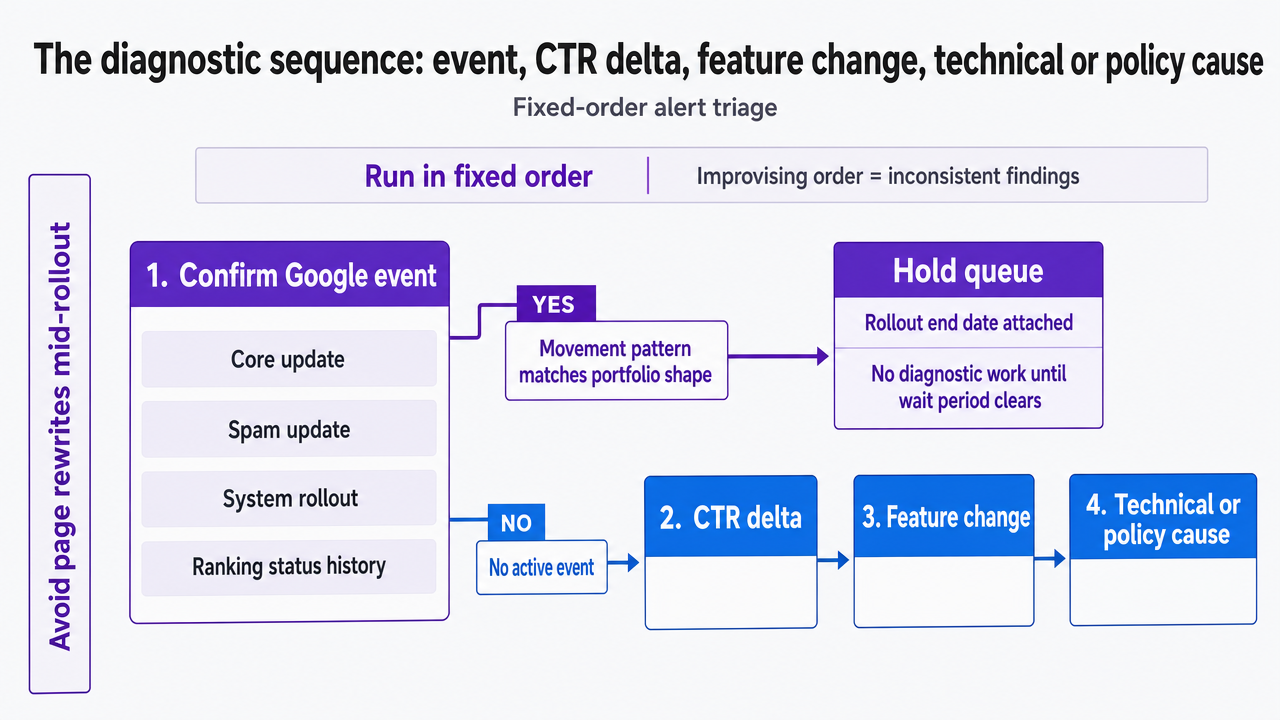 Show the fixed-order triage sequence described in the section as a linear decision flow, so readers can see the exact order alerts should be diagnosed in
When to rewrite, when to hold, when to escalate to the client
The output of the diagnostic sequence is one of three decisions, and each one carries a different client-communication load. Getting the mapping wrong is what damages retention, not the underlying ranking movement.
- Hold applies when a confirmed Google event is active and the account's movement matches the portfolio pattern. The client message is a dated note explaining the rollout, the expected analysis date, and the reason mid-rollout work would compound the loss 5. No rewrite. No emergency call. The tracker's event overlay is the artifact that makes this credible rather than evasive.
- Rewrite applies when the diagnostic isolates a CTR delta with no active event and no new SERP feature, and the snippet or intent audit finds a specific gap 2. Query reformulation research shows that downstream user behavior on the SERP shapes future click patterns, so title, meta, and on-page intent alignment are the levers that actually move CTR back toward curve 12. Rewrite decisions do not need client escalation before they run; they need documentation after.
- Escalation applies when the cause is layout, paid encroachment, or a technical or policy issue the client controls. New AI Overviews or ad expansion on a money query is a market condition to brief the client on directly, because the response is strategic and often cross-channel rather than a page-level fix 3, 10. Technical or policy causes escalate immediately because remediation depends on client-side access. Each escalation carries the tracker's dated evidence with it, which is what turns a bad-news call into a defensible one.
See How Leading Agencies Use SERP Tracking to Sustain Client Rankings at Scale
Learn how enterprise-grade SERP monitoring workflows help agencies detect ranking shifts early, quantify impact, and standardize reporting—without expanding specialist teams or losing control over quality.
If you supervise a portfolio: codifying triage to raise accounts per analyst
This section shifts scope from single-account diagnostics to the operator running a book of 40 to 200 domains. The economics of that role are not measured in rankings recovered. They are measured in analyst hours per account per week, and in how many accounts one experienced analyst can supervise before the next hire becomes unavoidable.
The lever is codification. When triage rules live in a shared protocol rather than in each analyst's head, the same alert produces the same decision regardless of who opens it, and low-value work stops reaching the queue at all. The table below models the weekly hours per account under two operating modes, using agency-supplied inputs rather than sourced benchmarks. The variables are illustrative and meant to be replaced with each team's own timing data.
| Weekly workflow per account | Manual monitoring | Codified triage |
|---|---|---|
| Daily rank review | 2.5 hrs | 0.5 hrs |
| CTR-vs-expected check | 1.5 hrs | 0.25 hrs |
| SERP feature audit | 1.0 hrs | 0.25 hrs |
| Core-update triage | 2.0 hrs | 0.5 hrs |
| Client reporting prep | 1.5 hrs | 0.75 hrs |
| Total hrs/account/week | 8.5 | 2.25 |
Two inputs drive the compression. Revenue-weighted alert thresholds cut the volume of movements that reach a human at all, which is the only sustainable response to hourly Search Console data feeding a portfolio of dozens of accounts 9. And a fixed diagnostic sequence, running event correlation before CTR delta before feature check before technical audit, removes the improvisation that inflates ticket time and produces inconsistent QBR narratives 5, 2.
The supervisory outcome follows directly. An analyst with 40 hours of client-facing capacity a week supervises roughly five accounts under the manual pattern and closer to eighteen under the codified one, before quality degrades. The next hire moves from a function of client count to a function of portfolio revenue exposure, which is the number a Head of SEO can actually defend to a CFO.
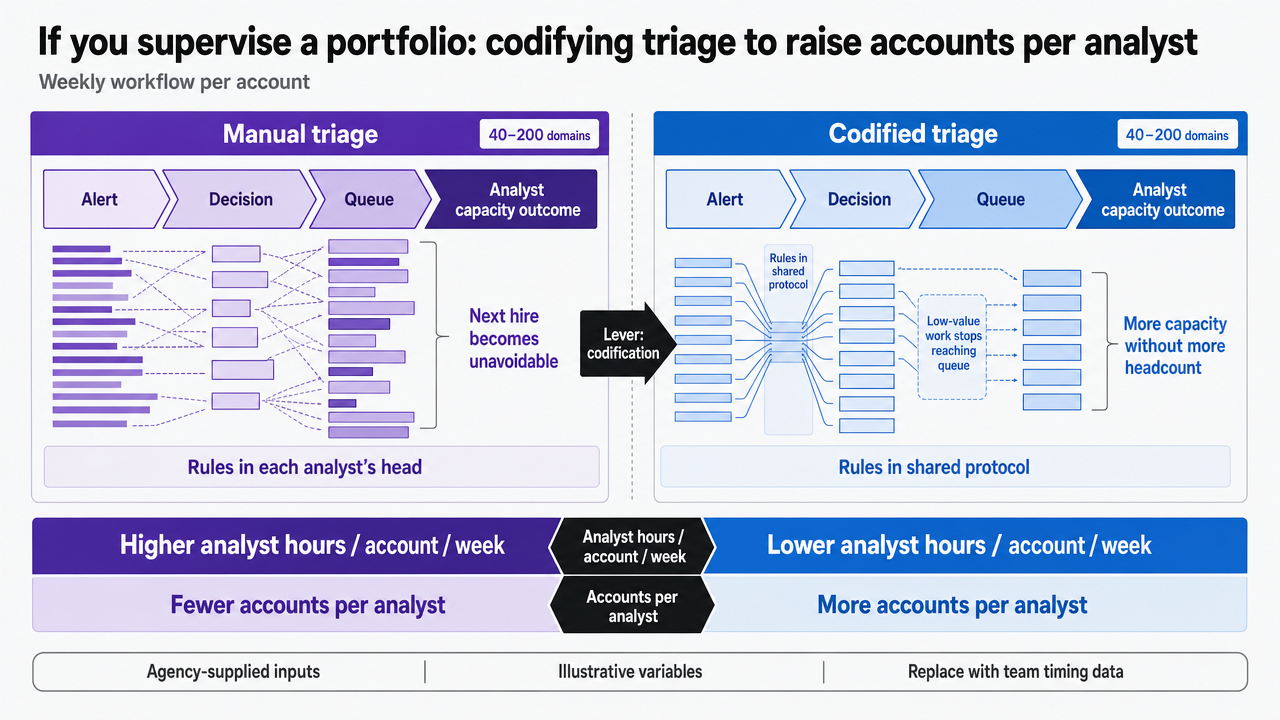 Turn the article's manual-vs-codified weekly hours table into a clean side-by-side comparison visual so the operating-model contrast is immediately legible
Reporting that survives a core update
The report a client reads two weeks after a rollout is where retention is either earned or lost. A monthly deck built on isolated keyword swings falls apart the moment a CMO asks why one term dropped four positions while three others improved. A deck built on aggregate visibility, dated event overlays, and CTR-versus-expected trend lines answers the question before it is asked.
Three artifacts do most of the work.
- A portfolio visibility trend annotated with confirmed Google events shows which movements coincided with a March or May 2026 core rollout and which did not 6.
- A CTR-delta view separates rankings being hollowed out by layout changes from rankings that recovered on their own once the rollout stabilized 2, 4.
- A dated technical and policy checklist confirms that eligibility issues were ruled out before any narrative about algorithmic impact was written 7, 8.
The report that survives a core update is the one that tells the client what was waited on, what was diagnosed, and what was rewritten, with the evidence attached in the order the tracker produced it 5. That sequence is the credibility, not the recovery number.
Frequently Asked Questions
References
- 1.Click-Through Rate from Search Analysis.
- 2.Click-Through Rate (CTR) from Search - Marketing Analysis.
- 3.The cannibalization of organic search.
- 4.Google pushes organic results further down: Here's everything publishers should know.
- 5.Google Search's Core Updates.
- 6.History for Ranking | Google Search Status Dashboard.
- 7.Search Engine Optimization (SEO) Starter Guide.
- 8.Google Search Essentials (formerly Webmaster Guidelines).
- 9.An improved way to view your recent performance data in Search Console.
- 10.Analyzing the Relationship Between Organic and Sponsored Search Results.
- 11.Device-dependent click-through rate estimation in Google organic search results.
- 12.Identification of Factors Predicting ClickThrough in Web Search Results.