
Key Takeaways
- Crawl and index governance separates infrastructure drift, directive changes, and coverage shifts into distinct queues so strategists triage 20-client Mondays instead of auditing one property.
- Duplication control at portfolio scale is a consolidation decision engine that groups near-duplicates, scores local signal density, and proposes merge verdicts before review.
- Structured data functions as a contract with three enforceable clauses — type integrity, attribution consistency, and freshness alignment — grouped by template so one regression becomes one ticket.
- Page experience findings only warrant sprint work when tied to conversion-weighted URLs, template-wide regressions, third-party script bloat, or field-versus-lab divergence worth strategist interpretation.
- Accessibility coverage requires two queues — continuous automated scans and scheduled hybrid audits — because Section508.gov treats both as necessary for WCAG 2.1 AA conformance 4, 7.
- Security and transport integrity convert scanning into triage by cross-referencing the CISA KEV catalog 5and enforcing NIST TLS baselines 3with CISA remediation windows 1.
- Privacy surface checks continuously inventory tags, forms, third-party scripts, and storage writes, framing each as a data-processing activity under NIST Privacy Framework 1.1 6.
- Unified measurement and approval workflow give every finding identical metadata and a documented sign-off path, turning six dashboards into one ledger of approved changes and KPI deltas.
Why Portfolio-Scale Audits Need a Different Blueprint
A site checker that works for one flagship site rarely survives contact with a portfolio of 40 or 150. The signals it produces are the same — crawl coverage, canonical integrity, schema validity, page experience, accessibility conformance, security posture, measurement fidelity — but the operating problem changes. At portfolio scale, the constraint is not detection. It is deciding which of thousands of findings deserves a strategist's hour this week, which client gets an escalation call, and which items batch into next month's report.
Agency leads managing regulated verticals face a sharper version of this. A missed TLS misconfiguration on a legal client's intake page, an unlabeled analytics tag firing on a behavioral health form, or a WCAG failure on a municipal contractor's site each carry consequences that a generic SEO scorecard will not surface. Federal frameworks — CISA's remediation guidance 1, NIST's TLS specifications 3, DOJ's ADA web guidance 9, and NIST Privacy Framework 1.1 6— supply the severity language that ranking these findings requires.
The seven features that follow are framed as operating capabilities, not checklist categories. Each one answers a specific question: what does this signal decide for the agency, and how does it become approved, tracked work across dozens of client sites?
Crawl and Index Governance Across the Portfolio
Crawl and index coverage is the first place portfolio scale exposes a weak site checker. On a single flagship site, a technical SEO can eyeball log samples, spot-check robots.txt, and reconcile Search Console coverage reports in an afternoon. Across 80 client properties running on six CMS platforms, three CDNs, and a rotating cast of developer teams, that same reconciliation becomes the bottleneck that decides whether a strategist ships remediation work this week or next quarter.
The governance question is narrower than the underlying SEO concept. It is not "can Googlebot reach these URLs" — it is which client's coverage delta this week represents an intentional deployment, a template regression, or a hosting-layer incident that warrants a same-day escalation. A portfolio-grade checker separates those three cases automatically. It baselines each site's expected indexable footprint, flags directional shifts against that baseline, and attributes the change to a specific pattern: a noindex added to a paginated series, a Disallow rule broadened during a staging push, a canonical rewrite that consolidated a product family, or a CDN edge rule now returning 403 to Googlebot's user agent.
Three signal classes deserve dedicated queues:
- Server-response drift — spikes in 5xx, unexpected 301 chains, or soft 404s — gets escalated because it usually indicates infrastructure the client's IT vendor controls, not the agency.
- Directive drift — changes to
robots.txt,X-Robots-Tagheaders, meta robots, or sitemap composition — gets diffed against the last approved state and routed to the strategist who owns that client. - Coverage drift — the delta between submitted, discovered, and indexed URLs — is trended, not alerted, because week-to-week noise obscures the signal.
The operational payoff is triage speed. When a site checker groups findings by attribution class rather than by URL, a strategist governing 20 clients can clear a Monday queue in the time it used to take to audit one property.
Duplication Control as a Consolidation Decision Engine
Duplication at portfolio scale is rarely a canonical tag problem. It is a decision problem: which of the four variants of a service-area page should survive, which should redirect, and which should stay as intentional near-duplicates because the client's local footprint requires it. A site checker that only flags "duplicate content detected" hands that decision back to the strategist. A checker built for consolidation work makes the decision defensible before the strategist opens the file.
Three patterns dominate the finding queue for agencies running multi-location and templated-content clients:
- Programmatic near-duplicates — dental practice location pages, personal injury attorney city pages, home services ZIP-code landing pages — where 90% of the DOM is shared and the differentiator is a phone number and a map embed.
- Faceted and parameter drift — session IDs, tracking parameters, filter combinations, and pagination variants that a CMS or third-party plugin generates without canonical consolidation.
- Cross-client cannibalization on shared templates, where an agency's own boilerplate service copy has propagated across a vertical and is now competing with itself in the SERP.
Each pattern demands a different consolidation verdict. Programmatic pages get scored on unique local signal density — reviews, embedded schema variance, staff bios, service-area copy — and either kept, merged into hub-and-spoke, or 301'd to the parent. Parameter drift gets resolved at the directive layer with rel=canonical, parameter handling rules, or crawler exclusions, not by rewriting content. Boilerplate propagation gets flagged back to the content team as a template refresh, not a per-URL fix.
The operational win is that a consolidation-aware checker delivers a ranked recommendation, not a list. A strategist reviewing 300 flagged URLs across a DSO client can approve a merge plan in one sitting because the checker has already grouped, scored, and proposed the verdict for each cluster.
Start optimizing real client sites today risk-free
Experience full-scale SEO execution and measure impact on live projects before committing.
Structured Data as a Contract, Not a Checkbox
Most site checkers treat schema markup as a validator problem: does the JSON-LD parse, does it match the type definition, does the rich result test light up green. For portfolio operators, that framing misses the actual liability. Structured data is a contract between the client's site and the search engines that consume it — and when a template ships broken schema across 60 dental practice location pages, the agency owns the ranking loss and the remediation clock.
The contract has three enforceable clauses:
- Type integrity confirms that the entity declared matches the entity rendered — a
LocalBusinesswithout a validaddressandgeois not a local business to Google, regardless of how the DOM presents it. - Attribution consistency verifies that
Organization,Person, andProductnodes reference the same canonical identifiers across every page they appear on, because a mismatchedsameAsarray across 200 attorney bio pages fragments the knowledge graph signal the client is paying for. - Freshness alignment checks that
datePublished,priceValidUntil,availability, andEventdates reflect the current state of the page, since stale schema is a common trigger for rich result suppression.
A portfolio-grade checker groups schema findings by template, not by URL. When a single component regression breaks FAQPage markup across an entire content type, the strategist sees one ticket routed to the development team — not 340 duplicate warnings that obscure the fix. That grouping is what converts schema monitoring from a validator readout into a defensible change of record the agency can present to the client.
Page Experience Signals That Trigger Sprint Work
Page experience findings pile up faster than any other category in a portfolio checker, and most of them do not deserve a strategist's attention. Largest Contentful Paint drifted 200ms on a client's blog archive. Cumulative Layout Shift regressed on a template used by four of 60 pages. Interaction to Next Paint variance widened on a device class that represents 3% of traffic. A checker that surfaces all of it with equal weight buries the two findings per week that actually warrant a sprint ticket.
The triage question is which pages, on which devices, are underperforming against a threshold that maps to revenue. For a personal injury firm, that is the intake landing page on mid-tier Android over 4G. For a DSO, it is the location page on iOS Safari. For a home services client, it is the quote form under third-party chat and review widgets. A portfolio checker earns its keep by scoring findings against each client's own conversion-weighted URL set, not against a global corpus of tested pages.
Three signal patterns should route directly to development sprints:
- Template-wide regressions, where a shared component pushed LCP or CLS past threshold across an entire page type, get one ticket with the offending commit or plugin update named.
- Third-party script bloat — tag manager containers, chat widgets, session recorders, A/B testing snippets — gets diffed against the last approved tag inventory and flagged when render-blocking behavior appears.
- Field-versus-lab divergence, where CrUX data disagrees with synthetic runs, gets held for strategist interpretation because it usually indicates a caching, geography, or user-population issue that a scripted fix will not resolve.
The rest becomes a monthly trend line in the client report, not a Monday alert.
Accessibility Coverage That Survives Legal Scrutiny
Accessibility is the category where a portfolio checker's limits become a legal exposure question. The U.S. Department of Justice identifies WCAG 2.1 Level AA as the technical standard for state and local government web content and mobile apps under its Title II rule 7, and any agency serving public entities, healthcare systems, senior living operators, or municipal contractors inherits that standard through the client relationship. The DOJ's broader web accessibility guidance names keyboard navigation, meaningful text alternatives, captions, accessible forms, headings, and sufficient contrast as the practical measures a site must support 9— most of which an automated crawler can only partially verify.
Section508.gov is explicit on this point. Conformance validation uses three methods — automated, manual, and hybrid — and the framework treats each as necessary for different question classes 4. Automated scans reliably catch missing alt attributes, empty form labels, insufficient color contrast ratios, missing document language, and heading-order regressions. They cannot confirm whether alternative text is meaningful, whether a custom widget announces its state to a screen reader, whether keyboard focus order matches visual reading order, or whether a modal traps focus correctly. Those questions require manual inspection with assistive technology. Hybrid testing combines both: automation handles portfolio-wide coverage and regression detection, and human review handles the interaction, semantic, and AT-compatibility findings that decide whether a client's page is actually usable.
For a portfolio checker, the operational consequence is that accessibility findings need two queues, not one. The automated queue runs continuously across every client site and catches regressions the moment a template ships them — a redesigned CTA button that drops its accessible name, a new form component that omits label associations, a hero image treatment that pushes contrast below the 4.5:1 threshold. The hybrid queue is scheduled work: quarterly or per-release manual audits on the pages that carry legal weight for the client, which usually means intake forms, appointment scheduling, patient portals, service-request flows, and any page a covered entity relies on to deliver a public-facing program.
Attribution matters here as much as detection. When an automated scan flags 1,200 contrast failures across a client's blog archive, the strategist needs to know that 1,100 of them trace to a single deprecated theme class — one development ticket, not 1,200. And when a manual audit surfaces a keyboard trap on a scheduling widget, the finding routes to the third-party vendor that owns the component, with the WCAG success criterion named in the ticket so the client's legal counsel has a defensible record of the request.
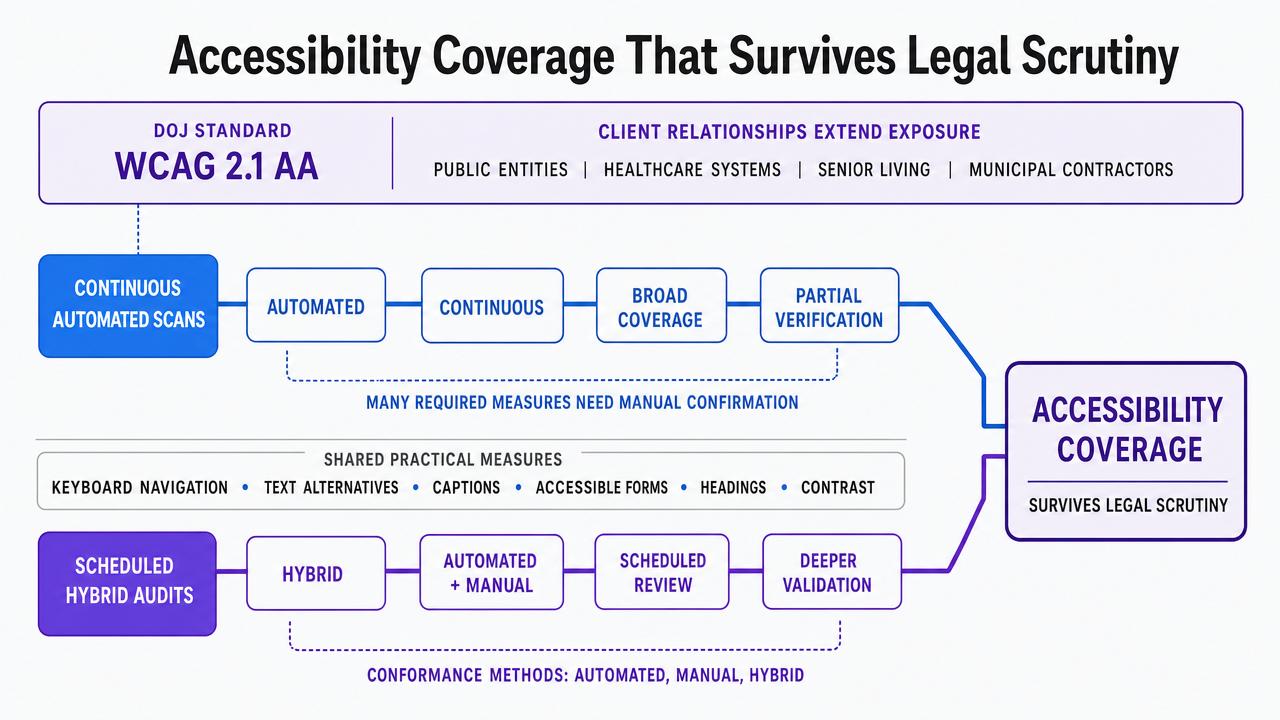 Illustrate the two-queue accessibility workflow (automated continuous scans vs. scheduled hybrid audits) grounded in Section508.gov's automated/manual/hybrid conformance methods and the DOJ WCAG 2.1 AA standard cited in the section
See How Leading Agencies Leverage Site Checker SEO Features for Scalable Client Results
Request a walkthrough of advanced SEO automation workflows proven to reduce manual audits and accelerate quality assurance for high-volume client portfolios.
Security and Transport Integrity at Client Scale
Security is the category where a site checker stops being an SEO tool and starts being a liability control. Ranking loss from a defaced page, a browser warning on a checkout flow, or an expired certificate on a client's intake form arrives faster than any algorithm update. For agencies managing regulated verticals, the checker's job is to convert continuous scanning into a triage queue that names the client, the asset, the exposure, and the deadline — not a monthly PDF listing every open port.
Two capabilities carry most of the weight at portfolio scale. The first is vulnerability triage that maps discovered software, plugins, and dependencies against an authoritative exploitation feed so the strategist knows which findings deserve a same-day call. The second is continuous transport-layer monitoring that catches certificate expiration, protocol drift, and cipher regressions before a browser does. Both work only when the checker treats federal guidance as the severity dictionary — CISA remediation windows 1, NIST TLS specifications 3, and CISA's HTTPS and HSTS baseline 2— rather than inventing its own scoring model.
Vulnerability Triage Against the KEV Catalog
A portfolio checker that reports every CVE it fingerprints buries the strategist in noise. The signal that matters is the intersection between what a client site is actually running and what attackers are actively exploiting. CISA maintains the Known Exploited Vulnerabilities Catalog as the authoritative source of vulnerabilities exploited in the wild and publishes it in CSV and JSON for automated ingestion 5. A checker that pulls the KEV feed and cross-references it against detected CMS versions, plugin manifests, and JavaScript dependencies converts a scanner's raw output into a ranked escalation list.
Severity alone does not set the clock. CISA recommends remediating critical vulnerabilities within 15 days and high vulnerabilities within 30 days on internet-accessible systems 1. Those windows give agencies a defensible SLA to attach to every finding a client sees, and they map cleanly onto a portfolio workflow: KEV-listed matches trigger the 15-day queue with an auto-escalation to the client's technical contact, high-severity findings without KEV confirmation enter the 30-day queue for the next sprint, and medium and low findings batch into the monthly report. The chart below operationalizes those windows as an agency remediation queue.
TLS, HSTS, and Configuration Drift Monitoring
Certificate presence is the easy check. Configuration parity across 60 client hosts is the one that fails silently. NIST SP 800-52 Rev. 2 specifies TLS 1.2 with approved cipher suites as the baseline and requires support for TLS 1.3 in covered environments 3, and CISA's web security guidance calls for HTTPS-only delivery with HSTS while explicitly directing operators to disable SSLv2, SSLv3, 3DES, and RC4 2. A portfolio checker enforces those specifications as a continuous diff, not a one-time scan.
Four monitoring surfaces belong in the queue:
- Certificate expiration windows trigger at 30, 14, and 7 days out with the responsible party named per client.
- Protocol and cipher regressions get flagged when a hosting provider rolls back a configuration during maintenance.
- HSTS header drift catches the common failure mode of a redirect chain that downgrades to HTTP on a subdomain the client added last quarter.
- Redirect consistency verifies that every entry point — apex, www, marketing subdomains, tracking hostnames — terminates at the canonical HTTPS origin.
The infographic below consolidates the transport-security specification into a single reference card.
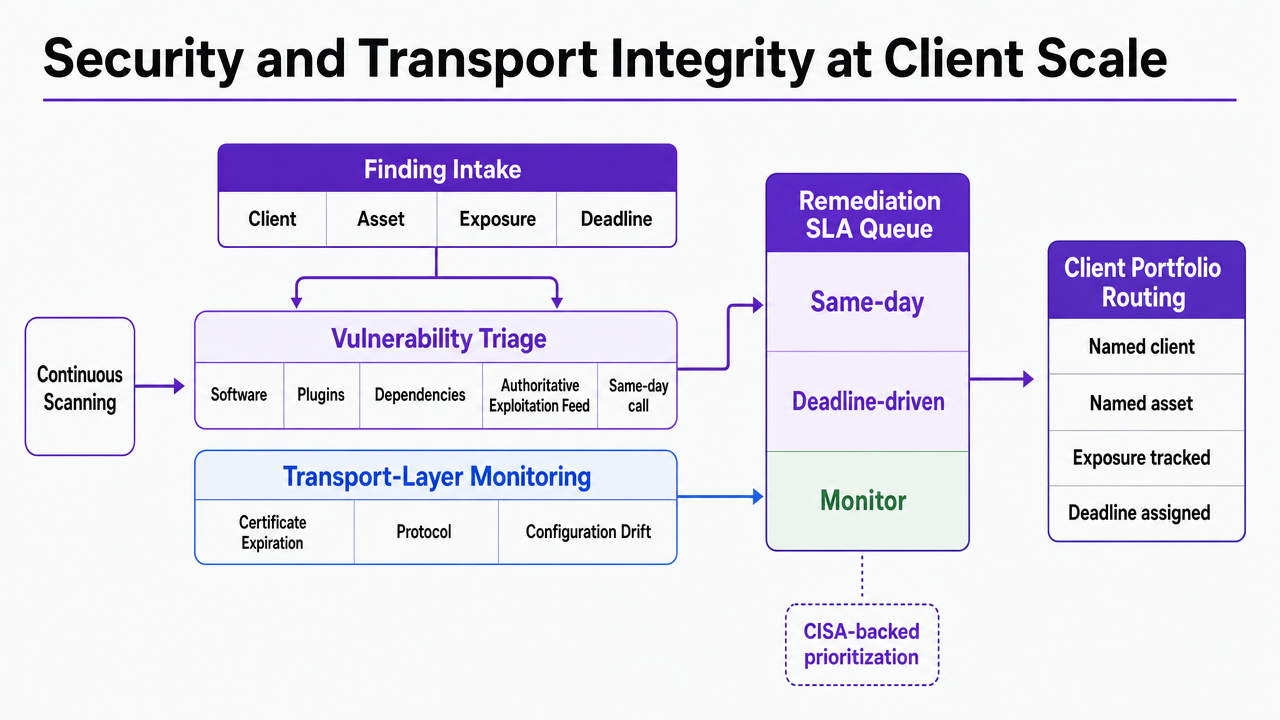 Visualize the CISA-backed remediation SLA queue that structures how findings are routed and prioritized across a client portfolio, directly supporting the numbers cited in this section
Privacy Surface Checks for Tags, Forms, and Third-Party Scripts
Privacy exposure lives in the places SEO audits usually skip: the tag manager container, the call-tracking snippet on the intake form, the chat widget that loads a session recorder, the pixel a media buyer added last quarter without telling the strategist. Each one is a data-processing activity, and NIST's Privacy Framework 1.1 frames the operator's job as identifying those activities, mapping their privacy risks, and prioritizing actions to close the gaps against a target profile 6. A portfolio site checker earns its place in that workflow by making the inventory continuous instead of quarterly.
Four surfaces belong in the scan:
- Tag inventories are diffed against the last approved container state so a new pixel appearing on a behavioral health confirmation page triggers a review before it fires in production.
- Form fields are inspected for the data categories they collect — email, phone, date of birth, health status, matter type — and matched against the consent language actually rendered on the same page.
- Third-party script origins are enumerated per template, because a chat widget loading from a vendor the client never contracted with is a governance failure a strategist needs to see.
- Cookie and storage writes are logged per origin so the checker can flag first-party analytics behaving as third-party trackers after a CDN change.
Grouping matters here as much as detection. When a single tag manager change propagates a new pixel across 40 client sites in a vertical, the checker routes one approval request to the account lead — not 40 duplicate privacy warnings that dilute the signal.
Unified Measurement and the Approval Workflow
The seventh feature is the one that separates a site checker from an operating platform. Crawl governance, duplication control, schema contracts, page experience triage, accessibility coverage, security triage, and privacy inventories all produce findings. Without a unified measurement layer and an approval workflow attached to each finding, those signals become six dashboards the strategist reconciles by hand every Monday morning.
Unified measurement means every finding carries the same metadata regardless of which module produced it: client, asset, severity, source authority, proposed remediation, and the KPI the change is expected to move. A KEV-matched CVE 5and a schema regression on a location template land in the same queue with the same shape, which is what lets a strategist governing dozens of properties triage across categories in a single pass. It also gives the client report a single source of truth — one ledger of what was found, what was approved, what shipped, and what moved — rather than seven exports stapled together at the end of the month.
The approval workflow is the second half of the mechanism. Automation handles detection, grouping, attribution, and remediation drafting continuously across the portfolio. Human judgment handles the sign-off on any change that touches a client's live site. That division is what makes portfolio scale defensible: the strategist stops writing tickets and starts approving them, and every approved change becomes a timestamped record the agency can point to when a client asks why a template shipped, why a tag was removed, or why a redirect chain changed last Thursday.
From Finding to Approved Change of Record
A finding becomes a change of record when four things happen in order:
- The checker detects and attributes the issue.
- The strategist reviews the proposed remediation against client context.
- The client approves the change through a documented channel.
- The execution layer ships it with the KPI baseline captured.
Skip any step and the audit trail breaks — which matters most in regulated verticals where a client's legal or compliance team may need to reconstruct exactly what changed on which date and who signed off.
The measurement layer closes the loop. Every approved change stamps a before-state on the affected URLs, tracks the intended KPI (organic sessions, indexed URL count, CLS distribution, contrast pass rate, KEV exposure count), and reports the delta against that baseline on a fixed cadence. Findings that never got approved stay in the queue with the reason logged. Findings that shipped but did not move the KPI get flagged for strategist review, because a change that produced no measurable effect is either mis-scoped or masked by a larger regression the checker has not yet caught.
If you manage a growing portfolio: strategist-to-site ratios
The scope shifts here from single-client audit workflow to portfolio economics. The question a Head of SEO faces at 40, 80, or 150 client sites is how many properties one strategist can realistically govern before quality erodes, and the answer is a function of how much of the finding-to-approval path is automated versus manual.
When detection, attribution, grouping, and remediation drafting run automatically across every module — crawl, duplication, schema, page experience, accessibility, security, privacy — the strategist's remaining work compresses to review and approval. That is where platforms like Vectoron fit: specialist strategists surface ranked recommendations through a Command Center, and every recommendation routes for human sign-off before execution. The ratio a Head of SEO can defend to a CFO is not a fabricated headcount number — it is the observed throughput of approvals per strategist per week, measured on the agency's own portfolio and reported alongside the KPI deltas the approved work produced.
Frequently Asked Questions
References
- 1.Website Security.
- 2.CISA Insights - Enhance Email & Web Security.
- 3.SP 800-52 Rev. 2, Guidelines for the Selection, Configuration, and Use of Transport Layer Security (TLS) Implementations.
- 4.Validate Rulesets.
- 5.Known Exploited Vulnerabilities Catalog.
- 6.Using Privacy Framework 1.1.
- 7.Accessibility of Web Content and Mobile Apps Provided by State and Local Government Entities.
- 8.Guidelines on Securing Public Web Servers.
- 9.Guidance on Web Accessibility and the ADA.
- 10.Securing Web Transactions: TLS Server Certificate Management.