
Key Takeaways
- Treat the site as a revenue operating system where performance, trust, accessibility, compliant persuasion, and measurement run as one continuous loop rather than separate quarterly vendor projects.
- Rank optimisation work by the revenue weight of each template, not audit severity, and measure field performance on booking and service pages where tenth-of-a-second deltas move funnel math 1.
- Audit the top twenty revenue pages against named authorship, currency, disclosure, owner authority, and substantiation, since trust artifacts regress constantly and directly predict intention to act 11.
- Consolidate specialist execution under one ranked backlog and single approval workflow, so change throughput is capped by the VP's approval capacity rather than vendor handoff latency.
The Site as a Revenue Operating System, Not an SEO Project
The question VPs keep getting from their boards is not whether site optimisation works. It is whether it still works enough to defend the line item against paid media, AI-assisted search experiments, and whatever the sales team wants next quarter. That framing is the problem. It treats the site as a channel, and channels can be cut. The site is not a channel. It is where every other channel either converts or dies.
The research base supports a wider lens than keyword rankings or template redesigns. Mobile speed changes correlate with funnel progression and order value across retail, travel, and lead-generation sites 1. Trust cues such as clear layout, author expertise, and visible owner authority show up repeatedly in peer-reviewed credibility research as predictors of intent to act 10. Accessibility gaps persist even inside organisations with formal mandates and dedicated digital teams, which means they almost certainly persist inside leaner marketing orgs too 4. And interface design that crosses the line from persuasion into manipulation now carries documented enforcement attention from the FTC 14.
Pulled together, those strands describe something more useful than an SEO workstream. They describe a revenue operating system: performance, trust, accessibility, compliant persuasion, and measurement running as one continuous loop rather than as separate vendor contracts that touch the site once a quarter. The sections that follow examine each layer on its own evidence, then return to what that means for how a marketing VP structures the work, the team, and the budget conversation.
Performance: Where Milliseconds Convert to Pipeline
Performance is the layer where the revenue argument is easiest to defend because the measurement is unambiguous. Pages either load in time for the visitor to act, or they do not. The commercial consequence shows up in the funnel within the same session.
The most-cited evidence remains Deloitte's Milliseconds Make Millions analysis, which examined mobile-speed changes across 37 brand sites in retail, travel, luxury, and lead generation over a four-week window and was commissioned by Google. A 0.1-second mobile-speed improvement was associated with retail conversions rising 8.4%, travel conversions rising 10.1%, and retail average order value rising 9.2% 1. Those are correlations across real commercial data, not controlled lifts attributable to speed alone, and the sample skews toward large brands with the engineering capacity to measure at that resolution. The directional signal is still useful: on sites where mobile traffic drives revenue, tenth-of-a-second deltas sit inside the range that moves funnel math.
The U.S. Web Design System reaches a similar conclusion from an independent, public-sector vantage point, stating that performance influences conversion rate and that studies have shown performance improvements consistently improve conversion rates across a wide range of applications 12. For a VP being asked why the engineering backlog should include render-time work, two separate evidence streams—one commercial, one governmental—pointing in the same direction is a stronger case than either source alone.
The operational implication is where most teams lose the thread. Lab scores on a staging environment do not predict revenue. Field performance on the specific templates that carry commercial intent does. For a multi-location service business, that usually means the location landing pages, the provider or service-detail pages, and the contact or booking flow—not the homepage that gets the most pride and the least qualified traffic. Segment real-user metrics by template and by device class, then rank remediation by the revenue weight of the page, not by the severity of the Lighthouse warning. A 400ms improvement on a booking page in the 75th-percentile mobile cohort will outperform a 2-second improvement on a press-release archive every quarter.
Performance work also has a half-life. Third-party tags, consent scripts, new hero media, and framework upgrades regress the baseline between quarterly audits. Treating performance as a quarterly project produces a sawtooth graph; treating it as a monitored input with an owner, a budget, and a rollback trigger produces a floor. The budget argument writes itself when the dashboard shows template-level load time plotted against template-level qualified lead rate on the same axis.
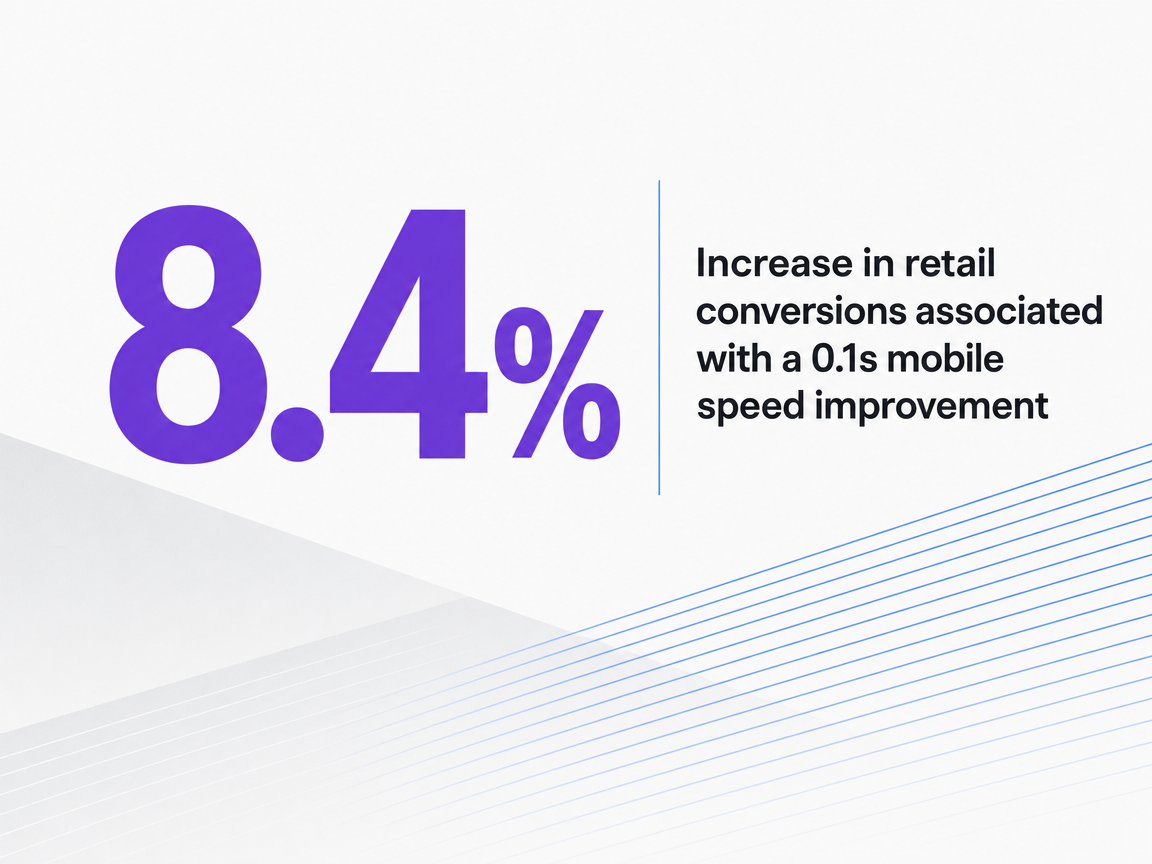 Increase in retail conversions associated with a 0.1s mobile speed improvement
Increase in retail conversions associated with a 0.1s mobile speed improvement
Trust, Credibility, and the Content Layer That Actually Converts
Performance gets a visitor to the page. Trust decides whether they fill out the form. For high-stakes service verticals, trust is not a brand attribute measured in surveys; it is a measurable input into the conversion math on the pages that carry revenue.
The peer-reviewed evidence is unusually consistent on which cues matter. A systematic review of web-based health information identified clear layout, visible owner authority, author expertise, interactive features, contact details, and content quality as recurring predictors of trust and credibility, with advertising showing a negative association 10. A separate meta-analysis of health website credibility named authorship, content currency, usefulness, disclosure, user support, and privacy as the design principles that most reliably support credibility judgments 9. These are not aesthetic choices. They are the specific elements a VP can audit on a provider bio page, a service-detail page, or an intake form and ask whether they are present, accurate, and current.
How much of real revenue behavior do these models actually explain? More than most CRO decks assume. A revised trust model built on data from online health-information users found that trust had a significant direct effect on intention to act, with a standardized β of 0.59, and that credibility and impartiality were the strongest direct predictors of trust itself 11. The data were collected in 2015 and self-reported, so the coefficient should be read as a design hypothesis rather than a conversion benchmark, but the direction is clear: credible authorship and impartial presentation move stated intent, not just perception. Two commercial studies push the point further. A survey of 350 Alibaba users modelled culture, usability, trust, and intention; in the European subsample, the full model explained roughly 76% of variance in online purchase behavior, with trust predicting intention at β = 0.54 6. A study of 789 Chinese online shoppers found that electronic word of mouth influenced purchase intention at a coefficient of 0.47, with website-quality dimensions feeding both eWOM and intention 7. Both samples are geographically bounded and survey-based, so neither generalises to every market, but together they describe trust and website quality as inputs that explain a non-trivial share of the behavior VPs are trying to produce.
The operational translation is specific. On a legal, behavioral-health, dental, or senior-living site, the pages that convert carry a short list of trust artifacts: a named author or clinician with real credentials, a last-reviewed date, a visible owner or ownership structure, contact information that is not buried behind a form, and claims that are substantiated rather than asserted. Review widgets and testimonials belong in this layer too, which is why the FTC's guidance on endorsements and material connections is a conversion constraint, not a legal footnote 13. A testimonial carousel assembled from unverified or incentivised sources is not a trust cue; it is a liability wearing the costume of one.
The budget argument that follows is less about adding content and more about assigning ownership. Trust artifacts regress the same way performance does. Bios go stale, credentials change, review feeds break, disclosures fall out of date after a service-line change. A quarterly audit of the top twenty revenue pages against the trust checklist derived from these reviews—authorship, currency, disclosure, contact, owner authority, substantiation—will typically find more missing elements than any single redesign would have caught, and each gap closed is a direct input to the intention-to-act math.
Test Revenue Impact of Full-Site Optimisation Now
Experience measurable site performance gains on live campaigns before making a long-term commitment.
Accessibility as a Discoverability and Revenue Lever
Accessibility sits in most marketing budgets as a legal line item owned by someone else. That framing understates what it does to revenue. The same work that makes a page usable for a screen reader—semantic headings, descriptive link text, labeled form fields, sufficient contrast, keyboard-navigable flows—also makes the page easier for search crawlers to parse, easier for voice interfaces to read aloud, and easier for every visitor on a slow connection or a glare-lit phone screen. The Department of Justice's ADA guidance names text alternatives, captions, headings, contrast, and keyboard navigation as the practical features that give users full and equal enjoyment of goods and services, and it points businesses toward WCAG and Section 508 as technical references 2. Those are the same artifacts that determine whether a visitor can complete a booking, read a provider bio, or submit an intake form.
The compliance pressure is real and worth stating briefly. The DOJ's 2024 Title II rule set a technical accessibility standard for state and local government web content and mobile apps, with compliance windows of two or three years depending on population size 3. Private service businesses are not directly covered by Title II, but the rule signals the direction of enforcement expectations and matters for any operator serving public entities, healthcare-adjacent populations, or regulated service lines.
The more useful framing for a marketing VP is operational. The U.S. Government Accountability Office's review of the 21st Century Integrated Digital Experience Act defines a federal site-quality model built on eight characteristics: accessible, consistent, non-duplicative, searchable, encrypted, user-data-driven, customisable, and mobile-friendly 5. Lifted out of its statutory context, that list is a defensible audit lens for commercial sites too. Each characteristic maps to a measurable question. Can every revenue page be reached and completed by keyboard alone? Is navigation consistent across location pages, or does each market run its own template drift? Are duplicate service pages competing for the same query? Can the on-site search surface a provider by name without three refinements? Is form data encrypted and the fact of that encryption visible? Are segments actually used to tailor the experience, or is personalisation a tag that never fired? Is the mobile experience the primary experience, as the traffic mix already assumes?
How hard this is to maintain is worth sitting with. The GSA's FY 2025 Section 508 assessment, drawn from 212 agencies and components, reported that fewer than half of top-viewed government ICT assets were fully conformant with Section 508 standards 4. These are organisations with formal mandates, dedicated accessibility staff, and procurement rules written around the standard. A marketing team with a smaller headcount and quarterly release cycles should expect worse baseline conformance on its highest-traffic templates, not better. The implication is not alarm; it is cadence. Accessibility is a continuous property of a site, like performance, and regresses with every component library update, third-party embed, and new campaign landing page. Running a quarterly audit against the eight-characteristic lens on the top twenty revenue pages tends to find more actionable defects than a one-off remediation project, and each one closed widens the funnel for users and crawlers at the same time.
Compliance-Aware Conversion: Persuasion vs. Dark Patterns
Conversion optimisation and consumer-protection enforcement have been on a collision course for several years, and the collision is now documented. A joint review by the FTC and the International Consumer Protection and Enforcement Network examined 642 subscription websites and mobile apps during a one-week sweep in early 2024 and found that nearly 76% used at least one possible dark pattern, with nearly 67% using multiple 14. The sample was narrow—subscription services, one week, possible rather than adjudicated violations—but the prevalence rate is high enough that a marketing VP should assume at least some of the techniques already live inside their own templates.
The FTC's underlying framework is useful because it draws the line in a place CRO teams can actually operate around. Dark patterns are defined as design choices that obscure, subvert, or impair consumer choice: disguised advertising, buried fees or terms, cancellation flows harder than signup flows, pre-checked consents, and interfaces that pressure data disclosure 15. Reducing friction on a legitimate booking form is not a dark pattern. Making the cancellation path three screens longer than the signup path is. The test is whether the design preserves informed choice, not whether it increases conversion.
Social proof sits in the same zone. The FTC's guidance on endorsements, reviews, and influencers warns operators against writing or procuring fake reviews, paying for favorable rankings on supposedly independent sites, suppressing negative reviews, or omitting material connections between endorsers and the business 13. For legal, dental, behavioral-health, and home-services sites, that guidance has specific template consequences. A testimonial carousel pulling from a review platform needs an auditable provenance trail. Provider rating badges need a disclosed methodology. Case-result claims need substantiation on file before they go on a page, not after a complaint arrives.
The operational shift is to treat compliance review as part of the CRO workflow rather than a gate at the end. Every proposed site change—countdown timer, scarcity badge, pre-selected add-on, consent banner redesign, review widget swap, urgency copy on a booking page—should pass through a short checklist drawn from the FTC frameworks: Does it obscure material information? Does it misrepresent independence or endorsement? Is the exit as easy as the entry? Can every claim be substantiated with a document, not a hope? Variants that fail those questions get killed before testing, which is cheaper than killing them after an inquiry.
Measurement: Closing the Loop Between Site Changes and Qualified Revenue
Every layer discussed so far—performance, trust, accessibility, compliant persuasion—produces defensible revenue arguments only if the measurement model can connect a specific site change to a specific downstream outcome. Most cannot. Dashboards still report sessions, bounce rate, and page-level conversion rate as if those were the same thing as pipeline, and the gap between what gets measured and what actually gets paid for is where site optimisation budgets quietly die.
The academic evidence that justifies optimisation work also warns against reading it too simply. The e-service quality study that explained 55.9% of variation in repurchase intention did so with survey-based structural models, not clickstream data 8, which means the finding supports retention and lifetime-value hypotheses but does not predict that a given button change will produce a given repurchase lift. The USWDS performance guidance makes the same disclaimer from the opposite direction: it summarises prior studies linking speed to conversion and tells teams to validate the relationship on their own highest-value pages through segmented field data and experimentation 12. The honest measurement model treats external evidence as a prior and the site's own data as the posterior.
Three measurement decisions separate a loop that closes from one that does not. First, define the dependent variable as a qualified outcome—booked appointment, intake completed, qualified call, SQL—rather than a form submission. Second, segment real-user data by template and device class so a change on booking pages is not diluted by homepage traffic. Third, hold a change window long enough to clear seasonality and paid-media mix shifts; a two-week test on a legal intake page measures the campaign, not the page. The resulting loop—signal, ranked recommendation, approved change, measured impact on qualified revenue—is what turns site optimisation from a line item into a compounding asset.
Quantify the Revenue Impact of Site Optimisation—See the Data Behind Conversion Gains
Request a tailored analysis showing how optimisation adjustments correlate with pipeline metrics in complex, multi-channel environments. Access benchmarks and actionable insights relevant to enterprise-scale teams managing high-stakes digital properties.
If You Manage Multiple Locations: The Coordination Economics of Site Optimisation
For VPs running multi-location portfolios—dental support organisations, behavioral-health networks, law firm footprints, home-services brands, senior-living operators—the site optimisation argument changes shape. The work does not get harder because the evidence base is different. It gets harder because every finding above has to be executed against a template system shared by twenty, fifty, or two hundred location pages, each with its own provider roster, service mix, local reviews, and intake flow. The coordination cost, not the technical cost, is what quietly consumes the budget.
The default stack reflects that reality. A typical multi-location operator ends up with a separate SEO vendor for local and organic, a CRO consultant for the booking flow, an accessibility auditor contracted annually, a performance engineer or dev shop on retainer, an analytics contractor stitching the reporting together, and an internal team spending a non-trivial share of the week in status meetings. Each vendor touches a slice of the revenue operating system described in the earlier sections. None of them owns the loop. A trust-cue update identified by the content team waits on the SEO vendor's publishing calendar; a performance regression caught by the engineer waits on the CRO team's test window; an accessibility defect flagged by the auditor waits on the next development sprint. The site changes, but the loop does not close.
The useful comparison is not dollar-for-dollar. It is cycle time and approval friction, which are what actually determine how many compounding changes ship per quarter. The variables below are the ones a VP can plug in from their own operations.
| Coordination variable | Siloed vendor stack | Unified execution model |
|---|---|---|
| Vendor relationships to manage | 4–6 (SEO, CRO, accessibility, performance, analytics, local) | 1 |
| Approval cycles per site change | Multiple, sequential across vendors | Single approval loop |
| Average revision latency | Days to weeks per vendor handoff | Within the approval window |
| Status meetings per month | One or more per vendor | Consolidated |
| Ownership of the full loop | Distributed; no single owner | Single ranked backlog |
| Change throughput per location, per quarter | Constrained by slowest vendor | Constrained by approval capacity |
The point is not that specialist expertise does not matter. It does. The point is that distributing that expertise across uncoordinated contracts converts most of the site optimisation budget into coordination overhead, and the compounding evidence from performance, trust, accessibility, and compliant persuasion only shows up on sites where changes actually ship. A unified execution model—specialist capabilities operating against one ranked backlog under one approval workflow—moves the constraint from vendor cycle time to the VP's own capacity to approve. That is the right constraint to have, because it is the only one aligned with the revenue the site is supposed to produce.
A Defensible Operating Model for the Next Budget Cycle
The budget conversation gets easier when site optimisation stops being described as a workstream and starts being described as a system with named inputs, measurable outputs, and an owner. Five inputs carry the evidence base: performance measured on revenue-weighted templates in the field, trust artifacts audited against authorship and currency, accessibility maintained against a stable eight-characteristic lens 5, persuasion engineered inside the lines the FTC has already drawn 15, and measurement defined at the qualified-outcome level rather than the form-submission level. Each input has a regression rate. Each regression rate has a cadence. Each cadence has a cost.
What a VP should defend at the next budget cycle is not a redesign and not an SEO retainer. It is the loop that keeps those five inputs inside tolerance on the twenty or so templates that actually produce booked revenue, ranked by revenue weight rather than by page views. The compounding effect only shows up on sites where approved changes ship on a cadence that outpaces regression, which is why the operating-model question matters as much as the tactical one. Teams that consolidate specialist execution under a single approval workflow spend their budget on changes; teams that distribute it across uncoordinated vendors spend it on coordination. Platforms built for that consolidation, including Vectoron, exist to move the constraint back to the only place a marketing VP should want it: their own capacity to approve the next change.
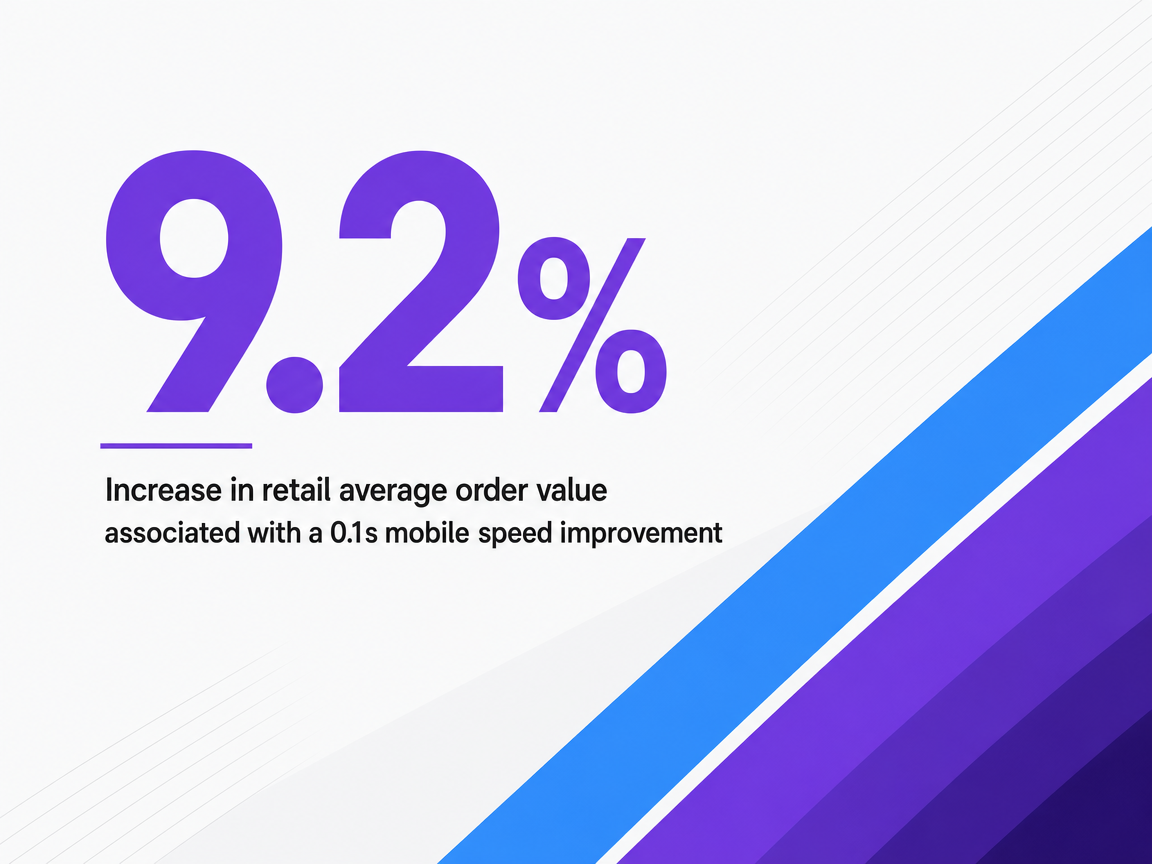 Increase in retail average order value associated with a 0.1s mobile speed improvement
Increase in retail average order value associated with a 0.1s mobile speed improvement
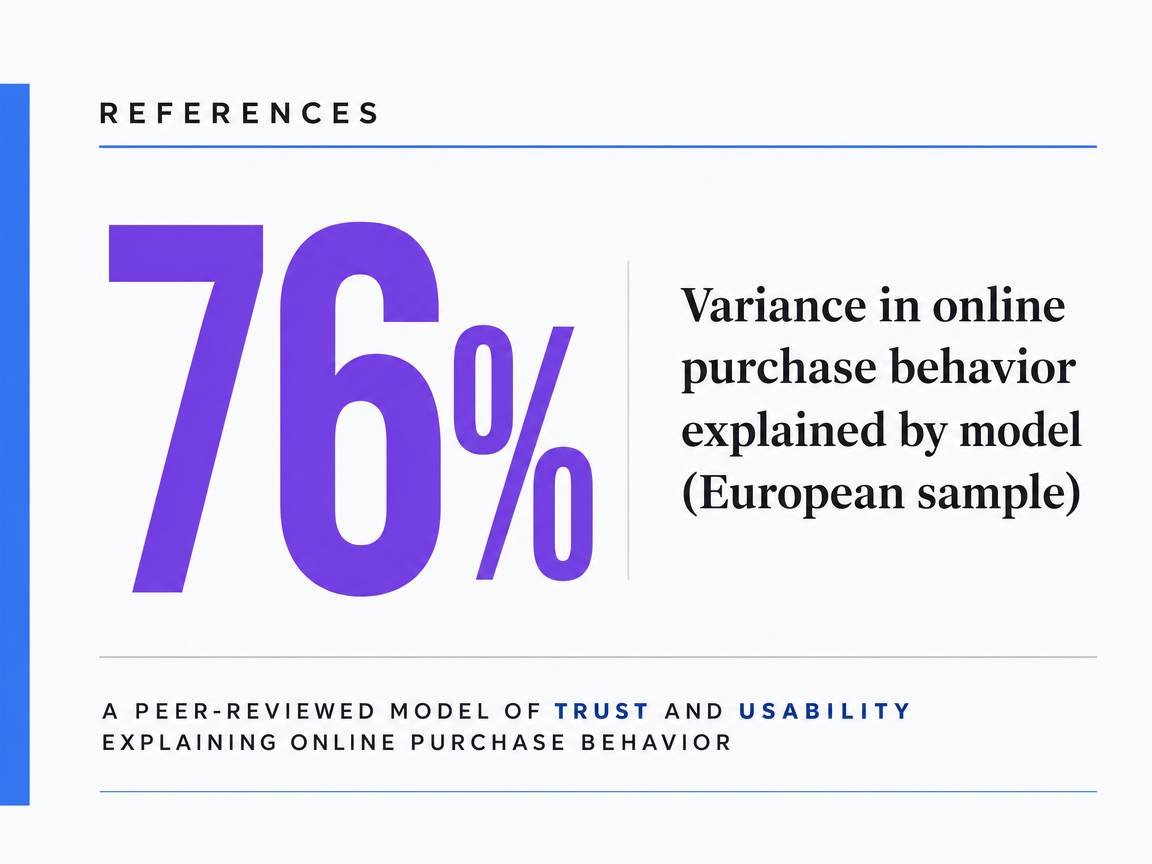 Variance in online purchase behavior explained by model (European sample)
Variance in online purchase behavior explained by model (European sample)
Frequently Asked Questions
References
- 1.Milliseconds Make Millions.
- 2.Guidance on Web Accessibility and the ADA.
- 3.Justice Department's Final Rule to Improve Web and Mobile App Access for People with Disabilities.
- 4.FY 2025 Section 508 Assessment Report—Reading View.
- 5.Digital Experience: Agency Compliance with Statutory Requirements.
- 6.Cultural dimensions in online purchase behavior.
- 7.The impact of website quality on customer satisfaction and purchase intention.
- 8.The impact of e-service quality and customer satisfaction on customer behavior in online shopping.
- 9.Can Patients Trust Online Health Information? A Meta-analysis of the Current State of Research on Health Website Credibility.
- 10.Trust and Credibility in Web-Based Health Information.
- 11.A Revised Model of Trust in Internet-Based Health Information.
- 12.Why track performance | U.S. Web Design System (USWDS).
- 13.Endorsements, Influencers, and Reviews - Federal Trade Commission.
- 14.FTC, ICPEN, GPEN Announce Results of Review of Use of Dark Patterns Affecting Subscription Services and Privacy.
- 15.Bringing Dark Patterns to Light.