
Key Takeaways
- Site optimization compounds revenue only when performance, content, trust, and measurement operate as one coupled system rather than four siloed workstreams with separate vendors and approval gates.
- Each layer maps to a specific pipeline metric: performance filters qualified sessions, content drives assisted conversions, trust lifts form completions, and measurement tightens revenue attribution confidence.
- Trust-layer decisions should be governed against WCAG 2.1 AA accessibility 7, the FTC clear-and-conspicuous disclosure test 5, and the FTC Consumer Reviews and Testimonials Rule 8.
- The decisive constraint is decision-loop latency—cycle time from signal to shipped fix—so focus next on consolidating approvals into one governed queue measured across every change type.
Why Site Optimization Stops Compounding
Most site optimization programs plateau because they are managed as a task queue rather than a system. A quarter's work often appears productive: page speed improvements, new landing pages, updated schema, refreshed testimonials, and CRO tests. However, twelve months later, organic sessions remain flat, form completion rates haven't improved, and the CFO questions why site-driven pipeline isn't compounding as expected, especially when compared to paid media spend.
This pattern is consistent across high-stakes service verticals. Individual tactics are implemented, but the connections between them are often missing. Performance work operates on one team's schedule, content on another's, compliance review on a third's, and measurement changes only occur when a report breaks. Each layer improves in isolation, while the crucial feedback loop that translates a signal into a deployed fix remains stretched.
For a VP reporting revenue-influenced metrics, the core issue isn't tactic selection. It's that four interconnected layers—real-user performance, people-first content, trust and compliance controls, and revenue-grade measurement—are managed as separate workstreams with distinct vendors and approval processes. Federal guidance from HHS on tracking 1, DOJ on accessibility 6, and the FTC on reviews and disclosures 8now impacts all four layers simultaneously. This article views site optimization as the operating system that integrates these components.
The Four Coupled Layers of a Revenue-Grade Site
Mapping Layers to Pipeline Metrics
A site designed to produce predictable revenue can be understood through four distinct layers, each primarily influencing a specific pipeline metric:
- Performance drives qualified sessions.
- Content boosts assisted conversions.
- Trust enhances form completion rates.
- Measurement refines the confidence interval for revenue attribution.
These layers are interconnected; a failure in one can negatively impact the metric owned by another.
Performance acts as the initial filter. Issues like slow render times, layout shifts, or unresponsive mobile interactions deter potential sessions. Content is what engages visitors once they arrive, encouraging further page views, return visits, and ultimately, assisted conversions. Trust is critical at conversion points like forms, call buttons, and pricing blocks; factors such as accessibility, clear disclosures, and credible social proof determine whether a visitor completes an action or abandons it. Finally, the measurement layer provides the data necessary for a VP to confidently report these insights to a CFO.
The WCAG 2.1 Level AA standard serves as a key benchmark for the trust layer, as it was specified by the DOJ in its 2024 Title II final rule for state and local government web content and mobile apps, with compliance timelines varying by population size 7. For the measurement layer, HHS mandates that HIPAA obligations apply when tracking technologies collect or disclose protected health information, requiring authenticated pages to be configured for HIPAA-compliant tracking 1. These regulations define the boundaries within which the content and performance layers operate.
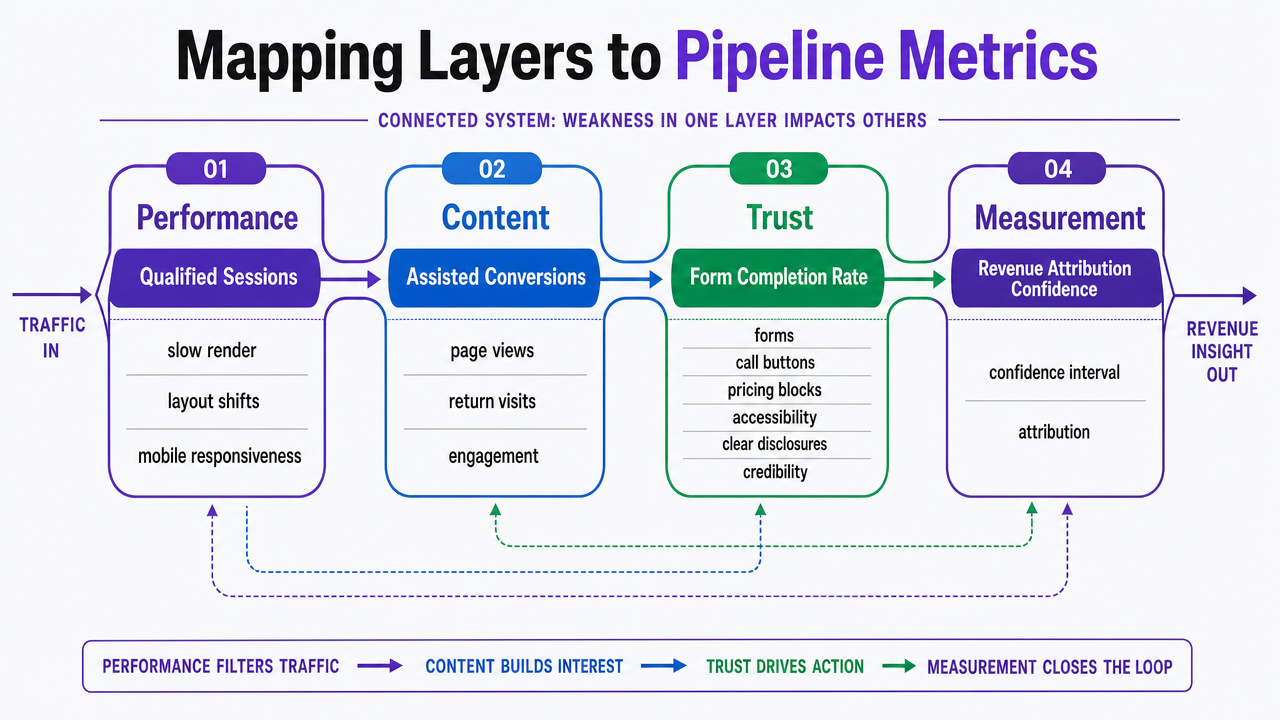 Visualize the four coupled layers of a revenue-grade site and the specific pipeline metric each one influences, directly supporting the section's central framework
Real-User Performance as a Demand Filter
Performance is not merely a technical metric; it dictates how much paid and organic demand successfully translates into a convertible session. When Largest Contentful Paint exceeds two-and-a-half seconds on mobile devices, or Interaction to Next Paint delays a click-to-call button, users tend to leave rather than wait.
In-house teams often possess valuable field data from Chrome User Experience reports and Search Console's Core Web Vitals, but rarely operationalize it by segmenting it by template. For instance, a regression in a location page template after a hero-image change would appear as a template-wide issue, not an isolated URL anomaly. Treating the template as the primary unit of work is crucial.
Sites that maintain consistent performance typically adhere to two operational practices:
- They establish a performance budget per template, enforced within the deployment pipeline. This ensures that any marketing-driven change, such as adding a large embed, necessitates a trade-off decision.
- They conduct monthly reviews of real-user data, rather than relying solely on quarterly lab data.
While lab scores are useful for debugging specific pages, real-user data provides VPs with a clear indication of whether the demand filter is becoming more or less restrictive over time.
People-First Content and the Substantiation Bar
The content layer is where many site optimization programs become inefficient due to overproduction. Templated location pages, minor service variations, and AI-generated FAQ blocks often accumulate without proper measurement of their contribution to assisted conversions. The solution is not increased volume, but rather a rigorous substantiation standard applied to existing content.
For any page making claims about outcomes, safety, effectiveness, or superiority, the FTC requires competent and reliable scientific evidence for health-related advertising claims, with the specific evidence depending on the claim and context 10. This standard, while written for health advertising, serves as a robust internal review benchmark for any high-stakes service page—be it for legal, financial, senior living, or dental services. It compels content teams to identify the supporting source for each claim before publication.
A practical content filter is straightforward: every service page should clearly state the problem it solves, its target audience, the visitor's expected process, and evidence for any outcome claims. Location pages should feature genuinely local information—clinicians, hours, intake procedures, accepted insurance, and parking—instead of generic, city-name-swapped text. Content that fails this filter is detrimental; it dilutes topical authority, negatively impacts template performance, and introduces review-integrity and substantiation risks. The recommended action is to inventory pages against this filter, identify failures, and prioritize them for rewrite or retirement before creating new content.
Trust and Compliance as Conversion Levers
Accessibility: WCAG 2.1 AA as the Working Benchmark
Accessibility failures directly translate to conversion losses and carry legal risks. A form inaccessible to a screen reader, a call-to-action button without a discernible name, or insufficient color contrast on pricing information can all alienate visitors who arrived with intent. The resulting revenue loss often precedes legal exposure.
WCAG 2.1 Level AA is the established technical standard for high-stakes service sites. The DOJ cited it in its 2024 Title II final rule for state and local government web content and mobile applications, with compliance deadlines tiered by population size 7. While this rule directly applies to public entities, not private businesses, the DOJ has also indicated that businesses open to the public should make their websites accessible under the ADA, and private-sector lawsuits frequently reference WCAG as the practical benchmark 6. Adopting WCAG 2.1 AA as an internal standard addresses this ambiguity and simultaneously safeguards conversion rates.
Three key standards collectively define conversion-page trust:
- WCAG 2.1 AA for accessibility, as per the 2024 DOJ Title II rule 7;
- The FTC's clear-and-conspicuous test for disclosures, which assesses prominence, proximity, and presentation 5;
- The FTC Consumer Reviews and Testimonials Rule, effective October 21, 2024, which governs testimonials and ratings on company sites 8.
A comprehensive trust-layer review that evaluates a page against all three standards can identify most conversion-blocking issues that an in-house team can address promptly.
Reviews, Testimonials, and AI-Assisted Reputation
Social proof is a powerful trust signal on conversion pages, and it is now subject to significant regulation. The FTC's Consumer Reviews and Testimonials Rule, effective October 21, 2024, prohibits the creation, sale, purchase, or distribution of fake or false consumer and celebrity testimonials. This includes AI-generated reviews that misrepresent a nonexistent reviewer or someone without actual experience with the business 9. The rule also addresses review suppression, undisclosed insider reviews, and misrepresented testimonials, granting the FTC authority to seek civil penalties for knowing violations 8.
For VPs managing AI-assisted content workflows, this has specific operational implications. Any process that generates review summaries, star-rating aggregations, patient or client stories, or case study language must include a documented step to link every quoted claim to an identifiable, consenting source, preserving its provenance. While AI can draft surrounding copy, it cannot invent an attributed voice. Undisclosed material connections—such as employee reviews, affiliate testimonials, or incentivized ratings—require disclosure at the point of consumption, not hidden in a footer.
A common failure is review suppression, such as selectively displaying only five-star ratings or funneling negative reviews to private channels that never reach public platforms. This conduct falls under the rule's purview. The site-side control involves maintaining a testimonial inventory: source, date, consent record, disclosure status, and the specific claim each testimonial supports. Pages that do not meet these inventory requirements should be removed before the next audit cycle.
Disclosures on Landing Pages, Financing, and Outcomes
Disclosures are often where conversion pages subtly lose trust. A financing offer with an APR range in small, gray text below the fold, a guarantee with conditions on a separate page, or a comparison block that appears editorial but is a paid placement—each erodes the credibility the page aims to build.
The FTC's standard for digital disclosures requires that essential information be clear and conspicuous. The agency evaluates prominence, proximity to the triggering claim, presentation, and consumer comprehension within the relevant context 5. For native and sponsored content, disclosures must be unambiguous, positioned as close as possible to the advertisement, easy to read, and prominent enough for consumers to notice and understand 4. This guidance applies to landing pages directing paid traffic to service offers, partner comparison pages, and advertorial content.
Outcome claims are held to a separate standard. The FTC mandates that health-related advertising claims concerning outcomes, safety, effectiveness, or superiority must be supported by competent and reliable scientific evidence appropriate to the specific claim, service, and context 10. The internal control for this is a one-line substantiation reference—study, source, or documented case basis—next to every outcome claim in the CMS. This allows reviewers to verify evidence alongside the claim. Claims lacking such a reference should be rewritten or removed before publication, not after a complaint arises.
Experience Predictable Pipeline Gains in One Week
See measurable site optimization impact on conversion and pipeline before you commit—publish live and track real results.
Revenue-Grade Measurement Under Privacy Constraints
What Analytics, Pixels, and Session Replay Can Capture
Measurement design begins with a critical question often implicitly and incorrectly answered by in-house teams: what data is the site permitted to record, and where? In regulated sectors, this isn't a matter of preference. HHS has clarified that HIPAA rules apply when tracking technologies collect or disclose protected health information. Authenticated pages must be configured to ensure tracking uses and discloses PHI only as HIPAA permits 1. This directive fundamentally reshapes the measurement landscape for healthcare, behavioral health, dental, or senior living sites.
A practical distinction can be made based on page state. On unauthenticated marketing pages—such as service descriptions, location pages, or top-of-funnel content—standard analytics, ad pixels, and session replay can generally operate, provided these pages do not solicit or expose PHI in forms, URLs, or replayed inputs. However, on authenticated pages behind a patient or client login, and on any page collecting health-condition information via a form, the tracking configuration must be carefully scoped, and vendor relationships documented under a business associate agreement where applicable 1.
Session replay is a tool that frequently fails this test silently. A replay script capturing keystrokes on an intake form will record diagnosis text, medication fields, and free-text symptom descriptions unless input masking is configured field by field. The operational control is a comprehensive page-and-field inventory: identifying which templates run which scripts, which fields are masked, which forms are entirely excluded from replay, and which vendors receive what data. This inventory should be managed by the measurement owner, not solely by the legal team, as the owner is responsible for implementing these changes.
A Data Inventory and Accountability Model
Once a page-and-field inventory is established, it requires a governance layer that can withstand staff turnover and vendor changes. The NIST Privacy Framework offers a voluntary tool for identifying and managing privacy risks while enabling useful products and services 11. This framework is well-suited for a measurement program that must justify analytics, personalization, lead capture, and call intelligence decisions to both a CFO and legal counsel. NIST's ongoing updates, including Privacy Framework 1.1 and a joint Data Governance and Management Profile, extend this structure to address the data-governance questions inherent in site optimization 2.
A functional model includes four columns per data element:
- What is collected
- Why it is collected
- Who has access
- How long it is retained
Applied to a website, the rows would detail concrete elements like form fields, cookie identifiers, call recordings, chat transcripts, replay sessions, CRM sync payloads, and third-party ad audiences. Each row specifies the vendor, the legal basis or business justification, and the retention window. Any rows lacking a named owner must be assigned one before the next release.
Accountability transforms the inventory from a document into an active control. Every measurement change—be it a new pixel, a new form field, an adjusted replay scope, or a new audience export—must pass through the same approval gate as content or performance changes. This establishes the governance connection to the decision loop.
Decision-Loop Latency: The Real Constraint
The primary factor differentiating sites that consistently generate revenue from those that stagnate is not tactic quality, but latency. The time elapsed from the emergence of a signal—such as a Core Web Vitals regression on a mobile location-page template, a 40% drop in intake-form completions after a field addition, a ranking loss for a high-intent service query, or a flagged testimonial—to the deployment of a fix is a metric most in-house teams neither measure nor can readily cite. Yet, this latency explains most stagnant quarters.
The decision loop comprises five steps, each contributing to latency:
- A signal surfaces from analytics, Search Console, CRM, call intelligence, or a compliance review.
- It becomes a ranked recommendation with a clear expected impact and supporting rationale.
- It routes to a human approver with the authority to greenlight the change.
- The change is executed—a copy revision, a template patch, a script scope adjustment, or a disclosure edit.
- Its KPI impact is measured against the pipeline metric owned by that layer.
When any of these steps is delayed by briefing cycles, status meetings, or vendor queues, the loop stretches, and the site's performance suffers.
Review-integrity signals offer a clear illustration. Under the FTC Consumer Reviews and Testimonials Rule, effective October 21, 2024, testimonials that misrepresent a nonexistent reviewer or someone without actual business experience are prohibited, with civil penalties for knowing violations 8. If such a testimonial is discovered on a location page, it needs to be removed within hours, not in the next content sprint. The operational challenge isn't identifying the risk, but ensuring the loop from identification to takedown operates within the same governed workflow as a performance fix or a disclosure edit, rather than stalling in a separate legal-review queue. Sites that consistently generate predictable revenue operate a single, integrated loop for all four layers, with one approval gate and a measured cycle time for each change type.
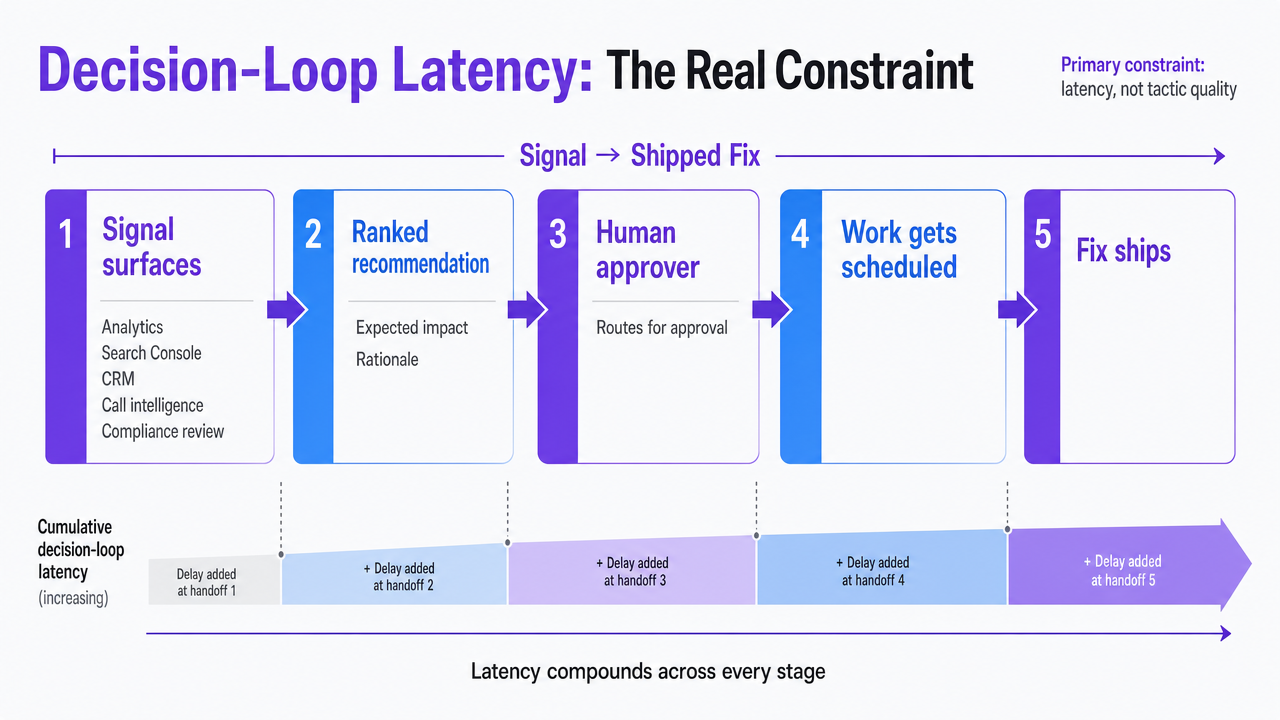 Diagram the five-step decision loop described in this section, showing how signal-to-shipped-fix cycle time compounds across stages
See How Data-Driven Site Optimization Fuels Consistent Pipeline Growth
Request a walkthrough of unified AI-powered workflows that align site performance, content, and conversion tracking—built to help enterprise teams scale revenue impact without expanding headcount or adding vendor complexity.
If You Manage Multiple Locations: Governance Across a Portfolio
For VPs overseeing multi-location portfolios, the decision loop adapts. The four layers remain constant, but the unit of work shifts from individual pages to templates. These templates are governed centrally and instantiated across all locations, with local variables managed as controlled inputs rather than editable free-text fields.
The per-location cost of a site change can be quantified as: approval cycle time multiplied by the number of affected locations, multiplied by the change volume per quarter. For example, a 30-location portfolio with a two-week approval cycle for a template patch spends more calendar time governing that single change than many single-site operators spend on a full quarter's work. Streamlining the loop directly addresses the first variable. This involves using one master template, N location variants, a single approval gate, and one measured cycle time per change type.
Two portfolio-specific risks reside within the trust layer:
- Testimonial governance under the FTC Consumer Reviews and Testimonials Rule scales linearly with the number of locations, as each location page requires its own inventory of quoted claims, dates, consent records, and disclosure status for audit purposes 8.
- Accessibility regressions scale in the same manner: a header component failing WCAG 2.1 AA on the master template will fail on every instance, and the fix must be deployed to all instances through the same controlled gate 7.
The operational implication is precise: governing a portfolio is less about producing more local content and more about minimizing instances where local edits can bypass the central loop. It also involves measuring the cycle time from signal to shipped fix as a single metric across the entire estate.
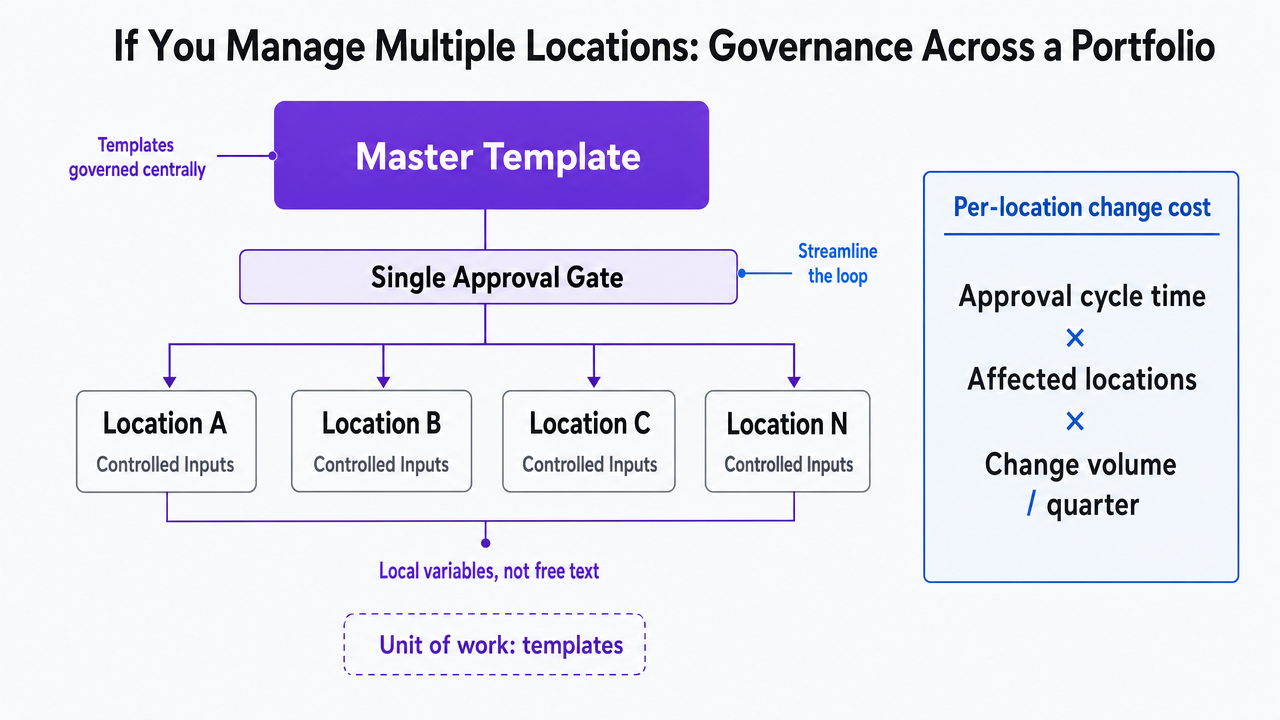 Illustrate the master-template-to-location-variants governance model with a single approval gate, which is the specific operating model described in this section
Running the Loop Without Adding Headcount
The question of headcount often arises when this framework is presented: who manages four coupled layers, a single governed loop, and measured cycle times? The reality is that most in-house teams already possess the necessary specialists. What they lack is a unified approval gate and a single queue where performance regressions, content rewrites, disclosure edits, testimonial takedowns, and measurement changes are prioritized against each other, rather than in isolation.
The consolidation moves towards fewer briefing cycles, fewer status meetings, and fewer vendor handoffs. It establishes a single point where a signal becomes a ranked recommendation with clear reasoning, routes to a human approver, and is then implemented. The NIST Privacy Framework supports this by providing the measurement layer with the same governance vocabulary used by other layers 11. Every change is assigned an owner, a justification, and a retention or review window.
The Vectoron platform is designed around this centralized gate, with six specialist strategists surfacing ranked work into one Command Center, with execution only after sign-off. Teams evaluating this model can begin a two-week trial at $599 per month, and measure cycle time from signal to shipped fix as the key predictor of next quarter's revenue.
Frequently Asked Questions
References
- 1.Use of Online Tracking Technologies by HIPAA Covered Entities and Business Associates.
- 2.Privacy Framework 1.1 | NIST.
- 3.Justice Department's Final Rule to Improve Web and Mobile App Access for People with Disabilities.
- 4.Native Advertising: A Guide for Businesses.
- 5.How to Make Effective Disclosures in Digital Advertising.
- 6.Guidance on Web Accessibility and the ADA.
- 7.Fact Sheet: New Rule on the Accessibility of Web Content and Mobile Apps Provided by State and Local Governments.
- 8.The Consumer Reviews and Testimonials Rule: Questions and Answers.
- 9.Federal Trade Commission Announces Final Rule Banning Fake Reviews and Testimonials.
- 10.Health Claims.
- 11.Frequently Asked Questions - NIST.