
Key Takeaways
- Organic visibility has split into four surfaces—traditional rankings, AI citations, zero-click answers, and conversational referrals—each with distinct selection logic and its own measurement instrument.
- Google confirms AI Overviews run on core Search systems with no special schema or llms.txt required, so standard indexing and expert content remain the eligibility bar 1, 2.
- Click compression is real but scoped: first-position CTR on AI-Overview keywords fell to roughly a third of 2024 levels, while peer publishers report median Google referral declines in the single to low double digits 12, 13.
- Marketing leaders should instrument each surface separately, track citation share and branded demand as leading indicators, and shift budget from thin informational pages toward expert-dense, entity-rich content.
The Ranking Model Fractured Into Four Surfaces
Site ranking and traffic used to describe one thing: where a page appeared in ten blue links and how many people clicked. That model is no longer sufficient. AI search has split organic visibility into four distinct surfaces, each with its own selection logic, its own reporting instrument, and its own economic value.
The first surface is still the traditional ranked result. Blue links have not disappeared, and Google confirms that pages must be indexed and eligible for a normal Search snippet before they can appear in any AI feature at all 1. The second surface is the AI citation, where a page is used as a source inside an AI Overview, an AI Mode response, or a Copilot answer. The third is the zero-click answer itself, where a user reads the summary and never leaves the results page. The fourth is the conversational referral, where a user starts inside ChatGPT or Copilot and clicks through directly to a site.
Each surface behaves differently. Independent research shows that the sources cited by AI systems differ substantially from the top-ranked results in traditional Search, which means a page can rank well and still be invisible in generative answers, or the reverse 8. This divergence is the practical reason marketing leaders cannot manage AI-era organic pipeline with a single rank-tracking dashboard. A site's position on one surface no longer predicts its position on the other three, and each surface produces a different mix of impressions, clicks, and downstream conversions.
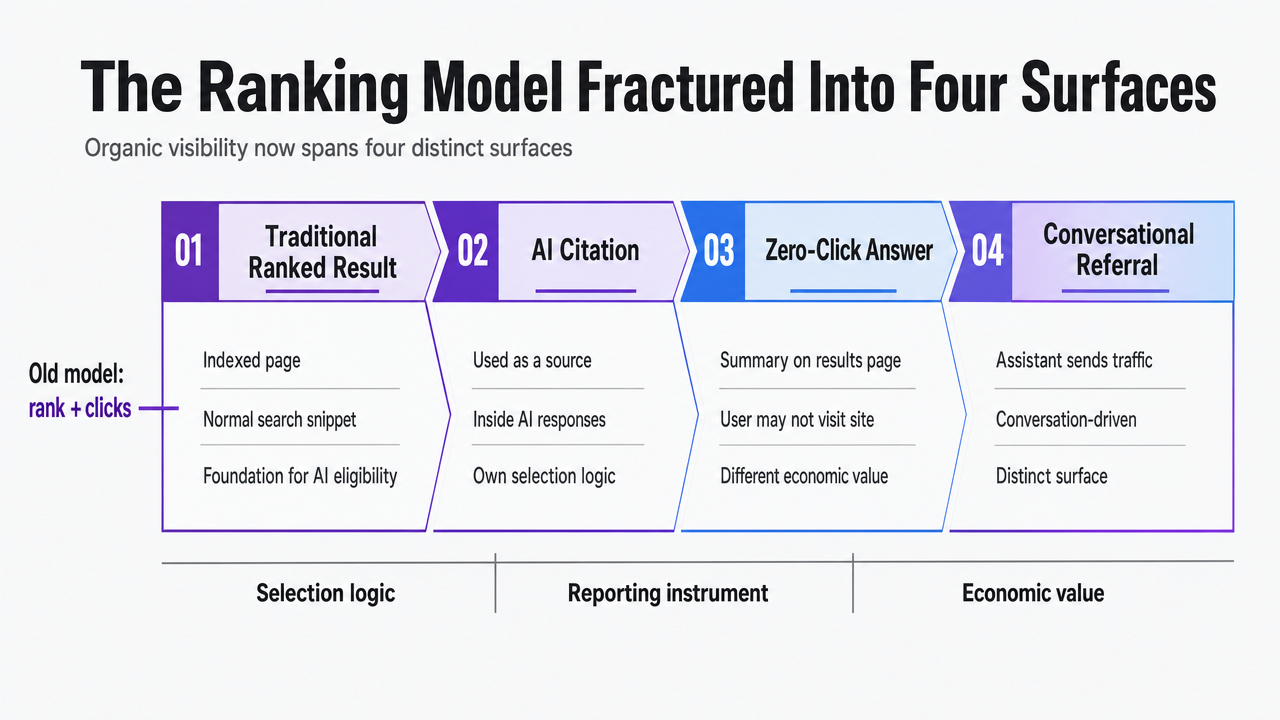 Visualize the four distinct organic visibility surfaces introduced in this section, giving readers a mental model for the rest of the article
What Google Actually Says About AI Search
Most of the noise about "generative engine optimization" collides with a plain-language answer from Google itself: AI Overviews and AI Mode run on the same core Search systems, and there are no additional technical requirements to appear in them 1. Pages must be indexed and eligible for a normal Search snippet. That is the eligibility bar. Nothing more.
Google's optimization guide reinforces the point. Asked whether SEO still matters in a generative-search world, the guidance answers,
"In short, yes!"
and explicitly states that special files such as llms.txt or bespoke schema are not required for inclusion in Google's AI features 2. The same guide adds detail on retrieval-augmented generation, query fan-out, unique expert content, crawlability, and accurate local and product information as the levers that actually move visibility.
This matters for how a marketing VP allocates budget. A parallel academic literature is coalescing around the term Generative Engine Optimization, framing AI visibility as a distinct information-retrieval problem with its own tactics 9. That framing conflicts with Google's official position. Treating GEO as a separate discipline requiring new markup, new pages, or a new vendor line item introduces cost without a documented lift from the platform that still drives the majority of organic sessions. The defensible reading is narrower: keep the SEO foundation intact, measure the new surfaces with the new instruments Google and Microsoft have shipped, and treat AI visibility as an outcome of good indexing and expert content rather than a separate optimization stack.
The Click Erosion Is Real, and Narrower Than Headlines Suggest
The most-cited number in the AI-search debate belongs in context. On keywords that trigger an AI Overview, the click-through rate for the first organic result fell from 7.3% in March 2024 to 2.6% in March 2025, a 34.5% relative decline reported by Digital Content Next based on a third-party keyword analysis 12. The study covered AI-Overview-triggering queries only, measured position-one results only, and represents one analysis rather than a universal benchmark across all search behavior.
That scope matters. A marketing VP looking at a Search Console dashboard should not expect every keyword set to move like the AI-Overview subset. Informational queries that summarize well into a paragraph — definitions, comparisons, how-to steps, symptom lists — are the queries most likely to trigger an AI Overview and therefore the queries most exposed to click compression. Transactional and navigational queries, local intent, and branded searches behave differently and are not represented by the same figure.
The operational read is straightforward. First, segment Search Console performance by query intent and check whether declines cluster in the informational bucket. Pages that answered a top-of-funnel question in two hundred words are the pages absorbing the compression, and their historical CTR benchmarks are no longer valid planning inputs. Second, stop treating position one as a fixed traffic yield. A rank-one page on an AI-Overview keyword now delivers a fraction of the sessions it did eighteen months ago, even when the ranking itself is unchanged.
The headline claim that AI has killed organic clicks overstates the finding. What the data supports is narrower and more actionable: a specific class of queries, on a specific surface, has lost roughly two-thirds of its first-position click yield in a single year. That is enough to reshape which pages deserve continued investment and which have quietly become impressions without sessions.
Organization-Level Evidence: What Publishers Are Seeing in Analytics
Keyword-level CTR studies describe what happens on a results page. They do not describe what shows up in a monthly board deck. For that, organization-level referral data is more useful, and the Digital Content Next survey is one of the few public datasets that measures it.
DCN surveyed 19 member organizations across an eight-week window in May and June 2025, comparing Google referral traffic against the same period the year prior. The median result was a 10% year-over-year decline overall, with news brands down 7% and non-news brands down 14%. Losses outnumbered gains roughly two to one across the sample 13. The non-news category is the more relevant reference point for most service-business marketing leaders, because non-news publishers rely on the same informational and evergreen content patterns that dominate top-of-funnel service pages.
The sample size and scope deserve honest handling. Nineteen organizations is not a market census, the window is eight weeks, and the study cannot cleanly separate AI Overviews from concurrent algorithm changes, seasonality, or shifts in reader demand. A marketing VP citing this number to a CEO should present it as directional evidence from a peer cohort, not as a forecast for a specific site.
What the data does justify is a change in how referral trends are interpreted internally. A single-digit year-over-year decline in Google sessions no longer qualifies as an anomaly worth investigating; it now falls inside the range peer organizations are reporting. The diagnostic question shifts from "why did our traffic drop" to "is our decline steeper than the peer median, and if so, which content clusters are driving it." That reframing changes the reporting cadence too. Monthly session totals become less informative than quarterly comparisons at the URL-cluster level, split by whether the underlying queries trigger an AI Overview.
One more observation from the DCN cohort matters for planning. Non-news publishers lost twice as much as news publishers in the median. Evergreen explainers, comparison pages, and reference content — the categories closest to what service businesses publish for organic acquisition — appear to be absorbing the largest share of the compression.
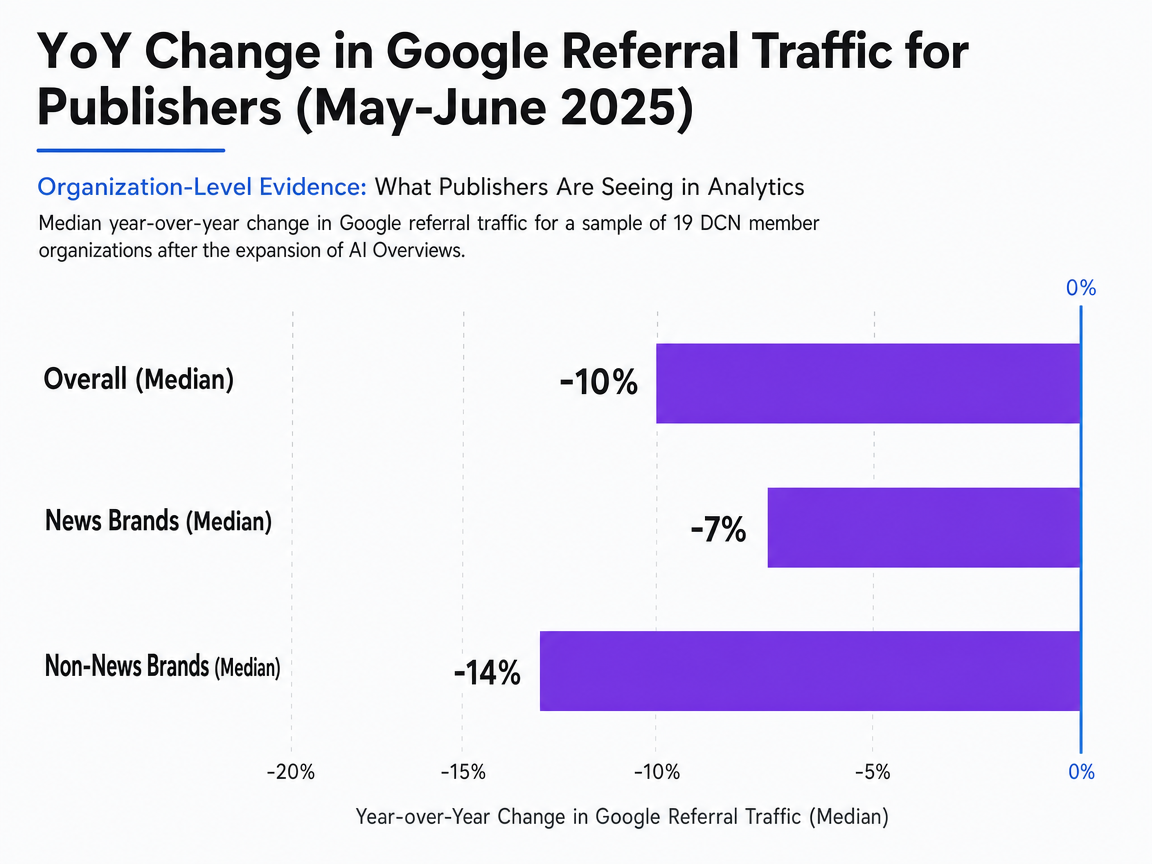 YoY Change in Google Referral Traffic for Publishers (May-June 2025)
Median year-over-year change in Google referral traffic for a sample of 19 DCN member organizations after the expansion of AI Overviews.
Test AI-driven content for measurable ranking impact
Gain firsthand data on how AI content execution influences site rankings and organic traffic in real time.
AI as a Smaller but Growing Discovery Channel
The counterweight to the click-erosion data is a growth channel that did not exist at scale eighteen months ago. Similarweb's 2025 generative-AI report tracked a 76% year-over-year increase in monthly visits to generative-AI platforms, a 319% rise in app downloads, and more than 1.1 billion referral visits from AI platforms to third-party sites in June 2025 alone 11. The report also estimates a roughly 7% conversion rate on transactional-site referrals from AI platforms, a figure that varies by sector and funnel type and should not be applied as a universal benchmark.
Context keeps the number honest. Traditional search still moves an order of magnitude more sessions than AI referrals for most sites, and 1.1 billion visits distributed across the entire web is a modest per-site yield. The signal worth acting on is directional: AI referrals are growing faster than traditional search is shrinking, and the users arriving through conversational platforms tend to arrive later in the decision process, having already consumed a summary and chosen to click through for verification, pricing, or contact.
For a marketing VP, that shifts how AI-referral traffic should be valued in reporting. A ChatGPT or Copilot session is not a replacement for a lost blue-link click at the top of the funnel; it is a different visit type, typically lower volume and higher intent. Tracking it as a separate channel with its own conversion rate, rather than folding it into aggregate organic, is what makes the growth visible before it becomes material.
A Four-Surface Measurement Stack
Traditional Rankings and Branded Demand
Rank tracking still belongs in the stack, but its role has narrowed. Position data now answers a single question: is a page eligible to appear anywhere, including in AI features that require normal Search indexing as the entry ticket 1? A page that ranks in the top ten remains a candidate for AI Overview citation, zero-click summary, and blue-link click alike. A page that drops out of the top ten loses all four surfaces at once.
Branded search volume is the companion metric that most reporting decks under-weight. When a user reads an AI summary and later types the company name into Google, that visit registers as branded organic, not as an AI referral. Tracking week-over-week branded impressions in Search Console, alongside direct-navigation sessions, captures the downstream effect of AI visibility that no citation dashboard will show. A rising branded curve against flat non-branded impressions is the pattern that signals AI exposure is working even when raw session counts look soft.
AI Citations in Google and Bing
Google and Microsoft have both shipped dedicated instruments for the citation surface. Search Console's generative AI performance report shows impressions, pages, countries, devices, and dates for URLs appearing in Google's AI features, giving marketers a direct visibility metric rather than an aggregate Web Search line 3. The report separates AI-feature exposure from standard search performance, which is the split needed to explain why total impressions can rise while clicks fall.
Bing's AI Performance dashboard in Webmaster Tools tracks total citations, average cited pages, page-level citation activity, and citation trends across Copilot and Bing's AI-generated summaries 4. The June 2026 update added intent, topic, comparison, and Citation Share views, where Citation Share is the percentage of citations attributed to a site out of all citations shown for a specific grounding query 5. That metric is what makes competitive AI visibility legible for the first time.
One caveat belongs in every board slide that uses these numbers. Microsoft explicitly notes that citation counts are not equivalent to ranking, authority, or importance, and Google's impressions are not clicks. Both are visibility signals, not conversion signals, and need to be paired with analytics and CRM data before they inform budget decisions.
Conversational Referrals From ChatGPT and Copilot
Direct referrals from conversational platforms are the fourth surface, and they are the easiest to instrument because the platforms attach their own attribution. OpenAI documents that ChatGPT referral URLs carry the parameter utm_source=chatgpt.com, which routes cleanly into any standard analytics tool as a distinct source 7. Copilot and Perplexity pass their own referrer strings that most analytics platforms already recognize. Building a dedicated channel group for AI referrals takes an hour and gives the reporting cadence a metric that grew from near zero to something measurable in eighteen months.
Eligibility for ChatGPT search answers depends on crawler access. OAI-SearchBot is the crawler OpenAI uses to surface sites in ChatGPT search features, and sites that block it in robots.txt will not appear in ChatGPT search answers, although they may still appear as navigational links 6. The measurement takeaway is narrow: confirm OAI-SearchBot access matches the intent, then track sessions, conversion rate, and revenue per visit on the new channel as a separate line item rather than folding it into aggregate organic.
The Crawler-Access Decision Marketing VPs Are Being Asked to Make
A question that did not exist two years ago now lands on the VP's desk from legal, from IT, or from the CEO after a board dinner: should the site block generative-AI crawlers? The framing is usually defensive — protect the content, deny the model, preserve the moat. The evidence on what happens next is less comforting than the framing suggests.
The one empirical anchor available is publisher-focused and observational. A 2025 working paper on LLM impact on online news consumption estimates that blocking generative-AI crawlers was followed by a 23% decline in Similarweb traffic and a 13.9% decline in Comscore traffic relative to pre-blocking periods 10. Two important caveats belong in the same breath: the study measures news publishers, not multi-location service businesses, and the estimates are observational, meaning concurrent algorithm changes, publisher composition, and self-selection into blocking cannot be cleanly separated from the block itself. A VP citing this to a CEO should present it as a directional warning from an adjacent industry, not a forecast for a law-firm site or a dental network.
The mechanism is worth understanding even if the magnitude does not transfer. Blocking OAI-SearchBot in robots.txt removes a site from eligibility to appear in ChatGPT search answers, though the site may still appear as a navigational link 6. Blocking equivalent crawlers from other AI platforms produces the same result on those surfaces. The traffic that disappears is not only the direct AI referral; it is also the branded searches and direct visits that would have followed a citation in a conversational answer.
The defensible default is to allow search-oriented AI crawlers, monitor citation share and referral quality on the resulting surfaces, and reserve blocking for training-only crawlers that offer no discovery upside. That preserves the visibility ledger while the reporting instruments catch up.
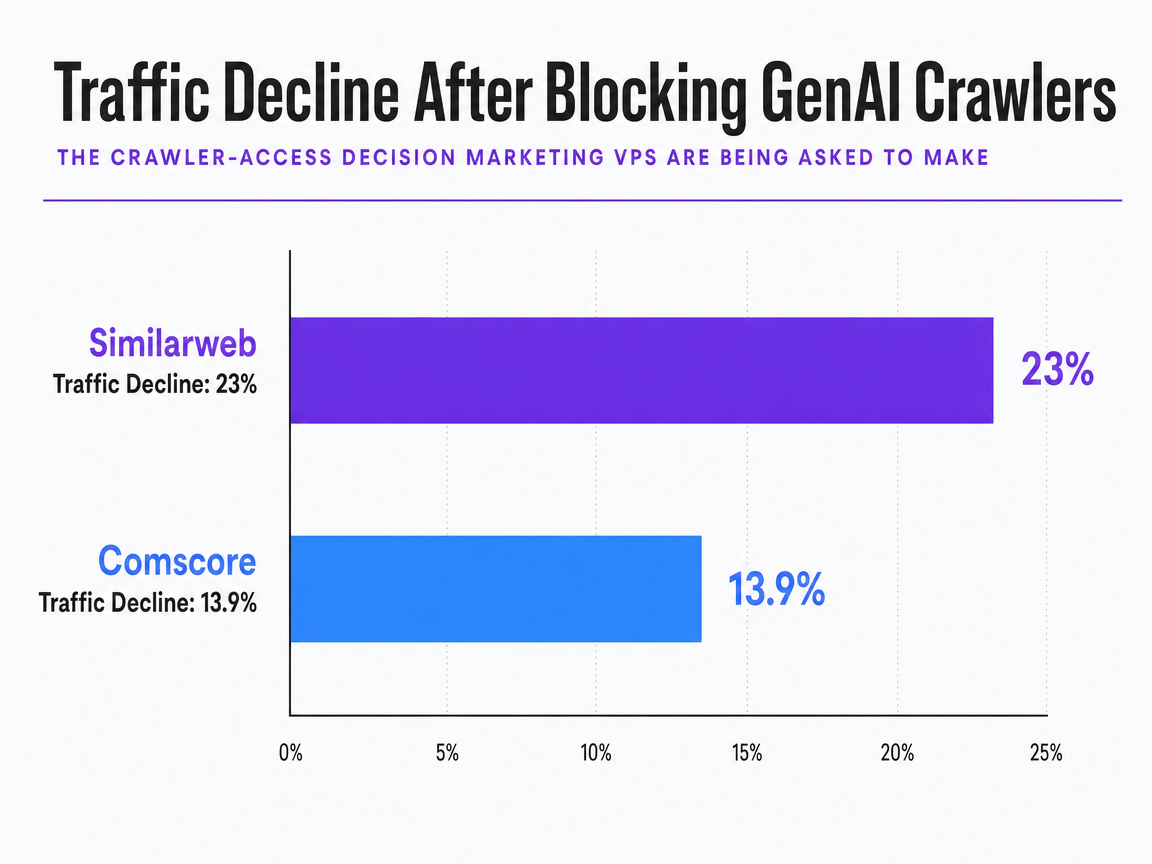 Traffic Decline After Blocking GenAI Crawlers
Associated decline in traffic for publishers after blocking generative-AI crawlers, as measured by Similarweb and Comscore. The study is observational.
See How AI Search Is Redefining Site Ranking—And What Top Teams Are Doing About It
Request a data-driven assessment of your current site ranking and traffic exposure in the age of AI search, with actionable recommendations for multi-location brands and agency portfolios.
Where to Reallocate Content Investment Without Adding Headcount
The fracture across four surfaces changes which pages earn their keep. Thin informational content — the two-hundred-word definition posts, the generic "what is" pages, the shallow FAQ hubs — has become the primary donor to AI Overview summaries and the primary casualty of first-position click compression. Continuing to commission that content at 2023 volumes funds impressions that no longer convert. Cutting it frees hours without cutting output.
The categories that gain value share three traits: they require expertise that a summary cannot replace, they carry entities a retrieval system needs to resolve, and they answer a question the user still has after reading an AI answer. Expert-authored explainers with named practitioners, comparison pages that put two named options side by side with concrete criteria, pricing and process pages that specify what a service actually costs and how it is delivered, and local pages that anchor a service to a specific address and service area all fit this pattern. Google's own guidance points to unique expert content, accurate local and product information, and crawlability as the levers that move visibility across both traditional and AI surfaces 2. That guidance also aligns with the empirical finding that AI systems select substantially different sources than top-ranked pages, meaning depth and specificity — not word count — are what earn a citation 8.
The staffing question is where most reallocation plans stall. Producing expert-dense comparison and local content at the cadence four surfaces now require typically means either hiring a second content team or compressing the production loop. The second option is what AI content platforms coordinated through human approval have made viable: strategists surface which URL clusters are losing sessions, drafts are produced against expert inputs, and every piece routes through editorial sign-off before publishing. The headcount stays flat; the throughput doubles or triples. That is the operational model behind platforms like Vectoron, and it is the reallocation path that lets a VP shift budget from thin-content volume to expert-content velocity without a hiring cycle.
If You Manage Multiple Locations: Citation Share as an Early-Warning Metric
For marketing leaders running dental groups, law-firm networks, home-services franchises, or senior-living portfolios, the four-surface model produces a problem that single-location operators do not face: AI visibility can concentrate in a handful of locations while others go dark, even when traditional local rankings look uniform across the map.
Bing's Citation Share metric is the first instrument that makes this legible. Citation Share reports the percentage of citations attributed to a site out of all citations shown for a specific grounding query, and Microsoft's expanded AI Visibility Insights break the view down by intent, topic, and competitor comparison 5. Run the same grounding queries — "pediatric dentist [city]," "personal injury lawyer [city]," "emergency plumber [city]" — across a portfolio, and the citation-share distribution across locations often looks nothing like the local-pack rankings. Two or three flagship locations can carry 60% to 80% of citations while a dozen others register near zero, because the flagship pages have deeper practitioner bios, more specific service descriptions, and stronger entity signals a retrieval system can resolve.
The reallocation logic follows the delta, not the average. Locations with high traditional rankings and low citation share are the early warning: they still capture blue-link clicks today, but the informational queries feeding those clicks are the same queries AI Overviews are compressing. The operational move is to shift content investment toward under-cited locations before the traditional traffic decays, using cost per qualified call as the yardstick for which locations justify the lift first.
What to Tell the CEO Next Quarter
The board narrative most marketing VPs need to prepare is not a defense of a traffic decline. It is a reframing of what organic pipeline now includes. Rankings still gate eligibility, but visibility is now distributed across four surfaces, each with a distinct instrument and a distinct conversion pattern.
Three numbers hold the reframing together. Peer publishers are reporting median Google referral declines in the single to low double digits 13. First-position click yield on AI-Overview keywords has compressed to roughly a third of its 2024 level 12. And AI referrals, though smaller than traditional search, are growing fast enough to register as a separate channel with its own conversion profile 11. Report each once, with scope attached.
The quarterly ask writes itself: fund expert-dense content velocity against under-cited URL clusters, instrument the four surfaces separately, and treat citation share and branded demand as leading indicators of the traffic curve six months out. Platforms like Vectoron exist to make that throughput possible without a hiring cycle.
Frequently Asked Questions
References
- 1.AI Features and Your Website | Google Search Central.
- 2.Google's Guide to Optimizing for Generative AI Features on Google Search.
- 3.Introducing Search Generative AI performance reports in Search Console.
- 4.Introducing AI Performance in Bing Webmaster Tools Public Preview.
- 5.New AI Visibility Insights in Bing Webmaster Tools: Intents, Topics, Citation Share, Compare.
- 6.Overview of OpenAI Crawlers.
- 7.Publishers and Developers - FAQ - OpenAI Help Center.
- 8.How Generative AI Disrupts Search: An Empirical Study of Google Search, Gemini, and AI Overviews.
- 9.Generative Engine Optimization: How to Dominate AI Search.
- 10.The Impact of LLMs on Online News Consumption and ....
- 11.AI Discovery Surges: Similarweb's 2025 Generative AI Report Says.
- 12.Google's AI overviews linked to lower publisher clicks.
- 13.Facts: Google's push to AI hurts publisher traffic.