
Key Takeaways
- Slug SEO at portfolio scale is a governance problem, not a page-craft debate — the margin comes from enforcing one codified standard across every client site, not relitigating conventions per launch.
- The non-negotiables are settled: descriptive words, hyphens, lowercase enforced at the server layer, no fragments for indexable content, slugs of 25–30 characters within 50–60 total 9, 8.
- Cap standard templates at three folder levels from root, noindex or disallow faceted URLs above two active parameters, and pick one service-first or location-first pattern for multi-location clients portfolio-wide 2, 14.
- Every slug change carries a twelve-month 301 retention floor with audits at 30, 90, and 365 days — reject dates, seasons, and version numbers at brief stage to prevent forced migrations 17, 4.
Why Slug Decisions Belong in Portfolio Governance, Not Page Craft
Most slug advice is written for a single page on a single site. That framing is the wrong altitude for anyone running SEO across a client book. When one convention has to hold across twenty ecommerce catalogs, forty multi-location service brands, and a rotating set of lead-gen sites, the interesting question is not whether a slug should be three words or five. It is whether the same rule gets applied the same way on every site, every week, without a senior strategist in the room.
Slug SEO, viewed from that altitude, is a governance problem. The primary sources agencies rely on already agree on the mechanics: descriptive words, hyphens, lowercase, shallow hierarchies, and stable paths controlled by canonicals and 301s 9, 13. The disagreements are narrow and defensible, mostly around depth limits and how aggressively to constrain faceted URLs 2, 5, 1, 10. What separates agencies that scale from agencies that firefight is not knowledge of those rules. It is whether the rules are codified once and enforced across the portfolio.
The cost of not codifying is where margin quietly disappears: crawl traps from parameter sprawl, migration rework from volatile slugs, and audit hours that compound with every new client. This piece treats slug SEO as a portfolio policy, anchors each rule to a primary source, and takes positions where the field genuinely disagrees.
The Non-Negotiables: What Google Actually Requires
Descriptive Words, Hyphens, Lowercase: The Rules That Never Move
Google's URL structure guidance is unusually direct for a search documentation page. Use descriptive words rather than long ID numbers. Use hyphens instead of underscores to separate those words. Avoid URL fragments to change the content of a page, because Google Search generally does not support fragments as distinct content 9. Those three rules are not stylistic preferences. They are the parseable signals Googlebot relies on to associate a slug with the topic it covers.
Lowercase is the fourth non-negotiable, and it is the one most likely to break at the server layer. Mixed-case URLs on case-sensitive servers create duplicate paths that fragment link equity and multiply the canonical work required to clean them up. The recommendation across technical guides is to enforce lowercase at the server or CDN rather than at the CMS template, so no editor or migration script can reintroduce capitals downstream 6.
For an agency setting one standard across every client site, these rules translate into four preflight checks any junior auditor can run:
- descriptive slugs (no numeric IDs)
- hyphens only
- lowercase enforced above the application layer
- no reliance on fragments for indexable content
When those four pass, the debatable questions — depth, length, facet handling — become tractable. When they fail, every downstream policy inherits the mess. Codify them in the delivery playbook before arguing about anything else.
Sourced Numeric Standards for Slug and URL Length
Length is where opinionated aggregator posts start inventing thresholds. The defensible numbers come from a small set of sources and should be stated once, then held as portfolio policy.
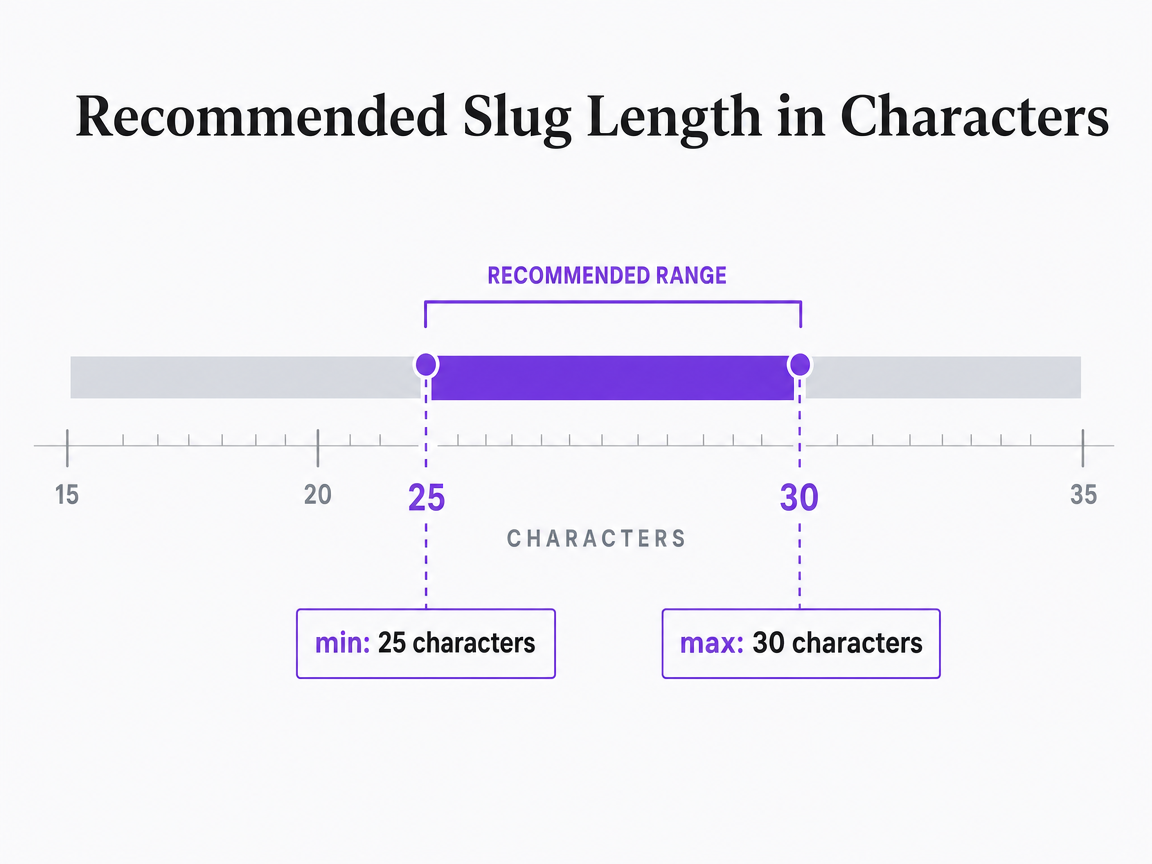
The most specific published guidance sets slugs at 3–5 meaningful words, roughly 25–30 characters, and total URL length under approximately 50–60 characters 8. A separate technical checklist frames the same range from the ceiling side: the meaningful part of the slug should sit under about 60 characters, treated as an upper bound rather than a target 6. Read together, the working standard for an agency portfolio is a 25–30 character slug within a 50–60 character URL, with 60 characters as the hard ceiling before a slug gets flagged in audit.
Those numbers are rules of thumb, not ranking thresholds. Google itself does not publish a character count. What the numbers actually control is downstream cost: readability in SERP snippets, share-link truncation, and the audit surface when a delivery team has to review thousands of slugs across a book of clients. A 27-character slug is legible in a Search Console report at a glance. A 78-character slug requires a second look every time.
Codifying the range matters more than defending any specific value inside it. Once 25–30 characters and 50–60 total is the portfolio standard, every new page template, every migration mapping, and every content brief can be checked against one number. Debate over whether 32 characters is meaningfully worse than 28 is not where agency margin is won or lost.
 Recommended Slug Length in Characters
A best practice from Briskon suggesting that URL slugs should be between 25 and 30 characters long.
Depth, Hierarchy, and the Debate Worth Taking a Position On
The 2–3 vs. 3–4 Folder Depth Disagreement
Depth is where primary sources stop nodding at each other. One camp holds that a site should mirror its architecture within two to three folder levels from the root, arguing that shallower paths concentrate link equity and give crawlers a cleaner map 2. A second guide sets the same working range of 2–3 levels for the majority of pages, allowing deeper paths only when the content genuinely requires them 5. A third source stretches the ceiling to three or four folder levels before crawl efficiency starts to degrade on large sites 1. Google's own guidance stays deliberately quiet on depth as a number and instead tells operators to group similar content in directories and keep URLs simple 13.
The disagreement is narrower than it looks. Every source agrees that shallow beats deep, that depth without a linking justification is waste, and that adding a folder level is a decision, not a default. The 2–3 versus 3–4 argument is really about how much headroom a template gets before it needs a review.
The defensible agency default is a maximum of three folder levels from root for standard templates, with a fourth level permitted only when a strong internal linking case exists — typically deep category catalogs or location + service combinations. That default sits inside every source's tolerance range, is easy to audit across a portfolio, and forces a conversation before any template introduces a fourth segment. Codify it as a hard limit in the delivery playbook. Anything at four levels or deeper triggers a review, not an exception.
Category-to-Product Patterns for Ecommerce and Multi-Location Clients
For ecommerce and multi-location service clients, the depth rule collides with a template question: how should categories, subcategories, and detail pages nest inside the slug pattern? Google's ecommerce guidance is direct. Group similar products in directory-based URLs, link from the home page or a main category page to every category, and link from category pages to the individual product pages inside them 12. Shopify's enterprise guidance translates that into descriptive, hyphen-separated collection and product paths such as /collections/organic-skincare rather than parameter strings or opaque handles 3.
The portfolio pattern that holds up across both ecommerce and multi-location books is a two-segment path for the standard case: /category/product or /service/location. That keeps most templates at two folder levels, leaves the third level available for genuine subcategories, and preserves the fourth as an exception under governance review.
Multi-location service clients need a scope note. A service-first path (/plumbing/traverse-city) concentrates topical authority on the service and treats location as a modifier. A location-first path (/traverse-city/plumbing) concentrates authority on the location hub. The choice is not neutral, and it should be made once at the portfolio level based on which entity the client competes on, then applied to every new site onboarded. Mixed patterns across a book of clients are how audit hours compound and how internal linking briefs stop being reusable. Pick the pattern, document it, and hold every new build to it.
Test Data-Driven Slug Optimization at Scale
See measurable improvements in site structure and slug SEO performance within your own client sites.
Parameters and Faceted Navigation: Where Margin Actually Leaks
A Defensible Facet Policy Across Client Sites
Faceted navigation is where a clean slug system quietly turns into a crawl trap. A category page with six filters and three sort options can generate thousands of parameterized URLs from a single template, and every one of them competes for crawl budget against the pages that actually earn revenue. Google's own guidance on faceted navigation is prescriptive rather than suggestive: if filter URLs are not needed in the index, disallow them in robots.txt or use URL fragments, which search engines generally ignore 10. It also directs operators to maintain a consistent order of filters in the URL path and to return a 404 for combinations that produce no results 10.
The defensible portfolio default sits on top of a threshold that most technical guides converge on. Faceted URLs with more than two active parameters should be noindexed or disallowed by default, with every important page reachable through clean collection and pagination URLs first 14, 7. That single rule collapses most facet sprawl without a case-by-case debate on every client site.
The decision path an agency delivery team can apply on any client looks like this:
- If a filter is UI-only and does not need indexation, use a URL fragment 10.
- If a filter produces a genuinely valuable long-tail combination (one or two parameters, meaningful search demand), keep it crawlable and canonicalize to itself.
- If it exceeds two parameters or duplicates a canonical view, disallow in robots.txt or noindex 14.
- If it returns zero results, serve a 404 10.
- Filter order is normalized at the server or platform layer so /shoes?color=black&size=10 and /shoes?size=10&color=black do not both get crawled.
Codifying that decision path once, then applying it at onboarding for every ecommerce and location-led client, is where the portfolio saves crawl budget and audit hours. The alternative is relitigating facet policy per client, which is where the margin goes.
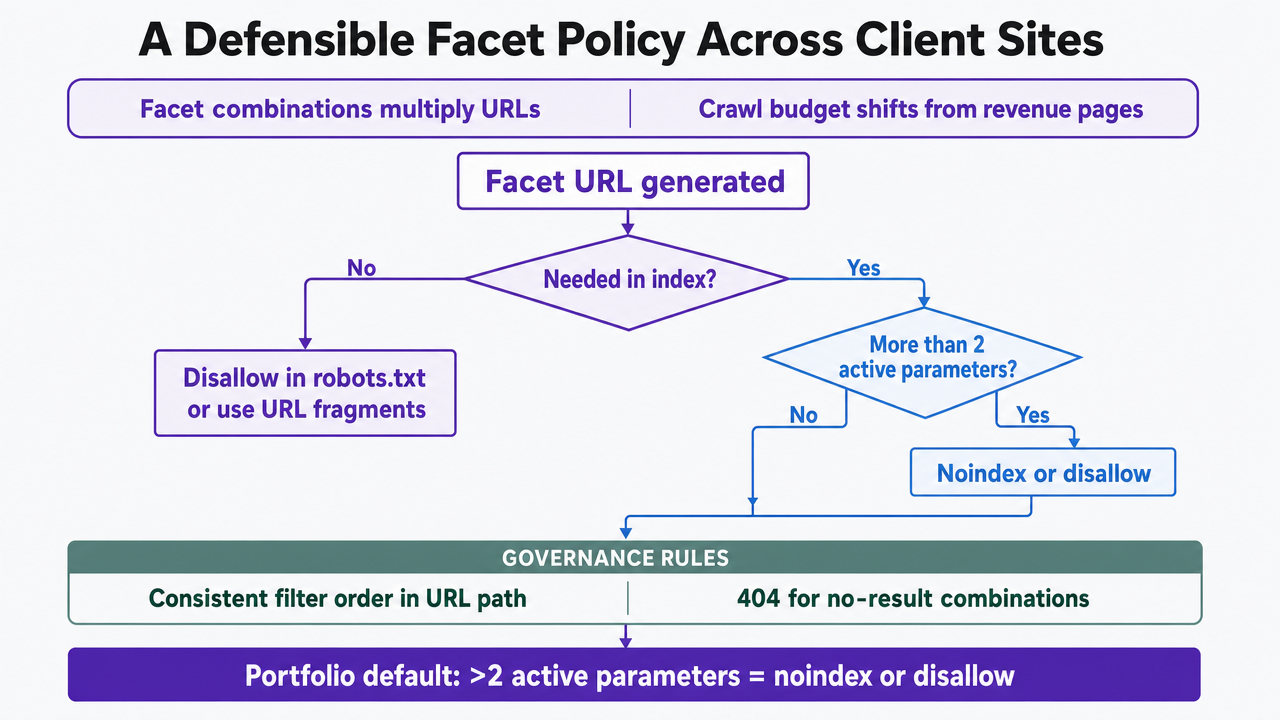 Translate the section's cited decision path for faceted navigation into a scannable process diagram that delivery teams can apply per client, since the section explicitly outlines a step-by-step policy
Internal Linking Thresholds That Make Slugs Discoverable
A clean slug that nothing links to is a clean slug that Google will not prioritize. Facet policy controls what gets crawled; internal linking controls what gets crawled often enough to matter. The working thresholds for large-site architecture are direct: every important page should sit three clicks or fewer from the home page and receive at least five internal links from other pages on the site 14. Anything below that floor is a discoverability problem no slug convention can fix.
Google's own link guidance sets the mechanics. Internal links belong in standard anchor elements with an href attribute, and anchor text should be descriptive rather than generic 11. For ecommerce and location-led sites, that translates into a linking chain: home page or main category hub links to every category, categories link to their subcategories, and subcategories link to every product or location page in scope 12.
The audit rule for a delivery team is a single query against the internal link graph: how many pages fall below five internal links or beyond three clicks from home? That number, tracked per client, is the discoverability debt the slug system is carrying.
Migration Rules: The Slug Policy That Survives a Site Move
The 301 Contract and the One-Year Retention Floor
Every slug change is a promise to Googlebot that the old URL still points somewhere useful. Break that promise and the ranking equity attached to the old path leaks out over the weeks it takes Google to figure out the page is gone. Google's site move documentation is unambiguous on the mechanic: use 301 redirects when moving content to new URLs, and keep those redirects in place for at least a year 17. That one-year floor is not a recommendation. It is the minimum window Google needs to fully process the change and transfer signals to the new path.
For an agency running migrations across a client book, the operational consequence is that a 301 is not a one-time deploy. It is a maintenance liability that stays on the books for twelve months minimum, and often longer for high-value pages with backlink profiles worth preserving. That reframes the migration budget. The cost of a slug change is not the redirect rule written on migration day. It is the redirect rule plus the audit hours required to keep it alive, monitored, and free of chains through the retention window.
The portfolio policy that follows is a hard rule: no slug change ships without a mapped 301, a sitemap update reflecting the new path, and a scheduled audit at 30, 90, and 365 days to catch chain redirects, broken hops, and any old URLs that quietly lost their rule during a platform update 17. Consistency and canonicalization discipline reinforce that contract, because parameter-heavy or duplicate paths reintroduced during a migration undo the equity transfer the 301 was supposed to protect 13. Every migration deck a delivery team ships should include the retention calendar, not just the redirect map.
Slugs That Don't Force Rewrites: No Dates, No Volatile Terms
The cheapest migration is the one that never has to happen. Slugs that embed dates, version numbers, or seasonal language guarantee a rewrite the next time the content updates. A path like /2026-seo-guide/ forces a rename in January; /seo-guide/ with an updated date field on the page does not 4. The same rule applies to product taxonomies that bake in year-model identifiers, campaign slugs that reference a specific quarter, and location pages that hard-code neighborhood names likely to shift with expansion.
The governance principle is that a slug should describe what a page is, not when it was written or which version it belongs to. Volatile terms create work in two places: the 301 map on migration day, and the redirect maintenance calendar for the year that follows 17. Multiply that by every dated URL across a portfolio of clients and the compounding cost becomes visible fast.
Codify the rule at content brief stage, not audit stage. Any proposed slug containing a year, a season, a version number, or a promotional term gets rejected before publish. That single gate removes the largest recurring source of forced migrations from the delivery pipeline.
If You Manage a Book of Client Sites: Portfolio Economics of Slug Governance
Scope shift: the rest of this piece has argued at the level of a single client site. This section is for the Head of SEO carrying a book of them. Once slug decisions repeat across ten, thirty, or fifty sites, the unit economics change. The same convention debated on one site becomes a recurring line item — audit hours per site per quarter, redirect maintenance across a year-long retention window 17, and rework whenever a template ships without governance.
The comparison worth running is not slug A versus slug B. It is one enforced standard across the portfolio versus per-site improvisation. The table below uses variables rather than invented dollar figures, holding the sourced standards constant: a 25–30 character slug within roughly 50–60 total characters 8, a maximum of three folder levels for standard templates 2, 5, and a 301 retention floor of at least twelve months per slug change 17.
| Cost Line | No Governance (per-site improvisation) | One Enforced Standard (portfolio policy) || --- | --- | --- || Slug audit hours per site per quarter | H × N sites, with H rising as conventions drift | h × N sites, where h is a fixed preflight checklist || Migration rework per uncontrolled slug change | Full remap + 301 build + 12-month monitoring 17 | Prevented at brief stage; only intentional moves incur cost || Redirect maintenance load | Accumulates across every ad-hoc change, per site | Bounded by planned migration calendar || Facet policy decisions | Relitigated per client, per launch | Applied once at onboarding 10, 14 || Depth exceptions (>3 levels) | Case-by-case debate, no audit trail | Triggers review against documented default 2 |
The pattern the table exposes is compounding. In the improvisation column, every variable scales with N clients and with time. Audit hours grow because each site drifts in its own direction. Redirect load grows because uncontrolled slug changes keep entering the retention window before old ones age out. Facet policy grows because every new ecommerce client arrives with its own filter sprawl 10. In the governance column, most lines are bounded by a documented rule applied at onboarding, and the recurring cost per site trends toward a fixed preflight check rather than a strategist's judgment call.
This is where AI-coordinated execution earns its place in an agency's delivery stack. Codifying slug conventions is a one-time policy exercise; applying them consistently across every brief, template, and migration mapping across a client book is the throughput problem. The margin is not in knowing the rules. It is in enforcing them the same way, on every site, every week, without routing each decision through a senior specialist.
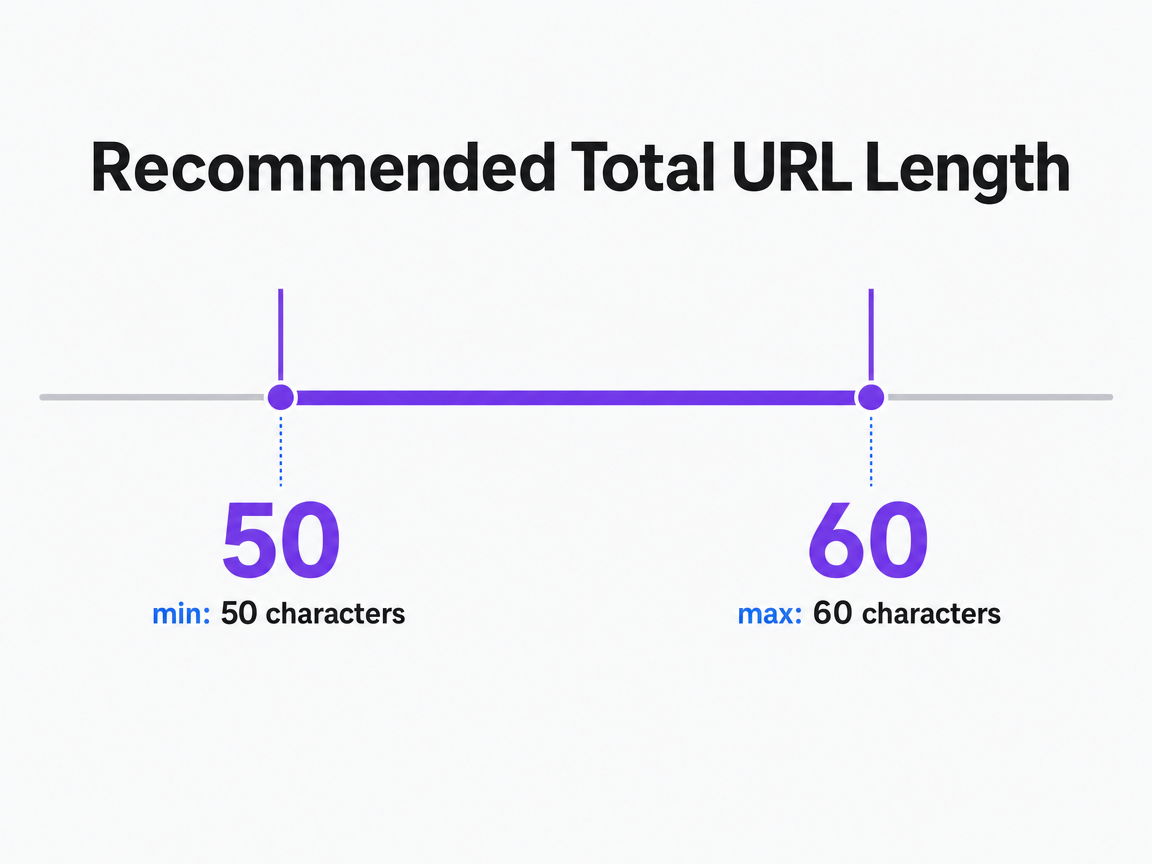
A best practice from Briskon suggesting the entire URL should be under approximately 50 to 60 characters.
See How Centralized Slug Governance Delivers Measurable SEO Gains at Scale
Connect with a specialist to review real-world data on scalable slug management, approval workflows, and multi-site architecture that leading agencies use to drive consistent SEO outcomes across large portfolios.
The Portfolio Slug Governance Checklist
What follows is the delivery-team version of everything above: a single checklist a Head of SEO can hand to a junior auditor on day one, applied identically across every client site in the book.
Convention layer. : Descriptive words, no numeric IDs. Hyphens between words, never underscores. Lowercase enforced at the server or CDN, not the CMS template. No URL fragments for indexable content 9. Slug length 25–30 characters within a 50–60 character total URL, with 60 characters as the hard slug ceiling before audit flag 8, 6. No dates, seasons, version numbers, or promotional terms in the path 4.
Hierarchy layer. : Maximum three folder levels from root for standard templates 2, 5. A fourth level requires a documented linking justification. Ecommerce clients follow /category/product; multi-location clients follow one portfolio-wide pattern — service-first or location-first — decided once and applied everywhere 12, 3.
Facet layer. : Filter parameters above two are noindexed or disallowed by default 14. UI-only filters use fragments. Filter order is normalized at the platform layer. Zero-result combinations return 404 10.
Discoverability layer. : Every important page sits three clicks or fewer from home and receives at least five internal links, using standard anchor elements with descriptive text 14, 11.
Migration layer. : No slug change ships without a mapped 301, a sitemap update, and monitoring at 30, 90, and 365 days. Redirects stay live for at least twelve months 17.
Print it. Attach it to every onboarding. Audit against it quarterly.
Enforcement Beats Debate
The disagreements in slug SEO are narrower than the volume of writing about them suggests. Descriptive words, hyphens, lowercase, and shallow paths are settled at the source 9. Depth tolerates a one-level argument. Facet policy has a defensible default above two parameters 14. Migrations have a twelve-month redirect floor that is not up for negotiation 17. None of that is where an agency's throughput problem actually lives.
The problem lives in whether the same rule gets applied the same way on every site, every brief, every migration mapping, without a senior strategist adjudicating each call. Codify the standard once. Enforce it at onboarding, brief stage, and quarterly audit. That is where a platform like Vectoron earns its place in the delivery stack — coordinating specialist execution against one governed policy across a book of clients, so the margin from consistency compounds instead of leaking.
Frequently Asked Questions
References
- 1.SEO-Friendly URL Structure Guide for Better Rankings | W3Era.
- 2.URL Structure Best Practices for SEO: What Google Wants ....
- 3.The Enterprise Guide to Ecommerce Technical SEO in 2026.
- 4.URL Structure for SEO: What Actually Matters in 2026.
- 5.URL Structure: Best Practices for SEO-Friendly Websites.
- 6.URL Structure for SEO: Build Clean, Rankable URLs.
- 7.Shopify Technical SEO: Complete 2026 Guide for UK Stores.
- 8.SEO URL best practices for 2025 - Optimize URLs that rank ....
- 9.URL Structure Best Practices for Google Search.
- 10.Crawling December: Faceted navigation.
- 11.SEO Link Best Practices for Google.
- 12.Help Google understand your ecommerce site structure.
- 13.Search Engine Optimization (SEO) Starter Guide.
- 14.Site Architecture for Large Sites: Crawlable & Scalable SEO.
- 15.Shopify Technical SEO Blueprint: Architecture to Schema.
- 16.SEO-Friendly URLs: Keyword Tips & Best Practices.
- 17.Site moves with URL changes.