
Key Takeaways
- Snippet text is drawn primarily from page content, so rewriting the extractable body passage where Google pulls its preview beats editing meta descriptions on pages that already rank.
- Layout, not rank alone, decides clicks: join Search Console data with the SERP feature each query triggers, then score rewrite candidates using Impressions × CTR gap × commercial intent.
- Treat featured snippets as a three-way decision — pursue when ranking 2–5 on a snippet query the page doesn't own, block on high-intent queries the page already leads, ignore the rest 2.
- Focus quarterly effort on the top-decile rewrite queue, construct two-to-three-sentence extractable passages above the fold, and freeze URLs for 21–28 days before judging impressions-normalized CTR lift.
The CTR gap hiding in pages that already rank
Most demand gen teams inherit a portfolio of pages ranking on page one that quietly underperform their impression volume. The ranking is real. The clicks are not showing up. That gap is where snippet optimization pays back, and it is almost entirely a function of what the result preview looks like — not where the URL sits on the page.
Layout, not rank, now drives a large share of click behavior. A 2023 analysis of 24 SERP features across 67,000 keywords, more than 6 million clicks, and over 24 million views found that organic CTR is shaped substantially by which features appear above and around a result 15. Earlier caption-level research already established the mechanics: missing snippets, short snippets, missing query terms, and awkward URLs all suppress clicks even when relevance is otherwise fine 10.
The practical implication for in-house teams: treat the snippet as a controllable revenue lever with a measurable delta, not a formatting checkbox. What follows is how to identify which snippets to rewrite, what actually controls the text, and how to prove the lift.
What snippet text actually comes from (and what it doesn't)
Page content is the primary source, not the meta description
The most common snippet-optimization mistake is spending rewrite hours on meta descriptions. Google clarified in its 2024 documentation update that snippet text is generated primarily from the page content itself, and structured data is not the primary source of snippet wording 19. Meta descriptions are used situationally — only when Google judges them a more accurate match for the specific query than what the algorithm can pull from the body 2.
That reordering matters for how demand gen teams allocate time. Editing a meta description on a page whose snippet is already being drawn from an H2 and a supporting paragraph will not change what searchers see. The rewrite has to happen inside the body copy — specifically in the passages that surface for the queries the page ranks on.
Google also supports directive controls that operate on top of this hierarchy: nosnippet, max-snippet, and data-nosnippet let publishers restrict or truncate what appears, but they cannot force a specific string into the preview 2. The practical read: control the source text, and treat the meta description as a fallback that Google may or may not use.
The three control surfaces: title link, snippet body, rich-result eligibility
Three distinct levers shape what a result looks like, and each has its own rules.
Title link.
: Google generates the clickable title from the <title> element, on-page headings, and other prominent text. Its guidance is explicit: give every page a unique, descriptive title, keep it concise, and skip keyword stuffing or repeated boilerplate 1. Titles are frequently the first thing rewritten in a CTR-recovery pass because they influence perceived relevance before the eye reaches the snippet body.
Snippet body.
: As covered above, this is drawn primarily from page content, with meta descriptions used when they better match the query 2. The description meta tag remains a supported input and is sometimes used verbatim in results 3, but treating it as the default control lever misreads how Google actually assembles the preview.
Rich-result eligibility.
: Structured data does not rewrite the snippet text. It qualifies a page for richer visual treatments — review stars, product prices, FAQ dropdowns, carousels — that sit alongside or replace the plain caption 4. Product markup can surface price, availability, ratings, and shipping when review, aggregateRating, or offers is present 5.
A note on Bing: same anatomy, different weightings
Bing builds its captions from the same four ingredients — title, snippet, URL, and preview — and its documentation states the snippet may come from the meta description, from directory data, or from algorithmic extraction of page content 7. The practical difference is that Bing gives meta descriptions more consistent weight than Google does, so a page optimized purely against Google's page-content hierarchy may leave a Bing-specific rewrite opportunity on the table. Bing's broader webmaster guidelines reinforce that snippet quality depends on the same crawlability and metadata fundamentals 8.
Why layout, not rank, now decides whether a ranking earns clicks
SERP-feature effects are non-uniform across 24 layout types
The instinct to model organic CTR as a function of rank alone is now a modeling error. A 2023 study analyzing 24 distinct SERP features across 67,000 keywords, more than 6 million clicks, and over 24 million views found that features amplify or attenuate CTR in different directions depending on the feature and where it sits on the page 15. That is the important nuance: there is no single "SERP-feature penalty" to bake into a forecast. Video carousels, image packs, knowledge panels, direct answers, and shopping units each move clicks differently, and some layouts leave organic CTR largely intact while others compress it hard.
A separate trace-based analysis of Google search components reinforces the non-uniformity. In that dataset, direct answers and featured snippets suppressed clicks and increased time spent on the SERP itself, with featured snippets showing a measured effect of roughly -6.5 percentage points on organic CTR in the reported layouts 14. That number is not a universal law — it reflects specific query mixes and result configurations in one large trace — but it establishes the direction and rough magnitude of a class of layout effects.
For demand gen teams, the operational read is that a portfolio's ranking report and its CTR report have to be joined at the query-and-layout level, not at the URL level. A page ranking second on a query with a snippet, a video carousel, and a People Also Ask block is a different revenue asset than the same page ranking second on a plain ten-blue-links layout.
Featured snippet CTR by position within the snippet layout
Position inside a feature matters as much as the ranking position that produced it. SISTRIX's layout-specific dataset — one of the most-cited SERP-CTR breakdowns available — reports featured snippet CTR of 23.3% at position 1, 20.5% at position 2, and 13.3% at position 3 within the featured-snippet layout 16. The drop from position 2 to position 3 is roughly a third of the click share evaporating between two adjacent slots inside the same feature type.
That shape has two implications for how in-house teams should read their own data. First, layout-specific CTR benchmarks diverge sharply from aggregate rank-based benchmarks, which is why generic "position 3 gets X percent" tables lead to bad prioritization decisions when applied to feature-heavy queries. SISTRIX's numbers apply to the featured-snippet layout specifically, not to every SERP with a snippet somewhere on the page 16. Second, the position curve is steep enough that a rewrite lifting a page from the third snippet slot into the first is a materially different outcome than one that only tightens the existing preview text.
The chart below shows the featured snippet CTR curve inside the snippet layout, sourced from SISTRIX 16. Teams building a scoring model for rewrite candidates should treat these numbers as ceiling references for featured-snippet queries, not as blanket organic benchmarks. For queries where the feature is not present, the applicable benchmark is a different curve entirely, which is why the audit workflow later in this article splits candidates by the layout they appear in before applying any expected-lift math.
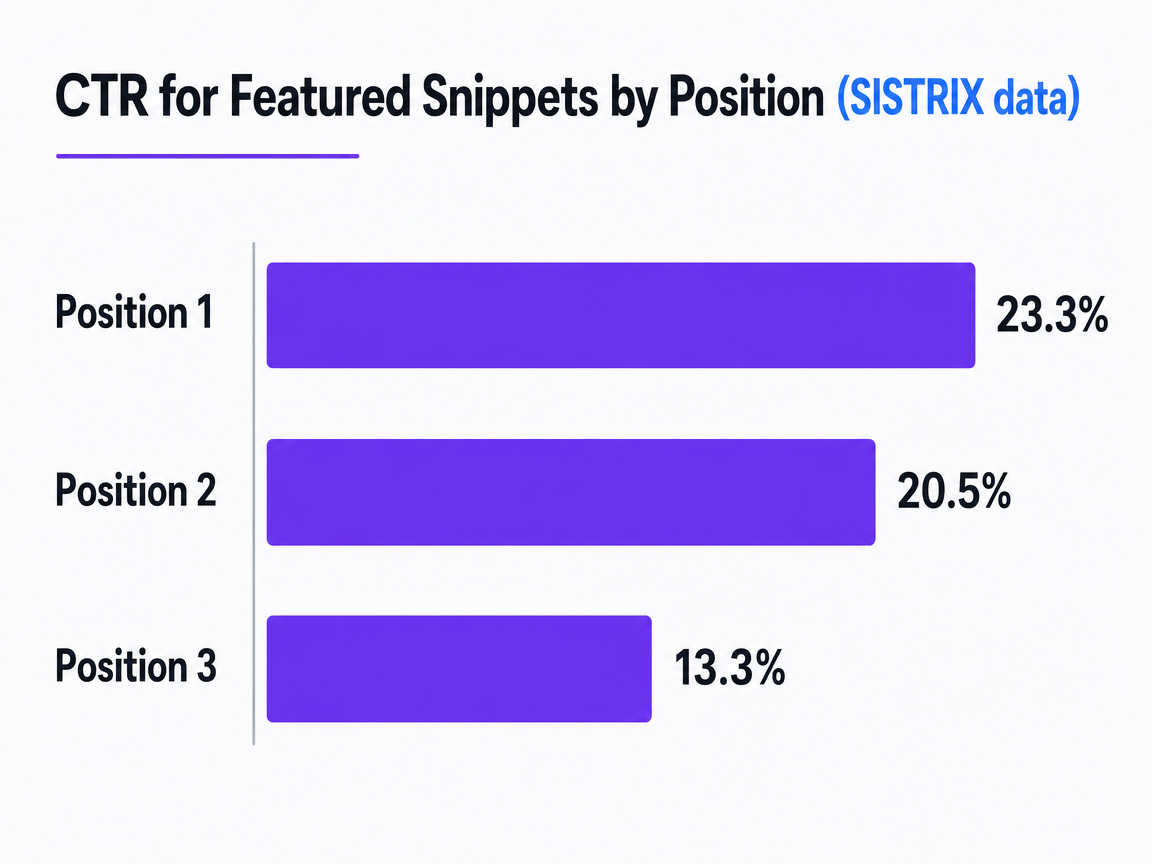 CTR for Featured Snippets by Position (SISTRIX data)
SISTRIX data shows the click-through rate for featured snippets varies by their position within the featured snippet layout on the search results page.
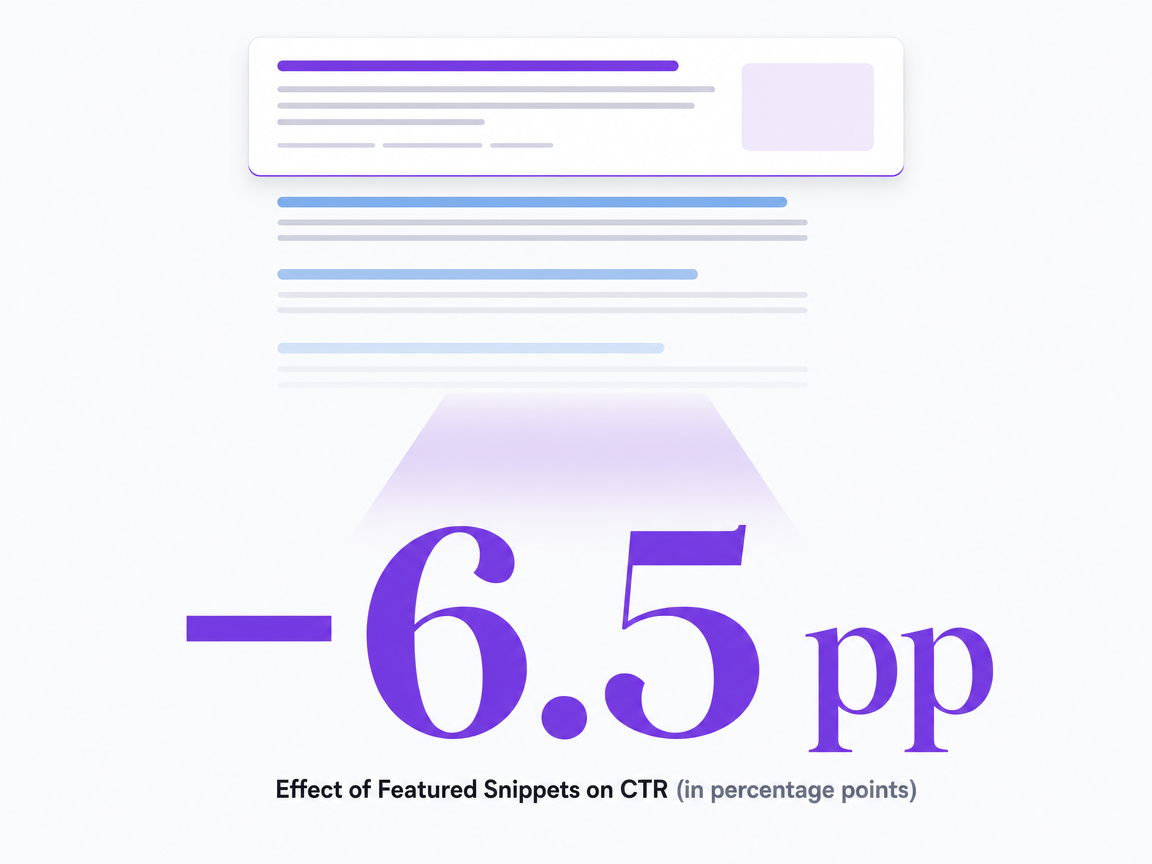 Effect of Featured Snippets on CTR (in percentage points)
Effect of Featured Snippets on CTR (in percentage points)
Test Data-Driven Snippet Optimization On Live Pages
See the impact of optimized snippets on your actual rankings and click-through rates before you commit.
Resolving the featured-snippet contradiction: pursue, block, or ignore
The cannibalization case: first-result CTR falls from 26% to 19.6%
Ahrefs' widely cited featured-snippet analysis, summarized in Search Engine Land, found that the first organic result drops from 26% CTR without a featured snippet on the page to 19.6% CTR when a featured snippet is present, while the snippet itself picks up 8.6% of clicks 17. Read as a swap, roughly 6.4 percentage points of click share move off the first organic slot and about 8.6 points land in the snippet box — meaning the page that owns the snippet in that layout captures more than the page that would otherwise sit at rank one without it.
The chart below visualizes that redistribution: first-result CTR with versus without a featured snippet, alongside the snippet's own capture rate 17. The scope matters. This is a keyword-level comparison from a single crawler-based dataset, not a controlled experiment, and it does not distinguish informational from commercial queries. What it does establish cleanly is directional: on pages where a snippet appears, the ranked-first URL underperforms its rank-based expectation unless that URL is also the snippet source.
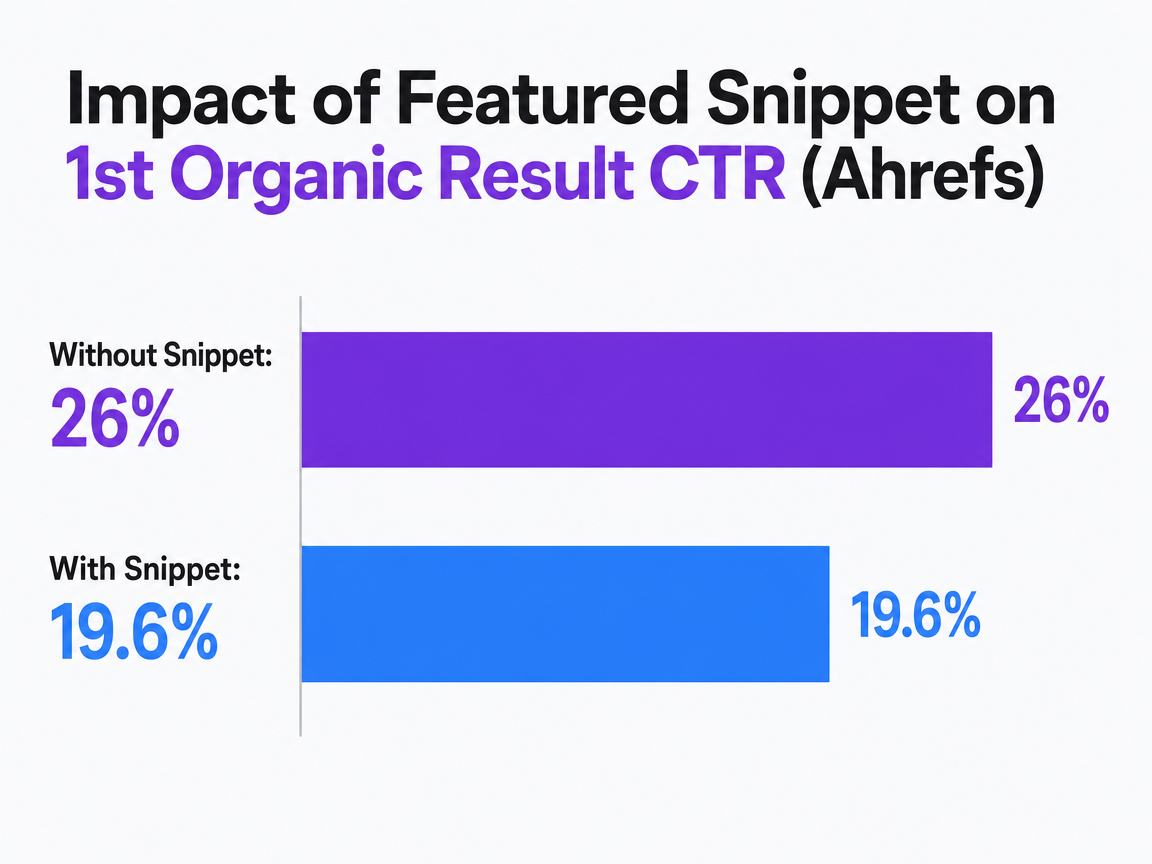 Impact of Featured Snippet on 1st Organic Result CTR (Ahrefs)
Data from an Ahrefs study shows the drop in click-through rate for the first organic search result when a featured snippet is present on the page.
The click-neutral counterweight from 250M SERPs
A larger dataset tells a different story. Perficient Digital's analysis of roughly 250 million SERPs, reported by Search Engine Land, found featured snippets to be approximately click-neutral in aggregate — clicks shift across positions when a snippet appears, but the total organic click volume for the page does not collapse the way the cannibalization framing suggests 18. The two studies are not directly contradictory. Ahrefs measured what happens to the first organic result specifically; Perficient measured aggregate click behavior across the full result set.
Put together, they describe a redistribution effect rather than a pure loss. Clicks move toward the snippet slot and away from adjacent organic positions, and the net outcome for any individual page depends on whether that page is the snippet source, sits directly below it, or ranks further down where the layout effect is smaller. Teams treating featured snippets as universally bad — or universally worth chasing — are working from half the evidence.
A decision rule for pursuing or blocking featured snippets
The operational read is a three-way sort by current position and commercial intent, not a blanket policy.
- Pursue the snippet when the page currently ranks in positions 2–5 on a query where a snippet already appears and the page is not the source. The snippet slot's capture rate in that layout (8.6% in the Ahrefs data) typically exceeds what positions 3–5 earn on the same query 17, and winning the source position lifts the page above the rank-based ceiling it would otherwise hit.
- Block the snippet — using
max-snippet:0ordata-nosnippeton the passage Google is likely to extract 2— when the page already ranks first on a high-commercial-intent query and the search intent is answerable in one or two sentences. Blocking removes the featured-snippet treatment for that URL, keeping the click on the full-page result rather than the truncated answer box. - Ignore the feature when the query is informational, the page ranks outside the top five, or the snippet is being awarded to a source the page cannot realistically outrank. Rewrite time is better spent on the passage-level work covered in the next section.
Building snippet-worthy passages instead of writing meta descriptions
What micro-browsing research says about individual words in the preview
Snippet text is not read the way body copy is read. A micro-browsing model of search snippets found that users scan snippet lines at a resolution fine enough that specific words within a single line influence click behavior, and CTR itself functions as a relevance signal that feeds back into how future results are ranked 13. The unit of optimization, in other words, is not the snippet as a whole. It is the phrase.
That shifts the rewrite target. On a page ranking third for a query with clear commercial intent, the useful question is not "is the meta description compelling." It is which sentence inside the page body currently gets extracted, and whether the query terms, the qualifier, and the value phrase all appear inside the two or three lines Google will display. Older caption research established the baseline: missing query terms in the snippet suppress clicks even when the page is otherwise relevant 10. Micro-browsing evidence sharpens that finding by pointing to word-level attention, not sentence-level presence 13.
The length-informativeness tradeoff: longer feels better, decides worse
A SIGIR study isolating snippet length as a variable found that participants judged longer summaries as more informative and interacted with them more often as length increased 11. That maps to the intuition that more preview text earns more clicks. It also comes with a caveat the same study documented: longer snippets did not consistently improve the accuracy of participants' downstream decisions about whether a result actually answered their query 11.
For demand gen teams, the practical read is that length is a CTR lever, not a qualification lever. A longer, more informative preview can pull in more clicks and more mismatched clicks at the same time. On high-intent commercial queries where post-click qualification matters — demo requests, quotes, consultations — the passage should optimize for a precise match between what the snippet promises and what the landing section delivers, not for maximum word count.
A passage construction pattern for high-intent queries
The construction pattern that follows from the micro-browsing and length evidence is a two-to-three-sentence block placed early in the page body, structured to be extractable on its own. Three components do most of the work.
- An opening sentence that contains the query phrase or its closest natural variant plus the specific outcome or artifact the page delivers. Google's snippet generation draws primarily from page content 19, and giving it a sentence where the query terms and the value phrase are adjacent raises the odds that sentence is the one selected 2.
- A qualifier sentence that names the audience, scope, or condition — the phrase that filters mismatched clicks before they happen.
- An optional third sentence carrying a concrete number, timeframe, or deliverable, which functions as the word-level attention hook the micro-browsing research identifies 13.
The block should live above the fold in the HTML, not buried under an H2 halfway down. Titles remain the first CTR lever 1, but the extractable passage is what determines whether the snippet under that title reinforces the promise or contradicts it.
See How Data-Driven Snippet Optimization Increases Qualified Clicks
Request a demo to review real-world snippet improvements and benchmark your current SERP performance against industry leaders in multi-location and enterprise sectors.
Running snippet optimization as a portfolio program
The scoring model: Impressions × CTR gap × commercial intent
A rewrite queue built on gut feel produces gut-feel results. The scoring model that separates high-value snippet work from busywork has three inputs, and all three come from data demand gen teams already have.
Impressions is the ceiling. : A query with 300 impressions per month cannot produce meaningful lift no matter how sharp the rewrite is. Pulling the last 90 days of Google Search Console impressions per query per URL sets the addressable volume for each candidate.
CTR gap is the delta between current CTR and a layout-appropriate benchmark. : For queries triggering the featured-snippet layout, the SISTRIX position-specific rates (23.3% / 20.5% / 13.3%) serve as ceiling references 16. For plain organic layouts, a smoothed internal benchmark from the same site's better-performing queries in the same position tends to outperform any generic curve — SERP-feature composition varies too much across 24 layout types for a single external table to fit every query 15. The gap is expressed as benchmark CTR minus current CTR, floored at zero.
Commercial intent weight is a multiplier, not a filter. : A 1.0 weight for informational queries, 1.5 for consideration-stage queries, and 2.0 for demo-request or quote-request queries reflects that a click on a bottom-of-funnel query is worth more to pipeline than a click on a definition query. The weights are calibratable against the team's own closed-won data by query cluster.
Multiply the three. Sort descending. The top decile is the rewrite queue.
Audit workflow from GSC export to measurement window
The workflow runs in five steps, all of which fit inside a normal marketing operations cadence without new headcount.
- Export. Pull 90 days of Search Console data at the query-URL grain, filtered to positions 2–15. Positions above 2 have limited rewrite upside on most queries; positions below 15 rarely produce enough impressions to move the score.
- Classify by layout. Tag each query with the SERP feature that appears — featured snippet, People Also Ask, video carousel, knowledge panel, or plain organic. Layout composition determines which benchmark applies to the CTR-gap calculation 15.
- Score and rank. Apply the Impressions × CTR gap × commercial intent formula. The top 20 to 40 candidates typically absorb a quarter's worth of rewrite capacity for a two-person content team.
- Rewrite the extractable passage, not the meta. Locate the sentence Google currently pulls (visible in the SERP preview), then rewrite the passage in the page body using the construction pattern from the previous section. Meta description edits go last, as a fallback 2.
- Measurement window. Freeze the URL for 21 to 28 days post-publish before judging lift. Snippet regeneration is not instant, and week-over-week noise on a single URL is high enough to produce false negatives inside a two-week read. Compare impressions-normalized CTR pre and post, not raw clicks.
If you manage snippets across multiple brands or portfolio properties
Teams running snippet optimization across a portfolio — multi-brand groups, multi-location service businesses, or agencies managing several client properties — face a different problem than single-site operators. The scoring model still applies per property, but rewrite capacity has to be allocated across properties, and the pages competing for that capacity have different commercial intent weights depending on which brand's pipeline they feed.
The workable pattern is a two-tier queue. Each property produces its own top-decile candidate list using the same formula. A central review then re-ranks across properties using a portfolio-level weight — pipeline contribution, average deal size, or CAC recovery per lead — to decide which property's rewrites ship first each sprint. This keeps property-level teams focused on their own data while preventing the largest-impression property from consuming all rewrite capacity by default.
What operators should do this quarter
Snippet optimization pays back fastest as a 90-day program with three concrete deliverables.
- A joined dataset: Search Console impressions and CTR at the query-URL grain, tagged with the SERP layout each query triggers, so rewrite candidates get scored against the right benchmark rather than a generic rank curve 15.
- A top-decile rewrite queue produced by Impressions × CTR gap × commercial intent, with the extractable body passage — not the meta description — as the primary edit target 19.
- A featured-snippet decision applied per URL: pursue when ranking 2–5 on a snippet query the page does not own, block on high-intent queries where the page already ranks first, ignore the rest 2.
Teams running this across multiple properties without adding headcount typically need a coordination layer. Vectoron is one option in that category — an AI marketing execution platform with an approval workflow that keeps human sign-off on every rewrite.
Frequently Asked Questions
References
- 1.Influencing your title links in search results.
- 2.How to Write Meta Descriptions.
- 3.Meta Tags and Attributes that Google Supports.
- 4.Structured Data Markup that Google Search Supports.
- 5.Intro to Product Structured Data on Google.
- 6.Customizing Results Snippets.
- 7.Anatomy of a Bing caption.
- 8.Webmaster Guidelines.
- 9.Incorporating Clicks, Attention and Satisfaction into a Search Model.
- 10.Clickthrough Patterns in Web Search.
- 11.A Study of Snippet Length and Informativeness.
- 12.Microsoft Word - chi13-clickablesnippets\_v17.docx.
- 13.Micro-Browsing Models for Search Snippets.
- 14.Google the Gatekeeper: How Search Components Affect Clicks and Attention.
- 15.Beyond Rankings: Exploring the Impact of SERP Features on Organic Click-through Rates.
- 16.These are the CTR's For Various Types of Google Search Result.
- 17.Another study shows how featured snippets steal significant traffic from ....
- 18.Analysis of 250 million SERPs finds no-click story more complex than it appears.
- 19.Google Clarifies How Algorithm Chooses Search Snippets.