
Key Takeaways
- Profound maps where a client's brand surfaces across ChatGPT, Perplexity, Gemini, and Claude, translating citation data into share-of-voice reports agencies can hand to clients 7.
- Peec AI measures citation rate and ranking movement against agency-defined prompt libraries, producing QBR-ready artifacts without covering the internal LLM pipeline 8.
- Otterly.AI tracks which URL a model chose to cite and alerts when citations change hands, giving SEO teams a diagnostic surface in familiar link-graph terms 7.
- AthenaHQ ties visibility gaps to specific content interventions and tracks whether those fixes moved the needle, closing the loop between diagnosis and delivery ticket 7.
- Langfuse traces every prompt, completion, and eval score with versioned prompt history, producing the audit artifact regulated clients' counsel asks to see 8.
- Arize AI instruments retrieval separately from generation, isolating whether errors trace back to source documents or the model itself — critical for RAG-driven client pipelines 8.
- Fiddler AI pairs prompt tracing with safety metrics, explainability, and model risk documentation, fitting behavioral health and financial services clients that require compliance-grade posture 8.
- WhyLabs extracts drift, toxicity, refusal, and jailbreak signals through LangKit, functioning as an early-warning system that aligns with ISO/IEC 42001's production monitoring obligation 2.
- Vectoron routes recommendations from six specialist strategists through human approval inside the production loop, making the audit trail the workflow itself and covering Govern natively 2.
The Two Categories Agency Buyers Keep Confusing
Search the phrase "software for LLM visibility" and the top results mix two products that solve entirely different problems for an agency. One category tracks whether a client's brand surfaces inside answers generated by ChatGPT, Perplexity, and Gemini. The other category watches the LLMs the agency itself uses to produce content, monitoring output quality, hallucination rates, prompt drift, and cost per call. Both get sold under the same keyword. Neither replaces the other.
AI-answer visibility trackers sit on the demand side. They tell a Head of SEO whether a law firm client shows up when a prospect asks a chatbot for a personal injury attorney in Phoenix, and whether the citation goes to the client's site or to a directory. LLM observability platforms sit on the supply side. They record every prompt an agency sends to a model, every response returned, and every eval score against a rubric — feeding the audit trail a client's legal team will eventually ask to see 2, 8.
The procurement consequence is direct: buying one and calling the job done leaves half the surface uncovered. A tracker that logs brand mentions in Perplexity cannot prove that the copy an agency shipped last Tuesday passed a hallucination check. An observability platform that traces every model call cannot tell a client whether their competitor is winning the AI answer for a high-intent query. The rest of this piece separates the two categories, then ranks the specific tools inside each.
Why LLM Visibility Became a Delivery Problem, Not a Tooling Preference
The volume moved faster than the controls. McKinsey's 2024 global survey found 65% of organizations regularly using generative AI, nearly double the prior year, with the largest jump inside marketing and sales functions 6. Forrester's 2024 read on US agencies puts adoption above 60%, with another 31% actively exploring use cases and 76% of decision-makers expecting a significant or very significant impact on how client content gets produced within two years 4, 9. On the practitioner side, the American Marketing Association's 2024 survey with Lightricks reports that roughly 90% of marketers have used generative AI at work and 71% use it weekly or more often 5.
That mix creates a specific delivery problem for a Head of SEO. Client work is being generated at weekly cadence by people who mostly reach for a general-purpose chatbot, while the observability layer underneath that work is inconsistent, partial, or absent. The AMA survey notes that 85% of AI-using marketers report productivity gains, but the same respondents flag ongoing doubts about whether AI-generated output matches human quality 5. Productivity ran ahead of QA.
McKinsey's 2024 update reinforces the gap: adoption is broad, but formal measurement of value and risk controls remains immature at most organizations 6. For an agency running 20+ accounts, that gap shows up as inconsistent brand voice across writers, unlogged prompt histories a client's counsel later asks to review, and no defensible answer when a regulated client asks how a claim in last quarter's blog was substantiated. LLM visibility software exists because the delivery pace no longer leaves room to answer those questions manually.
The Evaluation Rubric: Mapping Tools to NIST AI RMF Functions
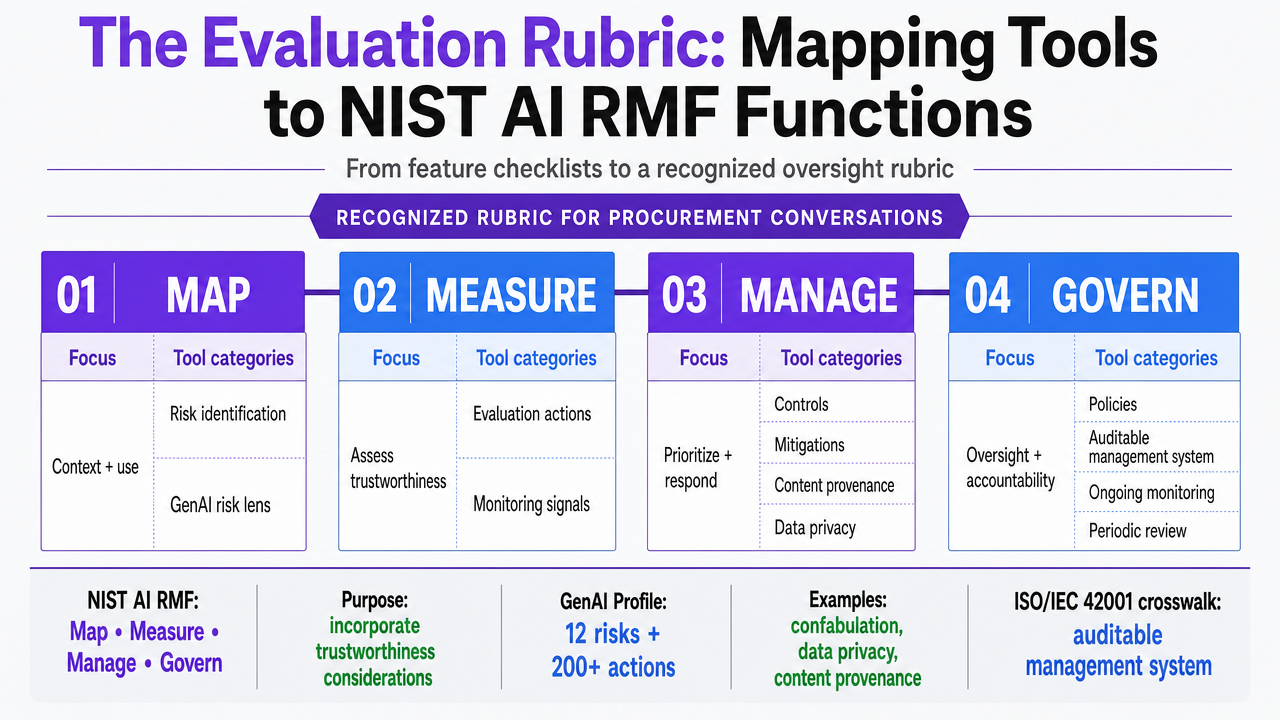
Feature checklists lose in procurement conversations. What survives is a rubric a client's counsel already recognizes. The NIST AI Risk Management Framework organizes AI oversight into four functions — Map, Measure, Manage, and Govern — and states its purpose as helping organizations
"incorporate trustworthiness considerations into the design, development, use, and evaluation of AI products, services, and systems"
7. The companion GenAI Profile (NIST AI 600-1) then narrows the lens to generative systems, cataloging 12 risks unique to or exacerbated by generative AI and more than 200 suggested actions to manage them, including confabulation, data privacy, and content provenance 8. The ISO/IEC 42001 crosswalk pushes the same functions into an auditable management system, requiring that
"ongoing monitoring and periodic review of the risk management process and its outcomes are planned"
and that AI system behavior is
"monitored when in production"
2.
Applied to tool selection, the four functions split cleanly across the categories this article separates:
Map : Where AI-answer visibility trackers earn their spot: they identify which client brands, competitors, and citations surface inside generated answers, defining the surface area of exposure. (Map)
Measure : The native job of LLM observability and evaluation platforms — they instrument prompts, log outputs, score against rubrics, and quantify drift over time.
Manage : Covers hallucination detection, red-teaming, and incident response, which some observability tools handle natively and others delegate to bolt-ons.
Govern : The audit-trail layer: role-based approvals, versioned prompts, and documentation a client's legal team can subpoena without a fire drill.
Most tools cover one function well and touch a second. Very few close all four. The practical read for a Head of SEO: score each candidate against which RMF function it primarily supports, then confirm whether the remaining three come from another tool in the stack or from documented process. A single vendor claiming to cover Map through Govern is worth questioning against the GenAI Profile's specific risk list before it lands on a shortlist 8.
 Visualize the four NIST AI RMF functions and how each tool category in the article maps to them, directly supporting the section's rubric framing
Test LLM visibility tools with real campaigns
Evaluate LLM-driven visibility metrics using your own client content during a risk-free trial period.
AI-Answer Visibility Trackers: Where the Brand Shows Up in Generated Responses
Profound
Profound built its category around a specific question: when a prospect asks a chatbot for a recommendation in the client's vertical, does the client show up, and how? The platform samples prompts across ChatGPT, Perplexity, Gemini, and Claude, then logs which brands appear in the generated answer, which URLs get cited, and how sentiment shifts across models. For a Head of SEO running a legal or dental DSO account, that output translates directly into a client-facing report: share of voice inside AI answers, competitor citation frequency, and citation source domains.
On the NIST rubric, Profound is a Map function tool 7. It defines where the client's brand exists inside the generative surface, but it does not measure the agency's own model output or manage prompt-level risk. Agencies using it typically pair it with an observability layer to cover Measure and Govern. The value is in surfacing which content assets are actually feeding cited answers, which then feeds an editorial roadmap.
Peec AI
Peec AI positions closer to a share-of-voice analytics product than a monitoring dashboard. It tracks brand mentions and competitor visibility across major generative engines on a prompt-set basis, letting an agency define the prompt library that matters for a specific client — say, 200 prompts a personal injury prospect might type into Perplexity — and then measures citation rate, ranking position within the answer, and week-over-week movement.
The reporting cadence fits agency delivery well. Peec's dashboards produce artifacts a Head of SEO can drop into a client QBR without reformatting. On the RMF map, it sits in Map with a partial reach into Measure 7, because it quantifies visibility trends rather than only cataloging presence. It does not touch the agency's internal LLM pipeline, so it is not a replacement for prompt-level logging when a regulated client asks how a specific claim was produced 8.
Otterly.AI
Otterly.AI focuses tightly on prompt monitoring across AI search interfaces, with an emphasis on the citation link — which page on the client's domain (or a competitor's) the model chose to reference. For agencies whose SEO teams already work in link-graph terms, that framing is native. A monitored prompt set updates on a schedule, alerts fire when a citation changes hands, and the exported data slots into existing SEO reporting stacks.
Otterly's practical strength is diagnostic. When a client's citation share drops on a high-intent query, the tool surfaces which competing URL replaced it, which the content team can then reverse-engineer. Category-wise, it is Map with light Measure 7. It does not evaluate the safety or accuracy of content the agency itself produces, so a regulated vertical still needs an observability platform underneath to satisfy the GenAI Profile's provenance and content-detection risks 8.
AthenaHQ
AthenaHQ approaches AI-answer visibility as an optimization workflow, not just a monitoring one. Beyond tracking whether a client appears in generated responses, the platform ties visibility gaps to specific content interventions — schema adjustments, entity coverage, citation-worthy asset creation — and tracks whether those interventions moved the needle across engines. For a Head of SEO managing 20+ accounts, that closes the loop between diagnosis and delivery ticket.
The procurement read is straightforward. AthenaHQ covers Map and pushes into Manage on the NIST rubric 7, because it operationalizes response to detected visibility gaps rather than stopping at reporting. It does not instrument the agency's LLM production pipeline, so it will not answer a client's counsel when they ask which model version generated a specific paragraph. Pair it with an observability tool on the supply side, and the two categories cover Map through Manage cleanly.
LLM Observability and Evaluation Platforms: What the Models Are Actually Producing
Langfuse
Langfuse is an open-source LLM engineering platform that traces every prompt, completion, tool call, and retrieval step inside an agent workflow, then attaches evaluation scores to those traces. For a Head of SEO running content operations across 20+ accounts, the useful primitive is the trace — a full record of what was sent to which model, what came back, and how a scoring rubric graded the output. Prompts get versioned, datasets get replayed against new model versions, and cost per generation is tracked at the client tag level.
On the NIST rubric, Langfuse sits squarely in Measure with meaningful reach into Govern 7. The versioned prompt history and dataset-linked evaluations produce the artifact a regulated client's counsel actually wants to see when asking how a specific claim was substantiated 8. Its open-source posture also matters in procurement — self-hosting keeps client prompt data inside the agency's own perimeter.
Arize AI
Arize AI grew out of ML observability and extended into LLM monitoring as generative workloads moved into production. The platform pairs trace-level logging with drift detection, a purpose-built eval library, and structured experiments — meaning an agency can set up a hallucination rubric, run it against a sample of last week's outputs, and see whether a model update degraded factuality on legal disclaimers.
What distinguishes Arize for agency delivery is its handling of retrieval-augmented generation. When client content pipelines pull from a knowledge base — case histories for a personal injury firm, procedure descriptions for a dental DSO — Arize instruments the retrieval step separately from the generation step, isolating whether errors trace back to the source documents or the model. On the RMF map, that puts it firmly in Measure and Manage 7, covering both quantification of behavior and the incident-response loop the GenAI Profile calls out for confabulation risk 8.
Fiddler AI
Fiddler AI leans into the governance side of the observability category. Beyond tracing prompts and scoring outputs, the platform emphasizes explainability, safety monitoring, and model risk documentation — the artifacts an enterprise client's risk committee expects when an agency proposes AI-assisted content for a regulated audience. Fiddler's LLM monitoring includes safety metrics (toxicity, PII exposure, prompt injection signals) alongside quality metrics (faithfulness, relevance).
For a Head of SEO delivering behavioral health or financial services accounts, the differentiator is the compliance-grade posture out of the box. Fiddler maps cleanly to Manage and Govern on the NIST rubric 7, with the safety and provenance controls that align to the GenAI Profile's data privacy and content detection recommendations 8. It is heavier to deploy than a developer-first tool like Langfuse, which is the tradeoff — more procurement friction for the agency, less procurement friction with the client.
WhyLabs
WhyLabs approaches LLM observability from a data-quality lineage. Its LangKit library extracts signals from prompts and responses — sentiment, toxicity, refusal rates, jailbreak attempts, semantic similarity to expected outputs — and pipes them into a monitoring layer that fires alerts when distributions shift. For an agency, that translates into a passive watchdog: when a writer's prompt patterns drift or a model version starts refusing on-topic legal queries, the alert lands before it reaches a client review.
The design philosophy fits agencies that want visibility without instrumenting every workflow manually. WhyLabs covers Measure and touches Manage on the NIST rubric 7, with particular strength in the ongoing-monitoring obligation the ISO/IEC 42001 crosswalk highlights — that AI system behavior must be
"monitored when in production"
2. It is less a debugging surface than an early-warning system, which is often the right primitive at portfolio scale.
Capability-Based Monitoring and the Human-in-the-Loop Gap
Most observability tools grade LLM output task by task: was this summary faithful, did this classification match the label, did this response cite the right source. A 2026 peer-reviewed paper on LLM oversight argues that framing misses the point. The authors state that
"large language models require a new form of oversight"
and recommend "capability-based monitoring" — grouping evaluations by the shared capability being exercised (summarization, retrieval, multi-step reasoning) rather than by isolated tasks, so systemic weaknesses surface before they propagate across use cases 1.
For a Head of SEO, the practical difference shows up when a model update quietly degrades reasoning on comparative claims. A task-based eval might flag one failing prompt in a legal client's Q3 content batch. A capability-based dashboard shows the reasoning capability itself trending down across every account that relies on it — dental DSO service comparisons, home services scope explanations, financial disclosure paragraphs. One is a bug ticket; the other is a portfolio-level alert.
The same paper flags the parallel risk: automation bias. When automated evaluators run at scale, human reviewers start rubber-stamping their verdicts, and the two-tier oversight model collapses into a one-tier one 1. The design fix the authors recommend is explicit — automated screening feeds a human review layer with defined thresholds, and reviewers see disagreement cases, not just the queue. Agencies evaluating observability tools should ask whether the platform routes borderline evaluations to human reviewers by default, or whether it presents every trace as green until someone digs. The second design pattern is what produces the compliance failure a client's counsel eventually surfaces.
See How Leading Agencies Achieve LLM Visibility at Scale
Request a data-driven walkthrough of unified platforms that automate LLM optimization, streamline approval workflows, and help agencies deliver measurable client impact without expanding headcount.
Vectoron: Approval-First Execution With Visibility Built Into the Production Loop
Every tool covered so far sits next to the agency's production workflow. Vectoron sits inside it. The platform coordinates six specialist strategists — content, SEO, PPC, backlinks, social, and call intelligence — through a Command Center where every recommendation carries the reasoning behind it and no output ships until a human approves it. Visibility is not a dashboard bolted on after the fact; it is the routing logic of the workflow itself.
That design changes the RMF conversation. A pure observability tool answers Measure and part of Govern by logging what a model did. An approval-first execution layer covers Govern natively — the audit trail is the workflow, because the versioned recommendation, the strategist's reasoning, and the human sign-off are all recorded as production runs 7. For a Head of SEO delivering behavioral health or legal accounts, that satisfies the ISO/IEC 42001 obligation that AI system behavior is
"monitored when in production"
without asking a client to accept a separate monitoring vendor 2.
The honest read for procurement: Vectoron does a different job than Langfuse or Profound. Pair it with an AI-answer tracker for Map, and the stack covers all four RMF functions with fewer moving parts than a four-vendor assembly.
If You Run a Client Portfolio: A Consolidation Lens for Multi-Account Delivery
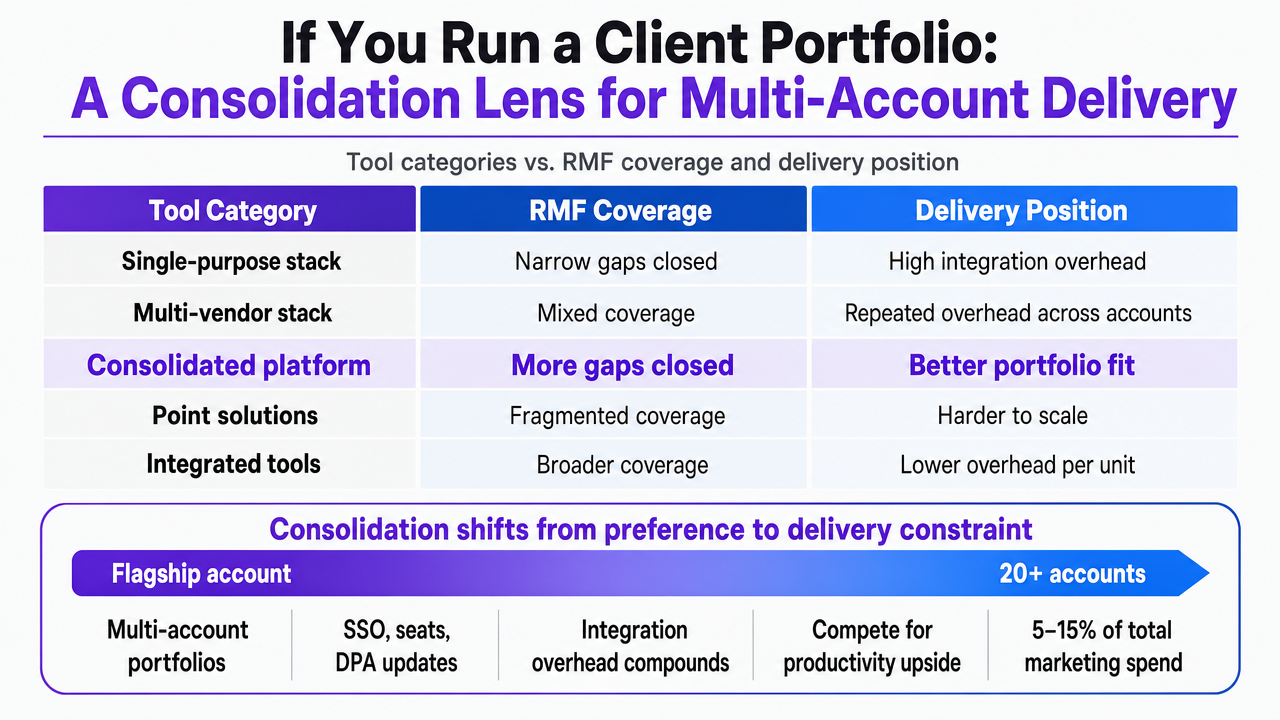
The calculus shifts at portfolio scale. A Head of SEO running one flagship account can absorb a four-vendor stack. The same leader running 20+ accounts across legal, dental DSO, behavioral health, and home services is paying integration overhead on every seat, every SSO connection, every data processing agreement a client's counsel wants updated. Consolidation stops being a preference and becomes a delivery constraint.
The value ceiling justifies the work. McKinsey estimates generative AI could lift marketing productivity by 5–15% of total marketing spend — roughly $463 billion annually in consumer marketing alone 11, 10. That band is the ceiling agencies are actually competing for, and the tools that close the most NIST RMF gaps per unit of integration overhead are the ones that let a portfolio operator capture it 7.
A practical consolidation view across the four categories this article separates:
| Tool category | Primary function | NIST RMF coverage | Regulated-vertical fit | Where it sits in delivery ||---|---|---|---|---|| AI-answer visibility trackers (Profound, Peec, Otterly, AthenaHQ) | Surface where client brand appears in generated answers | Map, partial Manage | Neutral — reports on external surface | Adjacent to SEO reporting || LLM observability (Langfuse, Arize, WhyLabs) | Trace and score internal model output | Measure, partial Manage | Strong when self-hosted | Underneath content production || Governance-grade observability (Fiddler) | Safety, explainability, model risk documentation | Manage, Govern | Strong out of the box | Compliance review layer || Approval-first execution (Vectoron) | Route recommendations and outputs through human sign-off | Govern, partial Measure | Strong — audit trail is the workflow | Inside the production loop |
Read across the rows: no single vendor closes all four functions cleanly, but a two-tool combination — one Map tool paired with one Measure/Govern tool — covers the surface most regulated clients audit against 7. That is the consolidation lens worth defending in a QBR.
 Render the comparison table from this section as a clean visual matrix so portfolio operators can scan tool categories against RMF coverage and delivery position
Procurement Signals: What Legal and Compliance Teams Will Ask For
Legal review is where LLM visibility tools either survive or get quietly cut from the stack. Client counsel rarely asks whether a platform tracks brand mentions in Perplexity. They ask five practical questions, and the answers determine whether an agency's AI workflow clears the master services agreement.
-
Where does prompt and response data live, and who processes it. Self-hosted or single-tenant options carry the shortest path through a data processing addendum.
-
Can the agency produce a versioned record of the prompt, model, and output that generated a specific paragraph on a specific date. This is the provenance question NIST public commenters pushed to strengthen, urging
"more detailed data provenance standards"
and mechanisms to
"interrogate AI-generated content"
3.
-
Does the tool map to a recognized framework — the ISO/IEC 42001 crosswalk expects that AI system behavior
"is monitored when in production"
with roles and responsibilities defined 2.
-
How are the 12 GenAI-specific risks in NIST AI 600-1 addressed, particularly confabulation, data privacy, and content provenance 8.
-
Who signs off, and is that sign-off logged.
Tools that answer these five directly move to contract. The ones that don't stay in the pilot phase forever.
Frequently Asked Questions
References
- 1.Large language models require a new form of oversight.
- 2.NIST AI RMF to ISO/IEC FDIS 42001 AI Management System Crosswalk.
- 3.NIST Generative AI RMF Draft – Public Comments.
- 4.The State Of Generative AI Inside US Agencies, 2024.
- 5.Generative AI Takes Off with Marketers.
- 6.The state of AI in early 2024.
- 7.AI Risk Management Framework | NIST.
- 8.Artificial Intelligence Risk Management Framework: Generative Artificial Intelligence Profile.
- 9.US Agencies Are Currently Leading Generative AI Adoption.
- 10.The economic potential of generative AI: The next productivity frontier.
- 11.How generative AI can boost consumer marketing.