
Key Takeaways
- Continuous technical auditing replaces quarterly sweeps by running crawlers on a rolling cadence, routing standard fixes through templates so senior strategists stop absorbing production hours 2.
- AI-assisted content production with a three-layer editing model—machine draft, analyst edit, senior review on strategic pages—cuts review load without shipping generic or inaccurate copy 3.
- Answer-engine and generative engine optimization deserve dedicated capacity because 44% of AI-search users treat it as their primary insight source and citation tracking needs distinct KPIs 9.
- Automated reporting collapses the Friday deck ritual from roughly five hours to one per account weekly, freeing senior time for QBRs and strategic escalations 12.
- Approval-gated execution separates agencies compounding capacity from those scaling errors, tiering sign-offs so template fixes ship fast while pillar content lands in a senior queue 8.
- Structured data and clean architecture act as a rework prevention layer, letting every downstream automated workflow read the site consistently rather than forcing manual verification 13.
- Intent modeling filters keyword lists by matching searcher jobs against existing coverage, shifting senior time from list-building to prioritization decisions automation cannot make alone 4.
- Cross-functional alignment determines whether reclaimed hours become margin or refill with production work, requiring named capacity budgets and shared standups across SEO, content, and analytics 11.
The Capacity Problem Behind the Technique Question
Agency SEO leads searching for techniques for SEO in 2026 are rarely looking for another primer on internal linking. They are managing books of 15 to 80 accounts with senior time trapped in production work, and the real question is capacity: how many clients can one strategist govern before quality slips? Framed that way, the useful techniques are the ones that convert hours of manual output into hours of judgment.
The numbers behind that shift are already visible. One documented workflow overhaul cut monthly analyst hours per account from 92 to 28 while monthly organic sessions climbed from 42,100 to 126,900 2. Broader survey data puts AI-driven automation across roughly 45.5% of common SEO tasks, yet 72.6% of respondents still have not integrated AI into their SEO strategies in any structured way 4. Adoption is uneven, which means the operating gap between agencies compounding capacity and those still pricing by the hour is widening quarter over quarter.
The eight techniques that follow are ordered by that lens. Three of them—continuous technical auditing, AI-assisted content production with editorial oversight, and approval-gated execution—carry the largest hour deltas and receive deeper treatment. The remaining five sharpen specific parts of the delivery model: answer-engine optimization, automated reporting, structured data foundations, intent modeling, and cross-functional alignment. Each one is evaluated against a single benchmark: does it let a strategist govern more accounts without degrading the work that actually moves rankings and pipeline?
Continuous Technical Auditing Replaces the Quarterly Sweep
The quarterly technical audit is the most expensive habit still sitting inside most agency delivery models. A senior specialist blocks a week per account, exports crawl data, marks up a slide deck, and hands developers a backlog that is already stale by the time it lands in a sprint. Multiply that ritual across a 40-account book and the math stops working long before the audit produces a ranking change.
Continuous crawling changes the unit of work. Instead of a scheduled sweep, monitoring runs against every property on a rolling cadence, flags regressions as they appear, and routes tickets straight into the queue that already handles rework. One documented workflow rebuild took monthly analyst hours per client account from 92 to 28 while lifting monthly organic sessions from 42,100 to 126,900 2. That is a 70% reduction in production hours paired with a tripling of traffic on a single ecommerce book—useful as a directional benchmark, not as a promise. The case reflects one mid-market operator's stack and vertical, and results will move with baseline site health and content velocity.
Two mechanics do most of the work:
- First, the crawler stays on. Broken canonicals, orphaned pages, redirect chains, and Core Web Vitals regressions surface within hours instead of at the next scheduled review.
- Second, remediation moves from strategist to ticketing system: standard fixes carry pre-approved templates so junior analysts or engineering partners can close them without a senior gate.
Forrester frames this shift plainly, noting that handing technical SEO tasks to generative AI "affords marketers time and energy that they can invest in strategic, creative initiatives" 8.
The operational takeaway for a Head of SEO is narrower than "install a crawler." It is a scoping decision: which audit findings must a senior review, and which can ship on templates? Every finding pushed below the senior line is capacity returned to strategy, competitive analysis, and the kind of judgment calls that actually differentiate one agency's book from another's.
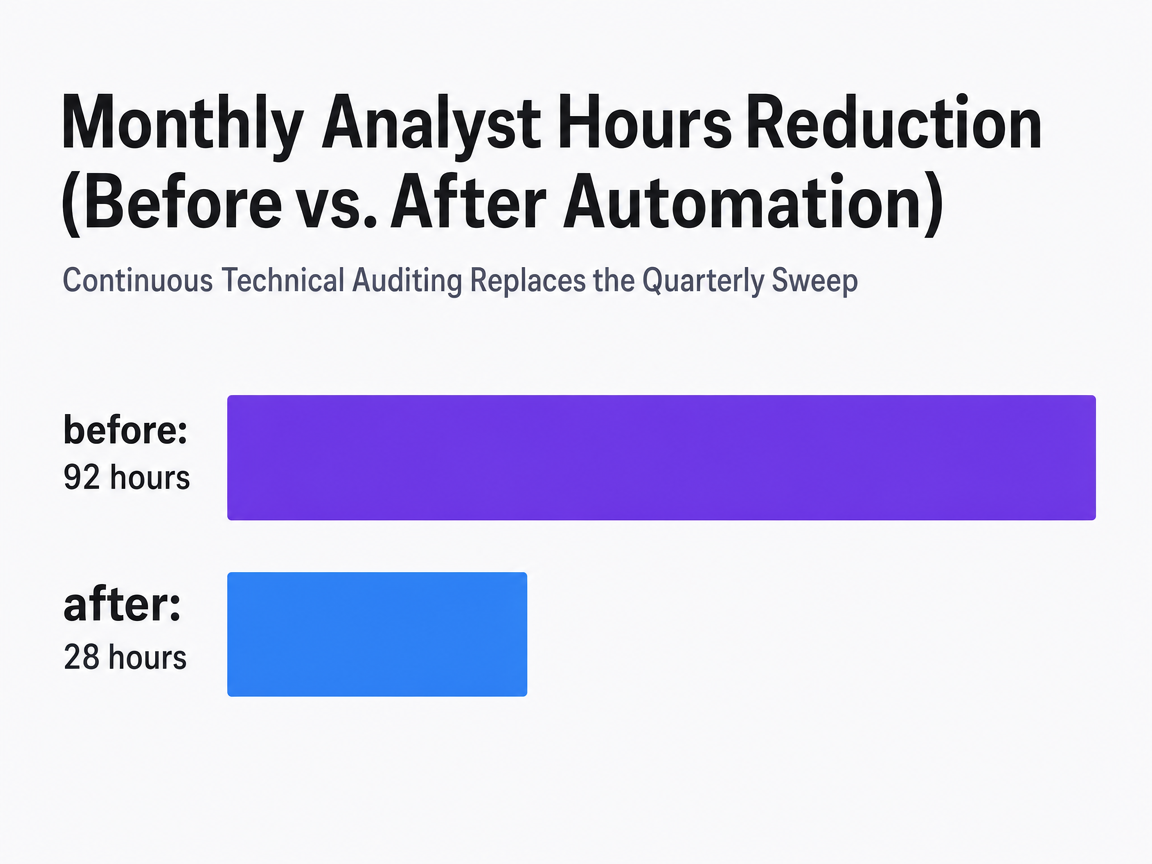 Monthly Analyst Hours Reduction (Before vs. After Automation)
A case study comparison showing the reduction in manual analyst hours required per month after automating SEO tasks.
AI-Assisted Content Production With a Human Editing Layer
Content production is where most agency SEO time still leaks. Keyword mapping, brief construction, first-draft writing, on-page optimization, and QA together consume the bulk of a strategist's week, and each step historically required a human at the keyboard. Generative tooling has changed the economics of the first four steps without changing the economics of the fifth—which is precisely the point.
Survey data from the AI SEO Benchmark Report puts AI-driven automation at 45.5% of key SEO tasks overall, with keyword research at 45.5% and content creation at 44.2% leading the mix. The same survey found that 72.6% of respondents have not yet integrated AI into their SEO strategies in any structured way 4. The scope matters: this is a practitioner survey, not a market-wide audit, and it captures self-reported integration rather than output quality. Read as a directional signal, it says the tooling gap between agencies compounding capacity and those still writing briefs by hand is now wider than the tooling gap between agencies with different rank-tracking stacks. IBM's cross-industry work on generative AI in marketing points in the same direction, reporting cycle-time reductions of up to 60% for content and campaign development processes among organizations that have restructured workflows around the technology 14.
The production model that actually holds up in delivery has three layers:
- The first is machine-generated: keyword clusters, competitive gap analysis, brief scaffolds, and draft body copy run on templates tied to the client's topical map.
- The second is analyst-level: a junior or mid-level editor tightens structure, verifies claims, corrects factual drift, and enforces brand voice against a documented style guide.
- The third is senior review, but only on the sample that carries strategic weight—pillar pages, category hubs, YMYL content, and anything with schema implications.
A 40-page monthly content order stops requiring 40 senior reviews and starts requiring five.
The reason the human editing layer stays non-negotiable is quality control at the seams. Generative drafts can produce inaccuracies or generic phrasing, particularly around statistics, product specifics, and any claim that requires primary-source verification 3. Fully automated publishing pipelines that skip the editing pass tend to ship confident-sounding filler that eventually shows up in rankings, refund conversations, or both. The agencies gaining hours without losing quality are the ones treating editors as governance, not as production bottlenecks.
Answer-Engine and Generative Engine Optimization as Their Own Discipline
AI-driven traffic climbed 527% in a recent measurement window, and the search surfaces driving that growth do not behave like a traditional SERP 5. Answers get synthesized inside the interface, citations appear inline, and the click—when it happens at all—lands on a page selected by a model rather than a ten-blue-links ranking algorithm. Treating that shift as an extension of conventional SEO underestimates the workflow change it requires.
McKinsey frames the discipline as generative engine optimization and reports that 44% of AI-powered search users already treat it as their primary source of insight, while GEO performance typically lags traditional SEO by 20% to 50% during the first optimization cycles 9. Two implications follow for agency delivery:
- First, GEO earns dedicated capacity rather than a checkbox at the bottom of a standard audit.
- Second, the measurement stack has to account for LLM-driven sessions and citation frequency inside AI answers, not just organic rank and CTR 5.
Agencies still routing this work through the same brief templates as blog posts are underweighting a channel that already sends meaningful traffic and is compounding fast.
The operational shape of a GEO practice looks different from a traditional on-page workflow. Content gets structured for extractability—clear entity definitions, direct answer paragraphs, comparison tables, and schema that maps to the questions AI interfaces are actually resolving. Diagnostic runs check citation presence across ChatGPT, Perplexity, Gemini, and Google's AI Overviews rather than a single rank tracker. Agencies profiled in trade coverage are already reshaping content formats, technical optimization, and analytics around these surfaces, with the ones moving early carving out reporting frameworks their competitors have not yet defined 6.
For a Head of SEO scoping 2026 headcount, GEO is a distinct line item on the capacity plan. A dedicated analyst or a documented percentage of every strategist's week, with its own KPIs and its own diagnostic cadence, keeps the discipline from getting absorbed into general SEO and quietly starved of the hours it needs to compound.
Test AI-powered SEO execution with real output
Evaluate operational efficiency gains by publishing live SEO content during your trial.
Automated Reporting That Ends the Friday Deck Ritual
Client reporting is the tax that quietly consumes senior time at the end of every week. Pulling GSC exports, refreshing rank data, screenshotting Looker Studio, and writing narrative summaries can absorb a full afternoon per account—work that clients skim and rarely act on before the next check-in.
Automation collapses that ritual into a scheduled job. Trade reporting on 2026 agency workflows documents the shift plainly: reporting drops from roughly five hours a week to about one, and technical audits shrink from eight hours to two once crawlers run continuously instead of on a quarterly schedule 12. On a two-task basis alone, a strategist reclaims ten hours a week—more than a full working day—per account, before any other technique in the stack lands.
The mechanics are unglamorous but effective. Live dashboards pipe organic sessions, rankings, conversions, and GEO citation counts into a client-branded view that updates on its own. Narrative summaries get generated against the underlying data with the strategist editing rather than composing. Anomaly alerts push regressions into the same ticketing queue that handles audit findings, so a drop in indexed pages surfaces on Tuesday morning instead of hiding until the monthly review.
The operational point for a Head of SEO is not "automate the deck." It is deciding which reporting artifacts still deserve a senior voice—QBRs, strategic recommendations, escalations—and which are commodity outputs that a template and a data pipe can produce without one. Every hour returned from reporting is an hour available for the accounts where judgment actually changes the outcome.
Approval-Gated Execution: The Operating Model Behind Scaled Delivery
The failure mode agencies keep discovering the hard way is that automation without governance ships confidently wrong work. A rank-tracking bot flags a meta title change, a generative model rewrites it, a CMS integration publishes it, and nobody notices the new title contradicts the client's brand guidelines until the account manager sees it in a screenshot. Speed without a decision gate produces the same problem a sloppy junior produces, just at higher volume.
Approval-gated execution is the operating model that separates agencies compounding capacity from agencies scaling their mistakes. The mechanics are straightforward: automated systems generate the signal, rank the recommendation, and prepare the execution package, but nothing publishes until a named human approves it. Forrester's framing of the shift is that delegating technical tasks to generative AI "affords marketers time and energy that they can invest in strategic, creative initiatives"—a redeployment that only works when the strategic layer includes a governance gate, not just a to-do list 8. McKinsey's analysis of generative AI in marketing reaches the same conclusion from the productivity side, noting that gen AI optimizes strategies through automated testing and data-driven recommendations, but the recommendations still need someone to weigh them against client context 10.
Several platforms now sit in this category, each pairing automated production with a human approval step: purpose-built SEO automation stacks like SEO.ai and Rankability, agency-focused workflow tools such as Semrush's ContentShake, and broader marketing execution platforms including Vectoron, which routes ranked recommendations across content, technical, and reporting workstreams through a single sign-off queue before anything ships. The category label matters less than the design principle. If the tool publishes without approval, it is automation. If it queues, ranks, and waits, it is approval-gated execution.
For a Head of SEO the design decision is where to place the gate. Placed too early—on every keyword pulled or every crawl finding—and the queue becomes the new bottleneck. Placed too late—only on final published output—and low-stakes errors compound before anyone sees them. The agencies getting the model right tier their gates: template-level fixes ship on standing approval, mid-stakes changes route to a mid-level reviewer, and anything touching pillar content, schema, or client-facing narrative lands in a senior queue. The result is a delivery model where automation carries the volume and senior judgment carries the risk, which is the combination that turns saved hours into margin instead of into cleanup work.
Structured Data and Clean Architecture as a Rework Prevention Layer
Every hour saved by automation gets paid back if the underlying site fights the tools. Broken canonical logic, inconsistent URL patterns, and missing schema force strategists back into manual verification—checking what a crawler should have resolved on its own. Structured data and clean information architecture function less as ranking levers than as a rework prevention layer for everything else in the stack.
Google's own guidance is direct on the mechanism: structured data markup "helps Google better understand the content of your pages" and shapes how those pages appear in search results 13. The same markup carries weight inside AI answer surfaces, where entity definitions and question-answer schema help models extract content cleanly rather than guessing at context. On the architecture side, consistent URL taxonomies, predictable internal linking, and a single source of truth for product or service entities mean that automated content briefs, technical audits, and GEO diagnostics all read the site the same way.
The operational move for a Head of SEO is to treat schema and IA as an onboarding gate for new accounts rather than an ongoing optimization line item. Fix them once, document the pattern, and every downstream automated workflow runs faster and cleaner across the book.
See How Top Agencies Scale SEO Workflows Without Expanding Headcount
Request a demo to benchmark your current SEO delivery process against AI-powered automation proven to reduce manual overhead and accelerate multi-client execution across all channels.
Intent Modeling and Keyword Automation That Actually Filters
Keyword research is one of the tasks generative tooling handles well, with survey data placing AI automation at 45.5% of that specific workflow 4. The problem is that raw volume is not the constraint most agency SEO leads are working against. A crawler and a language model together can produce ten thousand candidate keywords for a mid-market law firm in an afternoon. Filtering that list to the two hundred queries worth briefing against is where senior time still gets spent.
Intent modeling is the filter. Instead of ranking keywords by search volume or difficulty alone, the automated layer classifies each query by the job the searcher is trying to complete—informational, comparative, transactional, or navigational—and maps it against the client's existing coverage:
- Queries with matching intent and no ranking page enter the brief queue.
- Queries the client already covers get flagged for on-page refinement.
- Queries that do not fit the service model get dropped before a strategist ever sees them.
The operational payoff is a shorter shortlist, not a longer one. Broader productivity work suggests generative AI can lift marketing-function output by 5% to 15% of total marketing spend, with the largest gains landing where automated analysis feeds human decisions rather than replacing them 15. Applied to keyword workflows, that means the senior review shifts from list-building to prioritization—the judgment call automation cannot make on its own.
Cross-Functional Alignment So Saved Hours Reach Strategy
Hours reclaimed inside SEO delivery do not automatically become margin. They can just as easily land in unstructured meetings, cleanup work, or the same status calls that consumed them before. The alignment question is where those hours go once the automation stack is running.
Forrester's read on US marketing agencies is blunt on this: generative AI is currently sitting on the cost side of the ledger, with internal productivity gains outpacing revenue impact until operating models catch up 11. The efficiency shows up in analyst timesheets. It does not show up in agency P&L until saved hours get routed into work clients actually pay a premium for—competitive positioning, GEO strategy, digital PR, and the strategic recommendations that shape a quarterly plan.
Three alignment moves make the difference:
- First, SEO strategists sit inside the same standup as content editors, paid media leads, and analytics so that a ranking regression on Tuesday triggers a coordinated response, not four parallel investigations.
- Second, the reclaimed capacity gets budgeted like any other resource, with named percentages of each strategist's week assigned to strategy, GEO, and client-facing analysis rather than left as slack that quietly refills with production work.
- Third, adoption sits high enough on the agency's operating agenda that it does not stall at the pilot stage—86% of SEO experts globally have integrated AI tools in some form, but integration and governance are different problems, and the agencies converting hours into margin are the ones treating both as leadership decisions rather than tooling decisions 3.
What a 40-Account Book Looks Like Once the Stack Lands
Stacking the eight techniques changes the shape of a two-strategist pod. The starting point on a 40-account book is roughly 92 monthly analyst hours per client on the manual side of the ledger 2. The endpoint, once continuous auditing, automated reporting, structured briefs, and approval-gated execution are running together, sits closer to 28 hours per account on comparable ecommerce work 2. That is not a promise for every vertical, but it is a directional anchor for capacity planning.
| Workstream | Manual hours/account/month | Automated hours/account/month | Source anchor |
|---|---|---|---|
| Technical audits | ~32 | ~8 | 12 |
| Reporting | ~20 | ~4 | 12 |
| Keyword and brief production | ~20 | ~9 | 4 |
| On-page and QA | ~20 | ~7 | 4 |
| Book total (blended) | ~92 | ~28 | 2 |
The strategic question is not whether to run the stack. It is where the reclaimed 64 hours per account land—GEO capacity, competitive analysis, or the next 20 accounts a pod can govern without hiring. Agencies that route those hours through an approval gate keep the quality bar. The ones that ship without one scale their errors instead.
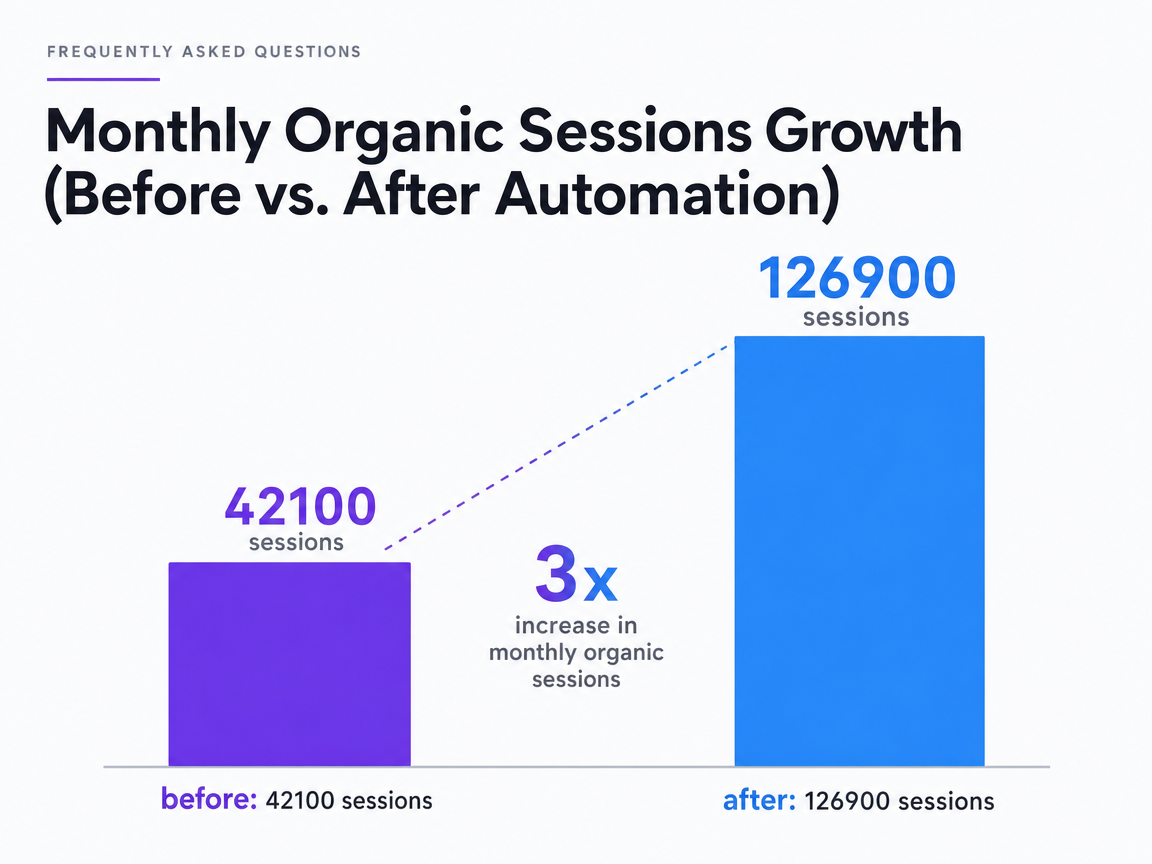 Monthly Organic Sessions Growth (Before vs. After Automation)
A case study comparison showing the increase in monthly organic traffic to a website before and after implementing an automated SEO workflow.
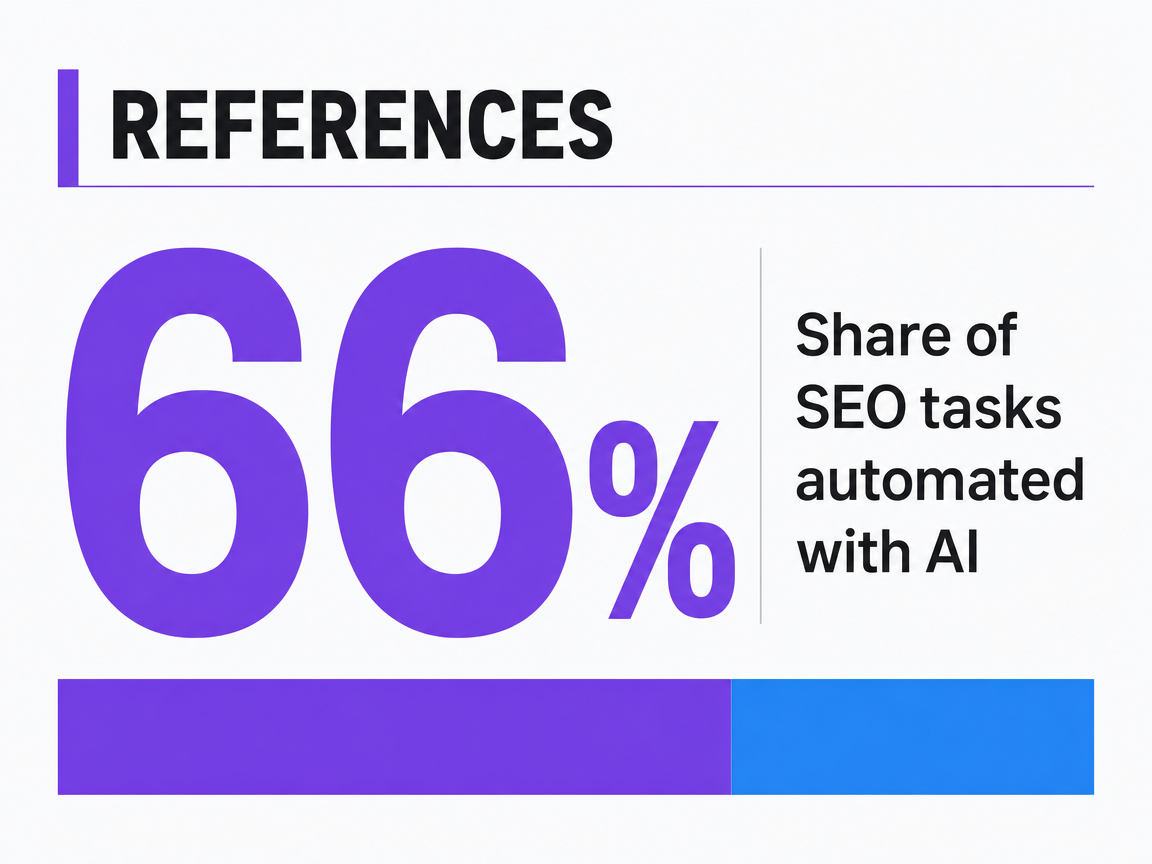 Share of SEO tasks automated with AI
Share of SEO tasks automated with AI
Frequently Asked Questions
References
- 1.Ai In The Seo Industry Statistics: Market Data Report 2026.
- 2.Automating SEO Workflows: Real-World Case Study.
- 3.How AI is Changing SEO: Tools & Trends for 2025 - TechJury.
- 4.AI SEO Benchmark Report: Key Stats & Insights.
- 5.AI traffic is up 527%. SEO is being rewritten..
- 6.How digital marketing agencies are adapting to AI search.
- 7.An AI SEO Study About the Future of Search - 2024.
- 8.Generative AI Has Answers, But SEO Practitioners Are Still Guessing.
- 9.New front door to the internet: Winning in the age of AI search.
- 10.Marketing and sales soar with generative AI.
- 11.The State Of Generative AI Inside US Marketing Agencies, 2025.
- 12.How SEO Automation Is Changing the Way Agencies Rank Clients in 2026.
- 13.Google Search Central: SEO Starter Guide.
- 14.IBM Institute for Business Value: Generative AI in Marketing.
- 15.The economic potential of generative AI: The next productivity frontier.