
Key Takeaways
- A white-label production shop absorbs overflow content and on-page work at a stable per-page rate, but its linear hours-in, hours-out model keeps per-account economics flat.
- A link acquisition partner belongs outside the AI layer, since publisher relationships and outreach judgment reward human specialists and carry reputational exposure Google actively penalizes.
- A technical SEO specialist clears migration and Core Web Vitals backlogs as project-based capacity, preventing the internal technical lead from bottlenecking 40 accounts during escalation cycles.
- An enterprise SEO platform functions as the shared data spine every other partner reads from, cutting reporting and research hours while enabling client-facing dashboards over static decks.
- A programmatic content partner earns budget only on multi-location or multi-SKU accounts, where templated pages drive marginal cost toward zero on the 10,000th output.
- An AI-visible content specialist restructures assets for answer-engine citability, justified where AI overviews have visibly softened clicks despite rising impressions 14.
- An AI execution platform shifts specialists from drafting to approval, moving per-account cost from headcount to subscription and delivering 46% faster content creation 7.
The delivery stack replaces the vendor list
The query "best SEO companies" used to return a shortlist. For an agency Head of SEO in 2026, it returns a stack decision. The partners that actually move throughput across a 40-account book are rarely other agencies to white-label. They are a mixed set of production shops, enterprise SEO platforms, and AI execution systems that slot into the delivery layer at different points.
McKinsey's 2025 survey work shows organizations capturing value from AI are the ones redesigning workflows around it, not the ones buying more tools in isolation 15. That finding reframes the vendor question. The right comparison is no longer Agency A versus Agency B on retainer price. It is which combination of partners raises accounts-per-specialist without breaking the quality gates a client audit would catch.
This list is scored from that seat. Seven partners, each evaluated on how they change the math for a delivery org managing 15 to 80 accounts with a fixed specialist bench. The frame is operator fit, not brand prestige. The output is a stack, not a winner.
How this list was scored: four operator criteria
AI adoption inside marketing organizations has passed the novelty stage. McKinsey reports that 78 percent of respondents use AI in at least one business function and 71 percent regularly use generative AI in at least one function 15. For a Head of SEO evaluating partners, that means AI capability is baseline, not a differentiator. What matters is how each partner changes the delivery math on a specific book of business.
Four criteria carry the scoring across the seven partners below.
Throughput multiplier. : How much production output does the partner add per specialist hour retained on the agency's side? A partner that doubles page output but requires 1.5x the QA hours has a weak multiplier. The number to watch is accounts-per-specialist at constant quality gates.
Oversight model. : Where does human judgment sit in the workflow? Partners that require briefs and return finished work fit a different oversight posture than platforms that surface ranked recommendations for approval before execution. Neither is inherently better; the fit depends on the agency's internal review capacity.
Integration surface. : What does the partner plug into? A production shop that emails Google Docs has a different integration cost than a platform that reads GSC, GA4, call data, and CMS state directly. Integration surface determines how much coordination overhead the partner adds or removes.
Per-account economics. : What is the marginal cost of adding the 41st account? Traditional partners scale linearly with headcount. Platforms scale differently. This is the criterion that most often decides which partner earns the slot.
Every entry in the list is scored against these four, not against awards, logos, or retainer size.
The market context a Head of SEO is buying into
Partner selection sits inside a spending shift that reshapes what "best" means. Menlo Ventures pegs enterprise generative AI spend at $37 billion in 2025, up from $11.5 billion in 2024, a 3.2x year-over-year increase 5. That capital is not landing evenly. It is concentrating in agentic systems that automate multi-step workflows across marketing, support, and knowledge work, which is precisely the layer an agency delivery org occupies.
The implication for a Head of SEO is straightforward. Every serious partner in the category is now either building an AI production layer, buying one, or watching clients ask why they haven't. Forrester's 2025 read on US marketing agencies shows the same pattern from the seller side: agencies are actively deploying gen AI to accelerate content production, improve personalization, and optimize media, while wrestling with talent gaps and governance 9.
Two things follow. First, the partners worth evaluating in 2026 include categories that did not exist in the 2022 vendor list. Second, a delivery stack picked entirely from traditional agency partners will lag on per-account economics within a budget cycle. The scoring below assumes both.
Test AI-powered SEO workflows in real time
See how automated execution delivers measurable results for agency-scale SEO campaigns before you commit.
The seven partners, scored on operator fit
White-label production shop for content and on-page at volume
The classic overflow partner still earns a slot, but the scoring has tightened. A white-label shop that delivers briefed content and on-page implementation at volume solves one problem: it absorbs production hours when the internal bench is capped. That is it.
Throughput multiplier. Linear. Adding pages means adding writers on their side, and margin comes from their labor arbitrage, not from a workflow redesign. Expect 1:1 hours in, hours out, minus a QA tax on the agency's side.
Oversight model. Brief-in, draft-out. The agency writes the brief, reviews the draft, and owns the strategic layer. Forrester's read on US agencies confirms this posture is still dominant, with gen AI mostly used to accelerate the production step rather than replace the briefing loop 9.
Integration surface. Thin. Shared drives, ticket queues, sometimes a CMS login. Coordination overhead scales with account count.
Per-account economics. Predictable but flat. The 41st account costs roughly what the 40th did.
The slot is worth keeping when the agency has strong internal briefs and needs a reliable execution arm for evergreen content, category pages, and on-page updates at a stable per-page rate.
Link acquisition partner with campaign-level briefs
Link building is the one production line where a pure-play specialist still tends to beat a generalist AI workflow. Outreach quality, publisher relationships, and campaign judgment are hard to fully automate without triggering the exact quality problems Google penalizes.
Throughput multiplier. Moderate. A good partner adds 20 to 60 placements per month per campaign without the agency staffing outreach directly. The multiplier lives in what the internal team no longer has to do.
Oversight model. Campaign brief in, monthly placement report out. The agency approves target lists, angle pitches, and anchor strategy. Nothing publishes without the agency's sign-off on the linked asset.
Integration surface. Medium. Most partners work in shared trackers and expect the agency to supply the linkable assets. Weak asset supply chokes the partner's throughput more often than outreach capacity does.
Per-account economics. Priced per placement or per campaign, not per FTE. Margin depends on how tightly the agency can bundle links into retainer tiers rather than pass-through costs.
Keep this partner outside the AI production layer. It is a specialist function with legal and reputational exposure that rewards human judgment.
Technical SEO specialist for audit backlog and migrations
Every scaling agency accumulates a technical audit backlog. Migrations, Core Web Vitals cleanup, structured data rebuilds, and JavaScript rendering issues sit in a queue that internal specialists rarely reach before the next client escalation. A dedicated technical partner clears that queue.
Throughput multiplier. High on the specific tasks it takes, near zero elsewhere. A migration that would consume 60 internal hours across two weeks becomes a fixed-scope engagement that frees the bench for strategy work.
Oversight model. Scoped statement of work, technical spec review, and a joint QA pass before deployment. The agency's senior technical lead still signs the pre-launch checklist.
Integration surface. Deep on the affected properties, thin across the book. Expect direct access to GSC, log files, staging environments, and the client's dev team during migrations.
Per-account economics. Project-based, not retainer-based. Cost lands in the quarter the work happens, which makes forecasting cleaner than a monthly technical retainer that goes unused half the time.
Slot this partner as an on-demand capacity valve, not a standing line item. It exists to prevent the internal technical lead from becoming the bottleneck on 40 accounts at once.
Enterprise SEO platform as the shared data spine
An enterprise SEO platform is not a partner in the retainer sense. It is the shared data layer that the rest of the stack reads from. Without one, every other partner in the list operates on partial information and duplicates effort pulling rank, crawl, and share-of-voice data.
Throughput multiplier. Indirect but compounding. The platform itself does not produce pages. It removes the reporting hours, keyword research cycles, and status-meeting overhead that specialists otherwise burn each week. IBM's framing of AI marketing systems as a continuous data-analysis-to-execution loop describes what a well-configured platform enables at the delivery layer 1.
Oversight model. The platform surfaces signals; humans interpret them. Strategy stays inside the agency. Client-facing dashboards replace static monthly decks.
Integration surface. Wide by design. GSC, GA4, crawl data, backlink indexes, SERP tracking, and increasingly CMS state through APIs. This is the connective tissue the AI production layer plugs into later.
Per-account economics. Priced per tracked domain or keyword volume. Cost grows with the book, but at a fraction of the specialist hours it displaces on reporting alone.
Treat the platform choice as an architectural decision, not a tooling decision. Every other partner in the stack has to read from it.
Programmatic and localized content production partner
Multi-location clients break the standard content model. A 200-location home services brand needs city-level pages, service-area combinations, and localized FAQ sets that no writing team produces manually at margin. A programmatic content partner solves the volume problem with templated systems and data-driven variation.
Throughput multiplier. High on templated formats, low on editorial. Expect thousands of location pages generated from structured data inputs, with quality gates on the template rather than the individual page.
Oversight model. Template approval, data source validation, and a sampling QA process. The agency signs off on the pattern, not each output.
Integration surface. Heavy on the client side. The partner needs clean location data, service taxonomies, and CMS access that supports bulk publishing. Data hygiene on the client side is usually the constraint, not production capacity.
Per-account economics. Priced per page or per template license. Marginal cost on the 10,000th page approaches zero, which is the entire reason the category exists.
This slot only earns budget on accounts with genuine location or SKU multiplicity. On a single-location B2B account, it is dead weight.
AI-visible content specialist for answer-engine formats
Search behavior has shifted enough that this partner category now warrants a dedicated slot. Pew reports that 65% of U.S. adults at least sometimes encounter AI summaries in search results, a scope limited to U.S. adults but large enough to change what client content has to do to earn a citation 14. The specialist here restructures existing content for extractability and produces new assets in formats that answer engines cite: definitional openers, direct-answer paragraphs, structured comparison tables, and entity-clear headings.
Throughput multiplier. Moderate. The work is part rewrite, part net-new production. Volume runs lower than a bulk content shop, but the per-page value on high-intent pages is higher.
Oversight model. Editorial review with a specific rubric for answer-engine citability. Not every agency has this rubric internally yet, which is what the partner sells.
Integration surface. Reads from the enterprise SEO platform for topic prioritization and from GSC for query-level performance shifts. Writes back into the CMS through the agency's normal publishing flow.
Per-account economics. Priced per asset or per page audited. Justifiable on accounts where organic traffic has softened as AI overviews expanded across query classes.
Book this partner selectively, on accounts where the SERP has visibly changed and the client is already asking why impressions rose while clicks fell.
AI execution platform as the production layer
The seventh slot is the newest and the one that most directly changes the per-account economics of the entire stack. An AI execution platform sits between the enterprise SEO platform and the publishing layer, taking approved recommendations and producing the deliverables that specialists used to draft by hand.
The operator-relevant deltas are large enough to reshape delivery math. MindStudio's agency benchmarks put AI-agent-enabled workflows at 46% faster content creation, 32% quicker editing cycles, up to 40% lower operational cost, and roughly three times faster delivery on completed work 7. Those numbers describe throughput on production tasks, not strategy hours, which is exactly where a scaling agency has the most compressible cost.
Throughput multiplier. Non-linear. Specialists shift from drafting to reviewing, and the accounts-per-specialist ratio climbs without a proportional QA increase, assuming the platform enforces approval gates on every output.
Oversight model. Approval-first. The platform surfaces ranked recommendations with the strategic reasoning attached; a human approves before anything ships. This matches the augment-not-replace posture that Harvest identifies as the durable pattern for AI adoption inside SEO agencies 4.
Integration surface. Wide. Reads live business signals (calls, bookings, cost per lead, pipeline where available), pulls from the enterprise SEO platform for query and rank context, and writes into the CMS after approval. That direct read on outcome data is what separates an execution platform from a generic AI writing tool.
Per-account economics. Subscription-based, not headcount-based. The marginal cost of the 41st account is the incremental platform cost, not another FTE. This is the criterion that most often flips a stack decision, and the reason this category earns a slot rather than sitting inside "tools."
Vectoron is the platform in this category worth evaluating against the others in the list, particularly for agencies whose growth plan requires accounts-per-specialist to move rather than the specialist bench itself.
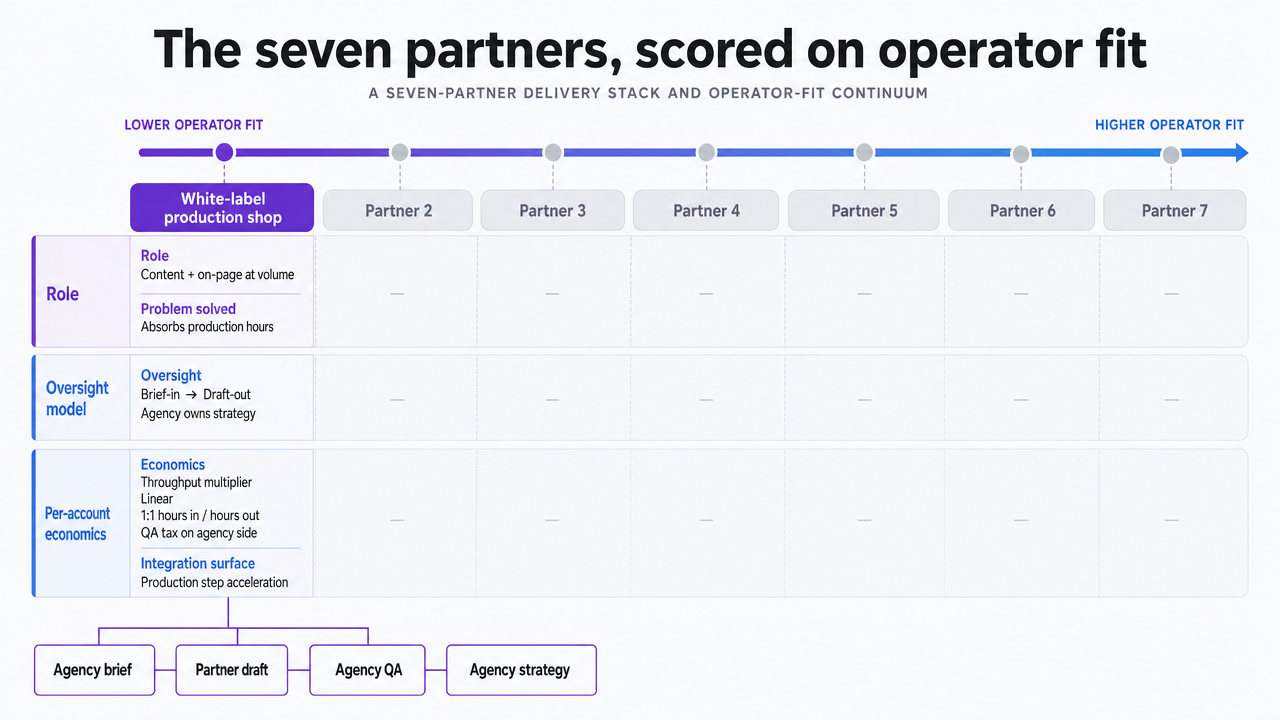 Visualize the seven-partner delivery stack as a comparison framework showing each partner's role, oversight model, and per-account economics profile, directly supporting the section's core structure
Consolidation economics: what shifts when the production layer changes
The stack decision comes down to what happens on the margin. When a production layer shifts from specialist FTEs to an AI execution system, the compressible cost is the drafting, editing, and formatting time, not the strategy hours. McKinsey estimates that generative AI can drive productivity gains of 30–45% in marketing and customer operations broadly, not SEO specifically, but the compression band is directionally what an agency Head of SEO should model against 3.
The table below uses variables rather than invented dollars. Let H equal monthly production hours per account under a specialist-led model. Let A equal the share of those hours that are automatable, bounded by the sourced 30–45% range. Blended cost per specialist hour (C) is supplied by the agency.
| Delivery model | Effective specialist hours per account | Implied accounts per specialist FTE (160 hrs/mo) |
|---|---|---|
| Traditional specialist-led | H | 160 ÷ H |
| Hybrid with AI production layer | H × (1 − A), A = 0.30 | 160 ÷ (0.70H) |
| AI-execution-led with human approval | H × (1 − A), A = 0.45 | 160 ÷ (0.55H) |
At H = 20, the traditional model supports 8 accounts per FTE. The hybrid case moves it to roughly 11. The upper-bound execution-led case moves it to about 15. Dollar impact depends on C, which the agency owns.
Two constraints on this math. Automation only reaches the upper band when approval gates are structured, not when review becomes the new bottleneck. And accounts-per-FTE only climbs if the strategy layer is not simultaneously absorbing hours displaced from production.
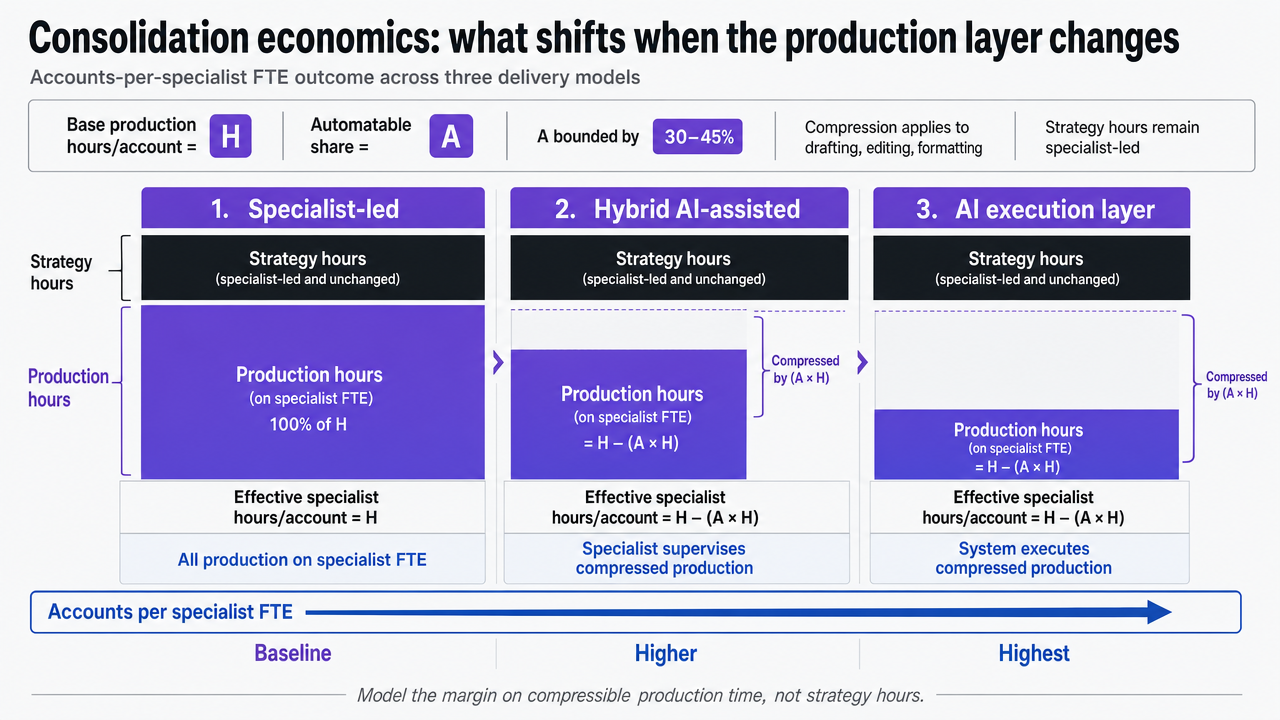 Chart the accounts-per-specialist FTE outcome across three delivery models using the McKinsey 30–45% productivity band cited in the section, directly supporting the section's economic math
Governance and oversight: the approval gates that keep quality gates intact
The upper band of the productivity math only holds if approval gates hold. When they slip, review becomes the bottleneck and the accounts-per-FTE gains reverse inside a quarter.
NIST's AI Risk Management Framework, together with its Generative AI Profile, gives agency leaders a defensible reference model for embedding trustworthiness into AI-assisted delivery: risk mapping, measurement, and management applied to the specific outputs a client sees 11, 12. For an SEO delivery org, that translates into three concrete gates:
- A pre-publication review checkpoint on any AI-drafted asset with citation or claim density above a defined threshold.
- A rubric-based check on factual, brand, and E-E-A-T signals rather than a subjective read.
- A logged approval trail per asset, tied to the specialist who signed off, so quality issues surface with attribution rather than as anonymous drift.
Forrester's read on US agencies flags governance and talent gaps as the two barriers slowing gen AI adoption inside delivery teams 9. The gates above address the first. The stack decisions in the prior sections address the second by keeping specialist hours on judgment work, not drafting.
See How Top Agencies Scale SEO Output Without Expanding Their Team
Connect with our experts to benchmark your agency’s current SEO workflow and discover data-driven methods for increasing client delivery capacity without hiring more specialists.
If you manage a multi-brand portfolio: sequencing the stack rollout
For agency leaders running a holding-company portfolio or a rollup of acquired shops, the stack decision is not one choice. It is a sequencing problem across brands with different client mixes, legacy toolchains, and margin profiles.
- Standardize the data spine first. An enterprise SEO platform shared across brands eliminates the reporting duplication that kills margin at the group level.
- Layer the AI execution platform second, on the brand with the highest ratio of production hours to strategy hours, since that is where the automatable share of work lands closest to the upper 45% band 3.
- Hold specialist partners (links, technical, programmatic) at the brand level until the shared spine and production layer are settled.
Sequenced this way, the group captures compounding gains on accounts-per-specialist without forcing every brand onto the same delivery model in the same quarter.
Choosing what to add first
The sequencing rule is simple: fix the data spine, then compress the production layer, then add specialists against remaining bottlenecks. Agencies that skip the spine and start with an AI writing tool tend to end up with faster drafts and the same reporting hours, which is a rounding-error gain on per-account economics.
Vectoron is worth evaluating in the production-layer slot for agencies where accounts-per-specialist has to move within a budget cycle rather than a hiring cycle. The platform's approval-first workflow keeps the strategy layer inside the agency while the drafting, formatting, and publishing hours compress against the sourced 30–45% band 3. That is the criterion that decides whether the stack redesign shows up in gross margin or stays theoretical.
Start with the criterion that hurts most on the current book. If reporting is the drag, the spine goes first. If drafting is the drag, the production layer goes first. Nothing else changes the accounts-per-FTE number.
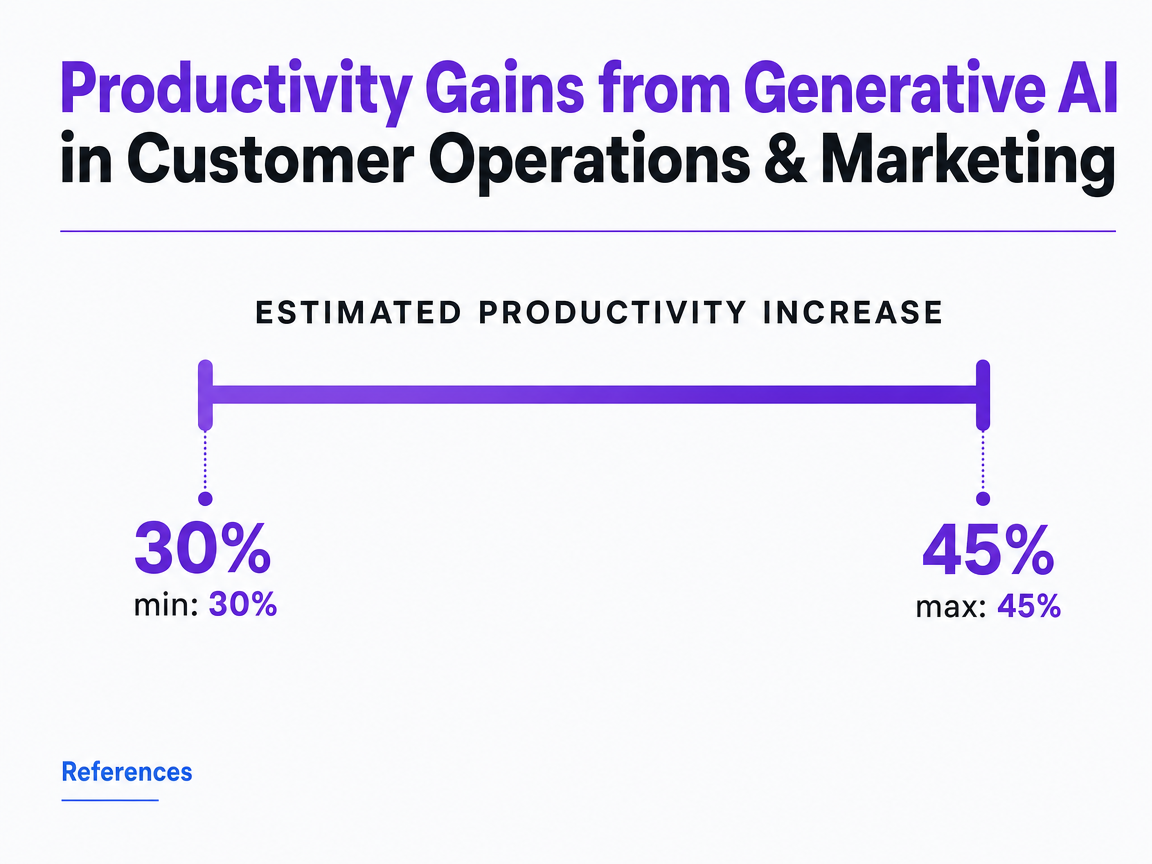 Productivity Gains from Generative AI in Customer Operations & Marketing
A percentage range indicating the estimated productivity increase in functions like marketing and customer care by applying generative AI.
Frequently Asked Questions
References
- 1.Utilizing AI in Marketing Automation.
- 2.The State of AI: Global Survey 2025.
- 3.The economic potential of generative AI: The next productivity frontier.
- 4.AI Changing SEO Agencies 2025: Strategies & Insights.
- 5.2025: The State of Generative AI in the Enterprise.
- 6.Generative AI: Reshaping the Landscape of Professional Services.
- 7.AI Agents for Marketing Agencies: Complete Guide.
- 8.AI Will Shape the Future of Marketing.
- 9.The State Of Generative AI Inside US Marketing Agencies, 2025.
- 10.Americans and AI 2026: Chatbots, Smart Devices and Views on Impact.
- 11.AI Risk Management Framework.
- 12.Artificial Intelligence Risk Management Framework: Generative Artificial Intelligence Profile.
- 13.Draft NIST Guidelines Rethink Cybersecurity for the AI Era.
- 14.Americans have mixed feelings about AI summaries in search results.
- 15.The state of AI: How organizations are rewiring to capture value.