
Key Takeaways
- Ahrefs earns its shortlist spot because its backlink graph turns competitive research into a filtered prospecting queue fast enough to feed link acquisition across a full client book.
- Semrush pays off at portfolio scale, handling multi-site position tracking, keyword gap work, and branded reporting exports without the spreadsheet gymnastics lighter tools force on larger teams.
- Clearscope compresses brief production from roughly four hours to ninety minutes by surfacing terms and entities, provided strategists treat grades as input rather than the goal writers chase.
- Screaming Frog remains the deep-inspection scalpel for technical audits, delivering crawl depth without per-seat rent, though it needs a continuous auditor upstream to close the monitoring gap.
- Sitebulb or Lumar handle scheduled crawls, issue diffing, and rollup reporting across a client book, collapsing a week of manual reconciliation into a triage review of flagged deltas.
- BrightLocal treats the location as the primary object, making citation tracking, GBP audits, grid rank tracking, and white-label reporting workable across multi-location and franchise delivery.
- AI-native execution platforms absorb the production layer between approved plans and published work, moving the strategist leverage ratio into the 20 to 35 client range when paired with research and technical tools.
Why the Shortlist Changed: Delivery Capacity Now Beats Database Size
For years, the shortlist of the best SEO software was a database contest. Whichever platform indexed the most backlinks, tracked the most keywords, or crawled the deepest won the review roundups. That criterion has aged badly. Every serious research suite now claims trillion-plus link indexes and near-real-time SERP data. The differences at the top of the market are within noise for most agency use cases.
What is not within noise is delivery capacity. An agency Head of SEO scaling from twelve to forty client retainers cannot solve the throughput problem with a bigger keyword database. The bottleneck sits inside the workflow: brief production, technical audit cadence, content velocity, link prospecting, local page fanout, and monthly reporting. Tools that compress those stages meaningfully change the strategist-to-client ratio. Tools that do not, no matter how deep their index, add cost without adding capacity.
The stakes are visible in spend patterns. Analysts tracking the category project double-digit compound growth through the early 2030s, with enterprise buyers driving most of the volume 6. Agencies are not being asked to pick the deepest tool. They are being asked to assemble a stack that lets fewer strategists oversee more sites without dropping quality.
The Three-Tier Framework for Agency Stack Decisions
Intelligence, Technical, and Execution: Sorting Tools by Bottleneck Removed
The cleanest way to evaluate the best SEO software is to stop comparing tools horizontally and start sorting them by which stage of delivery they compress. Three tiers cover the field:
- Intelligence tools handle research and competitive signal: keyword universes, SERP tracking, backlink graphs, brief construction.
- Technical tools handle crawl, site health, and monitoring cadence.
- Execution tools handle the production and deployment layer where recommendations become published assets.
Each tier removes a different bottleneck. Intelligence platforms remove the time cost of figuring out what to work on. Technical platforms remove the cost of catching problems before rankings drop. Execution platforms remove the cost of turning a validated plan into shipped work. An agency that keeps hiring senior strategists to close the execution gap is paying labor rates for a tooling problem.
The spending trajectory reinforces this reframing. Analysts value the SEO software market at USD 67.32 billion in 2023 and project growth to USD 207.41 billion by 2032 at a 13.37% CAGR 6. That capital is not chasing better dashboards. It is chasing workflow compression across all three tiers.
The Strategist Leverage Ratio as an Evaluation Lens
Feature checklists do not answer the question an agency Head of SEO actually has to defend at a quarterly business review. That question is how many client sites one senior strategist can meaningfully oversee once a given tool is in the stack. Call it the strategist leverage ratio.
A senior SEO running keyword research and briefs by hand tops out somewhere between six and ten retainers before quality slips. Add a mature intelligence platform and the ceiling moves. Add a continuous technical auditor and the same strategist stops losing hours to crawl reconciliation. Add an execution platform that drafts, deploys, and reports under approval, and the ratio jumps again.
The ratio also exposes bad picks. A tool that adds a dashboard but still requires the strategist to copy findings into a brief template does not move the number. Neither does a platform that surfaces issues but generates a fresh ticket queue. The evaluation question is simple: after this tool is in place, how many more clients can the same person carry without dropping the standard?
Where Enterprise Concentration Pushes the Picks
Budget concentration matters when picking software because it dictates which platforms get built for team workflows and which stay solo-first. Enterprise buyers command over 54% of global SEO software market share, with high tool integration levels inside those environments 7. That share explains why the mature platforms in each tier now ship with role-based permissions, multi-site rollups, and approval routing, while lighter tools remain optimized for one operator on one site.
For an agency scaling from twelve to forty retainers, that split is decisive. Solo-freelancer tools are cheaper on a per-seat basis but multiply coordination overhead: no shared project state, no client-level access control, no consolidated reporting. Enterprise-grade platforms cost more per seat and pay for themselves the moment the team stops managing status through spreadsheets and Slack threads.
The seven picks that follow all clear that filter. Each supports multi-site oversight, role separation, and reporting rollups without custom engineering. Tools that require duct tape to run across a client book were removed before this list was written.
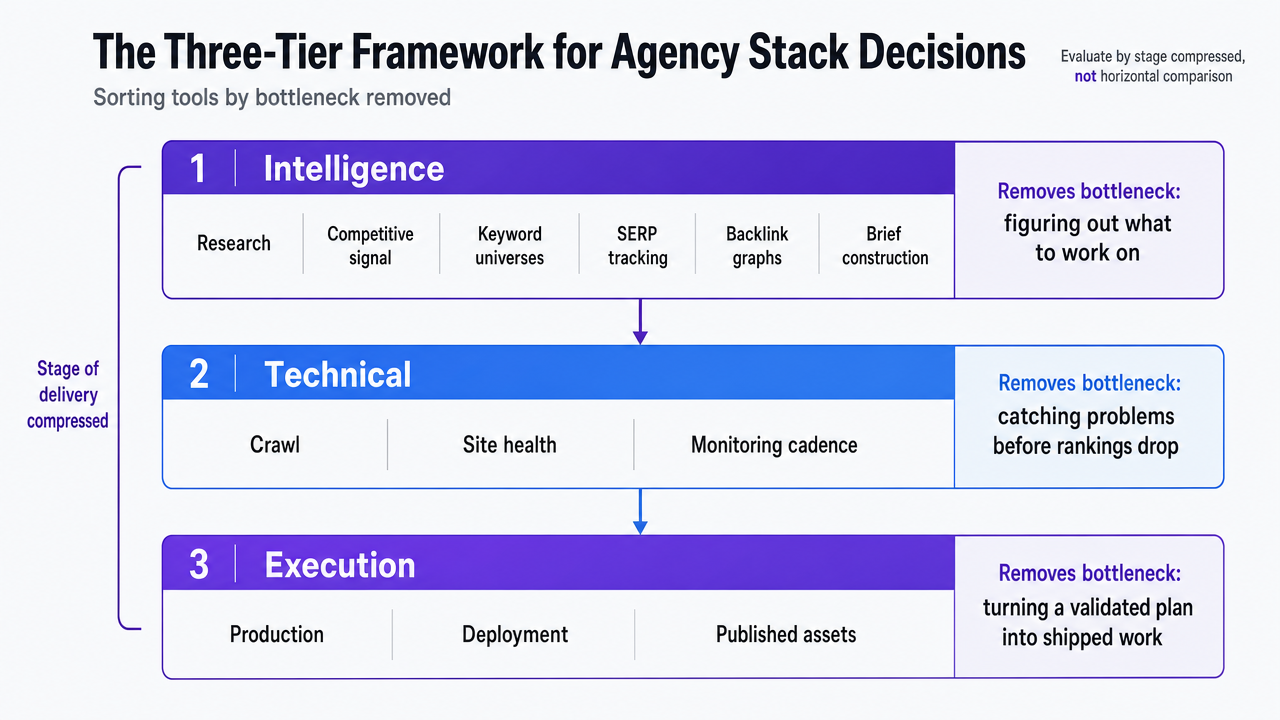 Visualize the three-tier framework (Intelligence, Technical, Execution) that organizes the seven picks and directly supports this section's structural argument
Intelligence Tier: Research and Competitive Signal
Pick 1 - Ahrefs: Backlink Graph Depth as a Prospecting Engine
Ahrefs earns its spot on any agency shortlist because its backlink index remains the fastest way to turn competitive research into a prospecting queue. For a Head of SEO running a client book with mixed link profiles, that speed matters more than the raw index size marketing charts.
The practical use case is not "look at competitor backlinks." It is filtered prospecting at portfolio scale: pull the referring domains for a client's top three organic competitors, filter by domain rating band, remove domains the client has already earned or lost, and export a working list into an outreach queue. A senior strategist can build that list for six clients in an afternoon. Doing the same work through manual competitor scraping consumes a full week and produces worse targeting.
Content Explorer and Site Explorer share the same underlying value: they compress the research half of link building and content gap analysis into a repeatable motion. Rank tracking is included but rarely the reason agencies stay on the platform. The reason is that the prospecting queue never runs dry, and the queue is what feeds link acquisition velocity across the book.
Pick 2 - Semrush: Keyword and SERP Intelligence at Portfolio Scale
Semrush overlaps with Ahrefs on paper. In practice, agencies keep both because their strengths diverge under load. Where Ahrefs is optimized for the link graph, Semrush is optimized for keyword and SERP breadth across many projects at once. That distinction shows up the moment a strategist needs to run parallel research on twelve retainers without losing project state.
The Position Tracking module handles multi-site rollups without the spreadsheet gymnastics that solo tools require. Keyword Magic Tool and Keyword Gap surface expansion opportunities fast enough to feed a content calendar in real time rather than in a quarterly research sprint. The traffic analytics side, while directional rather than deterministic, gives new-business teams enough signal to build credible pitch decks without waiting on the prospect's own analytics access.
For an agency Head of SEO, the honest read is that Semrush's value scales with project count. A team running four clients can substitute lighter tools. A team running thirty-plus needs the workspace structure, the shared keyword lists, and the branded reporting exports. The seat cost stops being the interesting number once portfolio coordination replaces individual research as the daily bottleneck.
Pick 3 - Clearscope: Brief Production Compression
Brief production is where most agencies leak margin without noticing. A senior strategist who spends four hours building a single brief cannot carry more clients regardless of how good the research tools are upstream. Clearscope targets exactly that stage.
The platform scores drafts against a target keyword's top-ranking corpus and surfaces the terms, entities, and structural signals a competitive page needs. That output cuts the strategist's brief-writing time meaningfully because the terminology inventory is no longer assembled by hand. A brief that took four hours drops closer to ninety minutes without loss of editorial control.
The caveat matters. Term coverage is a proxy, not a strategy, and treating Clearscope's grade as the goal produces the exact commodity content that stops ranking within two algorithm updates. The correct use is upstream input into a strategist-led brief, not a scorecard writers chase. Handled that way, Clearscope moves the strategist leverage ratio without eroding quality control.
Test AI-driven SEO workflows risk-free this week
Deploy SEO strategies on live client sites and measure impact before committing long-term.
Technical and Monitoring Tier: Where Audit Cadence Lives
Pick 4 - Screaming Frog: Crawl Depth Without a Seat Tax
Screaming Frog remains on the shortlist for one reason: it crawls at the depth a senior technical SEO actually needs without charging per-seat rent that scales with the client book. The desktop model looks dated next to cloud dashboards, and that is precisely why it survives at agencies running audits across dozens of sites.
The practical workflow is unglamorous and effective. A technical lead points the crawler at a client property, exports the standard set of issue reports (redirect chains, canonical conflicts, orphaned pages, hreflang mismatches, indexable-but-noindexed collisions), and hands a filtered list to the strategist who owns the account. For a book of thirty retainers, that motion runs in a rotating cadence rather than as a one-off quarterly audit.
The limits are honest. Screaming Frog does not monitor continuously, does not diff crawls automatically at the portfolio level without configuration, and does not produce client-ready reports without an intermediate step. It is a scalpel, not a dashboard. Agencies that try to make it the whole technical layer burn strategist hours reconciling exports. Paired with a continuous auditor upstream, it becomes the deep-inspection tool the rest of the stack cannot replace.
Pick 5 - Sitebulb or Lumar: Continuous Audit Across a Client Book
The gap Screaming Frog leaves is monitoring cadence. Rankings drop on a Tuesday because a deploy on Monday broke canonicals across a template, and the crawl that would have caught it is not scheduled until next month. Continuous auditors close that window.
Sitebulb and Lumar (formerly Deepcrawl) sit at different price points but solve the same problem: scheduled crawls across a client book with issue diffing between runs, prioritization scoring, and rollup reporting that a strategist can review without rebuilding a spreadsheet. Sitebulb leans toward mid-market agencies that want opinionated hint scoring and readable client-facing outputs. Lumar leans toward larger deployments with enterprise sites, engineering-team integrations, and log file analysis alongside crawl data.
The strategist leverage math is direct. A senior technical SEO manually reconciling crawl exports across fifteen clients loses most of a week to comparison work. A continuous auditor collapses that week into a triage review of flagged deltas. The tool does not replace judgment on which issues actually matter for a given site's revenue pages, but it stops charging strategist hours for the mechanical work of noticing what changed.
Execution Tier: Where AI-Native Platforms Change the Math
Pick 6 - BrightLocal: Local SEO Fanout for Multi-Location Delivery
Local SEO breaks the standard agency stack because the unit of work multiplies with every location. A single national brand with two hundred locations is not one SEO project; it is two hundred citation profiles, two hundred Google Business Profile listings, two hundred review streams, and two hundred sets of local rankings to track. Intelligence tools built for domain-level analysis are the wrong instrument for that shape of work.
BrightLocal was built around the location as the primary object. Citation tracking, GBP audits, local rank tracking on a grid rather than a single point, and review monitoring all roll up into a client-level view a strategist can actually scan in a morning. The reporting side, often an afterthought in research tools, is where BrightLocal earns its seat. White-label local reports go out on a schedule without a strategist rebuilding them each month.
The honest limitation is scope. BrightLocal does not replace an intelligence-tier tool for national organic work, and treating it as a general SEO platform wastes the specialization. Paired with a research suite upstream, it collapses the coordination cost of multi-location delivery from unmanageable to routine.
Pick 7 - AI Execution Platforms: Recommendation, Approval, and Deployment Under One Roof
The seventh pick is a category, not a single product. AI-native execution platforms sit downstream of research and technical tools and take on the stage that has resisted software the longest: turning validated plans into shipped work. The category includes several vendors with different architectures; the shared trait is that recommendation, human sign-off, and deployment run inside one system rather than across three vendors and a project manager.
The operational thesis is straightforward. A senior strategist reviewing an intelligence tool's brief output, a technical auditor's issue list, and a content calendar in a fourth system is doing coordination work, not strategy. Execution platforms compress that stack by generating drafts, technical fixes, and on-page changes directly from the upstream signal, then routing each artifact through a defined approval step before anything publishes. The strategist reviews recommendations and outputs; the platform handles the mechanical work between decisions.
The throughput implication is what changes the shortlist. A strategist overseeing fifteen retainers with research and technical tooling alone still writes briefs, hands them off, and reconciles output. The same strategist working through an execution platform reviews prioritized recommendations across the book, approves what should ship, and monitors KPI feedback afterward. The strategist leverage ratio moves because the platform absorbs the production layer, not because the strategist works longer hours. Vectoron sits in this category alongside a small set of comparable platforms, each with different opinions on how much of the production layer should be automated between approvals.
Governing the Execution Layer: What Approval-First Actually Means
The reason the AI execution tier requires a governance frame, and not just a feature list, is that the same automation that raises throughput also raises the cost of a bad output shipping unreviewed. NIST's AI Risk Management Framework Generative AI Profile catalogs twelve risk categories and more than two hundred recommended actions for organizations deploying generative AI in production workflows 3. Agencies letting AI touch client-facing content are inside that scope whether they acknowledge it or not.
Approval-first is the operational answer, and it has a specific meaning worth naming. NIST's trustworthy AI characteristics include explainable, valid and reliable, and accountable and transparent 4. Translated into a delivery workflow, that means every recommendation carries the reasoning behind it, every draft is reviewable before it publishes, and every published artifact traces back to a named human approver. Platforms that ship content without a sign-off gate fail the accountability test regardless of output quality.
The evaluation caveat matters too. NIST's own GenAI pilot study found that assessing generative model capabilities and detector reliability remains an open problem 2. That finding argues against full automation and in favor of the human gate the execution tier is designed to preserve.
Delivery Capacity Per Strategist by Stack Composition
The strategist leverage ratio stops being abstract once it is mapped against actual stack configurations. Three compositions cover most agency setups, and each removes a different bottleneck from the delivery workflow. The ranges below use client sites overseen per senior strategist as the unit, with the specific stage the stack unblocks named alongside.
| Stack Composition | Client Sites Per Senior Strategist | Primary Bottleneck Removed ||---|---|---|| Research-only (intelligence tier alone) | 6 to 10 | Keyword universe and competitive signal assembly || Research + continuous technical audit | 10 to 18 | Crawl reconciliation and monitoring cadence || Research + technical + AI execution platform | 20 to 35 | Brief-to-published production and reporting rollup |
The jump from the second row to the third is where enterprise buyers are concentrating spend. Analysts tracking the category find enterprise usage commands over 54% of global SEO software market share, with high tool integration levels inside those environments 7. That share is not vanity; it reflects where the throughput math actually breaks in favor of platform consolidation over hiring.
The ranges are variables, not promises. Vertical complexity, client size, and content standards move them. What holds across configurations is the direction: each added tier compresses a stage the strategist otherwise pays for in hours.
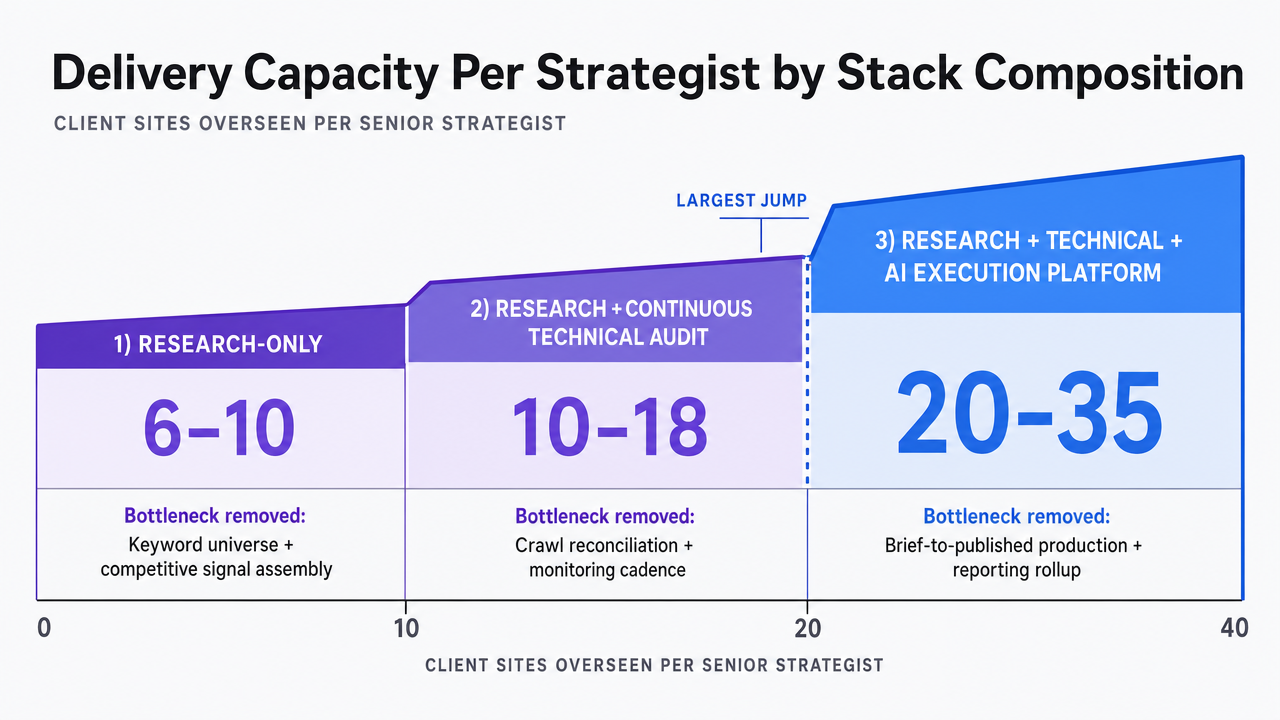 Translate the section's comparison table of stack compositions and strategist leverage ranges into a scannable visual that reinforces the same numbers cited in prose
See How Top Agencies Use AI-Driven SEO Platforms to Scale Client Delivery
Connect with our team for a walkthrough of AI-powered workflows designed for agencies managing high client volumes—streamline approvals, automate execution, and preserve expert oversight without expanding your headcount.
If You Manage Multiple Locations, Franchises, or Portfolio Brands
The stack picks shift once the account isn't a single domain. Multi-location operators, franchise systems, and portfolio holding companies face a different unit of work: the location, the franchisee, or the brand, each with its own local intent, review stream, and technical footprint. A stack tuned for national organic work misreads this shape entirely.
Three adjustments matter:
- The local specialist (BrightLocal in the earlier tier) moves from optional to mandatory. Citation consistency and GBP hygiene across two hundred locations is not a research problem; it is an operational one, and the tool has to treat the location as a first-class object.
- The intelligence tier gets used for brand-level pillar work while location pages are handled through template governance rather than one-off briefs. A strategist writing individual briefs for every location page has already lost the margin fight.
- The execution tier does the heaviest lifting here: generating location-specific content variants under a shared template, routing each variant through franchisee or regional-manager approval, and pushing published pages back into monitoring. That approval routing is what keeps the model workable when the sign-off owner isn't the agency but the local operator.
A Scoring Model Heads of SEO Can Actually Defend to a P&L
Feature grids do not survive a P&L review. What does is a scoring model that ties each pick to a delivery outcome the CFO recognizes. Four criteria hold up across agency contexts:
- Strategist leverage delta: how many additional client sites the tool lets one senior SEO carry without dropping the quality standard.
- Approval integrity: whether the platform preserves a human sign-off gate on any output that reaches a client, which NIST's trustworthy AI characteristics frame as explainable, valid and reliable, and accountable and transparent 4.
- Portfolio rollup: whether reporting, permissions, and project state span the full client book without spreadsheet reconciliation.
- Bottleneck specificity: whether the tool removes a named stage, not a vague category.
A pick that scores well on three criteria and fails on approval integrity is disqualified, not discounted. The margin math only works when throughput gains do not create a governance liability that shows up two quarters later as churn.
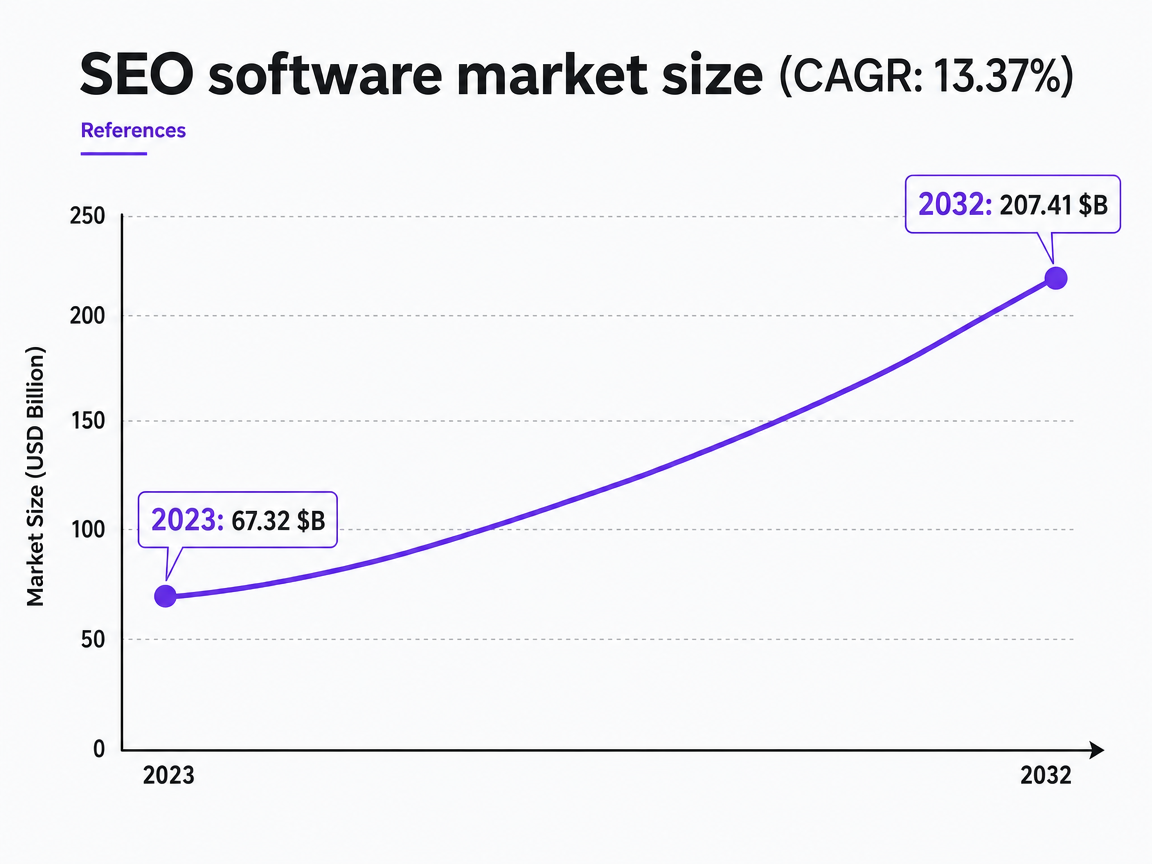 SEO software market size (CAGR: 13.37%)
Source: SEO Software Market Size, Share & Growth Report
Frequently Asked Questions
References
- 1.Secure Software Development Practices for Generative AI and Dual-Use Foundation Models.
- 2.2024 NIST GenAI (Pilot Study).
- 3.Department of Commerce Announces New Guidance and Tools 270 Days Following President Biden's Executive Order on AI.
- 4.Generative Artificial Intelligence Reference Guide.
- 5.SEO Software Market Size Worth USD 265.91 Bn by 2034 Driven by Digital Marketing Growth and Increasing Online Competition.
- 6.SEO Software Market Size, Share & Growth Report 2032 - SNS Insider.
- 7.SEO Software Market Size & Share 2025-2034.
- 8.SEO Software Market - Global Strategic Business Report.
- 9.SEO Software Market Size, Competitors & Forecast to 2030.
- 10.Global SEO Software Market 2024-2028.
- 11.North America SEO Software Market Size & Competitors.
- 12.Adversarial Machine Learning: A Taxonomy and Terminology of Attacks and Mitigations.