
Key Takeaways
- Standardize the technical audit as a versioned artifact so specialists run against one template, cutting review time and creating a diffable history of what changed between quarters.
- Codify SERP intent before briefs leave the strategy desk, scoring each query against a fixed rubric so drafts answer the SERP instead of arguing with it.
- Treat AI-assisted production as a governed workflow with source records, approval history, substantiation files, and provenance tags attached to every asset 9.
- Build entity briefs that encode a pre-approved claim inventory with citations, so reviewers verify against attached evidence rather than chasing sources across tabs 4.
- Install a two-gate review model that separates specialist judgment from compliance sign-off, preventing single-reviewer fatigue from setting the portfolio's actual risk ceiling 6.
- Consolidate regulated-vertical obligations into one portfolio control layer covering substantiation, endorsements, fake-review rules, HIPAA tracking configuration, and marketing authorization 8, 3, 10.
- Systematize local SEO across multi-location portfolios with a central data model, fixed page framework, incentive-free review SOP, and per-location scorecards that expose underperformers.
- Choose a delivery capacity model deliberately, recognizing that every option—in-house, offshore, freelance, or AI platform—is bound by review capacity rather than production capacity 7.
- Reallocate specialist time by moving structured execution tasks into AI workflows and protecting judgment work like intent classification, brief architecture, and review gates 5.
- Rebuild reporting around visibility, qualified traffic, conversions, and revenue, and instrument HIPAA-covered accounts server-side to keep protected health information out of analytics 3.
- Institutionalize a post-publication monitoring loop that watches rankings, claim freshness, technical regressions, and provenance integrity, routing tripped thresholds into the same queue as new work 2.
Why Scaling SEO Delivery Is a Governance Problem, Not a Volume Problem
Agency SEO leaders have already run the AI-productivity experiment. Most piloted assisted drafting in 2023 and 2024, and most hit the same wall: quality drift, compliance exposure, and client-approval bottlenecks that ate the margin the tools were supposed to create. Stanford's 2025 AI Index found that generative-AI use in at least one business function jumped from 33% to 71% between 2023 and 2024, yet marketing-and-sales users reporting revenue gains most commonly saw increases below 5% 7. Adoption has clearly outpaced measurable outcome improvement.
The agencies that are actually scaling delivery across a growing client roster without proportional headcount growth are not the ones producing the most content. They are the ones that have institutionalized how SEO work moves through the shop: how audits are standardized, how briefs encode evidence, how drafts pass through specialist and compliance review, how measurement survives AI-search dilution, and how post-publication signals feed back into the queue.
The 11 disciplines that follow are framed for Heads of SEO deciding what to build once and apply across every account, not tactics an individual specialist runs on a single site.
Standardize the Technical Audit as a Repeatable Artifact
The single largest source of specialist time waste at mid-market agencies is the bespoke technical audit. Senior SEOs pull the same crawls, run the same log-file passes, and write the same findings in a slightly different narrative for every new account. That work should exist once, as a versioned artifact, and every specialist should run against it.
A repeatable audit template encodes the crawl configuration, the log-sampling window, the render-mode checks, the internal-link depth thresholds, the indexation ratios that trigger escalation, the schema coverage matrix by page type, and the Core Web Vitals field-data cutoffs that constitute a pass. Findings are written into structured fields, not prose, so severity, effort, and expected impact are consistent across accounts. That structure is what lets a mid-level specialist produce an audit a director can review in twenty minutes instead of two hours.
Heads of SEO should own the template revision cycle directly. When Google changes indexation behavior or a client vertical develops a new render pattern, the template updates once and propagates. The output becomes a diffable record: what changed between the Q1 and Q3 audits on a given account, and whether the intervening remediation actually moved the flagged metrics. That audit history is also the raw material for the post-publication monitoring loop covered later in this piece.
Codify SERP Intent Before Any Brief Leaves the Strategy Desk
Most brief-quality problems trace back to a skipped step: no one classified the SERP before the keyword was assigned. A specialist opens a Google Doc, types the target query into the header, and starts outlining based on volume and difficulty scores. The resulting draft argues with the SERP instead of answering it, and the client review cycle absorbs the cost.
A codified intent matrix removes that failure mode. Each target query is scored against a fixed rubric before a brief is written:
- dominant result type (informational, commercial investigation, transactional, local pack, video-led)
- presence and composition of AI-generated summaries
- entity anchors in the top ten
- freshness signals in the top three
- format conventions such as comparison tables, step lists, or embedded calculators
Strategists document the classification in the brief header, and specialists write to match it. When a SERP shifts format, the brief flags the shift explicitly rather than shipping a mismatched draft.
The matrix also feeds triage. Queries where AI overviews already summarize the answer route to formats that earn citation inside the summary or capture downstream navigational intent, not to another 1,800-word explainer. Queries with heavy local-pack dominance route to local landing frameworks rather than blog production. That routing decision, made once at the strategy desk, protects specialist hours across every account on the roster.
Treat AI-Assisted Production as a Governed Workflow, Not a Shortcut
The economic argument for AI-assisted drafting is over. Stanford's 2025 AI Index reports that the cost to run a model at GPT-3.5 capability level fell more than 280-fold between November 2022 and October 2024 1. Inference is no longer a meaningful line item in an agency's production stack. That single fact reframes the question every Head of SEO faces: if generating a draft costs almost nothing, what determines whether the draft ships, and who owns the risk when it does?
The answer is a governed workflow with named artifacts at each stage. NIST's Generative AI Profile identifies confabulation, information integrity, intellectual property exposure, and accountability as the primary risks agencies must actively manage across the content lifecycle 9. Translating that into agency operations means four artifacts attached to every AI-assisted asset:
- a source record showing which references informed the draft
- an approval history showing which specialist accepted or rejected which claims
- a substantiation file for any factual assertion that carries client risk
- a provenance tag identifying which portions were model-generated versus human-written
NIST's synthetic-content guidance treats provenance and audit records as complementary controls rather than optional documentation 2.
Heads of SEO should draw the line at what the model is authorized to produce without review. First-draft prose against a specialist-approved brief is appropriate. Original claims, statistics, quotations, entity relationships, and client-specific commitments are not. Drafts that assert unsupported numbers should route back to the specialist for evidence sourcing, not forward to the client. That routing rule is what converts cheap inference into defensible output rather than published liability.
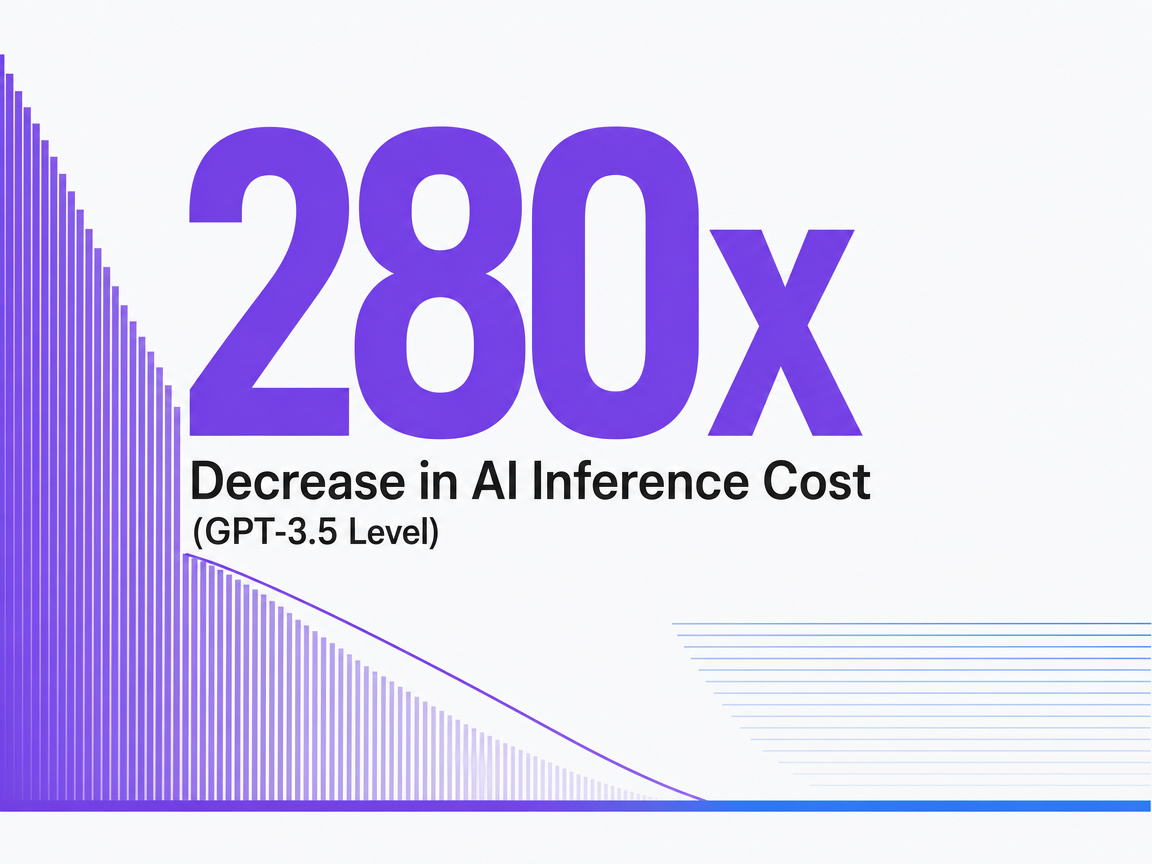 Decrease in AI Inference Cost (GPT-3.5 Level)
Decrease in AI Inference Cost (GPT-3.5 Level)
Build Entity Briefs That Encode Evidence, Not Just Keywords
Keyword briefs produce keyword content. Entity briefs produce answers the SERP is willing to cite. The distinction matters more now that AI summaries and knowledge panels reward pages that resolve entities, relationships, and claims cleanly rather than pages that repeat a target phrase at a target density.
A production-grade entity brief specifies the primary entity, the related entities that must appear for topical completeness, the claim inventory the draft is authorized to make, and the evidence source attached to each claim. Statistics, dates, prices, dosages, jurisdictional rules, and outcome numbers move into the brief as pre-approved facts with citations, not as prompts for the drafter to research mid-sentence. FTC guidance is explicit that advertisers must possess adequate substantiation for objective claims before dissemination, and that obligation applies whether the medium is a landing page, a blog post, or an AI-assisted draft 4.
The operational payoff is compounding. Specialists stop re-sourcing the same statistics for every account in a vertical, because the claim inventory is versioned at the practice-area level and reused across briefs. Reviewers verify against the attached evidence in minutes instead of chasing citations across tabs. And when a regulator, a client legal team, or an editor asks where a number came from, the answer is in the brief header, not in a Slack thread from six weeks ago.
Test scalable SEO workflows on real campaigns
Experience full-platform SEO execution and measure campaign impact before making a commitment.
Install a Two-Gate Review Model: Specialist Judgment, Then Compliance
Single-reviewer models collapse under portfolio load. When one senior specialist owns both editorial judgment and compliance sign-off, the review queue becomes the bottleneck the entire delivery pipeline waits on, and the reviewer's fatigue rate determines how much risk actually reaches the client. A two-gate model separates the questions and assigns them to different people at different moments.
The first gate is specialist judgment. A senior SEO evaluates whether the draft answers the SERP, resolves the target entity, matches the brief's format classification, and holds together as an argument. Claims flagged as unsupported route back to the drafter with the missing evidence identified, not with a vague rewrite request. The second gate is compliance. A reviewer trained on the client's vertical checks substantiation for objective claims, endorsement disclosures, and any regulated-language triggers before the asset moves to client approval. FTC guidance treats substantiation as a pre-dissemination obligation regardless of medium 6, which means the compliance check belongs inside the agency, not at the client's legal desk.
Heads of SEO should track gate-level rejection rates by drafter, reviewer, and vertical. Those numbers reveal where briefs are underspecified and where training investment actually pays back.
Consolidate Regulated-Vertical Compliance Into One Portfolio Control Layer
Agencies that carry legal, healthcare, dental, home services, and behavioral health accounts on the same roster cannot afford to run compliance as an ad-hoc reflex on each account. The obligations overlap enough to consolidate into a single portfolio control layer, and the penalties for getting them wrong scale with the number of clients exposed to the same broken workflow.
Five obligations belong in that layer.
- Substantiation for objective claims. FTC health-products guidance requires advertisers to possess adequate substantiation before dissemination, and claims may be conveyed by implication through headlines, imagery, or context rather than only through literal wording 4.
- Endorsement and testimonial controls. Endorsers cannot describe experiences they have not had, and material connections that affect credibility must be disclosed clearly and conspicuously 11.
- The 2024 FTC final rule on fake reviews, which prohibits creating, buying, selling, or disseminating reviews known or reasonably expected to be fake, including AI-generated reviews that misrepresent the reviewer's experience 8.
- HIPAA tracking-technology configuration. Authenticated pages using analytics, conversion tags, call intelligence, or retargeting must be configured so that protected health information is used and disclosed only in compliance with the Privacy Rule and secured under the Security Rule 3.
- HIPAA marketing authorization, which requires written patient authorization before a covered entity uses or discloses protected health information for marketing, with limited exceptions 10.
The portfolio control layer is a shared artifact set: a claim-substantiation register indexed by vertical, an endorsement and review-collection SOP that blocks incentive-tied positive sentiment, a measurement-stack configuration checklist for HIPAA-covered accounts, and a routing rule that escalates any client-specific commitment to a named compliance reviewer before publication. Heads of SEO should audit the layer quarterly and log which accounts triggered which escalations. That log is the evidence that the control layer is operating, not just documented, and it is the fastest way to identify which drafters or briefs are generating disproportionate review load.
Systematize Local SEO Across Multi-Location Portfolios
The operating problem shifts once an agency takes on multi-location clients. A dental group with 40 offices, a home-services franchisor with 120 branches, or a behavioral health network with 25 clinics does not need 40, 120, or 25 versions of a local SEO program run in parallel. It needs one program instantiated 40, 120, or 25 times with controlled variance. Delivery leads who treat each location as a bespoke account burn margin on work that should be templated.
The systematization has four components:
- A location data model owned centrally: canonical NAP, service taxonomy, practitioner or crew rosters, hours logic, and service-area polygons live in one source of truth that pushes to Google Business Profile, Apple Business Connect, structured data on location pages, and the citation network.
- A location page framework with fixed sections and variable slots—service scope, staff, intake process, insurance or licensing, driving directions, and location-specific proof—so specialists populate slots rather than architect pages.
- A review-generation SOP that collects authentic feedback per location without incentives tied to positive sentiment, which the 2024 FTC final rule treats as prohibited conduct when reviews are known or reasonably expected to be fake 8.
- A per-location scorecard that separates pack visibility, organic visibility, and downstream calls or bookings so a single underperforming location does not hide inside portfolio averages.
Heads of SEO should decide which variables locations may override and which they may not. Brand voice, claim inventory, and schema patterns stay central. Staff bios, local proof, and community references stay local. That boundary is what keeps a 120-location rollout from becoming 120 audits.
Choose a Delivery Capacity Model Deliberately
This section shifts the frame from single-account tactics to portfolio economics. Heads of SEO scaling from 15 to 30 or 60 accounts are not choosing between tools; they are choosing between staffing architectures, and each architecture carries a different risk profile and a different ceiling.
Four models dominate mid-market agency delivery today:
- In-house specialist hiring produces the highest judgment quality but the longest ramp and the steepest fixed-cost curve.
- Offshore production pods reduce variable cost per deliverable but push review overhead back onto senior staff, often eroding the labor arbitrage on regulated accounts.
- Freelance networks flex with pipeline but fragment institutional knowledge and complicate substantiation trails.
- AI marketing execution platforms with human approval workflows compress production time and standardize provenance, but they require the governance disciplines described earlier in this piece to convert cheap drafts into defensible output.
Stanford's 2025 AI Index tempers the pure automation pitch: generative-AI use in at least one business function reached 71% of surveyed organizations in 2024, but among marketing and sales users reporting revenue gains, the increases were most commonly below 5% 7. Adoption alone does not move margin. The delivery model has to be paired with the review gates, entity briefs, and compliance layer already established.
The comparison below isolates the operating variables Heads of SEO should weigh before committing to a model. Dollar figures are deliberately excluded because they depend on client mix, vertical exposure, and existing tooling; the point is directional trade-offs.
| Model | Setup Time | Variable Cost Driver | Review Overhead | Compliance Risk Exposure | Scaling Ceiling |
|---|---|---|---|---|---|
| In-house specialist hiring | Long (recruit, onboard, ramp) | Fully loaded salary per FTE | Low per asset; high per hire | Contained if training is current | Bound by hiring pace |
| Offshore production pod | Medium | Hours billed per deliverable | High; senior review absorbs QA | Elevated in regulated verticals | Bound by senior reviewer bandwidth |
| Freelance network | Short per assignment | Piece rate or hourly | High; fragmented context | Elevated; inconsistent substantiation trails | Bound by coordination overhead |
| AI execution platform with approval workflow | Short after integration | Platform fee plus review labor | Concentrated at named gates | Contained if governance layer is enforced | Bound by reviewer throughput |
The honest read of the table is that every model is bound by review capacity, not production capacity. The delivery decision is really a decision about where the agency wants its reviewer bottleneck to sit and how tightly it can be governed.
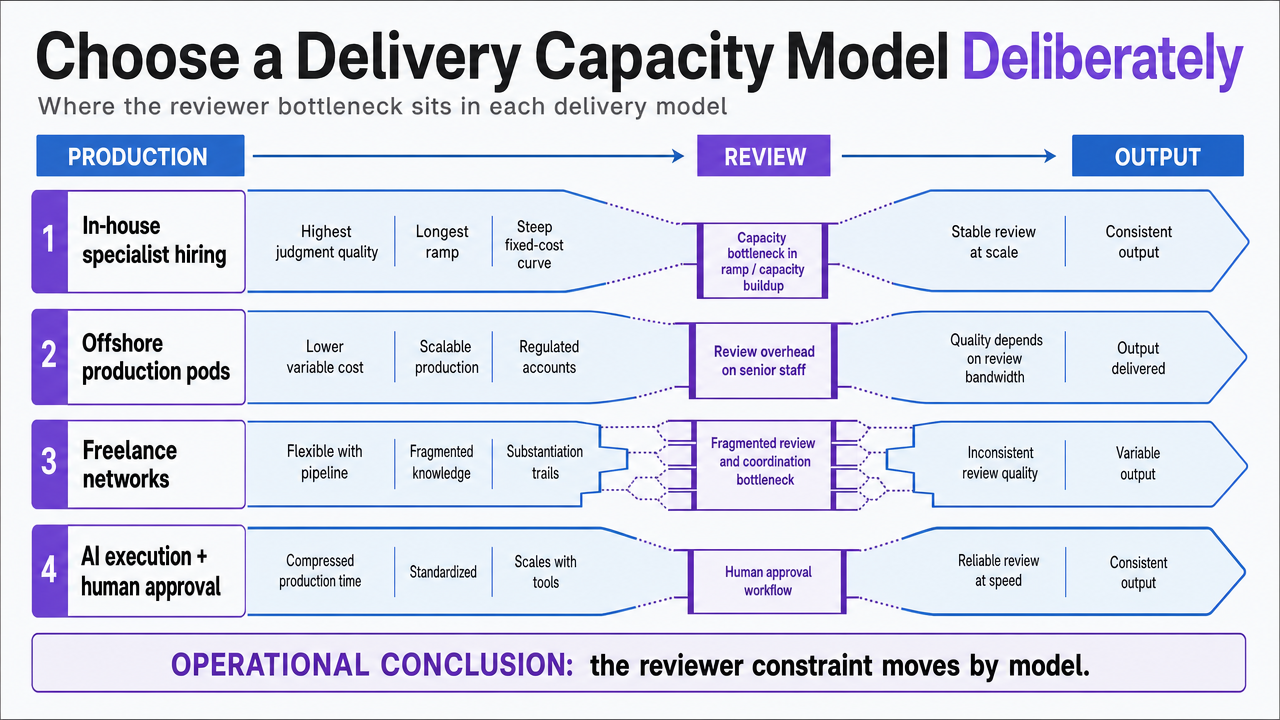 Reinforce the section's four-model comparison table by visualizing where the reviewer bottleneck sits in each delivery model, which is the section's central operational conclusion
Operationalize Scalable SEO Without Expanding Your Headcount
Connect with our team to see data-backed workflows that enable agencies to scale SEO execution, maintain quality, and streamline multi-client management—without increasing resource allocation or sacrificing oversight.
Reallocate Specialist Time to the Tasks Where AI Actually Reduces Load
The productivity question is not whether AI helps, but where. Stanford's 2025 AI Index synthesis of research covering more than 200,000 professionals reports productivity gains ranging from 10% to 45%, with the strongest effects concentrated in technical, customer-support, and creative tasks 5. The band is wide because the gains are task-specific, and the tail of that distribution is where agency delivery leads should be pointing specialist reallocation decisions.
Inside an SEO practice, the tasks that sit at the high end of the range are the ones already governed by structured inputs:
- technical audit findings written into template fields
- meta title and description variants generated against a specialist-approved pattern
- schema markup drafted against a documented type map
- internal link suggestions surfaced from crawl data
- first-draft prose written against an entity brief with a locked claim inventory
These are execution tasks with clear right answers, and they consume the largest share of mid-level specialist hours across a portfolio.
The tasks that sit at the low end, or that fall outside the band entirely, are the judgment tasks:
- SERP intent classification when the top ten is mixed and unstable
- entity brief construction for a new practice area
- remediation prioritization when technical findings conflict with editorial calendars
- claim substantiation for regulated verticals
- the specialist review gate itself
These do not compress well, and pushing them into AI-first workflows is what produces the confabulation and information-integrity failures NIST flags as primary generative-AI risks.
Heads of SEO should audit specialist time by task category quarterly and move the execution band into governed AI workflows first. The reallocated hours belong on intent classification, brief architecture, and review gate throughput, which are the three constraints that determine how many accounts the shop can carry without quality drift.
Rebuild the Reporting Frame Around Qualified Outcomes, Not Rankings
Ranking reports and session counts age badly when AI summaries answer the query on the SERP itself. Agencies still shipping monthly decks led by average position and organic sessions are training clients to evaluate SEO on inputs that no longer map cleanly to revenue. The frame has to move down the funnel, and it has to move before a client asks why sessions are flat while pipeline is up.
A qualified-outcomes reporting frame replaces the top-line vanity chart with four layered signals:
Visibility : across traditional and AI-mediated surfaces — tells the reviewer whether the entity is present in the answer set.
Qualified traffic : segmented by intent classification — tells them whether the visitors match the SERP intent the brief targeted.
Conversions : instrumented at the property — tells them whether the page did the job.
Revenue or booked pipeline : attributed back to the entry query where the client's data model allows — tells them whether the job was worth doing.
Heads of SEO working HIPAA-covered accounts have to solve this without leaking protected health information into analytics or ad platforms. HHS is explicit that authenticated pages using tracking technologies must be configured so those technologies use and disclose PHI only in compliance with the Privacy Rule, with ePHI secured under the Security Rule 3. That constraint pushes healthcare reporting toward server-side event capture, hashed identifiers, and call intelligence that separates outcome signal from patient data. The reporting frame becomes an instrumentation decision, not a slide template.
Institutionalize a Post-Publication Monitoring Loop
Publication is a checkpoint, not an endpoint. The assets shipped in Q1 are the same assets that will drift in Q3 when a SERP reformats, a claim ages out, or a competitor updates the entity graph the page was built to resolve. Agencies without a monitoring loop treat drift as a client complaint; agencies with one treat it as a scheduled queue item.
A production-grade loop watches four signal classes on a fixed cadence:
- Ranking and visibility shifts on tracked queries, flagged when movement exceeds a threshold rather than reported as noise.
- Claim freshness on any asset carrying statistics, prices, or regulatory language, with expiration dates written into the entity brief and surfaced when they hit.
- Technical regressions caught by the same audit template the account was onboarded against, so drift is measured against a known baseline.
- Provenance integrity for AI-assisted assets, which NIST identifies as a maintenance obligation across the content lifecycle rather than a one-time publication control 2.
Heads of SEO should route loop outputs into the same queue that intake new work. When a monitored asset trips a threshold, it competes for specialist hours against new production on a common priority scale. That is what keeps the back catalog from silently decaying while the front of the shop ships fresh drafts.
Where Vectoron Fits in an Agency's Delivery Stack
The disciplines above describe an operating model, not a product. Any agency willing to build audit templates, entity briefs, two-gate review, a consolidated compliance layer, and a qualified-outcomes reporting frame can run this playbook with the tooling it already owns. The question Heads of SEO are actually asking is whether to build that governance stack in-house or adopt a platform that ships with the artifacts already wired together. Vectoron is one option in the AI marketing execution category, with specialist strategists across content, SEO, PPC, backlinks, social, and call intelligence coordinated through a Command Center that routes every recommendation for human approval before execution. Agencies evaluating that category should judge it against the same review-gate throughput, provenance discipline, and compliance controls established earlier, then test it on live accounts during the two-week trial before committing at $599 per month.
Frequently Asked Questions
References
- 1.The 2025 AI Index Report | Stanford HAI.
- 2.Reducing Risks Posed by Synthetic Content An Overview of Technical Approaches to Digital Content Transparency.
- 3.Use of Online Tracking Technologies by HIPAA Covered Entities and Business Associates.
- 4.Health Products Compliance Guidance.
- 5.CHAPTER 4: Economy - Stanford HAI.
- 6.Advertising and Marketing on the Internet: Rules of the Road.
- 7.Economy | The 2025 AI Index Report | Stanford HAI.
- 8.Federal Trade Commission Announces Final Rule Banning Fake Reviews and Testimonials.
- 9.Artificial Intelligence Risk Management Framework: Generative Artificial Intelligence Profile.
- 10.Marketing.
- 11.Advertisement Endorsements.