
Key Takeaways
- Rankings are a probabilistic output of partially observable signals, so agencies scale by building a system that reads signals, sequences work, and ships approved changes—not by stacking tactics 1.
- A three-layer operating model—signal reading, prioritization under uncertainty, and strategist-owned approved execution—concentrates senior judgment on arguments, claims, and governance rather than production review.
- Segment paid keywords by current organic position and re-price budget on a rolling basis, since strong organic visibility largely absorbs paid clicks on the same query 3.
- Route review acquisition and YMYL content through a governed approval gate with named reviewers, logged claim substantiation, and FTC-aligned policies to protect portfolio-scale rankings from compliance liability 4.
Why ranking is a probabilistic output, not a production target
Agency heads who have run more than a handful of accounts know the pattern. A site climbs after a technical cleanup, then plateaus. A competitor with weaker content outranks it for six months, then falls off. The team ships a new hub, watches it stall, and ships another. The instinct is to add tactics. The problem is that tactics assume the ranking function is legible enough to reverse-engineer, and the evidence for that assumption has been thin for two decades.
The AIRWeb analysis of Google's ranking function framed rankings as a binary classification problem and tested how well observable features could predict which of two pages would rank higher. Ranking by the single strongest feature in a category, whether inlinks or text similarity, predicted pairwise order with 57% to 70% precision depending on the feature. The authors were explicit that the full scoring function could not be closely approximated using only observed features 1. That study modeled a 2005 web against a 2005 index, so the specific numbers are historical, not current. What survives is the shape of the finding: even the best single observable signal leaves a persistent gap, because too many inputs, from query logs to link age to crawl dynamics, sit outside what any external analyst can measure.
For a portfolio operator, the operational consequence is direct. Treating ranking as a production target, where a specific tactic is expected to move a specific position on a specific date, misprices risk. Rankings are a probabilistic output of many partially observable signals. The unit of work that scales is not the tactic but the system that reads signals, sequences work against them, and ships approved changes fast enough to compound across 20 or 80 accounts. That framing is what the rest of this piece builds against.
The three-layer operating model behind portfolio-scale rankings
Signal reading: what the account is actually telling the strategist
Most account reviews start with rank trackers and Search Console. That is the wrong end of the stack. By the time a position moves, the decisions that produced the movement are three to twelve weeks old, and the signals that would have flagged the opportunity earlier are sitting in systems the SEO team rarely touches: the CRM, the call log, the booking platform, the intake form, and the paid media console.
Signal reading, as the first layer of the operating model, is the discipline of pulling those inputs into the same view the strategist uses to make weekly decisions.
- Qualified call volume by service line.
- Booked-consult conversion rate against organic landing pages.
- Cost per lead delta between organic and paid for the same query cluster.
- Which pages the sales team quotes back to prospects.
- Which questions come up on discovery calls that the site does not answer.
The AIRWeb work is a useful anchor here. If the ranking function cannot be closely approximated from observable external features 1, the compensating move is not to guess harder at those features. It is to enrich the signal set with proprietary business data the ranking model does not see. A strategist who knows that a client's highest-margin service line generated fourteen qualified calls last month, twelve of which came from three URLs, has a clearer read on where ranking movement matters than one working from keyword volume alone.
Signals are not dashboards. A signal is an input that changes the next decision. Anything that does not is reporting.
Prioritization: sequencing work against partially observable ranking behavior
The second layer is where portfolio agencies most often break down. Signals get read, and then everything goes into a backlog that gets worked in roughly the order it arrived. Strategist attention ends up distributed by whichever account manager escalated most recently, not by expected impact.
Prioritization is a sequencing problem under uncertainty. Because the ranking function includes signals no external analyst can observe 1, every planned change carries a probability distribution over outcomes, not a point estimate. A schema fix on a high-intent template might move ten URLs; it might move none. A new comparison page might rank in six weeks or six months. The prioritization layer's job is to rank candidate work by expected value against strategist hours, then re-rank as new signals come in.
Three inputs make this tractable across a book of 20 to 80 accounts.
- The size of the pipeline exposure attached to each candidate change: how much booked revenue is currently routed through the pages in question, or blocked from reaching them.
- The marginal cost in strategist time, not production time. Producing a page is cheap; deciding what the page argues, who signs off on the claims, and how it is measured is not.
- The recovery cost if the change underperforms, which is higher for template-wide edits than for isolated URL rewrites.
Agencies that run this layer well stop shipping work in strict FIFO order. They ship the smallest change with the largest exposure first, wait for the signal, and re-sequence. Positions move faster because the queue does, not because the tactics changed.
Approved execution: where strategist judgment changes outcomes versus reviews production
The third layer is where most agencies overspend strategist hours. Senior SEOs sit in review queues editing meta descriptions, checking heading hierarchy, and reformatting FAQ blocks. That work needs to happen, but it is not where judgment changes the outcome. Judgment changes the outcome at three points: the argument a page is making, the claims it substantiates, and the approval to publish work that carries reputational or regulatory weight.
The framing that clarifies this layer comes from how search quality itself is evaluated. NIST's foundational work on search-engine measurement treats quality as something that has to be defined, instrumented, and tested against real user outcomes rather than assumed from surface features 8. The same logic applies inside an agency. Execution quality is not whether a page shipped on schedule. It is whether the shipped page moved a measurable outcome the strategist predicted in advance.
Approved execution separates two things that agencies routinely conflate: production throughput and governance. Production can be automated, templated, or delegated aggressively once the argument and claims are locked. Governance cannot. The approval gate is where a strategist confirms that a client's medical claim is sourceable, that a legal disclaimer is present, that a review incentive language is compliant, and that the argument on the page still matches the signal that triggered the work three weeks earlier.
Run this way, the operating model looks like a directed flow: signal reading feeds prioritization, prioritization feeds a production queue, and the queue passes through a strategist-owned approval gate before anything reaches the client's site.
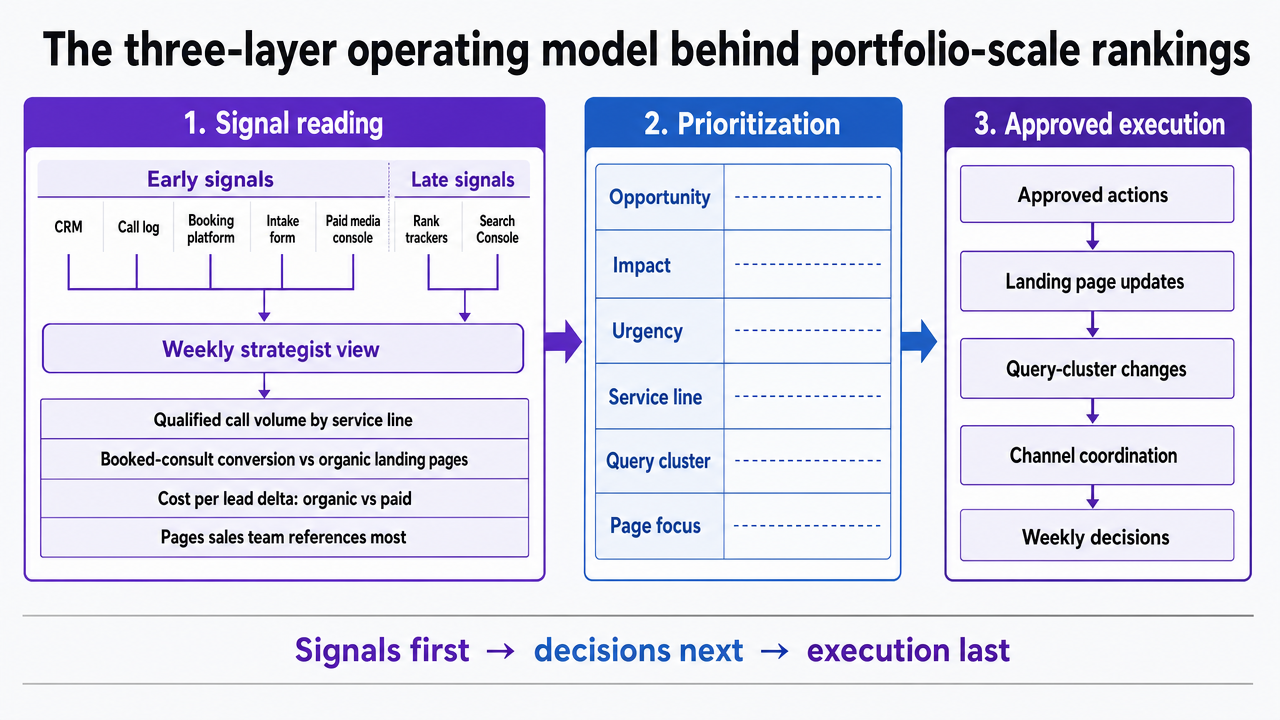 Visualize the three-layer operating model (signal reading, prioritization, approved execution) described as a directed flow in this section
Rankings translated into pipeline: the organic-paid substitution argument
Ranking screenshots do not survive quarterly business reviews anymore. Clients want to know what a position-two result is worth against the paid budget they are already spending on the same query, and whether the SEO retainer is buying incremental pipeline or subsidizing work the paid team could do faster. That question has a better answer than most agencies give it.
The Ghose and Yang analysis of organic and sponsored search interaction found that the two channels are not independent demand pools. Strong organic rankings can substitute for paid clicks on the same query, and the incremental value of a paid impression depends materially on whether the same domain is already visible organically. In cases where organic visibility is strong, paid ads primarily shift clicks that would have gone to the organic listing rather than expand total clicks to the site 3. The reverse also holds: when organic visibility is weak, paid clicks are more genuinely incremental, because there is no organic result absorbing the demand.
That asymmetry is the argument agencies can take directly to a client's CFO. On query clusters where the client holds top organic positions, a portion of the paid spend on those exact terms is buying clicks the site would have won for free. On clusters where organic visibility is thin, paid is doing real acquisition work. The operational move is to segment the paid keyword list by current organic position and re-price the paid budget against that map on a rolling basis. Terms that cross into the top three organically get paid budget reduced or paused and the savings redirected to clusters where organic is still climbing.
Run consistently across a portfolio, this reframes the SEO retainer. It stops competing with the paid budget for attribution credit and starts governing where the paid budget is spent. Pipeline predictability improves because two channels that used to be measured against each other are now sequenced against a single query-level economic model.
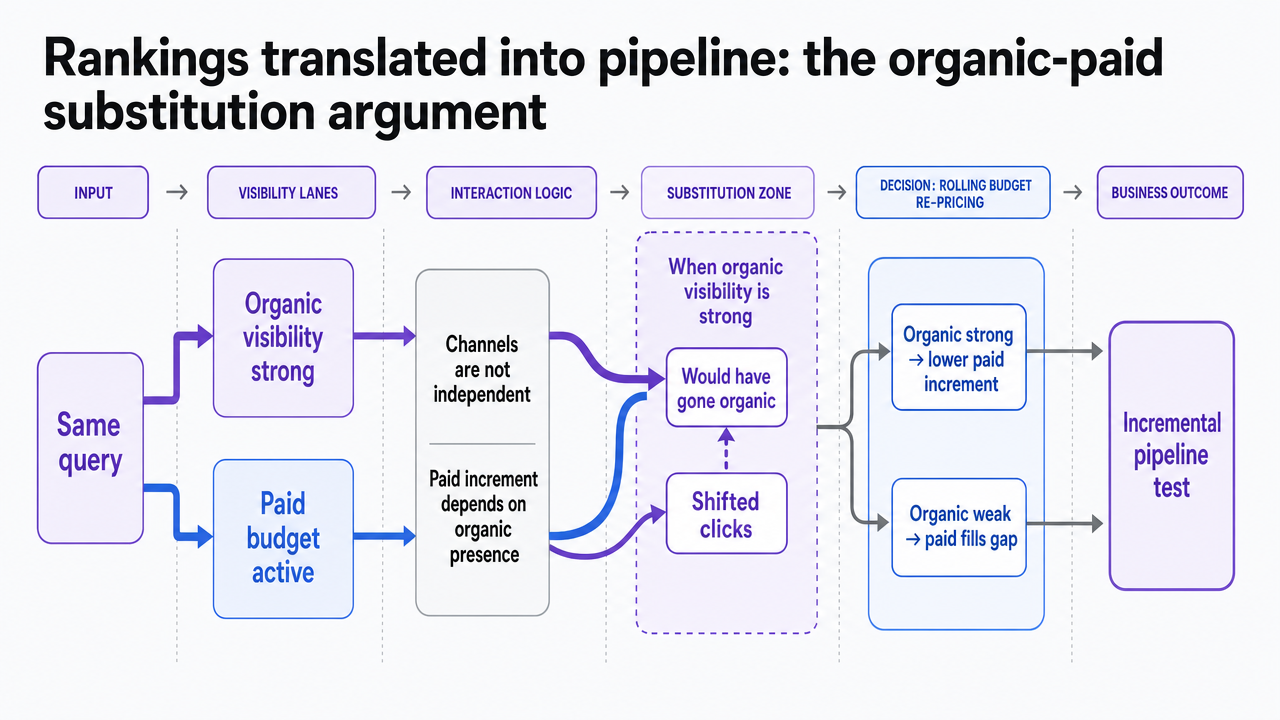 Illustrate the organic-paid substitution logic and the rolling budget re-pricing decision described in this section
Test Predictable Top Rank SEO Workflows Yourself
Experience hands-on delivery of live, publishable SEO content to assess ranking and workflow impact in real scenarios.
Portfolio economics: staffing math when strategist attention is the bottleneck
Scope shift: this section addresses agencies running 20 to 80 client accounts, not single-site operators. The economics that follow break down entirely at one or two accounts, and they become the whole business at portfolio scale.
The throughput ceiling at most SEO agencies is not writer capacity, developer capacity, or link acquisition capacity. It is senior strategist hours. Junior specialists can produce drafts, run audits, and stage changes; they cannot decide which claim on a personal injury page needs a citation, which service line to prioritize when qualified call volume shifts, or whether a competitor's new comparison hub warrants a defensive response. Every one of those decisions routes back to a strategist, and every strategist has a hard weekly ceiling.
Agencies that grow headcount linearly to add accounts hit a predictable failure mode. A senior strategist covering eight accounts at four hours each spends 32 hours in account work and the balance in review queues. Adding a ninth account either compresses per-account attention below the threshold where prioritization decisions get made deliberately, or it pushes review work onto a junior who does not yet have the judgment to catch a regulated-vertical claim before it ships. Neither outcome scales.
The alternative is not more strategists. It is separating governance hours from production hours and pricing them against a realistic worksheet. The table below is a template, not a benchmark. Agency heads should populate it with their own numbers.
| Input | Traditional staffing model | Coordinated production model |
|---|---|---|
| Accounts per senior strategist | 6–10 | 20–40 (variable) |
| Strategist hours per account per month | Production + review + QA | Signal review + approval only |
| Briefing cycles per deliverable | 2–4 rounds | 1 locked argument, then execution |
| Approval gate | Ad hoc, per deliverable | Single governed queue |
| Reference price point | Fully loaded strategist cost | Vectoron trial at $599/mo per account, plus retained strategist hours |
The worksheet resolves one question: at what account-per-strategist ratio does judgment quality start to degrade, and what does moving the production and QA load off the strategist do to that ratio? Agencies that answer it honestly usually find that the constraint is not budget but where strategist attention gets spent. NIST's framing of search quality as a measurement discipline 8 applies to internal ops as much as to Google's index: the ratio that matters is not accounts per head but approved decisions per strategist-hour, tracked against outcomes the strategist predicted in advance.
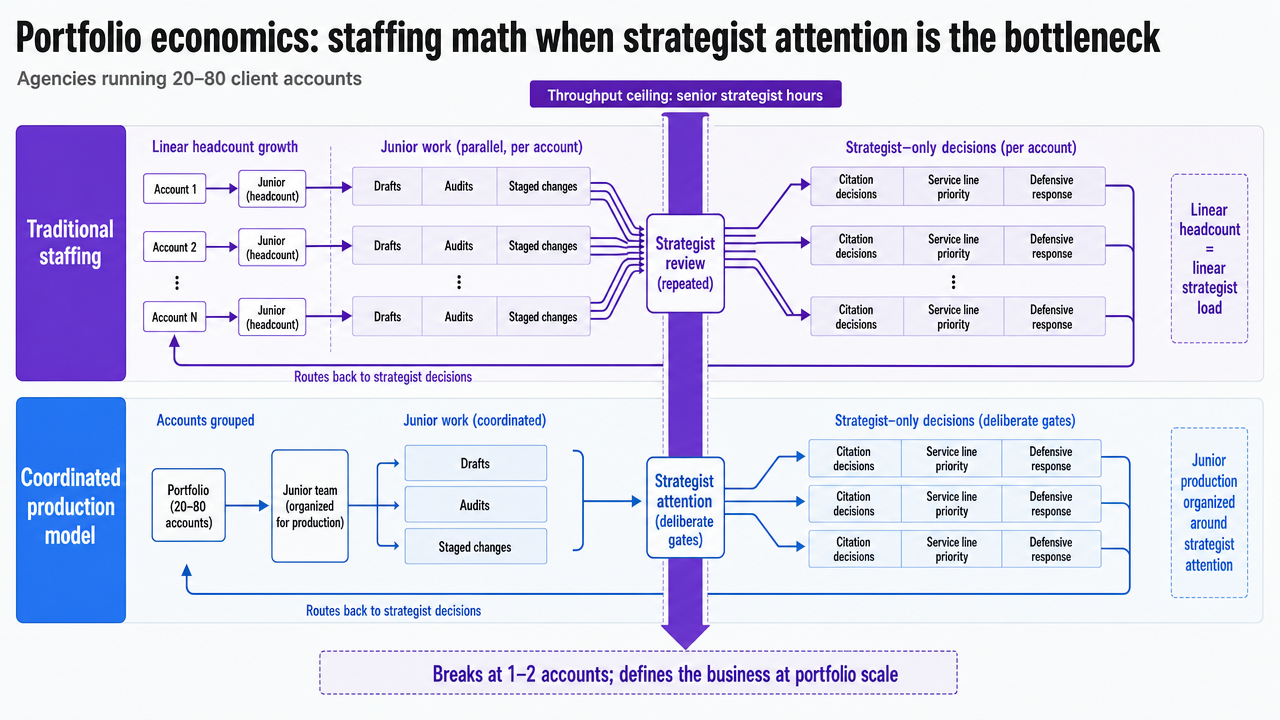 Reinforce the comparison between traditional staffing and the coordinated production model presented in the article's table
Review integrity as regulated infrastructure, not reputation work
Review workflows sit inside SEO ops now, whether agency heads have organized them that way or not. Local pack visibility, star-rating snippets in SERPs, and the trust signals that convert an organic click into a booked consult all route through the same review corpus. Pew found that 82% of U.S. adults at least sometimes read online customer ratings or reviews before buying something new 7, which puts the review layer downstream of the ranking work and upstream of the revenue that justifies the retainer.
What has changed is that review acquisition is now regulated infrastructure. The FTC's business guidance on endorsements and reviews consolidates obligations under the FTC Act and the Consumer Review Rule, covering incentivized reviews, undisclosed material connections, employee-written reviews, and the suppression of negative feedback 4. The platform-facing guide adds operational specifics:
- Solicitations must go to all customers rather than only satisfied ones.
- Incentives cannot be conditioned on positive sentiment.
- Moderation policies must handle positive and negative reviews equivalently 5.
When suspicious reviews appear on a client's Google Business Profile, the FTC's documented path is to flag them through the profile and report to ReportFraud, not to hire a removal vendor 6.
For a portfolio agency, this collapses several previously separate workstreams into one governed process. Review request cadence, incentive language, employee disclosure rules, response templates, and suspicious-review escalation belong in a single compliance stack owned by the same strategist who approves publishing. Splitting review ops from SEO ops, which most agencies still do, produces the failure mode regulators actually enforce against: a marketing team runs a gated review campaign for a client whose intake team is separately soliciting five-star ratings in exchange for account credits, and the disclosures do not match.
The operational takeaway is narrow. Review acquisition, moderation, and reporting should pass through the same approval gate as content publishing, with documented policies attached to each client account. That gate is where a strategist confirms the request language is neutral, the incentive structure is compliant, and the escalation path for fake reviews is the one the FTC actually documents. Rankings that depend on a review corpus built outside that gate are ranking on a liability the client has not been priced for.
See How Leading Agencies Achieve Top Rank SEO at Scale—Without Expanding Headcount
Request a data-driven walkthrough of unified AI-powered workflows designed for agencies managing multi-client SEO—measurably increasing ranking velocity and content throughput while maintaining strategic oversight.
YMYL delivery: why legal, health, and senior living accounts need a different production line
Scope shift: this section applies to accounts where a search result can materially affect a reader's health, legal exposure, finances, or a family member's care. Personal injury, criminal defense, oncology practices, behavioral health, and senior living communities all sit inside this band. The production line that works for a plumbing franchise will get a legal or health client demoted, sued, or both.
The search behavior in these verticals is not the same as in generic services. A systematic review of online health searching found that patients turn to search during moments of uncertainty, and that whether those searches reassure or worsen anxiety depends heavily on the accuracy and comprehensibility of what they find, and on how the clinician responds afterward 2. The content is not competing with other content. It is competing with a clinical conversation the reader will have in the next 48 hours, and it either supports that conversation or undermines it.
Cornell's summary of high-stakes search-trust research adds a second constraint. In contexts where the answer materially affects the reader, misinformation was rarely clicked and did not reduce trust in accurate results ranked below it 10. Readers filter aggressively. Thin content, unsourced claims, and content-farm phrasing do not just fail to rank; they fail to convert on the traffic they do get, because the audience has already learned to skip them.
The production consequence is that YMYL accounts need three things a generic service line does not.
- Named author attribution to a credentialed reviewer, with the review documented in a form a strategist can defend.
- Claim-level substantiation logged before publication, not reconstructed after a client complaint.
- An approval gate where the reviewer confirming a medical or legal claim is not the same person producing throughput.
Agencies that run one queue for all verticals absorb the YMYL risk into accounts that were not priced for it. Running a separate production line, with its own approval routing and its own claim log, is how the portfolio survives an audit or a bar complaint.
Instrumenting the strategy-to-publish loop without surrendering editorial judgment
The gap between a strategist deciding what needs to change and that change appearing on a client's site is where most agency SEO velocity dies. Briefing cycles, staging reviews, legal sign-off, developer queues, and client approvals stack on top of each other, and by the time work ships the signal that triggered it is stale. Compressing that loop is the last piece of the operating model, and it is the one agencies most often try to solve by hiring rather than by instrumentation.
Instrumentation, in this context, means three specific things.
- Every recommendation carries the reasoning that produced it, including the signal it responds to and the outcome it predicts.
- Every approval is logged against a named strategist, with the claim substantiation and compliance checks attached to the decision, not to a separate ticket.
- Every shipped change is tied back to the outcome metric the strategist named in advance, so the next cycle's prioritization runs on evidence rather than memory.
This is what NIST's framing of search as a measurement discipline looks like when applied inside the agency itself 8: quality is defined before the work ships, not reconstructed after.
Editorial judgment does not get automated in this model. It gets concentrated. Strategists stop spending hours on formatting reviews and meta-description edits and start spending them where the decision actually carries weight: locking the argument a page makes, approving a regulated claim, deciding when a signal shift warrants re-sequencing the queue. Production, staging, and QA move to a governed queue that runs against approved specifications. The approval gate stays human, because that is where the liability sits and where the judgment compounds across accounts.
Agencies that instrument the loop this way stop measuring throughput in deliverables per month. They measure approved decisions per strategist-hour and outcome accuracy against predictions. Both metrics improve when the reasoning behind each recommendation is visible at the moment of approval rather than buried in a project management tool. Both degrade when the strategist is the bottleneck for work that does not require judgment. Platforms built around this pattern, including Vectoron, exist to hold the reasoning, the approval, and the execution in one loop so the strategist's attention lands where it changes the outcome rather than where it merely signs off on production.
Frequently Asked Questions
References
- 1.An Analysis of Factors Used in Search Engine Ranking.
- 2.Online Health Searches and Their Perceived Effects on Patients and Patient-Clinician Relationships: A Systematic Review.
- 3.Analyzing the Relationship Between Organic and Sponsored Search Advertising.
- 4.Endorsements, Influencers, and Reviews.
- 5.Featuring Online Customer Reviews: A Guide for Platforms.
- 6.How To Report Suspicious Online Reviews.
- 7.2. Online reviews.
- 8.Building Better Search Engines by Measuring Search Quality.
- 9.Main findings.
- 10.Most people trust accurate search results when the stakes are high.