
Key Takeaways
- Linear agency delivery breaks because every new client adds the same strategist hours and overhead, flattening margin and sagging quality the moment capacity is exceeded.
- Codified editorial governance—named reviewers, source hierarchy, claim register, defect log—encodes senior judgment into a repeatable standard that outranks most baseline YMYL content 1.
- A standardized brief functions as a contract with fixed fields for intent, persona, source whitelist, claim register, and audience-fit, so writers stop reinventing standards per draft 4.
- AI-assisted drafts need three mandatory passes—source replacement, named authorship, and specificity edits—because generative output scores lowest on the credibility signals SERPs reward 2.
- Consolidating substantiation, disclosure, Consumer Reviews Rule screening, and HIPAA authorization into one approval gate eliminates scattered checks and unaccounted legal exposure 7, 8, 10.
- Technical SEO run as shared infrastructure—one crawl stack, schema library, Core Web Vitals dashboard, and linking standard—collapses per-client audits into brief exception reviews.
- Authority and digital PR scale when run as a portfolio with a shared media list, data-asset library, and vetted expert roster rather than 40 disconnected pitching hustles.
- Multi-location agencies protect margin by operating local SEO as a franchise system with centralized GBP templates, review-response libraries, citation stacks, and schema packages 8.
- Reporting should center on qualified leads, booked appointments, cost per qualified lead, and pipeline value by cluster—metrics a strategist can defend to a client CFO.
- The approval-gated model moves senior strategists from executors to approvers, lifting capacity to 30–50 clients each while concentrating risk at the review step.
Why linear agency delivery breaks before it scales
Agency SEO delivery has a math problem. Every new client adds roughly the same strategist hours, QA cycles, and account-management overhead as the last one, so margin flattens the moment the roster passes a senior strategist's cognitive capacity. The usual response—hire another specialist, add another pod—restarts the clock on training, defect rates, and client-brand drift. The economics stay linear while the quality floor sags under volume.
The pressure gets worse in YMYL verticals. Agencies serving law firms, dental groups, behavioral health, and senior living carry claim-substantiation risk, HIPAA exposure, and FTC review-rule obligations that no junior writer should be adjudicating in a Google Doc at 11 p.m. Scattered checks and inconsistent briefs are how a published page becomes a legal problem.
The agencies breaking the linear curve treat delivery as a governed production line: standardized inputs, codified editorial review, approval-gated automation, and shared measurement. The nine controls that follow are not fresh tactics. They are the operating conversions that let one senior strategist's judgment reach 40 accounts instead of 8—without lowering the quality signals search systems reward.
Codify editorial governance as the first scaling control
Editorial governance is the control that decides whether an agency can safely multiply output. Without a written standard for who reviews what, which sources count, and what disqualifies a draft from publishing, every strategist invents their own bar. Quality then tracks whichever junior shipped the page.
The baseline web is weaker than most agency leaders assume, which is the opportunity. A meta-analysis of 153 cross-sectional studies evaluating 11,785 health websites found that no site was rated excellent on DISCERN; 37–79% were rated good depending on the assessment, and the remainder scored poor 1. The scope matters: the review covered health websites, not every page on the open web, and quality varied by instrument and topic. For agencies serving YMYL verticals, the implication is still direct. A documented editorial standard, consistently applied, outranks most of what already exists in the SERP.
A codified governance layer has four parts an agency can audit:
- A named reviewer tier per vertical—a licensed clinician, attorney, or credentialed subject expert who signs off on claims before publishing.
- A source hierarchy that writers cannot override: peer-reviewed literature, government agencies, and professional associations rank above trade press, which ranks above brand blogs.
- A claim register attached to every brief that lists each factual assertion, the supporting source, and the date it was verified.
- A defect log that tracks review rejections by reason—unsupported claim, outdated source, missing authorship, readability failure—so the standard improves instead of drifting.
The tradeoff is visible: review cycles add 24 to 72 hours per deliverable, and a reviewer tier costs real money. The return is that one senior editor's judgment, encoded as a checklist, now travels across every account the agency ships. That is the first conversion from heroic delivery to governed delivery, and nothing downstream scales without it.
Standardize the content brief so judgment travels across accounts
The brief is where senior judgment either compounds or dies. When each strategist writes briefs in a personal format, every writer gets a different signal about what matters, and the editor becomes the only redundant quality gate. A standardized brief turns that one-time judgment into a reusable asset the whole roster can execute against.
A brief that scales carries five fixed fields:
- The query cluster and the search intent decoded in plain language.
- The reader persona with their reading level and the decision they are trying to make.
- A source whitelist ordered by trust tier—peer-reviewed literature, government agencies, and professional associations first, trade publications second, brand-owned content last—matching the hierarchy audiences themselves apply, where medical professionals, medical journals, and government agencies rate most trustworthy and social media rates lowest 4.
- A claim register listing every assertion the writer plans to make, each paired with a source and a verification date.
- An audience-fit standard that specifies plain-language targets and comprehension checks, consistent with the AHRQ framing of digital health literacy as the ability to find, understand, appraise, and apply electronic information 5. Lower-literacy audiences also trust lower-quality sources more readily, which raises the editorial stakes rather than lowering them 3.
The brief is not a template. It is a contract. A writer cannot swap in a Reddit thread because the deadline is tight; the source whitelist does not permit it. A reviewer cannot debate scope at QA; the claim register already defined what shipped. The cycle-time cost is 30 to 60 minutes of senior time per brief, concentrated upstream where it is cheapest to apply. The payoff is that defect rates drop at review, writers stop re-litigating standards per draft, and the editor's calendar opens up for the next ten accounts.
Treat AI-assisted production as a reviewed draft, not shipped output
Generative tools have collapsed the time cost of a first draft, which is exactly why agencies keep shipping worse pages than they did two years ago. The model produces fluent prose, the writer polishes the voice, and the editor approves it on vibes. The quality signals search systems actually weigh—source attribution, factual accuracy, readable structure, visible expertise—get skipped because the output already reads like a finished article.
The reliability gap is measurable. A 2025 study comparing how Google, Bing, Gemini, and ChatGPT answer consumer health queries found that Google scored highest on both DISCERN and JAMA, the standard instruments for credibility and source transparency, while ChatGPT scored lowest among the four platforms 2. The sample was limited to selected health webpages and queries, so the finding does not generalize to every topic. The operational implication for an agency still holds: a workflow that pipes generative output straight to publishing is optimizing for the system that scored worst on the exact signals SERPs reward.
A governed AI-assisted workflow treats model output as a research draft with three mandatory passes before it reaches QA:
- Source replacement: every claim the model produced gets paired with a citation from the brief's whitelist, and any assertion without a supporting source is cut rather than softened.
- Attribution and authorship: a named human author, with credentials where the vertical demands them, is added along with a visible reviewer line.
- Readability and specificity: generic phrasing is replaced with concrete nouns, numbers, and local or clinical detail the model could not have known.
The cycle-time math still favors the agency. A reviewed AI draft typically consumes 40 to 60 percent of the hours a from-scratch draft would, which is where the delivery leverage actually lives. The error is treating the saved time as margin instead of reinvesting part of it in the three passes above. Agencies that keep the review discipline multiply output without surrendering the quality floor. Agencies that skip it ship pages that look fine and underperform in SERPs for a quarter before anyone diagnoses why.
Test AI-powered SEO execution on real campaigns
Experience measurable SEO impact by publishing live content and tracking results during your trial period.
Consolidate compliance into one approval gate instead of scattered checks
Most agencies handle compliance the way they handle oil leaks: a paralegal review here, a privacy email there, a reviewer plugin on a few pages, nothing documented. That scatter guarantees two outcomes. The slow one is cycle-time drag, because every account manager relearns which rule applies to which asset. The fast one is a published page that violates a rule no one owned.
The fix is a single compliance gate that every deliverable passes through before publishing, regardless of channel or client. Four regulatory inputs belong inside it, and they do not need their own meetings.
The first is substantiation. The FTC requires that advertising claims be truthful and supported by evidence, with heightened care for health, safety, and performance claims, and testimonials must reflect typical results unless the ad clearly says otherwise 7. For health and wellness clients, that evidentiary bar sharpens: advertisers need competent and reliable scientific evidence for health claims, and testimonials cannot imply outcomes the underlying evidence does not support 9. The gate checks the claim register from the brief against the actual draft and rejects any assertion the register cannot defend.
The second is disclosure. Material connections between an endorser and a brand must be disclosed clearly and conspicuously, with the disclosure appearing alongside the endorsement itself rather than buried in a bio or footer 6. The gate confirms every testimonial, influencer post, affiliate link, or employee-authored review carries a disclosure in the right place.
The third is the Consumer Reviews and Testimonials Rule, which took effect October 21, 2024 and authorizes civil penalties for knowing violations 8. The rule bans fake or AI-generated reviews that misrepresent real customer experience, incentives conditioned on a particular sentiment, undisclosed insider reviews, and review suppression 11. The gate inspects any review-generation workflow, reputation page, or AI-assisted testimonial draft before it ships.
The fourth, for healthcare clients, is HIPAA. With limited exceptions, a covered entity needs an individual's written authorization before protected health information is used or disclosed for marketing, which reaches patient stories, before-and-after assets, call-intelligence transcripts, retargeting audiences, and conversion events 10. The gate requires a signed authorization on file for every PHI-adjacent asset or routes the deliverable back for de-identification.
One reviewer owns the gate. One checklist drives it. One defect log records what failed and why, so the standard tightens over time instead of resetting with every new account manager. The cycle-time cost lands in a predictable window—usually 24 to 48 hours per deliverable—because the checks run in parallel against artifacts the brief already produced. The alternative is not faster delivery; it is unaccounted legal exposure distributed across every strategist who happened to be on the account.
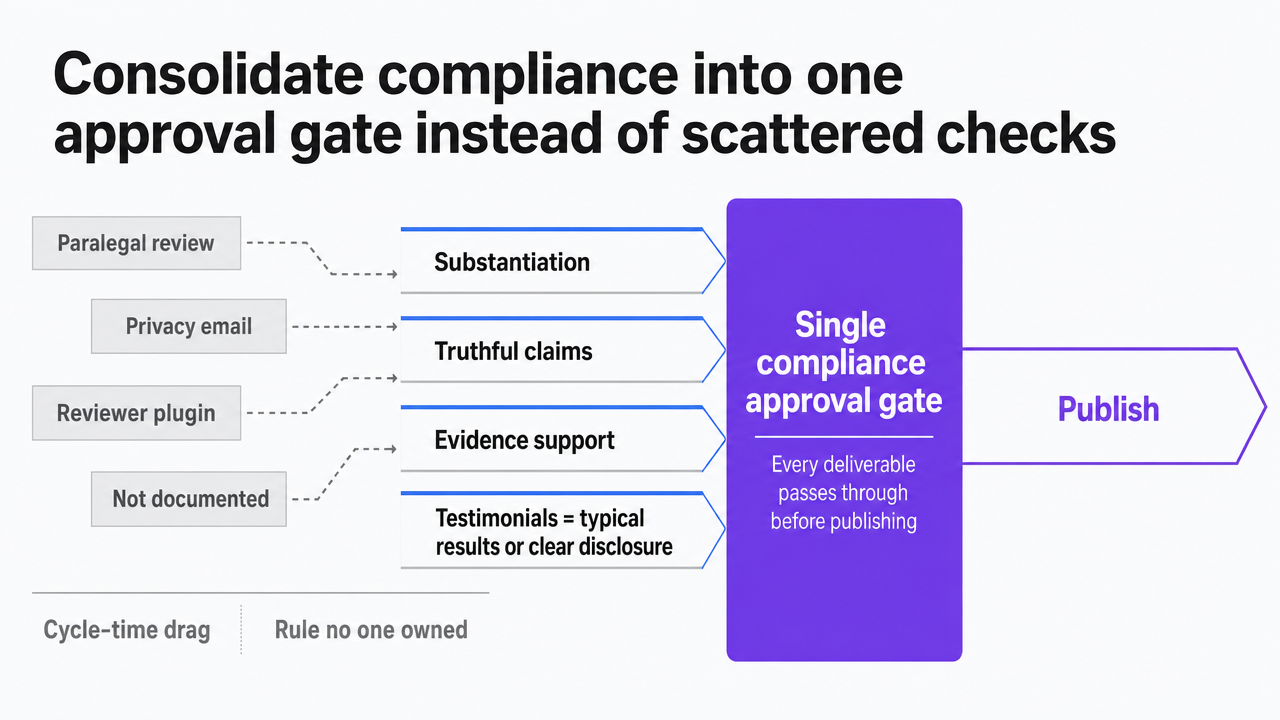 Visualize the four regulatory inputs that flow through the single compliance approval gate described in this section, matching the article's cited framework
Build technical hygiene as a shared platform, not a per-client audit
Per-client technical audits are where agency margin quietly dies. A senior SEO spends four hours crawling a site, writes a ticket list the client's dev team ignores for six weeks, and repeats the exercise next quarter against a drifted baseline. Multiply that across 40 accounts and the agency is paying strategist rates for work a shared platform should be running on a schedule.
The conversion is to treat technical SEO as infrastructure the agency owns, not a service each account rediscovers:
- One crawl stack monitors every client site on a weekly cadence.
- One schema library ships pre-validated templates for the entity types each vertical actually uses—LocalBusiness and Physician for healthcare, Attorney and LegalService for law, Dentist for DSOs.
- One Core Web Vitals dashboard flags regressions by threshold, not by whoever remembered to check.
- One internal-linking standard governs hub and spoke structures across accounts so a writer does not reinvent taxonomy per client.
What the strategist still owns is judgment on the exceptions: a migration, a canonical conflict, a JavaScript rendering issue the automated crawl flagged but could not resolve. Everything else runs as monitoring with alerts routed to the account's ticket queue. The per-client audit collapses from a quarterly four-hour project to a 20-minute exception review, and the baseline tightens because every account inherits the same technical floor the day it onboards.
Run authority and digital PR as a portfolio, not a per-account hustle
Most agency link programs operate as 40 disconnected hustles. Each account manager pitches journalists cold, chases HARO replies in isolation, and reinvents a pitch angle every quarter. The link velocity is unpredictable, the editorial relationships die when the account manager leaves, and the senior strategist has no leverage across the roster.
The conversion is to run authority as a portfolio with shared infrastructure:
- One media list, segmented by vertical and beat, lives at the agency rather than in a strategist's inbox.
- One data-asset library turns proprietary client numbers—booked-appointment conversion rates, call-answer benchmarks, admissions timelines—into reusable pitch hooks that journalists actually open.
- One expert roster lists which clinicians, attorneys, and operators across the client book have agreed to serve as named sources for commentary requests, with their credentials and availability already vetted.
Authority also compounds when source quality is enforced upstream. Audiences themselves rank medical professionals, peer-reviewed journals, and government agencies as the most trustworthy sources and social media as the least 4, and the same hierarchy drives which placements move E-E-A-T signals rather than vanity metrics. A link from a .gov citation or a credentialed trade publication earns more than ten brand-mention pickups from content farms.
The strategist's job shifts from pitching to curating: approving which assets ship, which experts get routed to which reporter, and which placements count as portfolio wins. Linear hustle becomes governed throughput.
Ready to Operationalize Scalable SEO Across Your Client Portfolio?
Connect with a strategist to see how leading agencies are automating SEO workflows at scale—maintaining quality, oversight, and measurable impact without increasing headcount.
If you manage multi-location clients, operate local SEO as a franchise system
This control applies specifically to agencies running multi-location rosters—DSO groups with 40 practices, home-services brands with regional franchises, senior-living operators with campuses in six states, behavioral-health networks with intake across markets. Treating each location as a bespoke local SEO project is where multi-location margin collapses first.
The conversion is to run local as a franchise system with centralized assets and location-level deltas:
- One Google Business Profile template per vertical defines the attribute set, category hierarchy, service list, and photo taxonomy every location inherits on day one.
- One review-response library stores approved reply patterns by sentiment and topic, so a regional manager is not drafting responses from scratch at every location.
- One citation stack is pushed to the aggregators once per quarter rather than per location per month.
- One schema package ships LocalBusiness, Physician, Dentist, or relevant entity markup with location variables injected at build time, not hand-coded per page.
Reviews are the operational hazard inside the franchise model. The FTC's Consumer Reviews and Testimonials Rule took effect October 21, 2024 and bans incentives conditioned on positive sentiment, undisclosed insider reviews, and review suppression across every location a brand operates 8. A centralized review-acquisition workflow with a documented request script, no sentiment conditioning, and a logged response cadence protects the entire portfolio. One location improvising a five-star incentive becomes a civil-penalty problem for the parent brand.
The strategist's role shifts from location-by-location execution to exception management: new openings, listing suspensions, duplicate conflicts, Q&A moderation at scale. Everything else runs as scheduled infrastructure. A roster of 60 locations stops consuming 60 units of strategist attention and starts consuming one governed system plus the exceptions it surfaces.
Tie measurement to qualified outcomes a strategist can defend in a QBR
Keyword rankings and session counts no longer survive a serious QBR. A client CFO who is reviewing a renewal line item wants to know what the agency moved in the pipeline, not which long-tail term climbed from position 14 to position 9. Measurement that cannot be defended in that room is measurement that gets cut.
The conversion is to redefine the reporting contract around qualified outcomes the strategist can trace to search work. Four metrics belong at the top of every account's scorecard, regardless of vertical:
- Qualified leads attributed to organic sessions, defined by a client-specific qualification rule rather than a generic form fill.
- Booked appointments or consultations sourced from organic entry, matched to CRM records weekly rather than estimated monthly.
- Cost per qualified lead compared against the client's blended acquisition cost, so SEO's contribution is visible against paid channels.
- Pipeline value by content cluster, so the strategist can defend which topic investments earned renewal and which should be sunset.
The inputs that make those metrics defensible are governance, not dashboards. Call-tracking numbers mapped to landing-page clusters. Qualification rules written down and reviewed quarterly with the client, not assumed. CRM stage definitions synced to the agency's reporting layer so a lead that stalls at intake does not get counted as a win. For healthcare and behavioral-health accounts, call-intelligence transcripts and audience data stay inside the authorized workflow established in the compliance gate 10.
The strategist's job in the QBR shifts from defending traffic charts to narrating the delivery line: which clusters produced qualified leads, which controls kept quality high while volume scaled, and which decisions the client needs to approve next quarter. That is the conversation that renews contracts.
Rebuild delivery economics so one strategist can govern 40 accounts
The nine controls that precede this one are only worth adopting if they change the shape of the delivery P&L. Governance that adds review time without expanding account capacity is just overhead with better documentation. The point of codifying briefs, consolidating compliance, and treating technical SEO as shared infrastructure is to move the senior strategist from executor to approver, which is where the capacity math finally bends.
The comparison below uses variables an agency Head of SEO already tracks, with ranges rather than invented dollar figures. The pod column reflects traditional delivery where a senior strategist, writer, editor, and account manager touch every asset. The approval-gated column reflects an operating model where AI-assisted production handles first drafts, codified briefs carry the governance load, and the senior strategist reviews exceptions and approves outputs.
| Delivery variable | Pod-based model | Approval-gated AI-assisted model |
|---|---|---|
| Pages per senior strategist per month | 8–15 | 40–80 |
| Hours per 1,500-word YMYL deliverable | 9–14 | 3–5 |
| QA/review cycles per deliverable | 2–4 | 1–2 |
| Clients per senior strategist | 6–10 | 30–50 |
The ranges move together, not in isolation. A standardized brief cuts review cycles because the claim register already resolved what the editor would have flagged. A consolidated compliance gate shortens approval queues because one reviewer owns the artifact set instead of three functions negotiating scope. A shared technical platform removes the quarterly audit from the strategist's calendar entirely. Each control compounds the next, which is why fractional adoption rarely produces the delivery economics the model implies.
The tradeoff worth naming: the approval-gated model concentrates risk at the review step. If the reviewer is weak, the whole roster ships weak pages faster than before. The strategist's hiring bar goes up even as headcount goes down. That is the operating conversion. Platforms built around this model, including Vectoron, exist to make the approval queue itself the product rather than an afterthought.
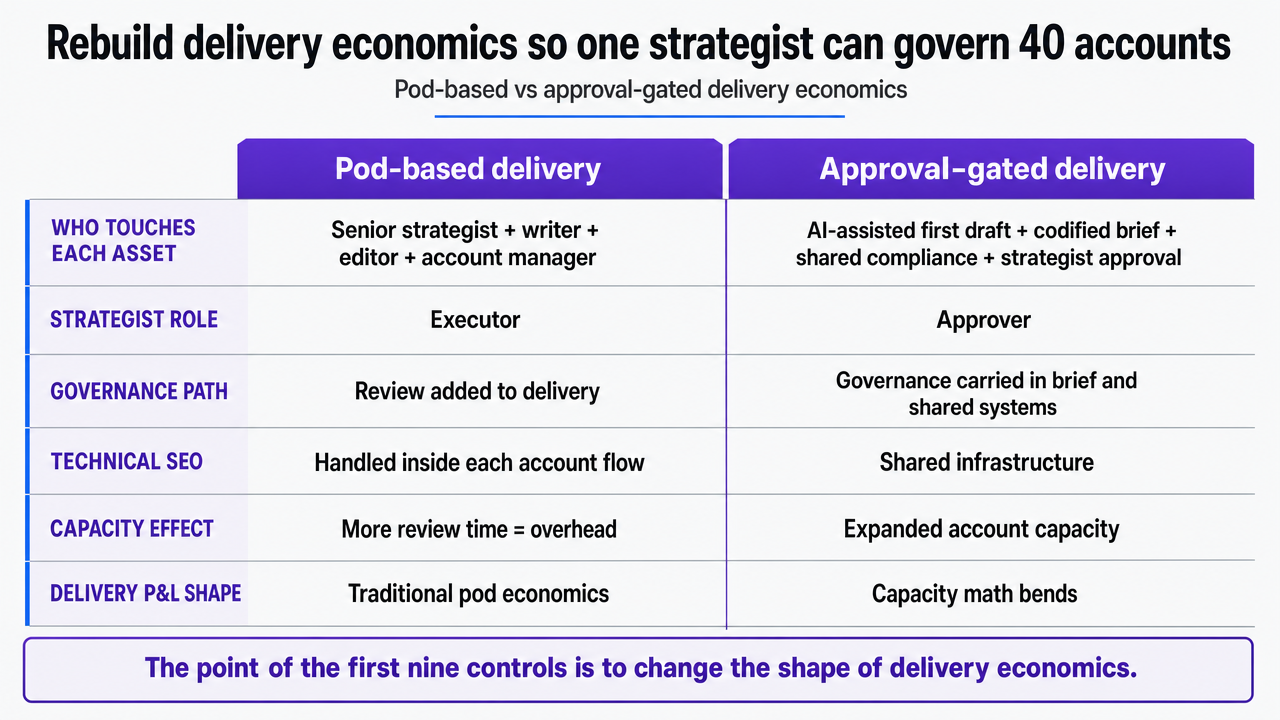 Render the article's comparison table of pod-based vs. approval-gated delivery economics as a side-by-side visual so readers can scan the operating-model shift
Frequently Asked Questions
References
- 1.Can Patients Trust Online Health Information? A Meta-Analysis Addressing the Problem of Quality and Errors in Health Information.
- 2.The Reliability Gap: How Traditional Search Engines and Generative AI Platforms Compare in Delivering Consumer Health Information.
- 3.Health Literacy and Use and Trust in Health Information.
- 4.Health Information Sourcing and Health Knowledge Quality.
- 5.Digital Health Literacy.
- 6.Disclosures 101 for Social Media Influencers.
- 7.Advertising and Marketing on the Internet: Rules of the Road.
- 8.The Consumer Reviews and Testimonials Rule: Questions and Answers.
- 9.Health Products Compliance Guidance.
- 10.Marketing.
- 11.Federal Trade Commission Announces Final Rule Banning Fake Reviews and Testimonials.