
Key Takeaways
- Position alone misrepresents client visibility because SERPs vary by location, device, and login state, and a single integer ignores composition and conversion context.
- A modern tracking stack covers five jobs: first-party truth, third-party rank observation, SERP feature surveillance, geo-segmented monitoring, and conversion attribution.
- Borrowing NDCG, reciprocal rank, and average precision from IR evaluation gives client scorecards graded meaning that a raw position number cannot provide 9.
- Personalization introduces volatility unrelated to SEO work, so every observation should timestamp location, device, login state, and locale, then average repeated samples 2.
- A curated keyword list is a sample, and tracked-set movement should be reported alongside Search Console impression coverage to expose the untracked long tail 8.
- Search Console with the BigQuery export serves as the truth layer, since all third-party observations must reconcile against Google's own logged clicks and impressions.
- Semrush and Ahrefs deliver competitive breadth, while STAT-class trackers provide the collection discipline required for graded metrics on curated tracked sets 9.
- SERP feature and AI Overview surveillance records page composition per keyword per date, so click drops can be reconciled against layout changes rather than misread as ranking losses.
- Local monitoring demands ZIP or lat/long targeting per market, because 97.76% of tested queries produced geographically inconsistent organic results 3.
- Conversion attribution ties rank movement to booked calls, forms, and pipeline through GA4, call intelligence, and CRM joins, preventing visibility charts from standing alone in client decks.
- Vectoron sits above the observation layer as a coordination surface, ranking actions by expected pipeline impact and routing them through Command Center approval before execution.
- Multi-location query budgets scale multiplicatively, so trim check frequency or device targeting before cutting keywords or aggregating markets, and disclose the sampling design to clients 6.
Why position alone stopped being a defensible client metric
An agency SEO lead reporting a keyword moving from position 6 to position 4 is describing a single observation within a system that no longer provides a singular answer. Search results vary significantly based on user location, device, and login status. Reporting one such observation as the client's definitive position is a fundamental misrepresentation.
The evidence for this graded, context-dependent evaluation stems from information-retrieval literature, which also informs Google's systems. NIST's TREC Deep Learning Track assesses ranking quality using graded measurements like NDCG and average precision, based on relevance judgments, rather than simply counting top-slot URLs 1. Any dashboard that simplifies a client's visibility to a single integer per keyword overlooks critical dimensions considered essential by professional evaluation methodologies.
Commercially, clients pay agencies for pipeline generation, not just ordinal positions. A number-three ranking behind an AI Overview, local results, and shopping units yields different traffic than a number-three ranking on a traditional ten-blue-links page. Position, without considering SERP composition and conversion outcomes, no longer provides a complete picture. This article explores rank tracking as part of a measurement stack designed to address this reality.
The five jobs a modern tracking stack has to cover
A robust tracking layer for agencies isn't a single product but a collection of five distinct functions unified by a shared data collection standard. Defining these jobs first simplifies tool selection, making it a procurement decision rather than a debate about preferences.
These five jobs include:
- first-party truth, which encompasses clicks, impressions, and average position reported directly by Google via Search Console and its BigQuery export;
- third-party rank observation, involving standardized position sampling across keywords, locations, and devices to supplement first-party data;
- SERP feature and AI Overview surveillance, monitoring the types of units occupying the search results page and their impact on organic real estate;
- local and geo-segmented monitoring, providing market-specific observations for multi-location clients where a single ZIP code is insufficient;
- conversion attribution, linking observed visibility to booked calls, forms, and pipeline to assign commercial value to ranking movements.
NIST defines evaluation as pairing a specific task with metrics and a clear interpretation of scores 11. Each of these five jobs represents such a pairing in miniature. A tool earns its place by effectively handling one job, rather than attempting to cover all five.
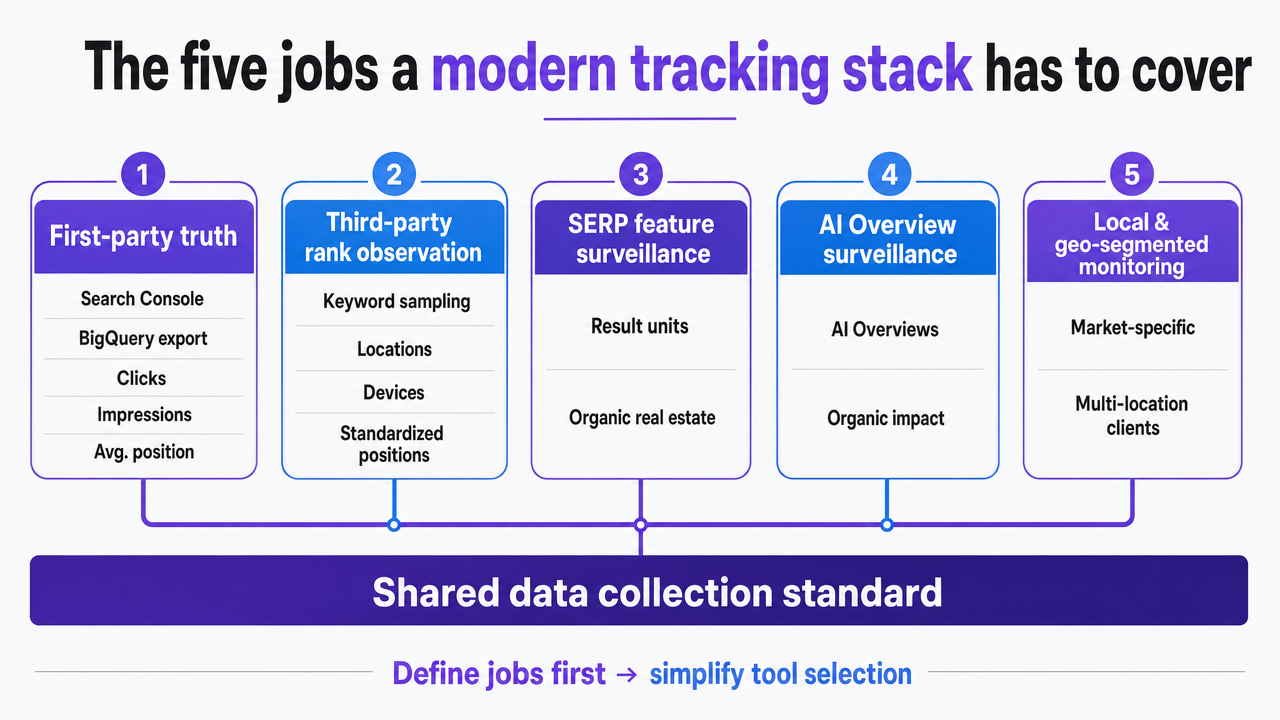 Visualize the five distinct jobs of a modern SERP tracking stack described in the section, giving readers a scannable framework map
Designing the evaluation before choosing the tools
Borrowing NDCG, reciprocal rank, and average precision from IR evaluation
Before committing to a rank-tracking contract, reporting teams should define the specific scores they aim to generate. Information-retrieval evaluation has long addressed this, offering a vocabulary directly applicable to client work. For instance, the TREC 2021 Deep Learning Track primarily used NDCG@10, complemented by reciprocal rank and average precision 9. Each metric captures a different aspect of the ranked list: NDCG assesses graded relevance within the top results, reciprocal rank measures how quickly a relevant result appears, and average precision evaluates consistent quality throughout the observed results.
In agency scorecards, a keyword moving from position 6 to position 4 on a SERP dominated by an AI Overview and a local pack would score lower under NDCG than the same move on a clean organic page. This is because the graded value of the top positions has already been consumed by non-organic elements. Reciprocal rank, applied across a client's tracked queries, provides a single metric that penalizes deep-page visibility and rewards top-window presence, making it easily digestible for clients. Average precision ensures the scorecard reflects performance across the long tail, preventing a few high-volume terms from skewing the overall narrative. NIST emphasizes that no single metric tells the complete story, a principle reporting stacks should emulate 9.
Personalization and volatility as the reason to standardize collection
Metrics are only meaningful if the underlying observations are collected under controlled conditions. The Hannak personalization experiment demonstrated this empirically: personalized results pages showed significantly more volatility than non-personalized ones, with volatility peaking around rank seven 2. While this study is historical, its methodological implication remains relevant.
Two observations of the same keyword, taken moments apart from different IP addresses, login states, or device types, can yield different ranked lists for reasons unrelated to the client's SEO efforts. Without a fixed and recorded collection standard, week-over-week dashboard movements may reflect the sampling method as much as the site's actual performance. A robust tracking layer must timestamp every observation and record location (down to the market), device class, login/cookie state, and browser locale. It should then average repeated samples per keyword-market cell instead of reporting single pulls. This ensures that metrics like NDCG or reciprocal rank are interpreted accurately by the client.
Coverage limits: what your keyword sample cannot see
Even a perfectly configured rank tracker only measures the queries it is instructed to monitor. This limitation is akin to TREC's incomplete-judgments problem: when the evaluation pool omits relevant items, measured precision and recall deviate from the underlying truth 8. NIST defines precision as the proportion of retrieved items that are relevant, and recall as the proportion of relevant items that were retrieved 10. A client's keyword list is a retrieval sample, typically representing only a small fraction of the actual query surface driving impressions.
Operationally, this means a rising visibility score on a 500-keyword tracked set can coexist with flat or declining impressions in Search Console, because the untracked long tail is performing differently. Agencies should present tracked-set movement alongside total impression coverage from Search Console and explicitly state the sampling ratio. This approach transforms a coverage limitation into a transparent methodological note, preventing embarrassment when a client cross-references the numbers.
Test live SERP tracking workflows at scale now
Experience real-time SERP data and publish results-driven content during your trial to validate operational impact immediately.
The tracking stack, by job
First-party truth: Google Search Console and BigQuery export
Google Search Console is the definitive source for what Google actually served to users on a client's property. Clicks, impressions, CTR, and average position are derived directly from Google's logs, making them the foundational data point against which all other stack layers must reconcile. However, the web UI limits query rows and anonymizes long-tail terms below Google's privacy threshold, meaning agencies relying solely on the interface are viewing an incomplete record.
The BigQuery bulk export removes the row cap and provides daily-partitioned raw data across URL, query, country, device, and search appearance. This enables two key agency-scale actions: joining impression data to internal keyword clusters at the client's desired granularity, and calculating weighted-average position for a defined query set, rather than relying on Search Console's default averaging. While the export doesn't recover anonymized queries, leaving a coverage gap, it significantly enhances data utility.
Search Console should be considered the "truth layer" for Google's recorded data, with all downstream information serving as directional context that must either align with it or provide a clear explanation for any discrepancies.
Third-party rank observation: Semrush, Ahrefs, and STAT-class trackers
Third-party trackers address what Search Console cannot: a client's current rank for a specific query, from a defined market and device, regardless of whether a click occurred. Tools like Semrush and Ahrefs excel in breadth, offering crawled indexes for competitor visibility, backlink context, and share-of-voice analysis across a vast keyword universe, which is a common reporting posture for mid-market retainers.
STAT-class trackers, including STAT itself and specialized tools like AccuRanker or SerpApi-backed internal builds, prioritize collection discipline over sheer breadth. They provide daily desktop and mobile pulls per keyword per market, detailed SERP feature parsing, and audit trails that allow analysts to reconstruct observations precisely. For agencies using client scorecards that incorporate NDCG or reciprocal rank on curated tracked sets, this discipline is essential, as graded metrics require stable observation conditions to be meaningful 9.
A typical stack might involve Ahrefs or Semrush for competitive analysis and content gap research, combined with a STAT-class tracker for the daily rank-of-record feed that populates client dashboards.
SERP feature and AI Overview surveillance
A position-three organic listing holds different significance on a traditional ten-blue-links page compared to a page featuring an AI Overview, People Also Ask section, local pack, and shopping module. The tracking stack needs a component that records SERP composition alongside position, otherwise the position number carries undue commercial weight.
Most STAT-class trackers already parse feature presence, including featured snippets, knowledge panels, local packs, image packs, video carousels, sitelinks, top stories, and the AI Overview block. The operational strategy is to store feature presence per keyword per date. This allows a drop in clicks to be reconciled against changes in page composition rather than incorrectly attributed to a page-two slide. NIST's framework of retrieval evaluation—a defined task with metrics and a stated interpretation—applies directly: rank without compositional context lacks a valid interpretation 11.
AI Overview surveillance is a developing area. Trackers can detect the block's presence, capture cited sources, and flag client domain citations, but they cannot measure the click suppression it imposes on organic listings below. Agencies should report presence and citation inclusion, but avoid reporting AI Overview "rank" as if it were comparable to organic position.
Local and geo-segmented monitoring for multi-market delivery
This layer is crucial for agencies serving multi-location clients—such as DSOs, law-firm networks, senior living portfolios, or home services franchises—enabling them to establish a robust reporting posture across diverse geographic footprints. A single national data pull from a central location does not accurately reflect what a searcher in Phoenix, Tampa, or Fresno experiences.
The empirical evidence for per-market collection is compelling. The Bobble study, a distributed measurement experiment, found that 97.76% of tested Google queries produced at least one inconsistent organic result set attributable to geography 3. While this figure is historical, it underscores that geographic variation is the default state of the SERP. Further peer-reviewed research confirms that search results shift with the searcher's geographic location, especially for queries with local intent 6.
Operationally, the geo layer requires trackers that support precise ZIP-code or lat/long targeting, rather than broad metro-area rollups. Each tracked keyword must be pulled against each defined market. Local pack composition, map-pack ranking, and organic ranking should be recorded as separate signals per market, as a client's presence in the three-pack does not guarantee presence in organic listings. The economics of scaling this collection are discussed in the query-budget section.
Conversion attribution: closing the loop from SERP to pipeline
Rank observation without conversion attribution often leads to a common agency reporting failure: visibility charts trending up while booked calls remain flat. The attribution layer's role is to connect tracked-keyword movement to the actual outcomes clients value—form submissions, qualified calls, booked appointments, and closed pipeline.
The mechanics involve several components. GA4 or a server-side equivalent handles session-to-event stitching. Call intelligence providers (e.g., CallRail, Invoca) capture phone conversions, tagging them by landing page and referring query when possible. A CRM or booking system tracks downstream states like "qualified," "booked," and "closed," converting conversion events into revenue signals. The reporting layer then consistently joins Search Console URL-level clicks to landing-page conversions and CRM outcomes, linking rank-tracked keyword cohorts to pipeline movement rather than just raw sessions.
While the individual pieces are not new, the discipline lies in refusing to present a rank movement chart in a client deck without its corresponding conversion tail.
Coordination layer: Vectoron for turning observations into approved actions
The final job in the stack, one that no rank tracker alone performs, is translating weekly ranking, feature, and conversion signals into a prioritized list of next actions, routed for human approval before execution. Most agencies currently manage this with project managers, spreadsheets, and stand-up meetings, creating coordination overhead that limits strategist capacity.
Vectoron functions as the coordination surface above the observation layer. Its AI-powered strategist analyzes the tracked SERP feed, Search Console export, and conversion outcomes, then ranks actions by their expected pipeline impact. Each recommendation is routed through a Command Center approval workflow before execution. This approach preserves human judgment and sign-off while automating the read-rank-route work that typically scales linearly with client count in traditional agency models.
If you manage multiple locations: query-budget math for the tracking layer
While the preceding sections focused on a single-brand agency scenario, this section addresses the significant tracking-cost challenges faced by agencies managing multi-location clients—such as DSOs, law-firm networks, home-services franchises, senior-living portfolios, and medical groups—where the observation surface expands with each new market.
The cost calculation is multiplicative, not additive. Query volume per client per month scales as: Locations × Keywords per location × Devices × Check frequency. For example, a 40-location DSO tracking 60 commercially relevant terms per market across desktop and mobile, pulled daily, generates 40 × 60 × 2 × 30 = 144,000 SERP observations monthly for a single account. Reducing check frequency to weekly lowers this to approximately 33,600. Halving the keyword list to 30 core terms further reduces it. Every vendor prices some version of this quantity, whether termed credits, queries, or tracked keywords.
| Client profile | Locations | Keywords / market | Devices | Frequency | Monthly queries |
|---|---|---|---|---|---|
| Single-brand SMB | 1 | 200 | 2 | Daily | 12,000 |
| Regional law network | 12 | 75 | 2 | Daily | 54,000 |
| Multi-state DSO | 40 | 60 | 2 | Daily | 144,000 |
| Home-services franchise | 150 | 40 | 2 | Weekly | 48,000 |
The inclination to reduce the keyword list first is often counterproductive. Geographic variation is a critical signal for these accounts, and aggregating markets into regional averages obscures the city-specific divergences clients pay to see 6. More defensible budget trims include adjusting check frequency (weekly for stable, non-seasonal terms; daily for high-value keywords and active campaigns) and device targeting (mobile-only if mobile's share of impressions in Search Console exceeds 80%). This sampling design should be explicitly communicated to the client as a methodological note, not hidden as a cost-saving measure.
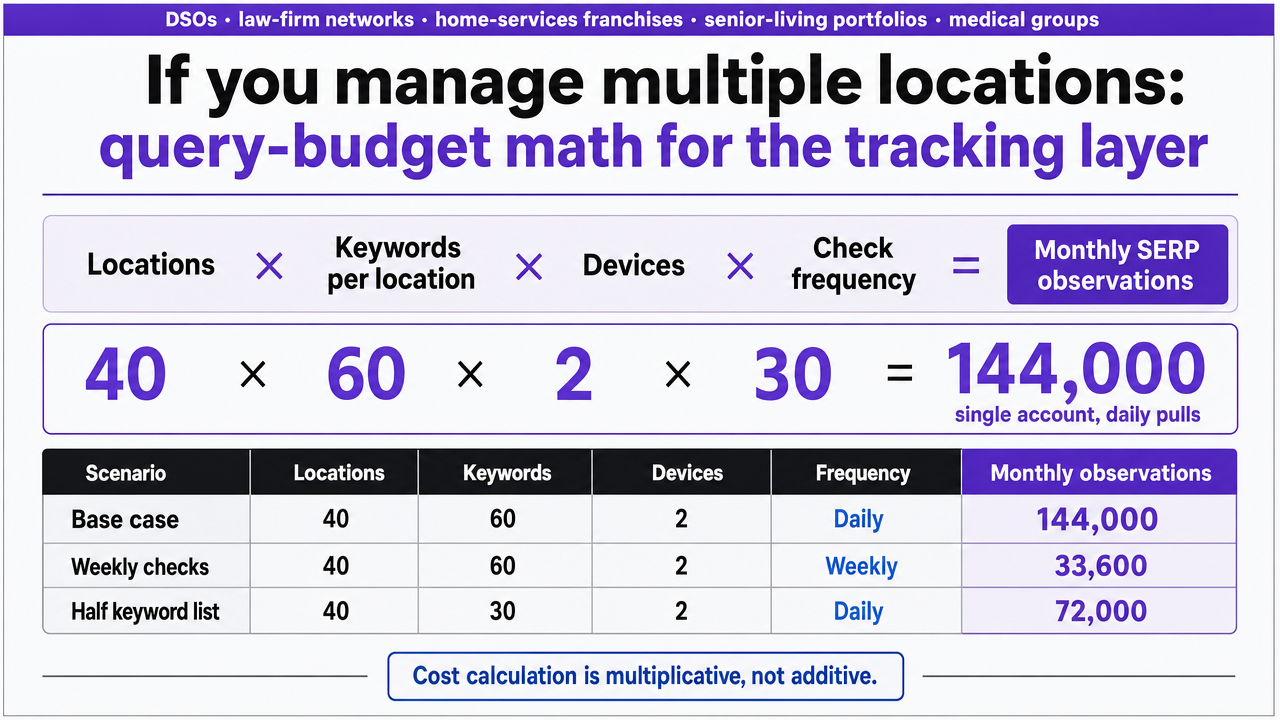 Visualize the multiplicative query-budget math table from the section, showing how monthly SERP observations scale across client profiles
See How Leading Agencies Streamline SERP Tracking Across Hundreds of Clients
Connect with experts to benchmark your current SERP monitoring workflows and discover data-backed strategies for scalable, multi-client position tracking—without adding headcount or sacrificing reporting precision.
What no tracker can see, and how to disclose it to clients
Every tracking stack has inherent limitations, and transparently acknowledging these blind spots upfront is crucial for maintaining client trust. Three key blind spots warrant disclosure in any recurring report's methodology note.
Anonymized Search Console queries. : Google suppresses low-volume and privacy-sensitive terms in the query dimension, meaning even the BigQuery export undercounts the long tail. While aggregate impressions still reconcile, the query-to-URL join is incomplete for a portion of traffic that clients will never see itemized.
AI Overview click suppression. : Trackers can detect the presence of the AI Overview block, capture its citations, and identify if the client's domain is cited. However, no tracker can accurately measure the extent to which this block diverts clicks from the organic listings below it. Agencies should report the AI Overview's presence and citation inclusion, but refrain from reporting an AI Overview "position."
Personalization the sampler doesn't reproduce. : User login state, search history, and prior engagement influence live search results in ways that automated, headless collection cannot fully replicate. Therefore, any tracked position is a controlled approximation, not a universal truth 2. NIST's incomplete-judgments framework applies here: a curated keyword list is a sample, and measured visibility will deviate from the underlying truth in directional, but not exact, ways 8. Agencies should disclose the sample size, collection standard, and coverage ratio against Search Console impressions in every quarterly review. Clients who understand these limitations upfront are more likely to focus on actionable insights rather than treating rank charts as absolute promises.
Building the dashboard around a defined client task
A dashboard should not simply be a display of every metric the stack can measure; it should visually answer a specific question important to the client. NIST's evaluation framework is valuable here, enforcing a discipline often overlooked in agency dashboards: an evaluation methodology consists of a defined task, metrics to measure progress on that task, and a clear interpretation of what the scores mean 11. Skipping the task definition step often results in a wall of charts that neither the agency nor the client knows how to act upon.
The task should be articulated in the client's language before any dashboard panel is built. For example, "Grow booked consultations from non-branded organic search in the twelve metros where we have capacity" is a clear task, whereas "Improve SEO" is not. Once the task is defined, the relevant panels become evident: tracked-keyword NDCG or reciprocal rank for the non-branded set, Search Console impressions and clicks filtered to the specified metros, SERP feature composition for high-value terms, and booked consultations attributed back to landing pages. All other data can be relegated to an appendix for on-demand review.
The interpretation layer is frequently omitted from dashboards. Each panel should include a concise note explaining what a change in the number signifies and what it does not. For instance, a rise in tracked-set reciprocal rank coupled with flat impressions often indicates coverage gaps in the keyword sample, not a Search Console error 8. Clients who see these interpretations are more likely to approve actions rather than question data discrepancies.
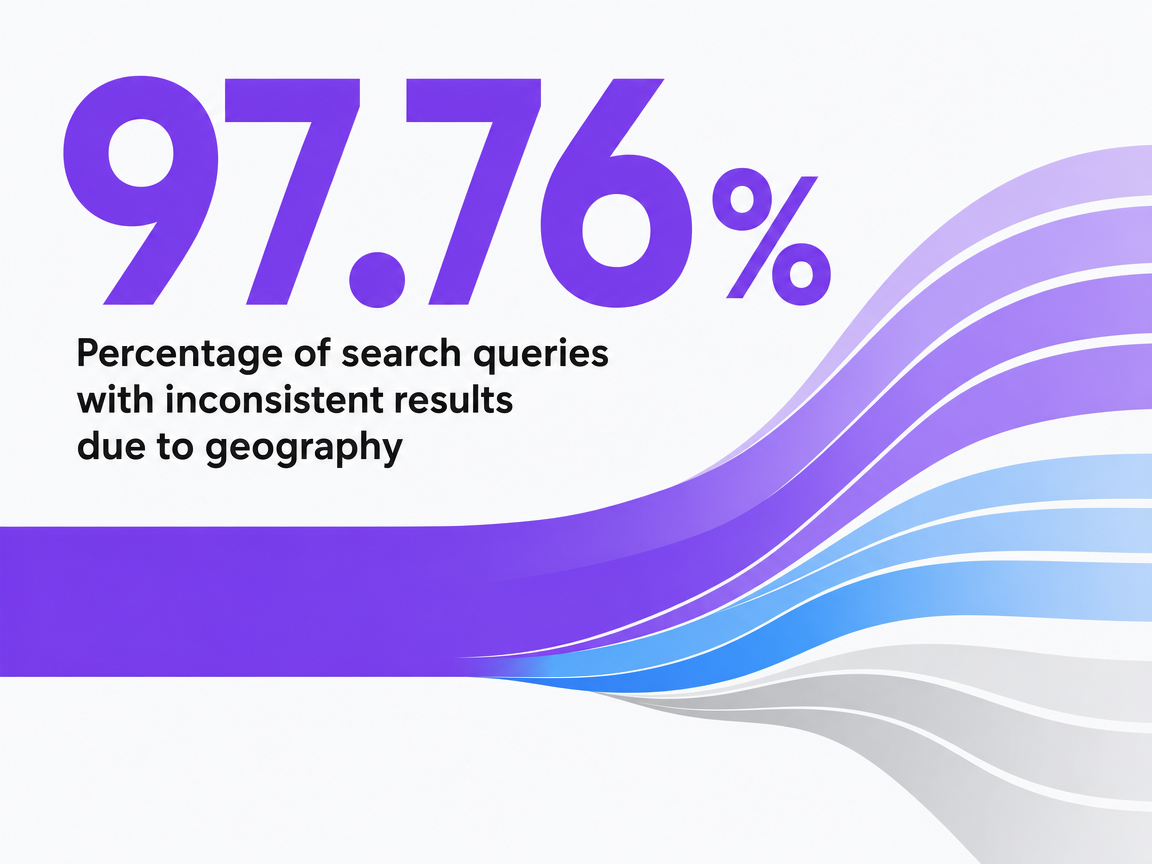 Percentage of search queries with inconsistent results due to geography
Percentage of search queries with inconsistent results due to geography
Frequently Asked Questions
References
- 1.OVERVIEW OF THE TREC 2023 DEEP LEARNING TRACK.
- 2.Measuring Personalization of Web Search.
- 3.Exposing Inconsistent Web Search Results with Bobble.
- 4.Overview of the TREC 2022 Deep Learning Track.
- 5.rank\_cdf.eps.
- 6.Location, Location, Location: The Impact of Geolocation on Web Search Personalization.
- 7.Department of Justice Wins Significant Remedies Against Google.
- 8.Retrieval Evaluation with Incomplete Information.
- 9.OVERVIEW OF THE TREC 2021 DEEP LEARNING TRACK.
- 10.1 Common Evaluation Measures.
- 11.Building Better Search Engines by Measuring Search Quality.