
Key Takeaways
- Pipeline-grade SEO reduces to five disciplines: intent-led content, technical and indexation work, local presence, authority and trust, and conversion measurement — every other tactic resolves back into one of these.
- Rankings and sessions are intermediate signals; the defensible scoreboard runs qualified organic visits through calls, booked appointments, opportunities, and closed revenue, with each discipline owning a specific stage.
- Rate each discipline against lead-quality lift, time-to-impact, and defensibility rather than production category — intent-led content and local filter audiences hardest, authority compounds slowest but resists replication.
- Sequence investment across four quarters: technical and measurement first, then intent-led content and local in parallel, then authority, then refinement against the per-stage conversion rates the attribution stack surfaces.
The Five Disciplines That Move Qualified Leads
Pipeline-grade SEO reduces to five interlocking disciplines:
- Intent-led content
- Technical and indexation work
- Local presence
- Authority and trust
- Conversion measurement
Every other label a vendor might sell — schema audits, entity optimization, digital PR, AI overview tuning — resolves back into one of those five. The methods review in F1000Research makes the same structural point: search performance is a set of methods spanning technical, content, and authority work, not a single ranking tactic 1.
What separates a VP-grade taxonomy from a beginner glossary is the scoreboard. Rankings and sessions are intermediate signals. The defensible scoreboard runs qualified organic visits → calls and forms → booked appointments → opportunities → closed revenue. Any discipline that cannot be tied to a stage on that path is a candidate for the cut list, regardless of how loudly it trends on LinkedIn.
The mix also weights unevenly by vertical. A personal injury firm and a 40-location DSO share the same five disciplines but sequence them differently: the firm leans on authority and intent-led content; the DSO leans on local and measurement. In regulated categories — healthcare, behavioral health, dental, legal — credibility functions as a conversion mechanic rather than brand polish, a point the peer-reviewed evidence on perceived information quality supports directly 6. The sections that follow rate each discipline on lead-quality lift, time-to-impact, and defensibility, then close with a sequenced investment model.
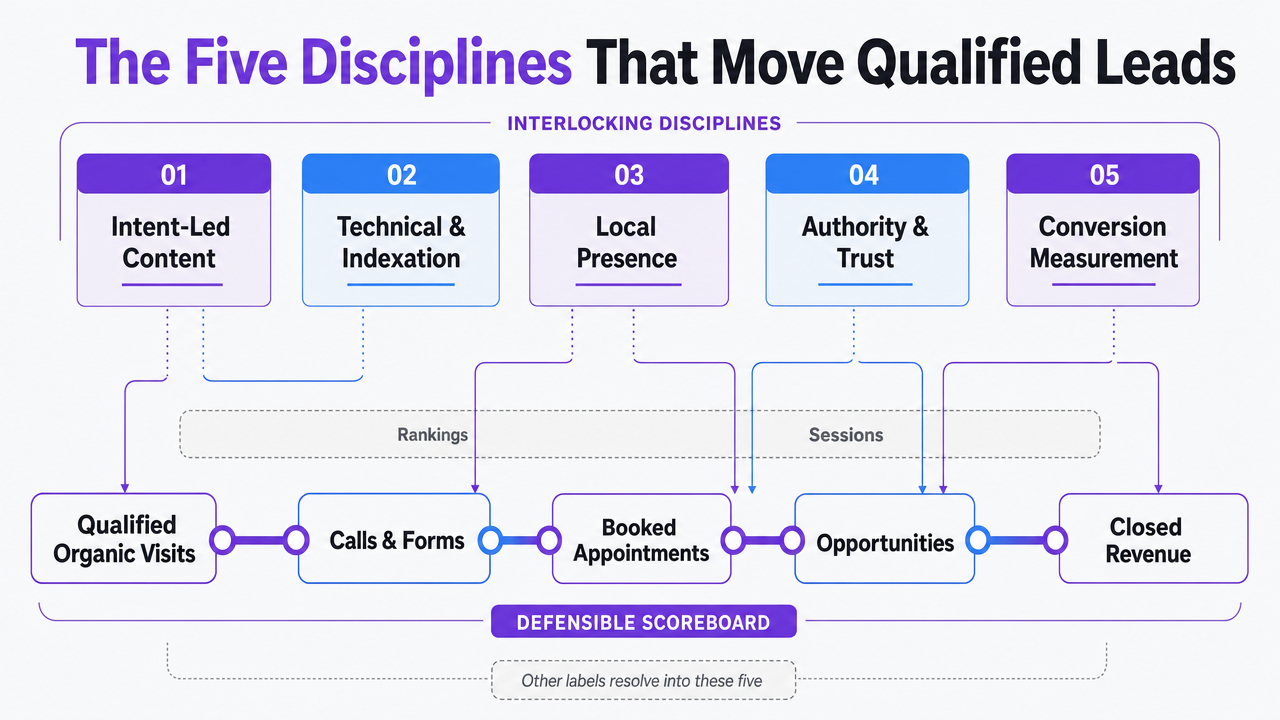 Visualize the five SEO disciplines and the pipeline stage each one influences, matching the article's core framework
Why the Standard Taxonomy Fails Pipeline Owners
Visibility Is Not Pipeline: What Clicks Actually Predict
The most-cited number in every SEO deck describes clicks, not customers. A 2023 comparative study of observed user behavior on Google and Bing found that 97.11% of Google clicks and 99.49% of Bing clicks landed on first-page results, with top-five results absorbing roughly 86% of Google clicks and 92% of Bing clicks 3. The study measured click distribution across observed queries; it did not measure conversions, form fills, booked appointments, or revenue. That distinction matters when a VP is asked to defend a six-figure content investment.
What the data actually justifies is a visibility floor: for commercially relevant queries, ranking outside the top five effectively removes an asset from the demand pool. What the data does not justify is treating rank as a proxy for pipeline. A personal injury firm ranking third for a high-intent city query and a national aggregator ranking first for the same query can produce entirely different qualified-call volumes, because the aggregator monetizes traffic through referral arbitrage while the firm needs a signed representation agreement.
The click-behavior evidence is a starting condition, not a scoreboard. It explains why ranking work is worth funding at all. It does not explain how much of that traffic converts, at what cost, or with what lifetime value. Pipeline owners who accept rank reports as outcome reports are optimizing an intermediate metric and paying for it in unqualified inbound.
Reframing the Types Around Pipeline Contribution
The conventional taxonomy — technical, on-page, off-page, local, international — sorts SEO by where the work happens. That is a production view, useful for a coordinator staffing tickets. It is the wrong view for a marketing VP allocating budget against a pipeline number.
A pipeline-first taxonomy sorts by downstream contribution:
- Intent-led content decides which visitors arrive and how qualified they are before any conversion element loads.
- Technical and indexation work decides whether earned rankings hold through site changes, migrations, and Core Web Vitals shifts.
- Local presence decides which map-pack and geo-modified queries produce booked appointments in specific ZIP codes.
- Authority and trust decide whether a qualified visitor believes the offer enough to call, submit, or schedule.
- Measurement decides whether any of that becomes a defensible line item at the next board review.
Rated on three axes a VP actually uses, the disciplines separate cleanly. Lead-quality lift is highest for intent-led content and local, because both filter the incoming audience before the form. Time-to-impact is shortest for technical fixes and local optimization, and longest for authority. Defensibility — the difficulty of a competitor replicating the asset — is highest for authority and topical content depth, and lowest for on-page tweaks a good freelancer could clone in a week.
The next sections rate each of the five disciplines against those three axes and connect them to the pipeline stage they actually influence.
Intent-Led Content: The Discipline That Sets Lead Quality
Content decides who arrives. Every other discipline responds to that decision. A behavioral health group ranking for "outpatient depression treatment near me" and one ranking for "what is depression" both count as organic traffic in the same report, but only the first produces admissions calls. Intent-led content is the discipline of engineering the mix of queries a site earns, not the number.
The practical work sorts into three query tiers:
- Transactional queries — "emergency dentist Charlotte," "personal injury lawyer free consultation," "assisted living pricing Denver" — convert fastest and carry the highest lead-quality lift.
- Comparative queries — "Invisalign vs. braces cost," "IOP vs. PHP," "gutter guards worth it" — capture visitors mid-evaluation and feed the pipeline within weeks.
- Informational queries build topical depth and internal linking equity that support the first two tiers, but rarely produce a call on first visit.
Lead quality lift: highest of the five disciplines. Time-to-impact: 60 to 180 days for transactional pages on a site with baseline authority, longer for cold domains. Defensibility: high, because a competitor cannot clone six months of published depth in a sprint.
Clarity is part of the mechanism, not a nice-to-have. A 2024 study of 71 diabetic-retinopathy sites found readability correlated with stronger authority scores (r = 0.267, P = 0.024) — a modest, correlational signal from one YMYL category, but consistent with the broader meta-analytic finding that perceived information quality shapes intention and action across 147 studies of health-information behavior 2, 6. For a VP, the operational read is straightforward: publish for the query that maps to a booked appointment, write at a reading level the audience can process, and audit the topic footprint quarterly against the pipeline stages it is meant to feed.
Technical and Indexation Work: Protecting the Ranking You Earn
Technical SEO does not win rankings on its own. It protects the ones content and authority have already earned. A migration that breaks canonical tags, a JavaScript rewrite that hides service-page copy from the crawler, or a Core Web Vitals regression after a template redesign can erase months of pipeline in a single deploy. The discipline is insurance against self-inflicted losses.
The cost of instability is quantifiable. A 2024 experiment with 3,196 participants examining ranking, clicking, and trust behavior found that each one-position drop in ranking reduced the odds of an accurate result being clicked by roughly 16% 4. The study used COVID-19-related queries in controlled experimental settings, so the 16% figure should not be transposed onto commercial CTR curves without adjustment. What it does establish, cleanly, is that position decay compounds: a service page slipping from position two to position five is not losing a few percentage points of visibility, it is losing a multiplicative share of the click pool.
Lead-quality lift: neutral. Technical work does not filter the audience; it preserves access. Time-to-impact: shortest of the five disciplines, often within a crawl cycle. Defensibility: low as a standalone advantage, high as a floor.
The practical scope for a VP is narrower than most audit reports suggest. Indexation coverage, canonical integrity across duplicate location pages, structured data on service and review markup, mobile rendering parity, and Core Web Vitals stability cover the majority of pipeline-relevant technical risk. Everything else is refinement. A dental group with 40 location pages generated from one template will get more pipeline protection from clean canonicals and consistent NAP schema than from a 200-line audit of image compression opportunities. The rule for budget defense: fund the technical work that prevents rank loss on pages already converting, and treat speculative technical polish as a lower-tier line item.
Test Which SEO Types Drive Real Pipeline
Validate pipeline impact by publishing SEO content live during your trial—see measurable results before you commit.
Local SEO: Where Location-Based Demand Becomes Booked Appointments
Local is the discipline where a ZIP code becomes a booked chair, a signed intake, or a scheduled tour. For a service business that fulfills in a physical location, local presence often outperforms every other SEO investment on cost-per-qualified-call, because the query itself pre-filters the audience by geography and intent. "Emergency dentist near me" at 9pm on a Tuesday is not a research query.
The work concentrates in three assets:
- The Google Business Profile and its equivalents on Bing and Apple Maps decide map-pack eligibility.
- Location pages on the primary domain decide whether the site earns geo-modified organic listings alongside the map pack.
- Review integrity and NAP (name, address, phone) consistency across directories decide whether both of those assets are trusted enough to rank.
A behavioral health group with 12 outpatient clinics and a home services operator with 8 metros face the same three-asset problem at different scales.
Lead-quality lift: high, and often the highest cost-adjusted lift of the five disciplines for multi-location service businesses. Time-to-impact: 30 to 90 days for profile optimization and review velocity, longer for competitive urban map packs. Defensibility: moderate — profiles and reviews can be matched by a diligent competitor, but consistent NAP data, unique location-page content, and a sustained review flow compound over quarters.
The failure mode is templating. Forty location pages generated from one boilerplate, with the city name swapped in the H1, will not earn distinct rankings and will not convert distinctly either. Each location page has to carry unique proof: the practitioners assigned to that site, the services actually delivered there, driving directions from local landmarks, and reviews attributed to that specific address. Local SEO stops producing pipeline the moment it starts producing duplicates.
Authority and Trust: Credibility as a Conversion Mechanic
Authority work is usually sold as a ranking input. In regulated service categories, it is a conversion input first and a ranking input second. A visitor who reaches an outpatient addiction treatment page after clicking a top-three result still has to decide, in the span of a scroll, whether the organization behind that page is credible enough to call. The signals that answer that question are the same signals search engines increasingly weight: verifiable authorship, evidence quality, source transparency, and readable prose.
The peer-reviewed evidence points in one direction. A 2024 study identifying user-centered credibility criteria for online health information isolated six that consumers actually apply: authorship, reliability, usefulness, accessibility, readability, and privacy and confidentiality, with clearly stated author qualifications singled out as a direct contributor to perceived credibility 7. Those six function as an editorial QA gate. A service page missing a named clinical reviewer, a citation trail, or a plain-language explanation of the treatment fails the gate regardless of how well it ranks.
The readability piece is not cosmetic. In the 71-site diabetic-retinopathy analysis cited earlier, readability correlated with authority scores at r = 0.267 (P = 0.024) — a modest, correlational signal from a single YMYL category, not a universal ranking law 2. What makes it operationally useful is the alignment with conversion evidence: the 147-study meta-analysis on perceived health information quality found that credibility judgments shape intention and action, not just trust 6. In pipeline terms, an unreadable page loses the visitor before the call button loads.
Off-site authority — earned links, cited mentions in industry publications, practitioner bylines in trade outlets — still matters, but the return has shifted. The measurable lift now comes from links that also serve as trust proof to a human reader: a state bar directory listing, a peer-reviewed publication credit, a hospital-system affiliation page. Link volume without credibility signal converts poorly and ranks unreliably.
Lead-quality lift: high, indirect but durable. Time-to-impact: 6 to 12 months for authority signals to compound. Defensibility: highest of the five disciplines, because named authors, verifiable credentials, and cited evidence cannot be templated. The operational rule: treat the six-criterion checklist as a publishing gate, not a post-launch audit.
Measurement: The Pipeline Attribution Stack
Measurement is the discipline that decides whether the other four survive the next budget review. Without a stack that ties organic activity to revenue events, every SEO line item defends itself with rank reports and session counts — the exact metrics a CFO will discount on sight.
The pipeline attribution stack has six stages, and each stage answers a different question:
- Organic session answers whether the site is being found.
- Qualified visit — filtered by landing page intent, geography, or on-site behavior — answers whether the right people are arriving.
- Call or form submission answers whether the offer converts a visitor into a lead.
- Booked appointment answers whether the lead is real enough to schedule.
- Opportunity answers whether the booking becomes a revenue candidate.
- Closed revenue answers whether the whole chain paid for itself.
Each SEO discipline owns a stage. Intent-led content moves session-to-qualified-visit conversion by filtering the query mix. Technical work protects session volume by holding rankings on already-converting pages. Local presence moves qualified-visit-to-booked-appointment conversion by pre-filtering for geographic intent. Authority and trust move call-to-booking and booking-to-opportunity conversion by resolving credibility questions before the visitor picks up the phone.
Two instrumentation requirements make the stack usable. Call tracking with dynamic number insertion attributes phone conversions back to the organic session, and CRM handoff carries the source through to opportunity and closed-revenue stages. Without both, organic gets credit for form fills and nothing else — a systematic undercount in service categories where 40 to 70 percent of high-intent conversions arrive by phone. A VP who can produce a per-discipline conversion rate at each stage of that stack can defend the SEO budget line by line. A VP who cannot is negotiating from a rank report.
AI Search and the Reliability Gap in High-Stakes Verticals
Generative answers changed the surface, not the scoreboard. AI Overviews, ChatGPT citations, and Perplexity summaries pull from the same organic index the five disciplines already serve, which means the pages ranked and credentialed for traditional search are the pages most likely to be cited by an AI system. The measurement question shifts from "did we rank" to "were we the source the model chose," but the underlying authority and content work does not change.
The reliability gap is what should give a VP in a regulated vertical pause before over-indexing on generative traffic. A 2025 comparative study evaluating consumer health information across traditional search and generative AI platforms using DISCERN and JAMA Benchmark Criteria found Google produced the highest mean quality and credibility scores, while ChatGPT scored lowest across the study's quality measures — and all evaluated content, on every platform, exceeded recommended public-health reading levels 5. The evaluation reflects sampled queries at one point in time, not a universal verdict on any platform.
The operational read: track AI-referred sessions as a distinct source in the pipeline stack, but keep authority and readability investment aimed at the criteria both search and AI systems reward. Cited sources today are the sources the next model version trains on.
See How Leading Brands Quantify SEO’s True Pipeline Impact
Request a tailored analysis of which SEO types measurably drive pipeline for enterprises—based on your own data, not industry averages. Discover actionable insights to optimize spend and execution.
Compliance Boundaries for Regulated Service SEO
Compliance is not a legal footnote to SEO work in regulated verticals. It is a scoping constraint that decides which tactics survive an FTC inquiry and which produce liability disguised as pipeline. Three rules cover most of the operational risk.
Reviews first. The FTC's final rule on consumer reviews and testimonials, announced August 14, 2024 and effective October 21, 2024, prohibits the sale or purchase of fake reviews, including AI-generated reviews that misrepresent a reviewer's existence, experience, or identity, and authorizes civil penalties for knowing violations 8. The Commission's Q&A defines testimonials as advertising messages consumers are likely to believe reflect an actual user's opinions or experience, which extends the rule's reach to case-result quotes on a personal injury site and patient stories on a dental group's location pages 9. Legitimate review solicitation remains permitted; incentivized reviews, suppression of negative reviews, undisclosed insider reviews, and fabricated testimonials do not.
Claim substantiation second. Health-related advertising claims require solid, evidence-based proof, and objective claims must be truthful, nonmisleading, and adequately substantiated before dissemination 10, 11. That standard applies to the exact copy where SEO and conversion meet: title tags, H1s, service-page bullets, FAQ answers, and CTA microcopy. "Proven to reduce anxiety in two weeks" fails the test. "Evidence-based outpatient therapy delivered by licensed clinicians" does not, if the underlying service matches. The operational rule for a VP: run every high-intent template through a substantiation review before it earns rankings, not after a complaint arrives.
If You Manage Multiple Locations: Consolidation Economics
The economics shift when the operator is a 40-site DSO, a 12-clinic behavioral health group, or an 8-metro home services brand rather than a single-site business. At that scale, the traditional stack fragments across specialists:
- A technical SEO vendor for indexation and Core Web Vitals
- A local SEO vendor for profiles and citations
- A content agency for service pages and blog production
- A reputation vendor for review generation
- Often an analytics contractor to reconcile the data
Each contract carries its own retainer, briefing cycle, reporting cadence, and account manager.
The frame that matters for a VP defending budget is not per-vendor cost. It is total loaded cost per location per month, including the internal PM hours consumed by coordination. The table below is a framework to populate with actual numbers rather than an argument from invented benchmarks.
| Cost variable | Traditional stack | Consolidated workflow |
|---|---|---|
| Vendor retainers (monthly) | Sum across technical, local, content, reputation, analytics | Single line item |
| Internal PM hours per week | Hours × locations × vendor count | Hours × locations × 1 |
| Briefing cycle time to publish | Days per asset × handoffs | Days per asset × 1 approval loop |
| Reporting reconciliation | Multiple dashboards, manual merge | One attribution stack |
The variables the VP already knows — location count, retainer sums, PM hours, cycle time — populate both columns. The exercise usually reveals that coordination overhead, not vendor fees, is the largest hidden cost at 10-plus locations. Consolidation defends itself when the same governance produces faster publish cycles and one attribution view; it fails to defend itself when it sacrifices specialist depth on any of the five disciplines. That trade-off is the actual decision.
A Sequenced Investment Model for the Next Four Quarters
Sequencing matters more than selection. Funding all five disciplines in quarter one produces coordination overhead without compounding returns. A four-quarter sequence lets each investment stabilize before the next one loads on top of it.
- Quarter one is technical and measurement. Fix indexation, canonical integrity, and Core Web Vitals on pages already earning traffic, and stand up the six-stage attribution stack with call tracking and CRM handoff. Nothing else can be defended without those instruments in place.
- Quarter two is intent-led content and local, run in parallel. Publish the transactional and comparative pages that map to booked-appointment queries, and rebuild location assets — profiles, unique location-page copy, review velocity — for every fulfillment site.
- Quarter three is authority. With traffic converting and measurement live, invest in named authorship, cited evidence, and earned mentions that also serve as trust proof to a human reader.
- Quarter four is refinement: prune content that produces sessions without qualified visits, retire location pages that duplicate rather than differentiate, and reweight the mix against the per-stage conversion rates the attribution stack now produces.
That is the point at which SEO stops being a cost center defended by rank reports and starts being a pipeline line item defended by revenue.
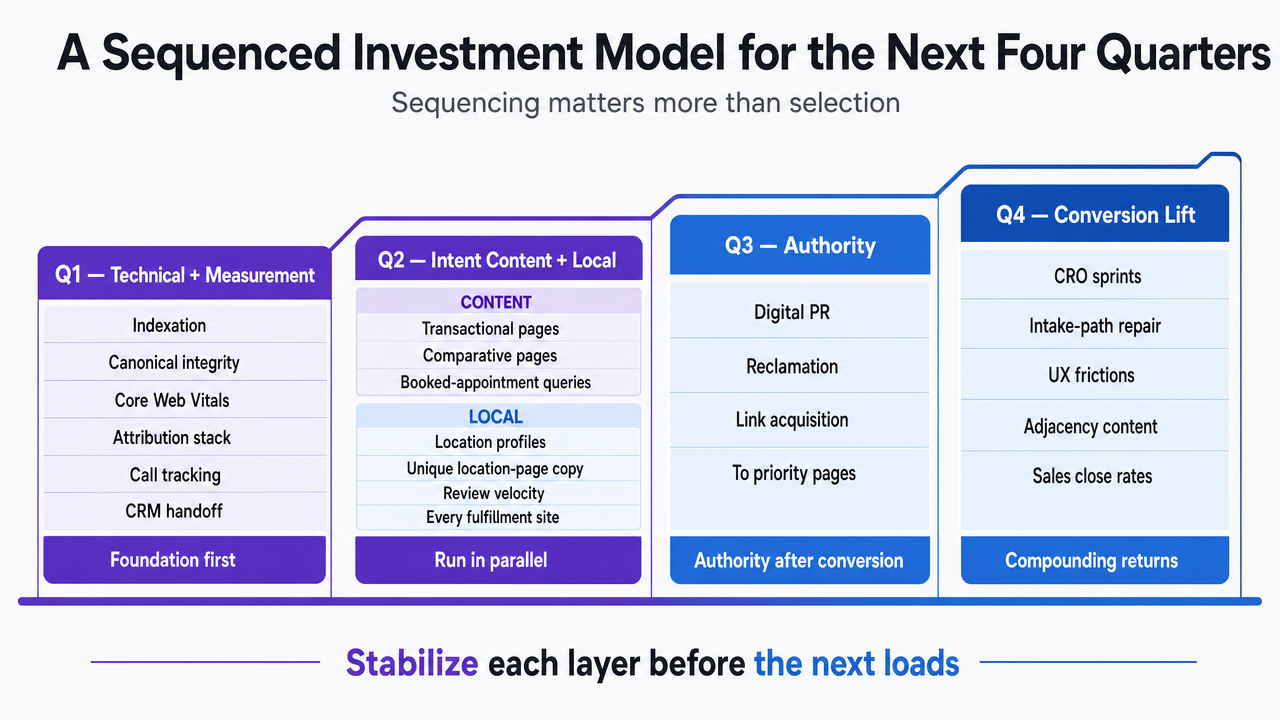 Visualize the four-quarter sequencing plan described in the section, showing which disciplines load in which quarter
Frequently Asked Questions
References
- 1.Search engine Performance optimization: methods and techniques.
- 2.Search engine optimization and its association with readability in online health information.
- 3.You are how (and where) you search? Comparative analysis of search engine users’ clicking behavior.
- 4.Misinformation does not reduce trust in accurate search results, but ....
- 5.The Reliability Gap: How Traditional Search Engines Compare with Generative AI Platforms in Consumer Health Information.
- 6.Consumers' Evaluation of Web-Based Health Information Quality.
- 7.Assessing Credibility: Quality Criteria for Patients, Caregivers, and Health Professionals.
- 8.Federal Trade Commission Announces Final Rule Banning Fake Reviews and Testimonials.
- 9.The Consumer Reviews and Testimonials Rule: Questions and Answers.
- 10.Health Claims.
- 11.Health Products Compliance Guidance.