
Key Takeaways
- Parameter soup and session IDs in indexable paths create combinatorial URL explosions that waste crawl budget; fix it with a template-layer parameter allowlist and self-referencing canonicals 1.
- Mixed casing and trailing-slash drift produce duplicate crawlable variants because path components are case-sensitive 13; enforce one lowercase, single-slash convention with permanent redirects at the CDN edge.
- Fragment-based routing in single-page apps hides slugs from search because Google does not support fragments for content changes 1; use the History API and real anchor links instead 10.
- Canonicalizing every paginated page back to page one strips deeper listings from the index; give each page a self-referencing canonical and treat indexability as a strategic call 6.
- Redirect chains accumulate silently with each rename and weaken consolidation past three hops 4; flatten the redirect map on every publish so sources point directly to the final destination.
Why slug decisions stop being editorial once you cross ten client sites
On a single client site, a slug is a copywriting call. A specialist picks descriptive words, drops the stop words, and moves on. The stakes are low because the blast radius is one URL. Across a portfolio of twenty, fifty, or two hundred sites running on shared templates, that same decision stops being editorial and starts behaving like infrastructure. One templated pattern replicates into thousands of URLs, and every quirk—an uppercase letter that survived the CMS, a session parameter appended by a plugin, a fragment that only resolves in the browser—compounds into crawl waste, canonical drift, and migration debt that lands on the Head of SEO's desk after the next rebuild.
Google's own URL guidance frames the issue in operational terms: overly complex URLs and unnecessary parameter combinations can create excessive URL volumes that waste crawl resources and prevent complete indexing 1. The starter guide reinforces the governing rule: each piece of content should be reachable through one preferred URL, with non-preferred versions redirected 12. Those two statements, read together, describe a standard—not a preference. At portfolio scale, treating them as preference is what generates the audit backlog. The red flags worth ranking are the patterns that break those rules structurally, not the ones that offend an editor's eye.
The governance shift: from per-article judgment to versioned standard
A Head of SEO running delivery across dozens of client sites cannot review every slug a copywriter drafts. That is not a scale problem worth solving; it is a delegation problem worth eliminating. The shift that actually holds under portfolio pressure is treating slug rules the same way a product team treats an API contract: a versioned document, checked into a shared location, referenced by every specialist and contractor, and enforced by validation before publication rather than by senior review after the fact.
The document itself is short. It fixes the pattern for category paths, article paths, location paths, and paginated sequences. It names the canonical casing (lowercase), the trailing-slash policy (one or the other, consistently), the parameter allowlist, the maximum path depth, and the handling for stop words, dates, and IDs. It also specifies what a slug rename requires: a permanent redirect from the source, an updated canonical annotation, and a sitemap refresh—the three signals Google weights most heavily when selecting the preferred URL 2.
Versioning matters because the standard will change. A CDN migration alters trailing-slash behavior. A new CMS handles parameters differently. When the standard moves from v1.3 to v1.4, the delta becomes a QA checklist for existing templates rather than an argument in Slack. The starter guide's rule that each piece of content should be reachable through one preferred URL becomes enforceable only when the definition of "preferred" is written down and dated 12. Without that artifact, every specialist re-derives the rules, and the portfolio drifts one slug at a time.
Red flags ranked by portfolio-scale severity
Parameter soup and session IDs in indexable paths
Rank this first because it scales worst. A single templated pattern that appends tracking, session, or state parameters to canonical paths does not create one duplicate URL per client—it creates a combinatorial explosion. A category page rendered as /services/, /services/?sessionid=abc123, /services/?sort=asc&view=grid, and /services/?sessionid=abc123&sort=asc&view=grid is four crawlable variants of the same content, and that math repeats for every category on every site running the template.
Google's URL guidance is direct on the operational consequence: overly complex URLs with excessive parameter combinations can create excessive URL volumes that waste crawl resources and prevent complete indexing 1. The ecommerce guidance extends the same principle to any scalable URL system—minimize alternative URLs that return the same content, and use the same URL consistently in internal links, sitemaps, and canonical annotations 5.
The governance move is a parameter allowlist enforced at the template layer, not a robots.txt patch applied after the fact. Session IDs belong in cookies or headers, not paths. Sort, view, and filter parameters that do not change the underlying content need a self-referencing canonical pointing back to the clean URL 2. Analytics parameters get stripped before the URL enters an internal link. Applied across a fifty-client portfolio, that single template rule can eliminate the largest source of low-value URLs from every Index Coverage report in the book.
Mixed casing, trailing slash drift, and CDN-level normalization gaps
Casing and trailing slashes look like cosmetic issues until a CDN rule change turns /Services/Family-Law/ and /services/family-law/ into two crawlable pages with split internal links. RFC 9110 is explicit that scheme and host are case-insensitive while other URI components are generally compared case-sensitively, which means the path portion of a URL is a distinct resource under a different case unless the origin server normalizes it 13. Google's URL guidance confirms that URL handling is case sensitive on its side as well 1.
The drift usually enters through three vectors:
- a marketing team that hand-types capitalized URLs into email campaigns,
- a CMS that generates one casing convention while a legacy import used another, and
- a CDN or reverse proxy that adds or strips trailing slashes inconsistently across route patterns.
Each vector produces duplicate variants that Google may consolidate—or may not, when signals conflict 2.
The standard is one canonical casing (lowercase) and one trailing-slash policy per site, enforced with permanent redirects at the edge rather than in application code 3. Audit the CDN configuration for every client on the same portfolio schedule as the SSL certificate check. A single misconfigured normalization rule at the edge is faster to fix than the twelve months of canonical drift it creates.
Fragment-based routing and slugs that only exist in JavaScript
Any client site built on a single-page application framework deserves a fragment audit before it enters the portfolio. Slugs that resolve only through URL fragments—/#/services/family-law rather than /services/family-law/—are effectively invisible to search. Google's URL guidance states plainly that it generally does not support URL fragments for changing page content 1. The JavaScript SEO documentation reinforces the same point from the routing angle: links are discoverable when they are HTML anchor elements with an href attribute, and single-page applications should use the History API rather than URL fragments to load different content 10.
The operational failure is not the framework choice; it is the assumption that the framework's default routing works for search. React, Vue, and Angular projects that shipped with hash routing enabled produce clean-looking URLs in the browser and unreachable content in the crawler. The QA test is simple: fetch the raw HTML for a template page and confirm that navigation links appear as anchor elements pointing to path-based URLs. If they do not, the site is publishing content that Google will not index reliably regardless of how well the slugs are named.
Paginated sequences canonicalized to page one
The most common pagination mistake on portfolio audits is canonicalizing every page in a sequence back to page one. It appears to solve a duplicate content concern and instead removes the deeper pages from the index entirely, taking the products, articles, or listings that live on pages two through twenty with them.
Google's pagination guidance is direct: each paginated page should have a unique URL, and Google no longer uses rel="next" and rel="prev" to consolidate sequences 6. A self-referencing canonical on each page—/blog/page/2/ canonical to /blog/page/2/, not to /blog/—preserves independent addressability while still signaling the preferred URL for that specific page. Whether a given paginated page should be indexable is a strategic decision based on its content depth and internal-link role, not a universal rule.
Fix this at the template layer once and the pattern propagates across every archive, category, and listing on every site using it. Leave it as a per-site editorial call and the same mistake reappears in every quarterly audit.
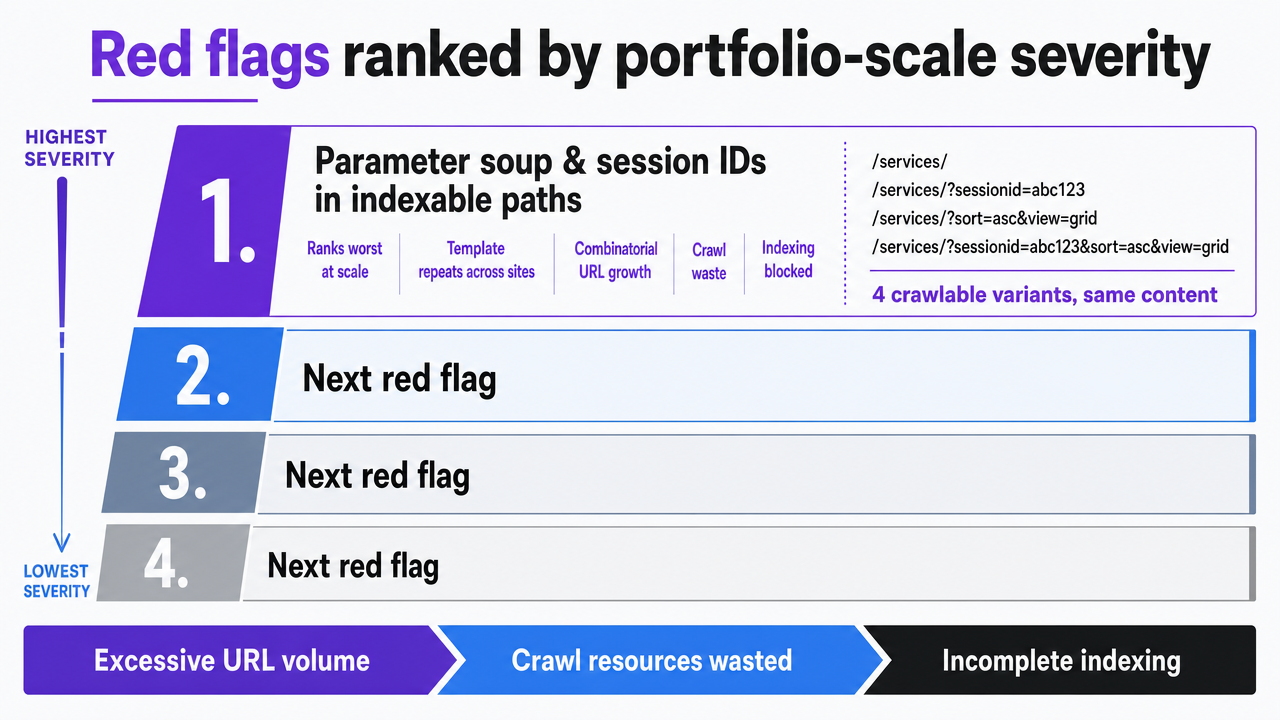 Visualize the ranked comparison of four red flag categories introduced in this section, giving readers a scannable severity hierarchy that mirrors the subsection structure
Redirect chains: the hidden tax on every slug rename
Every slug rename adds a redirect. Every rename of a renamed slug adds another. Six months into a content refresh cycle, /blog/seo-tips/ points to /blog/seo-strategies/ which points to /resources/seo-strategies/ which points to /guides/seo-strategy/. Each hop is defensible in isolation. The chain is what pays the tax.
Google's migration guidance is specific about the ceiling: redirects should go directly to the final destination, and chains should ideally stay at three hops, with fewer than five as the outer limit 4. A chain at four hops is degraded but functional; a chain at seven has crossed the threshold where canonical signals weaken and crawl efficiency drops measurably. The rule is not aesthetic. It reflects how Googlebot allocates fetches per URL and how consolidation signals attenuate across hops.
The operational fix is a redirect map that flattens on every publish, not a rename policy that forbids changes. When a slug renames from A to B, the map updates every existing A-to-X entry to point directly from A to B, collapsing the intermediate hop. Server-side permanent redirects handle the transition, canonical annotations align to B, and the sitemap drops A entirely 2, 3. Temporary redirects belong to genuinely temporary states—an A/B test, a seasonal landing page—not to slug renames, because they preserve the source URL in search results rather than replacing it 3.
Across a fifty-client portfolio, chain length is a monitorable metric. A monthly crawl that exports every 3xx response and counts hops per source URL produces a two-column report: client, max chain depth. Any client above three enters the remediation queue before the next migration compounds the problem.
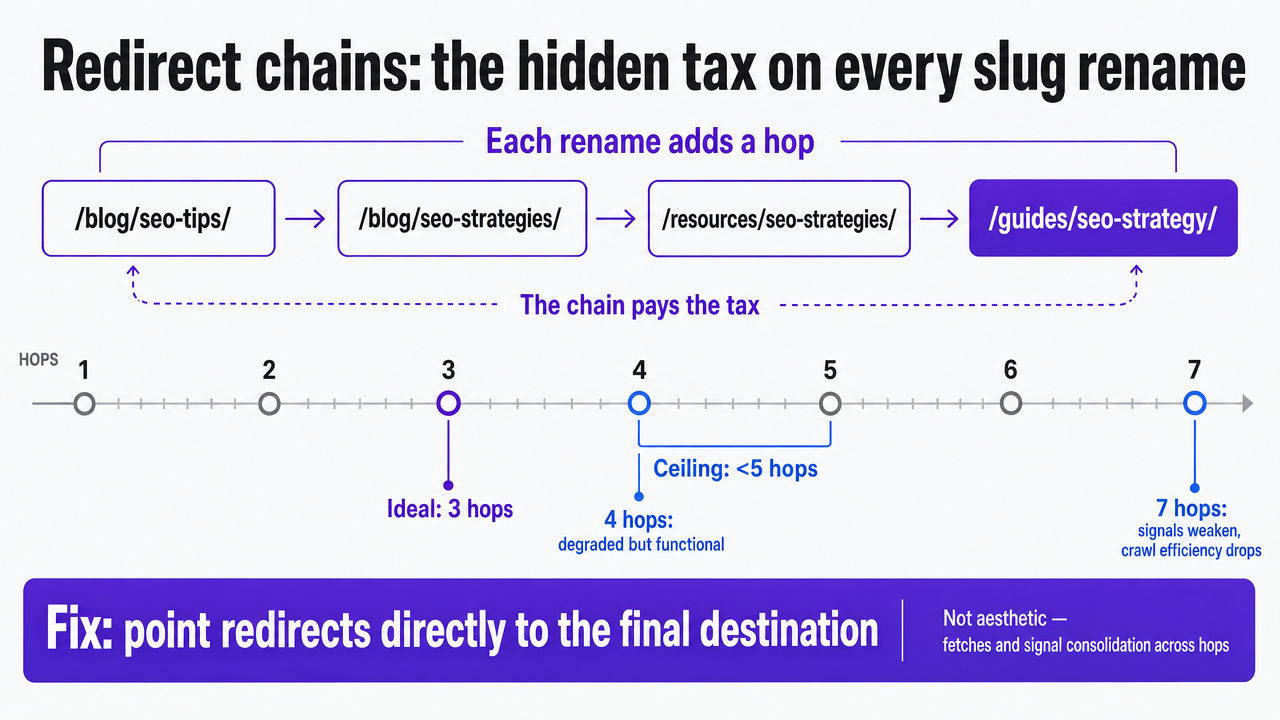 Illustrate the redirect chain concept and the 3-hop ideal / 5-hop ceiling cited from Google's migration guidance, which is stated in the surrounding prose
Test AI-driven SEO workflows with live sites
Experience end-to-end SEO execution on your actual client domains before making a commitment.
Faceted navigation and multi-location slug explosions
Multi-location service clients change the math. A single law firm with fifteen offices, five practice areas, and three intake filters is not a fifteen-page site—it is a 225-URL grid before pagination, and a much larger one once a filter UI starts encoding state into the path. The templates that generate those grids are where portfolio-level crawl budget goes to die.
Google's faceted-navigation guidance names the mechanism directly: filter combinations can consume substantial computing resources because they generate large numbers of URLs and rendered pages, and the recommended controls are preventing crawling of unnecessary combinations, maintaining consistent filter order when filters live in paths, avoiding duplicate filters, and returning HTTP 404 for empty combinations 7. Each of those recommendations translates into a template rule. Consistent filter order means /locations/chicago/family-law/ and /locations/chicago/family-law/ resolve to the same URL every time, never /locations/family-law/chicago/. Duplicate filters means the template rejects /locations/chicago/chicago/ at the routing layer rather than serving it. Empty combinations means a query for personal injury attorneys in a market where the firm has no personal injury practice returns a 404, not a thin "no results" page with an indexable URL.
The strategic call sits on top of the technical one. Not every location-by-service combination deserves an indexable URL. A firm with genuine capacity and content depth for family law in Chicago earns /locations/chicago/family-law/ as a canonical destination with unique attorney bios, case results, and local signals. The same firm's personal injury filter in a market where they refer the work out earns a noindex or a 404. That decision is a client conversation, not a template default. What the template must guarantee is that whatever the answer, exactly one URL represents the indexable version and every filter variant either canonicalizes to it or does not resolve at all 5. Get that rule into the multi-location template once, and the same discipline propagates across every DSO, home-services franchise, and senior-living portfolio the agency runs.
Localized slugs and hreflang reciprocity across markets
Agencies running clients across regions inherit a slug problem that single-market portfolios never see. When the same article ships under /en-us/services/estate-planning/, /es-mx/servicios/planificacion-patrimonial/, and /fr-ca/services/planification-successorale/, three separate governance rules have to hold at once: the local slug has to render and encode correctly, the canonical has to point to the right regional variant rather than a default, and every version has to declare every other version reciprocally.
Google's multi-regional guidance accepts localized words in URLs and internationalized domain names, but requires UTF-8 encoding and proper escaping when those characters appear in links 8. The failure mode is predictable: a copywriter drafts a Spanish slug with an accented character, the CMS stores it one way, the sitemap generator escapes it another, and the internal navigation links to a third variant. Three URLs, one page, and Google picking whichever signal looks strongest that week.
Hreflang closes the loop only when reciprocity holds. Each localized version must identify itself and every other relevant version, and every alternate URL must be a complete URL including the transport scheme 9. The template rule that scales: generate hreflang annotations from the same source table that generates the slug map, so a missing translation cannot silently break the reciprocal chain across the portfolio.
The pre-publish QA gate junior specialists can execute
The point of a versioned slug standard is that a specialist two years into their career can enforce it without escalating. That requires the standard to exist as a checklist a person runs in under five minutes per URL, not as a document a senior reviews after publication. The gate belongs before the publish button, wired into the CMS workflow as a required step rather than a norm.
Seven checks handle the majority of red flags.
- The slug is lowercase, hyphen-separated, and contains no session IDs, tracking parameters, or fragment characters 1.
- The path matches the site's declared depth pattern—typically /category/article/ or /locations/city/service/, not both on the same site.
- The slug does not duplicate an existing path under a different casing or trailing-slash variant, verified by a live fetch against the production origin.
- The canonical annotation on the draft points to itself as an absolute URL with the correct transport scheme 2.
- The sitemap entry, when generated, matches the canonical exactly rather than a parameterized or alternately cased variant 5.
- If the URL replaces an existing one, a permanent server-side redirect from the source is queued to deploy with the publish, and the source is removed from the sitemap 3.
- Internal links inserted in the body use the canonical form, not a legacy variant pulled from search results or an older article.
Embedding those checks as CMS validation—regex on the slug field, a canonical preview, a duplicate check against the sitemap—removes the senior review from the critical path. The Head of SEO reviews exceptions, not every publish. Applied across the portfolio, the same seven-item gate propagates the standard without propagating the reviewer.
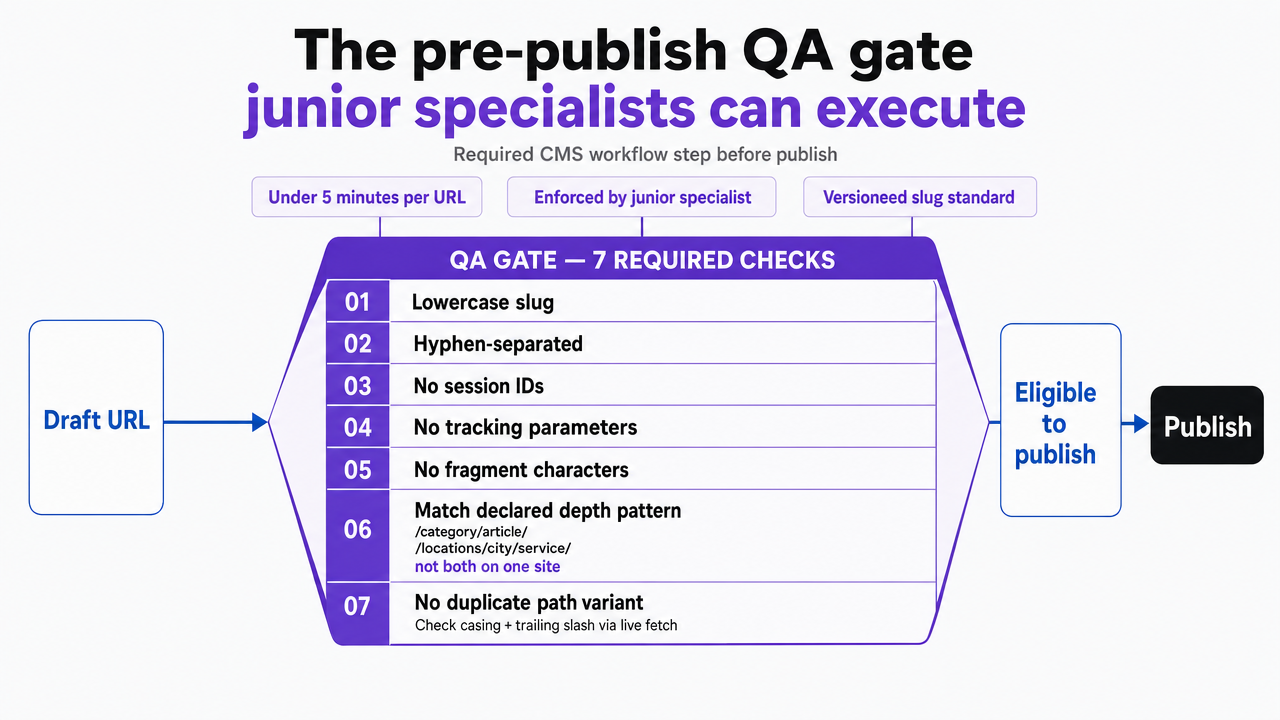 Visualize the seven-item pre-publish checklist enumerated in the section as a scannable workflow gate, matching the article's explicit list
Pinpoint and Resolve URL Slug Issues Before They Undermine Client SEO Performance
Connect with our team to access a data-backed audit framework for identifying high-impact URL slug errors at scale—designed for agencies managing complex, multi-site SEO portfolios.
Search Console as the enforcement layer, not the discovery layer
Most agencies still treat Search Console as a diagnostic tool a specialist opens when a client asks why traffic dropped. At portfolio scale that framing is backwards. The Index Coverage report and URL Inspection are the enforcement layer for the slug standard—the mechanism that surfaces which templates broke the rules before the client's analytics does.
The operational shift is scheduled review, not reactive review. Index Coverage provides a site-level overview of pages Google indexed or attempted to index, while URL Inspection returns current index status, live-test results, and loaded resources for a specific URL 11. Read on a weekly cadence against a stable baseline, those two reports answer the questions the slug standard was written to prevent:
- how many URLs are excluded as duplicates without a user-selected canonical,
- how many are crawled but not indexed,
- how many parameter variants slipped past the template rules, and
- how many redirect chains are attenuating consolidation signals.
The monitoring artifact is a portfolio dashboard, not a per-client report. Three columns per site—duplicate-without-canonical count, crawled-not-indexed count, and max redirect chain depth—converted to a weekly delta. Any client whose numbers move outside a defined threshold enters the queue. Search Console reports are not a complete crawl audit; server logs, third-party crawls, and sitemap diffs fill the gaps 11. But as the trigger for when to run those deeper audits, the dashboard removes discovery from the Head of SEO's calendar and puts remediation on the specialist's.
If you manage slug standards across a portfolio
The compounding math is what separates portfolio work from single-site work. A slug rule that saves one specialist ten minutes on a single article saves a delivery team hundreds of hours across a hundred templates and thousands of URLs. A rule that fails silently on one site fails silently on every site running the same template, and the audit to unwind it scales with the count of variants, not the count of clients.
The operating model that holds under that math has four moving parts, and every one of them is already named in Google's own documentation:
- A versioned slug standard defines the pattern 12.
- Pre-publish validation enforces it at the CMS layer before a specialist can ship a URL that duplicates an existing path, embeds a session ID, or breaks the canonical convention 1.
- Server-side permanent redirects and self-referencing canonical annotations handle renames, migrations, and consolidation without accumulating chains 2, 3.
- Search Console's Index Coverage and URL Inspection close the loop weekly, surfacing the templates that drifted before the client's traffic does 11.
Agencies building that stack in-house assemble it from spreadsheets, Slack channels, and senior review. The teams scaling past a hundred sites are moving toward approval-first execution platforms—Vectoron among them—that route slug rules, redirect maps, and Search Console signals through one governed workflow rather than four disconnected ones.
Where governance ends and craft begins
A slug standard settles the questions that should never reach a specialist twice: casing, trailing slashes, parameters, path depth, redirect handling, canonical form. What it does not settle is which words go in the slug. That decision still belongs to whoever understands the client's audience, the query landscape, and the article's role in the funnel. Governance handles the structural failures that scale into audit debt 1, 12. Craft handles the descriptive choice inside the pattern the standard allows. A Head of SEO who conflates the two either bottlenecks the delivery team on every publish or ships a portfolio full of technically clean URLs that describe nothing. The operating model that holds treats the pattern as fixed and the words as editorial—and reviews the standard, not the slug.
Frequently Asked Questions
References
- 1.URL Structure.
- 2.How to Specify a Canonical with rel="canonical" and Other Methods.
- 3.Redirects and Google Search.
- 4.Start the site move.
- 5.Ecommerce URL Structure Best Practices.
- 6.Pagination Best Practices for Google.
- 7.Managing crawling of faceted navigation URLs.
- 8.Managing Multi-Regional and Multilingual Sites.
- 9.Localized Versions of your Page.
- 10.Understand JavaScript SEO Basics.
- 11.How To Use Search Console.
- 12.SEO Starter Guide: The Basics.
- 13.RFC 9110: HTTP Semantics.