
Key Takeaways
- Ranking keywords by search volume inflates traffic while starving pipeline; reclassifying the portfolio by decision stage—problem-aware, category-aware, and vendor-aware—is what shifts organic sessions into booked meetings 11.
- SERP composition classifies intent more reliably than query wording, so when modifiers and result-page layout disagree, the SERP wins and the content brief follows it 8.
- A defensible B2B allocation weights commercial-investigation and transactional content ahead of informational coverage, freed by retiring explainer assets that rank but never appear in closed-won attribution 10.
- The strongest buyer-intent keyword lists come from closed-won deal notes, support tickets, sales call transcripts, and demo request forms, then validated against SERP composition before entering the portfolio 10.
Why Volume-First Keyword Selection Underdelivers Pipeline
Most keyword programs still rank opportunities by monthly search volume and keyword difficulty, then wonder why organic traffic climbs while pipeline flattens. The mismatch is structural. Search volume measures how many people type a phrase; it says nothing about whether those people are ready to evaluate a vendor, request a quote, or sign a contract.
The research literature has been consistent on this point for two decades. Jansen, Booth, and Spink established that queries carry distinct informational, navigational, and transactional goals, and that these goals shape everything from click behavior to task completion 1. Later SEO-focused work extended the taxonomy to include commercial investigation and product-comparison intents, precisely because B2B purchase paths rarely fit the original three buckets 5. Practitioner guidance now treats intent as the single most important variable in content prioritization, ahead of volume and difficulty 11.
For a demand gen manager carrying an organic pipeline number, the operational consequence is direct. A term with 12,000 monthly searches and problem-aware intent will produce sessions that decay before a form fill. A term with 210 monthly searches and vendor-aware intent—pricing, alternatives, comparison modifiers—produces the meetings that sales actually books 10. Volume-first selection systematically overinvests in the first pattern and underinvests in the second.
The correction is not to abandon informational content. It is to reclassify the existing portfolio by decision stage, then reallocate production toward the tiers where revenue forms. The rest of this article works through that reclassification.
Intent as a Spectrum, Not a Bucket
The Three-Category Foundation and Where It Breaks
The dominant intent framework in SEO traces back to a single study. Jansen, Booth, and Spink analyzed large-scale search engine transaction logs and proposed that queries resolve into three hierarchical categories: informational, navigational, and transactional 1. The taxonomy has held up because it maps cleanly to how consumer search behaved in the mid-2000s, when most queries were either fact-finding, brand-seeking, or action-completing.
The framework breaks down under two pressures relevant to demand gen work. The first is granularity. A B2B purchase path routinely includes a research phase that is neither pure information gathering nor a transaction, but a structured comparison of vendors, features, and price ranges. The original three buckets absorb this phase into "informational," which flattens meaningful behavioral differences between someone reading a definition and someone building a shortlist.
The second pressure is mixture. Later research argued that intent is often multi-dimensional, extending the taxonomy to include content-related, task-related, social, and aggregation-based intents 2. A query like "marketing automation for law firms" carries an informational component, a category-evaluation component, and often a vendor-shortlist component simultaneously. Treating it as one bucket forces a content decision that mismatches at least two of the three underlying goals.
The three-category foundation is still useful as a first pass. It stops being sufficient the moment a keyword portfolio is expected to produce pipeline rather than sessions.
Extending the Taxonomy for Commercial Search
SEO-focused research has already made the extension. A query intent detection paper written from the SEO perspective explicitly identifies buying, comparing, and simulating services as distinct intents that sit alongside pure information acquisition 5. Practitioner guides converged on a four-tier taxonomy that separates commercial investigation from both informational and transactional intent, defining commercial searches as those where users research products or services before buying 8.
The 2026 practitioner literature is even sharper. It splits queries into informational (learn, understand), navigational (reach a page or brand), commercial (compare, evaluate, shortlist), and transactional (take action: purchase, demo, quote, sign-up) 9. The split matters because the commercial tier is where most B2B and multi-location service pipeline actually forms. A prospect searching "best patient intake software" is not learning what patient intake is, and is not yet buying. They are constructing a shortlist, and the content that ranks decides whether a given vendor makes that shortlist.
For a demand gen manager, the operational consequence is that a two-tier mental model—top of funnel versus bottom of funnel—wastes the middle. Commercial-investigation queries are the tier where organic sessions convert into evaluated opportunities, and they require different content formats, different schema, and different measurement than either flanking tier 9.
Problem-Aware, Category-Aware, Vendor-Aware: The Operator's Zones
The cleanest operational restatement of intent for B2B keyword work comes from a three-zone model: problem-aware, category-aware, and vendor-aware 11. Each zone corresponds to a distinct question the searcher is asking, and each is identifiable by the modifiers attached to the query and the composition of the resulting SERP.
Problem-aware queries describe a symptom without naming a solution category. Modifiers cluster around "how," "what is," "why is," and "signs of." A search like "how to reduce no-show rates" belongs here. The searcher has not yet decided whether the answer is software, staffing, or process change. Content that ranks in this zone builds category demand but rarely converts on the same session.
Category-aware queries name the solution category and evaluate approaches within it. Modifiers include "best," "top," "vs," "alternatives," and "comparison." "Best appointment reminder software" or "CRM vs marketing automation" sit in this zone. The searcher has accepted the category and is narrowing a shortlist. This is where commercial-investigation content earns its keep.
Vendor-aware queries include a brand name or a purchase-adjacent modifier: "pricing," "demo," "reviews," "login," "integration," "buy." A search like "[vendor] pricing" or "[vendor] alternatives" belongs here. These are the lowest-volume, highest-conversion terms in the portfolio, and practitioner research names intent as the single most important variable in deciding what content to build and how sales follows up 11.
The three zones do not replace the four-tier taxonomy; they translate it into signals a keyword analyst can actually observe.
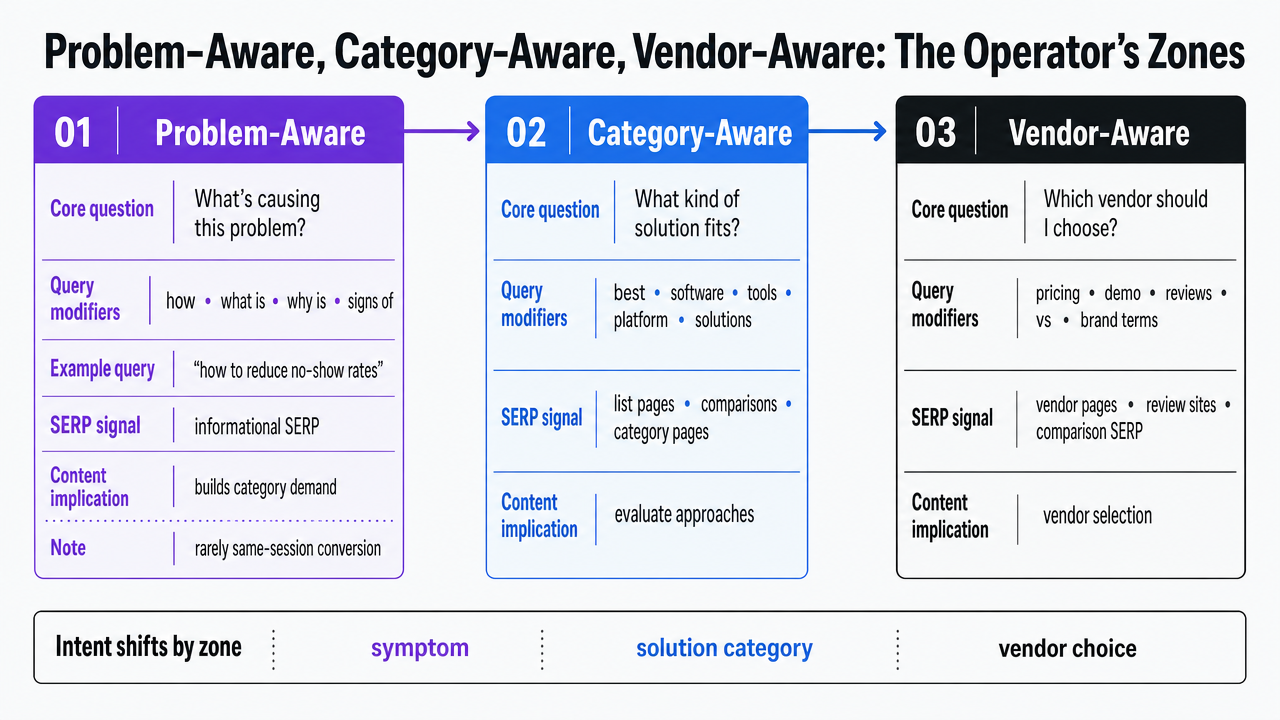 Visualize the three-zone operator model with the distinct modifiers and SERP signals for each zone, directly supporting the section's framework
The SERP Is the Referee: Classifying Intent by Result-Page Composition
Query wording lies. A search for "marketing automation" reads informational on the page, but the SERP that Google actually returns is stacked with product carousels, vendor comparison sites, and pricing-focused pages. The layout is the classification. Practitioner guidance now treats SERP composition as the primary intent signal and query modifiers as a secondary one, because Google's ranking system has already resolved the ambiguity that a keyword tool cannot 8.
The mapping is legible once the SERP features are read as a matrix.
- Informational intent surfaces featured snippets, People Also Ask blocks, definition boxes, video carousels, and long-form editorial results.
- Commercial-investigation intent surfaces third-party comparison sites, "best of" listicles, review aggregators, and category pages that rank vendors against each other.
- Transactional intent surfaces product pages, pricing pages, demo CTAs, sponsored shopping listings, and vendor domains occupying the top organic positions 8.
A demand gen analyst who audits ten SERPs against this matrix will classify a portfolio faster and more accurately than one who reads modifiers alone.
The 2026 practitioner literature adds a second discipline: validate the classification with schema alignment. Informational SERPs reward FAQ and HowTo schema, commercial SERPs reward review and comparison schema, and transactional SERPs reward Product and Offer schema 9. When the top three organic results all carry a specific schema type, the intent tier is settled regardless of how the query reads.
Two operational rules follow. First, when a query's modifiers suggest one tier but the SERP composition suggests another, the SERP wins. Google's ranking system is optimizing for observed click satisfaction, which encodes intent more reliably than a keyword tool's category label 8. Second, SERPs shift. A term that surfaced editorial results eighteen months ago may now surface a product carousel because purchase behavior migrated. Practitioner guidance recommends weekly SERP monitoring for priority keywords and reclassification when the layout changes materially 8. A static intent map decays; a SERP-audited map compounds.
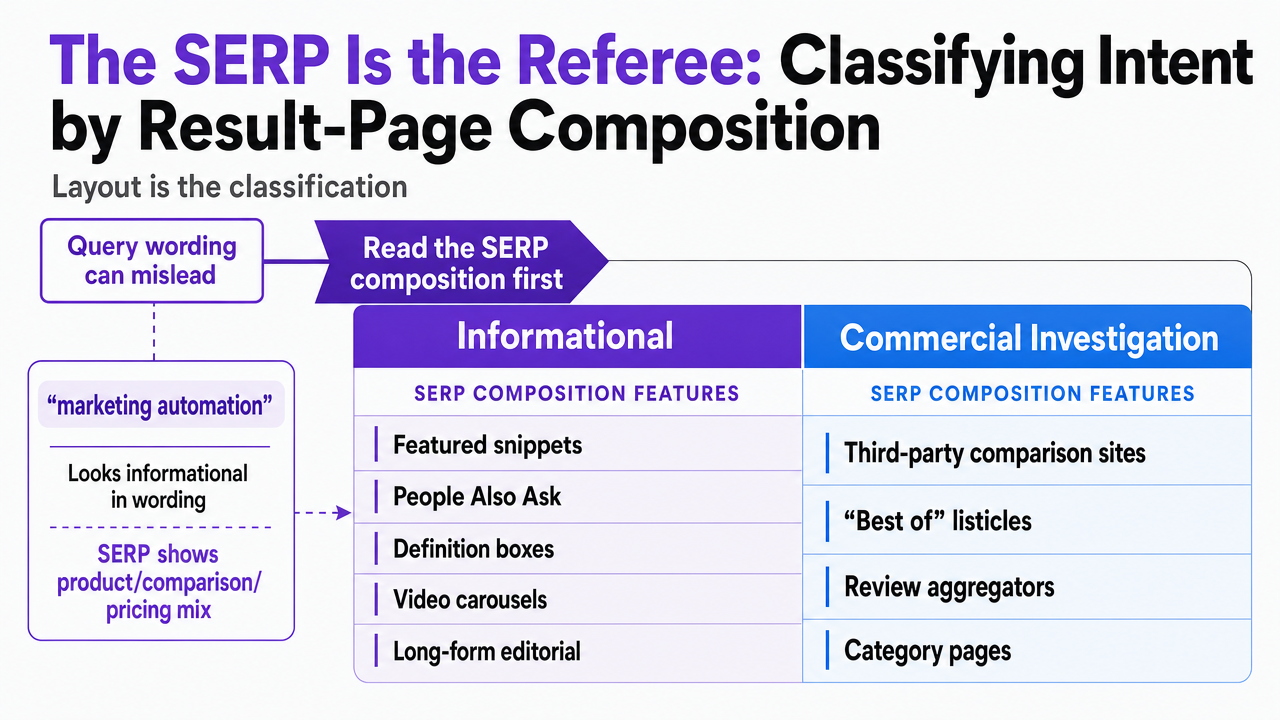 Translate the SERP composition matrix described in the section into a scannable classification reference
Test intent-driven keyword strategies on live campaigns
Validate your keyword mapping and content impact using real data before committing long term.
Resolving Ambiguous and Mixed-Intent Queries
Why Single-Bucket Classification Fails on Borderline Terms
A material share of the queries in any B2B keyword portfolio refuse to sit inside a single intent bucket. "Marketing automation for law firms" is the canonical example: the phrase reads informational, but the searcher may be defining a category, building a shortlist, or checking whether their existing vendor covers a vertical. All three motivations produce the same string of text.
The academic literature identified this problem early. A query goal classification study demonstrated that ambiguous queries cannot be assigned to one of navigational, informational, or transactional with confidence, and proposed instead a framework that estimates associations across classes when the goal is unclear 4. The underlying observation is that intent is often a distribution, not a label. Forcing a single-bucket assignment on a borderline term throws away the information that would actually guide content decisions.
For demand gen work, single-bucket classification fails in two specific ways. It routes commercial-investigation queries into informational content templates, producing explainer articles for readers who wanted a shortlist. It also routes mixed navigational-plus-informational queries into pages that answer neither goal well. Practitioner research on SEO-focused intent detection notes that comparing and simulating services are distinct behaviors that overlap with information acquisition, and treating them as one category collapses the very distinctions that make a keyword worth building for 5.
Click Patterns and Probabilistic Association Across Classes
The resolution comes from behavior, not wording. Microsoft Research proposed click patterns as an empirical representation of complex query intent, showing that mixtures of navigational and informational goals occur regularly in live search traffic and can be identified by how users distribute clicks across the result page 3. When a query produces a bimodal click distribution—some sessions landing on a brand domain, others fanning out across editorial results—the intent is genuinely mixed, and any single-page content strategy will underserve half the traffic.
The probabilistic approach from the query goal classification work extends this idea. Rather than forcing a label, the framework predicts which intent classes carry high association with a given query and lets the analyst weight content decisions accordingly 4. A query with 60% category-aware association and 40% vendor-aware association merits a comparison page that also surfaces pricing and demo CTAs, not a pure listicle.
Two operational moves follow.
- Audit the top ten SERP results for click-behavior heterogeneity: if the ranking mix includes editorial, comparison, and vendor domains simultaneously, treat the query as mixed and design a hybrid page rather than picking a lane.
- Read engagement metrics through the same lens. A page targeting a mixed-intent term will show CTR and dwell-time patterns that a single-intent benchmark would flag as underperformance, when the traffic is simply split across goals the page was built to serve 6.
Reallocating the Content Portfolio by Intent Tier
Most demand gen content libraries, when audited honestly, look inverted. Roughly 70 to 80 percent of published assets target problem-aware informational queries, 15 to 20 percent target commercial-investigation terms, and the transactional tier carries a handful of pages built years ago and rarely refreshed. The distribution reflects what volume-weighted keyword tools reward, not what a pipeline number requires.
The 2026 buyer-intent keyword guidance inverts that ratio deliberately. It recommends prioritizing commercial and transactional intent first, then filling out informational coverage as a demand-generation supplement rather than the portfolio's center of gravity 10. Applied to a production budget, the practical shift for a B2B demand gen team is closer to 30 percent informational, 45 percent commercial-investigation, and 25 percent transactional. The commercial tier carries the largest share because that is where shortlists form, and shortlists are what convert to opportunities.
The reallocation is not additive. Very few teams get more headcount or more freelance budget after this exercise. The math has to come from retiring or consolidating informational assets that produce sessions without producing meetings. A demand gen manager auditing the existing library against SERP composition will typically find twenty to forty explainer articles that rank for problem-aware modifiers, hold traffic, and never appear in a closed-won attribution path. Those pages become consolidation candidates. The freed production capacity moves into comparison pages, alternatives pages, category-versus-category guides, pricing explainers, and vendor-evaluation frameworks that map to category-aware and vendor-aware zones 11.
Two disciplines keep the reallocation from drifting. First, every new brief carries a declared intent tier in its header, so production cannot quietly regress toward informational defaults. Second, the portfolio distribution is reviewed quarterly against pipeline-sourced keyword lists—terms that appeared in closed-won deal research, sales call transcripts, and inbound demo requests 10. When the pipeline surfaces a modifier the portfolio does not cover, the gap gets a brief before the next informational asset is greenlit. Volume metrics become a tiebreaker inside a tier, not the selection criterion across tiers.
See How Leading Teams Map Keywords to Buyer Intent—With Measurable Pipeline Impact
Request a walkthrough of intent-driven keyword workflows that align SEO strategy to revenue outcomes—built for teams managing complex multi-channel campaigns at scale.
Sourcing Buyer-Intent Keywords From Revenue Data
The best buyer-intent keyword list a demand gen team will ever build does not come from a keyword tool. It comes from the last two quarters of closed-won deals. The 2026 buyer-intent keyword guidance is explicit on this point: the discovery workflow starts with CRM records, support tickets, and sales call transcripts, and treats the SERP as a validation step rather than the seed 10. The logic is that terms which appeared in the language of prospects who actually bought are, by definition, terms with proven conversion association.
Four sources compound into a workable list.
- CRM opportunity notes surface the phrases prospects used when they first described the problem and the category.
- Support tickets from existing customers reveal the modifiers attached to expansion and renewal conversations—integration names, feature comparisons, workaround queries.
- Sales call transcripts, run through a simple search for competitor names and category modifiers, expose the vendor-aware zone with unusual precision.
- Inbound demo request forms carry the exact wording of intent at the moment of conversion 10.
Each candidate term then gets validated against its SERP. If the top ten results include comparison sites, pricing pages, or vendor domains, the classification holds. If the SERP surfaces editorial explainers, the term reads commercial in the CRM but performs informational in the wild, and the content brief adjusts accordingly 8. The workflow runs weekly, seeded by the most recent closed-won cohort, and compounds into a list of proven buyer-intent phrases that a volume-first keyword tool would never surface 10.
Measuring Contribution: Tying Keyword Tiers to Pipeline Stages
Why Engagement Metrics Must Be Read Through Intent
Click-through rate and dwell time are the two metrics most likely to mislead a keyword program. Both are treated as universal quality signals in dashboards, and both encode intent-specific behavior that a single benchmark cannot interpret. Empirical work on search intent and click activity found a measurable bias between what users click and what documents are actually relevant, and the size of that bias varies with the intent type of the underlying query 6. A page that looks like an underperformer against an average CTR line may be serving its intent tier correctly; a page that looks like a winner may be capturing sessions that never had purchase potential.
The behavioral logic is straightforward.
- Informational queries produce high scroll depth and long dwell times because the searcher is reading to learn.
- Commercial-investigation queries produce fast lateral movement across tabs as the searcher opens three or four comparison pages simultaneously, which registers as low dwell on any single asset.
- Transactional queries produce short sessions that end at a form or a pricing block, which reads as a bounce in an untuned analytics setup.
Search intention itself is a strong determinant of the resulting online behavior, so the same engagement metric carries different meaning across tiers 7. Reading them without that filter turns optimization into noise.
A Stage-Mapped Measurement Model
A defensible measurement model assigns each keyword tier a primary conversion event and a secondary engagement benchmark, and refuses to compare across tiers.
- Informational assets are measured by assisted-conversion association and downstream retargeting reach, not by direct form fills.
- Commercial-investigation assets are measured by demo requests, comparison-page-to-pricing-page progression, and the share of sessions that touch a vendor-aware URL within thirty days.
- Transactional assets are measured by direct conversion rate on the landing session and by influenced pipeline for accounts that entered through those pages.
The model closes the loop by tying keyword tiers to CRM stages rather than to ranking positions. Every organic-sourced opportunity in the CRM carries the entry keyword and the entry URL, and the reporting layer rolls those up by intent tier. A quarterly review then answers three questions:
- What share of pipeline originated in each tier?
- What share of closed-won revenue attributes back to each tier?
- Where do the tier ratios in the content portfolio diverge from the tier ratios in the pipeline?
When a tier produces disproportionate revenue against its content share, production shifts toward it. When a tier consumes production without appearing in closed-won attribution paths, its assets become consolidation candidates.
Ranking reports remain useful as a diagnostic for whether the SERP classification held 8, but they stop being a primary KPI. The primary KPI is stage-mapped: sourced pipeline by intent tier, and closed-won revenue by entry-keyword tier. That is the number a demand gen manager defends in a quarterly business review, and it is the number that survives contact with a CFO asking what the organic program actually contributed 10.
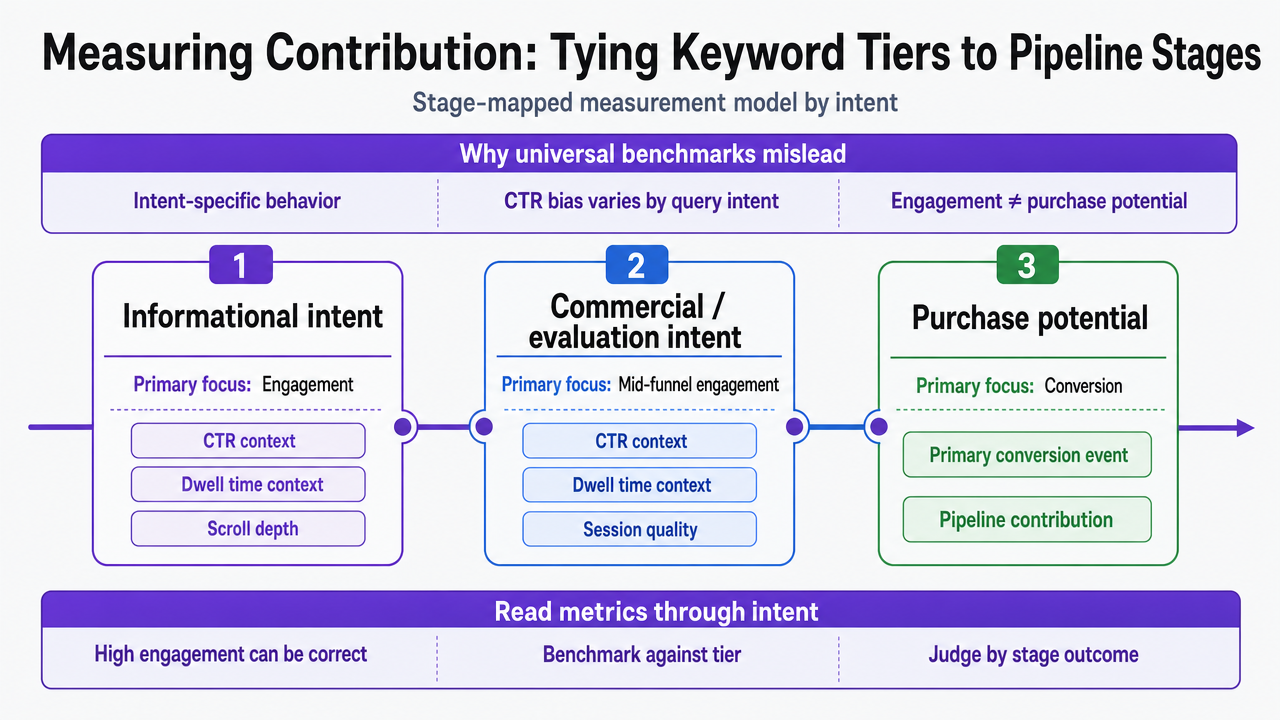 Visualize the stage-mapped measurement model that assigns primary conversion events and engagement benchmarks to each intent tier
Frequently Asked Questions
References
- 1.Determining the informational, navigational, and transactional intent of Web queries.
- 2.Can We Predict User Intents from Queries?.
- 3.Click Patterns: An Empirical Representation of Complex Query Intents.
- 4.Determining the User Intent Behind Web Search Queries by Query Goal Classification.
- 5.Query Intent Detection from the SEO Perspective.
- 6.Search intent and click activities (Paper 0.7.docx).
- 7.A uses and gratification perspective on Internet search intention.
- 8.Identify Informational, Navigational, Commercial & Transactional Search Intent for SEO.
- 9.Search Intent Types in SEO: A Practical Guide (2026).
- 10.B2B Buyer-Intent Keywords: A Practical Guide (2026).
- 11.B2B Search Intent: How to Read Buying Signals in Keyword Research.