
Key Takeaways
- AI answer-engine visibility tracking measures whether client brands surface inside LLM-generated answers to purchase-intent prompts, closing a gap rank trackers cannot detect as buyer research shifts to ChatGPT and Perplexity 8.
- AI-augmented marketing mix modeling now links spend to sales KPIs at granular levels and compresses time-to-insight from days to minutes, turning MMM into a live budget conversation rather than a quarterly autopsy 6.
- Cross-media measurement with probabilistic attribution unifies walled-garden and open-web signals into one revenue view, replacing deterministic cookie-based tracking as the industry pivots to AI-based inference 5.
- Prescriptive optimization suites issue ranked action lists with reasoning attached rather than dashboards, and companies putting data at the center of marketing decisions improve marketing ROI by 15 to 20 percent 9.
- Unified execution platforms with approval workflows close the handoff tax between insight and shipped work, capturing the roughly $6 billion productivity share of the AI measurement value opportunity 2.
The Measurement Layer Agencies Already Own Isn't the One Clients Are Paying For
Rank trackers still rank. Search Console still reports impressions. Brand mention monitors still ping when a competitor gets quoted. None of that answers the question a client actually asks on a quarterly review call: is visibility producing revenue, and where should the next dollar go?
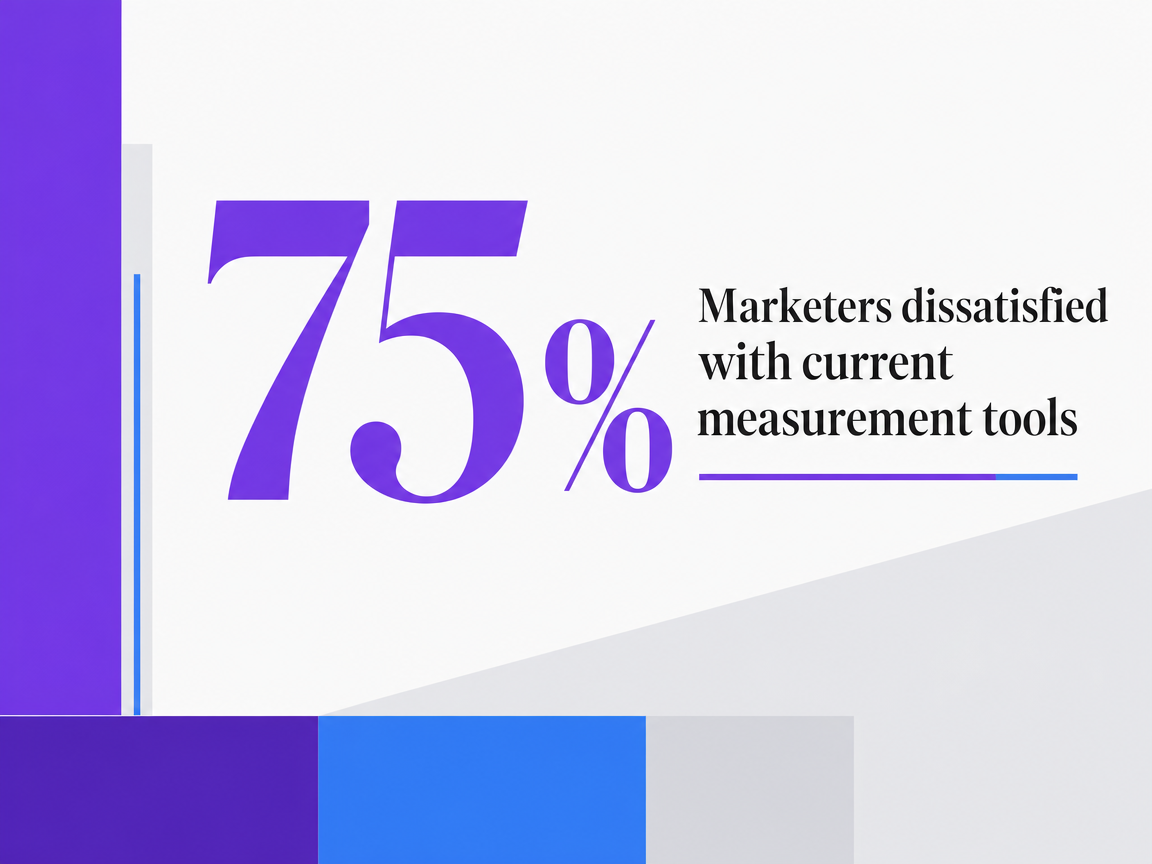
The gap is measurable. In the IAB State of Data 2026 survey of marketers, up to 75% said their current attribution, incrementality tests, and marketing mix models underperform on rigor, timeliness, trust, and efficiency 2. That figure describes the buy-side view of measurement infrastructure, not agency deliverables directly — but agency SEO leaders inherit the consequences. When a client's CFO doesn't trust the attribution model, retainer defense gets harder every quarter.
What follows is a map of the five tool categories that answer the revenue question, ordered by measurement maturity: AI answer-engine visibility, AI-augmented marketing mix modeling, cross-media measurement, prescriptive optimization suites, and unified execution platforms with approval workflows. Each represents a distinct capability agencies rarely own yet, and each ties visibility signals to a budget decision rather than a screenshot in a monthly report.
How the Five Categories Map to Measurement Maturity
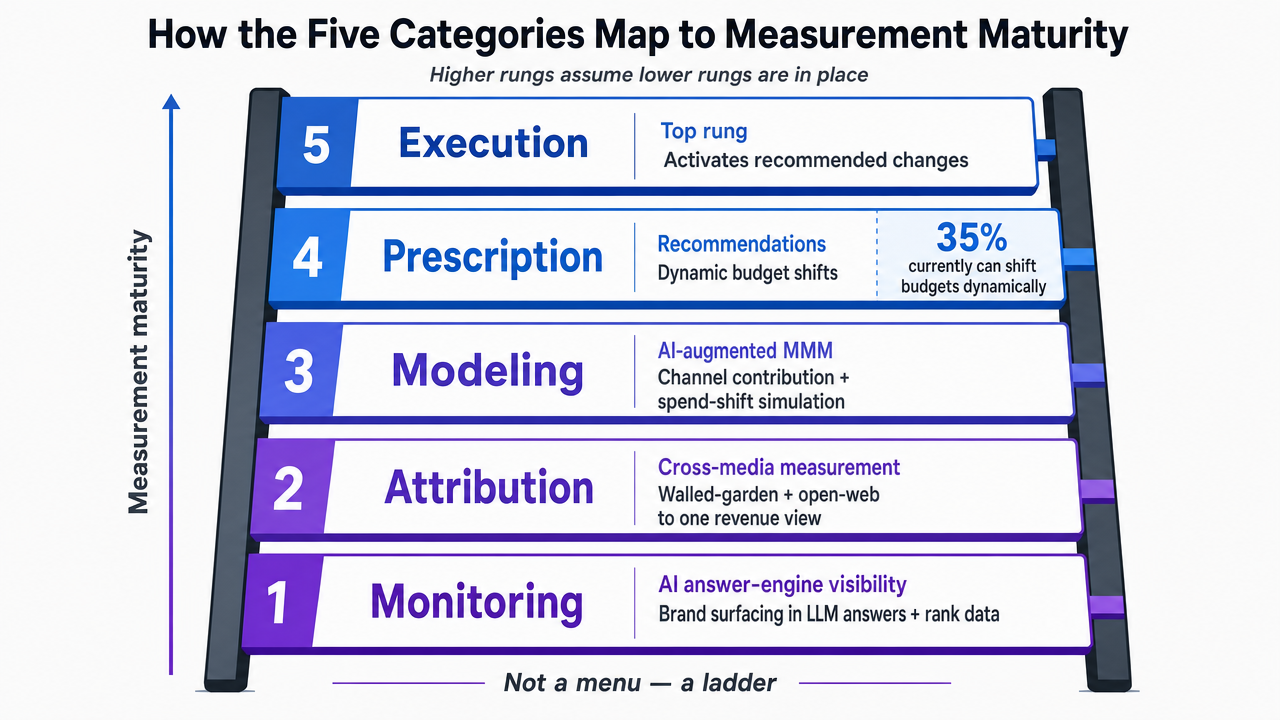
Think of the five categories as rungs on a ladder, not as a menu. Each rung adds a capability the previous one doesn't cover, and the higher rungs assume the lower ones are already in place.
Monitoring sits at the bottom: AI answer-engine visibility tracking tells agency leaders whether client brands surface inside LLM answers, alongside the rank data they already collect. Attribution comes next — cross-media measurement stitches walled-garden and open-web signals into a single revenue view. Modeling follows, where AI-augmented MMM quantifies channel contribution and simulates spend shifts. Prescription is the rung where the stack stops describing and starts recommending; BCG found only 35% of surveyed companies can currently shift budgets across platforms dynamically based on those recommendations 7. Execution is the top rung — unified platforms that turn approved recommendations into shipped work without another vendor handoff.
The rest of this piece walks each rung in that order.
AI Answer-Engine Visibility Tracking
The first category exists because a client's ideal customer increasingly starts a research session inside ChatGPT, Perplexity, Gemini, or Claude rather than a search box. If the brand isn't cited in those answers, the pipeline it built through organic ranking quietly narrows — and no rank tracker will flag it.
Adoption context matters here. The 2024 State of Marketing AI Report found ChatGPT was cited by 37% of marketer respondents as their most-used AI tool, with Perplexity next at 12% 8. Client audiences are running the same queries. Agency SEO leaders who can quantify LLM presence — not just infer it — get a defensible answer to the question clients are already asking on review calls.
The category is not brand mention monitoring with a new label. Social listening tools catch a brand name in a paragraph; AI answer-engine visibility tools measure whether a brand surfaces inside a generated answer to a purchase-intent prompt, and how that share compares to named competitors over time. The distinction is the difference between hearing your name in a hallway and being handed the microphone in the room where the decision gets made.
Two capabilities separate serious tools from wrappers: prompt-level tracking that runs real queries across multiple LLMs on a schedule, and correlation with the search and conversion data agencies already own. The next two subsections cover each in turn.
What Prompt-Level Tracking Actually Measures
Prompt-level tracking runs a curated set of prompts — usually 200 to 2,000 per brand — across GPT-4, Claude, Gemini, Perplexity, and often open-source models on a recurring cadence. The output is visibility expressed as a percentage of tracked prompts in which the brand appears, cited, or linked, trended over time and benchmarked against a competitor set 3.
That structure gives agency leaders three artifacts a rank tracker cannot produce: a share-of-voice number per LLM, a competitor gap analysis at the prompt level, and a visibility trend line that responds to content and PR interventions within weeks. Prompts should be curated from the client's actual buyer questions, not scraped from keyword tools — the measurement is only as sharp as the prompt library behind it.
Connecting LLM Citations to GSC and GA4 Signals
A visibility percentage in isolation is a vanity number. The tools worth paying for connect the prompt panel to Google Search Console impressions and clicks, GA4 sessions, and downstream conversion events, so agency leaders can show whether a rising LLM citation rate correlates with organic branded search lift or assisted conversions 3.
The loop looks like this: a prompt panel runs scheduled queries across major LLMs, a citation-extraction layer measures visibility as a percentage of tracked prompts and stores time-series data, and a correlation view overlays that trend against GSC impressions and GA4 conversions 3. Agency SEO leaders should treat that four-part loop — prompts, multi-LLM coverage, extraction, correlation — as the minimum spec when evaluating a vendor. Anything less is monitoring in a new wrapper.
AI-Augmented Marketing Mix Modeling
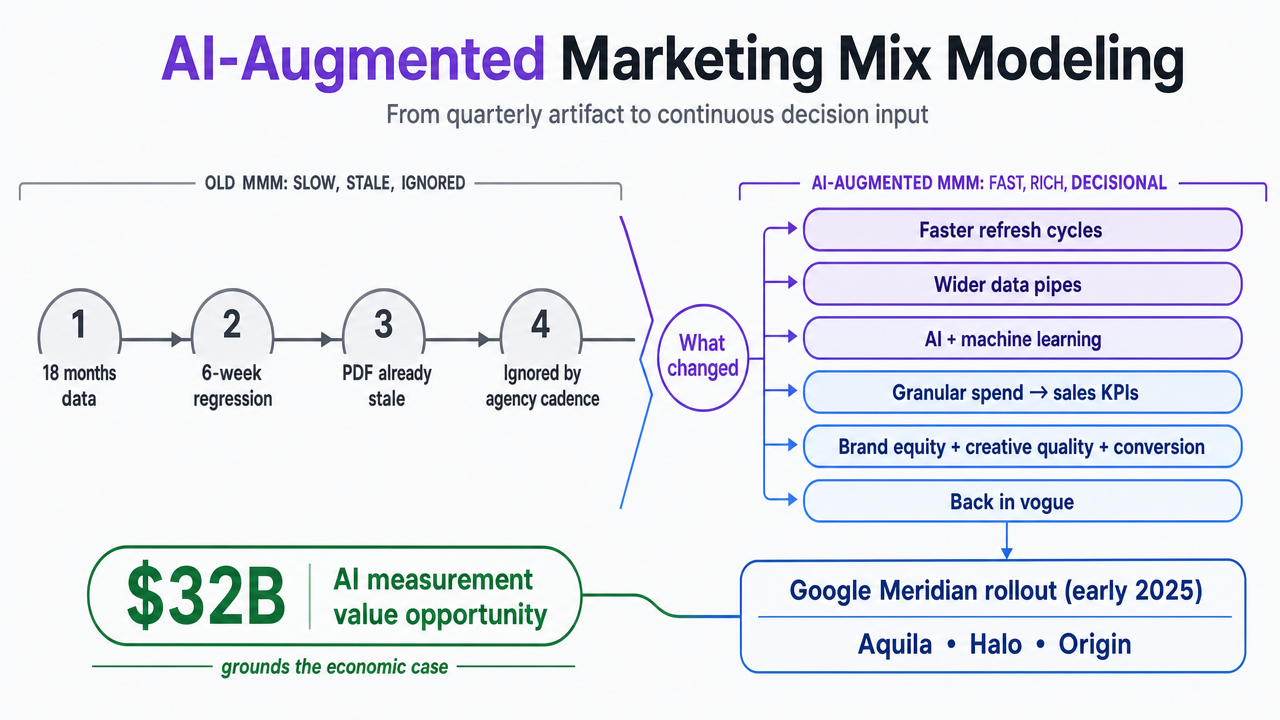
Marketing mix modeling used to be a quarterly artifact. An outside consultant would ingest 18 months of spend and sales data, spend six weeks building a regression, and hand back a PDF that was already stale. Agencies mostly ignored it because the cadence didn't match how retainers actually move.
That calculus has changed. AI-enhanced MMM is back in circulation because model refresh cycles compressed and the data pipes got wider. The Current reports that more capable AI and machine learning are already bringing MMM back in vogue for marketers, with tools now able to link spend to sales KPIs at a granular level while balancing brand equity and creative quality signals alongside conversion data 1. Google's Meridian MMM solution began a global rollout in early 2025, and industry-backed cross-media platforms like Aquila, Halo, and Origin have launched to give the buy side unduplicated measurement across TV, video, and digital 1.
For agency SEO leaders, the practical import is narrower than the trade press framing. MMM at this layer answers a question rank data cannot: given a client's total marketing budget, how much incremental revenue did organic and content investment actually drive, net of paid search, social, and offline halo effects? That number is what defends a retainer when a CFO asks why SEO spend should hold flat while paid gets cut. The next two subsections cover why the category returned and what changed about the delivery speed.
Test Multi-Channel Visibility Optimization in Real Time
Experience hands-on visibility gains using live campaigns and data before making a long-term commitment.
Why MMM Came Back — and What AI Changed
Two forces revived a category most agencies had written off. Signal loss made deterministic attribution weaker every quarter, and AI collapsed the labor cost of building and refreshing a model. The IAB flagged the same pivot: the industry is moving from deterministic to AI-based probabilistic techniques, with MMM and multi-touch attribution gaining ground as cookie-based tracking degrades 5.
What changed inside the model itself is more useful for agency leaders to name. AI-enhanced MMM now links spend to sales KPIs at a granular level while balancing brand equity and creative quality signals against conversion data — a scope of inputs the old regression-in-a-consultant's-laptop version could not process 1.
From Days-to-Insight to Minutes-to-Insight
The old MMM cycle produced a slide deck. The new one produces a decision surface. Nielsen describes the shift plainly: generative AI's primary value in measurement is collapsing time-to-insight from days to minutes, letting advertisers move from retrospective reporting to real-time campaign optimization 6.
For agency SEO leaders, that compression changes what MMM is useful for. A model refreshed weekly can inform a mid-flight budget conversation with a client rather than a post-quarter autopsy. Scenario simulation — what happens to pipeline if organic investment holds and paid search drops 20% — becomes a live workflow instead of a consulting engagement. Retainer conversations shift from defending last quarter to allocating next quarter.
Cross-Media Measurement and Privacy-First Attribution
Attribution is the rung where visibility stops being a channel report and starts being a revenue view. Cookies degrade quarter by quarter, walled gardens publish their own numbers, and open-web analytics catch a shrinking share of the journey. The category that answers this — cross-media measurement paired with privacy-first attribution — is what agency SEO leaders reach for once monitoring is handled and before they invest in modeling.
The scope of what these platforms unify has widened. Industry-backed cross-media initiatives like Aquila, Halo, and Origin launched specifically to give the buy side unduplicated measurement across TV, video, and digital, a scope no single-channel tool has ever offered 1. eMarketer's Ad Measurement Trends H2 2024 report frames AI and machine learning as the practical mechanism for handling that complexity, enabling more frequent model updates and agile cross-channel views that legacy attribution pipelines can't produce on the same cadence 4. For agencies defending organic and content spend inside a client's full media budget, that unified view is what makes a channel-level contribution number credible.
Probabilistic AI Attribution as the Post-Cookie Default
The IAB documented the pivot directly: the industry is moving from deterministic to AI-based probabilistic techniques, gravitating toward contextual signals, first-party data enrichment, and sophisticated attribution methods that don't depend on third-party cookies 5. Probabilistic doesn't mean less rigorous — it means the model infers pathways from patterns rather than reading them off a persistent identifier. For agency SEO leaders, the operational read is that any attribution vendor still selling deterministic user-level tracking as its core method is selling a shrinking asset.
Unifying Walled-Garden and Open-Web Signals
The harder problem is stitching Meta, Google, TikTok, and Amazon reporting to open-web analytics without double-counting. Cross-media platforms tackle it by ingesting each source at aggregate level and reconciling reach and outcomes into a single view 1. Data access limits and methodology differences across walled gardens remain contested 1, so agency leaders should pressure-test a vendor's specific method for unduplication before signing. Ask which sources are ingested at what granularity, and where the reconciliation logic sits.
Prescriptive Optimization Suites
Modeling tells agency leaders what happened and what could happen. Prescription tells them what to do next. That distinction is the fourth rung on the ladder, and it's the one where measurement stops being a report and starts becoming a workflow.
Forrester's definition of the category is worth borrowing verbatim: these platforms deliver comprehensive, cross-channel performance visibility and prescriptive optimization recommendations, integrating experimentation, MMM, and MTA into a single system often augmented by AI to accelerate insight generation 10. The output isn't a dashboard update — it's a ranked list of where the next marketing dollar should move, with the reasoning attached.
The competitive window on this capability is closing faster than most agencies have priced in. IAB State of Data 2026 data shows 50% of buy-side organizations are already scaling AI within their advanced measurement frameworks, and more than 70% of the non-adopters expect to implement it within one to two years 2. That's not a slow adoption curve — that's prescriptive AI moving from differentiator to baseline expectation inside eighteen months. Agency SEO leaders who wait for the category to mature will find their clients' internal marketing teams already running prescriptive workflows the agency can't match.
Two capabilities matter when evaluating a vendor in this rung: whether the platform actually issues recommendations versus surfacing charts, and whether the underlying analytical rigor supports the ROI delta the McKinsey research documents. The next two subsections take each in turn.
See How Leading Agencies Eliminate Visibility Gaps—Without Expanding Teams
Request a walkthrough of unified, AI-driven visibility optimization workflows designed for agencies managing multi-client portfolios at scale—focused on measurable outcomes, not just monitoring dashboards.
Recommendations, Not Just Dashboards
The test is simple: does the platform tell an agency leader what to do, or does it hand back another chart to interpret? Forrester's Wave criterion is prescriptive optimization recommendations delivered inside a cross-channel view, not a reporting layer bolted onto a data warehouse 10. A useful output looks like a ranked action list — shift 12% of paid social spend to mid-funnel display next week, hold organic investment flat, pause the underperforming YouTube flight — with the model's reasoning attached. Vendors that stop at visualization are asking the agency to do the analytical work the platform was purchased to eliminate.
The 15–20% ROI Delta and What It Requires
McKinsey's analytics research puts a number on the prescriptive rung: companies that put data at the center of marketing and sales decisions improve marketing ROI by 15 to 20 percent 9. That range is the payoff prescriptive suites are pitched against, and it's the delta agency leaders should hold vendors to during a pilot.
The delta doesn't arrive from the software alone. It requires granular customer-level inputs, live experimentation, and multi-touch attribution wired into the same platform that issues recommendations 9. Prescription without those inputs is opinion in a chart. Agency SEO leaders evaluating a suite should confirm all three feed the recommendation engine before crediting the ROI claim.
Unified Execution Platforms with Approval Workflows
The top rung collapses the distance between a recommendation and shipped work. Prescriptive suites tell agency leaders where the next dollar should move; unified execution platforms move it — content briefs written, drafts produced, publishing queued, paid budgets adjusted — with human approval gating every step. The category exists because the handoff tax between measurement and execution eats most of the ROI delta prescriptive tools promise.
The economics justify the category. IAB State of Data 2026 pegs the AI-driven measurement value opportunity at roughly $32 billion, split into approximately $26 billion in reallocated media investment and $6 billion in productivity gains 2. That $6 billion figure is the one agencies should read carefully: it's the labor cost measurement AI removes once insight generation stops requiring analyst hours per client per week. For a portfolio manager running 20 accounts, the productivity share is what makes scaling delivery without proportional headcount growth actually feasible.
BCG frames the capability that separates this rung from the previous one. Only 35% of surveyed companies can currently shift budgets across platforms and channels dynamically based on performance signals 7 — which means the workflow from insight to action still stalls in most organizations. Unified execution platforms close that gap by wiring measurement outputs directly into the production and publishing systems that turn recommendations into work, with an approval layer between every automated step and the client's environment.
Where Measurement Stops Being a Report and Starts Being a Decision
The functional test is whether an approved recommendation triggers execution inside the same system that produced it. A prescriptive suite that hands a ranked action list to a project manager who then briefs a copywriter, a media buyer, and a developer is still a reporting layer with better outputs. Nielsen's framing applies here: generative AI's measurement value is compressing time-to-insight from days to minutes and moving advertisers from retrospective reporting toward real-time optimization 6. Unified execution extends that compression through production. Agency SEO leaders should evaluate vendors on the round-trip time from signal to shipped asset, not on dashboard fidelity.
If You Manage a Client Portfolio: Illustrative Stack Composition
This subsection speaks to agency leaders running a book of 10 to 50 accounts, where per-client tool sprawl compounds fast. A typical portfolio stack layers a rank tracker, an AI answer-engine visibility tool, a cross-media attribution platform, an MMM subscription, and a reporting layer on top — each licensed per seat or per account, each requiring analyst time to reconcile against the others. A unified execution approach collapses production, measurement correlation, and publishing into one governed workflow with approval gates.
| Layer | Point-Tool Stack | Unified Execution Platform |
|---|---|---|
| Rank + AI visibility | 2 vendors, per-account seats | Included |
| Attribution + MMM | 2 vendors, enterprise contracts | Included correlation layer |
| Production + publishing | Separate briefing and CMS workflows | Approval-gated automation |
| Reconciliation labor | Analyst hours per client per week | Absorbed by platform |
Vectoron sits in this category, with specialist strategists for content, SEO, PPC, backlinks, social, and call intelligence routed through a Command Center that requires human sign-off before any execution ships.
What the Next 18 Months Reward
The five categories aren't equally urgent. AI answer-engine visibility is the fastest-closing gap because client audiences have already moved; cross-media measurement and prescriptive optimization are where the buy-side is already scaling AI 2. Agency SEO leaders who sequence adoption in maturity order — monitoring first, then attribution, then modeling, then prescription, then execution — build a stack that compounds rather than fragments.
What the next eighteen months reward is the round-trip. Signal to insight to approved decision to shipped work, measured in hours instead of weeks. The agencies that own that loop across a client portfolio, not just inside a single dashboard, are the ones defending retainers when internal marketing teams start running the same workflows without them.
 Marketers dissatisfied with current measurement tools
Marketers dissatisfied with current measurement tools
Frequently Asked Questions
References
- 1.The future of cross-media measurement takes shape with AI and marketing mix modeling.
- 2.AI poised to unlock $32 billion in marketing measurement value as current systems falter.
- 3.The Best AI Visibility Tracking Tools, Compared.
- 4.Ad Measurement Trends H2 2024.
- 5.IAB State of Data 2024: Reengineering for a Privacy-First World.
- 6.The Impact of AI on Measurement.
- 7.The Blueprint for AI-Powered Marketing.
- 8.The 2024 State of Marketing AI Report.
- 9.Using marketing analytics to drive superior growth.
- 10.The Forrester Wave: Marketing Measurement and Optimization Solutions, Q3 2023.