
Key Takeaways
- Rank still governs exposure because clicks concentrate heavily at the top of the SERP, but exposure is no longer the deliverable clients are paying agencies to produce 8.
- Position bias inflates CTR independent of content quality, so reporting that collapses rank and clicks into one performance number breaks down the moment rank moves without conversion lift 2, 11.
- A four-tier stack (visibility inputs, traffic quality, engagement, business outcomes) demotes rank from headline to diagnostic and lets account teams locate the actual bottleneck instead of guessing.
- Keep the ranking table in the deck but move it to a diagnostic appendix, narrate movement through the four tiers, and pre-commit clients to the volatility the 2025 DOJ remedies will introduce 5.
The question agency SEO leads keep getting from account teams
The question lands in Slack most Monday mornings: "Client X wants to know why their rankings dropped three spots. What do I tell them?" A decade ago that question had a clean answer. Pull the SERP, diagnose the slip, propose a fix, close the ticket. The account team walks the client through a rank-tracker screenshot and the relationship holds.
That script is breaking. AI Overviews now sit above the ten blue links on a growing share of commercial queries. Local packs, product grids, and sitelinks compress the organic area. Personalization and location signals mean the rank a client sees from their desk is not the rank a buyer in the next zip code sees. Meanwhile the actual revenue mechanics, calls booked and pipeline sourced, often move independently of position changes a rank tracker flags as significant.
The reasonable answer to the Monday Slack question is no longer a rank explanation. It is a reframe: rank still shapes exposure, but exposure is no longer the deliverable the client is paying for. The agencies that keep selling rank as the outcome will keep losing accounts to the ones that instrument rank as a diagnostic inside a qualified-click, lead, and AI-visibility model. The rest of this piece lays out what that reframe looks like, what the evidence supports, and how to defend the change to a client who still opens the deck looking for a ranking table.
What rank still does, and what it stopped doing
Exposure concentration: why position still governs who sees the client
Rank earns its place in the measurement stack because of a single stubborn property: clicks pile up at the top. In the Google dataset analyzed by Pedro and colleagues, 97.11% of clicks landed on first-page results, with position one capturing 51.3%, position two 15.68%, and position three 9.23% 8. The curve is steep enough that a slip from position two to position four is not a cosmetic event. It is a halving of expected exposure for that query, before any discussion of SERP features, personalization, or AI Overviews enters the room.
That concentration is why a Head of SEO cannot shrug off a rank drop even when downstream conversions look stable this week. Exposure is the raw input the rest of the funnel draws from. A page that falls from the first screen to the second does not get a second chance at the user for most commercial queries.
The caveat matters as much as the headline. The 97.11% figure comes from an observational analysis of browsing behavior across a specific user population and query mix 8. It is not a universal CTR curve for every vertical, every device, or every SERP layout. Local packs, product grids, AI Overviews, and sitelinks compress the organic area and reroute attention before the ten blue links are even scanned. The right way to use the number in a client conversation is as a structural claim about why position still matters, not as a forecast of click volume. Rank governs who gets seen. It no longer governs what happens after they see.
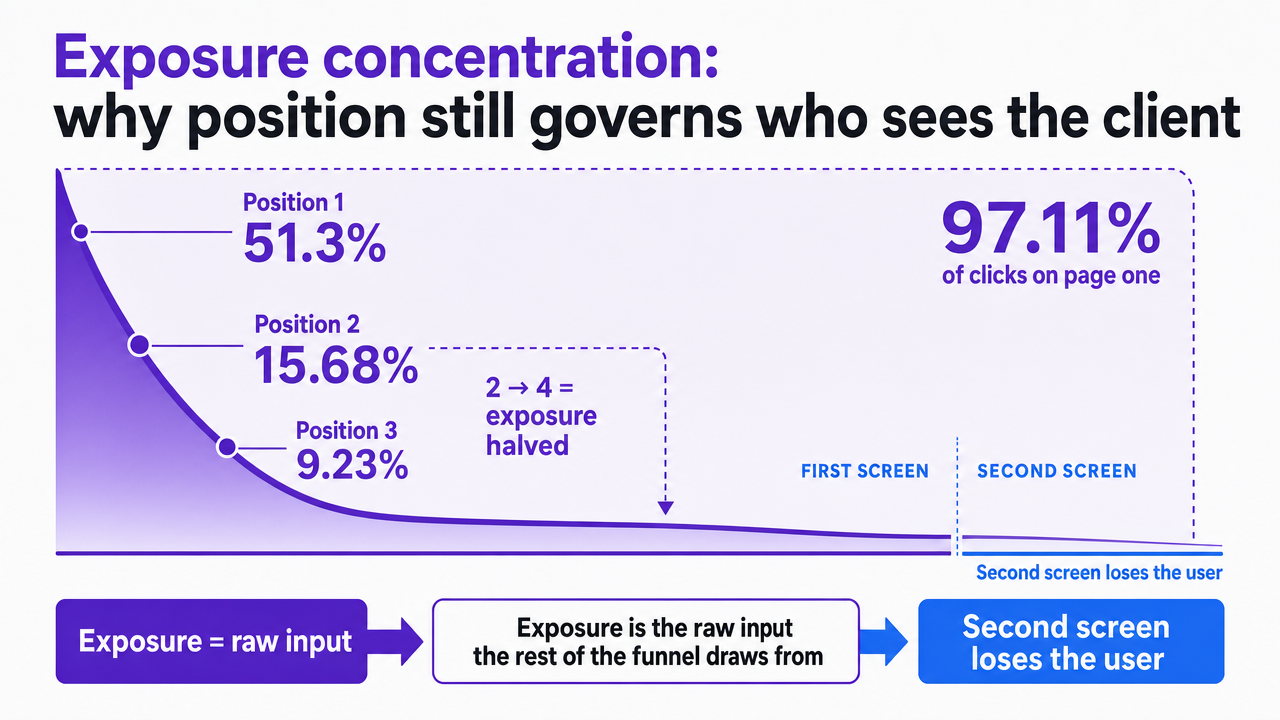 Visualize the steep click concentration curve across top SERP positions, which the surrounding prose cites directly from the Pedro et al. Google dataset
Position bias as a measurement confound in client reporting
The same property that makes rank valuable as an exposure lever makes it dangerous as a quality metric. Users click higher-ranked results more often even when relevance is not fully established, which means a top position inflates the apparent performance of the page that occupies it 2. CTR cannot be read as a clean signal of content quality when the ranking itself is doing part of the work.
That confound shows up in client decks constantly. A page moves from position six to position three, CTR triples, and the account team credits the content refresh. Some of that lift is probably the refresh. Some of it is the mechanical consequence of being higher on the page. Separating the two requires either controlled comparisons, holdout queries, or a reporting frame that stops asking CTR to carry both jobs.
The behavioral research is consistent on the broader point. Experiments that manipulate rankings show that higher positions draw more clicks, more attention, and longer time on page regardless of the content's independent merit 11. For an agency, the operational consequence is specific: do not promise clients that CTR improvements prove the content is working. Promise that CTR movements, read alongside ranking changes and intent-match data, help diagnose whether exposure or persuasion is the current bottleneck. Reports that collapse the two into a single "performance" number give clients a story that falls apart the first time rank moves and CTR follows it in lockstep without any conversion lift to show for it.
Relevance, not position, closes the click
Position gets the user to look. Relevance gets the user to click. An eye-tracking study of Google users found that both position and relevance significantly affected viewing and clicking, but relevance was by far the stronger determinant of which result actually earned the click 9. The sample was small, 25 participants, and the setting was experimental rather than commercial, so the magnitude should not be ported into a client forecast. The direction is what matters for agency strategy.
That finding reshapes what a top ranking is worth. A page ranked second for a high-intent query that misreads the searcher's goal will underperform a page ranked fourth that mirrors the intent precisely. The exposure advantage of position two does not survive a title, snippet, or page concept that signals the wrong answer. Agencies that have watched a client's "won" keyword fail to produce calls have usually watched this exact mechanism play out.
The reporting consequence is to pair every rank movement with an intent-match read. For each tracked query, the strategist should be able to say what the user is trying to accomplish, what the current ranking page offers, and where the gap sits. Rank without that layer is a number. Rank with it is a diagnostic that tells the client whether the next production cycle should chase position, rewrite for intent, or build a different page type entirely.
Quality mediates rank: the Stanford Bing experiment and its limits
Hold rank constant and change nothing but the quality of the results, and clicks move. That is the useful finding from a January 2025 Stanford field experiment that degraded Bing's organic results while leaving positions in place. Overall organic-link CTR fell by 7.51%, and the top link alone lost 15.3% of its clicks 1. The ranking slot was identical. What changed was whether the result deserved the slot.
That decoupling matters for how agencies interpret flat or declining CTR on a client whose rankings have not moved. The default explanation inside most agencies is a SERP feature change or a seasonal dip. The Stanford data points to a third possibility that rank trackers cannot see: the page is holding position but losing the click because the result underneath it has gotten weaker relative to what the user now expects. Snippet staleness, title decay, outdated schema, a thinner answer than a competitor's refreshed page. Each erodes CTR without touching position.
The limits of the finding need to travel with it. The experiment ran on Bing, not Google, and used a deliberate quality degradation rather than organic competitive drift. The paper also reports a broader downward CTR trend unrelated to the specific results served, which means secular behavior change contributes to CTR movement independent of any one page's quality 1. Porting the 7.51% or 15.3% figures into a client forecast is the wrong read. The right read is directional: at a fixed rank, result quality moves clicks by a magnitude large enough to matter, and the inverse applies when a competitor's quality improves faster than the client's.
For an agency Head of SEO, this converts into a specific production discipline. Pages that rank in the top three but show flat or declining CTR over a rolling window are candidates for snippet, title, and above-the-fold refresh before any link or technical work is scoped. Rank-holding pages with eroding clicks are the cheapest wins in the portfolio because the exposure is already paid for. The strategist's job is to protect the conversion of that exposure, which means treating the SERP listing itself as a creative asset that decays and needs scheduled attention, not a one-time deliverable that ships when the page ranks.
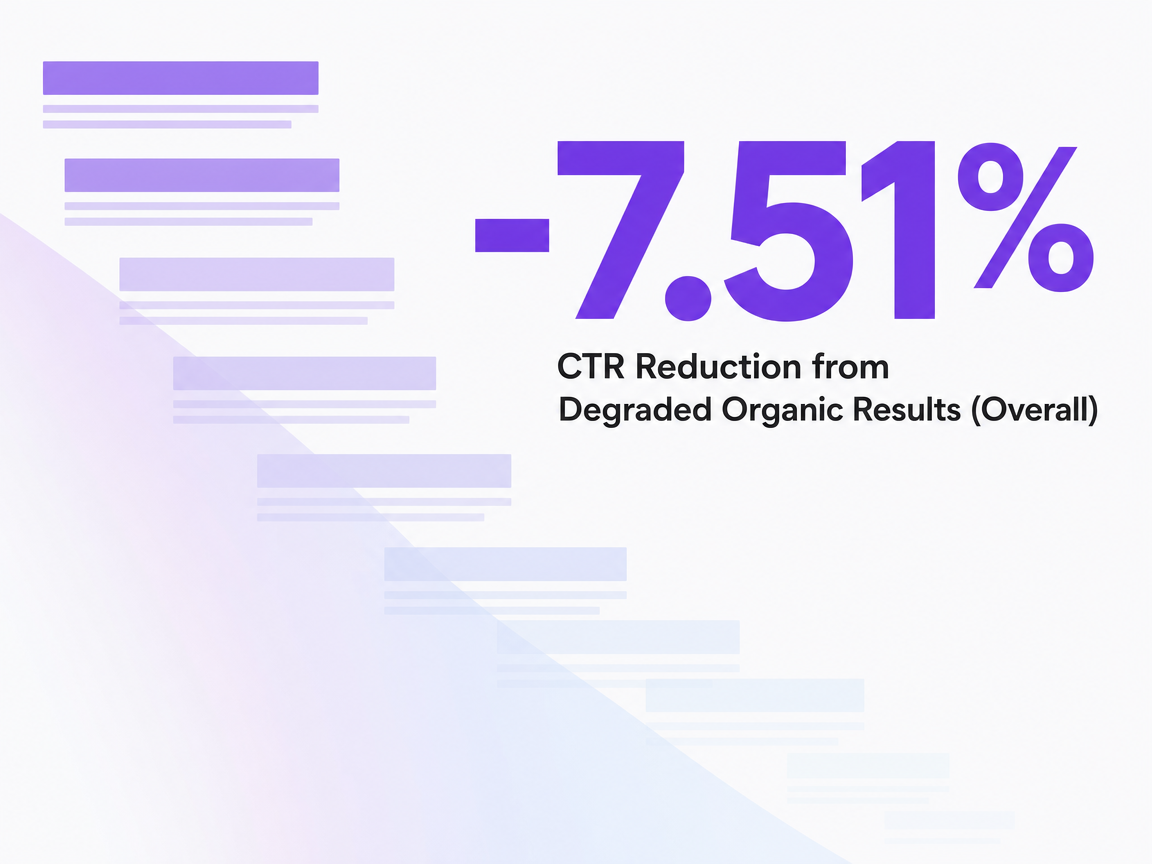 CTR Reduction from Degraded Organic Results (Overall)
CTR Reduction from Degraded Organic Results (Overall)
Test AI-driven SEO workflows on live sites
Validate ranking improvements and workflow efficiencies with real-time publishing and reporting before making a commitment.
Structural pressure: DOJ remedies, distribution shifts, and rank volatility
The ground rank sits on is moving. In September 2025, the Department of Justice announced remedies against Google covering unlawful monopolization of general search and search text advertising, with the final judgment issued in December 2025 5, 6. The remedies prohibit certain exclusive distribution arrangements, require Google to make specified search index and user-interaction data available to eligible rivals, and require search and text-ad syndication to competitors 5. The court's memorandum opinion grounds the remedies in the finding that Google maintained those monopolies through exclusive distribution agreements in violation of Section 2 of the Sherman Act 7.
For an agency Head of SEO, the near-term read is not that Google traffic collapses. It is that the inputs feeding ranking systems, the entry points users default to, and the surfaces where results appear are now subject to change by order rather than by product decision alone. Distribution agreements involving Google Search, Chrome, Assistant, and Gemini sit inside the remedy scope 5. When defaults shift, when rival engines gain access to index and interaction data, and when syndication reshuffles where results are served, rank volatility on individual client accounts will increase for reasons unrelated to any site change the agency made or failed to make.
That has a specific reporting consequence. Rank movement attributable to algorithm, content, or technical factors has to be separated from movement attributable to distribution and interface changes the client's SEO team cannot influence. Rolling baselines, annotated change logs tied to public remedy milestones, and segment-level reporting by device and query class protect the account team from owning volatility they did not cause. The practical effect of the remedies on any one client's organic visibility, traffic, or conversion costs remains uncertain and will play out through enforcement, competitor adoption, and technical implementation 6. Treating that uncertainty as a known variable in the measurement model, rather than discovering it inside a QBR, is how agencies keep accounts through the next 18 to 24 months of structural change.
Blended visibility and FTC disclosure posture across SEO, paid, and reviews
Agency dashboards rarely stay inside one channel. Organic rankings, Google Ads impressions, Local Service Ads, sponsored product placements, and review stars share the same client slide. That blending creates a disclosure question the FTC has been clear on for two decades. Consumers ordinarily expect natural search results to be ranked by relevance and impartial criteria, not by payment, and search engines should clearly and conspicuously disclose when websites paid for higher placement 3, 4. The agency-side consequence is operational: client reports that stack paid impressions next to organic rankings without labeling the difference inherit the same disclosure logic the platforms themselves are held to.
That matters for how account teams narrate wins. A "top-three visibility" claim that quietly aggregates a Local Service Ad slot, a shopping module, and an organic listing reads as earned relevance to the client and often to the client's buyers downstream in case studies, pitch decks, and testimonials. The FTC's deceptively formatted advertisements policy treats that collapse as a disclosure problem whenever consumers would reasonably assume impartiality 4. Reports should segment paid, sponsored, local-ad, and organic visibility as distinct lines, not combined visibility scores.
Reviews sit on the same compliance surface. The FTC's Consumer Reviews and Testimonials Rule took effect on October 21, 2024, and authorizes civil penalties for knowing violations covering fake reviews, undisclosed material connections, suppression of negative reviews, and related conduct 10. Local SEO programs that generate review velocity for map-pack visibility now carry documented regulatory exposure if solicitation is selective, incentives are undisclosed, or negative reviews are gated. The reporting change is small and specific: review-acquisition metrics belong in client reports alongside the compliance guardrails that produced them, not as a standalone volume number.
A four-tier measurement stack to replace rank-only reporting
The replacement for rank-only reporting is not a single metric. It is a four-tier stack that keeps rank in the model while demoting it from headline to diagnostic. Each tier answers a different question, and the tiers are read in sequence so the account team can locate the bottleneck instead of guessing at it.
Tier one is visibility inputs. Rank sits here alongside SERP feature presence (local pack, product grid, sitelinks, People Also Ask), AI Overview inclusion, and share of pixel above the fold. The tier answers whether the client's pages are eligible to be seen at all for the queries that matter. Rank still earns its slot because clicks remain heavily concentrated at the top of the page, with first-page results capturing the overwhelming majority of click volume in observed Google behavior 8. A page that is not visible in this tier cannot produce anything in the tiers below.
Tier two is traffic quality. The question shifts from eligibility to whether the exposure is drawing the right user. Qualified clicks, intent match against the tracked query, device and geography segmentation, and branded versus non-branded splits live here. This tier is where position bias stops masquerading as content quality. A click that arrived because the page sat at position one, not because the snippet mirrored the user's goal, shows up as a weak downstream signal in tier three.
Tier three is engagement. Dwell time, scroll depth, internal navigation, form starts, chat initiations, and assisted conversions sit at this layer. Engagement is where the page either earns the next step or exposes a mismatch the first two tiers could not see. It is also the tier most useful for diagnosing refresh priorities, because a page with healthy visibility and traffic quality but weak engagement is a content problem, not a ranking problem.
Tier four is business outcomes. Calls booked, forms submitted that qualify, appointments set, pipeline sourced, and revenue attributed. This is the number the client actually buys. Reporting that leads with tier four and uses tiers one through three as the diagnostic trail gives the account team a defensible story when any single tier moves. Rank slips but calls hold: exposure variance absorbed by stronger pages elsewhere in the set. Rank holds but calls drop: look at tier three for engagement decay or tier two for an intent shift the SERP has not yet reflected. The stack does not make rank less real. It makes rank legible as one input in a chain the client can follow.
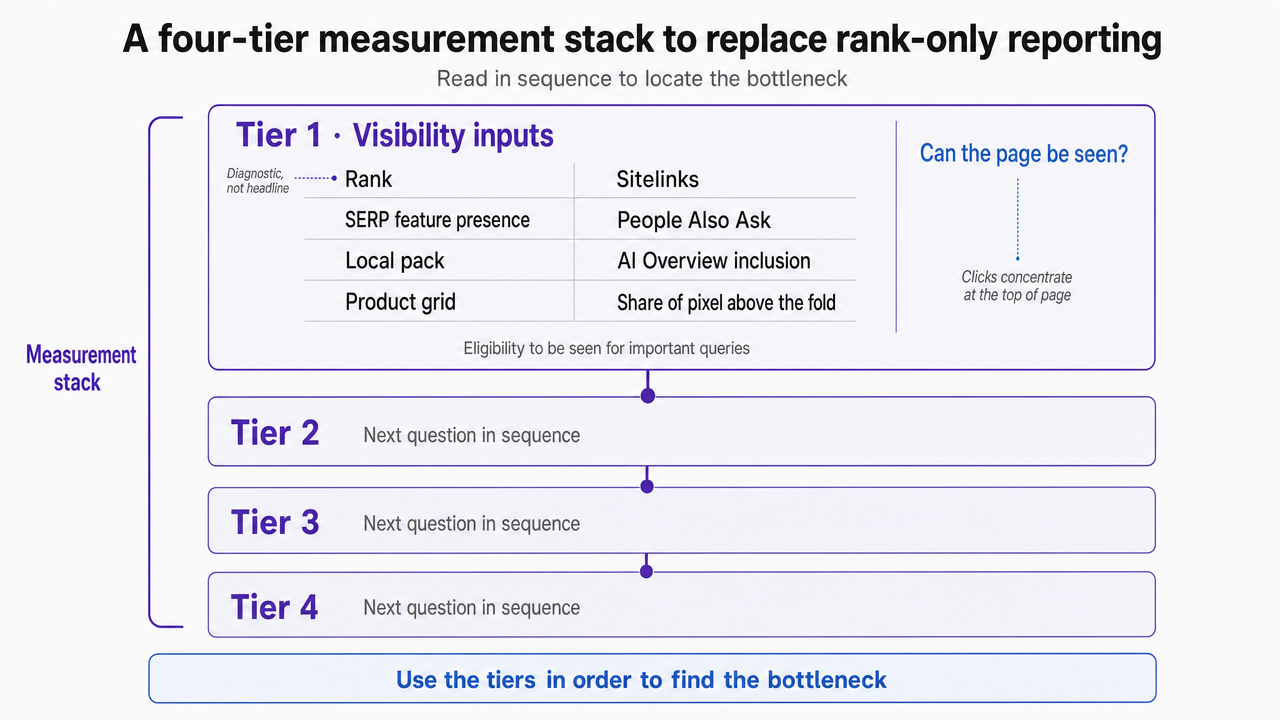 Visualize the four-tier measurement stack described step-by-step in the section, giving readers a clear framework diagram tied directly to the prose
See How Data-Driven Ranking Insights Impact Real Client KPIs
Request a walkthrough of advanced ranking analytics and approval workflows designed for agencies seeking measurable improvements in client performance without increasing team size.
If you manage a portfolio: hours, margin, and the case for coordinated execution
The reader frame shifts here. The preceding sections treated rank as a signal inside a single client's measurement model. This one is for the operator running 30, 60, or 120 accounts simultaneously, where the question stops being whether rank matters and starts being whether the current delivery model can produce the four-tier reporting stack at every account without collapsing margin.
The math is unforgiving. A traditional rank-tracking and manual-reporting workflow typically consumes four to eight strategist hours per client per month: pulling rank data, annotating SERP feature changes, cross-referencing GA4 and call-tracking exports, building the deck, and walking the account team through it. At a blended strategist cost of $85 to $140 per hour and a portfolio of 50 clients, that is 200 to 400 hours a month spent assembling reports before any production work ships. The reporting itself has become a cost center that competes with the content, technical, and link work that actually moves the tiers below rank.
The pressure gets worse when the measurement model expands. Instrumenting AI Overview presence, SERP feature share, intent-match scoring, and assisted-conversion attribution across a portfolio multiplies the data-handling load without adding billable deliverables. Hiring more strategists is the obvious lever and the one most agencies cannot pull without eroding the margin that justified the account in the first place.
| Delivery model | Strategist hours per client / month | 50-client portfolio load | Marginal cost of adding the 51st client |
|---|---|---|---|
| Manual rank-tracking + reporting | 4–8 hrs | 200–400 hrs/mo | Linear: full 4–8 hrs added |
| Coordinated AI execution + human approval | 1–2 hrs (approval + judgment) | 50–100 hrs/mo | Sub-linear: shared data layer absorbs most of the lift |
The operational answer is not to abandon the four-tier model. It is to move the data assembly, SERP monitoring, and first-pass diagnosis to coordinated AI execution while keeping strategist judgment on the approval and client-narrative layer. That is how a portfolio operator keeps rank instrumented across every account without paying for it in headcount the renewals cannot support.
How to defend the reporting change to clients who still ask about rankings
The change gets harder to defend when the client has been trained for five years to open the deck and look for the ranking table. The account team needs a script, not a philosophy. Three moves tend to hold the conversation.
The first is to show rank, not hide it. Removing the ranking view entirely reads as evasion, especially to clients who have paid for rank-tracking tools themselves. Keep the table. Move it from slide two to the diagnostic appendix, and label it as an exposure input feeding the outcomes slide the client now opens on. Rank that still shows up in the deck but no longer leads it signals discipline, not retreat.
The second is to narrate movement with the four-tier logic in plain language. When a tracked query slips from position two to position five, the account team says what the slip means for exposure, what tier two and three data show about qualified traffic and engagement on the page, and what tier four shows about calls or bookings over the same window. Clients accept a rank drop that comes with a stable or improving outcomes read. They lose confidence in a rank drop that arrives with a shrug.
The third is to pre-commit to the volatility the next 18 months will produce. The 2025 DOJ remedies against Google reshape distribution, data access, and syndication in ways that will move rankings for reasons unrelated to any site change 5. Telling the client that upfront, with annotated change logs tied to public milestones, converts future rank noise from a credibility problem into a predicted variable. The reporting change holds because the client was warned, and the account team gets to spend QBR time on the tiers that actually moved the business.
Frequently Asked Questions
References
- 1.Sources of Market Power in Web Search.
- 2.Personalized Web Search Ranking.
- 3.FTC Staff Closing Letter: Commercial Alert Response Letter.
- 4.Enforcement Policy Statement on Deceptively Formatted Advertisements.
- 5.Department of Justice Wins Significant Remedies Against Google.
- 6.Final Judgment: U.S. and Plaintiff States v. Google LLC.
- 7.Memorandum Opinion : U.S. and Plaintiff States v. Google LLC.
- 8.You are how (and where) you search? Comparative analysis of web search behavior and search engine results page interaction.
- 9.We still trust in Google, but less than 10 years ago: an eye-tracking study.
- 10.The Consumer Reviews and Testimonials Rule: Questions and Answers.
- 11.The search engine manipulation effect (SEME) and its possible impact on the outcomes of elections.