
Key Takeaways
- Rankings and CTR describe pre-click exposure, while retainer renewals hinge on post-click revenue, so reports must separate visibility metrics from contribution claims that a CFO will accept.
- Split reporting into two tiers: weekly or monthly performance monitoring against preestablished goals, and quarterly program evaluation using matched comparisons and pre/post windows 4.
- Document provenance for every metric, naming source, acquisition path, transformation logic, and alteration history so any revenue figure can be traced back to the row and query that produced it 1.
- Build the report on a three-layer join, Search Console to GA4 on landing_page, GA4 to CRM on conversion_id, CRM to finance on opportunity_id, with each key owned and validated.
- Treat CTR lifts as diagnostic, not proof, because click probability is strongly biased by position irrespective of relevance, and stratify by position band and SERP context before comparing 6.
- In YMYL verticals, minimize at the join by aggregating to cohorts, stripping PII, and keeping call recordings inside the client environment, since inferences about health conditions count as health data 10.
- Reduce analyst hours per report through documented lineage, versioned dictionaries, and automated joins, then redirect reclaimed time into the evaluation tier that actually defends renewal.
- Close every evaluation deliverable with the attribution model, its alternatives, known blind spots, and a confidence range on lift figures expressed in opportunities or pipeline dollars 8.
Why Rankings Charts Stopped Renewing Retainers
A client CMO reviewing a monthly SEO deck rarely disputes that impressions climbed or that a tracked keyword moved from position 8 to position 3. The dispute happens two slides later, when the agency cannot answer whether any of that movement produced pipeline. Rankings charts describe pre-click exposure. Retainer renewals are decided on post-click revenue, and the two live in different systems that most reports never actually join.
The gap has a name in public-sector evaluation work. GAO draws a clean line between performance measurement, which is the ongoing monitoring of progress toward preestablished goals, and program evaluation, which uses systematic studies to test whether a program actually works 4. Most agency reports collapse both jobs into a single monthly PDF and then wonder why the CFO treats it as marketing theater.
Search Console clicks are also a weaker revenue signal than they look. Clickthrough data reflects both document relevance and result presentation, and click probability is strongly biased toward higher-ranked results irrespective of relevance 5, 6. A CTR lift, on its own, is not proof of anything downstream. The reports that renew retainers separate visibility from revenue, join them through documented identifiers, and state contribution assumptions in language a finance lead will accept.
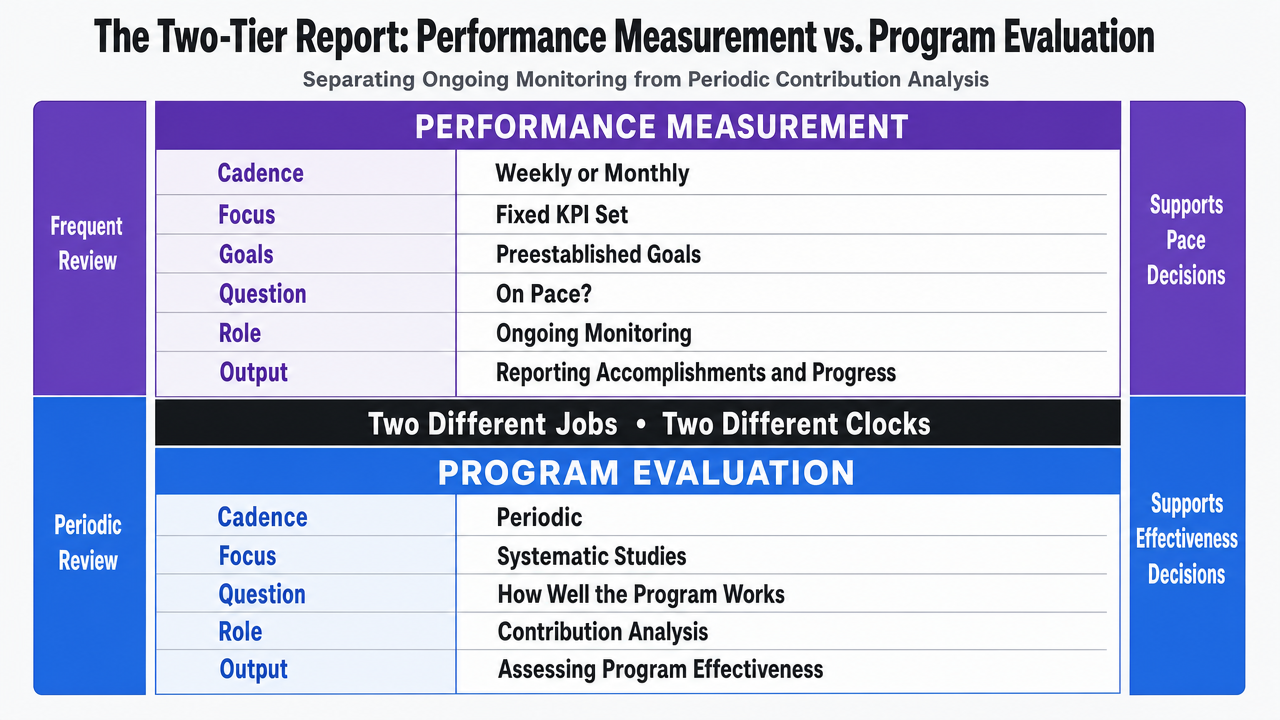
The Two-Tier Report: Performance Measurement vs. Program Evaluation
Separating Ongoing Monitoring from Periodic Contribution Analysis
The reports that survive procurement review do two different jobs on two different clocks. GAO frames the distinction cleanly: performance measurement is the ongoing monitoring and reporting of program accomplishments and progress toward preestablished goals, while program evaluation consists of systematic studies assessing how well a program works 4. An agency SEO report that conflates the two ends up with weekly dashboards attempting causal claims they cannot support, and quarterly reviews that recycle the same KPI screenshots the client already saw.
The practical split looks like this. The performance tier runs weekly or monthly, tracks a fixed KPI set against preestablished goals, and answers whether the program is on pace. Cadence is frequent, methods are descriptive, the primary audience is the account team and the client's marketing operations lead, and the decisions it supports are tactical: reprioritize a topic cluster, rework a title tag, escalate a crawl regression. The evaluation tier runs quarterly or per campaign, uses matched comparisons, pre/post analyses, and holdouts where possible, addresses a CMO or CFO, and answers a different question: did SEO contribute to pipeline, and by roughly how much 4?
Keeping the two tiers on separate documents, or at minimum separate sections with separate headers, prevents a common failure mode where a rankings uptick in the Monday dashboard gets narrated as a revenue win in the quarterly review. Ongoing monitoring earns the right to raise a question. Only evaluation earns the right to answer it.
Applying the GAO Digital-Marketing Practices to Agency Reporting
GAO's 2024 review of federal digital-marketing operations identified four practices worth porting directly into an agency's client reporting spec:
- develop an evaluation framework with measurable goals,
- use sophisticated statistical modeling,
- conduct ongoing analysis, and
- develop an understanding of how outcomes can be attributed to marketing 3.
Each maps to a concrete artifact inside the two-tier report.
Measurable goals belong in the account kickoff document and get restated at the top of every performance dashboard: qualified leads per landing_page cohort, booked consultations per practice area, cost per opportunity by acquisition channel. Goals stated as "grow organic traffic" fail this test. Goals stated as "lift qualified opportunities from non-branded organic landing pages in the intake-form set by X over the quarter" pass it.
Sophisticated statistical modeling and ongoing analysis belong to the evaluation tier. That does not require a data science team. It requires matched query groups, position-controlled comparisons, and pre/post windows around identifiable interventions such as a content refresh or a template change. The same GAO review found uneven attribution maturity across programs, with some able to connect marketing to engagements, leads, and signed contracts and others unable to close that loop at all 3. Agencies fall along the same distribution.
Outcome attribution is the fourth practice and the hardest sell. The evaluation section should name the attribution model in use, the alternative models considered, and the sensitivity of the contribution estimate to that choice. Precision in the caveat is what makes the number credible.
 Visualize the GAO-derived two-tier reporting model that structures the entire article: separating ongoing performance measurement from periodic program evaluation, with cadence, methods, audience, and decisions each tier supports
Data Provenance as the Backbone of a Defensible Report
Documenting Origin, Acquisition, Processing, and Alteration for Every Metric
Every revenue figure in a client report should be traceable to the row, table, and query that produced it. NIST defines provenance as the documented history of a data asset, including where, when, how, and by whom it was generated, acquired, processed, and altered 1. Ported into an agency reporting workflow, that means each KPI in the deliverable carries a documented lineage from source system through transformation logic to the visualization the client sees.
The practical artifact is a lineage note attached to every metric. For "qualified organic opportunities, Q3," the note names the source (HubSpot deal object, filtered to deal_stage in [SQL, Contract Sent, Closed Won]), the acquisition path (nightly export via the CRM API to the warehouse), the transformation (join to GA4 sessions on ga_client_id and conversion_id, deduplicated on opportunity_id, filtered to first_source_medium = organic), and the alteration history (schema change on 8/14 when the intake form added a service_line field). The client does not need to read the note. The account team needs to be able to produce it when finance asks.
The measurement method itself belongs in the lineage. Web analytics is the collection, measurement, analysis, and reporting of digital data, and the collection method shapes what behavior is observable and what remains a blind spot 2. A report that names its instrumentation, event definitions, and sampling posture is defensible. A report that presents numbers with no lineage is a slide, not a measurement.
Data-Quality Attributes Applied to Search Console, GA4, Call Tracking, CRM, and Finance
NIST's data-quality attributes provide a checklist that survives translation into any client stack: accuracy, completeness, consistency across sources, timeliness, relevance, provenance, and documentation 7. The value comes from applying them source by source rather than as a global disclaimer.
- Search Console is timely at the query level but incomplete: anonymized queries, thresholded impressions, and 16-month history caps mean the completeness column is never full.
- GA4 depends on consent state, cross-domain configuration, and event definitions, so accuracy and consistency are the columns most likely to fail.
- Call tracking introduces its own provenance chain: dynamic number insertion, session stitching, and manual disposition tagging by intake staff, each of which is a documented alteration under the NIST definition 1.
- CRM data carries the highest consistency risk because deal stages, source attribution fields, and pipeline definitions change under sales leadership pressure, often without notifying the marketing team.
- Finance is the timeliness bottleneck: closed revenue reconciles on a monthly close cycle, which is why performance-tier reports should show pipeline created and evaluation-tier reports should show closed revenue.
A matrix that scores each source against each attribute belongs adjacent to the metric dictionary. Rows list Search Console, GA4, Call Tracking, CRM, and Finance. Columns list accuracy, completeness, consistency, timeliness, provenance, and documentation, drawn directly from the NIST framework 7. Cells contain the known limitation and the mitigation, not a green-yellow-red rating. A client reviewing the matrix should be able to see, for example, that Search Console query-level completeness is capped by Google's anonymization threshold, and that the mitigation is aggregation to landing_page cohorts rather than reliance on individual query counts.
The matrix also does governance work. When a metric moves, the account team can point to the specific attribute that degraded and the source that caused it, rather than absorbing the credibility hit from a number the client cannot verify.
Test SEO-to-Revenue Reporting With Real Data
Experience how automated reports connect search rankings to revenue impact using your live client campaigns.
The Join Schema: From Impressions to Closed Revenue
Pre-Click, Post-Click, and Business Layers Connected by Documented Identifiers
A revenue-tied SEO report is three stacked datasets held together by identifiers that survive every hop.
- The pre-click layer comes from Search Console: query, page, impressions, clicks, and average position, keyed to landing_page URL.
- The post-click layer comes from GA4 and any tag-manager events: session, ga_client_id, source_medium, event parameters, and conversion_id fired on the intake form or booking widget, again keyed to landing_page.
- The business layer comes from the CRM and finance systems: lead_id, opportunity_id, deal_stage, close date, and revenue_id, keyed to the conversion_id that produced the record.
The joins are the whole report. Search Console to GA4 joins on landing_page URL with query-string normalization and canonical rules documented in the lineage note. GA4 to CRM joins on conversion_id, which the intake form must write to a hidden field the CRM ingests as an indexed property. CRM to finance joins on opportunity_id, matched to the invoice or revenue_id at monthly close. Each join key needs an owner, a validation query, and a documented failure mode: what happens when a form submits without a ga_client_id cookie, what happens when a call intake staffer overrides source_medium manually, what happens when a deal is manually re-parented in the CRM.
NIST's provenance definition anchors the discipline: every metric is the documented history of a data asset covering where, when, how, and by whom it was generated, acquired, processed, and altered 1. In practice, that means the landing_page value in the closed-revenue row can be traced back through opportunity_id, conversion_id, and ga_client_id to the impression Search Console recorded weeks earlier. Any break in that chain is a reporting gap the account team names in the deliverable rather than a number the client is expected to trust on faith.
A Metric Dictionary Agencies Can Ship With Every Client Report
A metric dictionary is a one-page appendix that defines every number in the deck. Each entry carries five fields: name, definition, source system and query, transformation logic, and known limitations. "Qualified organic opportunities" is not self-explanatory. Its dictionary entry names the CRM object, the deal_stage filter, the first_source_medium value that qualifies a record as organic, the deduplication rule on opportunity_id, and the lag window used to reconcile late-attributed deals.
The dictionary does two jobs. It removes the recurring dispute in which the client's marketing operations lead and the agency analyst arrive at different numbers for the same KPI because they filtered differently. And it satisfies the documentation attribute in the NIST data-quality set, alongside accuracy, completeness, consistency, timeliness, relevance, and provenance 7. A metric without a dictionary entry does not ship.
The entries should also state what the metric is not. "Organic clicks" is not a proxy for organic visits, because Search Console counts clicks and GA4 counts sessions under different definitions and consent regimes; the collection method shapes what behavior is observable and what remains a blind spot 2. "Conversion" is not a lead until the CRM validates the record. "Pipeline created" is not closed revenue until finance reconciles at month-end. Naming these boundaries in the dictionary prevents the client from stacking two numbers that were never intended to add.
Ship the dictionary as an appendix to every performance-tier report and reference it inline whenever a metric is disputed. Version it. When a definition changes, the changelog entry is the audit trail.
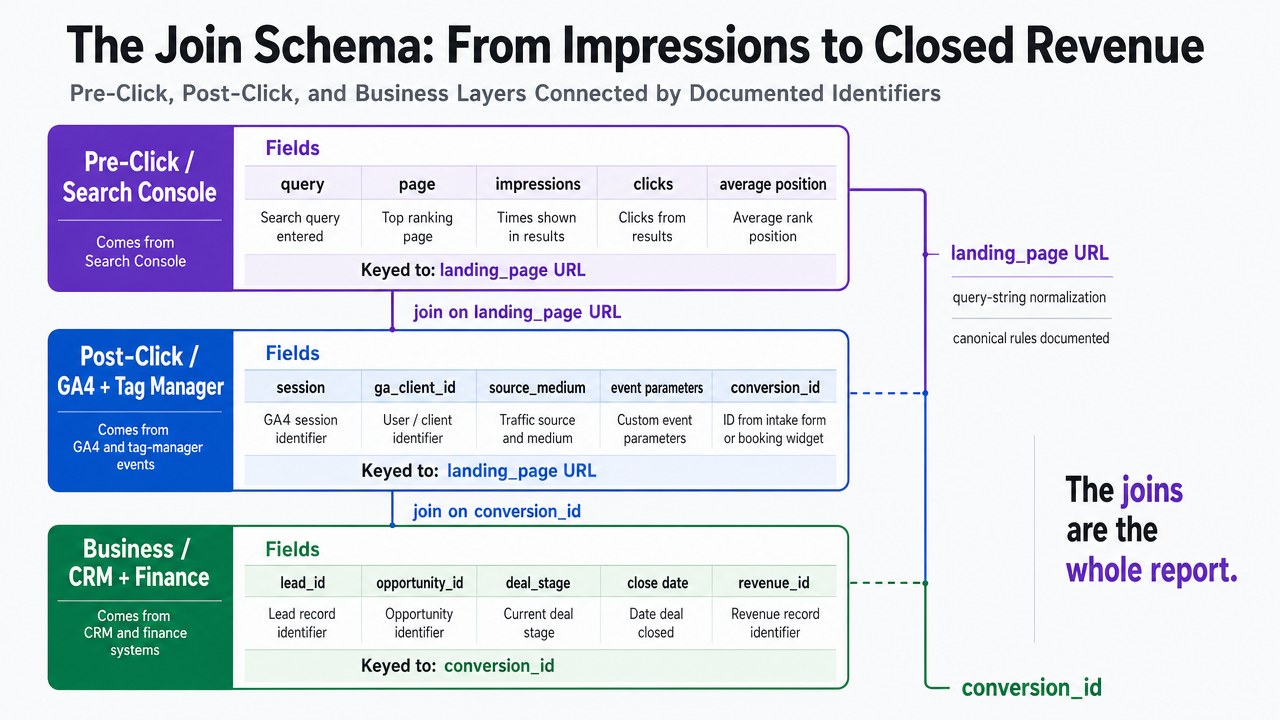 Diagram the three-layer data join (pre-click, post-click, business) connected by documented identifiers, which is the operational backbone the section describes and which the FAQ explicitly references
Why CTR Lifts Are Not Revenue Proof
A quarterly review that opens with "CTR on the priority landing pages rose 34%" tends to lose the room the moment the CFO asks what closed. Clickthrough data is informative, but the underlying research is explicit about what it can and cannot support. Clicks reflect both document relevance and result presentation, and the resulting signal shows reasonable agreement with explicit relevance judgments while providing only partial, relative preferences rather than absolute ones 5. A CTR lift is evidence that something in the SERP changed. It is not evidence that revenue moved.
The mechanical problem is position bias. Click probability is strongly biased toward documents presented higher in the result set, irrespective of relevance 6. When a page moves from position 6 to position 2, CTR climbs largely because of where the result now sits, not because the snippet suddenly persuades better. Comparing this quarter's CTR to last quarter's CTR without controlling for average position, SERP feature presence, query mix, and device split produces a number that flatters the account team and misleads the client.
The reporting fix is stratification, not suppression. Group queries into matched cohorts by position band and SERP feature context, then compare CTR within cohort and across pre/post windows tied to identifiable interventions such as a title rewrite or a schema deployment. Randomized ranking experiments that would isolate relevance from presentation are not available to SEO teams 6, so residual bias belongs in the limitations note rather than being explained away.
The larger discipline is refusing to let a pre-click metric substitute for a post-click outcome. CTR belongs in the performance tier as a diagnostic for snippet and template work. Revenue contribution belongs in the evaluation tier, joined through the identifiers the metric dictionary already defines. When the two are reported on the same slide without that separation, the client eventually notices that impressions and opportunities are not moving together, and the credibility loss falls on the agency that conflated them.
Compliance Layer for YMYL Verticals
An agency reporting stack that joins landing_page to conversion_id to opportunity_id will, by default, pull sensitive detail into places it does not belong. In behavioral health, healthcare, senior living, and dental verticals, that detail is regulated. The FTC has been explicit that health information is not limited to diagnoses or treatments: browsing, location, and purchase behavior that enables inferences about health conditions counts, and sharing it contrary to privacy promises can violate the FTC Act 10. A client report that surfaces query strings referencing a condition, a treatment page URL tied to a named lead, or a CRM export with intake notes attached to a session ID is a compliance exposure, not a KPI.
The 2024 changes to the Health Breach Notification Rule extended notification obligations to health apps and similar technologies handling unsecured identifiable health information, with duties to notify affected individuals, the FTC, and sometimes the media 9. Analytics pipelines, tag managers, call-recording platforms, and CRM exports all sit inside the perimeter that language covers. An agency that ingests a client's call recordings into a shared workspace for reporting has taken on custody of that data.
The operational rule for the reporting layer is minimization at the join.
- Aggregate to landing_page cohorts and service_line groupings rather than individual queries.
- Strip PII and any free-text intake fields before the CRM export reaches the warehouse.
- Report counts and revenue sums, not row-level records.
- Route call-tracking recordings and transcripts through the client's environment, not the agency's.
- Document the exclusion rules in the metric dictionary so the client's compliance officer can audit them against the NIST provenance chain the rest of the report already carries 1.
Sector-specific legal review still owns the final call; the reporting layer's job is to give that review something clean to sign off on.
See How Leading Agencies Connect SEO Performance Directly to Pipeline Impact
Request a walkthrough of automated SEO reporting workflows that tie keyword rankings and content performance to booked revenue—eliminating manual data merges and enabling real-time, client-ready insights across all accounts.
Portfolio Economics of Report Production
The question a Head of SEO eventually gets asked in a partner meeting is not whether the reports are good, but whether they are profitable. Report production is a labor line, and at portfolio scale that line decides whether the reporting layer subsidizes strategy work or crowds it out. The math is uncomfortable but simple.
Let H be the analyst hours a single client report consumes each month, R the loaded hourly cost of the analyst producing it, and N the number of clients on the retainer roster. Monthly report-production cost equals H × R × N. An agency running H = 6 across N = 25 clients spends 150 analyst hours every month on report assembly before any recommendation, content brief, or technical audit is written. Double the roster and the reporting layer alone consumes a full-time analyst's calendar, then a second. The hours do not scale linearly with insight; they scale linearly with client count.
The failure mode is predictable. When H rises, agencies protect margin by shortening the evaluation tier, which is the tier that actually earns renewal. Performance dashboards get produced because the cadence forces them. Program evaluations get skipped because the deadline does not. The GAO distinction between ongoing monitoring and periodic evaluation collapses in practice whenever reporting labor exceeds available analyst capacity 4.
The consolidation opportunity is to drive H down through documented lineage, versioned metric dictionaries, and automated joins on the identifiers the earlier sections defined, then redirect the reclaimed hours into the evaluation tier. An agency that cuts H from 6 to 2 across 25 clients recovers 100 hours a month. Spent on matched-cohort analysis, pre/post studies around interventions, and attribution sensitivity work, those hours produce the evidence that defends the retainer at the next quarterly review. Spent on more dashboard screenshots, they produce nothing the client will pay to renew.
Stating Uncertainty, Limitations, and Contribution Claims Plainly
The last page of a defensible SEO report is not a summary slide. It is a limitations note that names what the numbers can and cannot support. NIST's information-quality guidance treats utility, integrity, and objectivity as inseparable from measurement, and requires that results be accompanied by quantitative statements of uncertainty 8. An agency report that presents point estimates without ranges, or contribution claims without the counterfactual, fails that standard before the client's analyst opens it.
Three disclosures belong in every evaluation-tier deliverable.
- The attribution model in use, the alternatives considered, and the direction contribution would move under each.
- The known blind spots inherited from the collection method, since instrumentation choices bound what any KPI can observe 2.
- The confidence interval or sensitivity band around any lift figure, expressed in the units the CFO reads: opportunities, pipeline dollars, closed revenue.
The language matters. "SEO contributed an estimated X opportunities in Q3, within a Y range under the stated attribution model" is a defensible sentence. "SEO drove X in revenue" is not. Plain uncertainty is what makes a contribution claim survive scrutiny. It is also what earns the next quarter's evaluation budget instead of another dashboard refresh.
Frequently Asked Questions
References
- 1.NIST Research Data Framework (RDaF) Version 2.
- 2.Measuring user interactions with websites: A comparison of two methods.
- 3.Actions Needed to Address Digital Marketing Challenges.
- 4.GAO-11-646SP Performance Measurement and Evaluation: Definitions and Relationships.
- 5.Accurately Interpreting Clickthrough Data as Implicit Feedback.
- 6.Minimally Invasive Randomization for Collecting Unbiased Preferences from Clickthrough Logs.
- 7.NIST Research Data Framework (RDaF): Version 1.5.
- 8.NIST Guidelines, Information Quality Standards and Administrative Mechanism.
- 9.FTC Finalizes Changes to the Health Breach Notification Rule.
- 10.Collecting, Using, or Sharing Consumer Health Information? Look to HIPAA, the FTC Act, and the Health Breach Notification Rule.