
Key Takeaways
- Domain Rating and Domain Authority measure backlink popularity, not conversion capacity, and miss the accessibility, security, privacy, and substantiation factors that actually determine trust 4.
- Website authority resolves into six governed signals—expertise, technical access, security, privacy, substantiation, and third-party recognition—each with a named owner, artifact, and KPI marketing can defend.
- Accessibility under DOJ ADA guidance 3and security baselines from NIST CSF 2.0 1and CISA 7function as conversion prerequisites, since defects that block assistive-tech users also erode trust for every visitor.
- Portfolio operators should consolidate outputs from SEO, accessibility, security, privacy, review-management, and PR vendors into a single pre-publish approval workflow rather than expanding headcount to reconcile six calendars.
Why DR Scores Stopped Predicting Pipeline
Domain Rating and Domain Authority were never search engine outputs. They are third-party estimates built on link graphs, and the marketing teams still reporting them to a CEO are measuring the popularity of a backlink profile rather than the site's ability to convert qualified demand. That gap has widened as the actual determinants of authority have moved into territory the SEO industry does not price: federal cybersecurity guidance, accessibility law, privacy risk management, and substantiation rules for the claims a business makes on its own pages.
Peer-reviewed credibility research consistently identifies owner authority, author expertise, site design, usability, and content quality as the factors users weigh when deciding whether to trust a site, with advertising density working against perceived credibility 4. None of those factors show up in a DR calculation. Federal frameworks reinforce the same point from a different direction. NIST CSF 2.0 organizes risk management around Govern, Identify, Protect, Detect, Respond, and Recover, and it treats the marketing stack—forms, analytics, content management systems, customer records—as in-scope infrastructure 1. The DOJ's ADA web guidance treats accessibility as a compliance obligation for businesses open to the public 3, and the FTC requires that advertising claims be truthful and evidence-based 6.
Authority, defined this way, is a governed operating output. The rest of this analysis maps it to owners, artifacts, and KPIs a VP can defend.
The Six-Signal Authority Stack
A Governance Model, Not a Score
Website authority, treated as a governed output rather than a third-party estimate, resolves into six inputs that already have named custodians in federal guidance and peer-reviewed research. Each input is measurable. Each has a source that survives legal review. And each one, when neglected, produces a visible drag on conversion rate long before it registers in a rankings report.
The six signals are expertise, technical access, security, privacy, substantiation, and legitimate third-party recognition. Expertise and content quality trace to peer-reviewed credibility research identifying owner authority, author expertise, and usability as recurring positive factors 4. Technical access maps to the DOJ's ADA web guidance and its examples of contrast, alt text, captions, headings, keyboard navigation, and accessible forms 3. Security follows CISA's baseline for HTTPS, HSTS, weak-protocol removal, and administrative access controls 7. Privacy aligns with the NIST Privacy Framework and its 1.1 update, which is being written to sit alongside CSF 2.0 10. Substantiation is governed by the FTC's Consumer Reviews and Testimonials Rule, effective October 21, 2024, and its operational Q&A 8. Third-party recognition draws from the same credibility literature that penalizes unclear sponsorship and rewards verifiable citations 4.
None of these are opinions. They are the artifacts a marketing leader can hand to a CFO, a general counsel, or a board committee and defend line by line.
Owner, Artifact, KPI: Mapping Each Signal to Accountability
A framework that cannot be assigned to a person is a slide, not a system. Each of the six signals resolves to a primary internal owner, a governance artifact that proves the work was done, and a KPI that shows whether the work is producing the intended outcome. Marketing does not own all six. It coordinates all six.
| Signal | Governing Reference | Primary Owner | Artifact | KPI |
|---|---|---|---|---|
| Expertise | Credibility research 4 | Marketing + subject-matter lead | Author bio block, editorial review log | Byline coverage rate on YMYL pages |
| Technical access | DOJ ADA guidance 3 | Marketing + web engineering | Accessibility audit and remediation queue | WCAG conformance rate; form completion by assistive tech |
| Security | NIST CSF 2.0 1; CISA 7 | IT / security | CSF profile, HSTS and TLS configuration record | HTTPS/HSTS coverage; time to patch |
| Privacy | NIST Privacy Framework 10 | Legal + IT | Data inventory, consent-banner configuration, retention schedule | Consent-banner completion; DSAR response time |
| Substantiation | FTC Reviews Rule 8 | Legal + marketing | Claim substantiation file; testimonial approval log | Substantiation file completeness on published claims |
| Third-party recognition | Credibility research 4 | Marketing + PR | Verified citations, disclosure register | Count of independently sourced, disclosed citations |
The matrix does two things at once. It gives the VP of marketing a defensible handoff diagram when the CEO asks who owns what, and it converts abstract authority talk into artifacts an auditor can inspect. NIST's own framing supports this reading: CSF 2.0 is built to help organizations understand, assess, prioritize, and communicate outcomes across teams, not to sit inside a single department 1. The same coordinating logic applies to the other five layers. Authority work fails when it is assigned to marketing alone and succeeds when marketing runs the calendar while owners on IT, legal, and CX close their respective rows.
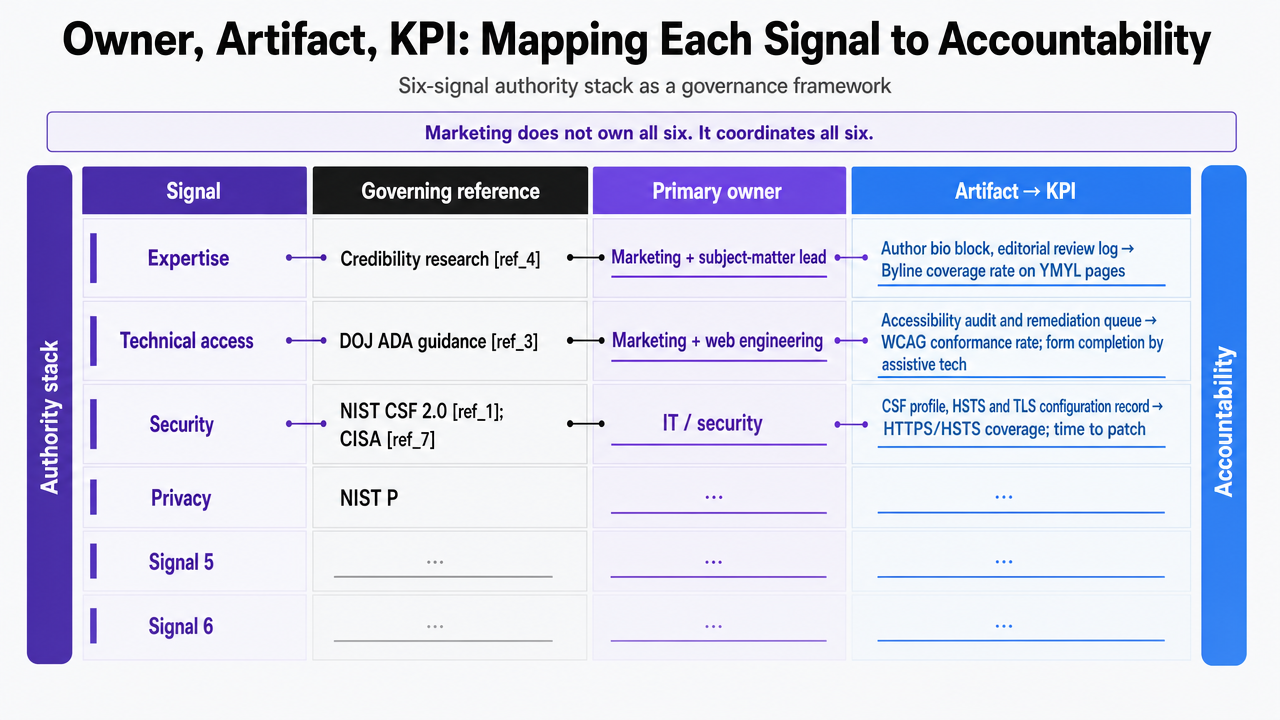 Visualize the six-signal authority stack with owners, artifacts, and KPIs as a governance framework directly cited in the surrounding table and prose
Expertise Signals That Reduce Friction to Conversion
What Credibility Research Actually Rewards
The credibility literature is unusually consistent about what moves a visitor from skeptic to lead. Site design, clear layout, usability, identifiable owner authority, author expertise, and content quality show up as recurring positive factors, while heavy advertising density works in the opposite direction 4. Nothing in that list rewards keyword density or publishing cadence. All of it rewards visible signs that a real, accountable organization stands behind the page.
The scale of the gap between publishing and quality is easier to see in the health vertical, where the research base is largest. A meta-narrative systematic review of 11,785 websites across 153 cross-sectional studies, using 14 different quality-assessment instruments, found that 18% carried Health On the Net (HON) Code certification and that no site reached the "excellent" category under the assessed framework; between 37% and 79% were rated "good" depending on the instrument 5. The scope matters. The finding is specific to patient-facing health content evaluated with formal quality tools, not a claim about every commercial website. But the direction is instructive for any YMYL operator: the volume of published pages far exceeds the volume of pages that pass a structured quality review, and the delta is where friction to conversion accumulates.
For a VP of marketing running a law firm, behavioral health group, or dental portfolio, the operational read is direct. Publishing more pages against the same set of intents does not compound credibility. Passing a structured review—identified ownership, credentialed authors, dated updates, cited sources, and restrained advertising—does. The signals credibility research names are the same signals a legal reviewer and a prospective patient use to decide whether the page is worth trusting.
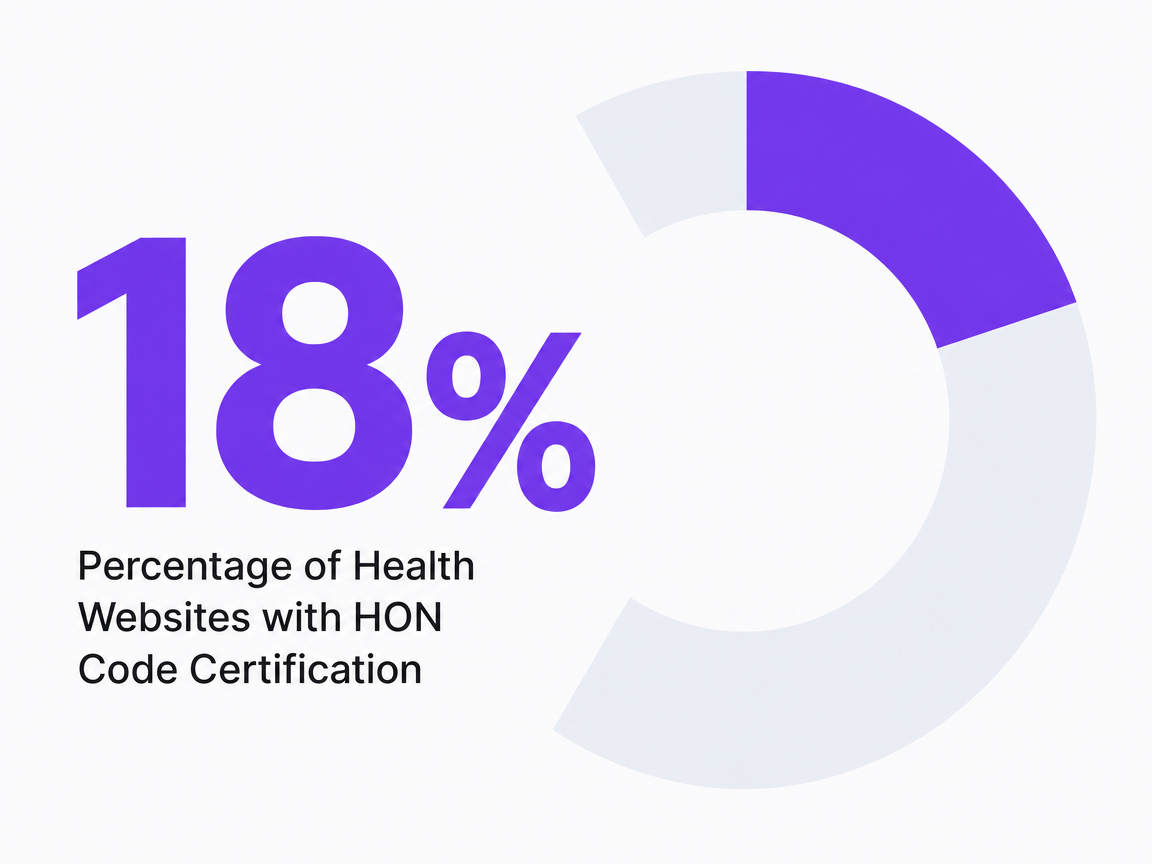 Percentage of Health Websites with HON Code Certification
Percentage of Health Websites with HON Code Certification
Author Bios, Editorial Review, and the YMYL Reverse-Engineering Test
MedlinePlus publishes the criteria a careful reader uses to evaluate a health-information page: who runs the site, its purpose and funding, whether experts review the information, where the information comes from, whether it is current, and how personal information is handled 14. Marketing teams in YMYL verticals can treat that checklist as a design specification. Every question a discerning visitor is trained to ask should have a visible, on-page answer.
In practice, that translates to a small set of concrete page elements. An author bio block with the reviewer's credentials and license number. An "About" page that identifies the operating entity and its funding model. A visible last-reviewed date on clinical, legal, or financial content. A short reference list under substantive articles. A privacy notice reachable from the same page as any intake form. These elements are cheap to build once and enforceable in a template. They are also the elements credibility research associates with owner authority and author expertise 4.
The reverse-engineering test is a governance shortcut. Before a YMYL page publishes, a reviewer walks the MedlinePlus checklist against the draft and flags any question the page cannot answer on its own. Pages that fail the walkthrough go back to the author, not to the publishing queue. The exercise sounds procedural, and it is—which is why it survives volume. It converts credibility from a stylistic aspiration into a repeatable pre-publish gate.
Test AI-driven authority-building on your domain today
Experience measurable improvements to your website authority in a real-world environment, risk-free for one week.
Technical Access as an Authority Prerequisite
The DOJ's web accessibility guidance is direct about who is on the hook: the ADA applies to services, programs, and goods offered online by businesses open to the public, and covered entities must comply while retaining flexibility in how they achieve conformance 3. The guidance names the same elements a UX team would list under "quality build"—sufficient color contrast, alt text on informative images, captions on video, accessible forms, logical headings, keyboard navigation, and a working mechanism to report barriers 3. Treated as an authority input rather than a legal footnote, each element removes friction that otherwise blocks a qualified visitor from completing an intake form or booking an appointment.
The overlap with credibility research is not coincidental. The same peer-reviewed literature that identifies owner authority and author expertise as trust drivers also names site design, clear layout, and usability as recurring positive factors 4. A page that fails keyboard navigation or ships forms without labeled fields is a page that reads as unprofessional to a sighted, mouse-using visitor as well—the visible defects that hurt assistive-tech users tend to be the same defects that erode confidence in every visitor.
For a VP of marketing, the operational move is to convert accessibility from a periodic audit into a pre-publish gate. New templates, landing pages, and form components pass a fixed checklist—contrast ratios, alt text on informative images, labeled fields, focus states, heading order, captioned media—before they reach staging. Remediation of existing pages runs on a tracked queue with WCAG conformance rate and assistive-technology form completion as the reported KPIs. That structure lets marketing hold the calendar while web engineering closes the tickets, and it produces the artifact—an audit log with dated fixes—that answers a general counsel's question before it is asked.
Security and Privacy: The Trust Layer Marketing Doesn't Own but Depends On
Applying NIST CSF 2.0 to the Marketing Stack
Security sits inside IT's remit, but the assets at risk are marketing's. Forms that capture protected health information, analytics tags that pipe user behavior to third parties, content management systems that publish authored pages, and customer databases that feed lifecycle campaigns all live on infrastructure a security team does not run day to day. NIST CSF 2.0 organizes risk work around six functions—Govern, Identify, Protect, Detect, Respond, and Recover—and it is written to apply to organizations of any size, sector, or maturity 1, 11.
The practical read for a VP of marketing is not to run the framework. It is to make sure the marketing stack appears in the identification step. A CSF profile that maps intake forms, appointment schedulers, chat widgets, tag managers, and CRM integrations to the Protect and Detect functions produces the artifact IT needs to prioritize patching, monitoring, and access review on the systems that actually convert visitors into leads. CISA's baseline sits underneath that profile: enforce HTTPS and HSTS, disable HTTP and weak protocols, protect administrative access, and keep software current 7. Missing HSTS headers on a booking flow do not just create risk; they read as sloppy to a visitor comparing three providers.
Two KPIs surface the work without dragging marketing into the security operations center. HTTPS/HSTS coverage across public URLs, and mean time to patch on the CMS and its plugins, both reported quarterly by IT to the marketing scorecard.
Consent, Retention, and the Privacy Framework 1.1 Update
Privacy is where marketing's data appetite meets the visitor's willingness to fill out the form. NIST describes its Privacy Framework as a voluntary tool for identifying and managing privacy risk through enterprise risk management, and the 1.1 update is being drafted specifically to align with CSF 2.0 10, 12. That alignment matters because the artifacts overlap. The same data inventory that supports a security profile supports a retention schedule; the same access controls that limit breach exposure limit unauthorized secondary use of visitor data.
Three artifacts carry most of the operational weight. A data inventory that names every field collected on every form and where it flows. A consent-banner configuration that reflects the actual tag inventory rather than a stock template. A retention schedule that specifies how long lead records, session recordings, and chat transcripts persist before deletion. MedlinePlus lists privacy handling among the criteria a careful visitor uses to judge a site 14, which means transparent notices function as a conversion asset, not just a legal one.
Consent-banner completion rate and DSAR response time are the two KPIs that indicate the plumbing is working. Both are legal-owned metrics that marketing should read weekly, because both move form completion.
Substantiation and the 2024 Reviews Rule
The FTC's Consumer Reviews and Testimonials Rule took effect October 21, 2024, and it changed what marketing teams can publish without a paper trail. The rule addresses deceptive or unfair conduct involving consumer reviews and testimonials, and knowing violations expose businesses to civil penalties 8. The August 2024 final rule announcement is specific about the scope: purchasing or selling fake reviews, misrepresenting the identity or experience of a reviewer, and AI-generated fake reviews are all in the prohibited set 13. That last item matters for any team using generative tools to draft customer stories or seed early social proof on a new location page.
Substantiation is the older, broader obligation the rule sits on top of. The FTC states plainly that advertising claims must be truthful, non-deceptive, non-unfair, and evidence-based 6, and the Endorsement Guides require that endorsers actually have used the service and that material connections affecting how a consumer weighs the endorsement be disclosed 9. A five-star review from an employee's spouse without disclosure is a compliance problem and a credibility problem in the same breath. The credibility research reaches the same conclusion from the user side: unclear sponsorship works against perceived trustworthiness 4.
Two governance artifacts do most of the operational work. A claim substantiation file—one row per published performance, outcome, or comparison claim, linked to the evidence that supports it—lets legal sign off before publish rather than during discovery. A testimonial approval log records the source, the material connection status, the verification step, and the AI-generation check for every customer story that reaches a landing page or ad. Both artifacts route through the same pre-publish gate that already handles YMYL bylines and accessibility conformance, which keeps substantiation from becoming a separate workflow marketing has to defend to finance. The KPI is not sentiment. It is substantiation file completeness on published claims, reported at the same cadence as the editorial calendar.
See How Leading Teams Operationalize Website Authority—Without Expanding Headcount
Request a walkthrough of AI-powered workflows that help multi-location brands and agencies build measurable authority and organic pipeline—streamlined, automated, and fully governed for enterprise needs.
Legitimate Third-Party Recognition Without a Link-Building Line Item
Third-party recognition earns its place in the authority stack because the credibility literature keeps finding it there. The same peer-reviewed review that identifies owner authority and author expertise as trust drivers also flags unclear sponsorship and heavy advertising as factors that work against perceived credibility 4. What a visitor treats as a legitimate signal—a citation from a professional body, an interview in a trade publication, an entry in a licensing directory, a case study co-published with a named institution—is not what a link-building vendor tends to sell.
The operational move is to stop procuring links and start producing citable artifacts. Original data from the practice's own case volume, a clinician's contribution to a specialty association's guideline, a general counsel's commentary in a bar publication, a partnership case study with a named vendor whose material connection is disclosed under the FTC Endorsement Guides 9—each produces the kind of reference a serious visitor and a serious search evaluator both weigh. MedlinePlus lists source references and identifiable authorship among the criteria a careful reader uses to judge a page 14, and the same standard applies to whoever is citing back.
The KPI is not link count. It is the number of independently sourced, disclosed citations added per quarter, tracked in the same register that already logs testimonials and substantiation.
If a Marketing Team Governs Multiple Locations
The scope shifts here from a single-site operator to portfolio marketing leaders—DSO marketing VPs, MSO growth heads, franchise home-services CMOs, senior-living portfolio directors—where the six-signal stack has to run across dozens or hundreds of location pages without a proportional increase in headcount. The signals do not change. The coordination cost does.
At a single location, one legal reviewer, one web engineer, and one marketing owner can close the loop on any given publish. At forty locations, the same workflow tends to fragment into six parallel vendor relationships:
- an SEO agency for content and technical work,
- an accessibility auditor for periodic WCAG reviews,
- a security or pen-test vendor working under IT,
- a privacy consultancy or consent-management platform under legal,
- a review-management platform for testimonial governance under the FTC's 2024 rule 8, 13,
- and a digital PR firm chasing third-party citations.
Each vendor produces its own artifact on its own cadence, and the marketing VP absorbs the coordination tax between them.
| Signal | Typical Vendor | Governance Artifact |
|---|---|---|
| Expertise | SEO / content agency | Editorial review log per location 4 |
| Technical access | Accessibility auditor | WCAG audit and remediation queue 3 |
| Security | Security / pen-test vendor | CSF profile, HSTS coverage report 1, 7 |
| Privacy | Consent platform / privacy counsel | Data inventory, retention schedule 10 |
| Substantiation | Review-management platform | Testimonial approval log 8 |
| Third-party recognition | Digital PR firm | Verified citation register 4 |
The consolidation move is not to fire the specialists. It is to route their outputs through a single approval workflow so that a location page cannot publish until every row is closed. When the six artifacts sit in one queue rather than six inboxes, the VP recovers the time previously spent reconciling vendor calendars and gains a defensible audit trail that scales linearly with locations rather than exponentially with meetings.
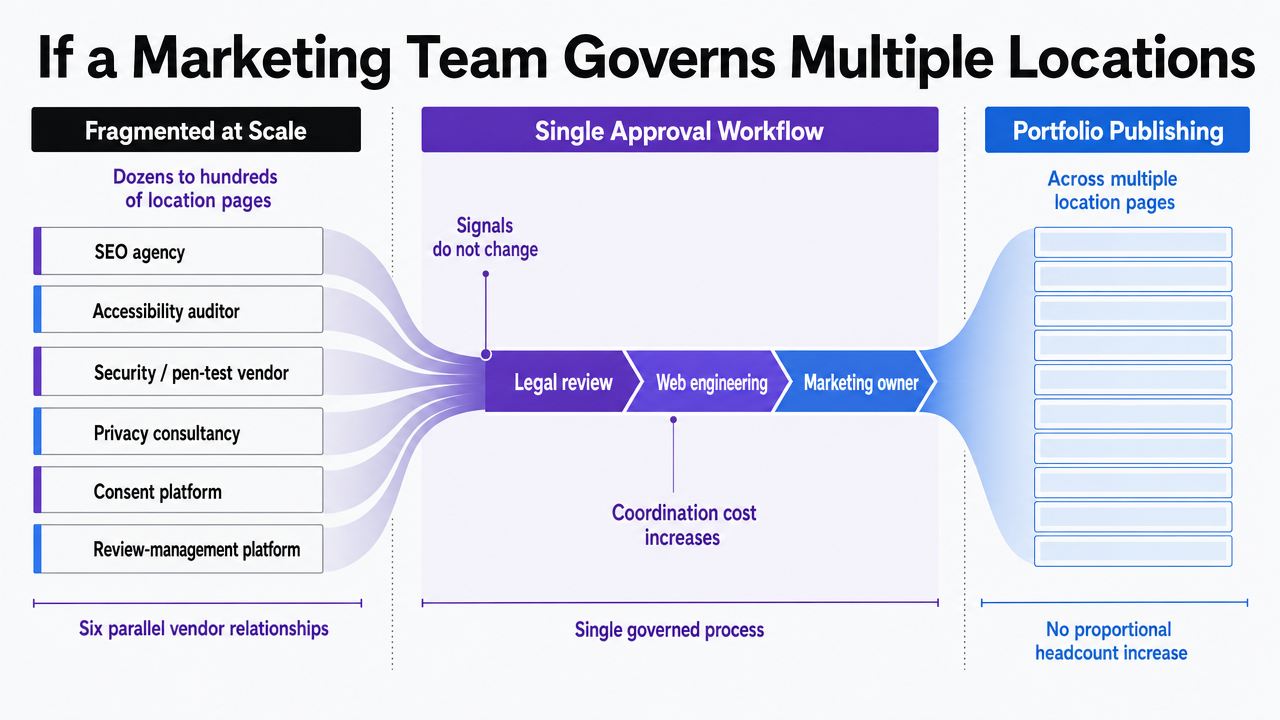 Visualize the consolidation of six vendor artifacts into a single approval workflow described in the section, mapping directly to the comparison table
Frequently Asked Questions
References
- 1.The NIST Cybersecurity Framework (CSF) 2.0.
- 2.NIST Cybersecurity Framework 2.0: Resource & Overview Guide.
- 3.Guidance on Web Accessibility and the ADA.
- 4.Trust and Credibility in Web-Based Health Information.
- 5.Can Patients Trust Online Health Information? A Meta-narrative Systematic Review Addressing the Quality of Health Information on the Internet.
- 6.Advertising and Marketing.
- 7.Website Security.
- 8.The Consumer Reviews and Testimonials Rule: Questions and Answers.
- 9.Advertisement Endorsements.
- 10.Privacy Framework 1.1.
- 11.Frequently Asked Questions — NIST Cybersecurity Framework.
- 12.FAQs — NIST Privacy Framework.
- 13.Federal Trade Commission Announces Final Rule Banning Fake Reviews and Testimonials.
- 14.Evaluating Health Information.