
Key Takeaways
- Agency retainers bundle six distinct roles—subject matter expertise, development, user research, usability testing, UI, and visual design—into one invoice, hiding which work the buyer actually consumes 6.
- Strategy, ICP definition, and audience research should stay internal because those upstream decisions shape every downstream brief and create a translation tax when outsourced 20.
- Replace the retainer with four procurement buckets—internal owner, freelancer, platform, AI workflow—assigned by cost, ramp time, and how much judgment each task requires 21.
- Swap the monthly status cadence for the five-step operating loop of goals, audience, site, analytics review, and channel choice, run on the buyer's schedule and data 2.
- Defend the swap with three measurable numbers: output variance exposed page by page, 60–90 day ramp time, and distributed single-point-of-failure risk across multiple producers.
- FTC substantiation, NIST AI risk controls, and Section 508 accessibility obligations move in-house the day the agency leaves and belong in pre-publish workflow steps, not policy documents 3.
- Multi-location operators gain the most: per-location retainer billing scales linearly, while unbundled stacks and platforms hit breakeven at the first or second site through shared infrastructure 14.
- Present the swap to finance and legal as a tighter control environment—unit-cost teardown, written governance map, and a 90-day parallel run with named output baselines 1.
The Agency Retainer Is a Bundling SKU, Not a Service
A monthly agency retainer is a packaging decision, not a deliverable. It groups strategy, copy, design, technical SEO, analytics review, and project management into one line item priced for procurement convenience, then bills it as if the bundle itself were the product. The actual work inside that bundle is a stack of discrete roles that can be priced, sourced, and measured independently.
Federal guidance treats digital marketing this way already. The International Trade Administration frames it as a five-step operating loop—goals, audience, site, analytics review, channel choice—rather than a service to be purchased whole 2. The SBA's marketing planning guidance says to define the audience, build a marketing action plan, and produce a complete budget breakdown before committing to channels or vendors 1. Both treat the buyer as the operator, not the agency.
For a Head of Growth being asked to compress a $400K to $2M marketing budget, the practical move is to stop evaluating retainers against each other and start evaluating each role inside the retainer against its lowest-cost competent producer. Some work belongs internally. Some belongs with a named freelancer at a known hourly rate. Some belongs in a platform or automated workflow that prices by output rather than hours 21. The rest of this piece walks through that decomposition, the procurement model that replaces the retainer cadence, and the governance the swap requires.
What a Retainer Actually Pays For: Unbundling the Line Item
The Six Roles Hiding Inside One Invoice
A website project is not one job. Federal usability guidance decomposes it into at least six named roles:
- subject matter expertise
- technical development
- user research
- usability testing
- UI design
- visual design 6
The same guidance notes that team members may cover multiple roles and that budget and expertise should drive resource allocation rather than habit 6. That last point is the procurement opening. If a single contributor can hold two or three roles, then so can a different sourcing model.
An agency retainer collapses these six roles into one billing event. The buyer sees a flat monthly number. The agency sees a staffing plan with utilization targets across senior strategists, mid-level designers, junior developers, and a project manager whose primary output is status reporting. The mismatch between what is billed and what is produced is not a scandal—it is the business model. Bundled SKUs always price for the average buyer, not the specific one.
For a Head of Growth, the immediate exercise is mechanical. Take the most recent agency statement of work and list which of the six roles each deliverable actually consumed. Most service-line site refreshes consume heavy subject matter expertise and visual design, light user research, and almost no usability testing. That distribution is what makes the unbundling profitable. Pay for the roles the work actually uses, not the ones the retainer template assumes.
Strategy and Audience Work Belongs Inside the Building
Two of the six roles should almost never leave the building: subject matter expertise and user research. Both are upstream decisions that determine what the rest of the stack produces. Outsourcing them creates a translation tax that every downstream vendor then bills against.
The SBA's market research guidance frames this as the operator's job, not the contractor's. Market research is how a company understands its customers, reduces risk, and identifies competitive advantage—work that informs positioning across every digital channel 20. Federal usability guidance is more specific on the audience layer: a site should be organized around three to five primary personas built on real user goals and tasks, not on the agency's persona template applied to a new logo 7. The same guidance flags a useful caution—there is little empirical proof that persona artifacts themselves improve outcomes, which means the work has to live close to the people who will act on it 7.
Inside a 5-to-25 person marketing organization, the practical assignment is a product marketer or growth lead who owns ICP definition, a content strategist who owns topic and intent mapping, and the Head of Growth who owns the budget allocation tied to those decisions. Total internal time is measurable in days per quarter, not retainer months. The output is a written brief that any production vendor—freelance, platform, or AI workflow—can execute against without a discovery call billed by the hour.
Production and Implementation: The Substitutable Layer
The four remaining roles—technical development, usability testing, UI design, and visual design—are substitutable. They produce artifacts against a brief, and they price by output: a page template, a Core Web Vitals fix, a moderated test session, a component library. Each has a competitive market of named individual producers with public rates.
A technical SEO contractor at $125 to $175 per hour will run a crawl, fix indexation issues, and ship schema markup against a defined scope. A freelance UI designer with a Figma portfolio will deliver a 12-page service-line site at a fixed project rate. Usability testing platforms run moderated sessions for a flat fee per participant. None of these need a retainer wrapper to function, and the federal digital marketing operating loop—goals, audience, site, analytics review, channel choice—treats them as discrete steps the buyer orchestrates rather than purchases as a package 2.
Peer-reviewed analysis of sales and marketing automation in the post-Covid period documents the labor-substitution case directly: automation integrates sales and marketing data, handles repetitive tasks, and improves scalability while controlling costs 21. The same research notes the catch—firms underutilize automation when they lack a clear strategy or internal capability to direct it 21. Which is why the strategy layer in section 2.2 has to be solved first. The production layer is cheap to swap. The brief that drives it is not.
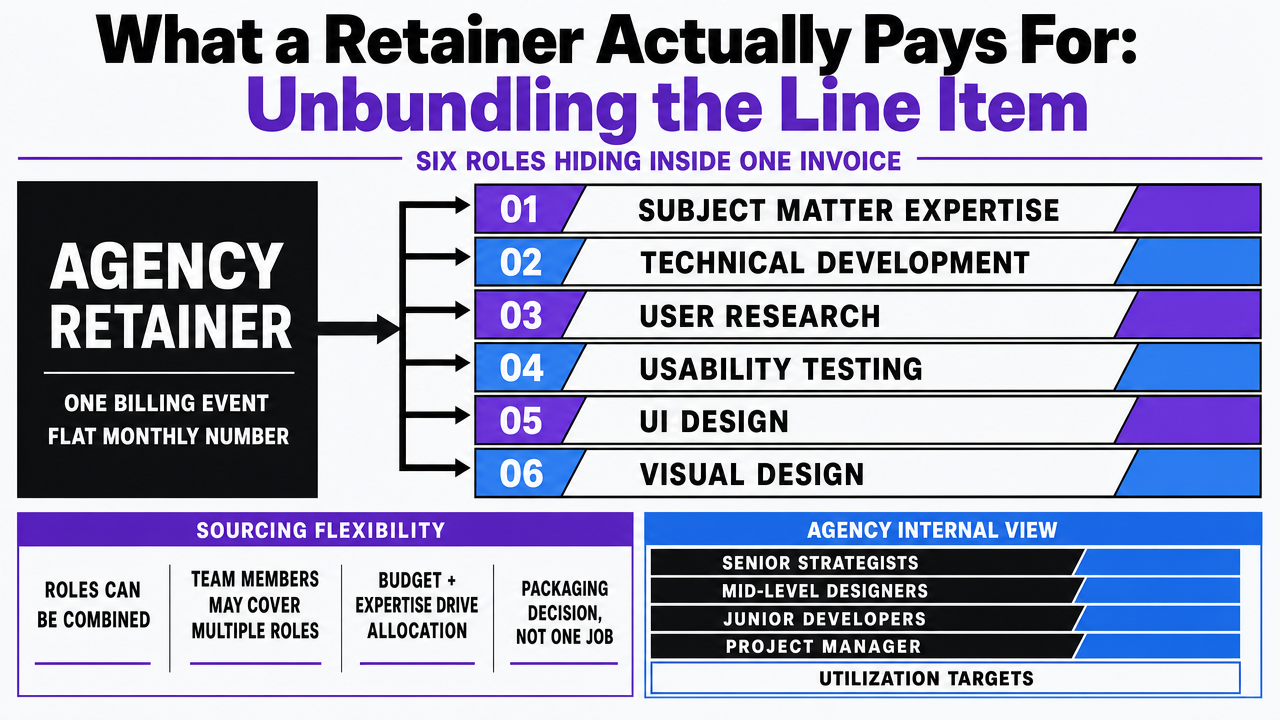 Visualize the six discrete roles bundled inside a single agency retainer invoice, supporting the section's central claim that the retainer is a packaging decision over six separable roles
Experience Agency-Free Website Design and SEO Execution
Test real-time website and SEO improvements without agency costs or delays during your 7-day trial.
A Procurement Model for the Unbundled Stack
Four Buckets: Internal Owner, Freelancer, Platform, AI Workflow
Once the six roles inside the retainer are visible, each one needs a home. Four buckets cover the realistic options:
- an internal owner with the work in their job description
- a named freelancer billing by hour or project
- a software platform pricing by seat or output
- an AI workflow that produces drafts an internal approver signs off on
The assignment is a matter of cost, ramp time, and how much judgment the work requires.
Strategy and audience definition sit with the internal owner because the decisions compound across every downstream artifact. Technical SEO audits, schema implementation, and Core Web Vitals fixes move to a freelancer because the work is bounded, the deliverable is testable, and the market rate is public. Analytics review and channel reporting move to a platform because the data already lives there and the marginal cost of another dashboard is near zero. Content production—blog posts, service-line pages, meta descriptions, alt text—is the bucket where AI workflows displace the most retainer hours, provided an internal editor owns the substantiation check before publish 21.
The SBA's planning guidance frames the buyer's task as a complete budget breakdown for marketing costs tied to a written action plan 1. That breakdown is what the comparison below requires. Each procurement model carries a different cost structure, ramp time, variance profile, governance burden, and switching cost, and the Head of Growth has to decide which combination the organization can actually operate.
| Dimension | Agency Retainer | Unbundled Internal + Freelance | AI Platform + Internal Approver |
|---|---|---|---|
| Cost structure | Fixed monthly fee | Salary + variable hourly | Fixed platform fee + approver time |
| Ramp time | 30–60 days onboarding | 60–90 days hiring + sourcing | 14–30 days configuration |
| Output variance | Moderate, hidden by bundle | High, dependent on freelancer mix | Low once briefs stabilize |
| Governance burden | Agency-owned, opaque | Buyer-owned, distributed | Buyer-owned, centralized |
| Switching cost | High, IP and history locked | Low per role | Low, briefs and assets portable |
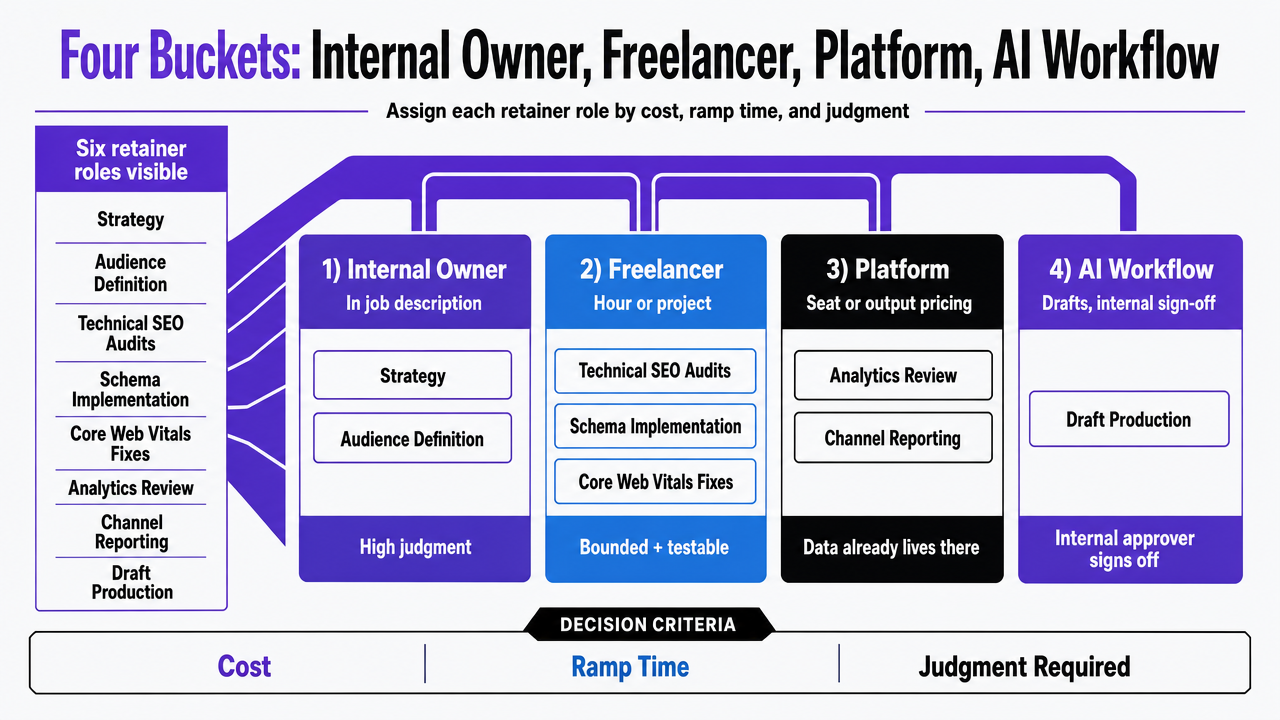 Render the section's comparison table as a scannable framework infographic so readers can map each of the six retainer roles into one of four procurement buckets
The Five-Step Operating Loop That Replaces the Retainer Cadence
A retainer imposes its own rhythm: monthly status calls, quarterly business reviews, annual renewals. None of that cadence is tied to the work itself. The International Trade Administration's digital marketing framework offers a cleaner replacement—a five-step operating loop covering goals, audience, site, analytics review, and channel choice 2. The loop runs on the buyer's schedule against the buyer's data.
- Goals come first because they set the scoring rubric for every downstream decision. A Head of Growth running a $400K to $2M budget needs pipeline-tied goals—qualified pipeline created, opportunity influence, cost per opportunity—not traffic or ranking proxies.
- Audience work follows, anchored to three to five primary personas built from real user goals and tasks rather than demographic guesswork 7.
- The site step is where production vendors get briefed against the personas and goals, not against an agency's house template.
- Analytics review is the step retainers most often skip because it requires the agency to admit when work did not move the metric. The federal guidance is explicit that reviewing website analytics is a standing operating step, not a quarterly slide 2.
- Channel choice closes the loop by reallocating budget toward what the analytics review proved out.
The cadence runs every two to four weeks for tactical decisions and quarterly for budget shifts. No status call required—the dashboard is the status call.
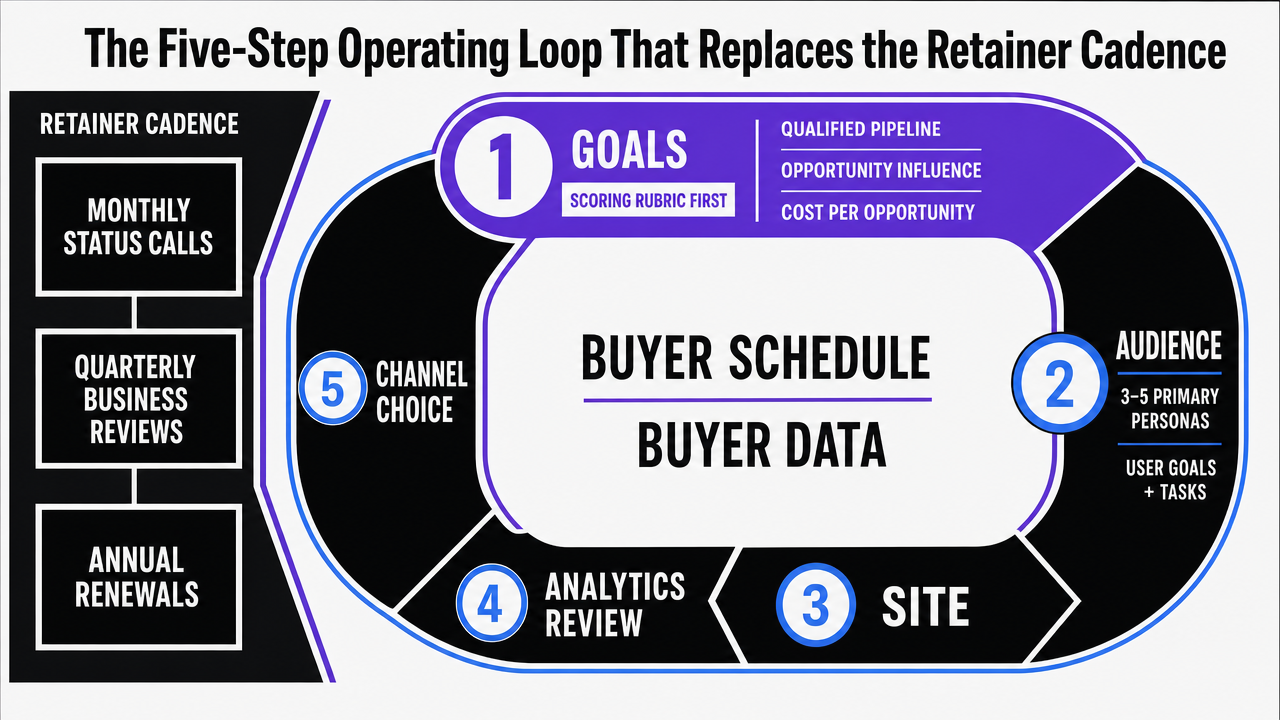 Visualize the cited five-step International Trade Administration operating loop that replaces the agency retainer cadence, directly supporting the section's process explanation
Measuring the Swap: Variance, Ramp Time, and Single-Point-of-Failure Risk
A CFO asked to approve dropping an agency wants three numbers, not a philosophy.
- The first is variance: how much does monthly output swing under the new model versus the old one. Agencies hide variance inside the bundle—the buyer pays the same whether the agency shipped two pages or twelve. An unbundled stack exposes variance immediately, which is the point. Output becomes countable.
- The second number is ramp time. Freelancer sourcing and internal hiring run 60 to 90 days from kickoff to steady-state output. A configured automation platform reaches steady state faster because the workflow is already built; the constraint is brief quality and approver bandwidth 21. The Head of Growth should model the swap as a 90-day parallel run, with the agency retained at reduced scope while the replacement stack proves it can match the baseline.
- The third number is single-point-of-failure risk. A retainer concentrates the risk in one vendor relationship. An unbundled stack distributes it across an internal owner, two or three freelancers, and a platform—any one of whom can be replaced without halting production.
The peer-reviewed automation research flags the inverse risk: firms that adopt automation without internal capability to direct it underutilize the tooling 21. The mitigation is the internal owner in bucket one, not another vendor.
Governance Is a Procurement Requirement, Not a Footnote
FTC Substantiation for Internal and AI-Generated Copy
Truth-in-advertising obligations do not transfer with the invoice. When an agency wrote the service-page copy, the agency carried part of the substantiation workload as a matter of professional habit—legal review, fact-check passes, a default skepticism toward superlatives. When that copy now comes from a freelance writer, an internal product marketer, or an AI draft, the substantiation work has to be rebuilt as an explicit step in the publish workflow.
The FTC's standard is plain: claims in advertisements must be truthful, cannot be deceptive or unfair, and must be evidence-based 3. That standard applies equally to a paid search headline, a landing-page hero, a testimonial block, and a meta description ranking in organic results. The agency's online marketing compliance guide reinforces that the same rules cover digital channels and serves as a small-entity compliance reference under the Small Business Regulatory Enforcement framework 4.
The operational fix is a pre-publish substantiation checklist owned by the internal approver:
- Every quantitative claim ties to a dated source file.
- Every testimonial carries written consent and a note on whether the experience is typical.
- Every comparative claim has the comparison data attached.
The checklist runs in under ten minutes per page once the source library exists, and it survives any change in who is writing the draft.
NIST AI RMF as the Control Layer for Automated Workflows
AI-assisted content production introduces a risk surface a retainer never had to document. NIST's voluntary AI Risk Management Framework is the cleanest reference point for naming that surface and assigning controls. The framework is designed to help organizations manage risks to individuals, organizations, and society associated with AI systems, with principles covering robustness, trustworthiness, and accountability 5.
Three control points cover most of the exposure in a marketing context:
- Provenance: every AI-generated draft carries a record of the model, prompt, and brief that produced it, so a claim challenged later can be traced to its source.
- Human review at the point of substantiation, not after publish.
- Monitoring for drift—periodic spot-checks against a sample of published pages to confirm that tone, factual accuracy, and brand claims have not degraded as the workflow scales.
NIST is explicit that adoption is voluntary, which means implementation depth varies 5. The Head of Growth's task is to set the depth that matches the organization's risk tolerance and write it into the workflow itself, not into a policy document no one reads. The control layer lives next to the publish button.
Accessibility Exposure When the Agency Stops Owning It
Accessibility is the obligation buyers most often discover they inherited only after a complaint arrives. While Section 508 formally applies to federal agencies and their contractors, the standard has become the practical benchmark for accessible electronic information and data across regulated and consumer-facing sites 12. SaaS companies selling into healthcare, finance, education, or the public sector inherit the expectation through procurement clauses well before any statute reaches them directly.
The unbundled stack needs accessibility built into the brief, not bolted on at QA. That means:
- contrast ratios and keyboard navigation in the Figma file
- alt text and heading structure in the content template
- automated accessibility scans wired into the deployment pipeline
The freelance UI designer needs the requirements in the scope of work. The AI content workflow needs alt-text generation as a step, not a suggestion.
The Head of Growth's concrete move is a one-page accessibility specification attached to every production brief and a quarterly audit—internal or contracted—against the WCAG criteria referenced in the Section 508 standard. The audit cost is bounded. The exposure if it never happens is not.
Reduce Design and SEO Spend by 60%—No Agency Fees, No Hidden Markups
See how leading SaaS and healthcare teams automate website design and SEO execution at scale, with outcomes tracked against industry benchmarks—without the cost or delays of traditional agency retainers.
If You Manage Multiple Locations: The Per-Site Math Changes
Why Per-Location Billing Compounds the Bundling Tax
The math shifts when a buyer operates more than one site. Healthcare growth teams running 5, 8, or 20 service-line locations face agency pricing that scales linearly with footprint: each location gets its own retainer, its own monthly call, its own content quota. The bundling tax described earlier compounds across the portfolio because the agency is selling the same fixed overhead—account management, reporting, coordination—N times.
The SBA's marketing planning guidance treats budget as a complete breakdown tied to a written action plan, not a per-vendor allocation 1. Applied to a multi-location operator, that breakdown forces a choice between three procurement models. The variables, not invented dollar figures, are what make the comparison defensible to a CFO.
| Cost variable (8-location operator) | Agency retainer (per-location billing) | Unbundled internal + freelance | AI platform + internal approver |
|---|---|---|---|
| Recurring fee structure | Monthly retainer × 8 locations | Loaded FTE cost + freelance hourly × scope | Fixed platform fee (e.g., $599/mo account-level) + approver time |
| Scaling behavior with new location | Linear: adds one full retainer | Sub-linear: marginal freelance hours only | Flat: same account-level fee |
| Coordination overhead | Per-location account manager | Internal owner consolidates | Centralized brief, distributed execution |
| Breakeven trigger | — | Retainer × 2–3 locations | Retainer × 1 location |
The breakeven row is where the per-location math turns. Plug the current retainer figure into the top row, multiply by location count, and the comparison resolves itself 1.
A Structured-Operations Model From the Public Sector
Multi-location operators looking for a governance template that already scales across dozens of properties have one nearby: federal agency website operations. The HHS 2023 modernization report, written under the 21st Century IDEA, documents how a single department coordinates upgrades, accessibility, and digital experience across a sprawling property portfolio through structured operations rather than ad hoc vendor engagements 14.
Three elements travel well to a private operator:
- A single account-level governance owner—one team setting standards for every site rather than each location negotiating its own vendor.
- Shared infrastructure: a common design system, a common analytics implementation, a common accessibility baseline, so the marginal cost of adding a location is integration work, not a new agency contract.
- Published progress against named metrics, which replaces the agency's quarterly business review with an internal cadence the CFO can read directly 14.
Defending the Swap to the CFO and Legal
The swap survives finance and legal review when it is presented as a procurement decision with documented controls, not as a cost-cutting story. Three artifacts carry most of the weight:
- a unit-cost teardown that ties every retainer line to a replacement producer
- a written governance map covering substantiation and accessibility
- a 90-day parallel-run plan with named output baselines
The finance argument runs on countable output and bounded risk. The SBA's planning guidance frames the buyer's task as a complete marketing budget tied to a written action plan, which is the same document the CFO already expects 1. Reformat it to show pages shipped, technical fixes closed, and pipeline-tied metrics moved per dollar spent under each model. Variance gets a row of its own—agencies hide it inside the bundle, while the unbundled stack exposes it page by page, which is the disclosure finance actually wants.
Legal's concern is whether substantiation and accessibility obligations remain enforceable after the agency leaves. The answer is the pre-publish checklist tied to FTC requirements that claims be truthful and evidence-based, plus the accessibility specification attached to every production brief 3. Both controls are workflow steps, not policies, which is what makes them auditable. Present the artifacts, name the internal owner, and the swap reads as a tighter control environment than the retainer it replaced.
Frequently Asked Questions
References
- 1.Marketing and sales | U.S. Small Business Administration - SBA.
- 2.Understanding Digital Marketing - International Trade Administration.
- 3.Advertising and Marketing | Federal Trade Commission.
- 4.Online Advertising and Marketing | Federal Trade Commission.
- 5.AI Risk Management Framework.
- 6.Project Team Roles and Responsibilities.
- 7.Segmenting Your Audiences.
- 8.An Analysis of US Academic Medical Center Websites: Usability Study.
- 9.Applying Website Rankings to Digital Health Centers in the United States: A Cross-Sectional Study.
- 10.Conceptualizing Usability for the eHealth Context: Content Analysis ....
- 11.Healthcare Website Design for the Elderly: Improving Usability.
- 12.CMS.gov Accessibility and Compliance with Section 508.
- 13.CMS Nondiscrimination, Accessibility, and Complaint Information.
- 14.2023 Report to OMB and the Public on Modernizing Agency Websites.
- 15.Usability in Health IT: Beyond Compliance to Meaningful Design ....
- 16.Web usability testing with a Hispanic medically underserved ....
- 17.Marketing in healthcare: Improving the consumer experience.
- 18.Customer experience in the next normal after COVID-19.
- 19.How COVID-19 has pushed companies over the technology tipping point—and transformed business forever.
- 20.Market research and competitive analysis.
- 21.Sales and marketing automation in the post-Covid-19 scenario.