
Key Takeaways
- Treat a website as pipeline infrastructure running five coordinated subsystems—topical architecture, URL hierarchy, internal linking, page-type UX, and migration governance—where each downstream layer inherits errors from the one above it.
- Topical architecture and URL vocabulary set the ceiling: name the five to eight clusters the domain owns, encode them in descriptive paths, and keep commercial hubs within three clicks of the homepage 1, 3.
- Internal links and page-type UX decide whether traffic converts—authority should flow via descriptive anchors toward commercial hubs, while category, detail, and proof pages carry distinct scanning, conversion, and credibility jobs 5, 9.
- Run the compound-or-leak diagnostic across the five subsystems in order, and protect earned authority during redesigns with a page-level 301 inventory rather than pattern-level bulk redirects 14.
The Site as Pipeline Infrastructure, Not a Marketing Brochure
Most website design conversations start in the wrong place. A VP inherits a site built by one vendor, layered with content from another, instrumented (poorly) by a third. When organic traffic stalls, the reflex is to commission a redesign or bolt on a fresh checklist of on-page tags. The pipeline number does not move. The redesign ships. Rankings dip. The cycle repeats.
The reframe is simple but consequential: a site is not a marketing brochure with SEO features attached. It is pipeline infrastructure. Google's own guidance treats structural choices—URL patterns, internal links, headings, structured data—as a coordinated signal set rather than a punch list, with descriptive URLs and crawlable links positioned as prerequisites for how content clusters and journeys get interpreted 1, 3. Search Essentials makes the same point from the user side: the same words users would search for should appear in prominent text, and every important page should be reachable through crawlable links 3.
That systemic view matters because B2B buying no longer runs on a linear funnel. McKinsey's decision-journey research describes a loop where buyers consider, evaluate, purchase, and continue evaluating across channels and sessions 18. A modern B2B buyer expects the same experience across every touchpoint they choose to use 17. If a site's architecture, page-type UX, and instrumentation are not coordinated to support that loop, organic traffic arrives and leaks out through unnamed cracks.
This article treats website design for SEO as five interlocking subsystems. Each one either compounds authority and conversion signal—or fragments it. The job is to know which is happening, where.
The Five Subsystems That Compound (or Leak)
Mapping the Interdependencies
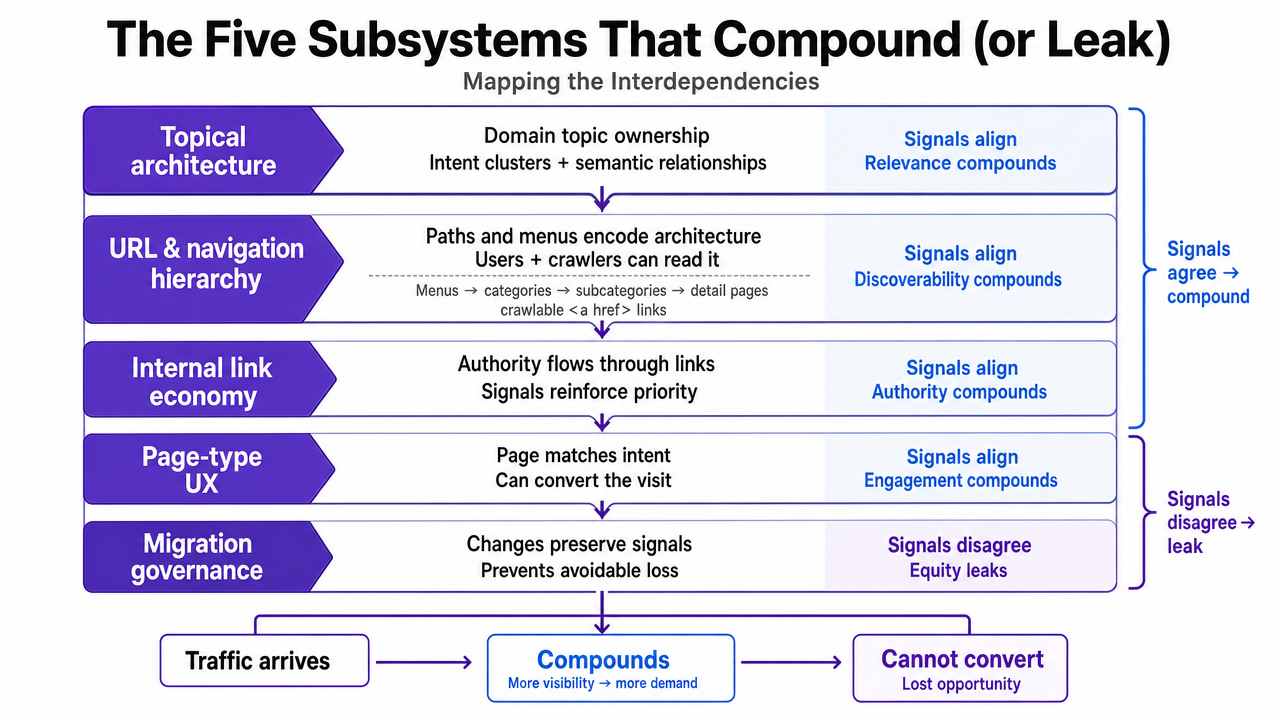
A site that ranks and converts is running five subsystems in coordination:
- Topical architecture
- URL and navigation hierarchy
- The internal link economy
- Page-type UX
- Migration governance
Each subsystem carries a signal. When the signals agree, authority and conversion intent compound. When they disagree, traffic arrives at pages that cannot cash the check the SERP wrote.
Topical architecture defines what the site is about at the domain level—the clusters of intent it owns and the semantic relationships between them. URL and navigation hierarchy encodes that architecture in paths and menus so both users and crawlers can read it. Google's ecommerce structure guidance is explicit that menus should link to categories, categories to subcategories, and subcategories to detail pages, with <a href> links crawlable throughout 2. The principle extends cleanly to B2B: service lines behave like categories, sub-services like subcategories, proof pages like detail pages.
The internal link economy sits on top of the hierarchy and redistributes authority laterally—cross-linking between related clusters, surfacing evaluation content next to commercial pages, and shaping what Google treats as the important pages of the site 6. Page-type UX determines whether the traffic that arrives can actually complete the job the SERP promised: category pages that scan, detail pages that convert, proof pages that reduce risk. Migration governance is the connective tissue that preserves all four when URLs change.
The dependency runs one direction. Weak topical architecture cannot be rescued by clever internal linking. A crawlable hierarchy cannot save a category page missing the attributes users need to evaluate. Every subsystem downstream inherits the errors of the one above it—which is why redesigns that touch only page templates rarely move the pipeline number.
Topical Architecture: What the Site Is About Before It Ranks
Before a single page is optimized, the domain has to decide what it is about. Topical architecture is that decision made explicit: the set of intent clusters the site claims, the semantic relationships between them, and the depth of coverage inside each one. Google's Search Essentials frames this in user terms—use the words people actually search for in titles, main headings, and prominent text, and make sure every important page is reachable through crawlable links 3. That is not a copywriting note. It is an instruction to align the site's vocabulary with the demand it wants to capture.
For a B2B service company, the architecture usually resolves into three tiers:
- Service-line hubs anchor the commercial intent—the pages a buyer lands on when they know what they want to buy.
- Sub-service pages sit beneath each hub and handle the specific variants, industries served, or delivery models.
- Evaluation content—comparisons, methodology explainers, proof stories, pricing logic—forms the third tier and feeds the hubs with contextual authority.
Google's ecommerce guidance describes the same pattern in retail vocabulary: menu to category, category to subcategory, subcategory to detail, with crawlable links throughout 2. The mechanics translate directly.
The failure mode is topical sprawl. Sites publish across dozens of loosely related themes, none deep enough to signal authority, and then wonder why service-line pages plateau. The SEO Starter Guide recommends organizing content into logical sections with clear heading structure so users and crawlers can see what belongs together 4. Applied at the domain level, that means auditing which clusters the site actually owns—measured by depth of supporting content, internal link volume, and query coverage—and consolidating or retiring the rest.
The test is direct. A VP should be able to name the site's five to eight core clusters, point to the hub page for each, and show the evaluation content that feeds it. If that inventory cannot be assembled in an afternoon, the architecture is not yet a system. It is a collection of pages waiting for one.
URL and Navigation Hierarchy: Encoding Meaning in Paths
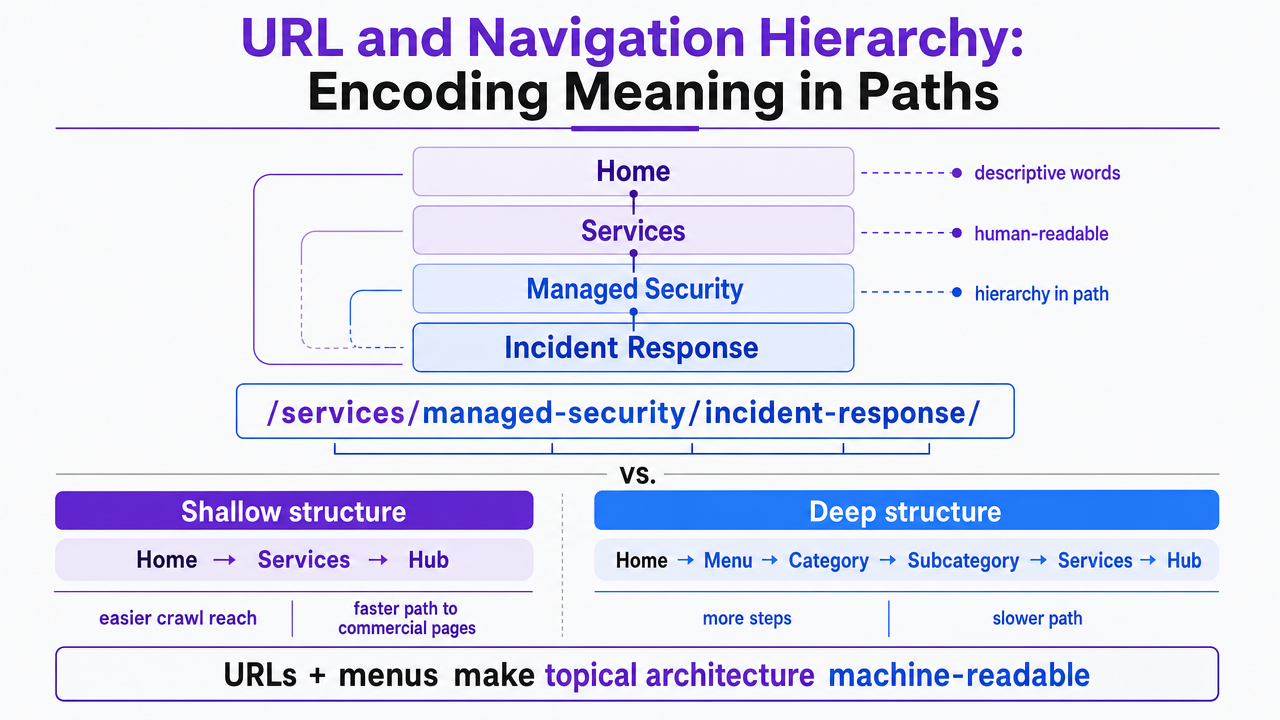
URLs and menus are where topical architecture becomes machine-readable. A path like /services/managed-security/incident-response/ tells a crawler and a buyer the same thing at the same time: this page belongs to a service line, inside a category, one level below the hub. Google's URL guidance is direct about this—use descriptive, human-readable words rather than long ID numbers, and keep parameters to what is actually needed 1. When URLs read like sentences, they encode hierarchy without a separate document explaining it.
Click depth is the other lever—the number of clicks from the homepage to any commercial page—governs how easily crawlers reach the pages that need to rank and how quickly users get to the ones that convert. A shallow structure keeps every service-line hub within three clicks of the homepage; a deep structure buries pages behind four, five, or six navigation steps. The difference shows up in two places: the frequency with which deep pages get recrawled, and the drop-off rate of users who abandon before they arrive.
Shallow vs. deep hierarchy: click depth to commercial pages
| Page type | Shallow hierarchy (≤3 clicks) | Deep hierarchy (4–6 clicks) |
|---|---|---|
| Service-line hub | 1 click from home | 2–3 clicks |
| Sub-service page | 2 clicks | 3–4 clicks |
| Proof/case content | 2–3 clicks | 4–5 clicks |
| Long-tail evaluation page | 3 clicks | 5–6 clicks |
The SEO Starter Guide reinforces the same principle from the content side: break material into logical sections with clear headings, and use sitemaps and internal links so that every important page is discoverable 4. Discoverability is not just about whether a URL exists in an XML file. It is about whether the path a user or crawler follows through the menu system arrives at the right place with fewer than a handful of decisions.
Two operational rules follow:
- Name folders after the clusters the site owns—
/industries/,/services/,/resources/—and keep those names stable across redesigns. URL churn is the fastest way to fragment authority. - Treat the primary navigation as a contract with the topical architecture: every core cluster gets a menu slot, every menu slot maps to a hub page, and every hub page carries the vocabulary the audience actually searches with 3.
If a category exists in the strategy deck but not in the top navigation, it does not exist to a crawler making its second pass.
Test data-driven website SEO strategies risk-free
Experience measurable SEO impact by deploying real content during your trial—no simulations, just actionable results.
The Internal Link Economy
Hierarchy tells a crawler what belongs where. Internal links tell it what matters. Every link on the site is a small vote that redistributes authority from the pages that have it to the pages that need it, and the pattern of those votes is what Google reads when it decides which pages deserve to rank—and which deserve sitelinks beneath the brand result 5.
Three link classes do the work:
- Hub-to-spoke links push authority down from service-line pages into their supporting sub-services and evaluation content.
- Spoke-to-hub links push relevance signals back up, telling the crawler which page anchors the cluster.
- Cross-silo links connect related clusters where the buyer's journey actually crosses them—a page on incident response that links to the managed detection service line, for example.
Search Engine Journal's synthesis of navigation research makes the same point in operational terms: content should be interlinked up and down category trees, with strategic cross-linking between silos where user intent overlaps 6.
Anchor text is the ballot. Google's sitelinks documentation is explicit that internal anchor text should be concise and relevant, because that language helps identify which pages are important enough to surface 5. Generic anchors—"learn more," "read here"—cast blank votes. Descriptive anchors that reuse the target page's core vocabulary reinforce the topical signal already encoded in the URL and heading structure 3.
The leak pattern is predictable. Blog posts pile up with links pointing only sideways to other posts, never up to the commercial hubs they support. Category pages fail to link to their most valuable sub-services because the menu handles it "well enough." Old campaign pages accumulate authority and pass none of it forward. Auditing the link economy means counting how many internal links each commercial page receives, whose anchor text describes what the page actually offers, and whether the pages with the most authority are pointing at the pages with the most pipeline potential.
Page-Type UX: Category, Detail, and Proof Pages as Distinct Instruments
A category page and a detail page share a template family and almost nothing else. They serve different jobs in the journey, answer different queries, and fail in different ways. Treating them as one design problem is how sites end up with beautiful hubs that do not convert and dense detail pages that never get found.
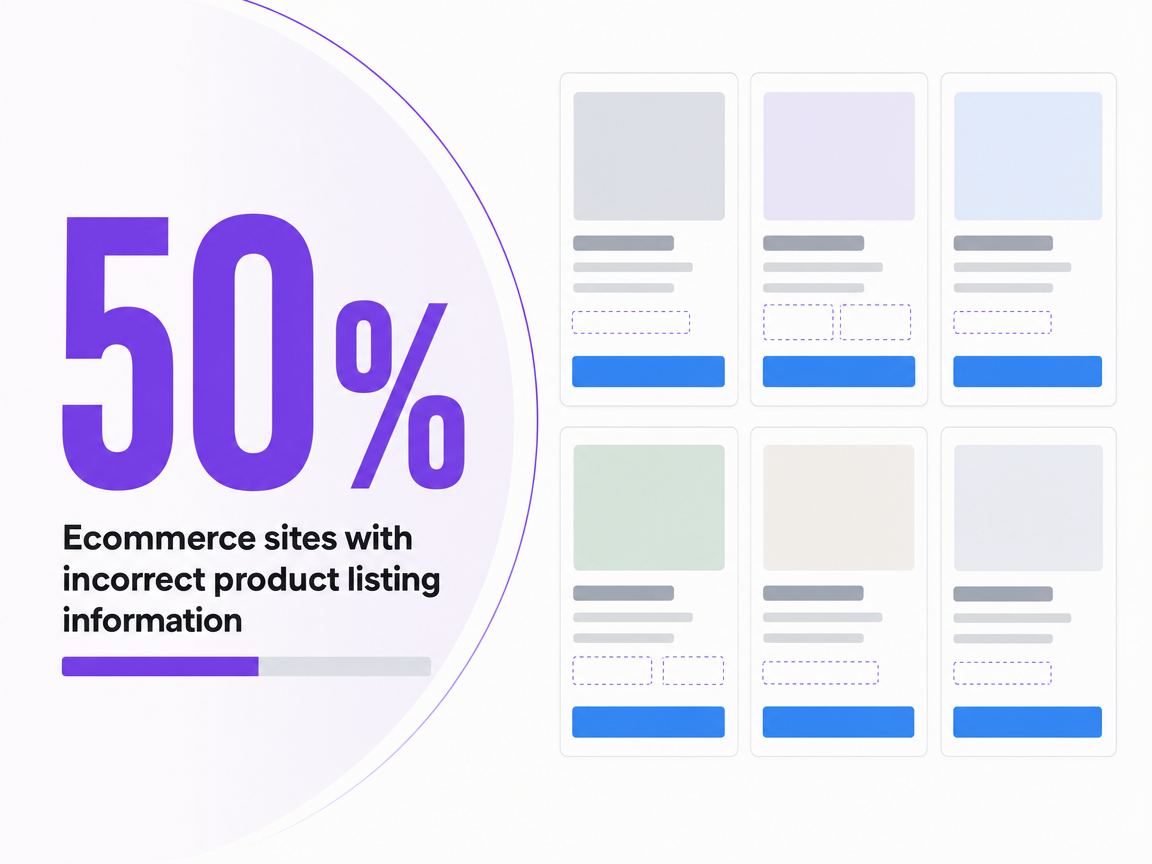
Category and index pages carry a scanning job. A visitor arriving from an organic query needs to compare options fast enough to decide which one to open. Baymard's usability testing of leading ecommerce sites found that 50% fail to include the attributes users need to evaluate items directly from the listing—specifically price, product title or type, thumbnail, user ratings average and count, and product variations—forcing users to click into each detail page to make any comparison at all 9. The consequence is measurable pogo-sticking back to the SERP.
The B2B translation is direct. A service-line index page that lists sub-services with only a name and a paragraph strips the reader of the same evaluation signals: delivery model, typical engagement scope, industries served, proof indicator. Baymard's product-list research adds that filters and sort controls should let users refine against the attributes that actually drive their decision, not the attributes easiest to build 7. On a B2B site, that means filtering resources by industry and stage, not by content format.
Detail pages carry a conversion job. The page has to close the gap between the promise the SERP made and the action the buyer is ready to take: request pricing, book a consultation, download the proof asset. Google's ecommerce guidance treats detail pages as the anchor of the crawl path—every one must be reachable through crawlable links, and structured data should reinforce what type of page it is 2. That semantic reinforcement matters because it feeds the sitelinks and rich results that shape SERP appearance 5.
Proof pages—case studies, methodology explainers, customer stories—carry a credibility job. Stanford's research on web credibility found that visual design coherence strongly influences whether visitors trust a site enough to continue 16. Proof pages that read like sales collateral cost the conversion the category and detail pages just earned. The three instruments have to play in tune.
 Ecommerce sites with incorrect product listing information
Ecommerce sites with incorrect product listing information
Journey Design: Serving a Loop, Not a Funnel
The subsystems above assume a job the site has to do. That job is not "move a visitor from top to bottom." B2B buyers no longer travel a linear funnel. McKinsey's decision-journey work describes a loop where buyers consider a shortlist, evaluate options across sessions and channels, purchase, and then re-enter evaluation for expansion or renewal—often without returning to the initial consideration set 18. The same research group's newer B2B work finds buyers using more channels than ever and expecting consistent experience across each one 17. A site designed for a funnel will disappoint every visitor who is not on the step it assumes.
Loop-shaped journeys change what each page cluster has to do:
- Consideration traffic lands on evaluation content—comparisons, methodology explainers, sizing frameworks—and needs a clear path back to the service-line hub when the question narrows.
- Evaluators return to hubs and detail pages repeatedly, often on different devices, to confirm pricing logic, delivery model, and proof.
- Buyers already inside the pipeline still open the site to answer specific questions before internal approval.
- Post-purchase users pull documentation and expansion content that quietly seeds the next cycle.
Google and Forrester's 2024 buying-experience research found that navigation has to be tested across desktop and mobile as a single system, not two, because the same buyer moves between them mid-decision 10.
The design consequence is concrete. Every commercial hub needs an evaluation shelf beneath it and a proof shelf beside it, cross-linked so a returning visitor lands on the shelf that matches the question in their head—not the step a funnel diagram assigned them.
See How Systematic Website Design Drives Measurable SEO Performance
Request a walkthrough of an AI-powered workflow that integrates on-page, technical, and UX decisions—built for agencies and enterprise teams seeking predictable, data-backed SEO results at scale.
Migration Governance: Where VPs Lose the Most Traffic
Every redesign is a signal event. URL paths change, templates change, internal link patterns change, and the site that Google spent years learning is replaced with one it has to relearn. The pages that lose the most traffic in that transition are almost never the ones the team paid the most attention to. They are the deep, high-authority evaluation pages that quietly fed the commercial hubs and never made it onto the migration spreadsheet.
Google's guidance on 301 redirects is direct: when content moves, a permanent redirect from the old URL to the new one consolidates ranking signals rather than splitting reputation between duplicate versions 14. The operational discipline that follows is a full pre-migration URL inventory—every indexed page, every page receiving organic sessions, every page receiving internal links from another page that ranks—mapped one-to-one to a destination on the new architecture. Bulk redirects to the homepage or to a top-level category collapse the very signal the redirect was meant to preserve.
Three governance rules keep migrations from bleeding traffic:
- Freeze URL patterns before the redesign begins; if folder names are going to change, change them once and lock the vocabulary to the topical architecture.
- Map redirects at the page level, not the pattern level, for any URL with earned authority—pattern rules catch the long tail, but the top 200 pages deserve individual attention.
- Audit the new site's internal links before launch so that redirected URLs are updated to point at their new destinations directly, avoiding redirect chains that dilute the signal each hop 14.
The redesign that ships without this discipline is the one whose organic line goes flat for two quarters and no one can explain why.
The Coordination Cost of Fragmented Execution
Most sites that fail the systems test do not fail from ignorance. Someone on the team knows the URLs should stay stable. Someone knows the category pages need scannable attributes. Someone knows the 301 map has to be built page by page 14. The knowledge exists. What breaks is the handoff between the people who hold each piece of it.
The typical stack has an SEO agency writing recommendations that a dev vendor implements on a template a UX contractor designed, populated by a content agency that never saw the keyword strategy. Each vendor is competent inside their scope and blind outside it. Contentsquare's B2B conversion research makes the same point from the measurement side: enterprise sites move the pipeline number when structure, content, and analytics are coordinated as one loop rather than sequenced as three deliverables 15. Fragmented execution is why redesigns ship on time and still lose organic sessions.
For VPs overseeing multi-location or multi-brand portfolios, the coordination math changes. Every additional brand or region multiplies the vendor interfaces, and the cost of a single misaligned decision—an inconsistent URL pattern across markets, a proof template that varies by location—compounds across the portfolio.
| Function | Traditional Vendor Stack | Unified AI Execution |
|---|---|---|
| SEO strategy & audits | Monthly retainer, varies by market | Included in platform |
| Content production | Per-project + revision cycles | Included in platform |
| Dev/UX implementation | Hourly or per-scope, varies | Approval-gated execution |
| Technical SEO consulting | Project-based, varies | Included in platform |
| Internal coordination hours | Significant weekly load | Single approval workflow |
| Platform cost | Sum of above | $599/mo after trial |
The variable that dominates is not the sum of retainers. It is the marketing team's own hours spent briefing, reconciling, and re-briefing across vendors who do not share a working model of the site. Consolidating strategy, production, and publishing behind one approval workflow removes the interface, not the judgment. The VP still owns every decision. The site stops paying the tax on decisions that never got made because no one owned the handoff.
A Diagnostic for the VP: Compound or Leak?
Every structural decision on a site either compounds authority and conversion signal or leaks it. That is the only question worth asking during a design review. A ten-minute audit produces more direction than a fifty-page technical report when it runs against the five subsystems in order.
- Topical architecture. Can the site's five to eight core clusters be named without opening a nav menu? If not, the domain has not decided what it is about, and downstream fixes cannot rescue it 3.
- URL and navigation hierarchy. Does every commercial hub sit within three clicks of the homepage, on a descriptive path that reads like a sentence 1? Does the primary menu contract match the cluster list, or does a strategy-deck category exist nowhere in the top nav?
- Internal link economy. Do the pages with the most authority point at the pages with the most pipeline potential, using anchor text that reuses the target's core vocabulary 5, 6? Or do blog posts link sideways forever while hubs starve?
- Page-type UX. Do category and index pages carry the attributes a buyer needs to compare without clicking through? Do detail pages close the gap between SERP promise and conversion action 2? Do proof pages read like evidence, not collateral 16?
- Migration governance. Is there a live URL inventory, mapped page by page, ready before the next redesign kickoff 14?
Any subsystem that fails its question is leaking. Fix them in order. The one above always constrains the one below.
Frequently Asked Questions
References
- 1.URL Structure Best Practices for Google Search.
- 2.Help Google understand your ecommerce website structure.
- 3.Google Search Essentials (formerly Webmaster Guidelines).
- 4.Search Engine Optimization (SEO) Starter Guide.
- 5.Learn About What Sitelinks Are.
- 6.Website Navigation: 7 Essential Best Practices.
- 7.Product List UX Best Practices 2025.
- 8.What Is an Ecommerce Filter? UI Best Practices.
- 9.What Information to Display in Product Listings (50% Get It Wrong).
- 10.Digital Buying Experiences Win Business.
- 11.URL Structure Best Practices for Google Search (Hindi version).
- 12.ई-कॉमर्स वेबसाइट का नेविगेशन स्ट्रक्चर | Google Search Central.
- 13.Filtering UX: “Visual” Filters.
- 14.Use 301 redirects for moved content.
- 15.The B2B Conversion Playbook for Digital Teams.
- 16.Stanford Guidelines for Web Credibility.
- 17.The new B2B growth equation.
- 18.The consumer decision journey.