
Key Takeaways
- Position-first SEO stalls pipeline because rankings measure SERP visibility, not whether visitors complete the task a page was built to serve.
- Website optimization works as three connected layers: search eligibility, experience conformance, and evidence loops that tie page changes to revenue outcomes.
- Define scenarios of use, baselines, quantitative requirements, and verification methods before touching a page, so 'done' means the numbers met the target 8.
- For multi-location operators, fragmented vendor stacks break the evidence loop across locations; consolidation, not vendor selection, is the decision that protects pipeline attribution.
The Rankings Trap: Why Position-First SEO Stalls Pipeline
Ranking reports often highlight superficial achievements. A page moving from position eleven to four might look good on a dashboard, but it doesn't necessarily translate to qualified leads or pipeline growth. This disconnect between visibility metrics and revenue metrics can cause organic programs to stall for marketing leaders accountable to CEOs or CROs.
The issue isn't that rankings are irrelevant, but that position-first optimization views the search result as the ultimate goal. This approach overlooks two critical factors for pipeline generation: whether visitors complete the intended task on the page and whether the team can demonstrate that site changes directly led to these outcomes.
Federal guidelines support this perspective. Digital.gov, the U.S. General Services Administration's resource for public-sector web teams, defines effective SEO as a function that promotes transparency and improves user experience, rather than merely chasing algorithmic positions 11. Similarly, NIST's user-centered usability process emphasizes understanding users, setting performance objectives, and iterative testing to meet those objectives 5. Neither framework considers keyword position as a standalone success metric.
Consequently, when rankings are the primary focus, optimization targets what search engines measure on the SERP. However, when task completion and verifiable evidence are central, optimization aligns with what the business can measure in terms of pipeline impact.
This analysis redefines website optimization SEO around three interconnected layers: search eligibility, experience conformance, and evidence loops. It posits that consolidating these layers, rather than acquiring more tools or agencies, is the true differentiator.
A Three-Layer Operating Model for Website Optimization
Layer One: Search Eligibility as a User-Experience Function
Eligibility is the point where search engine crawlers and human users' needs converge. A page is truly eligible for organic pipeline only if a search engine can render, index, and match it to user intent, and if the user who clicks the result can immediately confirm they've landed in the right place.
Most in-house teams are familiar with the technical requirements:
- clean canonicals
- correct status codes
- valid structured data
- indexable JavaScript
- an XML sitemap reflecting live URLs
- mobile parity
The common mistake is to treat this checklist as a machine-focused discipline separate from user experience. Digital.gov, for instance, frames SEO as enhancing user experience, positioning eligibility signals as service-delivery indicators rather than just ranking factors 11.
This reframing alters prioritization. Structured data becomes a comprehension tool for both crawlers and assistive technologies. Heading hierarchy serves as a navigation aid, not just a keyword placement. Internal linking becomes routing logic to facilitate the visitor's task. Page titles and descriptions become the initial, honest promise about the content found after clicking.
When eligibility work is approached this way, teams avoid implementing technical fixes that improve crawl metrics but fail to drive qualified traffic. Every eligibility change should be paired with two questions: "Which task does this page serve?" and "Does this change make that task easier to start?" Without this pairing, the layer generates activity, not pipeline.
Layer Two: Experience Conformance That Keeps Users in the Funnel
After a user clicks, the experience layer determines whether the visit converts or leads to abandonment. Here, Core Web Vitals, accessibility conformance, and task-flow design function as a unified retention system.
Accessibility provides a clear illustration. The DOJ's web guidance highlights alt text, captions, form labels, keyboard access, headings, and zoom capability as essential practices for user navigation 1. Each of these also serves as a signal that crawlers and assistive technologies use to interpret the page. For example, a missing form label disrupts both screen-reader flow and semantic structure. A caption failure impedes a deaf visitor and removes indexable text from a video. Conformance work is inherently retention work.
The current technical standard is WCAG 2.2, which includes nine new Success Criteria compared to WCAG 2.1, as confirmed by the U.S. Access Board 4. These additions address common points of funnel breakage, such as:
- focus appearance for keyboard users
- single-pointer alternatives for dragging movements
- appropriate target sizes for touch interactions
- consistent help placement across pages
Section 508 guidance for federal procurement aligns with these WCAG-based expectations, which is crucial for teams selling to government-adjacent clients 3.
Marketing leaders who view this solely as a compliance exercise miss the operational benefit. The nine WCAG 2.2 additions directly address common conversion frictions: forms that fail on mobile due to small targets, checkout processes that hinder keyboard users, and inconsistent help content that disorients returning visitors. Resolving these issues improves task completion for all visitors, not just those with disabilities.
Experience conformance also generates secondary benefits that search systems reward. Pages that retain users, satisfy their intent, and reduce "pogo-sticking" back to the SERP send positive behavioral signals. This layer's purpose is to make these signals a natural outcome of accessible, fast, and coherent design, rather than a direct optimization target.
Layer Three: Evidence Loops That Prove Revenue Impact
This third layer is frequently overlooked. While eligibility and experience work produce outputs—shipped pages, met criteria, passed vitals—these outputs alone don't prove pipeline impact. Evidence loops do.
An evidence loop is a closed system connecting a page hypothesis, the change implemented to test it, the measured outcome, and the subsequent decision. NIST's user-centered usability process outlines this standard practice: understand users, set performance objectives, and conduct iterative usability tests against those objectives 5. This framework positions measurement as the core purpose of the work, not an afterthought for reporting.
For an SEO program, this translates to a per-page contract. Each priority page has a defined task—e.g., request a consultation, book an appointment, download a report—and a quantitative objective tied to that task, such as success rate, time on task, error rate, and downstream conversion. Rankings and sessions become upstream indicators, not the primary metric.
Two operational practices are essential for maintaining the loop:
- Baseline every priority page before optimization to accurately attribute post-change deltas to the changes themselves, rather than seasonality or channel mix.
- Operationally define measures—what constitutes a task start, completion, or error—before running any tests.
NIST's guidance on integrating usability standards throughout the development lifecycle advocates for this discipline, embedding measurement into ongoing operations instead of reserving it for launch audits 7.
The payoff of this layer is cumulative. Each completed evidence loop on a priority page yields reusable insights: which headline style increases consultation requests in a specific vertical, which form pattern reduces mobile drop-off, or which internal linking strategy routes more high-intent traffic to conversion pages. Programs lacking this layer repeatedly learn the same lessons.
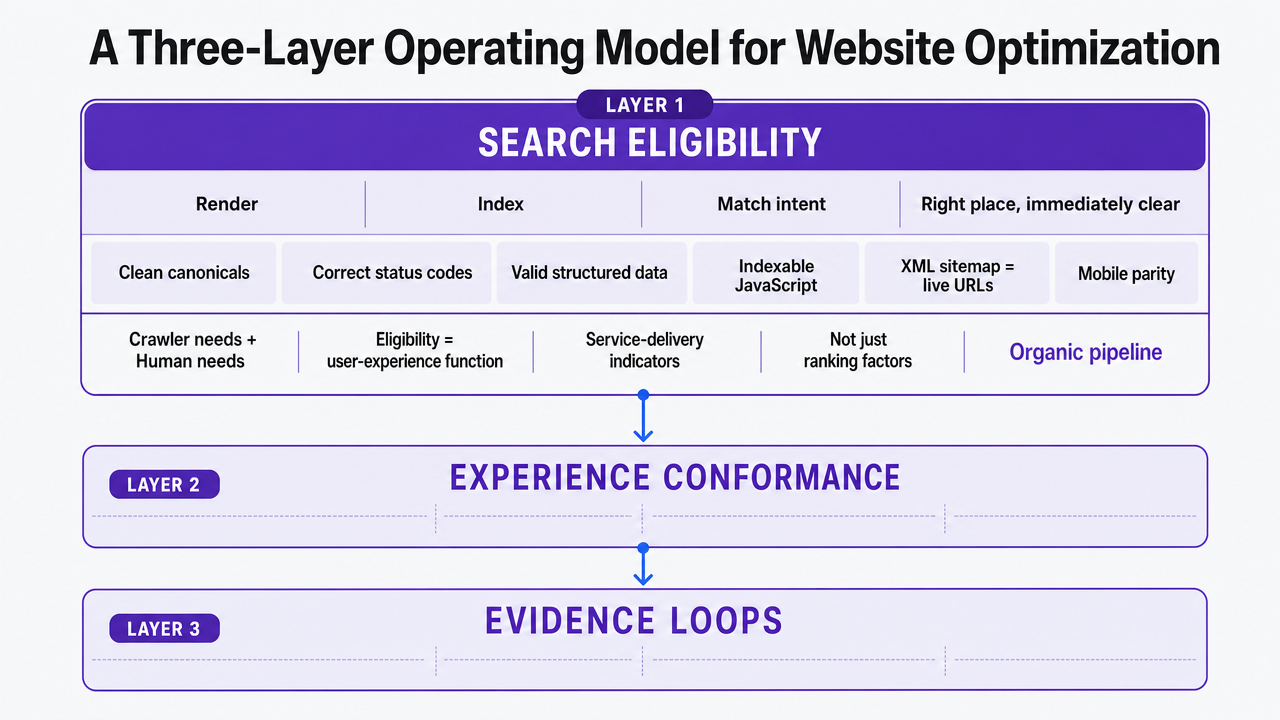 Visualize the three interconnected layers (search eligibility, experience conformance, evidence loops) that structure the article's operating model framework
Setting Performance Objectives Before Touching the Site
Most optimization efforts begin with a symptom—flat traffic, a competitor outranking a key page, a CRO requesting a demo form lift—and immediately jump to a solution. The crucial skipped step is defining what the page is supposed to achieve, for whom, and at what measurable level, before any changes are made.
NISTIR 7432, the federal Common Industry Specification for Usability, precisely defines this step. It states that a usability process should define scenarios of use, establish baseline measures, set quantitative requirements, and verify them through testing 8. These four components, in order, directly translate into auditable objectives for SEO landing page optimization:
- Scenarios of use are paramount. For a consultation-request page, the scenario isn't "visitor learns about the service." Instead, it's a specific user segment arriving from a particular query class, with a defined task—request a consultation, submit intake, schedule a call—completed within a specific device and session context. This scenario names the user, their entry point, and the completion event.
- Baseline measures follow. Before any headline tests or form redesigns, the team must capture current metrics: task success rate, time on task, error rate on form fields, and the downstream conversion that truly matters to the sales team. Without baselines, any post-change data is anecdotal, not evidence.
- Quantitative requirements convert the scenario into a target. For example, a page might aim to increase its consultation-request rate from 18 percent to 26 percent within two release cycles. The specific number is flexible, but the discipline of setting one is not.
- Verification testing concludes the specification. The team pre-determines the method—moderated task testing, unmoderated remote sessions, or instrumented live traffic—that will prove the requirement was met, and what sample size ensures trustworthy results.
NIST's user-centered process reinforces this sequence: understand users, set performance objectives, and iteratively test against them 5. This order is critical because it redefines "done." A team without pre-set objectives ships a page when it looks complete. A team with objectives ships a page when the numbers meet the requirement, and continues optimizing if they don't.
For a VP of marketing, the practical outcome is a more concise quarterly review. Every priority page comes with a one-page objective sheet—scenario, baseline, requirement, verification method—attached before work begins. Optimization transforms from a list of activities into a portfolio of contracts that the team either fulfilled or did not.
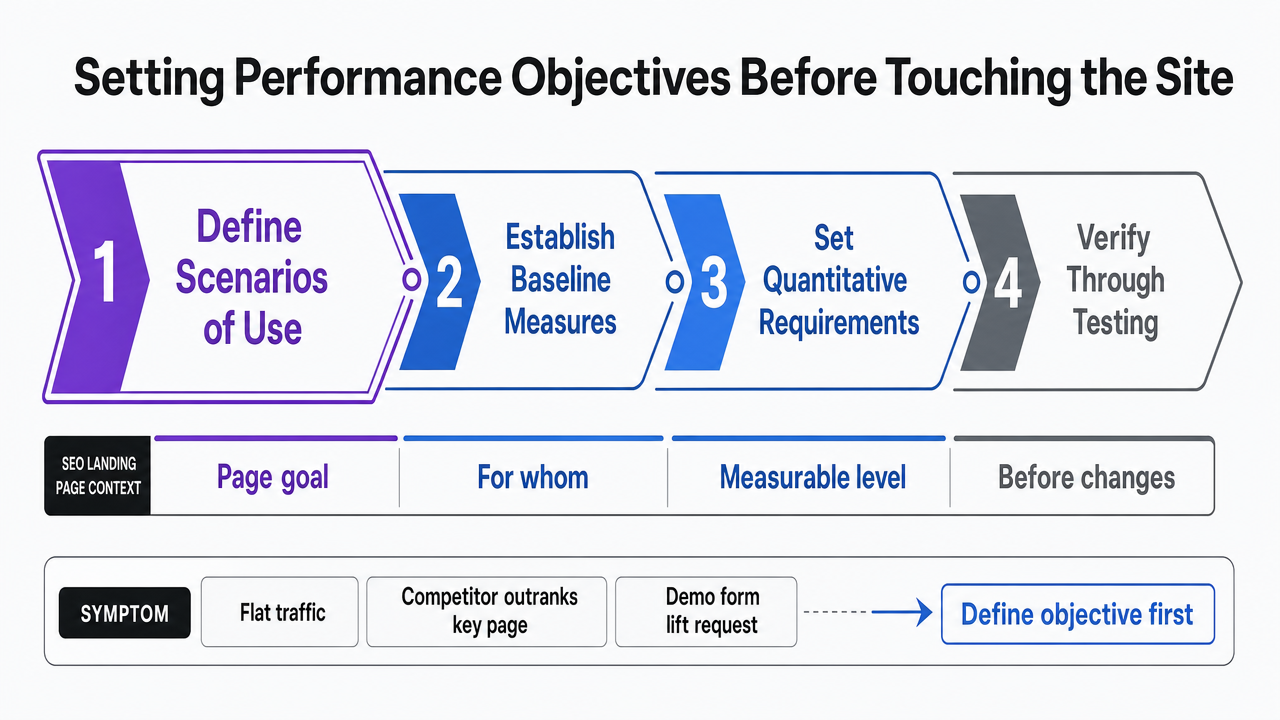 Visualize the four-step NISTIR 7432 sequence cited in this section for defining performance objectives before optimization work
Test Full-Funnel SEO Execution in Real Time
See measurable SEO impact on your website with live content published during your trial period.
The Regulatory Floor Marketing Leaders Cannot Ignore
Accessibility law now establishes the minimum requirements for a website before any discussion of rankings. The DOJ's 2024 rule for web content and mobile app accessibility for state and local governments mandates WCAG 2.1 Level AA as the technical standard, with varying compliance dates based on government size 2. While private-sector VPs of marketing aren't directly subject to Title II, this rule is significant for two operational reasons.
First, procurement extends this standard to private-sector work. Any team selling to government-adjacent clients—such as legal services for public contracts, healthcare systems linked to Medicaid, or home services vendors for municipal accounts—will encounter accessibility expectations through purchasing requirements. Section 508 guidance, which governs federal procurement, already aligns with WCAG-based expectations 3. When a public buyer's own site must meet WCAG 2.1 AA, their vendor's pages are often held to the same standard.
Second, the standard itself is evolving. The U.S. Access Board confirmed the publication of WCAG 2.2, which introduces nine new Success Criteria beyond WCAG 2.1 4. While regulators typically adopt newer versions with a delay, private litigation and enterprise procurement often move faster. Teams currently building to WCAG 2.1 AA should incorporate the 2.2 additions—focus appearance, dragging alternatives, target size, consistent help—into their next release cycle.
The DOJ's own web guidance identifies practical practices that satisfy the rule and also serve as quality signals for search systems and assistive technologies:
- text alternatives
- captions
- form labels
- keyboard access
- headings
- zoom support
A marketing leader who treats these six items as non-negotiable page requirements can mitigate most regulatory exposure and funnel friction simultaneously 1.
This regulatory floor is not the ultimate ambition, but it represents the minimum standard below which optimization work becomes indefensible. Programs operating below this standard accumulate two liabilities: a regulatory burden influenced by Title II expectations extending into private-sector norms, and an experience layer that loses conversions that eligibility efforts worked to attract.
The Common Industry Format as an Optimization Reporting Template
Optimization work that cannot be replicated cannot be justified. A quarterly presentation filled with screenshots and directional charts might show a CEO that the team was busy, but it won't tell a CRO which page change improved which pipeline metric, under what conditions, or if the finding will hold in the next release.
The federal Common Industry Format (CIF) for Usability Test Reports addresses this for usability teams, and it applies directly to SEO landing page optimization. This reporting standard specifies operational definitions for measures, procedures, participant instructions, and test details. These artifacts allow a second reader to reproduce the test and trust its results 9. Adopting this structure provides marketing leaders with a reporting template that withstands audits, vendor changes, or personnel shifts without losing institutional knowledge.
Six key fields are particularly important when applying the CIF to a priority page:
- Scenario of use identifies the user segment, the entry query class, and the task the page must facilitate.
- Operational metric definitions precisely state what counts as a task start, completion, error, and abandonment, ensuring consistent measurement across quarters.
- Participant profile specifies who generated the data, whether it's live traffic segmented by source, a moderated test panel, or an unmoderated remote sample.
- Procedure documents the change being tested, the release window, and traffic conditions.
- Results reports task success rate, time on task, and error rate against the pre-set requirement.
- Findings articulates the decision supported by the data: ship, iterate, roll back, or expand the pattern to similar pages.
Two disciplines enhance the template's effectiveness. First, metric definitions must remain consistent across reports. A team that redefines "consultation request" mid-year loses the ability to compare Q1 and Q3, rendering previous reports less useful. Second, findings should be documented before the next test is scoped, ensuring each cycle builds on previous evidence rather than starting from scratch. NIST's guidance on integrating usability standards throughout the development lifecycle emphasizes this continuous measurement practice 7.
For a VP presenting to the executive team, the benefit is a portfolio of one-page reports, one for each priority page, each answering the same five questions in a consistent format. These reports become evidence-based rather than narrative. When the CFO questions SEO investment, the answer is a stack of verified requirements met, not just a rankings screenshot.
See How Data-Driven Website Optimization Delivers Measurable Pipeline Gains
Request a demonstration of AI-powered multi-channel SEO execution workflows proven to accelerate qualified traffic and conversion rates—without expanding your team or adding vendor complexity.
Consolidation Economics for Multi-Location Operators
When the Vendor Stack Breaks the Evidence Loop
This section shifts focus from single-site programs to portfolio operators—such as multi-location legal networks, DSOs, home services franchises, senior living groups, or behavioral health rollups—where optimization work applies to dozens or hundreds of location pages simultaneously. The economic implications discussed here are relevant for teams managing such a footprint.
Fragmentation is common. A typical setup involves:
- an SEO agency for technical audits and content briefs
- a separate development shop for site changes
- a UX or CRO vendor for testing
- an accessibility firm for conformance scans
- an in-house team attempting to integrate these outputs
Each vendor produces reports in its own format and on its own schedule.
This fragmented approach breaks the evidence loop. NIST's user-centered process emphasizes measurement as a closed circuit: set objectives, test iteratively, and verify against requirements 5. When the objective resides with the SEO agency, changes are implemented by a dev shop, tests are run by a CRO vendor, and accessibility scans arrive weeks later from a fourth party, no single entity oversees the entire loop. The lifecycle view recommended by NIST—integrating usability standards throughout development, not just auditing at launch—collapses when multiple vendors each own a different phase 7.
For a portfolio operator, this loss is compounded by the number of locations. An insight that could inform one page cannot be easily applied across dozens of others.
Fragmented Stack vs. In-House Build vs. Unified Workflow
Marketing leaders typically face three operating models. The table below uses variables instead of fixed benchmarks, as costs for retainers, salaries, and coordination vary by market and industry. The VP can input their specific numbers to compare the outlined line items.
| Line item | Fragmented agency stack | Expanded in-house team | Unified AI-assisted workflow |
|---|---|---|---|
| Monthly cost load | Sum of SEO, content, dev, CRO, and accessibility retainers ($A + $B + $C + $D + $E per month, often scaled per location) | Loaded salary for added SEO, content, UX, and accessibility roles ($F fully burdened per hire, per year) | Platform subscription plus internal approver time (trial entry point at $599/mo for the referenced platform) |
| Briefing cycle time | Days to weeks per request, multiplied across vendors | Hours to days, gated by internal capacity | Hours, generated from live site and channel data |
| Approval-to-publish latency | Multiple handoffs between strategy, production, and dev | Single queue, bounded by team headcount | One approval gate, execution after sign-off |
| Vendor coordination hours | High; status meetings and status decks per vendor per week | Low; internal standups replace vendor calls | Low; coordination absorbed by the workflow |
| Evidence-loop integrity | Fragmented; each vendor reports in its own format | Consolidated if the team enforces one reporting standard | Consolidated by design; SEO, UX, and conversion data share one system |
Two lines in the table carry significant weight. Coordination hours represent the cost portfolio operators pay for a fragmented stack, and these hours scale with the number of locations, not just output. Evidence-loop integrity determines whether a program can justify its results to the CFO. The Common Industry Format's requirement for consistent operational metric definitions across reports 9 is only enforceable when those definitions are centralized.
An expanded in-house team can resolve the evidence problem if a single reporting standard is enforced, but this comes with a linear increase in salary costs. A unified workflow, such as offered by Vectoron, addresses both coordination and evidence issues without requiring additional headcount. This is why consolidation, rather than vendor selection, should be the primary differentiator marketing leaders evaluate. The key question for a VP is whether their current setup can close the evidence loop across all locations, not simply which vendor manages which layer.
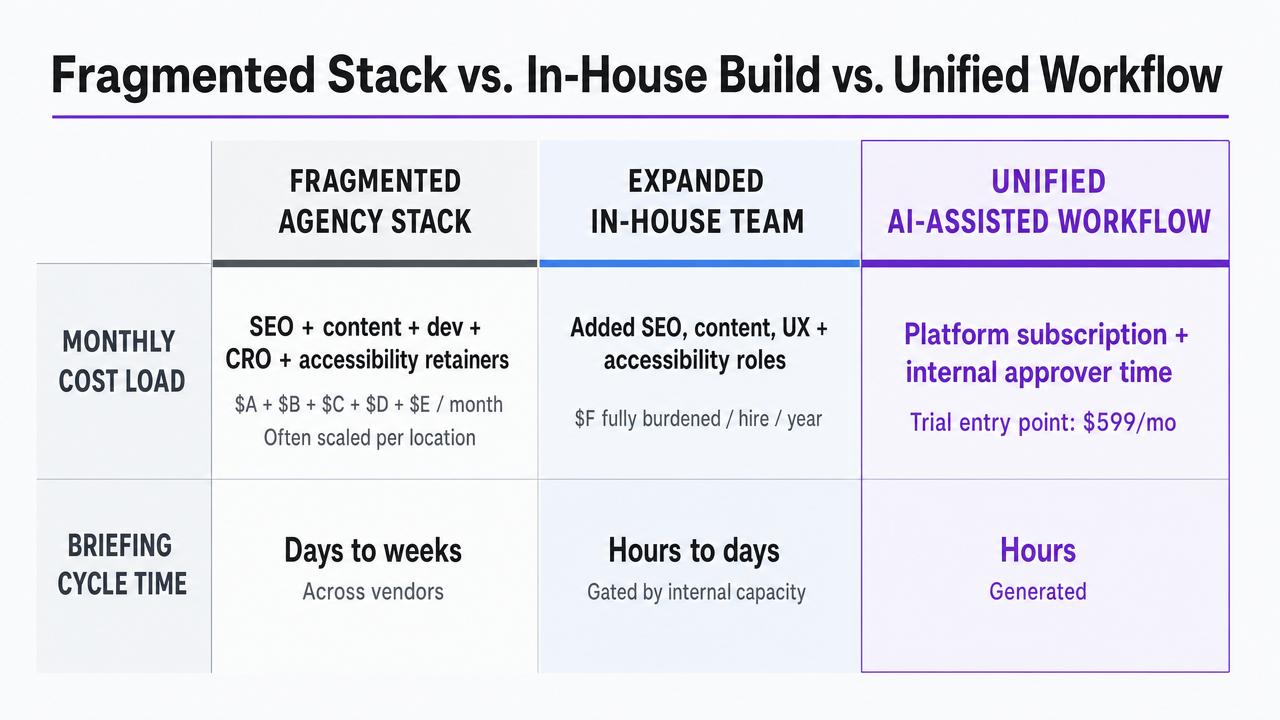 Visualize the three operating model comparison discussed in this section (fragmented agency stack vs expanded in-house team vs unified AI-assisted workflow) across the key evaluation criteria
Governing Optimization as a Continuous Lifecycle
Optimization programs decline when treated as finite projects. A site relaunches, an audit passes, a scorecard turns green, and the discipline that achieved these results gradually dissipates into ticket queues. Months later, the same team finds itself scoping another audit for a site that has deviated from its previous standards.
NIST's guidance on integrating usability standards throughout the development lifecycle offers an alternative: measurement and conformance should be part of ongoing operations, not just launch-day audits 7. This lifecycle perspective ensures that every release—a new location page, a form redesign, a template change, a Core Web Vitals patch—triggers a re-verification of eligibility, experience, and evidence against the same requirements met by previous releases.
Three governance habits implement this view:
- Every priority page has a named owner and a standing objective sheet. The scenario of use, baseline measures, and quantitative requirements defined earlier 8 remain with the page, not with the last person who edited it. When the page changes, the sheet updates; when the sheet updates, a verification test runs.
- The Common Industry Format report 9 is generated on a fixed cadence, not on demand. Quarterly is a practical minimum for portfolio operators, while monthly is suitable for pages driving significant pipeline. This cadence eliminates reporting negotiations from executive reviews.
- High-stakes industries apply the technical rigor documented by NIST for risk-sensitive interfaces: repeated evaluation of designs in progress, pilot testing before full rollout, and residual-risk review after release 10. For legal, healthcare, dental, and senior living operators, this discipline differentiates between a page that loses conversions and one that creates operational risk.
Governed in this manner, website optimization SEO transcends being a rankings project. It becomes what the underlying search intent truly demands: a continuous operating system for organic pipeline, managed against standards a VP can confidently defend to any executive.
Frequently Asked Questions
References
- 1.Guidance on Web Accessibility and the ADA.
- 2.Fact Sheet: New Rule on the Accessibility of Web Content and Mobile Apps Provided by State and Local Governments.
- 3.Developing Accessible Web Content - Section508.gov.
- 4.W3C WCAG 2.2 Now Available.
- 5.User-Centered Usability Engineering Processes for Websites.
- 6.NIST Guide to the Processes Approach for Improving the Usability of Health IT.
- 7.USABILITY STANDARDS ACROSS THE DEVELOPMENT LIFECYCLE.
- 8.NISTIR 7432 Common Industry Specification for Usability.
- 9.Common Industry Format for Usability Test Reports.
- 10.Technical Basis for User Interaction Design Considerations for Health IT.
- 11.Search Engine Optimization | Digital.gov (U.S. General Services Administration).