
Key Takeaways
- Rank tracking is no longer the bottleneck; analyst time spent interpreting movements across nine Google-documented signal surfaces now determines how many accounts an agency can scale.
- Multi-property performance data must respect Search Console API quotas, querying one day at a time and backfilling per property to avoid silent failures during dashboard refreshes 2.
- Rendered-page inspection across crawl, render, and index stages catches JavaScript sites where H1s, canonicals, or schema depend on fetches Googlebot never completes 4.
- Canonical reconciliation should compare declared canonicals, Google-selected canonicals, sitemap URLs, and redirect endpoints to expose why rankings rotate across near-duplicate clusters 5, 6.
- Sitemap-to-index reconciliation treats sitemaps as claims to verify, grouping mismatches like redirects, noindex, or non-canonical variants by root cause and owner 7.
- Core Web Vitals must be reported by device at the 75th percentile and grouped by template, since site-wide scores mask template-level failures on mid-range mobile devices 10.
- Structured data validation requires mapping supported types to template classes and revalidating nightly, since Google's required properties and eligibility rules change over time 11, 12.
- Mobile and desktop parity diffs should flag missing content, divergent metadata, and schema objects absent from the mobile render, which Google uses for indexing 13.
- Hreflang validation needs bidirectional checks confirming counterparts return 200, reference back, and share canonicals, with errors grouped by HTML, header, or sitemap method 14.
- Spam-policy monitoring must extend beyond link counts to scan inbound link patterns and AI-assisted content output for scaled abuse, site-reputation abuse, and cloaking 8.
- Approval and execution workflow turns issue queues into governed tasks with evidence, owners, and recorded decisions, removing the coordination burden that erodes agency margins.
- Portfolio economics favor coordinated platforms that reduce analyst hours per account across all nine capabilities, freeing capacity for strategic work rather than linear headcount growth.
Why rank tracking stopped being the scaling constraint
Position tracking has become a commodity. While vendors can easily provide daily SERP snapshots for numerous keywords, the real challenge lies in the analyst time required to interpret these movements. This includes understanding why a ranking changed, confirming the indexed page is the intended one, and prioritizing technical work across multiple client properties.
Google's documentation highlights the complexity of this work. Search Console offers performance data by query, page, country, device, and search appearance 1, with the searchanalytics.query method providing programmatic access 3. Beyond this, critical areas include crawl and render diagnostics 4, canonical reconciliation 5, sitemap-to-index validation 7, Core Web Vitals field data 9, structured data validation 11, mobile-first parity 13, hreflang implementation 14, and spam-policy exposure 8. These nine distinct signal surfaces demonstrate the need for advanced tools to prevent analysts from being overwhelmed.
The following sections evaluate each capability based on its impact on analyst hours per account, rather than just its presence in a feature list.
Multi-property performance data without the quota wall
A key differentiator for a scalable ranking tool is its ability to consume Search Console data across numerous properties without encountering sampling issues or API limits. Google's Search Console Performance Report provides impression and click trends by query, page, and country 1, and the searchanalytics.query method is crucial for automated reporting 3. Tools that only offer property-level aggregates force analysts to manually reconstruct detailed drill-downs.
Each dimension of the Performance Report addresses specific analytical needs:
- Query data reveals keyword movements.
- Page data identifies the exact URL Google is surfacing, which may differ from the client's intended page.
- Country segmentation distinguishes traffic from different regions within the same property.
- Device data separates mobile from desktop for targeted troubleshooting.
- Search appearance flags indicate whether an impression originated from a rich result, sitelink, or standard blue link, influencing the interpretation of position numbers.
The underlying challenge is managing API behavior. Google's API guidelines recommend querying one day at a time to prevent quota issues and suggest retrieving search-appearance dimensions before adding page, country, or query dimensions 2. A ranking tool that disregards this guidance will likely fail when multiple client dashboards refresh simultaneously. Conversely, a well-designed tool will backfill data, respect per-property quotas, and reconcile sampled queries against page-level totals before an analyst even accesses the report. This efficiency can significantly increase the number of accounts an analyst can manage.
Rendered-page inspection across the crawl, render, index sequence
A position number alone doesn't reveal whether Google successfully processed the content intended to influence it. Google processes JavaScript applications in three stages: crawling, rendering, and indexing, with robots.txt checks preceding URL fetching 4. A ranking tool that only reports the final SERP result overlooks critical checkpoints where client-side sites often fail.
- The first checkpoint is fetch eligibility. Blocked scripts, disallowed API endpoints, or misconfigured robots.txt rules can prevent Googlebot from accessing essential page resources. The tool should identify URLs requested, blocked, or returning non-200 responses during Googlebot's fetch attempt, not just during a synthetic browser session.
- The second checkpoint is render output. A scalable ranking tool compares the raw HTML with the rendered DOM, highlighting content that appears only after JavaScript execution, such as primary copy, internal links, canonical tags, hreflang annotations, and structured data. If crucial elements like the H1 or product description are dependent on client-side fetches that Googlebot cannot complete, the page is effectively empty at index time, regardless of how it appears in a browser.
- The third checkpoint is indexation evidence. Successful rendering does not guarantee indexing. Therefore, the tool must reconcile rendered output with URL Inspection data and Search Console coverage status to confirm page health.
For large portfolios, this process can be time-consuming. While an analyst can manually spot-check a limited number of URLs, a tool that monitors all three stages can automatically flag pages with discrepancies between rendered and indexed content, directing analysts to specific issues rather than requiring them to search for them.
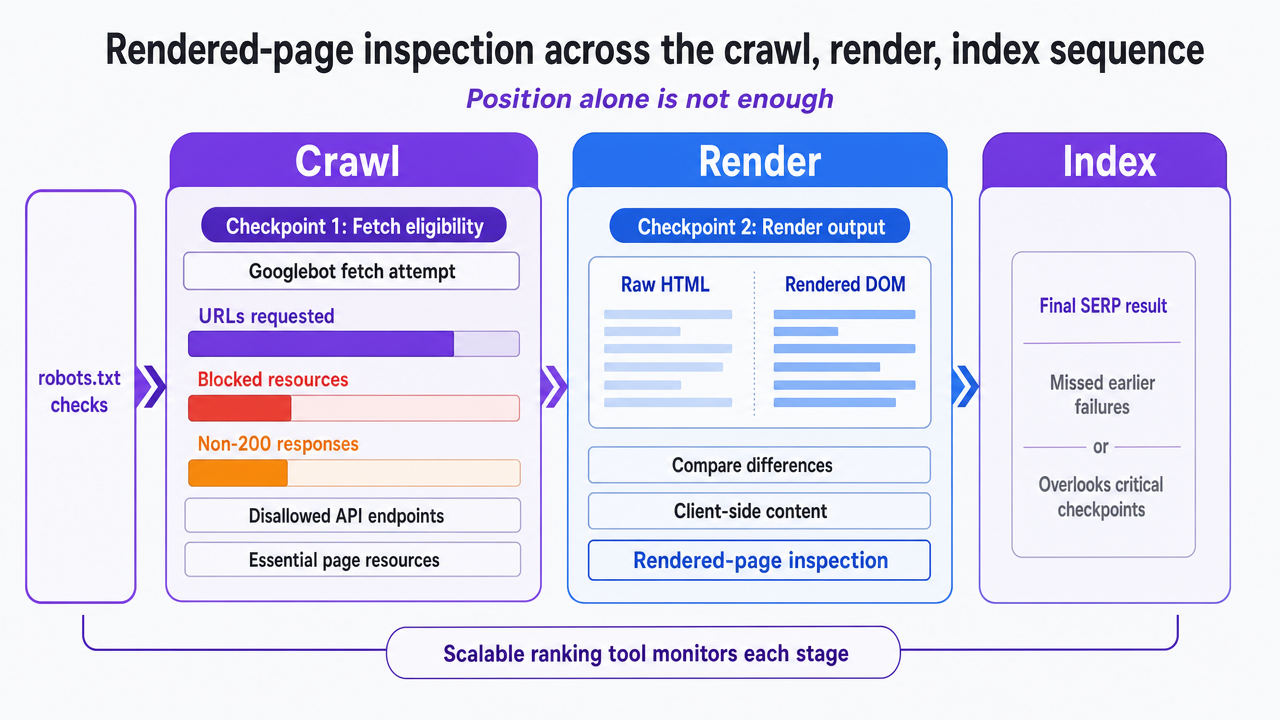 Visualize the three-stage crawl, render, index sequence cited from Google's JavaScript SEO documentation, showing the checkpoints a scalable ranking tool must monitor at each stage
Canonical reconciliation between declared and Google-selected URLs
Google defines canonicalization as the process of selecting the representative URL for a piece of content, considering signals like redirects, sitemap inclusion, HTTPS status, and rel=canonical annotations 5. The declared canonical is a signal, not a definitive command. A ranking tool that only reports the client's CMS declaration will miss the crucial information of how often Google aligns with that declaration across the portfolio.
The scaling capability here is reconciliation. For each important URL, the tool should track four data points:
- the declared canonical in the HTML,
- Google's selected canonical (from URL Inspection),
- the URL in the sitemap, and
- the final endpoint of any redirect chain.
Discrepancies among these points often explain ranking inconsistencies. For example, a product page with fluctuating rankings might be one of several near-duplicates where Google rotates its selection weekly. Visibility into these canonical clusters is essential for understanding such volatility.
Google's troubleshooting guidance emphasizes a similar workflow: checking Google's canonical selection, reviewing technical misconfigurations, and confirming that clustered pages are distinct enough to warrant separate URLs 6. A ranking tool designed for agency scale continuously performs this comparison, grouping exceptions by root cause. For instance, HTTP-to-HTTPS mismatches can be batched, as can parameterized duplicates or thin variants requiring consolidation. This approach allows the tool to surface critical canonical disagreements across multiple accounts, complete with technical signals, rather than requiring analysts to manually inspect individual URLs.
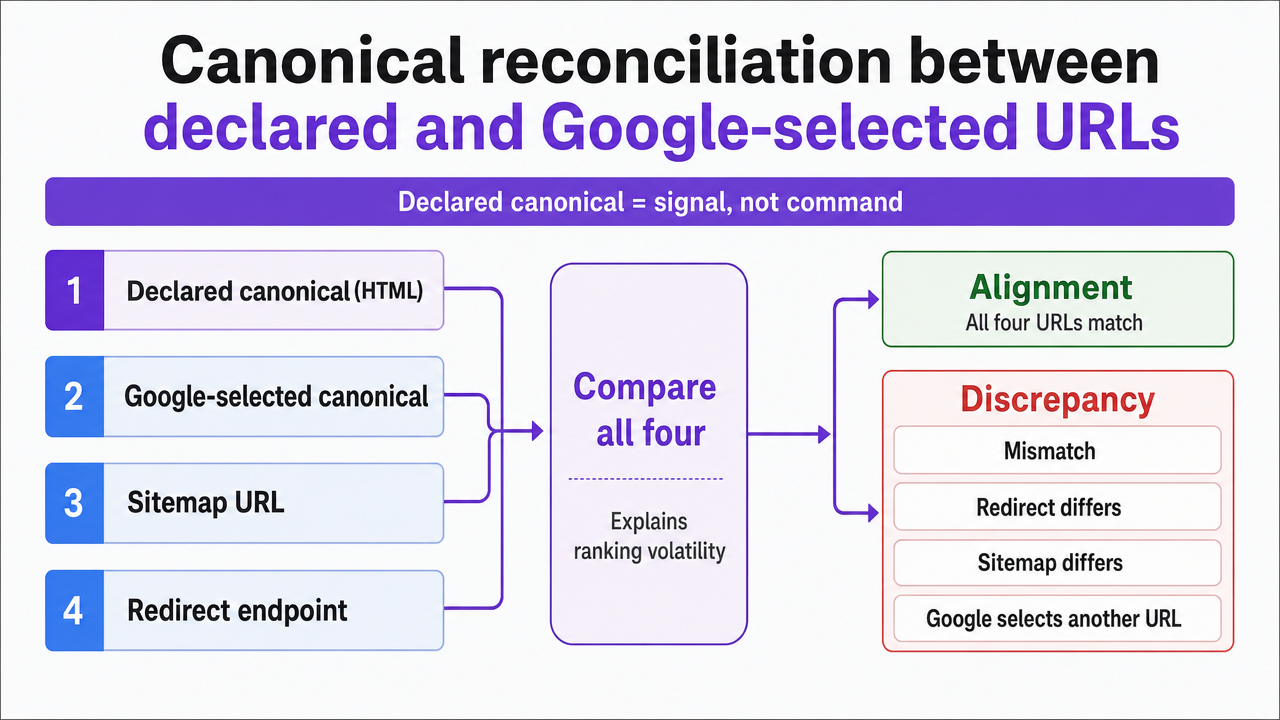 Illustrate the four-way canonical reconciliation described in the section (declared canonical, Google-selected canonical, sitemap URL, redirect endpoint) which the ranking tool must compare to explain volatility
Test AI SEO workflows with live client data
Experience measurable ranking improvements by running real campaigns before you commit.
Sitemap-to-index reconciliation as a portfolio-wide check
Google explicitly states that sitemaps aid search engine discovery and crawling but do not guarantee indexing 7. A ranking tool that treats a sitemap as an absolute source of truth, rather than a set of claims to be verified, risks reporting healthy coverage for properties where Google is silently ignoring a significant portion of submitted URLs.
The scaling capability involves a continuous three-way match: what the sitemap declares, what Search Console reports as indexed, and what the crawler finds when fetching each URL. Divergences typically fall into categories such as sitemap entries that redirect, resolve to non-canonical variants, return noindex, 404, or soft-404 responses, or are indexable but have never received impressions. Each category suggests a different fix and owner (development, content, or account strategy).
At a portfolio scale, this reconciliation eliminates the manual work of exporting Search Console coverage reports and cross-referencing them with sitemap XML. A ranking tool that performs this match nightly across numerous properties can highlight the specific URLs requiring attention, grouped by root cause, transforming the sitemap from a submission artifact into a verifiable inventory of what the client expects to rank.
Core Web Vitals reporting by device and percentile
Reporting a single Core Web Vitals score per URL is insufficient. Google defines Core Web Vitals as real-user experience measurements for loading performance, interactivity, and visual stability, recommending monitoring via the Search Console Core Web Vitals report rather than lab data 9. Field data and lab data serve different purposes, and optimizing solely based on lab scores can lead to misdirected efforts.
The web.dev thresholds are clear: LCP within 2.5 seconds, INP of 200 milliseconds or less, and CLS of 0.1 or less, all measured at the 75th percentile across mobile and desktop 10. A ranking tool built for agency scale should report each metric against these thresholds, segmented by device, at the specified percentile, and grouped by template. Failing to do so can obscure critical performance issues. For example, a retail category page that passes LCP on desktop but fails at the 75th percentile on mid-range Android devices is not healthy, and a site-wide score would mask this until traffic surges.
Template grouping is as important as device segmentation. Thousands of product URLs often share a few templates. Aggregating field data by template reveals which layout, component, or third-party script is negatively impacting performance. Without this grouping, an analyst might spend time optimizing individual URLs instead of addressing a single engineering ticket that fixes an entire template class.
It's important to note that good Core Web Vitals do not guarantee rankings, as Google considers them one factor among many in page experience and other ranking systems 9. A tool that provides pass/fail verdicts based on a composite score overstates its impact. However, a tool that surfaces the three metrics by device at the 75th percentile, grouped by template, and flags regressions against prior baselines, provides actionable insights for analysts.
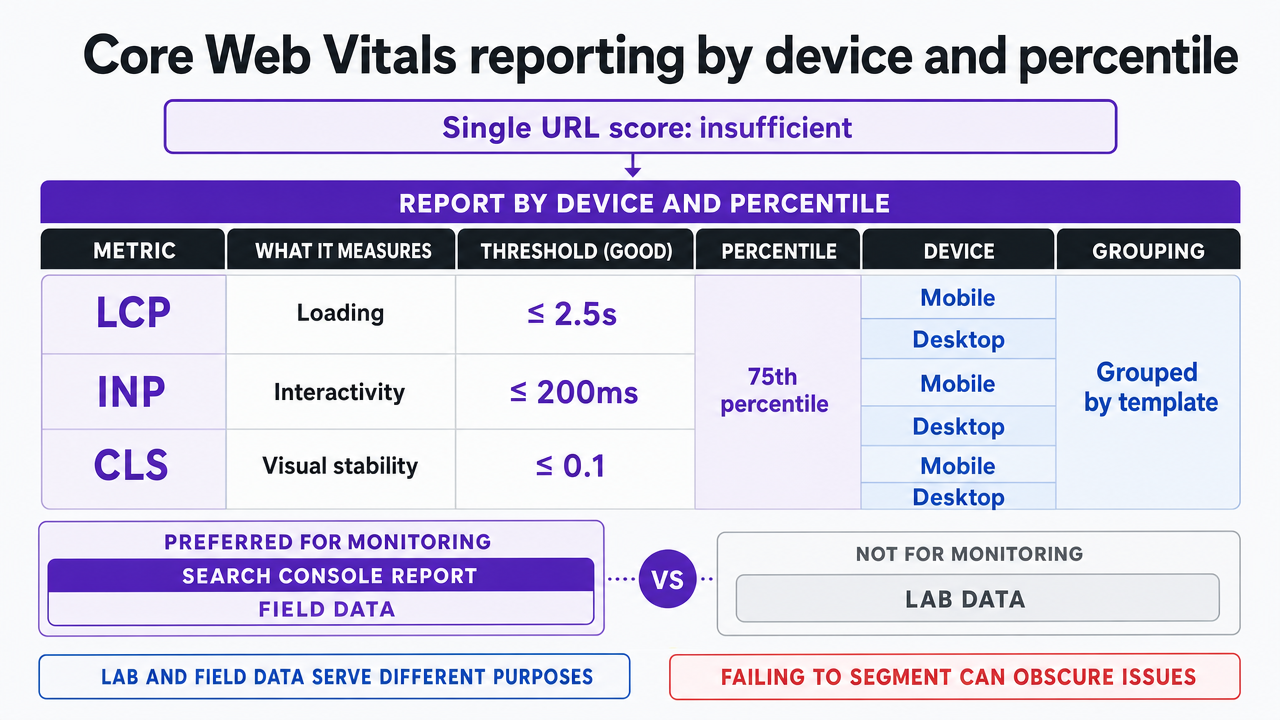 Present the specific Core Web Vitals thresholds cited in prose (LCP ≤ 2.5s, INP ≤ 200ms, CLS ≤ 0.1 at 75th percentile) so the numbers in the visual match the numbers in the section
Structured data validation mapped to supported result types
Structured data highlights the difference between a one-time audit and a continuous program. Google describes structured data as a standardized format for classifying page information, and rich result eligibility depends on the presence of required properties 11. A ranking tool that merely reports the presence of JSON-LD without validating required fields provides incomplete information.
The scaling capability has two components:
- Type-to-page mapping. Google's search gallery lists supported structured-data types and their potential appearances 12. A ranking tool for portfolio work should match each template class on a client site to the appropriate supported type. For example, product templates should use Product and Offer schema, article templates should use Article with required author, headline, and image properties, and local business templates should use LocalBusiness with relevant address and hours fields. Templates without a supported type should not have schema, avoiding the common practice of applying generic Organization markup everywhere.
- Continuous validation against evolving requirements. Supported types and required properties change, making one-time audits quickly outdated. A tool that revalidates nightly against current requirements, flags newly missing properties after a template deployment, and distinguishes eligibility errors from warnings provides analysts with a queue of pages that lost rich-result eligibility, rather than a static, outdated report.
Mobile and desktop parity checks that catch structured-data gaps
Google uses the mobile version of a site's content, crawled by the smartphone agent, for indexing and ranking, and recommends equivalent structured data on both mobile and desktop 13. This necessitates continuous parity checks across the portfolio for primary content, internal links, metadata, and structured data. If these elements differ between rendering paths, the mobile version takes precedence, potentially nullifying desktop assumptions.
Responsive templates often conceal these discrepancies. A dynamically served site might remove a FAQ block from the mobile version to shorten the page, causing the desktop's FAQPage schema to reference content the smartphone agent never sees. A separate m-dot subdomain might serve a lighter Product template lacking Offer or AggregateRating properties found on the desktop version. Even on fully responsive builds, a lazy-loaded review widget might render later on mobile than on desktop, leading to review markup existing in one index but not the other.
The scaling capability is a per-URL diff that flags four categories:
- content missing from the mobile render,
- internal links present only on desktop,
- title or meta description divergence, and
- structured-data objects or required properties appearing on one variant but not the other.
Across numerous accounts, this diff allows for the immediate detection of mobile schema gaps after a template deployment, rather than discovering them during a quarterly audit.
See How Leading Agencies Use AI to Streamline Website Ranking Across Clients
Connect with our experts to benchmark your current ranking tool stack, discover automation features proven to reduce manual workflow by up to 60%, and assess integration options for multi-site SEO delivery.
Hreflang and localized-version validation for international portfolios
Agencies managing clients with regional variants face an annotation challenge before a ranking problem. Google specifies HTML, HTTP headers, and sitemaps as methods for indicating localized page versions, with the hreflang attribute identifying language and regional variants for the same content 14. A ranking tool that reports country-specific rankings without validating these annotations measures outcomes without verifying the underlying system.
The scaling capability is bidirectional validation across the annotation set. For every URL claiming a localized counterpart, the tool must confirm that the counterpart returns a 200 status, declares a matching hreflang value pointing back to the original, and is not consolidated under a different canonical. Common failure modes include one-way references, orphaned language variants, and en-US pages that canonicalize to en-GB, leading to the incorrect regional URL ranking in a given market.
A scalable tool also differentiates annotation methods by property. HTML-tag implementations, HTTP-header implementations for non-HTML files, and sitemap-level declarations each have distinct failure patterns 14. Grouping errors by method transforms a large URL discrepancy into an actionable queue that an analyst can resolve efficiently.
Spam-policy monitoring for link profiles and AI-assisted publishing
Google's spam policies prohibit practices like link spam, cloaking, sneaky redirects, site-reputation abuse, machine-generated traffic, and scaled content abuse. The same policies also address attempts to manipulate generative-AI responses in Google Search 8. A ranking tool that only tracks inbound link counts addresses only a fraction of these concerns. Agencies managing multiple accounts require comprehensive monitoring.
For inbound links, the scaling capability is a portfolio-wide comparison of the link graph against Google's policy definitions. New referring domains are scored for patterns consistent with paid links, exchange schemes, or PBN footprints, with the tool flagging only exceptions for review. Sudden spikes in low-quality domains pointing to a client's key pages are surfaced as a queue, complete with offending URLs, anchor distributions, and first-seen dates.
For outbound content, site-reputation abuse and scaled content abuse present monitoring challenges with AI-assisted publishing. Google's criteria focus on purpose, originality, usefulness, and whether content is primarily created to manipulate rankings 8. A ranking tool integrated into the agency's production pipeline can flag near-duplicate output across clients, unsupervised third-party sections hosted on client subfolders, and cloaking or sneaky-redirect patterns before publication, preventing manual actions in Search Console.
Approval and execution workflow as a ranking-tool feature
Each capability discussed generates a queue of issues: canonical disagreements, sitemap mismatches, Core Web Vitals regressions, vanished schema properties, broken hreflang pairs, and link-spam patterns 8. A ranking tool that stops at generating these queues leaves the coordination burden to the analyst, which erodes agency margins.
The scaling capability is a governed path from identified signal to implemented change. Each flagged item should include supporting evidence, a recommended fix, the owner, and an approval status. A canonical conflict, for instance, routes to the strategist with the four reconciled URLs attached 6. A missing Product property routes to the content team with the specific field and template identified 11. A referring-domain anomaly routes to the link reviewer with anchor distribution and first-seen date. No changes are published or disavowed without human approval, and every decision is recorded for client transparency.
This approach eliminates the need for extensive meetings. Instead of analysts compiling reports, presenting to strategists, and waiting for producers to schedule fixes, the tool integrates all roles into a single workflow, with ranking evidence attached to each task. Vectoron exemplifies this category, coordinating specialist agents behind a unified approval surface, ensuring that the queue and execution occur within the same governed loop, rather than across disparate tools.
If the agency runs a portfolio: capability-hour economics across nine features
The shift in audience is crucial here. While the preceding discussion focused on capabilities per property, the true economic impact is realized at the portfolio level. An SEO director must justify analyst headcount against a book of fifty to two hundred accounts, making linear hiring for every new client unsustainable. The key question is not whether a tool offers a capability, but how many analyst hours per account per month that capability consumes when managed by a coordinated platform versus being pieced together from various point tools.
The table below uses variables instead of arbitrary dollar figures. Each row corresponds to a Google-documented surface previously discussed. Agencies can substitute their own blended hourly rates and account counts to model the actual margin impact.
| Capability (Google surface) | Point-tool hours/account/month | Coordinated-platform hours/account/month ||---|---|---|| Multi-property performance data 1, 3 | H_perf | 0.25 × H_perf || Rendered-page inspection 4 | H_render | 0.30 × H_render || Canonical reconciliation 5, 6 | H_canon | 0.20 × H_canon || Sitemap-to-index match 7 | H_sitemap | 0.25 × H_sitemap || Core Web Vitals by device/percentile 10 | H_cwv | 0.35 × H_cwv || Structured data validation 11, 12 | H_schema | 0.30 × H_schema || Mobile/desktop parity 13 | H_parity | 0.25 × H_parity || Hreflang validation 14 | H_hreflang | 0.20 × H_hreflang || Spam-policy monitoring 8 | H_spam | 0.30 × H_spam |
Across fifty accounts, the compounding effect significantly alters the staffing model. If point-tool hours sum to H_total per account per month, a coordinated platform can reduce this to approximately 0.27 × H_total. The recovered hours can then be reallocated to strategic work that clients value. This reallocation, rather than a mere feature checklist, is the compelling argument for viewing a website ranking tool as a portfolio operating system, not just a monitoring subscription.
Frequently Asked Questions
References
- 1.Search Console .
- 2.Getting your performance data | Search Console API.
- 3.Query your Google Search analytics data | Search Console API.
- 4.Understand JavaScript SEO Basics | Google Search Central.
- 5.What is URL Canonicalization | Google Search Central.
- 6.Fix Canonicalization Issues | Google Search Central.
- 7.What Is a Sitemap | Google Search Central | Documentation.
- 8.Spam Policies for Google Web Search | Documentation.
- 9.Core Web Vitals Google | Documentation.
- 10.Web Vitals | Articles | web.dev.
- 11.Intro to How Structured Data Markup Works | Google Search Central.
- 12.Structured Data Markup that Google Search Supports.
- 13.Mobile-first Indexing Best Practices | Google Search Central | Documentation | Google for Developers.
- 14..