
Key Takeaways
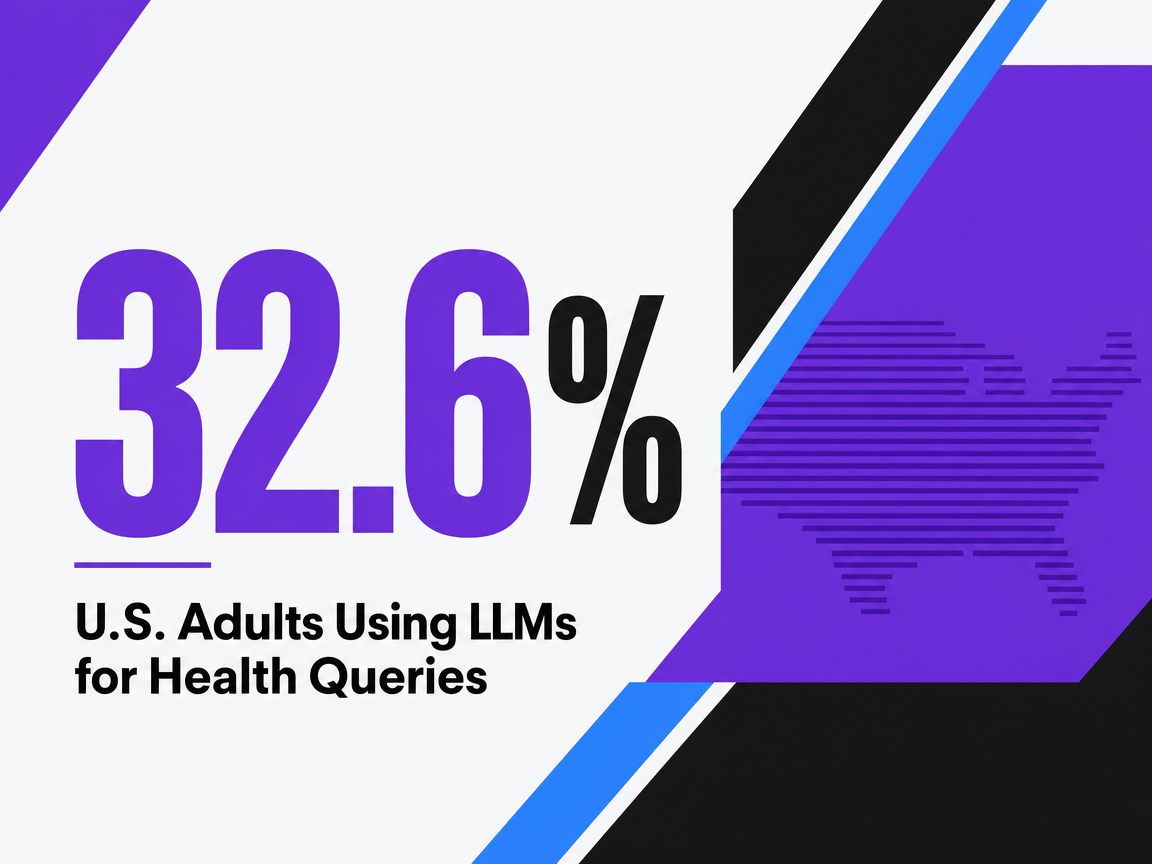 U.S. Adults Using LLMs for Health Queries
U.S. Adults Using LLMs for Health Queries
- Reframe procurement around four operating models—managed tools, fractional pods, AI platforms, or hybrid—because the traditional agency-versus-in-house question hides the real cost and quality trade-offs.
- Decompose the agency retainer into its six or seven bundled functions so each line item can be assigned to the owner best suited to the cadence and quality standard required.
- Hold every candidate to five non-negotiable criteria: E-E-A-T artifacts, content quality process, local execution cadence, compliance review surface, and live analytics integration 8.
- Treat advertising law, patient privacy, and clinical accuracy as one unified review workflow with a named internal approver, since fragmented checkpoints create handoff failures 4, 5.
- Procure for both classical SERPs and AI answer engines, because 32.6% of U.S. adults already use LLMs for health queries and extraction-ready structure determines citation 1.
- Run the consolidation math before scaling: per-location retainers compound coordination costs, while account-level models keep the marginal cost of each additional site nearly flat.
- Replace the retainer internally only with explicit governance—a topic map, editorial standard, publishing checklist, and weekly measurement view—each assigned to a named owner 3.
- Use the five-question scorecard during vendor calls and require artifacts; clearing all five signals a procurable service, while fewer than three signals the service is not ready.
The procurement decision growth leaders actually face
Growth leaders evaluating website SEO services often overlook the core question their CFO needs answered. The traditional "agency or in-house" framing obscures the real choice: which operating model delivers Google's Your Money or Your Life (YMYL) quality bar, ensures compliant execution, and contributes measurably to the pipeline at the lowest coordination cost.
This quality bar is particularly stringent in high-trust verticals like healthcare, where search quality guidelines penalize low-authority content that could cause harm 10. Research on nationally ranked digital health center websites highlights content quality as the highest-scoring performance variable 8. This suggests that an SEO budget heavily weighted towards technical audits and link velocity may be misallocated.
The procurement question can be broken down into four distinct models: managed SEO tools with in-house ownership, a fractional specialist pod, an AI marketing platform, or a hybrid approach. Each model unbundles traditional agency services differently, allowing functions like editorial production, local search execution, compliance review, analytics integration, and reporting to be procured as separate line items rather than a single retainer.
This article provides a framework for this decision, basing evaluation criteria on regulatory standards, peer-reviewed findings, or search authority guidelines. It concludes with a scorecard for evaluating vendors or platforms.
Four procurement models, not two
Decomposing what an agency retainer actually bundles
A monthly agency retainer is not a single service but a bundle of at least six distinct functions:
- Editorial production
- On-page optimization
- Technical audits
- Local search execution
- Link acquisition
- Reporting
Compliance review is often an unstated seventh. Each function has unique labor requirements, tooling needs, and quality standards.
Viewing this bundle as a single unit makes the procurement decision seem binary. Decomposing it shifts the question from "agency or in-house" to "who owns each function, on what cadence, against which standard." This reframing is crucial because these components do not scale uniformly. Editorial production scales with service lines and topics, local search with locations, technical audits with site complexity, and reporting with stakeholder count.
Analysis of retainer costs often reveals that 40% to 60% of monthly billable hours are dedicated to content production and reporting, with the rest split between audits and link building. Once these line items are visible, the three alternative models become viable. Google's SEO fundamentals are clear enough that internal teams can manage technical and on-page layers with documented processes 3, making editorial depth and local execution the more challenging procurement areas.
The four-model matrix: managed tools, fractional pod, AI platform, hybrid
Each of the four candidate models reassembles these decomposed functions differently. The matrix below compares them across five variables critical for sustaining a YMYL-grade program: coordination overhead, per-location scaling behavior, compliance review ownership, time-to-first-published-asset, and measurement cadence. Google's guidance, adapted by institutions like Columbia, shows that technical and structural SEO layers can be managed in-house with proper governance 3, enabling most models to meet baseline requirements.
| Variable | Traditional Agency Retainer | Managed Tools + In-House | Fractional Specialist Pod | AI Marketing Platform |
|---|---|---|---|---|
| Coordination overhead | High; account manager layer, weekly status calls | Moderate; internal PM owns cadence | Moderate-to-high; multiple contractors to align | Low; single approval surface |
| Per-location scaling cost | Linear; retainers compound per location | Flat tooling cost, linear labor cost | Linear with specialist hours | Account-level; flat across locations |
| Compliance review ownership | Shared, often ambiguous | Fully internal | Fully internal | Internal approval, AI-assisted drafting |
| Time-to-first-published-asset | 4–8 weeks (onboarding + briefs) | 2–4 weeks once process is set | 2–6 weeks depending on roster | Days, once brand intelligence is loaded |
| Measurement cadence | Monthly report deck | Continuous via GA4/GSC dashboards | Variable per specialist | Continuous, integrated with GA4/GSC/SEMrush |
| Indicative entry price | Mid-to-high four figures per location | Tooling sub-$1k/mo + internal labor | Hourly or per-deliverable | $599/mo trial pricing observed in market |
The matrix reveals that the retainer model is unique in its linear compounding of per-location costs and ambiguous compliance ownership. Managed tools with in-house ownership flatten tooling costs but shift labor internally. Fractional pods offer specialist expertise but at the cost of increased coordination. The AI platform consolidates coordination and measurement, making it a viable alternative for multi-location operators seeking efficiency without sacrificing quality.
It is important to note that none of these models eliminate the operator's responsibility for final review. They primarily redistribute labor and influence the predictability of output scaling.
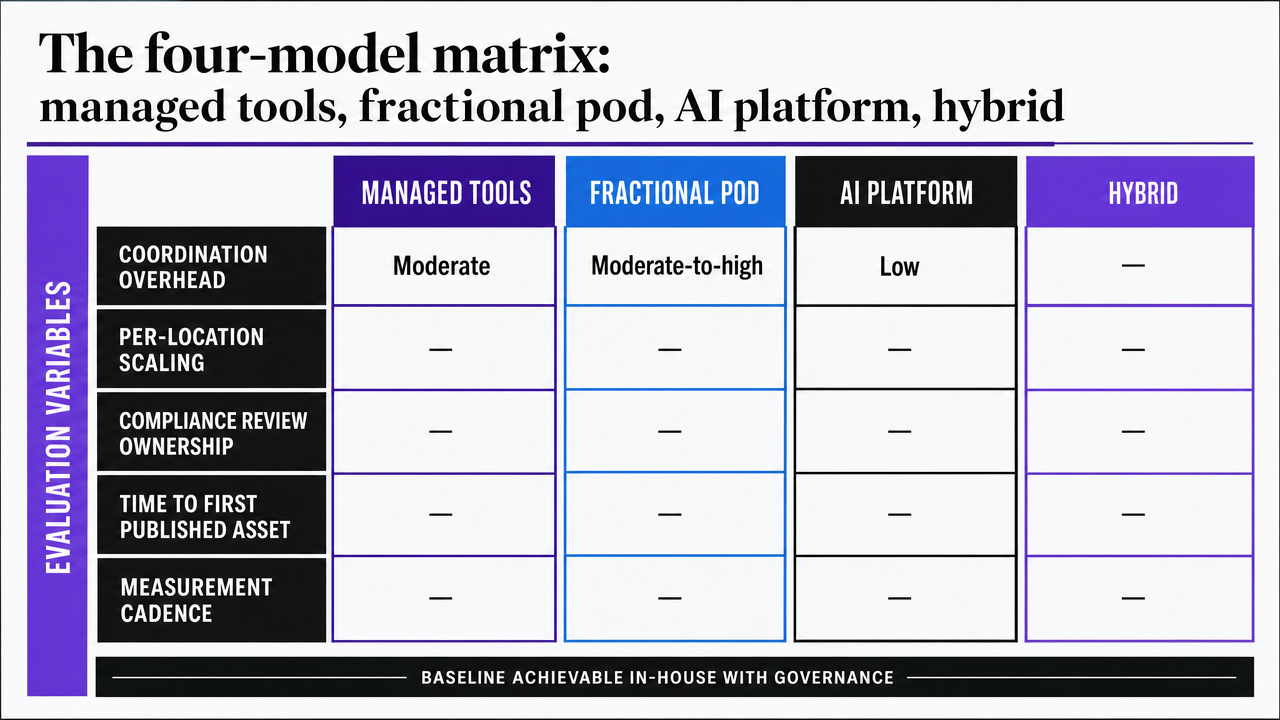 Visualize the four procurement models compared across the five evaluation variables introduced in the section, making the comparison table easier to scan
The five non-negotiable evaluation criteria
E-E-A-T evidence under the YMYL bar
Any SEO service must demonstrate, through tangible artifacts, how it produces evidence of experience, expertise, authoritativeness, and trust (E-E-A-T). The YMYL framework designates pages that could cause harm if incorrect as a separate quality tier, where Google aims to prevent the surfacing of content that could "cause significant harm" 10. A vendor unable to show how this standard is enforced in its production process is selling content volume, not search performance.
Key artifacts include bylines linked to credentialed authors with verifiable practice history, medical or subject-matter review signatures on every published asset, citation density connecting claims to primary sources, and update timestamps reflecting a genuine review cadence. The AMA's digital strategy guidance views these signals as integral to practice credibility, not just a marketing add-on 6.
Operators should request three published examples and trace their review chains. If the chain is broken—lacking a named reviewer, source list, or revision history—the service cannot meet the YMYL threshold at scale, regardless of its keyword research deliverables.
Content quality as the dominant performance variable
The empirical evidence supporting the prioritization of editorial depth over purely technical services is often underestimated in SEO procurement. A structured evaluation of nationally ranked U.S. digital health center websites found that
"content quality, on average, was the highest scoring variable" 8
This finding challenges typical agency proposals that front-load audits, schema work, and Core Web Vitals fixes before any new editorial content is produced.
Patient perception of quality is also well-documented. A systematic review of online health information seeking identified accuracy, readability, and ease of understanding as the primary factors influencing trust and user action 7. Public health scholarship reinforces this, stating that quality health websites support "health literacy and shared decision making" 2, making readability a critical performance metric.
An evaluation rubric should score SEO services on five content-quality inputs:
- Editorial brief depth (specifying clinical/technical claims and supporting sources)
- Reviewer chain (who signs off and against what standard)
- Readability targets (measured at a defined grade level)
- Citation density per asset
- Refresh cadence for existing pages
Services that cannot provide documented processes for these five areas are likely competing on output volume, which, according to ranked-website evidence, does not predict performance in this category.
Local search execution at the location level
This criterion is particularly relevant for multi-location operators, where local execution determines whether national content translates into booked appointments. A service that treats local search as a mere checklist—claiming listings, posting hours, monitoring reviews—misses the larger picture. Effective local execution at scale requires coordinated entity data across all location profiles, unique content for location-specific landing pages (not templated swaps), and a review-response workflow tight enough to influence ranking signals.
Public-sector SEO guidance emphasizes that effective findability relies on content that is "consistent and easy to navigate" and "produced by a source of authority on the subject" 9. At the local level, this means each profile and landing page must appear to be authored by the individuals providing care or service in that specific market, rather than being a duplicate of a corporate template.
The evaluation question is whether the service can publish, update, and audit location-level assets with the same cadence as the national program. If local work is handled in a separate workflow with separate billing, per-location costs will escalate, as highlighted in the procurement matrix.
Measurement cadence and analytics integration
A monthly report deck is merely a presentation layer, not true measurement. The distinguishing factor for defensible services is continuous and direct analytics integration: live connections to GA4, Search Console, and the operator's chosen rank-tracking source, with dashboards accessible to the growth team without needing an account manager.
Cadence is as important as integration. Editorial decisions—which pages to refresh, which clusters to expand, which underperformers to retire—require at least weekly signals. A service that provides ranking and traffic deltas with a thirty-day lag cannot effectively act on its data, as publishing decisions for that cycle would already be made.
Operators should request to see the actual dashboard, not just a screenshot. Three questions quickly sort vendors: which data sources feed the view, how often does the underlying data refresh, and which decisions are made based on which thresholds. Vendors unable to link specific metrics to specific actions are selling visibility, not actionable measurement.
Test AI-Driven SEO Execution In Real-Time
Experience live SEO content deployment with measurable impact during your risk-free trial—no agency involvement required.
Compliance is one workflow, not three
Most SEO procurement discussions fragment compliance into separate issues: advertising law, patient privacy, and medical accuracy. This fragmentation creates gaps. Truth-in-advertising standards apply to online marketing, covering claims, endorsements, testimonials, and disclosure language 4. The HIPAA Privacy Rule further mandates written patient authorization for using or disclosing protected health information for marketing, with limited exceptions 5. A single paragraph promoting a service can trigger both regulatory regimes.
Treating these as separate checkpoints—one for the FTC, one for HHS, one for clinical accuracy—leads to handoff failures. The operational solution is a single, unified review chain for every published asset: subject-matter or medical accuracy review, privacy review for any patient data, stories, images, or identifiers, and advertising review for claims, disclosures, and endorsement language. This means one workflow, three lenses, and one approver of record.
For vendor selection, this implies that an SEO service producing drafts but routing compliance back to the operator's legal or clinical team without a defined review surface is providing raw material, not compliant content. Services worth procuring document where each compliance lens applies in their production process, name the sign-off authority, and timestamp the result on the published page. While AI-driven platforms can streamline drafting and disclosure checks, the approver of record remains internal due to regulatory exposure.
Operators should ask any model to show the last ten published assets and the named reviewer for each of the three compliance lenses. If this record is absent, the workflow is likely non-existent.
Procurement for AI-mediated search
SEO procurement now addresses two retrieval surfaces. A national survey indicated that 32.6% of U.S. adults used large language models for health-related queries, with 62% still preferring to consult a health professional afterward 1. This split signals that AI answer engines are a significant discovery layer, but on-site content remains where trust is built. An SEO service optimizing only for classical SERPs is preparing assets for only half the user journey.
Operationally, this means content must be structured for extraction by generative AI: question-led headings, direct-answer paragraphs near the top of sections, citation-dense supporting prose, and entity markup to disambiguate the publisher. A patient-facing FAQ that earns a featured snippet is also what an LLM is most likely to summarize. Publishers with the clearest answers are cited; those who bury information are not.
Operators evaluating any SEO service should ask three direct questions: Does the production process prioritize question-and-answer extraction, or are FAQs an afterthought? Does measurement track citation appearances in AI overviews and chat tools, not just classical rank? Does the editorial standard withstand the heightened scrutiny of LLM-mediated answers, where a single inaccuracy can be surfaced verbatim?
A service unable to answer these questions is designed for a search environment that no longer fully reflects how audiences find and verify information.
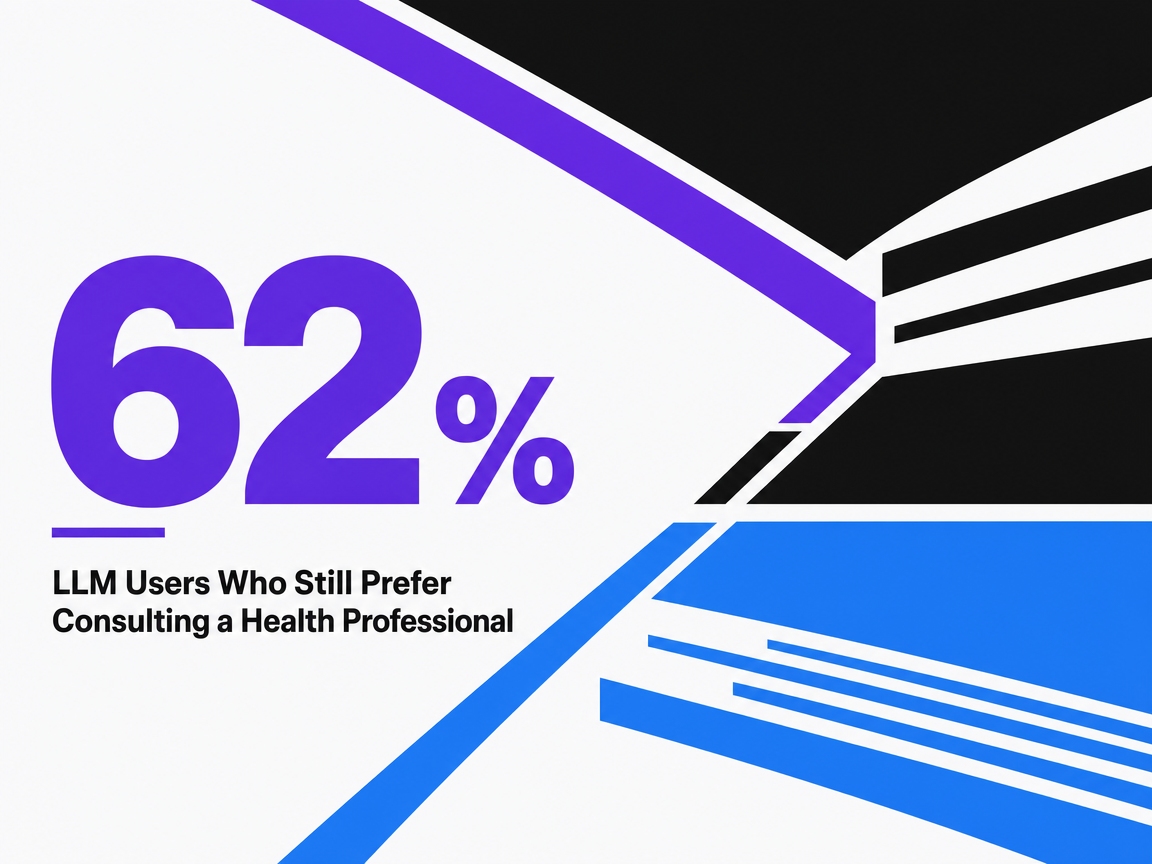 LLM Users Who Still Prefer Consulting a Health Professional
LLM Users Who Still Prefer Consulting a Health Professional
If operators run multiple locations: the consolidation math
This section is for growth leaders managing multiple locations, service lines, or brand sites under one P&L. The procurement math changes significantly once a program scales beyond a single site, often rendering a previously defensible model unsustainable.
Traditional retainers typically price per location. Each new clinic, branch, or service-line site incurs a separate monthly fee, onboarding cycle, and reporting deck. The labor that scales with location count—local landing pages, profile updates, review responses, citation cleanup—compounds directly with the retainer. A ten-location operator pays more than ten times the coordination cost due to added reconciliation work for account managers.
Managed tools combined with in-house ownership flatten tooling costs but shift per-location labor internally. This trade-off is rational until headcount limitations are reached, usually when local execution demands more hours than a single full-time employee can manage across all locations. Fractional pods fall between these models, exhibiting a similar linear labor curve to retainers but without the account-management premium.
The account-level model, such as an AI marketing platform like Vectoron, fundamentally alters this curve. A single program plan, approval surface, and measurement view across all locations means the marginal cost of adding an eleventh location is similar to adding the second. Google's findability fundamentals—consistent structure, authoritative sourcing, keyword alignment—apply uniformly across all sites, allowing an in-house or platform-driven program to maintain one standard without rebuilding governance per location 9. The consolidation math isn't about making any single location cheaper, but about preventing coordination costs from escalating with the number of locations.
Evaluate AI-Driven SEO at Scale—No Agency Required
Connect with our team to see a live demonstration of autonomous website SEO execution, including strategy, production workflows, and measurable results for complex digital portfolios—without the coordination costs and delays of traditional agencies.
An in-house governance model that replaces the retainer
Replacing an agency retainer does not mean simply replicating it internally. It requires formalizing the standards an agency would implicitly uphold and assigning them to named owners with a documented cadence. Google's core principles are codifiable enough for a growth team to manage technical, structural, and editorial layers using a single playbook 3. The key is making this playbook explicit.
A functional governance model includes four key artifacts:
- A topic and cluster map tied to service lines, prioritized by search demand and pipeline contribution.
- An editorial standard document detailing the reviewer chain, readability target, citation density, and refresh cadence, aligned with patient-centric readability and accuracy criteria 7.
- A publishing checklist ensuring every asset undergoes subject-matter, privacy, and advertising review before publication.
- A measurement view, fed by GA4 and Search Console, that the growth lead reviews weekly, not monthly.
Ownership is often overlooked in in-house efforts. One person should approve the topic map, another sign off on editorial standards, another manage the publishing checklist, and another interpret the dashboard. These roles can be distributed among two or three individuals, potentially assisted by AI production tools, but specific names must be assigned to each responsibility.
The scorecard: applying the framework to a live vendor evaluation
Each criterion in this framework can be translated into a yes-or-no question for vendor discovery calls, verifiable with artifacts. The following scorecard can be used during such evaluations.
- E-E-A-T artifacts: Can the service provide three published assets with named, credentialed authors, a documented reviewer chain, and primary-source citations? Score zero if the chain is broken for any asset.
- Content quality process: Does the editorial brief specify clinical or technical claims, a source list, readability target, and citation density before drafting begins 8? Vague briefs lead to vague output.
- Local execution cadence: Does the service publish, update, and audit location-level assets at the same cadence as national content, adhering to a documented authority standard 9?
- Compliance review surface: Can the vendor show the last ten published assets and the named reviewer for each of the three lenses—accuracy, privacy, and advertising? Missing names indicate a missing workflow.
- Measurement integration: Does the service offer live GA4 and Search Console connections, weekly data refresh, and a written rule mapping metric thresholds to publishing decisions?
A service clearing all five criteria is procurable. Three or four warrant conditional consideration. Fewer than three suggests the service is not yet suitable.
Frequently Asked Questions
References
- 1.Evolving Health Information–Seeking Behavior in the Context of Generative AI.
- 2.Making Quality Health Websites a National Public Health Priority.
- 3.Search Engine Optimization Starter Guide (Columbia University adaptation).
- 4.Online Advertising and Marketing.
- 5.Marketing | HHS.gov.
- 6.A Guide to Advanced Digital Strategies.
- 7.Online Health Information Seeking Behavior: A Systematic Review.
- 8.Applying Website Rankings to Digital Health Centers in the United States: An Evaluation of Nationally Ranked Centers.
- 9.Tapping Into SEO: How Government Websites Can Improve Content Findability.
- 10.Legal Help Searches in the Your Money or Your Life (YMYL) Framework.