
Key Takeaways
- Semrush handles portfolio-scale keyword and competitive intelligence through isolated Projects, letting one strategist cover eight to twelve accounts without the SERP analysis workload scaling linearly.
- Ahrefs provides backlink depth and API access that feeds client dashboards directly, making it valuable for digital PR retainers and accounts requiring defensible link data.
- Conductor suits agencies coordinating enterprise accounts where SEO decisions cross legal, brand, and product teams, offering workflow scaffolding and audit trails that survive client-side turnover 6.
- Screaming Frog exposes raw technical data—canonical chains, hreflang conflicts, JS rendering—so saved crawl profiles compress a two-day audit into roughly four hours across client domains.
- Sitebulb converts crawl data into prioritized, client-ready reports with severity scoring, cutting audit formatting from half a day to under two hours for routine reviews.
- BrightLocal centralizes citation cleanup, ZIP-level rank tracking, GBP posts, and review monitoring in a bulk-first workflow priced for multi-location portfolios rather than per storefront.
- Looker Studio removes the reporting drain by templating dashboards across GSC, GA4, Semrush, and Ahrefs, shifting strategist time from data gathering to narrative building.
- AI execution and approval-workflow layers like Vectoron sit downstream of intelligence tools, turning recommendations into gated briefs, drafts, and posts where per-client margin is usually lost 7.
The Stack, Not the Tool, Scales Portfolio Delivery
Forrester recently described the SEO platform market as a "cheese board" of point solutions, with vendors covering slices of the workflow—content, technical, analytics—rather than the whole delivery loop 3. This framing is crucial for agencies managing 10 to 75 client accounts. The challenge shifts from identifying the single best platform to optimizing the layers of the delivery stack that consume the most per-client hours.
Agency Heads of SEO understand this constraint. Adding a strategist for every new client erodes margins, while cutting scope to protect margins risks client retention. The sustainable solution lies in workflow architecture: separating the intelligence layer, which produces the plan, from the execution layer, which ships the work. Tools should then be selected to fit each layer's specific job.
Forrester's Q1 2025 landscape report reinforces this, noting that vendors segment by size, vertical, and integration model. Leaders are advised to choose based on these constraints rather than a universal "best-of" ranking 1. While enterprise suites continue to handle keyword research, tracking, and technical audits 10, a distinct AI execution layer is emerging alongside them.
This article identifies eight tools valuable for portfolio operations, mapping each to the specific bottleneck it addresses—be it research, technical issues, local SEO, reporting, or content production hours. This approach helps identify gaps in a current stack before onboarding new clients.
Five Layers of a Scalable SEO Delivery Stack
From an operational perspective, Forrester's "cheese-board" critique highlights that market fragmentation is not a flaw to be fixed but a reality to be embraced 3. Point solutions excel in depth, while enterprise suites offer coordination. Agency leaders scaling from 10 to 75 accounts must design their operations around this reality. A practical approach involves thinking in five distinct layers, each designed to remove a specific delivery constraint.
Intelligence : This layer covers keyword research, competitive gap analysis, backlink data, and SERP tracking. Enterprise SEO suites are essential here, as they aggregate data that would otherwise require significant strategist time per client.
Technical : This layer involves crawlers that identify indexation issues, schema problems, Core Web Vitals performance, and JavaScript rendering challenges across multiple domains, reducing the need for constant strategist oversight.
Local and Multi-location : Dedicated tools for Google Business Profile (GBP) management, citation consistency, and local page templating are crucial for portfolios including franchise, DSO, or home-services brands. This layer requires distinct tooling due to its bulk-first workflow.
Reporting : This layer focuses on client-facing dashboards that consolidate data from the intelligence and technical layers into a cohesive narrative for each account, eliminating the need for strategists to manually build reports each month.
AI Execution : The newest layer, this involves approval-workflow tools that transform ranked recommendations from the upper layers into actionable deliverables—such as content briefs, drafts, on-page updates, and GBP posts—with human sign-off at each stage.
The eight tools discussed below align with these five layers. Gaps in an agency's stack often become apparent when there's an over-investment in intelligence and an under-investment in execution, which is where most portfolio margin is lost.
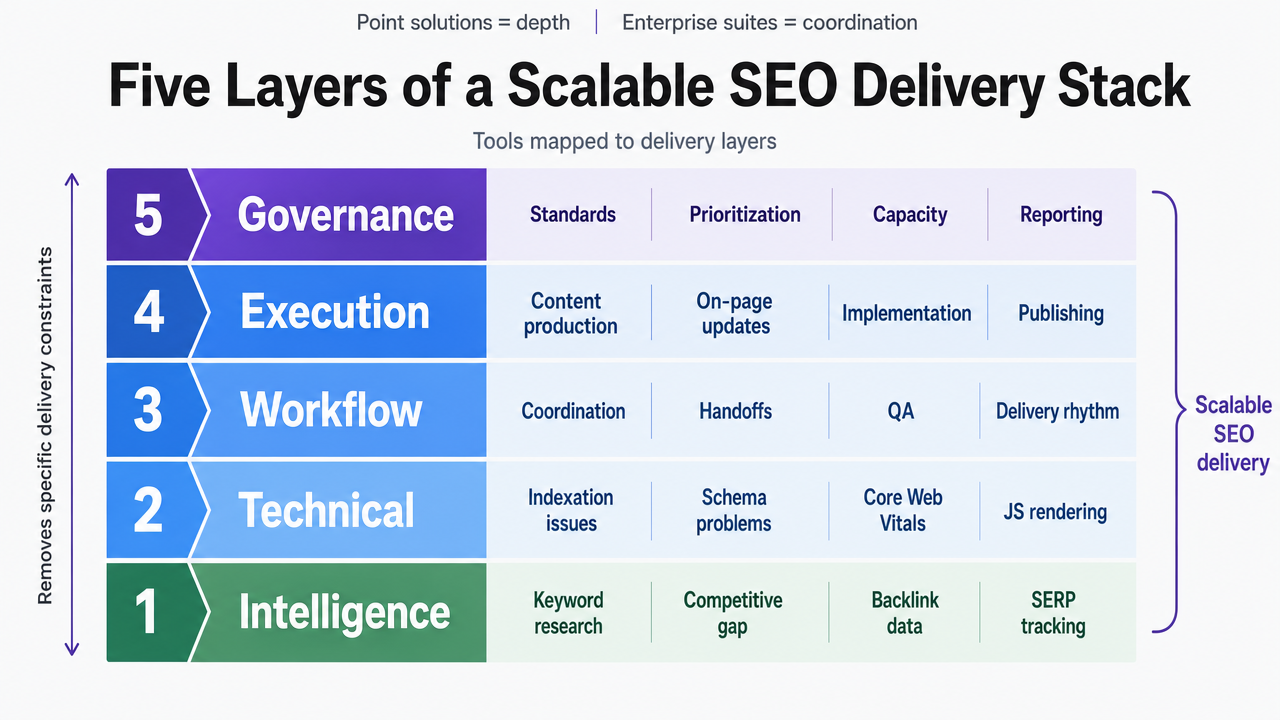 Visualize the five-layer stack framework the section explicitly enumerates, giving readers a mental model for how tools map to layers
Test AI-powered SEO workflows on live projects
Experience streamlined SEO delivery and publish real client content risk-free for seven days.
Eight Tools and Their Bottleneck Solutions
Semrush — Portfolio-Scale Keyword and Competitive Intelligence
Semrush is indispensable because keyword and competitive research does not scale linearly. While a strategist managing three clients can manually analyze SERPs, this becomes impossible for fifteen clients. This scaling limit often arrives sooner than agency leaders anticipate.
The platform's "Projects" structure is key for portfolio operations. Each client account benefits from isolated position tracking, site audits, and keyword lists, allowing a Head of SEO to assign a strategist to eight to twelve accounts without data overlap. Tools like Keyword Gap and Backlink Gap condense what was once a half-day of manual SERP analysis into a filterable comparison that a junior strategist can run before a client kickoff meeting.
A notable limitation is Semrush's database depth, which varies by market. For US and UK portfolios, coverage is generally sufficient for prioritization. However, for international portfolios or niche service verticals, strategists may need to cross-reference with a second data source before finalizing content plans.
Semrush's primary limitation lies in workflow. While it generates excellent lists and dashboards, the transition from identified opportunity to briefed, drafted, and published content often still relies on spreadsheets and communication tools. This gap is precisely where the AI execution layer, discussed later, becomes critical.
Ahrefs — Backlink Intelligence and API Access for Bulk Client Work
Ahrefs addresses a more specific problem than Semrush but with greater depth: providing backlink data that withstands enterprise scrutiny. For agencies pitching digital PR retainers or justifying link-based recommendations to skeptical in-house teams, this depth can be the deciding factor between securing a contract and losing an account.
Two features are particularly valuable for portfolio operations. Site Explorer's batch analysis allows strategists to compare fifty referring domain profiles simultaneously, helping link-building teams prioritize outreach efforts. The API, available separately, transforms Ahrefs from a research tool into an ingestion pipeline, enabling agencies to feed backlink changes directly into client dashboards or internal QBR decks without manual data extraction each month.
Ahrefs offers less robust workflow features compared to Semrush. Its project management, content brief, and reporting templates are less developed, often requiring agencies to pair it with another tool. This additional cost is why some Heads of SEO use Semrush as their primary tool and reserve Ahrefs for accounts with significant backlink needs or for due diligence during acquisitions, rather than deploying both universally.
Conductor — Enterprise Workflow for Cross-Stakeholder SEO Programs
Conductor operates in a different price tier and addresses a different need than Semrush or Ahrefs. Forrester's evaluations have categorized it as an enterprise suite designed for coordinating SEO across multiple stakeholders, rather than for individual strategist research 6. This distinction is important for agencies whose client roster includes brands where SEO decisions require approval from legal, brand, and product teams.
Conductor provides agencies with workflow scaffolding, including content briefs linked to keyword targets, page-level recommendations routed to specific writers or developers, and audit trails that persist through client-side organizational changes. For accounts with frequent in-house team turnover, this institutional memory is crucial for retainer renewals.
However, Conductor's pricing model is not suitable for agencies managing many small clients with thin margins. It is better suited for agencies handling three to eight enterprise accounts where each seat can be billed back to a retainer. Heads of SEO considering Conductor should evaluate its fit for specific accounts requiring multi-stakeholder coordination, rather than for their entire client base. Forrester's Q1 2025 landscape emphasizes that vendor fit should align with client scale 1.
Screaming Frog — Technical Audits Across Dozens of Domains
Screaming Frog remains the preferred technical crawler for many senior SEOs because it provides raw data that other tools often abstract away. Response codes, canonical chains, hreflang conflicts, JavaScript-rendered content, and redirect logic are all exposed in a single crawl. This allows a technical strategist to filter, export, and deliver findings to a developer without losing critical details.
For portfolio operations, its practical value lies in throughput. A configured crawl profile—including user agent, render mode, and custom extractions—can be saved and reused across all client audits, reducing a two-day technical review to four hours. Scheduled crawls with API integration to Google Search Console and PageSpeed Insights further streamline the process, enabling strategists to focus on exceptions rather than performing the audit from scratch.
The limitation of Screaming Frog is its presentation. It produces auditor-grade data, not client-ready deliverables. Agencies that rely solely on raw exports spend significant strategist hours reformatting findings into recommendations. The most effective approach is to pair Screaming Frog with a reporting layer or a template system that translates crawl output into prioritized fixes, aligned with the client's development capacity.
Sitebulb — Technical Crawler Built for Auditor Throughput
Sitebulb complements Screaming Frog by directly addressing the presentation challenge. While Screaming Frog provides a spreadsheet of data, Sitebulb delivers a prioritized report with severity scoring, explanations, and visualizations that are easily digestible for client executives.
For agencies offering recurring technical audits—such as quarterly reviews or one-off audits for prospects—Sitebulb's reporting layer significantly reduces strategist hours. A senior technical SEO can review Sitebulb's auto-generated report, adjust priorities, and send a client-ready document in under two hours. The same audit, if built from Screaming Frog exports, would require half a day of formatting.
The trade-off is depth in handling edge cases. Screaming Frog's custom extraction and scripting flexibility still make it superior for complex JavaScript sites, international configurations, or forensic analysis of migration issues. Sitebulb efficiently handles the majority of audits, while Screaming Frog is reserved for the more intricate 10%.
Most portfolio operations that use both tools leverage Sitebulb as the default for routine client crawls and deploy Screaming Frog for migrations, competitive analyses, and accounts where developers require raw data rather than interpretations.
BrightLocal — Multi-Location GBP and Local Page Management
Local SEO tooling operates under different economic principles than other stack components. Agencies managing a single storefront can handle local tasks manually. However, those managing a fifty-location DSO, a franchise home-services brand, or a regional senior living operator cannot; bulk operations become essential.
BrightLocal supports this bulk-first workflow. It centralizes citation building and cleanup, ZIP-code level rank tracking, GBP post scheduling across numerous locations, and review monitoring within a single interface, priced for portfolio operations rather than per-location. For agencies onboarding a multi-location account, initial tasks—auditing NAP consistency, standardizing categories, and implementing a review request cadence—are streamlined from weeks of manual effort into a structured, templated project.
The multi-location playbook emphasizes treating local SEO as a system, not a collection of microsites: one authoritative domain, unique local pages, and a verified GBP for each storefront, all managed centrally 5. BrightLocal provides the tooling to make this system scalable. However, it does not generate local page content itself; this production load is where the AI execution layer, discussed next, significantly alters the economics of per-location margin.
Looker Studio — Reporting Consolidation Across Client Dashboards
Reporting is a silent drain on portfolio margins. A strategist rebuilding monthly client decks, pulling data from Semrush, Google Search Console, GA4, and Ahrefs, can spend four to six hours per account before even formulating an insight. Across fifteen clients, this equates to a full-time reporting role that contributes no strategic work.
Looker Studio eliminates this by consolidating data sources into templated dashboards that refresh automatically. Once connectors are configured—for GSC, GA4, Semrush (via community connector), Ahrefs (via API), call tracking, and CRM—a Head of SEO can duplicate the template for each new client and simply swap account IDs. The strategist's monthly work then shifts from data gathering to crafting narratives based on a dashboard the client can already access.
A common pitfall is treating Looker Studio as a strategy tool. It is a presentation layer; the intelligence still originates from Semrush, Ahrefs, and Search Console. Looker Studio merely makes that intelligence comprehensible to clients. Agencies that bypass template investment and allow each strategist to build custom dashboards will inadvertently recreate the reporting bottleneck they aimed to remove.
AI Execution and Approval-Workflow Layers (Vectoron and Peers)
The newest category in the SEO stack, and one many agency leaders have yet to fully integrate, is the AI execution layer. These layers operate downstream from intelligence and technical tools, transforming ranked recommendations into briefed, drafted, and published work, with human approval gating each step.
This category exists because production hours, not research hours, are where per-client margin is most often lost. Enterprise SEO suites inform strategists what to do, but they don't execute the tasks. Historically, closing this gap required hiring writers and coordinators. AI execution layers fundamentally change this ratio.
McKinsey's analysis of generative AI's impact on marketing productivity estimates that 5% to 15% of total marketing spending can be recovered through AI-augmented workflows 7. While this is a broad estimate across marketing functions, not a specific benchmark for SEO agencies, it provides directional insight: production and personalization tasks are where the most significant gains are concentrated, precisely the workload an SEO delivery operation manages.
Vendors in this space include Vectoron and a growing number of competitors. What differentiates approval-workflow models from generic AI writing tools is the gating mechanism: every recommendation, brief, and draft is routed to a strategist for sign-off before execution. This structure allows agencies to scale output without sacrificing oversight, mitigating the risks associated with ungoverned AI content pipelines that might produce unapproved volume.
Multi-Location Portfolio Operations Economics
Running Local SEO as a System, Not a Stack of Microsites
This section targets agency leaders whose portfolios include multi-location service brands—such as DSOs, franchise home services, senior living operators, or regional legal/behavioral health groups. These clients present economic challenges that single-location tooling cannot address. Managing fifty locations doesn't simply mean fifty times the work; it requires a fundamentally different operational approach.
The multi-location playbook advocates for a specific architecture: one authoritative corporate domain with centralized data controls, complemented by unique local pages and a verified Google Business Profile for each physical storefront 5. Microsites and per-location subdomains, still promoted by some vendors, fragment authority and increase maintenance without providing commensurate local visibility.
Operationally, this architecture reshapes the tool stack. The intelligence layer operates at the brand level, centrally tracking category and market keywords. The local layer, managed by BrightLocal or similar tools, handles citations, GBP posts, and location-page templates in bulk. The reporting layer aggregates data from both, providing regional operators with consolidated performance insights without manual assembly by a strategist.
The significant unresolved cost lies in content. Generating fifty unique local pages, refreshed quarterly with local-specific details—reviews, staff, service updates—causes per-location margins to collapse under a human-only production model. The following section quantifies this impact.
Modeled Production Hours Per Client Per Month Across Three Delivery Models
For a Head of SEO managing multi-location accounts, understanding where production hours are spent is critical. McKinsey's marketing-orchestration analysis offers relevant data points: always-on AI orchestration is estimated to improve marketing ROI by approximately 30% and reduce execution-task time to as little as 10% to 15% of previous levels for affected tasks 9. These figures are derived from McKinsey's broader marketing engagements, not controlled SEO-agency benchmarks, and should be considered illustrative rather than guaranteed outcomes.
Applying these insights to a moderately complex multi-location client—one corporate domain, about twenty-five locations, quarterly local page refreshes, a monthly blog cadence, and ongoing technical and reporting work—the hours shift as follows across three delivery models:
| Task category (per client, per month) | Traditional stack (intelligence + human production) | Intelligence + AI-assisted content | Intelligence + AI execution/approval layer |
|---|---|---|---|
| Research and prioritization | 8–10 hrs | 7–9 hrs | 6–8 hrs |
| Content briefs and drafts | 30–40 hrs | 18–24 hrs | 10–14 hrs |
| Local page refreshes and GBP posts | 20–25 hrs | 14–18 hrs | 8–12 hrs |
| Technical audit review and fixes | 6–8 hrs | 6–8 hrs | 5–7 hrs |
| Reporting and QBR prep | 6–8 hrs | 5–7 hrs | 4–6 hrs |
| Total strategist + production hours | 70–91 hrs | 50–66 hrs | 33–47 hrs |
This pattern demonstrates that AI does not eliminate strategist judgment. Research, prioritization, and technical review tasks see modest reductions because they were already highly leveraged. The most significant reductions occur in briefs, drafts, and bulk local production—areas where McKinsey's 10–15% execution-time reduction figure is most applicable 9. An approval-workflow layer further amplifies these savings compared to generic AI writing tools, as the gating structure allows strategists to review outputs at scale rather than drafting from scratch.
Interpreted as a modeled illustration, the difference between column one and column three determines whether an agency can onboard its fifteenth multi-location account without needing a fifth strategist. This is the operational question that the eight tools discussed aim to address.
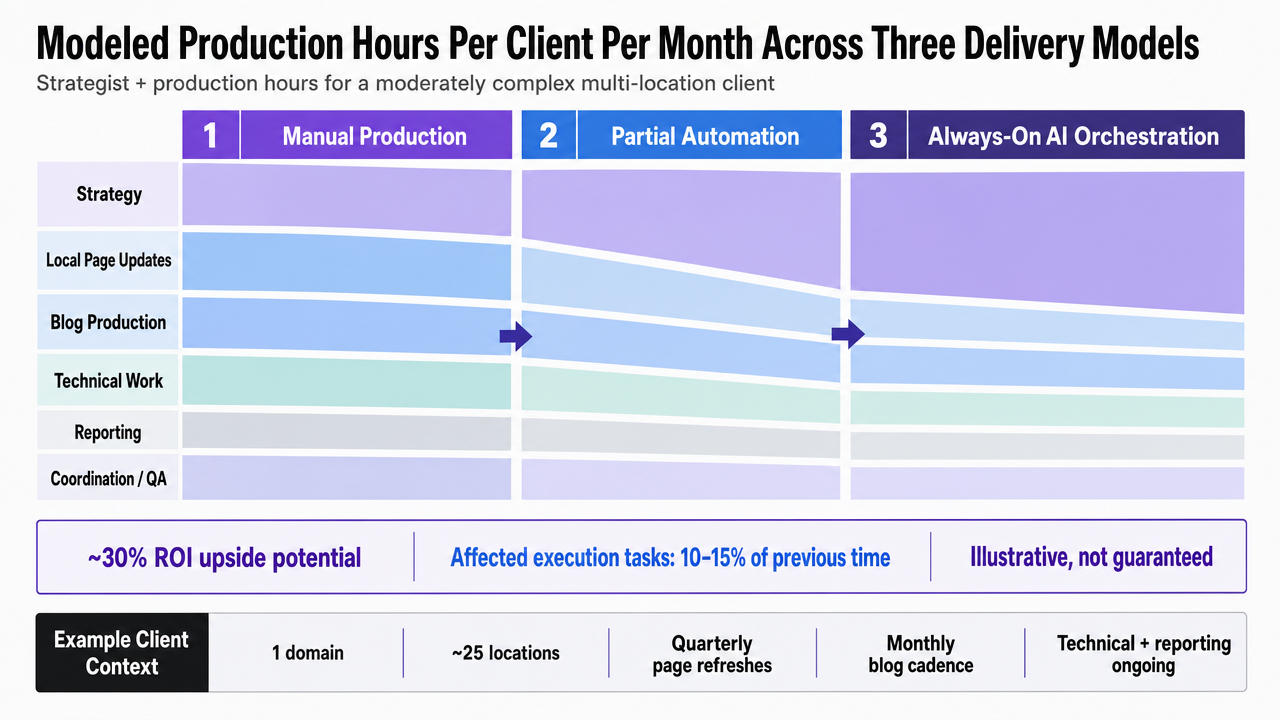 Compare total strategist + production hours per client per month across the three delivery models cited in the article's table, reinforcing the operational economics argument
See How Leading Agencies Streamline SEO Execution at Scale
Connect with our experts to discover data-driven workflows that eliminate SEO bottlenecks and enable multi-client delivery with enterprise-level oversight—no additional headcount required.
Assembling the Stack: Sequencing, Seat Economics, and Implementation Risk
The sequencing of stack decisions is a common pitfall. Agency leaders often prioritize consolidating the intelligence layer first, believing that visible seat savings on a spreadsheet make it the logical starting point. However, this is frequently the wrong initial move. Intelligence platforms are typically the most functional part of existing stacks. The hidden inefficiencies often lie in reporting and production hours, which are addressed by local, reporting, and AI execution layers.
A strategic sequence for a portfolio scaling from 10 to 50 accounts would involve:
- Solidifying the intelligence layer (one enterprise suite, with a specialist tool if a vertical demands it).
- Standardizing the technical crawler and audit template.
- Deploying Looker Studio templates before onboarding the next five clients.
- Piloting the AI execution layer on two to three accounts before a full rollout.
Forrester's Q1 2025 landscape suggests that vendor selection should be based on size and market focus rather than feature parity 1, cautioning against consolidating on a single suite at an inappropriate scale.
Seat economics require more rigorous scrutiny than they typically receive. Enterprise suites priced per user benefit agencies that centralize research with a small team of strategists, while per-project pricing suits agencies with distributed teams. MarTech implementation guidance emphasizes that platforms fail when treated as plug-and-play; process changes and training are critical for licensed seats to generate billable output 4. Agencies should budget three to six weeks for adoption friction per added layer and stage rollouts to avoid retraining strategists on multiple tools simultaneously.
Frequently Asked Questions
References
- 1.The Search Engine Optimization Solutions Landscape, Q1 2025.
- 2.AI-powered marketing and sales reach new heights with generative AI.
- 3.The SEO Platform Landscape Is A Cheese Board Of Point Solutions.
- 4.Enterprise SEO Platforms: A Marketer's Guide.
- 5.Multi-Location SEO: A Scalable Playbook for Businesses.
- 6.The Forrester Wave™: Search Engine Optimization (SEO) Platforms, Q3 2018.
- 7.Economic potential of generative AI.
- 8.How generative AI can boost consumer marketing.
- 9.The future of marketing in the age of AI.
- 10.Every Company Needs An SEO Platform.
- 11.The Forrester Wave™: SEO Platforms, Q4 2012.
- 12.The economic potential of generative AI: The next productivity frontier.