
Key Takeaways
- A content pillar is an information architecture decision about which topics a site owns, not a long-form blog post; the page is the artifact, the pillar is the schema behind it.
- Enterprise programs stall from structural sprawl rather than writer capacity, and 73% of enterprise marketers reporting improvement credited strategy refinement, not higher output volume, as the driver 2.
- Pillars operate on three distinct layers: the page as canonical URL, the topic as taxonomy node governing briefs, and the theme as the brand-level positioning claim that filters which topics earn investment.
- Durability depends on mechanical execution and governance: descriptive internal linking between pillar and clusters 1, a queryable taxonomy 12, and approval gates that prevent new briefs from forking the architecture.
The pillar as an information architecture decision, not a long blog post
A content pillar is not a 3,000-word blog post with a table of contents. It is an information architecture decision about which topics a site organizes itself around, which subtopics feed into each parent, and how those relationships are made visible to both readers and search crawlers. The pillar page is the artifact. The pillar itself is the schema behind it.
That distinction matters because most in-house teams inherit a content library that grew by request, not by design. Product marketing asked for a launch post. Sales asked for a comparison page. Demand gen commissioned a listicle. Each piece made sense in isolation. None of them share a parent topic, an anchor URL, or a consistent labeling system. The result is a library, not an architecture.
Information architecture, as government UX guidance defines it, is the practice of structuring, organizing, and labeling content so people can find what they need 4. A pillar applies that discipline to a marketing site: it names a topic the brand intends to own, assigns cluster pages to it, and enforces linking rules that make the relationship legible. Nielsen Norman Group frames IA as a set of structural models rather than a single template 8, which is why pillar implementations vary in shape but share the same underlying logic.
Treating pillars as an architectural choice, not a content format, changes what a content manager is actually approving when a pillar brief lands on the desk.
Why enterprise content strategies stall without pillar architecture
Enterprise content programs rarely fail because writers cannot produce. They fail because production outpaces structure. In CMI's 2025 enterprise benchmark, only 28% of enterprise marketers surveyed rated their content strategy as extremely or very effective 14. That figure describes strategy quality among enterprise marketing teams specifically, not the broader B2B population, and it captures a moment when many teams had already scaled headcount, tooling, and publishing cadence.
The following year told a different story. In CMI's 2026 enterprise report, 61% of enterprise marketers said their content strategy had improved over the previous twelve months, and 73% of those reporting improvement credited strategy refinement as the driver 2. Refinement, not volume. Structure, not staffing.
That distinction is where pillar architecture earns its place on the priority list. A content manager staring at a library of 400 posts, six product pages, and a resource hub tagged with 90 loose labels does not have a writer problem. The team has a taxonomy problem. Every new brief either duplicates a page that already exists under a different title or creates an orphan with no clear parent topic and no cluster it belongs to. Reporting suffers because performance is measured post by post rather than topic by topic. Internal linking becomes ad hoc. Refresh cycles miss pages that should be consolidated.
Pillar architecture converts that sprawl into a set of governed topics with defined cluster boundaries. It gives briefing decisions a rule: does this page extend an existing pillar, or does it require a new one? Teams that answer that question consistently produce the kind of refinement the 2026 data credits. Teams that skip the question keep hiring, keep publishing, and keep landing in the 28% band.
 Enterprise marketers reporting content strategy improvement in the last 12 months (2026)
Enterprise marketers reporting content strategy improvement in the last 12 months (2026)
Three things called a pillar: page, topic, and theme
Pillar page: the URL that consolidates a topic
The pillar page is the artifact everyone can see. It is a single URL that serves as the canonical entry point for a topic, links out to cluster pages that cover subtopics in depth, and receives inbound links from those clusters in return. A pillar page on commercial HVAC maintenance, for example, might run 3,200 words, cover preventive schedules, refrigerant compliance, energy audits, and vendor selection, and link to twelve cluster pages that each expand one of those threads.
What the pillar page is not: a listicle, a category archive, or a blog index. Category archives are generated automatically from post metadata. Pillar pages are authored deliberately, updated on a schedule, and treated as production assets with owners. Yale UX guidance is explicit that content should be organized around topics, services, or tasks rather than generic buckets like "Resources" 3, and the pillar page is the URL-level expression of that principle.
Confusing the artifact with the strategy is the most common failure mode. A team publishes a long guide, calls it a pillar, and treats the work as done.
Pillar topic: the taxonomy node that governs briefs
The pillar topic sits one layer above the URL. It is the taxonomy node in the site's information architecture that defines what belongs under a pillar and what does not. Facilities operations is a topic. Commercial HVAC maintenance is a topic. Both can host pillar pages, but the topic itself is the classification decision that governs every brief the editorial team writes.
Taxonomy, as the IA Conference paper frames it, is the intermediary that links users to the content they want by tagging and grouping pages into a coherent system 12. NN/g's Life Online taxonomy demonstrates the same discipline at scale, organizing more than 850 reported activities into a multi-level structure 7. Marketing sites need the same layer, and most do not have one that a briefing editor can actually query.
When the topic node is defined, briefs become decisions rather than negotiations. A request for a piece on refrigerant leak detection either extends an existing pillar topic or reveals a gap that requires a new one. The topic layer is where editorial governance actually lives.
Pillar theme: the brand-level positioning claim
The theme sits above the topic. It is the brand-level positioning claim that determines which topics deserve a pillar in the first place. Reliability is a theme. Compliance is a theme. Cost predictability is a theme. Themes are what a brand wants to be known for 13, and they filter which pillar topics earn production budget and which get declined even when traffic data looks attractive.
A facilities services brand positioning itself around reliability will invest in pillar topics that reinforce that claim: preventive maintenance, uptime guarantees, emergency response. It will decline pillar topics that dilute it, even if a keyword tool suggests the volume is there. The theme is the filter.
Most teams have themes implicitly and topics accidentally. Making both explicit is what turns a content library into an architecture, and it is the diagnostic layer where most restructuring conversations should start.
Test Full Content Pillar Workflow With Real Publishing
Experience live content pillar creation and approval, publishing actual articles during your trial—no restrictions, no placeholders.
The IA foundation most marketing teams skip
Content teams borrow the pillar model from marketing blogs. The model itself comes from information science, and the shortcut most teams take is skipping the foundation the discipline was built on.
Information architecture rests on three components: organization, content structure, and navigation 4. A pillar without any of the three is a document. A pillar with all three is a system that a briefing editor, a writer, and a search crawler can each interpret the same way. NN/g's Life Online project makes the underlying logic visible: researchers classified more than 850 reported user activities into a multi-level taxonomy, with parent categories, subcategories, and specific tasks nested underneath 7. That is the same nested structure a pillar imposes on a marketing site, only applied to topics the brand intends to rank for.
The step most teams skip is the labeling audit. Yale UX guidance is direct on this point: categories should reflect topics, services, or tasks that users actually recognize, not internal jargon or generic buckets like "Resources" 3. A pillar labeled "Solutions" or "Insights" fails the same test. It names a container, not a topic. Search engines cannot infer authority from a container label, and readers cannot predict what lives beneath it.
Taxonomy work is what makes labels operational. The IA Conference paper describes taxonomy as the intermediary between the user and the content they want, built from consistent tagging and grouping rules 12. For a content manager, that translates into a briefing decision: every new page gets a pillar assignment before it gets a writer, and the assignment uses the same label taxonomy the site's navigation and internal search already surface.
Teams that treat the pillar as a page skip this layer and pay for it later in refresh cycles, duplicate briefs, and pages that rank for nothing in particular. Teams that treat the pillar as an IA decision spend the labeling hours upfront and stop rewriting the same architecture every quarter.
Why pillars work as a production-throughput system
The productivity case for pillars is not that they help writers write faster. It is that they eliminate the upstream decisions that stall briefs before writing begins.
Every editorial calendar carries a hidden tax: the time spent deciding whether a proposed piece belongs on the site, which existing page it relates to, what should link to it, and which team owns the update cycle. In a pillar-less program, those questions get relitigated for every brief. In a pillar-governed program, they are answered once at the topic level and inherited by every cluster page underneath.
That inheritance is where throughput compounds. A defined pillar topic tells the briefing editor which subtopics are still open, which cluster pages already exist, and which internal links a new draft must earn on publication. Writers receive briefs with the topical context prewired rather than reconstructed. Refresh cycles target the pillar and its clusters as a unit, not as forty unrelated URLs surfaced by a stale-content report.
The output signal that matters to enterprise leadership tracks this closely. In CMI's 2026 enterprise report, 64% of enterprise marketers cited content relevance and quality as a driver of marketing effectiveness 2. Relevance is a function of topical coverage depth, and quality is a function of production discipline. Both are downstream of whether the pillar architecture exists to concentrate effort or whether writers are producing one-off pieces that compete with each other for the same keywords.
CMI's B2B 2026 report frames modern content operations as coordinated across channels and teams rather than run as isolated publishing sprints 10. Pillars are the coordination surface. They give product marketing, demand gen, and SEO a shared object to argue over, revise, and extend. The argument becomes "which cluster does this belong to" instead of "should we publish this at all," and the shift moves velocity from meetings into drafts.
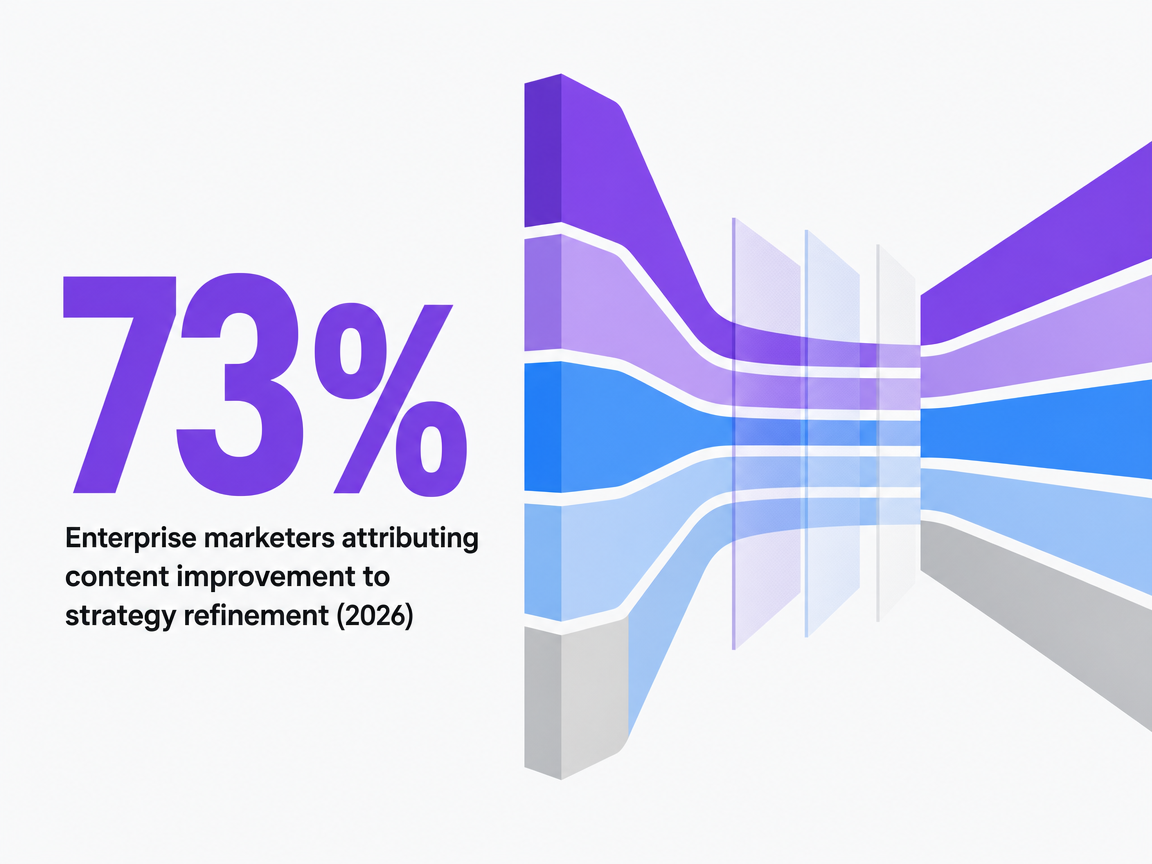 Enterprise marketers attributing content improvement to strategy refinement (2026)
Enterprise marketers attributing content improvement to strategy refinement (2026)
Crawlability and internal linking: the mechanical layer
Architecture only matters if crawlers can read it. The mechanical layer of a pillar model is the internal linking pattern that makes the topical hierarchy legible to Googlebot, and it is where most well-intentioned pillar builds quietly break.
Google's own guidance is blunt about the baseline: every page a site cares about should have a link from at least one other page on the site, and anchor text should be descriptive, concise, and relevant to the destination 1. A pillar page that receives inbound links only from the main navigation and a stray footer link fails that test. So does a cluster page linked from the pillar with anchor text like "learn more" or "click here." The relationship exists in the content strategist's diagram but not in the graph a crawler actually traverses.
The pillar-cluster pattern turns those rules into a repeatable linking contract. Each cluster page links back to the pillar with descriptive anchor text that names the parent topic. The pillar links out to every cluster using anchors that name the subtopic. Cluster pages link laterally to sibling clusters when the subtopics genuinely relate. Google Research work on semantic topic clustering supports the underlying premise that related content grouped through consistent signals is easier for search systems to interpret 6.
For a content manager, the operational takeaway is narrow: no cluster page ships without its pillar link audited, and no pillar page ships without a link inventory that names every cluster it governs.
See How Enterprise Teams Operationalize Content Pillars at Scale
Connect with specialists to review real examples of data-driven content pillar frameworks that accelerate topic authority, streamline approvals, and align multi-channel strategy—all without expanding headcount.
Diagnosing which pillar layer your team is actually missing
Most restructuring conversations skip diagnosis and jump to production. A content manager decides the site "needs pillars," commissions three long guides, and discovers six months later that traffic has not moved. The issue is usually not the pillar page. It is one of the two layers underneath.
The diagnostic sequence runs from the top down.
- Start with theme. Can the team name three to five things the brand intends to be known for, and can product marketing, demand gen, and SEO all recite the same list? If the answer differs across desks, the theme layer is missing, and any pillar page built without it will drift toward whatever keyword tool suggested it 13. New pillar pages will not fix that. A positioning conversation will.
- If themes are stable, move to topics. Does the site have a documented taxonomy that a briefing editor can query before assigning a writer, and do the labels match how users describe the work rather than how the org chart describes it 3? Sites with clear themes but no topic taxonomy tend to publish pillar pages that overlap, compete for the same queries, and cannibalize each other in search results. The remedy is a labeling audit and a mapped taxonomy 12, not more drafts.
- If themes and topics both check out, the missing layer is the page itself, and this is the easiest gap to close. Assign owners, set word-count and update-cycle expectations, and audit the internal link inventory each pillar receives from its clusters.
Naming the missing layer before commissioning work is what separates a restructuring project from another publishing sprint.
If you manage multiple locations or brand instances: pillar reuse as a throughput multiplier
A note for a narrower audience: content managers running multi-location service brands, franchise networks, or portfolio companies with sibling brand instances. The pillar economics change shape when the same architecture has to serve twelve, forty, or two hundred location subfolders.
In a single-site program, a pillar governs one topic across one URL tree. In a multi-location program, a pillar governs one topic across N location instances, and the throughput math shifts from linear to leveraged. A pillar topic defined once at the network level can seed cluster briefs across every location that offers the service, with local variables swapped in for jurisdiction, pricing, staff, and case examples. The architecture is authored once. The instances multiply.
The throughput variables are worth naming explicitly.
L : the number of locations
C : the number of cluster pages per pillar
H : the briefing hours saved per reused cluster brief versus authoring from scratch
Total hours saved on a single pillar rollout scale as L × C × H. A network with twenty locations, eight cluster pages per pillar, and three briefing hours saved per reused cluster recovers 480 briefing hours per pillar, not because writers moved faster but because the topical decisions were made once and inherited everywhere.
The failure mode is treating each location as its own content program. Duplicate briefs get written across markets, internal links get pointed at different pillar URLs depending on which location editor commissioned the piece, and taxonomy labels drift market by market until the network has forty variations of the same category. CMI's B2B 2026 report frames modern content operations as coordinated across channels and teams rather than run as isolated sprints 10, and multi-location networks are where that coordination cost shows up most plainly.
The reuse discipline is narrow: define the pillar topic and cluster map at the network level, standardize the label taxonomy across every location instance 12, and require that local variations extend the network pillar rather than fork it. Location editors gain speed by inheriting the architecture. The network gains topical authority by concentrating link equity on network-level pillar URLs instead of scattering it across forty near-duplicates.
Governance, approval workflow, and the pillar as a production contract
A pillar architecture is only as durable as the approval workflow that enforces it. Once the theme, topic, and page layers are named, the operational question shifts from "what should we publish" to "who signs off before a page is allowed to extend, fork, or replace a pillar asset."
That question is where most pillar programs quietly erode. A demand gen manager commissions a landing page that duplicates an existing cluster. A product marketer publishes a launch piece with a keyword focus that overlaps two pillar topics. An SEO analyst adds internal links using anchor text that names the wrong parent. Each decision is defensible in isolation. Together they undo the architecture in six months.
The remedy is treating the pillar as a production contract with named approval gates:
- Every new brief carries a pillar assignment before it enters the writer queue.
- Every draft carries an internal link inventory that names the pillar it reports to and the sibling clusters it references, with descriptive anchor text as Google's linking guidance requires 1.
- Every publish decision passes through an editor who owns the taxonomy and can reject briefs that fork a pillar without justification.
CMI's Modern Content Marketing Strategy Playbook frames current content operations as strategic and multichannel work that depends on coordination across teams 11. Approval workflow is what makes that coordination enforceable rather than aspirational. Without it, pillars degrade into folder names.
Platforms like Vectoron operationalize this layer by routing every pillar assignment, cluster brief, and internal link decision through a single approval surface before execution. The architectural question stays with the content manager. The enforcement runs on rails.
 Enterprise marketers citing content relevance and quality as a driver of effectiveness (2026)
Enterprise marketers citing content relevance and quality as a driver of effectiveness (2026)
Frequently Asked Questions
References
- 1.SEO Link Best Practices for Google | Google Search Central.
- 2.Enterprise Content and Marketing Trends: Insights for 2026.
- 3.Content Taxonomy and Labeling.
- 4.Information architecture (IA).
- 5.Topical clustering of search results.
- 6.Improving semantic topic clustering for search queries with machine learning.
- 7.Life Online Project Taxonomy - NN/G.
- 8.Information Architecture: 3 Key Models (Video).
- 9.Information Architecture: Study Guide.
- 10.B2B Content and Marketing Trends: Insights for 2026.
- 11.The Modern Content Marketing Strategy Playbook.
- 12.Connecting Users to Content: An Introduction to Taxonomy.
- 13.Content pillars: The next evolution of impactful branded ....
- 14.Enterprise Content Marketing Benchmarks, Budgets, and Trends.