
Key Takeaways
- Keyword SEO is the practice of identifying queries tied to audience intent, then building pages search systems can crawl, interpret, and justify ranking—not placing phrases repeatedly on a page.
- Google's neural matching returns relevant content even when exact query words are absent 2, so repetition-based tactics conflict with how ranking systems actually interpret meaning.
- Intent should be assigned to every keyword before clustering, since queries with similar vocabulary often represent different tasks and demand different formats, depths, and conversion paths 13.
- Scaled production stays compliant when each page answers a distinct information need with specific expertise; interchangeable pages built around keyword variants trigger Google's scaled content abuse policy 4.
The misconception that still shapes keyword strategy
Ask ten content managers to define keyword SEO and most will describe some version of the same tactic: identify a target phrase, place it in the title, sprinkle it through the body, and watch the rankings follow. That model is not just outdated. It conflicts with how Google documents its own ranking systems.
Google's ranking guide states plainly that neural matching helps Search return relevant content "even if it doesn't contain all the exact words used in a search," and that safeguards exist to prevent excessive weight on exact-match domains 2. In other words, the system is designed to interpret meaning, not to reward repetition. The guide also notes that Google uses multiple automated systems with both page-level and site-wide signals, which rules out any single keyword-placement rule as a shortcut 2.
The misconception persists because it is operationally convenient. A keyword count is easy to brief, easy to audit, and easy to defend in a status meeting. Intent, relevance, and authority are harder to measure and slower to explain. So teams default to the visible proxy and treat the keyword as the deliverable rather than the signal.
Reframing keyword SEO starts with a different premise. A keyword is the visible surface of an information need 15. The job is not to match the surface. It is to serve the need well enough that Google's systems have a reason to show the page.
A working definition grounded in how search actually operates
Keyword SEO is the discipline of identifying the queries a target audience uses, understanding the information need behind each query, and producing pages that search systems can crawl, interpret, and justify showing in results. The definition pulls three things together: query research, intent analysis, and content that holds up when ranking systems evaluate it. Word placement is a byproduct, not the practice itself.
That framing follows the mechanics Google publishes. Search runs in three stages: crawling, indexing, and serving results. During indexing, Google analyzes textual content, title elements, alt attributes, images, videos, and other page information. When serving results, it evaluates relevance using hundreds of factors that include the query itself, language, location, and device 1. A keyword enters this pipeline at two points, in the index as part of what the page is about, and in the serving stage as part of what the user asked. Neither point rewards repetition on its own.
The interpretive layer in the serving stage is where most of the old keyword rules break down. Neural matching, as Google describes it, helps Search return relevant content "even if it doesn't contain all the exact words used in a search," and the ranking systems include specific safeguards against giving excessive weight to exact-match domains 2. A page about dental implant recovery can rank for a query phrased as "how long does it hurt after getting an implant," because the system is matching concepts to concepts, not strings to strings.
That makes keyword SEO a two-sided problem. One side is demand research: which queries carry commercial or editorial value, at what volume, with what competitive field. The other side is relevance engineering: producing content the systems can confidently classify as a strong answer to the information need those queries represent 15. The target phrase is a label on the work. It is not the work.
A workable operating definition reads this way. Keyword SEO is the practice of selecting queries that match audience intent and business goals, then building pages that earn relevance signals strong enough to survive Google's indexing and serving logic. Everything else in a keyword program, from clustering to briefs to internal linking, serves that definition.
Intent as the operational core of keyword selection
If keywords are the surface of an information need, intent is the shape of the task underneath. Two queries with overlapping vocabulary can represent entirely different jobs. "Dental implants" from a researcher comparing procedures is not the same request as "dental implants near me" from someone ready to book. A keyword program that ignores that distinction will produce the wrong format, the wrong depth, and the wrong conversion path, regardless of how well the target phrase is placed on the page.
The classic framework for sorting this out comes from Jansen's work on Web-query intent. The 2008 study classified queries into three categories—informational, navigational, and transactional—and reported that more than 80% of Web queries were informational, with roughly 10% each navigational and transactional 13. A follow-up study using k-means clustering on 130,000 queries produced a similar distribution: more than 75% informational, approximately 12% navigational, and 12% transactional 14. Both figures come from historical search-engine logs analyzed by academic researchers. They are not current market shares and should not be used to forecast query mix for any specific industry or audience today. The value of the paired evidence is directional: across two independent datasets using different methods, informational intent dominated by a wide margin.
That directional finding has operational consequences. Content portfolios weighted toward transactional pages—service pages, pricing pages, booking flows—will not match the shape of inbound demand on their own.
- Informational queries demand explanatory formats: definitions, comparisons, step-by-step guidance, and reference material that answers the underlying question completely.
- Navigational queries demand that the brand's own pages be discoverable for its name and product terms.
- Transactional queries demand conversion-ready pages that remove friction at the decision point.
Intent classification also constrains keyword grouping. Two phrases that cluster together by vocabulary can split by intent, and when they do, forcing them onto one page weakens both. A page targeting "keyword research tools" (transactional comparison intent) and "what is keyword research" (informational definitional intent) will underperform two focused pages, because each query carries a different expectation of format, depth, and next action.
The practical move is to tag every candidate keyword with its dominant intent before clustering, then build the content map against intent groups rather than vocabulary clusters alone. This is also where Google's people-first guidance enters the keyword workflow: ranking systems are designed to prioritize helpful, reliable information created to benefit people, which means the format decision should follow the user's task rather than the writer's preferred structure 5. Intent is what connects the query to the task, and the task is what the content has to complete.
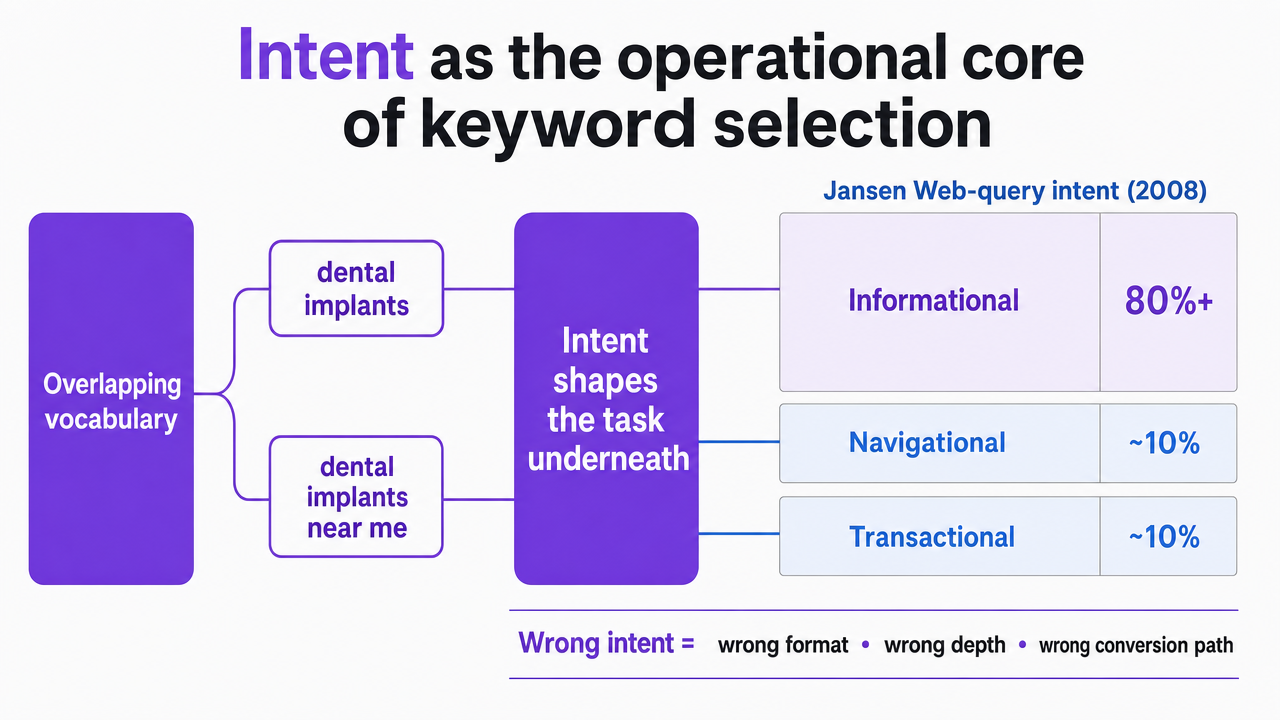 Visualize the three-category intent framework from Jansen's research, which the section explicitly cites with distribution figures that appear in the prose
Keyword-to-authority fit across the customer journey
Intent decides format. Authority decides whether the format gets a chance to perform. A keyword program that selects targets without weighing the site's competitive standing against the stage of the customer journey will produce pages that rank for the wrong queries at the wrong moments, or fail to rank at all.
The Journal of Retailing study on keyword selection in SEO, which examined query popularity, competition, specificity, intent, content relevance, and online authority as interacting factors in organic rankings and clicks, found that content relevance carries more weight for organic clicks when consumers are farther along the customer journey, while online authority carries more weight during awareness-stage searches 11. The finding is empirical, drawn from search queries and organic click data, and it reframes a decision most keyword programs make by instinct.
The practical read is straightforward. Awareness-stage queries, which tend to be broad, high-volume, and informational, are contested by sites whose domain-level authority allows them to clear the competitive field before relevance is evaluated. A newer or narrower site that chases those head terms with excellent, relevant content will often lose to a weaker page on a stronger domain. Decision-stage queries, which tend to be more specific and lower in volume, invert that dynamic. Deep relevance to the particular task the searcher is trying to complete carries more of the ranking load, and a focused page on a less-authoritative site has a real path to the click.
That inversion should drive portfolio allocation. A site still building authority gets more measurable return from decision-stage and long-tail keywords where relevance can do the work, and should treat broad awareness terms as a longer-horizon investment or a candidate for other channels. A site with established authority can defend awareness-stage terms directly and use that visibility to feed its decision-stage pages through internal links.
The study also cautions that improving relevance is not equally effective for every keyword; the value of a relevance gain depends on the keyword and the competitive context 11. The operating rule follows from that. Score each candidate keyword on two axes before briefing it: the stage of the journey it represents, and the site's authority relative to the current ranking set. Pursue the keywords where the two scores line up with the strength the page can realistically bring.
Experience high-velocity keyword SEO content production
Test real-world SEO workflows and publish optimized content before making any commitment.
The line between keyword targeting, keyword stuffing, and scaled content abuse
Three practices get confused in intro-level SEO writing, and the confusion matters because Google treats them differently. Keyword targeting is legitimate. Keyword stuffing is a spam violation. Scaled content abuse is a separate spam violation that can apply even when individual pages look clean on their own.
Google's starter guide addresses the first two directly. Titles should be unique to the page, clear and concise, and accurately describe the content, and keyword stuffing is explicitly listed as against Google's spam policies 3. The same guide also kills a myth that still appears in older SEO briefs: Google does not use the meta keywords tag 3. A keyword appearing in a title, heading, or body paragraph because it describes the content is targeting. The same keyword appearing in a hidden list, repeated unnaturally, or stacked out of context is stuffing.
The spam policy itself sharpens the distinction. Google defines keyword stuffing as filling a page with keywords or numbers to manipulate rankings, especially when terms appear unnaturally, in lists, or out of context 4. The violating signal is manipulative intent expressed through unnatural placement, not a specific density threshold. There is no safe word count because the rule is not about counting.
Scaled content abuse operates at a different level. Google defines it as generating many pages "for the primary purpose of manipulating search rankings and not helping users," and the current policy explicitly includes generative-AI-assisted production among possible examples when the resulting pages add little or no value 4. The policy is technology-neutral. AI assistance is not the violation. Producing interchangeable pages whose primary purpose is to capture keyword variants is.
For a content program, the operational line sits in three places:
- whether each page answers a distinct information need,
- whether the output demonstrates editorial judgment and first-hand expertise rather than templated restatement, and
- whether the keyword appears because it describes the content rather than because the content was built around repeating it.
Pages that fail any of those tests sit on the wrong side of the policy regardless of how they were produced.
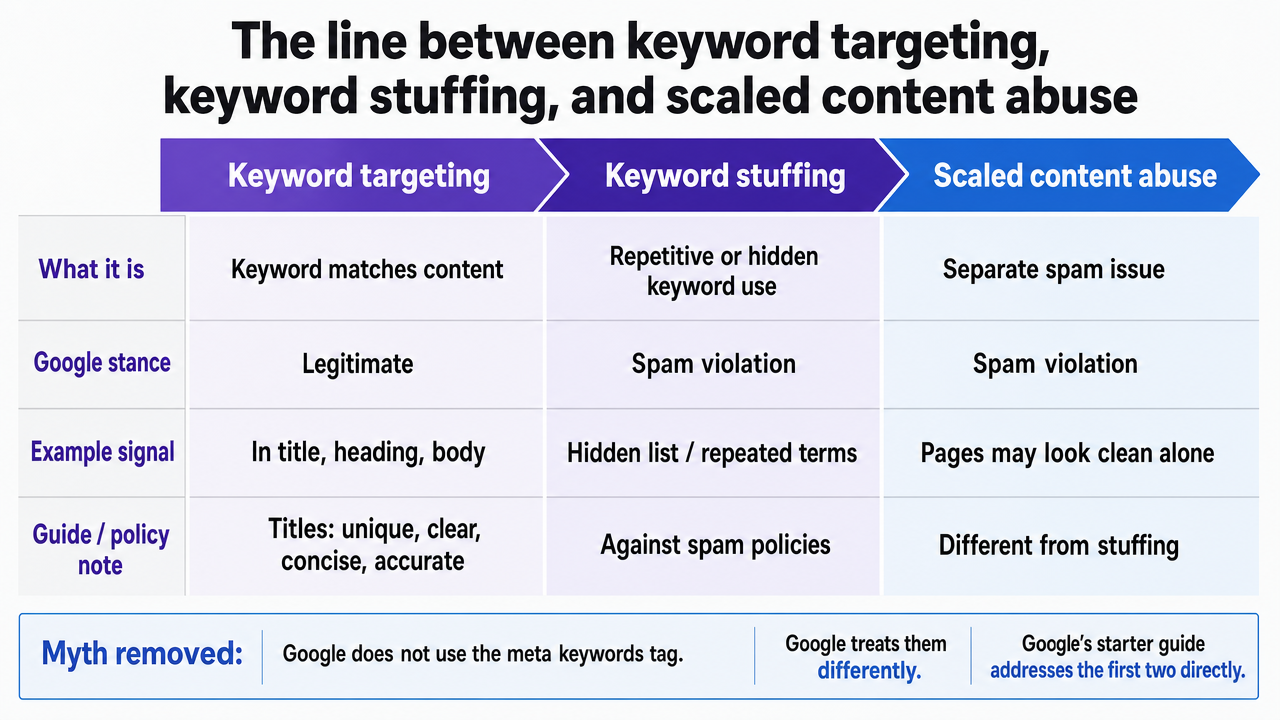 Compare the three practices the section defines, mapping each to Google's policy stance using language directly from the prose
Keyword SEO under AI Overviews and AI Mode
Generative Search features have changed the surface of the SERP without replacing the mechanics underneath. Google's own guidance on AI features in Search is explicit on the point: the best practices for SEO remain relevant for AI features, and eligibility to appear in those features depends on a page being indexed and eligible for a normal Search snippet in the first place 6. Keyword SEO is not displaced by AI Overviews and AI Mode. It is the gate.
What changes is what the page has to do once it clears that gate. Google highlights crawl access, internal links, page experience, text availability, useful media, and structured data that matches the visible content as factors it considers for AI feature inclusion 6. Each of those is a requirement a keyword-targeted page already should meet. The addition is that the content has to be interpretable in isolation. AI Overviews pull from passages, not from whole pages, which raises the premium on self-contained explanations near the terms that represent the information need. A paragraph that answers the specific question a query carries, with the entities and context the system needs to classify it, is more useful to a generative answer than a paragraph that assumes the full article as context.
Google's optimization guide for generative AI features reinforces the direction. It advises creators to produce "non-commodity content that's helpful, reliable, and people-first" 7. For a keyword program, that reads as a filter on the content behind each target: a page built to repeat a phrase at scale has little to offer a generative summary, because the summary is already a compressed restatement of common claims. A page built around first-hand expertise, specific examples, and defensible analysis gives the system material it cannot assemble from the commodity layer.
Google does not promise that optimizing a page will place it inside an AI-generated answer 6. Eligibility is a prerequisite, not a guarantee. The operational consequence for a content manager is narrower than the discourse around AI search suggests. Keep keyword selection grounded in real information needs, keep the pages indexable and technically sound, and write passages that stand on their own next to the query they target. The foundational practice is the same practice. The AI features are reading the same pages.
Production velocity without tripping scaled-content signals
Content managers running keyword programs at scale face a specific tension. The query map is wide, the production backlog is long, and the pressure to publish faster is constant. Google's spam policy sits across that pressure as a hard limit: generating many pages "for the primary purpose of manipulating search rankings and not helping users" is scaled content abuse, and the current policy explicitly names generative-AI-assisted production as a possible example when the resulting pages add little or no value 4. The policy is technology-neutral. It does not penalize speed. It penalizes purpose expressed through output quality.
That distinction gives velocity a legitimate path. The violating signal is a portfolio of interchangeable pages built to capture keyword variants. The compliant signal is a portfolio of pages that each answer a distinct information need, even when the production system behind them is highly automated. The question an auditor would ask of any single page is whether it demonstrates editorial judgment, first-hand expertise, or specific analysis that a commodity restatement would not contain. Google's optimization guidance for generative AI features frames the same bar from the other direction, advising creators to produce "non-commodity content that's helpful, reliable, and people-first" 7.
Four operational controls keep velocity on the right side of that line.
- Every keyword gets screened for whether it represents a distinct information need before it enters the production queue; near-duplicate queries collapse into one page rather than spawning parallel ones.
- Every brief carries the specific angle, evidence, or expertise the page is expected to contribute beyond what already ranks.
- Human review happens before publication, not after, and the reviewer has authority to kill output that reads as templated restatement.
- The people-first test from Google's helpful content guidance—content created primarily for people rather than to manipulate rankings 5—is applied page by page, not program by program.
Velocity is not the risk. Interchangeability is. A production system that can draft fifty pages a week is compliant when each of those pages carries something the system could not have assembled from the commodity layer. The same system is a liability when it ships fifty variants of the same page with different head terms in the title.
See How Leading Brands Operationalize Keyword SEO With AI Precision
Connect with our team to explore data-driven workflows for managing enterprise-scale keyword SEO—from research to measurable impact—without increasing headcount or compromising brand governance.
The technical layer keywords ride on
A well-chosen keyword only matters if the page carrying it can be found, loaded, and interpreted. The technical layer underneath a keyword program is not a separate discipline; it is the delivery system that decides whether relevance signals ever reach a ranking decision.
Discoverability comes first. Google defines sitemaps as files that provide information about site pages, videos, and other files, which search engines read to crawl sites more efficiently 8. A sitemap does not guarantee indexing, but a page that is poorly linked and missing from the sitemap gives Google no reliable path to the content a keyword is meant to represent. Internal links from topically related pages do similar work, concentrating crawl signals around the queries a site is trying to earn.
Interpretation comes next. Structured data lets Google classify page type and qualify a result for enhanced presentations when the markup matches the visible content and complies with Search policies 9. It is not a substitute for keyword relevance, and it does not guarantee a rich result. It is a parsing aid that reduces the system's work in classifying what the page is.
Then there is retention. Google's page-experience guidance states that Core Web Vitals are used by ranking systems and recommends achieving good scores for Search success and user experience 10. A page that matches a query but loads slowly or shifts under the reader's cursor loses the engagement that justifies the ranking it earned. Keyword SEO carries the demand side of the equation. The technical layer carries the supply side. Neither side compensates for failure in the other.
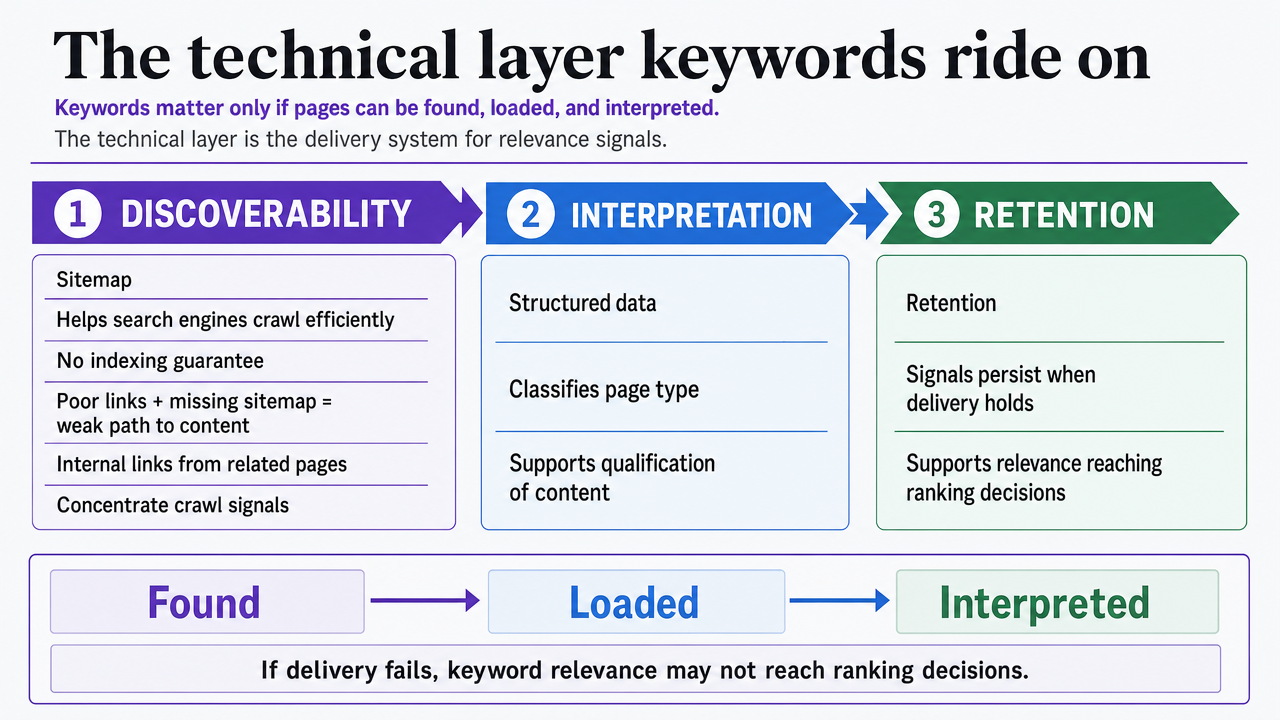 Visualize the three-stage technical pipeline (discoverability, interpretation, retention) the section walks through, matching the prose structure
A note for multi-location operators translating head terms into variants
A quick scope shift: this section speaks to multi-location service businesses—dental groups, law firm networks, home services franchises, senior living portfolios—where a single head term like "invisalign" or "estate planning attorney" has to work across dozens or hundreds of location pages. The temptation is to spin up a page per city, swap the location modifier into the title and H1, and treat the rest as boilerplate. That is the exact pattern Google's spam policy flags as scaled content abuse when the pages exist primarily to capture keyword variants rather than help users 4.
The defensible version carries location-specific substance on each page: the practitioners who work there, the services actually offered at that site, directions, hours, intake details, and local context the national template cannot supply. The head term appears because it describes what the location does. The variant exists because the location exists, not because the keyword does.
From keyword decisions to brand position
Keyword SEO sits downstream of a brand decision most content teams make before they open a research tool. The peer-reviewed review of SEO strategy and online brand positioning identifies four interacting components—niche differentiation, valuable content, targeted keywords, and scalable link building—as the structural pieces that connect search visibility to brand outcomes 16. Keyword selection is one of those pieces, not the whole program, and it inherits its leverage from the differentiation the brand has already chosen to defend.
That ordering has a practical consequence for content managers defending keyword strategy to executives. The question is not which phrases carry the highest volume. The question is which phrases a differentiated brand can credibly own, with content whose first-hand expertise and specific analysis a commodity restatement would not contain 7. A keyword program aligned to a sharp position produces fewer pages that compound; a program chasing undifferentiated head terms produces more pages that stall.
Teams running this workflow at production velocity—screening queries for distinct information need, briefing with specific angles, and reviewing before publication—are the use case Vectoron was built to support.
Frequently Asked Questions
References
- 1.In-Depth Guide to How Google Search Works.
- 2.A Guide to Google Search Ranking Systems.
- 3.SEO Starter Guide: The Basics.
- 4.Spam Policies for Google Web Search.
- 5.Ask ``who, How, And Why''.
- 6.AI Features and Your Website.
- 7.Google's Guide to Optimizing for Generative AI Features on Google Search.
- 8.What Is a Sitemap?.
- 9.Completeness.
- 10.Understanding page experience in Google Search results.
- 11.Keyword Selection Strategies in Search Engine Optimization.
- 12.Which keyword design increases the click and purchase probability ....
- 13.Determining the informational, navigational, and transactional intent of Web queries.
- 14.Classifying the user intent of web queries using k-means clustering.
- 15.Overview of TREC 2024 - Text REtrieval Conference.
- 16.Search engine optimisation (SEO) strategy as determinants to online brand positioning.