
Key Takeaways
- A meta title is the text inside the HTML
- Google rewrites titles that are missing, too long, keyword-stuffed, or misaligned with page content, substituting text from the other signals it evaluates 2, 10.
- The 50-60 character rule has given way to a 30-60 character planning range, since Google truncates by pixel width and renders titles differently across devices and queries 8, 9.
- At portfolio scale, consistency depends on templates, pre-publish approval gates, and Search Console diff-checking rather than case-by-case copywriting judgment 1, 4.
The title tag most managers write, and the title link Google actually shows
Most content managers still think of the meta title as a single deliverable: a string of text they write into the CMS, save, and forget. Google no longer treats it that way. The <title> element in a page's HTML head is one input among several the search engine considers when it constructs the clickable headline shown in results, a rendered artifact Google refers to as the title link 2. The two are related, but they are not the same object, and confusing them is where most meta title strategy quietly breaks.
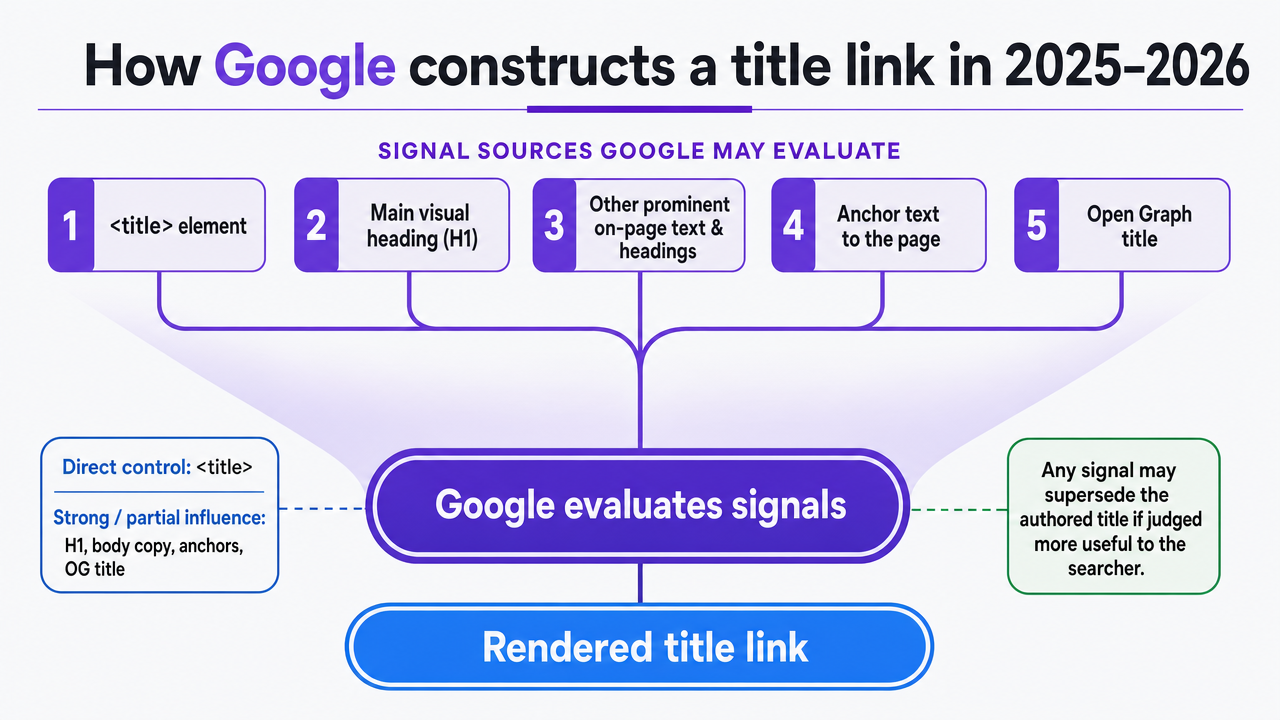
The title tag is what a writer authors. The title link is what a searcher sees. Google may draw on the <title> element, the main visual heading, prominent on-page text, anchor text pointing to the page, and Open Graph title data to decide which version to display 2, 8. When those signals contradict each other, or when the authored title is stuffed, generic, or misaligned with the page's actual content, Google increasingly overrides it and builds a new one from the other sources 5, 10.
For a content operation running 200 or more URLs, this reframes the job. Writing a good meta title is no longer a copywriting task judged in isolation. It is a signal-alignment task judged against the H1, the body copy, the anchors, and the social metadata. The rest of this article works through what that alignment looks like, how Google's rewrite behavior enforces it, and how to produce titles at scale without a full-time SEO editor auditing every draft.
Defining the meta title with precision
The HTML element behind the label
A meta title is the text inside the <title> element in a webpage's HTML head. That element is where the writer's control begins and, in most cases, where it ends. Google's own documentation names the <title> element as one of the primary sources it consults when constructing a search result, and it instructs site owners to specify a <title> on every page 5. Florida International University's editorial guidance describes the meta title as "an HTML element that labels the name of a webpage and describes the content on the page for search engines" 4, which captures both audiences the element serves: crawlers parsing structure and humans scanning results.
The technical footprint is small. A single line of markup, nested inside the <head>, invisible on the rendered page itself. The strategic footprint is not. That one string appears in search results, browser tabs, bookmarks, social shares that lack Open Graph overrides, and internal analytics reports keyed to page titles 6. For content managers auditing a library, treating the <title> element as a discrete field rather than a rendered artifact is the first move toward consistent production.
Meta title, SEO title, page title, title tag: one element, four names
The vocabulary problem trips up cross-functional teams more often than the technical one. "Meta title," "SEO title," "page title," and "title tag" all refer to the same <title> element. Glossary sources confirm the overlap explicitly, listing page title and SEO title as alternate labels for the same HTML construct 6. CMS platforms compound the confusion: some interfaces expose the field as "SEO Title," others as "Meta Title," and a few as "Browser Tab Title," while the underlying markup is identical.
The distinction that matters is not among those four names. It is between the authored <title> element and the title link Google renders in search results 9. The first is a static string the site controls. The second is a dynamic display Google may replace with text drawn from headings, body copy, or anchor text 2. Teams that conflate them end up debugging the wrong artifact when SERP titles drift from what the CMS shows.
Where the meta title appears beyond the SERP
The search result is the highest-visibility surface, but not the only one. The <title> element populates the browser tab label, the default bookmark name, the tooltip on hover in most desktop browsers, and the fallback text for social shares when Open Graph or Twitter Card metadata is missing 6, 7. It also shows up in browser history, tab-switcher previews, and screen reader announcements, which means accessibility and search performance draw on the same string.
For a content manager reviewing an editorial calendar, that multiplication of surfaces changes the QA calculus. A meta title that reads cleanly in a 600-pixel SERP preview may still truncate awkwardly in a browser tab, or lose its distinguishing keyword when a user has ten tabs open. Auditing titles across those contexts, not just the SERP mockup, catches problems that a single-view review misses.
Test live meta title optimization workflows now
Experience real-time impact of optimized meta titles on published content during your trial period.
How Google constructs a title link in 2025-2026
The five signal sources Google may pull from
Google's title link generation is not a simple read of the <title> element. The search engine's documentation names five inputs it may draw from when deciding what text to render as the clickable headline:
- the
<title>element itself, - the main visual heading on the page (typically the H1),
- other prominent on-page text and headings,
- anchor text pointing at the page from internal and external sources,
- and Open Graph title data when it is present 2, 8.
Any of those signals can supersede the authored title if Google judges the combination will serve the searcher better than what the site supplied.
That five-input model reframes what "writing a meta title" actually means. A writer controls the <title> field directly, has strong influence over the H1 and body copy through the CMS, has partial influence over Open Graph tags (often auto-populated from the title anyway), and has weak-to-indirect influence over anchor text, which depends on how other editors, publishers, and syndication partners describe the page. The <title> element is the loudest signal a site owner controls, but it is not the only signal Google weighs 5.
For content teams, the practical read is that the meta title never sits alone. It sits in a small constellation of on-page and off-page text that Google evaluates as a whole. When those signals reinforce each other, the authored title tends to survive. When they diverge, the rewrite risk climbs.
What triggers a rewrite: weak, stuffed, or misaligned titles
Google's guidance on when it substitutes its own title text is unusually explicit for a ranking-adjacent behavior. The company's title link documentation states that Google may generate a new title when the <title> element is missing, when it is too long, when it is keyword-stuffed, or when it does not accurately reflect the content of the page 2. The SEO Starter Guide reinforces that guidance, warning site owners against "extremely long or overly keyword-stuffed titles" and directing them to write titles that describe the page's actual content 10.
Three patterns produce most rewrites in practice:
- The first is boilerplate suffixes: pages that append the same brand-plus-tagline string to every title, leaving too little unique text for Google to distinguish one URL from another.
- The second is keyword stacking, where the writer chains related queries together in the hope of hitting more searches, producing a title that reads like a tag list rather than a description.
- The third is misalignment: the
<title>promises one topic, the H1 announces another, and the body copy focuses on a third.
In each case, Google's response is to look at the other four signal sources and construct something more accurate 5. The rewrite is not a penalty. It is a substitution, and the substituted text is often less compelling than a well-written original would have been.
Why the 50-60 character rule no longer holds
The 50-to-60 character rule was a pixel-width heuristic dressed up as a hard limit. It came from measuring how much text fit in the desktop SERP before Google truncated it with an ellipsis. Practitioner guidance has since moved to a wider planning range of roughly 30 to 60 characters, treated as a design constraint rather than a rule, and validated against real display behavior in Search Console 8, 9. The shift reflects three realities the older rule ignored.
First, mobile and desktop SERPs truncate at different points, and Google's rendering has grown more variable as it experiments with layout. A title that fits cleanly on desktop can clip on mobile, and vice versa. Second, Google truncates by pixel width, not character count, so wide characters like uppercase M or W eat more space than narrow ones like lowercase i or l. Two 58-character titles can render very differently. Third, the shorter end of the range often outperforms the longer end for pages where the intent is clear from a few words, which is why 30 characters is now treated as a legitimate minimum rather than a warning sign 9.
The operational implication is that character counts are a drafting guardrail, not an optimization target. Florida International University's editorial guidance frames the correct discipline as iterative testing: draft within a range, publish, monitor how Google actually renders the title, and revise based on what the SERP shows 4. That loop is more reliable than any static rule, and it accepts that Google may render the same <title> differently over time.
 Visualize the five signal sources Google evaluates when constructing a title link, directly supporting the section's cited framework
Signal alignment as the real optimization problem
Matching the
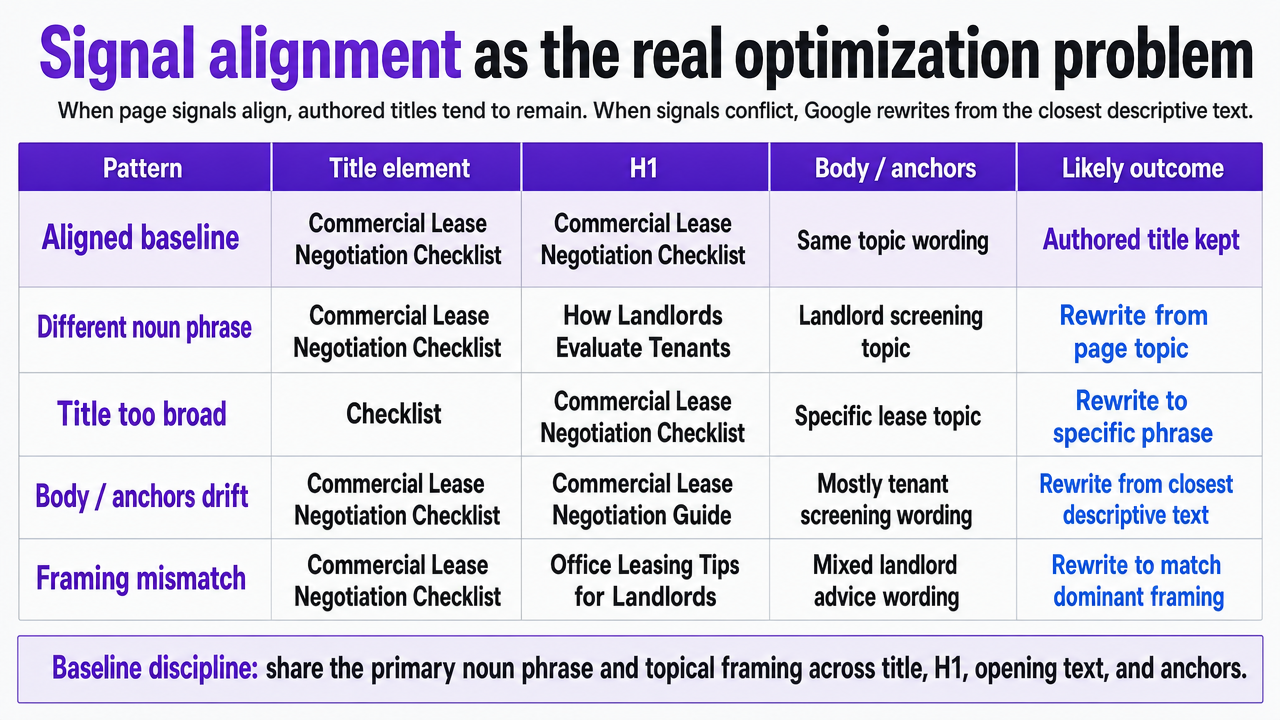
Alignment is the shortest path to keeping an authored title intact. When the <title> element, the H1, the opening body paragraph, and the anchor text pointing at the page all describe the same topic in similar language, Google has no cheaper substitute to construct and typically renders what the site supplied 2. When those signals disagree, the search engine reaches for whichever text most accurately describes the page and builds a title link from it 5.
Practitioner guidance now treats H1-to-title matching as a baseline discipline rather than an advanced tactic. The two do not need to be identical, but they should share the primary noun phrase and the same topical framing 9. A <title> that reads "Commercial Lease Negotiation Checklist" paired with an H1 that reads "How Landlords Structure Renewal Terms" tells Google two different stories about the same URL, and Google will pick one.
Anchor text is the signal writers control least and underestimate most. Internal links from category pages, related posts, and navigation modules feed Google a running description of what the destination is about 2. Editorial teams that let anchors drift, using "click here" on some pages and topic-specific phrases on others, create the same misalignment Google reads as a rewrite cue.
Anti-patterns and the rewrite each one invites
Four anti-patterns account for most avoidable title rewrites, and each one maps to a specific signal Google reaches for as a replacement. Keyword stuffing is the loudest. When a <title> chains variants together, Google's SEO Starter Guide flags it directly, warning against "extremely long or overly keyword-stuffed titles" and instructing site owners to write text that describes the page 10. The replacement typically comes from the H1 or the first prominent heading, which usually reads more naturally than the stuffed original.
Boilerplate suffixes are the quietest failure mode. Appending the same brand-plus-tagline string to every URL in a site leaves too little unique text for Google to distinguish one page from another, and the title link documentation identifies inadequate or repetitive titles as a rewrite trigger 2. Google's response is to look at the on-page heading or anchor text and construct something more specific to the page.
Brand-first ordering is a variant of the same problem. Leading with the site name before the topic pushes the descriptive keywords toward the truncation edge, and on narrower SERP layouts the brand consumes the visible pixels before the searcher sees what the page is actually about. Current practitioner conventions place the brand at the end, separated by a dash, precisely to keep the topical language in the visible range 9.
H1 mismatch is the most consequential. When the <title> promises one topic and the H1 announces another, Google reads the divergence and often chooses the H1 as the more accurate description of the page 2, 5. Content teams sometimes create this gap deliberately, writing a keyword-heavy <title> for search and a human-friendly H1 for readers. Google resolves the conflict by preferring the human-friendly one, which means the SEO work in the <title> is silently discarded.
Testing and validating in Search Console instead of guessing
Static rules cannot tell a content manager which titles Google is actually rendering. Search Console can. Florida International University's editorial guidance frames meta title work as an experimental loop: draft within a planning range, publish, observe what appears in results, and revise based on what the SERP shows rather than what the CMS field contains 4. The value of that loop is that it accepts a fact static rules ignore: the same <title> can render differently across devices, queries, and time.
The operational version is straightforward. Pull the queries a URL ranks for, compare the impressions-weighted title Google displays against the <title> in the CMS, and flag the deltas. Pages where the two diverge are the audit queue. Pages where they match and impressions climb are the pattern library, meta title structures worth replicating on similar URLs.
That measurement discipline turns meta title production from a copywriting judgment into a repeatable process. Titles that survive Google's rewrite logic get reinforced. Titles that get replaced get rewritten with the substituted text as evidence of what the alignment gap was.
 Visualize the four anti-patterns and their corresponding Google rewrite responses as a comparison table, directly supporting the cited section content
See How Enterprise Teams Accelerate Meta Title Optimization at Scale
Connect with our specialists to benchmark your current meta title workflow against AI-driven solutions proven to increase SEO efficiency, consistency, and measurable search impact across large content portfolios.
Producing meta titles at scale without eroding quality
Templates, approval gates, and diff-checking as workflow artifacts
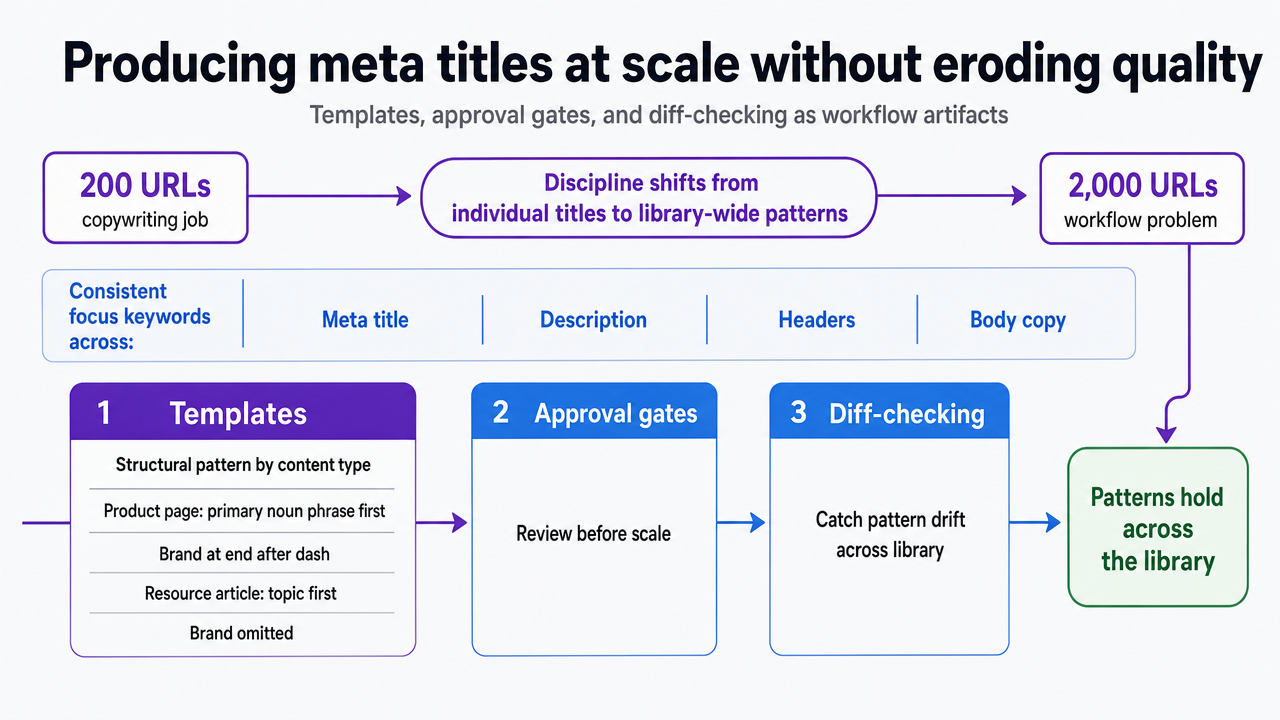
At 200 URLs, meta title production is a copywriting job. At 2,000, it is a workflow problem, and the discipline shifts from writing individual titles well to enforcing patterns that hold across a library. Ohio State University's editorial guidance frames content optimization as a repeatable process built on focus keywords appearing consistently across the meta title, description, headers, and body copy, precisely because ad-hoc discretion breaks down at portfolio scale 1.
Three artifacts do most of the enforcement work:
- Templates lock the structural pattern per content type: a product page template that places the primary noun phrase first and the brand at the end after a dash, a resource-article template that leads with the topic and drops the brand entirely, a location-page template that pairs service and city in a fixed order. Practitioner conventions on dash separators and brand placement give those templates a defensible starting shape 9.
- Approval gates catch the drift templates cannot. A pre-publish check that flags any
<title>diverging from its H1 by more than a shared noun phrase, or exceeding the drafting range, routes exceptions to an editor instead of letting them ship. - Diff-checking closes the loop after publish: comparing the CMS
<title>against the title Google renders in Search Console, flagging URLs where the two disagree, and feeding the mismatches back into the template library as revision candidates 4.
The workflow, not the writer, becomes the quality control.
AI-assisted drafting with human alignment review
AI drafting compresses the writing step; it does not replace the alignment judgment. A model given the H1, the opening body paragraph, the target query, and the template pattern can produce a <title> candidate that satisfies structural rules in seconds. What it cannot do reliably is judge whether the resulting title corroborates the anchor text pointing at the page, or whether it will read as descriptive rather than stuffed when Google evaluates it against the other four signal sources 2, 5.
The workable division of labor keeps drafting on the machine and alignment on a human reviewer. AI generates candidates against the template, checks them against Google's own guidance to avoid keyword stuffing and boilerplate 10, and surfaces the H1 and top internal anchors alongside each draft so the reviewer sees the signal set at a glance. The reviewer approves, edits, or rejects based on whether the candidate reads as a natural description of what the page actually covers.
That structure lets a small editorial team govern a large library without auditing every title from scratch. The Vectoron AI Content Platform is built around that approval-first pattern, drafting titles inside enforced templates and routing every candidate through human sign-off before publish.
 Visualize the three-artifact workflow (templates, approval gates, diff-checking) as a process infographic supporting the section's cited operating model
If you manage multiple locations or a portfolio of sites
The economics of meta title work change when the reader is running a multi-location brand, a franchise system, or a portfolio of sites rather than a single content library. At that scope, the unit of production is not a title, it is a template applied across dozens or hundreds of near-duplicate URLs, and the failure mode is drift: location pages that started with a consistent structure diverge over time as different editors, agencies, and franchisees touch them.
Ohio State University's editorial guidance treats content optimization as a repeatable process precisely because ad-hoc discretion does not survive at portfolio scale 1. For a manager overseeing 40 location pages across 12 markets, the meaningful variables are not creative. They are operational:
- the number of URLs in the library,
- the share of meta titles requiring refresh per quarter,
- the minutes spent per title on write plus alignment check plus CMS deploy,
- and the loaded hourly cost of the editor doing the work.
Multiply those four inputs and the quarterly cost of manual meta title maintenance becomes a line item worth measuring.
| Input variable | Operator supplies |
|---|---|
| URLs in library requiring meta title governance | Count from CMS export |
| Share requiring refresh per quarter | Percent flagged by Search Console diff |
| Minutes per title (draft + alignment check + deploy) | Time-tracked sample average |
| Loaded hourly cost of editor performing the work | Internal finance figure |
The payoff at portfolio scale is not a per-title savings figure. It is consistency enforcement: templates that hold across markets, H1-to-title alignment that survives editor turnover, and a Search Console feedback loop that surfaces which locations are being rewritten by Google and which are not 4. That is the systematized-portfolio discipline the institutional guidance points at, translated into a governance model a multi-location operator can actually run.
Frequently Asked Questions
References
- 1.Content Optimization | The Ohio State University.
- 2.Influencing your title links in search results.
- 3.What Is a Meta Title and How Does It Affect SEO?.
- 4.Testing Your Meta Title.
- 5.Influencing Title Links in Google Search | Google Search Central | Documentation | Google for Developers.
- 6.Meta Title: Definition, Length & SEO Best Practices.
- 7.What is a meta title? Definition, how it works, and FAQs | B12.
- 8.What Is a Title Tag? How to Write Title Tags for SEO.
- 9.Google Search Central Title Links: Best Practices 2026.
- 10.Search Engine Optimization (SEO) Starter Guide | Google Search Central.