
Key Takeaways
- A backlink is one site's hyperlink pointing to another, functioning as a third-party citation whose weight depends on the source's authority, independence, and topical relevance 6.
- A single citation from a credentialed publisher, like a university-affiliated medical center linking to an orthopedic group's clinical explainer, outperforms volume from low-authority directories because it moves both ranking predictors identified by Purdue research 6.
- In YMYL areas like healthcare and finance, search engines weight credibility signals more heavily because rank position alone poorly predicts information quality, making citations from sources meeting the National Academy of Medicine's four attributes essential 1, 4.
- Link acquisition intersects FTC rules whenever value changes hands, requiring disclosure for paid or incentivized placements and outright prohibiting fabricated reviews under the 2024 final rule 7, 9.
A working definition, anchored in one example
A backlink is a hyperlink on one website that points to a page on another website. Search engines treat each of these links as a third-party signal that the destination page is worth citing, with the signal's weight scaling with the authority, independence, and topical relevance of the source 6.
Consider a regional orthopedic group, Northshore Orthopedic Group, which publishes a clinical explainer on partial knee replacement. A university-affiliated academic medical center references that explainer in a patient education article and links to it. This single link is a backlink. It also represents a credibility transfer from an institution that meets the National Academy of Medicine's credibility attributes: independence from commercial bias, content review, transparency, and accountability 4.
This example anchors the discussion, unpacking what the link communicates to a search engine, why a single citation from a credentialed source outperforms volume from low-authority pages, and where link acquisition intersects with FTC rules, especially for content teams managing healthcare or other YMYL (Your Money Your Life) footprints.
What a backlink actually is, in technical and editorial terms
The mechanical definition versus the credibility definition
Mechanically, a backlink is an HTML anchor element on one domain whose href attribute points to a URL on another domain. A browser renders it, and a crawler follows it unless a rel attribute like nofollow, ugc, or sponsored instructs otherwise. This description is sufficient for a developer audit but incomplete for an SEO discussion.
Editorially, a backlink is a public, machine-readable act of citation by one publisher about another. The linking page commits its own reputation when it links externally, as every outbound link exists within an editorial context: the surrounding paragraph, the topic of the host article, and other sources cited in the same piece. Webometric research confirms that external links demonstrate the practicality and usefulness of content presented on a web domain 10.
These two definitions diverge in practice. A scraped directory listing and a paragraph citation within a peer-reviewed clinical explainer are identical at the HTML level but are not equivalent as credibility signals. The Northshore Orthopedic Group example highlights this gap: the orthopedic group gained a sourced reference within a patient education article from a credentialed institution, carrying editorial weight that a directory entry never could.
Why search engines still weight links heavily
Search engines need a method to estimate trust at scale across pages they did not create. Backlinks remain a valuable proxy because they are generated by independent editors, not by the destination page itself. While a page can claim expertise, a citation from a third party is more difficult to fabricate at scale.
Empirical evidence supports this. Purdue researchers found that the number of backlinks and the PageRank of backlink sources are among the strongest predictors of high ranking in Google search results 6. This emphasizes two variables: link count and source authority. This distinction is crucial, separating the myth that more links always help from the measured finding that source-level authority drives most of the ranking improvement.
This finding is coupled with another critical point for content teams: ranking position is a poor predictor of intrinsic information quality, especially in health contexts where Google's rank order influences patient access to information but does not validate its quality 1. Search engines are aware of this and have responded by relying more heavily on authority signals, such as links from credentialed sources.
For the Northshore Orthopedic Group example, this explains why a single citation from a university-affiliated academic medical center carries disproportionate weight. The referring page contributes both signals identified by the Purdue study as strongest: it adds a backlink, and the source itself possesses high domain-level authority. Volume without authority compounds slowly, whereas authority without volume can significantly impact a query.
The Northshore Orthopedic Group example, worked end to end
The scenario: a regional practice earns one citation from an academic medical center
Northshore Orthopedic Group is a hypothetical regional practice with four locations. The scenario illustrates what content teams commonly observe when a clinical explainer receives a citation from a credentialed source.
The practice's content team publishes an 1,800-word explainer on partial knee replacement candidacy, covering indications, contraindications, recovery timelines, and patient decision points. It cites three peer-reviewed studies, names the orthopedic surgeons who reviewed the page, and lists clinical review dates—standard practice for a well-resourced clinical content program.
Six months later, a writer at a university-affiliated academic medical center, drafting a patient education article on knee replacement options, needs a plain-language source explaining the partial-versus-total decision. The Northshore page appears in a search. The writer reviews it, confirms the clinical reviewers' credentials, and includes the URL as a sourced reference in a paragraph comparing partial and total approaches.
This constitutes the backlink: a single hyperlink, embedded in a patient education article paragraph, on a domain operated by an institution whose editorial process meets the National Academy of Medicine's credibility attributes for health sources 4. The Northshore content team neither paid for nor requested the placement; the link exists because a third-party editor deemed the destination useful enough to cite.
Anatomy of the link: anchor text, surrounding context, and outbound signals
The link is a single anchor element within a paragraph. Its anchor text, "a clinical overview of partial knee replacement candidacy," is descriptive, topical, and accurately reflects the destination page's subject without keyword stuffing.
The surrounding paragraph performs most of the editorial work, introducing the comparison between partial and total knee replacement, naming two institutional clinicians, and citing the Northshore explainer alongside two academic journal references. The host article's bibliography formally lists the link again. Webometric research directly addresses this type of placement, noting that external links demonstrate the practicality and usefulness of content presented on a web domain 10. The signal is not merely the URL, but the editorial company it keeps.
Four structural elements carry weight when a search engine parses the page:
- The anchor text describes the destination topic, providing a relevance cue to the crawler.
- The surrounding sentence places the link within a substantive comparison, not a sidebar.
- The neighboring citations are peer-reviewed journals, suggesting a consistent sourcing standard.
- The host page's overall topical cluster—patient education on orthopedic procedures—matches the destination's subject matter.
Each of these elements is visible to both a crawler and a human reader, which is why the signal is effective. Editors who cite carelessly risk losing credibility with their audiences first, and with algorithms second.
Why this one link outperforms dozens of low-authority alternatives
Contrast the academic medical center citation with an alternative: 50 links from regional business directories, low-traffic guest posts on unrelated lifestyle blogs, and aggregator pages republishing syndicated press releases. While the HTML is identical, the ranking impact is not.
The Purdue ranking study identified two variables explaining most backlink-driven ranking lift: the number of backlinks and the PageRank of backlink sources 6. The directory path increases the first variable but barely impacts the second. The academic medical center citation, however, influences both, as the referring domain itself carries high authority and adds a new referring domain.
A second, crucial layer applies more to healthcare than most verticals. Search engines apply stricter weighting to YMYL queries based on credibility signals, partly because ranking position is a poor predictor of intrinsic information quality in health contexts 1. A query like "partial knee replacement recovery" falls squarely into this category. The algorithm actively seeks reasons to surface credentialed sources, and a citation from a university-affiliated medical center provides precisely that reason.
Furthermore, directory links often carry compliance exposure that the academic citation does not. Many directories sell placement, potentially entangling the link in disclosure rules that content teams cannot ignore. An earned citation is not only a stronger ranking signal but also a cleaner record.
Test real SEO content production workflows now
Experience hands-on backlink and article publishing with live results during your trial period.
The credibility rubric: four attributes that separate a useful link from a wasted one
Most link prospect lists are sorted by third-party domain authority scores, which often prioritize the wrong variable. A more robust rubric comes from the National Academy of Medicine, which identifies four attributes distinguishing credible health information sources: independence from commercial bias, rigorous content review, transparency, and accountability 4. Each attribute corresponds to a question an SEO lead should ask before pursuing a backlink.
Independence from commercial bias asks whether the linking publisher has a financial stake in what it cites. An academic medical center publishing patient education has none. A trade publication funded by sponsored content has some. A directory that sells placement has only that. The Northshore citation clears this bar because the university-affiliated publisher does not profit from the outbound link.
Rigorous content review asks whether an editor, clinician, or subject-matter expert vetted the host article before publication. Peer-reviewed journals inherently meet this standard. Patient education programs at academic medical centers typically meet it through named clinical reviewers. Private blog networks, however, do not, as their editorial layer primarily serves paid placements.
Transparency asks whether the publisher names its authors, reviewers, funding sources, and review dates. Accountability asks whether the publisher will correct or retract content when errors surface. Together, these attributes filter out aggregator pages and syndicated press release republishers, where authorship is anonymous and corrections are rarely issued.
Applied as a screen, this rubric significantly narrows most prospect lists. Academic medical centers and professional societies pass all four tests. Trade publications pass two or three, depending on editorial discipline. Directories and private blog networks fail every test. An SEO lead using this rubric will focus on a smaller set of prospects, converting a higher percentage into citations that impact both ranking-relevant variables identified by the Purdue study.
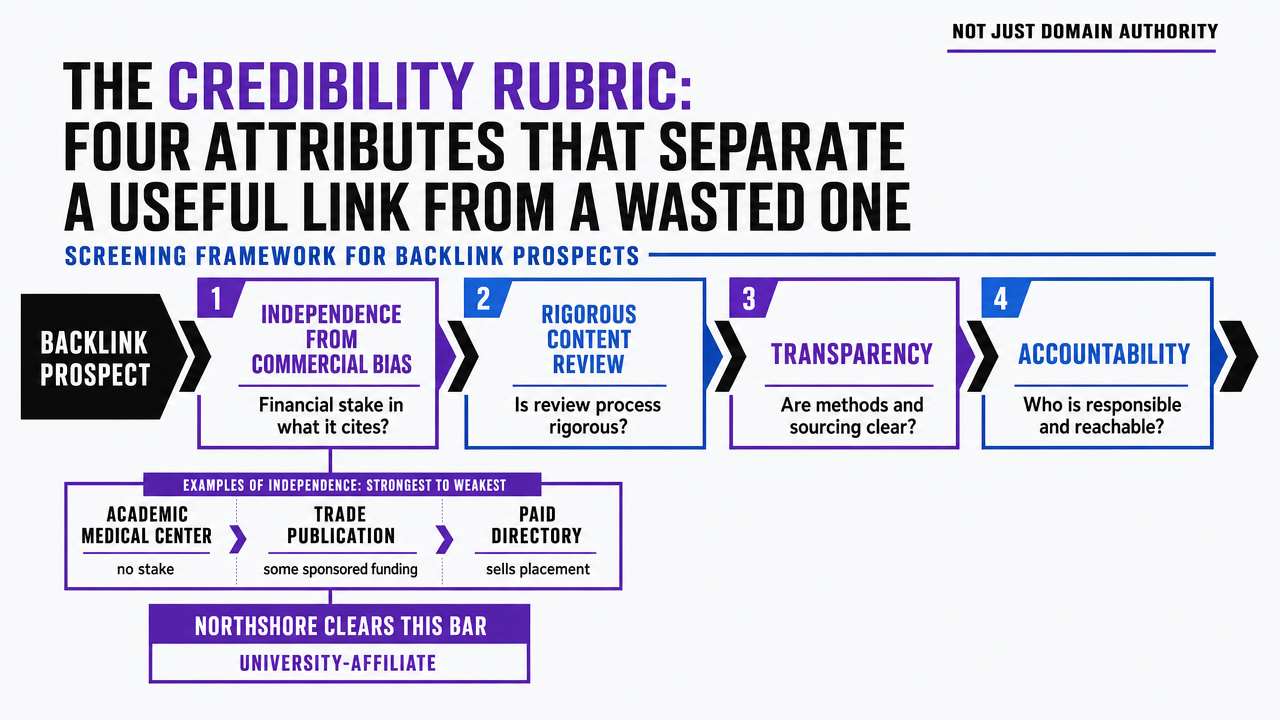 Visualize the four National Academy of Medicine credibility attributes cited in this section as a screening framework for backlink prospects
Backlinks in YMYL territory: why healthcare and finance raise the bar
Search engines apply a stricter evidentiary standard to queries that can affect a reader's health, safety, or financial well-being. This is structural: ranking position alone is a poor predictor of intrinsic information quality in health contexts, and while Google's rank system is important for patient access, it doesn't guarantee quality 1. This gap compels the algorithm to rely on externally verifiable signals, with backlinks from credentialed sources being among the most legible.
The risk of misinterpreting this is not theoretical. A 2025 meta-analysis of cancer-related information across social media and AI chatbots from 2014 to 2023 revealed moderate overall quality and a notable proportion of misleading or commercially biased content circulating through high-engagement channels 3. In health, visibility and accuracy often diverge more than in other verticals.
Quality also varies by topic within the same vertical. Searches related to the diagnosis and treatment of physical disease or injuries tend to yield higher-quality information than results for preventive and social health topics 2. An SEO lead managing a multi-location operator's content portfolio cannot assume the algorithm will treat a preventive-care page the same way it treats a procedural explainer. Both require credibility scaffolding, but the preventive page often needs more.
Backlinks from sources meeting recognized credibility attributes function as this scaffolding 4. For Northshore Orthopedic Group, the citation from a university-affiliated medical center serves a dual purpose: it adds an authoritative referring domain and signals to the algorithm that a credentialed editor deemed the destination useful enough to cite within patient education. In a query class where the algorithm actively discounts volume signals, this editorial endorsement is what drives page performance.
Compliance: where link building intersects FTC rules
Link acquisition falls under endorsement law whenever value changes hands. The 2024 FTC final rule prohibits the sale or purchase of fake reviews and testimonials, authorizing civil penalties against knowing violators 7. While not explicitly naming backlinks, its scope covers any arrangement where a publisher receives payment or other consideration to amplify a brand without disclosing the relationship. This includes sponsored placements, paid guest posts, and influencer mentions with outbound links.
The FTC's broader endorsement guidance clarifies the line content teams must internalize: paid benefits should be disclosed, and incentives cannot be conditioned on positive sentiment 8. A link earned because an editor found a page useful is editorial. A link placed due to money or product exchange between advertiser and publisher is an endorsement, and an undisclosed endorsement can be deceptive 9. This framework also applies to affiliate relationships behind product-review links, where the FTC has stated that affiliate-link disclosures may be necessary 11.
Three categories carry the highest exposure for healthcare and SaaS content teams:
- Paid placements in directories or sponsored posts without
rel="sponsored"or visible disclosure. - Reciprocal arrangements where a vendor exchanges a positive write-up for a link without disclosure.
- Incentivized reviews on third-party sites that include backlinks to the brand.
Each can convert a routine link into a regulated endorsement.
The operational standard is narrower than most prospect lists assume. Earned editorial citations from independent publishers carry no disclosure obligation. Paid or incentivized placements require disclosure and the correct link attribute. Arrangements involving the purchase or sale of fabricated reviews violate the 2024 rule outright. An SEO lead reviewing a vendor's link list should reject any prospect whose placement model cannot be described within these terms.
See How Enterprise Brands Build Authoritative Backlinks at Scale
Request a walkthrough of automated backlink strategies proven to outperform manual outreach, including real-world data from SaaS and agency campaigns managing thousands of referring domains.
If a content team manages multiple locations or practices
Concentrated authority versus distributed volume: a qualitative tradeoff
The calculus shifts when a single content team supports multiple orthopedic locations, urgent care clinics, or specialty practices under one brand. The question moves from whether to pursue a backlink to where to allocate finite outreach hours, especially when each location page competes in its own local query set.
Two paths emerge: concentrated authority involves investing in a small number of high-credibility citations, typically pointing to the brand's strongest clinical explainers or service hub pages, then using internal linking to distribute that authority across location pages. Distributed volume entails pursuing many lower-authority placements—local directories, chamber listings, community sponsorships—each pointing to a specific location URL.
The tradeoffs are clear across three variables supported by research:
| Variable | Concentrated authority (one academic medical center citation) | Distributed volume (50 directory and local placements) |
|---|---|---|
| Ranking signal strength | Moves both predictors identified by the Purdue study: referring domain count and source PageRank 6 | Moves count only; source authority contributes marginally 6 |
| Compliance exposure | Low. Editorial citation, no value exchanged, no disclosure obligation 9 | Variable. Paid directory placements and sponsored arrangements can trigger disclosure rules 7 |
| Credibility transfer in YMYL queries | High. Source meets independence, review, transparency, and accountability attributes 4 | Low. Most directory operators fail at least two of the four attributes 4 |
A multi-location operator cannot entirely forgo local citation work, as local directories and chamber listings still contribute to map-pack signals and serve as discovery surfaces. The key operational insight is that when outreach hours are limited, one earned institutional citation pointing to a service hub page yields more measurable ranking lift than the same hours spent on low-authority placements. The hub page then passes authority to location pages via internal links the content team already controls.
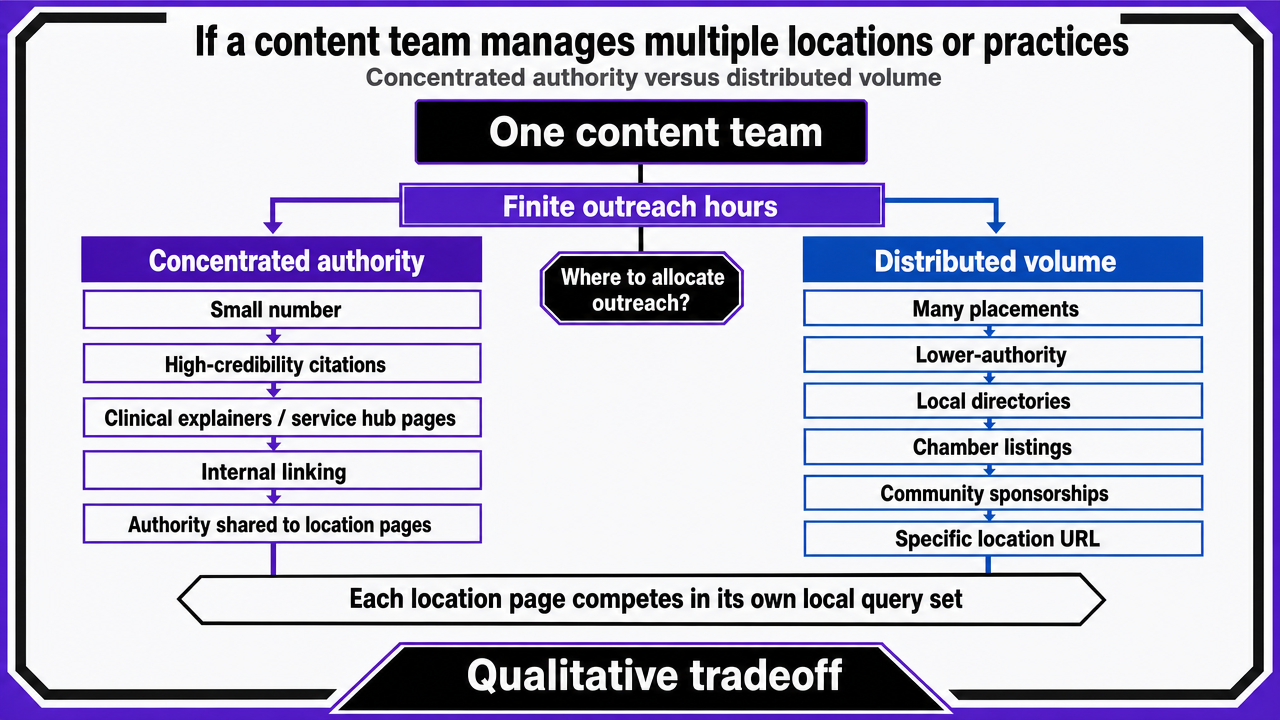 Visualize the qualitative comparison table already present in this section between concentrated authority and distributed volume strategies
A decision framework for evaluating any backlink prospect
Every content team can sort prospects using four sequential questions. Each question maps to a decisive signal identified by research, and a prospect failing any question should be rejected before outreach efforts begin.
- Does the referring domain possess independent editorial authority? A university-affiliated medical center, a peer-reviewed journal, or a professional society passes. A directory selling placement, a private blog network, or an aggregator republishing syndicated press releases fails. The Purdue ranking research identified the PageRank of backlink sources as one of the two strongest predictors of ranking lift, alongside backlink count 6. A weak source impacts the wrong variable.
- Does the host page meet the four credibility attributes identified by the National Academy of Medicine—independence from commercial bias, rigorous content review, transparency, and accountability 4? Two or more failures disqualify the prospect for YMYL destinations.
- Does value change hands? If money, product, or reciprocal placement is involved, the link falls under FTC endorsement territory, requiring disclosure and the correct
relattribute 9. Fabricated reviews paired with links directly violate the 2024 final rule 7. - Is the topical fit close enough that the anchor text and surrounding paragraph will read as editorial rather than promotional?
A prospect that clears all four questions warrants outreach time. One that fails any question should be disregarded, regardless of what a third-party authority score suggests.
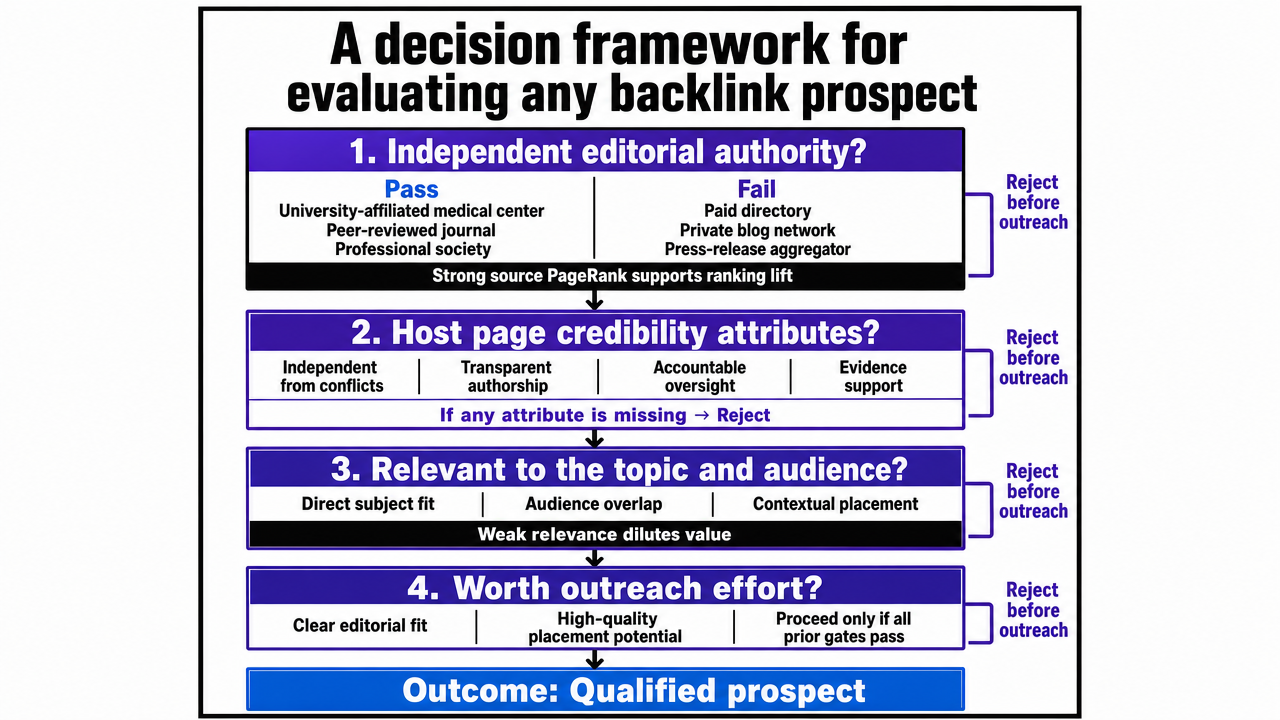 Visualize the four sequential gate-check questions described in this section as a decision flow
Frequently Asked Questions
References
- 1.Quality of patient health information on the Internet: reviewing a complex and evolving landscape.
- 2.Consumer, be aware: Quality of health-related Internet searches varies.
- 3.Quality of Cancer-Related Information on New Media (2014-2023).
- 4.Identifying Credible Sources of Health Information in Social Media: Principles and Attributes.
- 5.Evaluating the Quality of Health Information in a Changing Digital Ecosystem.
- 6.How to Improve Your Google Ranking: Myths and Reality.
- 7.Federal Trade Commission Announces Final Rule Banning Fake Reviews and Testimonials.
- 8.Soliciting and Paying for Online Reviews: A Guide for Marketers.
- 9.Endorsements, Influencers, and Reviews | Federal Trade Commission.
- 10.The Webometric Status of Isfahan University of Medical Sciences, Iran.
- 11.FTC's Endorsement Guides: What People Are Asking.