Key Takeaways
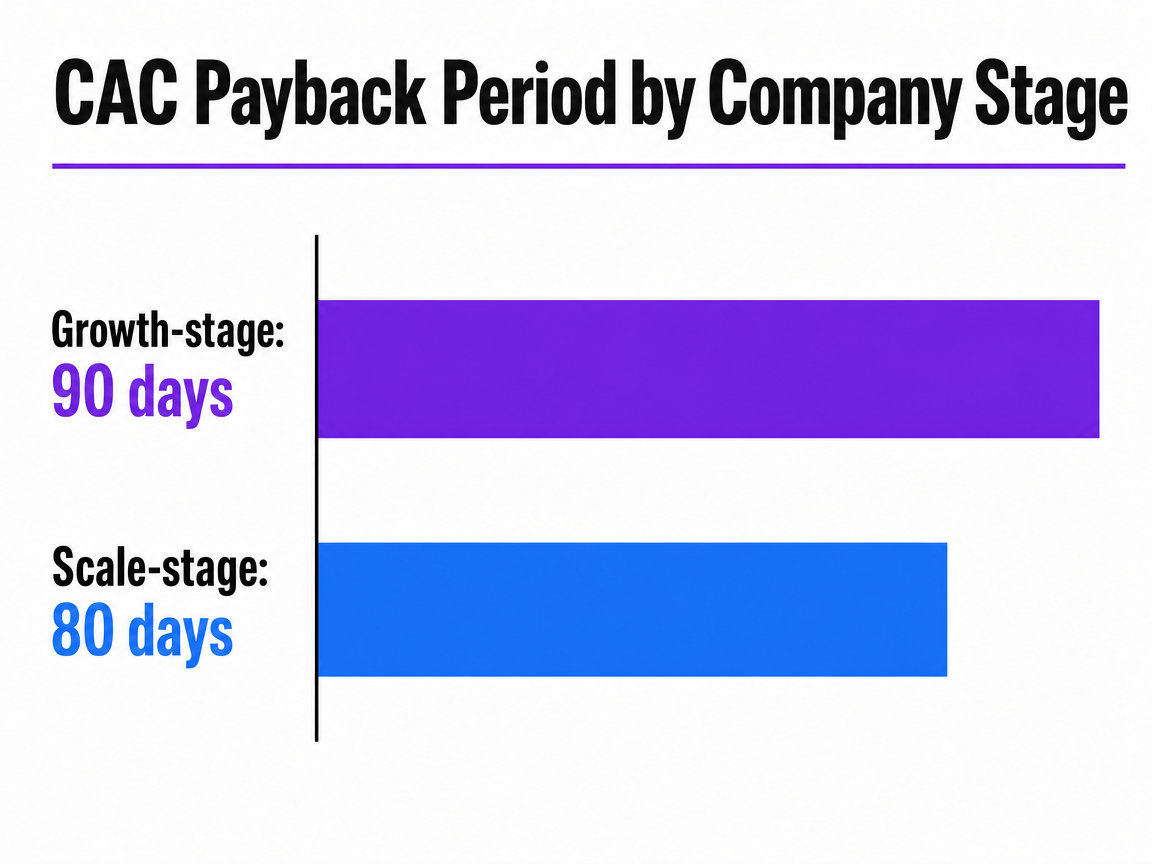 CAC Payback Period by Company Stage
Shows the average Customer Acquisition Cost (CAC) payback period in days for SaaS companies at different growth stages, indicating increased efficiency at scale.
- A SaaS digital marketing strategy is an operating system with three layers: ICP and economic targets at the top, channel mix in the middle, and shared targets, data, and cadence holding them together.
- Channel decisions are downstream of economics. Set the LTV:CAC corridor (3:1 minimum, 4–5:1 elite) and motion-specific payback targets before allocating spend 4, 9.
- Buyer behavior now requires full-funnel digital coverage, with 73% of B2B buyers comfortable spending over $500,000 through self-serve or remote channels 14.
- Treat each motion as a bounded experiment with a preset cut line, reallocate inside the weekly review, and let AI orchestration absorb the coordination tax that asynchronous handoffs create 9, 8.
The Operating System Problem in SaaS Marketing
Most SaaS marketing organizations do not have a strategy problem. They have a coordination problem dressed up as a strategy problem. The SEO team is publishing against a keyword universe the paid team has never seen. The paid team is bidding on terms the content team is already ranking for organically. The lifecycle team is nurturing leads the sales team has already disqualified. Each function is running a competent playbook in isolation, and the combined output still misses the number.
This is the operating system problem. A digital marketing strategy in B2B SaaS is not a list of channels or a quarterly campaign calendar — it is the logic that decides which channels answer to which targets, on what cadence, with which shared data, and against which economic constraints. Without that logic, channel investment compounds friction instead of pipeline.
The research consensus is direct on this point. SaaS marketing is now defined less by tactic selection and more by orchestration across acquisition, activation, expansion, and retention against a defensible LTV:CAC ratio 3. McKinsey's B2B Pulse work goes further: the companies pulling ahead are not the ones running the most channels, they are the ones running more channels and more self-service options and more personalization, integrated as a single system 6. Channel count alone is noise. Coordinated channel count is the signal.
For a VP of Marketing inheriting a fragmented stack, the practical question is not "what tactics should we add?" It is "what is the operating logic that makes our current tactics answer to the same number?" The rest of this article works through that logic — starting with the economic constraints that bound every downstream decision.
Strategy Begins With Economic Constraints, Not Channels
LTV:CAC and CAC Payback as the Strategy's Boundary Conditions
Channel selection is downstream of economics. Before a SaaS marketing leader decides how much to spend on SEO content, paid acquisition, or backlink programs, the strategy has to declare the unit-economic target every channel must answer to. That target is rarely controversial in the abstract and routinely ignored in practice: a defensible LTV:CAC ratio and a CAC payback window the finance function will defend in a board meeting.
The current B2B SaaS benchmark places 3:1 as the minimum viable LTV:CAC ratio for profitability, with 4:1 to 5:1 marking elite performance across stages and industries 4. The same benchmark work flags an underappreciated upper bound — ratios significantly above 5:1 often signal under-investment in growth rather than superior efficiency, meaning the company is leaving acquired customers and market share on the table 4. A digital marketing strategy that produces a 7:1 ratio is not necessarily winning. It may be a strategy that quietly forfeits expansion to better-funded competitors.
This is why the ratio functions as a boundary condition rather than a goal. It sets the corridor inside which channel investment is rational. A growth-stage SaaS company holding LTV:CAC at 3.5:1 with a 90-day CAC payback has economic permission to compound spend across SEO, paid, and content; a company at 2:1 does not, regardless of how attractive any individual channel looks in isolation 4. Strategy in this view is the discipline of refusing to fund tactics that pull the ratio in the wrong direction.
SaaS marketing leaders who build the strategy from the ratio down tend to write fewer channel briefs and more decision rules. The rule is not "invest in SEO." It is "invest in SEO until blended CAC payback drifts past the stage benchmark, then reallocate." Channels become instruments of an economic policy, not line items in a plan.
CAC Payback Targets by GTM Motion
LTV:CAC sets the corridor. CAC payback sets the clock. The two metrics work together because a healthy ratio with a 36-month payback still creates a cash-flow problem investors will not tolerate in the current environment. Payback compression has become the dominant efficiency story in SaaS, with growth-stage companies now targeting roughly 90-day payback and scale-stage companies pushing closer to 80 days as investor scrutiny on capital efficiency tightens 4.
The complication is that one payback number cannot govern every motion inside the same company. Product-led growth, SMB sales-led, mid-market, and enterprise ABM motions each generate revenue on different timelines, and a digital marketing strategy that applies one payback target uniformly will starve the motions with longer natural payback curves. Current 2026 GTM benchmarks separate the targets clearly:
- Product-led growth: under 12 months
- SMB sales-led: 8–12 months
- Mid-market: 14–18 months
- Enterprise ABM: 18–24 months 9
Those ranges do practical work for a VP of Marketing. They convert abstract "efficiency" pressure into specific channel decisions. A PLG motion targeting sub-12-month payback can carry self-serve content, organic search, and lifecycle automation as primary investments because the revenue arrives quickly enough to refund acquisition cost. An enterprise ABM motion accepting an 18-to-24-month payback can rationally fund deeper account research, custom content, multi-touch nurture, and field-marketing programs that would look indefensible on a PLG P&L 9.
The same logic prevents a common allocation error: funding mid-market and enterprise programs as if they were PLG programs in disguise. When a marketing leader benchmarks every channel against the shortest payback in the portfolio, the strategy quietly converges on bottom-of-funnel paid tactics that show fast attribution and starves the longer-horizon work that builds enterprise pipeline. The published payback bands by motion give the marketing leader cover — and an explicit number — to defend longer-cycle investment to a CFO who only sees the blended figure.
The discipline is to declare the motion mix first, attach the payback target to each motion, and then let those targets dictate the channel weight inside each. The strategy is not "more paid" or "more content." The strategy is "these motions, these paybacks, these channels under each."
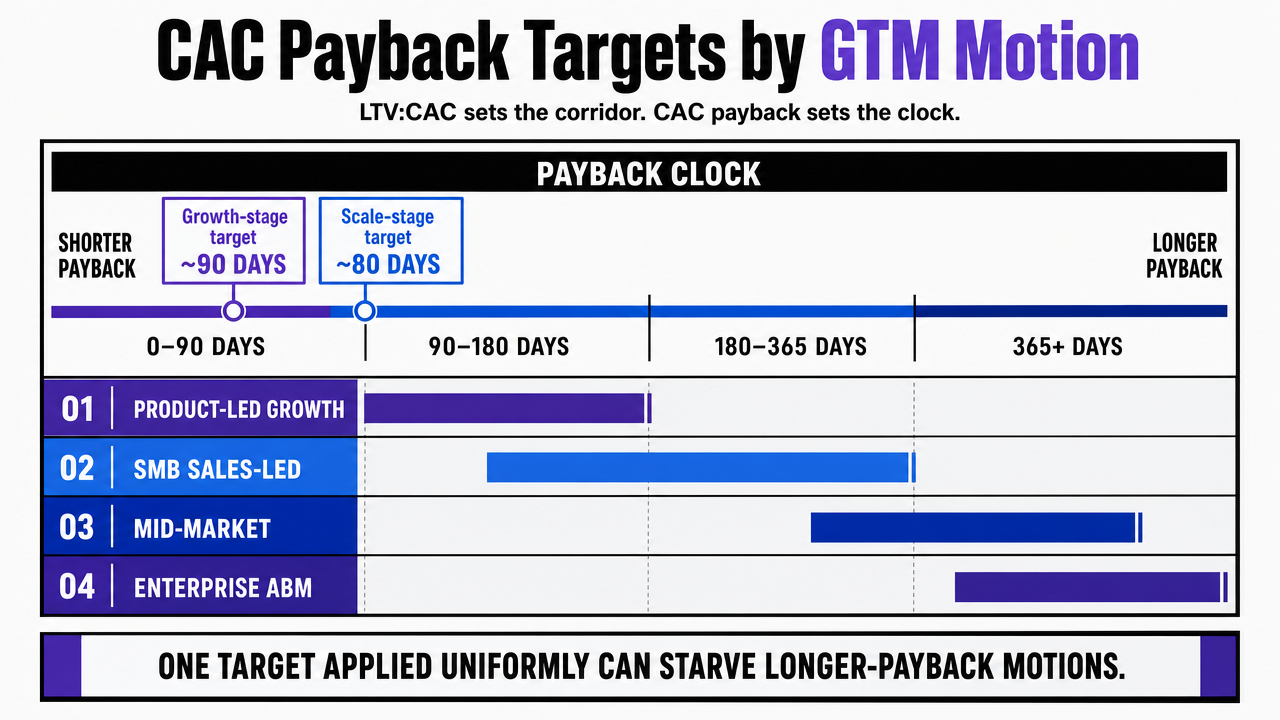 Visualize the four GTM motion payback benchmarks cited in the section to anchor the channel-weight argument
Pipeline Velocity as the Third Lever
LTV:CAC and CAC payback describe the economics of customers already won. Pipeline velocity describes how quickly the strategy is producing the next set. It belongs in the same conversation because a strategy can sit inside the right efficiency corridor and still miss the number simply by moving opportunities through stages too slowly to hit the quarter.
Pipeline velocity is one of the three GTM benchmarks SaaS companies are being told to track explicitly in 2026, alongside time-to-first-revenue and CAC payback, with each GTM motion treated as a bounded experiment carrying its own velocity target before scaling 9. The framing matters. Velocity is not a marketing metric the demand team owns alone — it is a joint output of message quality, channel mix, sales follow-up speed, and product activation friction.
For digital strategy specifically, velocity is the diagnostic that exposes coordination failures the LTV:CAC ratio hides. A company can hit a 3.5:1 ratio with a 14-month enterprise payback and still watch deals stall for 60 days between MQL and first sales conversation because content nurture and SDR cadence are not synchronized. The ratio looks fine on the quarter the customer signs; the pipeline that should be feeding next quarter is half-empty.
The practical move is to add stage-by-stage velocity targets to the same plan that carries the LTV:CAC and payback targets, then watch which channels accelerate or decelerate movement between stages. That is the data the next section's coordination layer is built to use.
Test Unified SaaS Marketing Execution Risk-Free
Experience coordinated SEO, PPC, and backlink workflows on your own campaigns before making a commitment.
The Definition, Earned: Strategy as Three Coordinated Layers
Strategy Layer: ICP, Positioning, and Economic Targets
With the economic boundaries set, the strategy itself can be defined. A SaaS digital marketing strategy is the explicit declaration of who the company sells to, the position it occupies in that buyer's mind, and the economic targets every downstream channel must answer to. Those three decisions sit in the top layer because every channel choice below them is a derivative of them.
The ICP work is foundational and routinely under-specified. A usable ICP names the industry, company size, technology stack, buying trigger, and budget authority of the accounts the product converts and retains at a healthy ratio — not the accounts the product could theoretically serve 1. The distinction matters because a loose ICP inflates the addressable universe, which inflates spend, which deflates LTV:CAC. Positioning then translates that ICP into the one sentence the buyer can repeat internally to justify the purchase. A SaaS go-to-market framework treats positioning as the bridge between target market definition and channel selection, with pricing and packaging as the proof points that make the position credible 12.
Economic targets close the layer. The strategy declares the LTV:CAC corridor, the payback target by motion, and the velocity targets by stage that the company will defend. Once those three numbers are written down, the channel layer below has the constraints it needs to make rational tradeoffs — and a marketing leader has the language to push back on board-level requests that violate them.
Channel Layer: SEO, Paid, Content, Backlinks, Lifecycle
The channel layer is where most SaaS marketing strategies start, and where most of them stall. The standard composition is well documented: SEO and organic content, paid search and paid social, lifecycle email, and backlink acquisition as the durable authority program underneath organic 10. A complete B2B SaaS marketing plan also assigns clear conversion events to each channel — demo requests, free-trial starts, content downloads — so that channel performance can be measured against the same pipeline definition the sales team uses 2.
The substantive question at this layer is weight, not presence. Every SaaS company runs some version of all five channels; the strategic decision is how much capital and attention each gets, and that allocation has to flow from the motion mix declared in the strategy layer above. A PLG-heavy company weights organic search, product-led content, and lifecycle automation because the buyer self-serves through them. An enterprise ABM-heavy company weights account-targeted content, paid social into named lists, and backlink-driven authority because the buyer requires social proof and analyst-grade reference material before a first call 7.
The error to avoid is treating channels as additive. Adding paid search to a strategy that already has strong organic rankings on the same terms cannibalizes the cheaper channel and inflates blended CAC. Adding outbound email to an inbound-heavy motion without sequencing it against content engagement signals burns list quality and damages domain reputation. The channel layer is a portfolio with internal interactions, not a checklist — which is precisely why it needs the layer above it.
Coordination Layer: Shared Targets, Shared Data, Shared Cadence
The coordination layer is the layer most strategies omit, and the layer that makes the other two work. It is the set of rules that force the SEO, paid, content, lifecycle, and backlink programs to answer to the same target, look at the same data, and operate on the same review cadence. Without it, the strategy layer becomes a slide deck no channel owner consults and the channel layer becomes five independent budgets competing for credit on the same deals.
The McKinsey B2B Pulse work makes the case for this layer directly. B2B winners use significantly more channels and offer more self-service options than peers, and they grow faster and capture higher share of wallet as a result — but the differentiator is not channel count alone, it is the integration of those channels into a single experience with shared data and personalization 6. The losing pattern is the inverse: many channels, no integration, declining returns on each incremental investment.
Three coordination mechanisms do most of the work:
- Shared target — usually a pipeline number broken down by motion, with each channel carrying a fractional contribution that adds to the whole.
- Shared data — meaning the same definition of an MQL, the same attribution model, and the same dashboard reviewed by every channel owner in the same meeting.
- Shared cadence — typically a weekly operating review where channel performance is compared against the pipeline target and reallocation decisions are made in the room rather than negotiated asynchronously over the following two weeks.
When all three layers operate together, the strategy reads as one document instead of three. The ICP and economic targets at the top constrain the channel mix in the middle, and the coordination mechanisms at the bottom keep the channels honest to those constraints week over week. That is the operating system. The rest of the article works through what it enables — and what it costs to run without it.
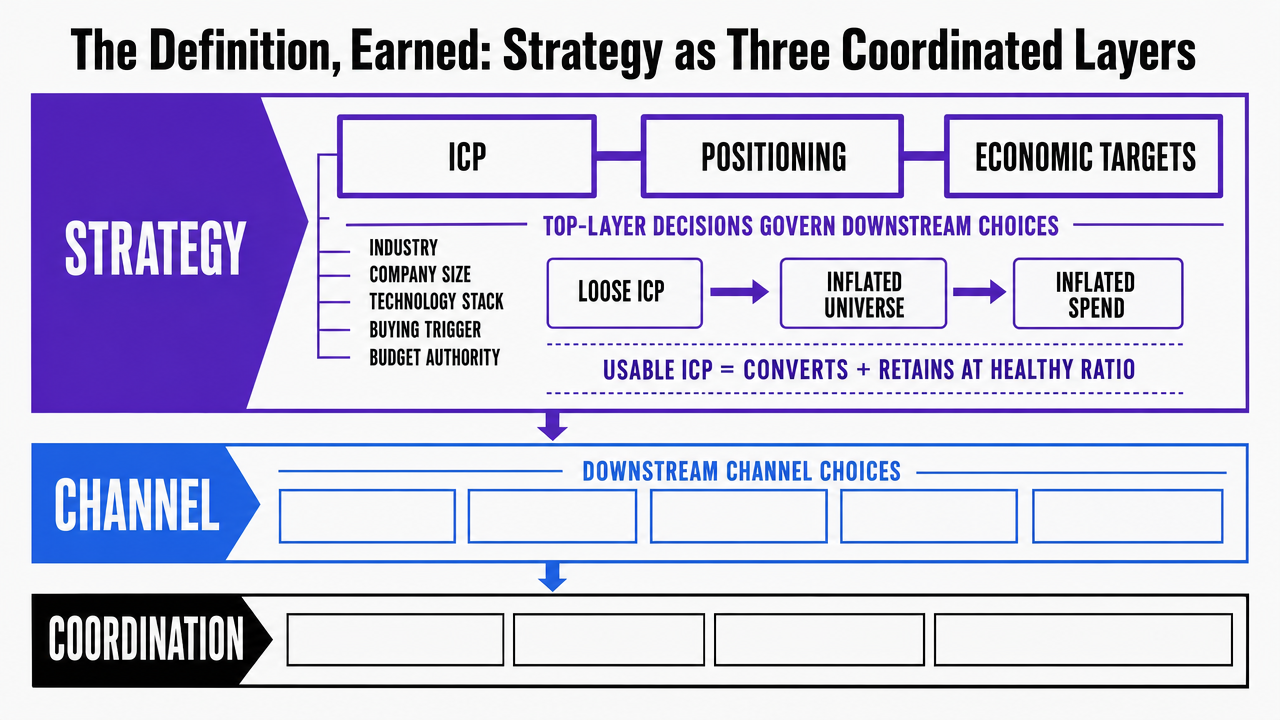 Visualize the three-layer operating system framework (Strategy, Channel, Coordination) that defines the article's central concept
Full-Funnel Digital: When the Buyer Closes Themselves
The strongest argument for treating digital marketing strategy as an operating system rather than a top-of-funnel program comes from how the B2B buyer has changed. McKinsey's B2B Pulse work found that 73% of B2B buyers are now comfortable spending more than $500,000 per order through digital self-serve or remote interactions — a behavioral shift across the global buyer base, not a niche willingness among small purchases 14. The implication for SaaS marketing leaders is direct: the digital experience is no longer a feeder system for sales. For a meaningful share of buyers, it is the purchase.
That changes what the strategy has to cover. A digital strategy built only for awareness and lead capture leaves the second half of the journey to a sales motion that may never get the call. The same Pulse research shows that the B2B companies pulling ahead pair channel breadth with deeper self-service options, allowing the buyer to research, evaluate, and transact without switching modes 6. The winning pattern is not "digital marketing hands off to sales." It is digital marketing carrying the buyer further into the decision, with sales available as one option among several.
For a VP of Marketing, this reshapes the asset inventory the strategy has to fund. Comparison pages, pricing transparency, ROI calculators, security and compliance documentation, integration directories, and self-serve trial flows stop being conversion-rate-optimization side projects and become primary strategic deliverables. They are the surfaces where a $500,000-comfortable buyer makes the decision before any human conversation 14.
The omnichannel evidence also rules out a tempting shortcut. Marketing leaders sometimes respond to self-serve behavior by stripping the human layer entirely, betting that a clean product-led funnel will replace sales. The Pulse data does not support that read. B2B buyers move between digital and human channels interchangeably and expect a consistent experience across them, which means the strategic question is sequencing and coverage, not substitution 5. The same buyer may research entirely online, pull a sales rep in for a 20-minute pricing clarification, and return to a self-serve checkout — and the digital strategy has to make that path coherent.
The practical reframe is to design the digital program against the full buyer journey rather than the marketing-qualified-lead handoff. Acquisition, activation, expansion, and retention all sit inside the strategy's scope, with measurable conversion events at each stage rather than a single demo-request finish line 2. That is what "full-funnel digital" actually means in the current buyer environment — and it is the standard the coordination layer described earlier has to support.
Coordinate SEO, PPC, and Backlinks with a Unified SaaS Marketing System
See how leading SaaS teams achieve 27% faster customer acquisition by aligning digital channels under one AI-driven operating framework—no added headcount or agency friction.
Experimentation Discipline: Test Broadly, Cut Ruthlessly, Scale Winners
An operating system only compounds if the team running it can tell the difference between a channel that is working and a channel that is comfortable. That is harder than it sounds. Most SaaS marketing teams carry a portfolio of tactics that have been on the plan long enough to feel load-bearing, even when the data stopped justifying them two quarters ago. The discipline that separates compounding strategies from drifting ones is the willingness to test broadly, cut what fails the cut line, and reallocate to what survives.
The research is blunt about this. In saturated SaaS categories, no single tactic wins on its own — the winning pattern is running many campaigns across many channels, tracking performance against a defined target, cutting underperformers aggressively, and doubling down on what survives 11. The instruction matters in both directions. Breadth without cutting produces channel sprawl and blended CAC inflation. Cutting without breadth produces a thin program with no replacement pipeline when the current winner saturates.
The 2026 GTM benchmark work adds the structural piece: each motion should be treated as a bounded experiment with an explicit CAC target attached before it scales, not a permanent line item that earns budget by inertia 9. That framing changes what a quarterly review looks like. Instead of asking "how did each channel do," the marketing leader asks which experiments cleared their target, which did not, and where the freed budget is moving next.
Three rules make the discipline operational:
- Set the cut line in advance — a specific CAC, payback, or pipeline-contribution threshold the channel must clear by a stated date.
- Limit concurrent experiments to what the analytics function can actually measure cleanly; teams running 14 simultaneous tests usually cannot attribute any of them.
- Reallocate inside the same review cadence the coordination layer already runs, so winning experiments absorb losing experiments' budget without a separate planning cycle.
That is how a strategy stays a strategy instead of slowly becoming a list of tactics no one is willing to kill.
The Coordination Tax and the Emerging AI-Orchestrated Model
Every uncoordinated SaaS marketing stack carries a coordination tax. It rarely shows up as a line item, but it is visible in the gaps: the two-week lag between an SEO content brief and the paid landing page that should mirror it, the recurring meetings where channel owners reconcile three different MQL definitions, the quarterly planning cycle that resets priorities the channels were finally executing against. The tax is paid in pipeline velocity and CAC efficiency, and it scales with channel count.
The structural cause is asynchronous handoff. A typical SaaS marketing org coordinates SEO, paid, content, lifecycle, and backlink work across some mix of in-house specialists, point agencies, and freelance contractors — each with its own reporting cadence, its own data view, and its own definition of success. McKinsey's reframing of B2B sales argues that digital, remote, and human interactions now have to be orchestrated as one system, with data and AI handling the integration work that asynchronous handoffs cannot do at speed 8. The same logic applies inside marketing. Channels that report to different review cycles cannot answer to the same pipeline number in real time, regardless of how aligned the strategy document claims they are.
This is where AI-orchestrated execution is starting to change the operating model. Instead of treating SEO, paid, content, and backlinks as separate vendors handing artifacts to each other, an AI-coordinated system reads the same account data — search performance, paid auction signals, conversion events, pipeline movement — and produces channel work that already reflects what the other channels are doing. The benchmark research recommends running each motion as a bounded experiment with its own CAC target before scaling 9, which is exactly the kind of continuous, data-conditioned decision loop that gets expensive when humans broker every handoff.
The practical implication for a VP of Marketing is not that the team disappears. It is that the coordination work — the part of the job that currently absorbs the most senior time and produces the least defensible output — moves to a system designed to do it without meetings. Specialists focus on judgment calls. The orchestration runs underneath. Platforms like Vectoron are built around that division of labor, treating strategy approval as the human decision and channel execution as the coordinated output.
Frequently Asked Questions
References
- 1.SaaS Marketing Strategy: A Complete B2B Growth Guide - Trackier.
- 2.Ultimate Guide to B2B SaaS Digital Marketing.
- 3.SaaS Marketing Strategy: 15 Tactics For Scalable Growth.
- 4.Best LTV to CAC Ratio Benchmarks for B2B SaaS in 2026.
- 5.The new B2B growth equation.
- 6.Five fundamental truths: How B2B winners keep growing.
- 7.Your Guide to Creating a B2B SaaS Marketing Plan - KPI Sense.
- 8.Future of B2B sales: The big reframe.
- 9.3 GTM Benchmarks That B2B SaaS Companies Must Track In 2026.
- 10.Digital Marketing Strategy Guide for SaaS Companies.
- 11.Digital Marketing Strategy For SaaS Companies In Competitive Markets.
- 12.What Is a SaaS Go-to-Market Strategy? Complete Framework.
- 13.How B2B Winners Grow – McKinsey Pulse Survey 2023.
- 14.McKinsey survey: 73% of B2B buyers buy online.