
Key Takeaways
- GEO now refers to two separate disciplines: geographic optimization, which targets spatial audiences through LocalBusiness schema and local pack signals, and generative engine optimization, which governs how AI systems cite sources inside synthesized answers.
- Generative GEO does not replace SEO because pages must still be indexed and snippet-eligible to appear in AI Overviews, and the generative layer draws from the same ranking infrastructure 3, 5.
- Generative visibility is a seven-stage pipeline—discoverability, retrieval, contextual rank, citation, prominence, absorption, and traffic—so single-score dashboards hide where a client is actually losing 16.
- Agencies should run both workstreams as parallel retainers with separate briefs and reporting, govern OAI-SearchBot and GPTBot independently, and track citation share, traffic, and attribution quality as distinct KPIs 7, 10.
Two Disciplines, One Acronym: Why GEO Keeps Getting Mispriced
Two distinct disciplines now share the acronym GEO, and agencies that treat them as the same thing are mispricing both. The older meaning, geographic optimization, governs where an audience is: service areas, local pack placement, LocalBusiness structured data, and the department-level attributes Google indexes for physical operators 1. The newer meaning, generative engine optimization, governs how AI systems represent a source inside a synthesized answer—whether a page is retrieved, cited, and placed with enough prominence to earn a click from an AI Overview or a Copilot answer card 15, 16.
These are not variants of the same practice. Geographic GEO is a mature workstream with a stable measurement surface and roughly a decade of agency convention behind it. Generative GEO is a four-year-old research field with shifting benchmarks, cross-engine inconsistency, and a measurement layer that only became URL-level trackable when Bing Webmaster Tools exposed citation data in early 2026 6.
Conflating the two creates a predictable pattern. Retainers get scoped against one definition, reporting dashboards reflect the other, and strategists end up defending work the client never understood they were buying. The sections that follow separate the two cleanly before examining what each actually requires.
The Disambiguation: Geographic GEO vs. Generative GEO
Geographic GEO: Where the Audience Is
Geographic GEO is the practice SEO teams have been running under names like local SEO, multi-location SEO, and geo-targeting for roughly a decade. The target is spatial: a service area, a metro, a radius around a storefront, or a department inside a larger facility. The signals are mostly structured and verifiable, which is why Google's own documentation on LocalBusiness markup reads like an engineering spec rather than a marketing framework. Hours, departments, reviews, and other business attributes are expressed as machine-readable fields that search systems can parse, index, and surface in local features 1.
The measurement surface is equally concrete. Google Business Profile insights, local pack impressions, direction requests, and call volume map directly to revenue events for physical operators. When a strategist talks about geographic GEO, they are talking about work that produces a map pin, a service-area page that ranks for "[service] in [city]," and a schema payload that validates in Google's Rich Results Test. The failure modes are familiar: duplicate listings, NAP inconsistency, missing markup, or a service-area definition that does not match reality on the ground.
Generative GEO: How AI Systems Represent a Source
Generative GEO is a different animal. The term was introduced in a 2023 research paper and formalized at KDD 2024, where the authors defined it as a framework for increasing a source's visibility inside the responses that generative engines produce 15, 22. The target is not a geographic query; it is the synthesized answer itself—whether the page is retrieved into the model's context window, selected as a supporting citation, placed with enough prominence that a user actually sees it, and absorbed into the answer rather than discarded as redundant context.
The 2026 critical survey of the field extends that framing by separating generative visibility into distinct stages, each with its own failure mode and its own intervention surface 16. A page can be discoverable but never retrieved. It can be retrieved but ranked low inside the answer context. It can be cited but placed so far down that no user clicks. The measurement surface is also newer and shallower: URL-level citation tracking only became broadly available when Bing exposed the data in Webmaster Tools in early 2026 6.
Side-by-Side: Six Rows That End the Confusion
The quickest way to end a scoping conversation with a client is to put both definitions on one page and let the differences carry the argument. The comparison below pulls from Google's LocalBusiness documentation 1for the geographic column, and from the foundational KDD 2024 GEO paper 15and the 2026 critical survey 16for the generative column.
| Dimension | Geographic GEO | Generative GEO ||---|---|---|| What it targets | A spatial audience: service area, metro, radius, department | A synthesized answer: inclusion, citation, and prominence inside AI output || Primary signal | Structured location and entity data (LocalBusiness schema, NAP, reviews) | Retrievability, evidence density, and answer-level support within a generated response || Measurement surface | GBP insights, local pack impressions, direction requests, call volume | URL-level citation activity, cited key phrases, citation share || Reporting metric | Rankings in the local pack, map views, calls, store visits | Citations per query, citation share, prominence inside the answer || Failure mode | Duplicate listings, NAP drift, missing or invalid schema | Non-retrieval, low contextual rank, citation without prominence, absorption without link || Primary source | Google LocalBusiness structured data documentation 1| KDD 2024 GEO paper 15; 2026 critical survey 16|
The rows that most often get collapsed in client conversations are measurement surface and failure mode. Geographic GEO fails loudly—a listing disappears, a phone stops ringing. Generative GEO fails quietly, often one stage at a time, which is why the pipeline framing in the next section matters.
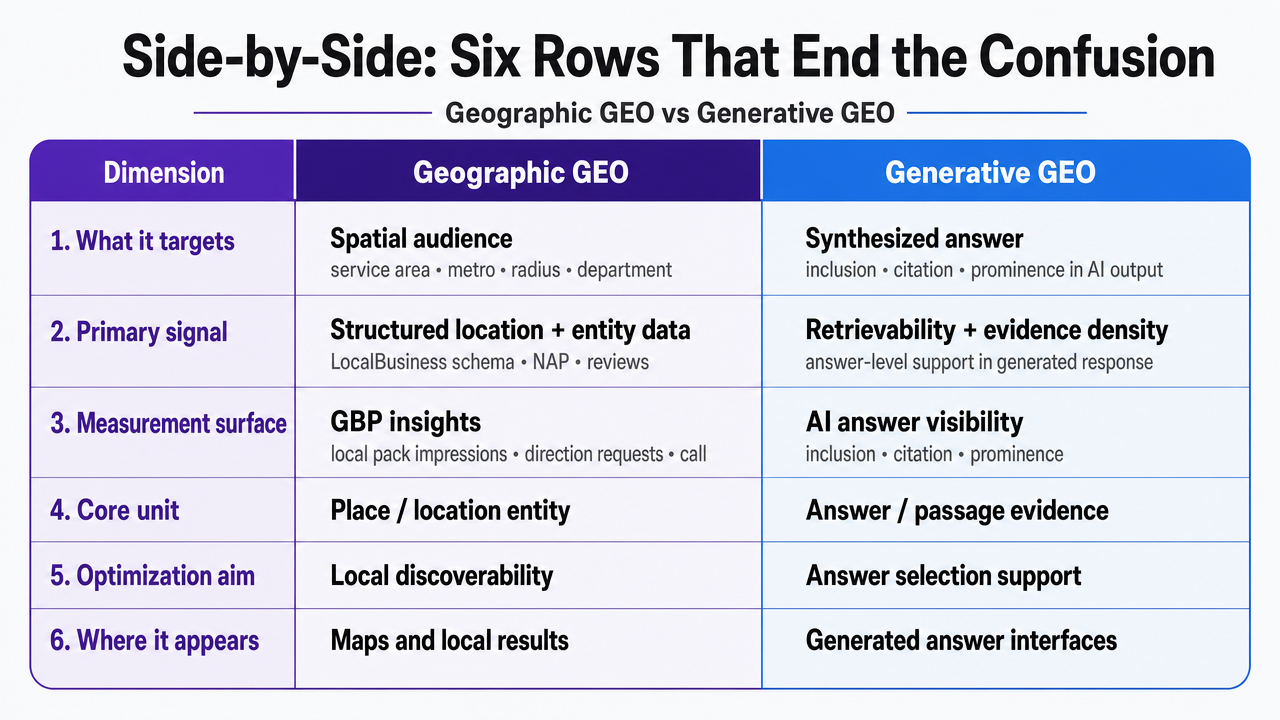 Visualize the six-row comparison table distinguishing Geographic GEO from Generative GEO, which is the central disambiguation of the article
The Shared Foundation: Why Generative GEO Does Not Replace SEO
Indexability Is Still the Entry Ticket
The clearest refutation of the "GEO replaces SEO" narrative comes from Google's own documentation. To be eligible as a supporting link in an AI Overview or inside AI Mode, a page has to be indexed and eligible to appear in Google Search with a snippet 3. That is the same technical bar conventional SEO has defended for years: crawlable, indexable, snippet-eligible, not blocked by robots directives or noindex tags.
The implication for agency scope is immediate. A client that cannot rank cannot be cited. Canonical issues, orphaned URLs, blocked assets, broken hreflang, and thin or duplicate pages that depress conventional visibility also depress generative visibility, because the retrieval layer in front of the generative model draws from the same index. Teams that quietly let technical hygiene slip in favor of "AI content" are undermining the eligibility that any generative placement depends on. The entry ticket is the same one it has always been.
Helpful Content and People-First Signals Carry Over
Google's generative AI optimization guide takes an unusually direct position for a developer document: unique, compelling, useful content is likely to influence a site's presence in generative AI search in the long run more than other suggestions 4. That language is not a hedge. It points directly back to the helpful-content guidance that defines people-first content by who created it, how it was produced, and why it exists 2.
The practical read for agency leads is that the editorial standard does not loosen for generative surfaces—it tightens. Content assembled to pattern-match an AI prompt, with no first-hand expertise or clear site purpose, fails both the ranking systems that feed retrieval and the quality signals Google uses to decide what gets synthesized. The common assumption that generative GEO rewards volume while conventional SEO rewards quality has it backwards. Both reward the same underlying asset. Generative surfaces just make shortcuts easier to spot.
AI Overviews Sit On Top of Ranking Infrastructure, Not Beside It
AI Overviews are not a parallel index. Google's own explainer describes them as a customized Gemini model working together with existing Search systems, quality and ranking systems, and the Knowledge Graph 5. The generative layer composes the answer; the ranking stack decides what evidence it has to work with.
That architectural detail reframes what GEO work actually buys. Interventions that improve a page's standing in conventional ranking—authoritative sourcing, entity clarity, structured data, internal link equity—also improve the pool of candidates the generative layer selects from. Interventions that only target the generative surface, with no corresponding improvement in the underlying ranking signals, tend to produce inconsistent results across queries and engines. For agency leads briefing clients, this is the sentence that defuses the "should we stop doing SEO?" question: the generative answer is a presentation layer, and the ranking infrastructure beneath it still decides who gets presented.
Test GEO-targeted SEO campaigns with real results
Launch, measure, and refine localized SEO content risk-free before scaling to more markets.
Generative GEO as a Pipeline, Not a Score
The Seven Stages Between a Query and a Click
The most common analytical mistake agency leads make with generative GEO is collapsing it into a single number—citations per week, mentions per engine, an "AI visibility score" sold by a vendor. The 2026 critical survey of GEO research argues the opposite framing: generative visibility is a sequence of distinct stages, each with its own failure mode and its own intervention surface 13, 16. The stages run from discoverability, through retrieval, contextual rank, citation, prominence, absorption, and finally referral traffic. An intervention that improves one stage can degrade another, which is why single-score dashboards tend to mislead both strategists and clients.
The mechanics are worth spelling out.
- Discoverability asks whether the page is reachable by the engine's crawler at all.
- Retrieval asks whether the retrieval layer pulls the page into the model's working context for a given query.
- Contextual rank describes where the page sits inside that context window relative to other candidates.
- Citation is the binary event of being named in the answer.
- Prominence governs whether the citation sits inline at a point a user actually sees, or buried in a footer list.
- Absorption describes what the model does with the content—whether it is quoted, paraphrased, or discarded as redundant.
- Traffic is the downstream click, which the survey explicitly separates from citation because the two correlate loosely at best 16.
Agency reporting that treats these as one metric cannot diagnose where a client is actually losing. A page can be cited constantly and generate no clicks. A page can rank well in retrieval and never be cited.
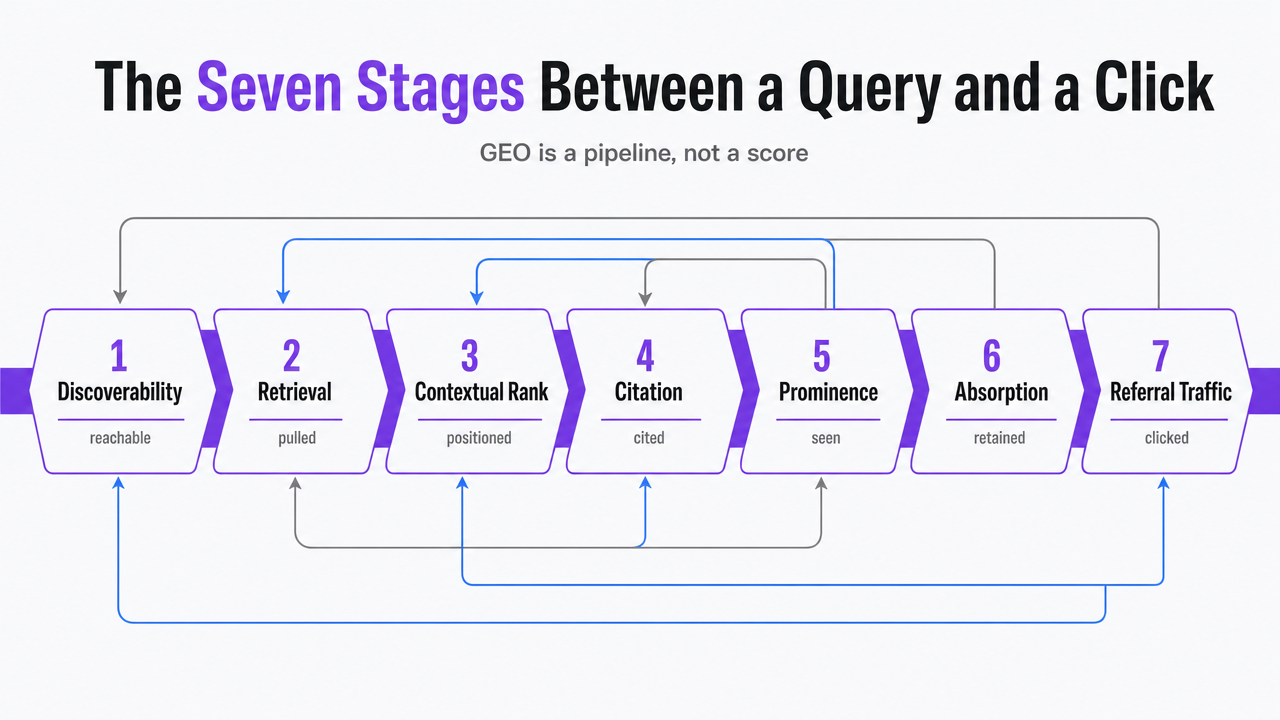 Visualize the seven-stage generative visibility pipeline cited from the 2026 critical survey, directly supporting the section's core argument that GEO is a pipeline, not a score
The +40% Visibility Claim, in Context
The number that gets quoted most often in generative GEO pitches comes from the foundational KDD 2024 paper, which reported visibility improvements of up to 40% from interventions such as adding citations, quotations, and statistics to source content 15. Repeated without context, the figure reads like a performance guarantee. It is not.
The 40% was measured on GEO-bench, a benchmark the authors constructed to test content modifications across multiple generative systems. It is a visibility metric defined inside that benchmark—roughly, the share of a response attributable to a given source—not a traffic metric, not a lead metric, and not revenue. The same paper notes that effectiveness varies substantially by domain, with some verticals responding strongly to statistics-heavy edits and others barely moving 15. Agency leads who quote the headline figure in client decks without those caveats are setting up a measurement conversation they will lose six months later, when the dashboard shows citation activity that does not map cleanly to pipeline.
Citation Quality Is a Separate KPI From Citation Count
What the Verifiability Data Actually Shows
The temptation inside agency reporting is to treat a citation as the terminal event—the moment the work paid off. The empirical record argues against that framing. An EMNLP 2023 study of four production generative search systems found that only 51.5% of generated sentences were fully supported by the citations attached to them, and 74.5% of citations supported the specific sentence they were associated with 14. Fluent, well-formatted answers routinely contain statements the cited source does not actually back, and sources routinely get credited for claims they do not make.
OpenAI's own user-facing guidance acknowledges the same gap. The ChatGPT web-search help page tells users to open cited sources because search results and citations can be incomplete, outdated, or incorrect 11. That warning matters for agency reporting in a specific way: when a client's domain appears as a citation inside an AI answer, there is no guarantee the surrounding sentence represents the brand accurately. A citation can anchor a correct quote, a loose paraphrase, a stale statistic, or a claim the page never made.
The operational consequence is that citation count and citation quality need separate tracking. The first measures surface visibility. The second measures whether the brand is being represented in a way that will survive a prospect clicking through.
Citation Share as a Defensible Agency Metric
Citation count on its own is a vanity figure. A client whose URLs were cited 400 times last month has no way to know whether that reflects category dominance or a quiet month across the field. Bing addressed that problem directly in June 2026 by exposing citation share inside Webmaster Tools, defined as the percentage of citations attributed to a site out of all citations shown across sites for the same grounding query 7. The denominator is what makes the metric defensible: it normalizes a client's visibility against the competitive set the engine actually considered for that query.
Microsoft is also explicit about what the metric is not. Citation share is not traffic share, does not expose competitor domains, and does not assign a quality score to the content 7. For agency QBRs, that framing is useful. Citation share quantifies competitive position inside generative answers; traffic share remains a separate line item sourced from referral analytics and UTM-tagged ChatGPT visits 9; and citation quality—whether the brand is accurately represented—requires sampled human review of the actual answers. Reporting all three as distinct KPIs prevents the single-number dashboards that collapse under client scrutiny.
The Crawler Governance Problem Agencies Keep Underestimating
Technical eligibility for generative surfaces is governed by crawler policy, and crawler policy is almost always owned by someone outside the SEO team. Engineering sets the robots.txt. Legal weighs in on training-data access. Security occasionally blocks user agents it does not recognize. The agency SEO lead inherits whatever those three functions produced, often without being consulted, and then has to explain to the client why their domain is absent from ChatGPT answers.
The current crawler map matters because the controls are not symmetric. OpenAI operates OAI-SearchBot for surfacing sites inside ChatGPT search features; sites that opt out of that specific bot will not appear in ChatGPT search answers 10. GPTBot is a separate agent associated with training-data crawling, and OpenAI documents independent robots.txt controls for the two 10. A client that reflexively blocked "OpenAI" at the WAF level a year ago to protect against training may also have blocked the search crawler that governs ChatGPT visibility—and OpenAI's publisher guidance is explicit that sites wanting inclusion in ChatGPT summaries and snippets should avoid blocking OAI-SearchBot 9.
The operational artifact an agency lead should hand to engineering is a four-row matrix: for Googlebot, Bingbot, OAI-SearchBot, and GPTBot, document the purpose, the robots.txt directive currently in effect, and the visibility consequence of a block. The first two preserve conventional and generative visibility on Google and Bing surfaces. OAI-SearchBot governs ChatGPT search inclusion independently of training. GPTBot governs training-data access and can be denied without affecting ChatGPT search eligibility 9, 10. Treating search access and training access as one decision is the error that quietly removes clients from a generative surface they thought they were optimizing for.
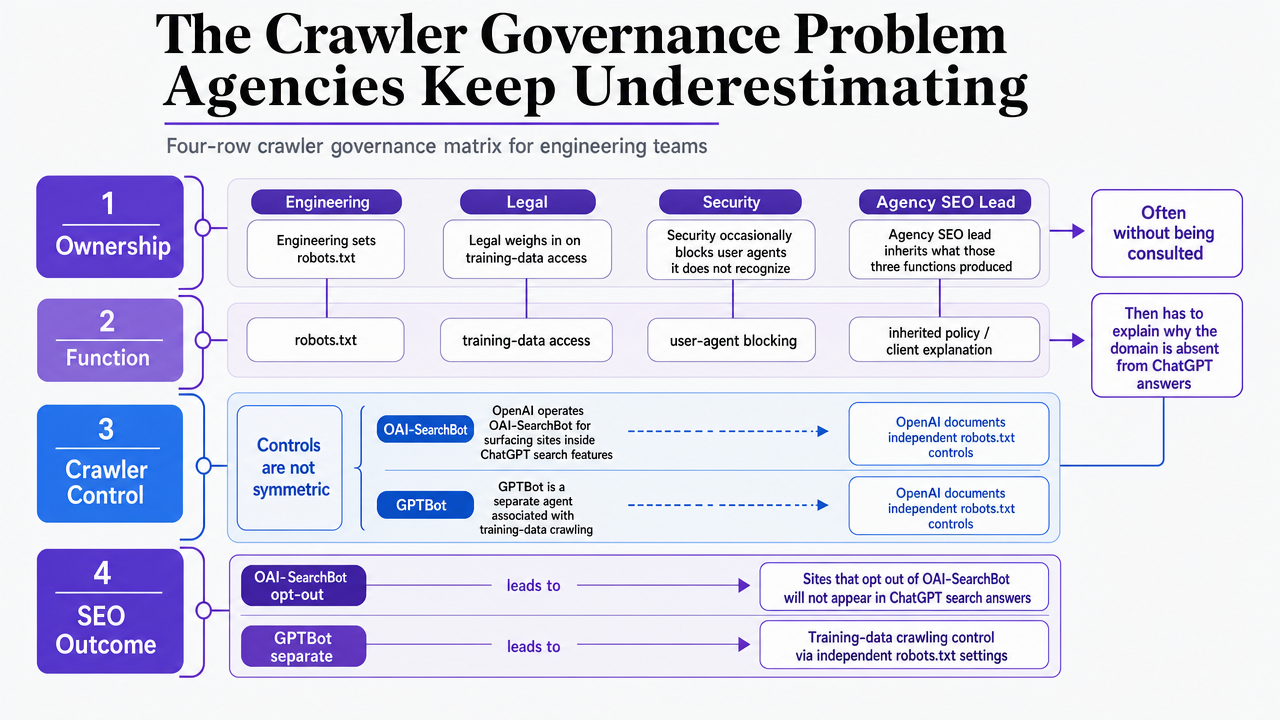 Visualize the four-row crawler governance matrix the article explicitly recommends handing to engineering teams
Scale GEO-Targeted SEO Without Expanding Your Team
Connect with experts on streamlining multi-region SEO campaigns using AI-driven workflows—achieve granular geo optimization and cross-client oversight with measurable efficiency gains.
If You Manage Multiple Clients: The Workload Multiplication Problem
Two Workstreams, One Retainer: A Per-Client Load Comparison
The scope shift here is deliberate: this section is written for agency leads running GEO across a portfolio of 15 to 80 accounts, not for an in-house team optimizing a single brand. At portfolio scale, running geographic GEO and generative GEO as parallel workstreams does not add linearly to the per-client retainer. It compounds, because each workstream brings its own deliverables, its own measurement surface, and its own reporting cadence—and most of those surfaces did not exist 24 months ago.
The table below consolidates the per-client load across both workstreams. The measurement surfaces and reporting tools are named only where they are documented in primary sources.
| Workstream | Core deliverables | Measurement surface | Reporting cadence ||---|---|---|---|| Geographic GEO | LocalBusiness schema maintenance, NAP governance, service-area pages, review and department markup 1| Google Business Profile insights, local pack impressions, direction requests, calls | Monthly || Generative GEO | Crawler policy coordination 9, 10, evidence-dense content revision 4, citation monitoring across engines, prominence sampling | Search Console generative AI performance report 4; Bing Webmaster Tools AI Performance and citation share 6, 7; ChatGPT UTM-tagged referrals 9| Weekly for citation activity; monthly for synthesis |
The multiplier is not just more dashboards. It is more surfaces that each require their own baselining, their own anomaly detection, and their own narrative in the client QBR. A 40-account portfolio that previously reconciled one measurement stack per client now reconciles three or four, with no shared schema across them.
High-Stakes Verticals Raise the Attribution Bar
The load math gets harder in verticals where attribution accuracy is non-optional. For agencies with law, healthcare, behavioral health, senior living, or DSO clients, a cited but misrepresented claim is not a reporting problem—it is a regulatory and reputational one. Research on source-grounded generation in sensitive domains argues that these environments require stricter reference discipline than general commercial content, precisely because fluent but incompletely supported answers carry higher downstream risk 19. Independent attribution-evaluation work reinforces that verifiability and relevance are distinct dimensions and need to be audited separately 18.
The operational consequence for portfolio leads: high-stakes accounts need a sampled human review of actual AI answers each reporting cycle, not just citation counts. That review is the line item most agencies have not yet priced into the retainer. Platforms like Vectoron are built for exactly this coordination load—running multi-surface execution under human approval so citation activity, prominence, and attribution quality can be governed per client without adding headcount.
Briefing Teams and Reporting Results Across Both Meanings
The practical move for an agency lead is to run geographic GEO and generative GEO as two retainers inside one account, with separate briefs, separate strategists, and separate reporting lines that meet only at the shared technical foundation. Geographic GEO briefs should name the target geographies, the LocalBusiness attributes under maintenance, and the local-pack and GBP metrics that define success for the quarter 1. Generative GEO briefs should name the target intents and topic clusters, the crawler policy in effect for OAI-SearchBot and GPTBot, and the stage of the visibility pipeline the work is intended to move—retrieval, citation, or prominence—rather than a vague "AI visibility" goal 10, 16.
Reporting should mirror that split. Local pack impressions, direction requests, and calls belong on the geographic page of the QBR. Citation activity from Search Console's generative AI performance report and Bing Webmaster Tools, citation share against the grounding-query set, and a sampled human review of how the brand is represented in actual answers belong on the generative page 4, 7. Clients that see both pages stop asking whether GEO replaced SEO, because the deliverables and the numbers finally match the words.
Frequently Asked Questions
References
- 1.Local Business (LocalBusiness) Structured Data.
- 2.Creating Helpful, Reliable, People-First Content.
- 3.AI Features and Your Website.
- 4.Google's Guide to Optimizing for Generative AI Features on Google Search.
- 5.AI Overviews and AI Mode in Search.
- 6.Introducing AI Performance in Bing Webmaster Tools Public Preview.
- 7.New AI Visibility Insights in Bing Webmaster Tools: Intents, Topics, Citation Share, Compare.
- 8.Introducing Copilot Search in Bing.
- 9.Publishers and Developers - FAQ.
- 10.Overview of OpenAI Crawlers.
- 11.Searching the Web with ChatGPT.
- 12.Assessing Support for the TREC 2024 RAG Track: A Large-Scale Comparative Study of LLM and Human Evaluations.
- 13.Optimizing Visibility in Generative Engines: A Critical Survey of Generative Engine Optimization (2023–2026).
- 14.Evaluating Verifiability in Generative Search Engines.
- 15.GEO: Generative Engine Optimization.
- 16.Optimizing Visibility in Generative Engines: A Critical Survey of Generative Engine Optimization (2023-2026).
- 17.Domain Experts Assess Generative Language Models.
- 18.Automatic Evaluation of Attribution by Large Language Models.
- 19.How do you know that? Teaching Generative Language Models to Reference Answers to Biomedical Questions.
- 20.Proceedings - Retrieval Augmented Generation (RAG) 2025.
- 21.Overview of TREC 2024 - Text REtrieval Conference.
- 22.GEO: Generative Engine Optimization.