
Key Takeaways
- Keyword density is calculated as (keyword occurrences ÷ total words) × 100, but Google confirms no ideal percentage exists and treats unnatural repetition as spam 2, 1.
- Retrieval has moved from raw term frequency through TF-IDF and BM25 to semantic matching, so a single density percentage no longer reflects how pages are actually ranked 6, 10.
- AI answer engines gain little from keyword stuffing, and retrieval-augmented defenses may read abnormally high density as a manipulation signal rather than relevance 14, 13.
- Editors should treat density as a diagnostic for coverage gaps and stuffing risk, prioritizing topical coverage, term placement, natural phrasing, and direct answer fit 11, 3.
The Formula and Verdict on Keyword Density
Keyword density represents the proportion of a page's words that consist of a specific keyword or phrase. The calculation is straightforward: (keyword occurrences ÷ total words) × 100. For example, a 1,000-word article using "keyword density" ten times has a density of 1%.
Despite its calculability, content teams should not view keyword density as an optimization target. Google explicitly states there is no "magical word count" or ideal keyword frequency, classifying unnatural repetition as keyword stuffing under its spam policies 2, 1. Modern information retrieval has evolved beyond simple page-level counts, integrating term weighting, corpus context, and semantic matching to assess relevance 6, 10.
The persistence of this metric in editorial discussions stems from its ease of calculation and audit. However, a metric that is easy to count is not necessarily one worth optimizing. For marketers, keyword density is best reclassified as a diagnostic tool, indicating potential coverage gaps or the risk of keyword stuffing, rather than a parameter to adjust before publication.
How Keyword Density is Calculated and Its Limitations
The basic formula for keyword density is (keyword occurrences ÷ total words) × 100. For instance, a 1,200-word article mentioning "patient intake" nine times has a density of 0.75%. This simple arithmetic contributes to the metric's enduring presence, even as its utility as a target has diminished.
Several factors can alter the calculated density before any editorial judgment:
- Phrase length — counting a multi-word phrase as one occurrence versus individual words.
- Variant handling — treating "keyword density" and "density of keywords" as the same term.
- Scope — whether the word count includes navigation, footers, and alt text, or only the main body copy.
Different density tools often make varying assumptions on these points, leading to inconsistent percentages for the same page.
The core concept behind density is term frequency, which is the number of times a term appears in a document 4. Density normalizes this frequency by document length, allowing comparison between pages of different sizes. However, this normalization can be misleading. Term frequency alone treats every repetition as equally significant and disregards how common the term is across a larger collection of documents. This limitation led information retrieval systems to adopt weighting schemes that consider document frequency and distribution, moving beyond simple page-level counts 5, 11. While content teams can still calculate this number, they should not mistake calculation for optimization.
From Term Frequency to Semantic Retrieval: Why Density is Obsolete as a Target
Term Frequency: The 1990s Starting Point
Term frequency, the direct precursor to keyword density, defines how many times a term appears in a document. Early retrieval systems in the 1990s weighted terms based on these counts 4. Density then normalized this count by document length, making it comparable across various page sizes.
This model was effective in an era when search engines had limited semantic understanding. A page that frequently repeated a query term was considered more relevant. This assumption, however, led to keyword stuffing, an early and persistent manipulation tactic against content-based ranking 12.
The inherent flaw in raw term frequency is its assumption that every occurrence is equally informative, ignoring the term's prevalence across the broader document collection 5. A page repeating a common phrase multiple times gains credit for repetition without demonstrating unique relevance compared to millions of other pages using the same phrase.
TF-IDF and BM25: Frequency Plus Corpus Context
To address the limitations of raw term frequency, the concept of inverse document frequency (IDF) was introduced. IDF assigns higher weights to terms that are rare across a corpus, making them more distinctive, and discounts common terms 5. When combined with term frequency, this creates TF-IDF. Stanford's information-retrieval text explains that TF-IDF is highest when a term appears frequently in a small number of documents and lowest when it appears in almost all documents 6. This marked a shift where a page's keyword count was no longer judged in isolation but in relation to how the term was used across the entire web.
BM25 further refined this approach. It is a probabilistic ranking function that integrates term frequency, inverse document frequency, and document length normalization, serving as a standard baseline in modern retrieval benchmarks. Research indicates that frequency is just one aspect of relevance, and other signals like corpus distribution and recency can influence a term's weight for a given query 10.
These advancements have two key implications for keyword density. First, the same keyword count can have vastly different weights depending on the term's commonality across the corpus, meaning no single density percentage directly correlates with a ranking outcome. Second, document length is already accounted for by ranking functions, eliminating the primary reason for normalizing term frequency into a percentage.
Semantic and Neural Retrieval: Meaning Over Counts
Even improved frequency-based models still largely treat documents as "bags of words." A 2024 LCF-IDF study highlighted this limitation, noting that while TF-IDF is effective for information retrieval and document classification, it struggles to capture deeper semantic and contextual meaning 9. Modern retrieval systems overcome this by using neural representations to encode passages as vectors, matching queries to content based on underlying meaning rather than superficial word overlap.
The location of terms within a document also holds more significance than their total page count. Research on document, sentence, and term event spaces demonstrates that the position and distribution of terms convey information that a single page-level percentage obscures 11. For example, a keyword used once in a heading and answered directly below functions differently from the same keyword scattered across unrelated paragraphs, even if the overall density is identical.
The evolution from term frequency through TF-IDF and BM25 to neural retrieval illustrates a clear progression: each stage incorporates more sophisticated signals that a simple density percentage cannot represent.
- Term frequency counts occurrences 4.
- TF-IDF adds corpus-level discrimination 6.
- BM25 and similar methods blend frequency with document length and other signals like recency 10.
- Semantic retrieval moves beyond counting entirely, matching intent through learned representations.
Keyword density resides at the least sophisticated end of this spectrum, offering minimal value for optimization.
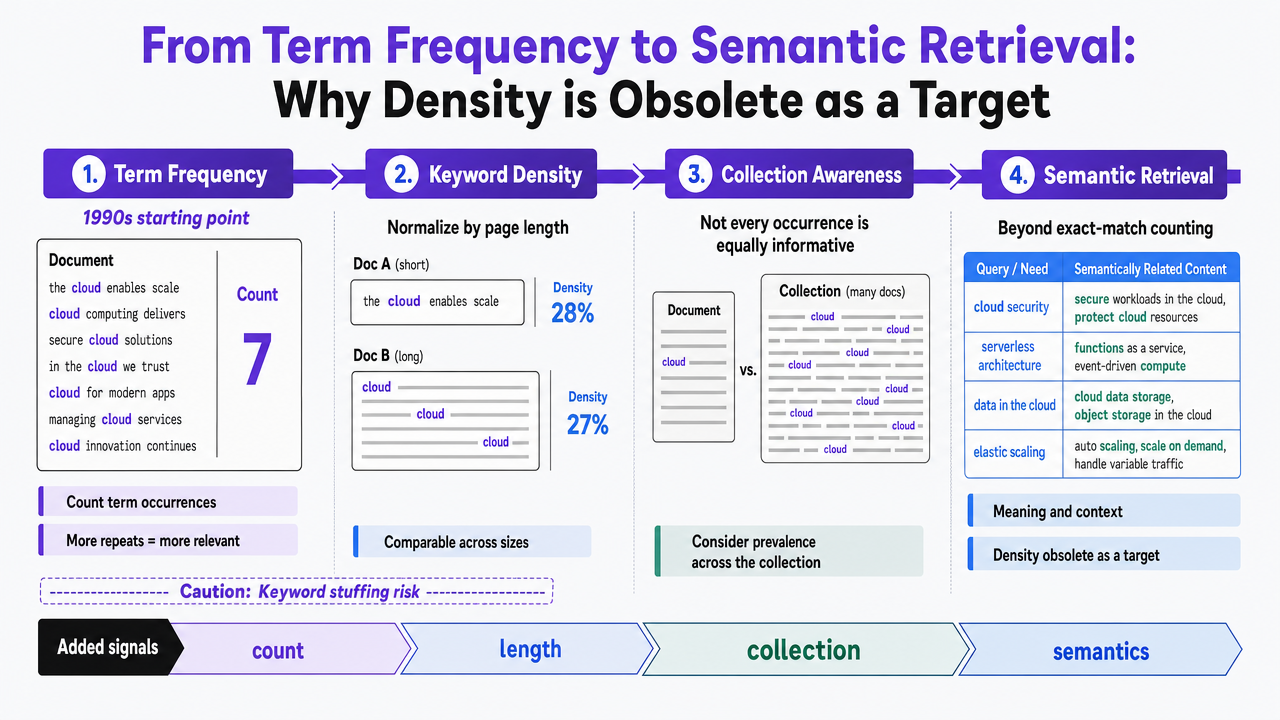 Visualize the four-stage evolution of retrieval models discussed in this section, showing how each stage adds signals beyond simple keyword counting
Test real-time keyword optimization in production
Experience live content publishing with data-driven keyword density analysis across your actual campaigns for seven days.
Google's Stance on Keyword Frequency
Google's official documentation provides definitive guidance on keyword frequency. The SEO Starter Guide explicitly states there is no "magical word count target" and warns against keyword stuffing, describing it as "tiring for users" and a violation of its spam policies 2. The guide also notes that Google's language-matching systems can determine a page's relevance without requiring exact query terms to appear verbatim, negating the technical justification for rigid exact-match repetition quotas 2.
Google's spam policy reinforces this guidance by defining keyword stuffing as "filling a page with keywords or numbers in an attempt to manipulate a site's ranking." It identifies specific patterns that trigger this policy, such as unnatural blocks of the same phrase, lists of location names without added value, and strings of phone numbers inserted out of context 1. Websites violating this policy may experience lower rankings or even removal from search results 1. Crucially, Google's threshold for stuffing is behavioral, not numerical; there is no specific percentage that defines a stuffed page.
The helpful-content guidance further reframes the editorial approach. Google's automated ranking systems prioritize "reliable information created to benefit people, not content built to manipulate search rankings" 3. For content creators, this principle replaces the need for a density field in a brief. The primary question should be whether the page serves the reader's purpose, not whether it achieves a target frequency. These three Google documents collectively provide a strong internal position for content leads: no target percentage exists, unnatural repetition is a policy violation, and keyword decisions are secondary to content usefulness.
Keyword Density as a Diagnostic, Not a Target
Instead of a density target, editors can use a three-zone diagnostic during content review without needing a counting tool. These zones describe the editorial signal a page sends, rather than a percentage it should achieve.
Underused. : This occurs when the term or a close variant appears minimally or only in the title. This indicates a coverage problem, not a density issue. If a page claims to address a query but fails to mention the subject in the body, headings, or examples, readers will disengage, and retrieval systems will have fewer signals to process. The solution is substantive: add paragraphs, headings, or examples that genuinely cover the topic, rather than merely sprinkling the phrase into existing sentences.
Natural. : The term appears as dictated by the subject matter. It is present in the heading that introduces it, the sentence that defines it, and the example that illustrates it, with variants used for better readability. No editorial intervention is required. For instance, a page about intake forms will naturally use "intake" more often than a page about billing, and the count should be driven by the topic itself, not by artificial caps or padding.
Stuffed. : This refers to repetition that a reader would find noticeable, awkward, or excessive. Google's spam policy directly addresses this, defining keyword stuffing as "filling a page with keywords or numbers to manipulate rankings" and providing examples like blocks of location names without added value 1. Pages that cross this line may face lower rankings or removal from results 1. The appropriate action here is to cut the repetition, not to recalibrate a percentage.
This floor-and-ceiling framework resolves the ongoing debate about keyword density in content briefs. Writers do not need a target percentage; they need to ensure the page adequately covers the topic and avoids sounding like it's trying to game the system. Everything between these two boundaries falls under writing decisions, not SEO mandates.
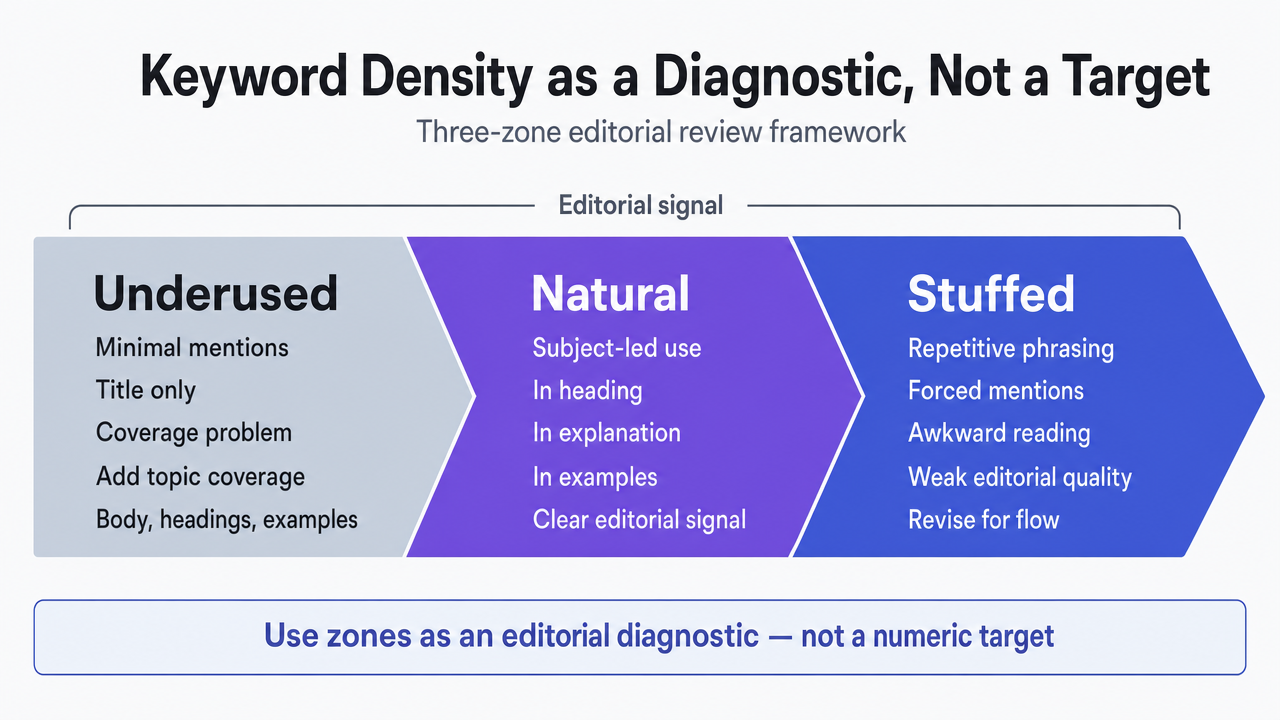 Visualize the three-zone editorial diagnostic framework (Underused, Natural, Stuffed) described in the section as a replacement for a numeric target
How AI Answer Engines Handle Repeated Keywords
Generative search systems and retrieval-augmented answer engines operate differently from the 1990s content-matching models that influenced early density targets. The GEO: Generative Engine Optimization study provides clear evidence, showing that keyword stuffing yielded "little to no improvement" in the generative-engine answers evaluated 14. This means additional repetitions did not measurably increase the likelihood of content being surfaced or cited. While this finding applies to the specific generative engines tested and future models may evolve, the general trend aligns with how these systems function: they retrieve passages, summarize across sources, and generate language, which inherently penalizes the superficial repetition that older ranking functions once rewarded.
From a defensive standpoint, retrieval-augmented generation research views high repetition as a sign of manipulation rather than relevance. The FlippedRAG analysis of adversarial documents suggests that "abnormally high keyword density within a document window may indicate keyword stuffing," characterizing term spam as an attempt to inflate retrieval scores rather than a legitimate relevance signal 13. Content that appears repetitive to a human reader is also likely to be flagged as suspicious by systems designed to filter adversarial content.
A 2026 preprint on LLM-enhanced search engines quantifies the effectiveness of these defenses. The authors reported that evaluated LLM-enhanced search engines mitigated over 99.78% of traditional black-hat SEO attacks, including keyword-stuffing tactics 15. While this figure is specific to a benchmark of real-world black-hat SEO sites and the LLM-enhanced search engines evaluated, it offers a practical insight for content teams: traditional density-based tactics are largely ineffective with AI answer surfaces. This is because adding keywords did not improve generative responses in the GEO evaluation 14, and the manipulation signature these tactics produce is precisely what retrieval-stage defenses are designed to catch. Effective writing for AI answer engines means creating passages that genuinely answer questions, not manipulating repetition counts.
Optimize Keyword Density with Data-Driven Precision
Connect with our team to discover how enterprise marketers automate keyword analysis and maintain optimal density at scale—while preserving brand voice and SEO performance across every channel.
An Editorial Checklist for Writers
Density calculators are best reserved for audits, not for drafting content. The following checklist provides writers and editors with a review process that identifies both coverage gaps and stuffing risks without requiring a counting tool, aligning directly with Google's own documentation.
- Name the subject in key locations. The query term or a direct variant should appear in the title, the opening paragraph, and at least one subheading. If removing the keyword from these areas makes the page feel off-topic, it indicates the keyword is crucial and should remain. Google's language-matching systems can assess relevance without exact-match repetition, so natural phrasing and variants are effective 2.
- Read the draft aloud to identify unnatural phrasing. Blocks of city names, lists of phone numbers, and repeated phrases in close succession are explicitly cited by Google's spam policy as keyword stuffing 1. Any sentence that sounds awkward or forced when read aloud should be revised or removed.
- Ensure each keyword occurrence serves a purpose. A term in a heading introduces a section, in a definition it conveys meaning, and in an example it anchors an illustration. A term inserted merely to increase a count, especially in a transition sentence, adds no value. The placement of terms is as important as their frequency, as page-level counts can obscure the signals preserved by location and distribution 11.
- Confirm the page directly answers the intended question. If the query is a question, the answer should be presented as a direct passage, not fragmented across multiple paragraphs. Google's ranking systems prioritize "people-first content" 3, making usefulness a key metric that replaces the density field in a brief.
- Avoid density tools if the content passes the above checks. The numerical output from a density tool will not alter the necessary edits and could lead to introducing patterns that Google's spam policy flags. Density audits are more appropriate for legacy pages suspected of stuffing, not for new drafts focused on answering user questions.
The City-Name Stuffing Trap for Multi-Location Brands
For content leads managing multi-location service brands, franchise marketing teams, and those overseeing location pages, the discussion around keyword density takes on a specific urgency. Location pages are frequently where stuffing patterns persist under the guise of "SEO best practices."
A common pattern involves a page for one city ending with a block listing every nearby town the business serves, or a footer repeating a service alongside various city names. Another example is a paragraph stringing together neighborhood names without any additional information. Google's spam policy directly addresses this, citing "blocks of location names stacked without added value" as a concrete example of keyword stuffing, alongside unnatural phrase repetition and phone number lists inserted without context 1. The consequence for violating this policy is the same as any other stuffing violation: lower rankings or removal from search results 1.
The editorial rule for location-heavy pages is precise: each mention of a location must convey unique, valuable information. A city name linked to specific service hours, a licensed technician, a local permit requirement, a nearby landmark, or a case handled in that jurisdiction justifies its inclusion. Conversely, a city name merely appearing in a comma-separated list adds no value and signals the exact pattern Google's policy flags. If an editor cannot articulate a genuine reason for a city's presence on the page, it should be removed.
Alternative Metrics to Keyword Density
Moving away from keyword density as a target creates a measurement void that content teams need to fill. Four alternative signals effectively replace the role density once played, each directly linked to how modern retrieval systems evaluate pages.
Topical coverage. : The relevant question is not how often a keyword appears, but whether the page comprehensively addresses the subtopics a reader expects. An article on intake forms that omits discussions of consent language, required fields, or routing rules is deficient, regardless of its density. Coverage can be assessed by identifying implied questions from the query and verifying that each is answered thoroughly, not just with sentence fragments. This approach aligns with how semantic retrieval scores pages, matching queries to content based on learned representations rather than surface-level word overlap 9.
Term placement. : The location of a keyword provides more information than its frequency. A term in a heading, a definition, or a worked example indicates a page structured around the topic. The same term scattered in transitional sentences suggests padding. Research on document, sentence, and term event spaces demonstrates that distribution and location preserve signals that a page-level percentage flattens 11.
Naturalness. : The "read-aloud test" is the most accessible method for detecting stuffing. Sentences that would be edited out of a print publication should be removed here, as the patterns Google's spam policy flags—such as unnatural phrase repetition and stacked location or phone number lists—are precisely what a human reader would notice 1.
Answer fit. : The ultimate check is whether the page effectively resolves the user's query. Google's ranking systems prioritize "helpful, reliable information created to benefit people" over content designed to manipulate rankings 3. For a question-based query, this means providing a direct, quotable passage. For a comparison query, it implies a table or a clear contrast. Answer fit replaces the density field in a brief because it measures the actual outcome that density was always a weak proxy for.
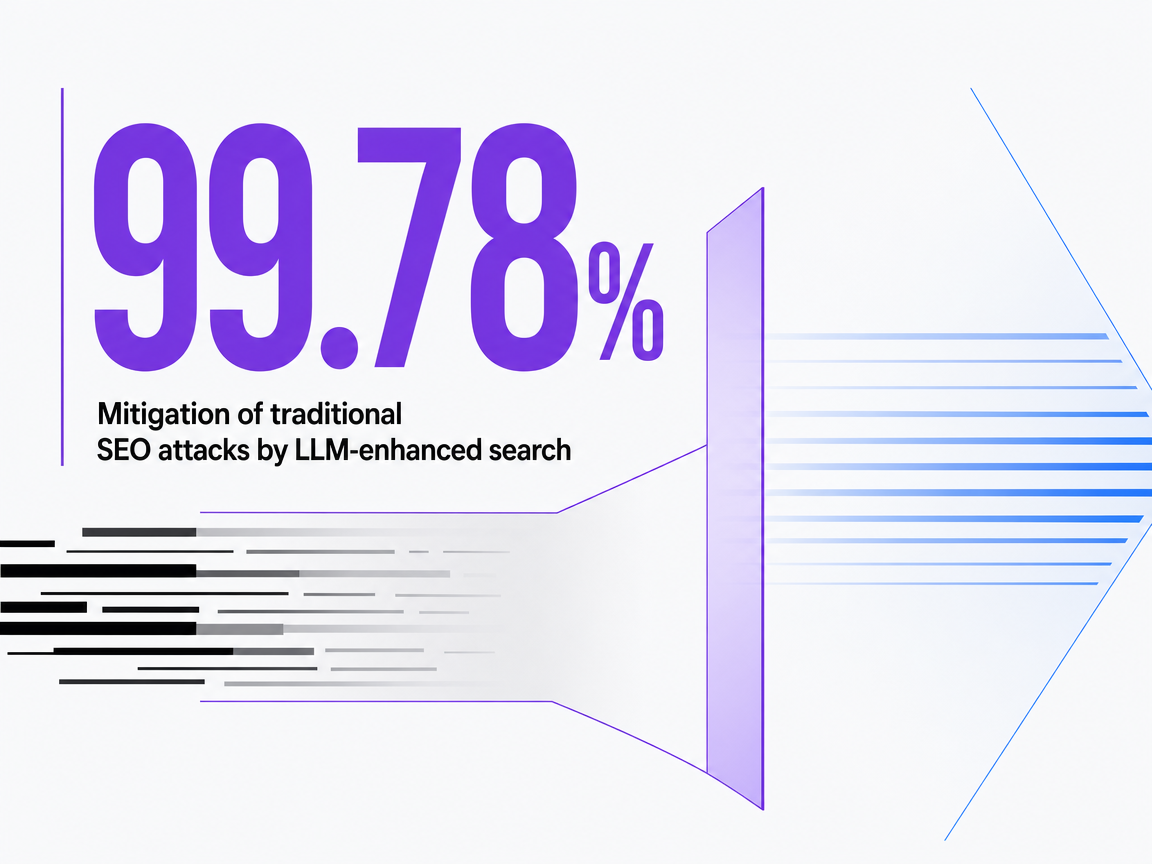 Mitigation of traditional SEO attacks by LLM-enhanced search
Mitigation of traditional SEO attacks by LLM-enhanced search
Frequently Asked Questions
References
- 1.Spam Policies for Google Web Search | Google Search Central | Documentation | Google for Developers.
- 2.SEO Starter Guide: The Basics | Google Search Central | Documentation | Google for Developers.
- 3.Creating Helpful, Reliable, People-First Content | Google Search Central.
- 4.Term frequency and weighting.
- 5.Inverse document frequency.
- 6.Tf-idf weighting.
- 7.Using Suffix Arrays to Compute Term Frequency and Document Frequency for Corpus-Based Word Analysis.
- 8.Using Suffix Arrays to Compute Term Frequency and Inverse Document Frequency.
- 9.An LCF-IDF Document Representation Model Applied to Long Document Classification.
- 10.Term-Recency for TF-IDF, BM25 and USE Term Weighting.
- 11.A Comparison of Document, Sentence, and Term Event Spaces.
- 12.A Survey on Adversarial Information Retrieval on the Web.
- 13.FlippedRAG: Black-Box Opinion Manipulation Adversarial Attacks to Retrieval-Augmented Generation.
- 14.GEO: Generative Engine Optimization.
- 15.Unveiling the Resilience of LLM-Enhanced Search Engines against Black-Hat SEO Manipulation.