
Key Takeaways
- A keyword gap is a missing area of query coverage where competitors satisfy a specific search intent the client site does not, not just a set-difference between term lists 1.
- Query intent skews roughly 80% informational, 10% navigational, and 10% transactional 2, so gap prioritization should weight rows by revenue contribution rather than raw missing-term counts.
- Automated intent classifiers cap near 74% accuracy 2and short queries resist reliable text-based labeling 3, so SERP inspection and Search Console behavior must validate high-value rows before briefing.
- Every validated gap row should exit triage with an intent tag and a page-type assignment — pillar, comparison, service page, tool, location, or entity page — not just a slug and word count.
The Definition Most Agencies Get Half-Right
Most keyword gap definitions circulating in SEO circles stop at the surface: terms competitors rank for that a client site does not. That description is technically accurate and strategically thin. It treats gap analysis as a set-difference problem between two keyword lists, which is exactly why so much gap-driven content ships, ranks in the 20s, and never recovers.
A more useful working definition: a keyword gap is a missing area of query coverage where competitors are satisfying a specific search intent that the client site is not. The word that matters in that sentence is intent. Web-search research has classified queries by intent for more than two decades, starting with the informational, navigational, and transactional split that anchors nearly every credible SEO framework in use today 1. Later work extended that model to include resource-seeking goals and entity-driven variants, which matter more as search behavior fragments across brands, locations, and tools 4.
Agencies that skip the intent layer end up publishing pages that mirror competitor URLs at the term level but miss the search goal underneath. The page ranks for the head term, fails the SERP, and the delivery team blames algorithm volatility.
The rest of this piece unpacks the intent-coverage reframe, walks through a portfolio-scale methodology, and marks where standard gap analysis breaks down under scrutiny.
Keyword Gap as Intent Coverage, Not Term Overlap
Broder's Three Classes and Why They Still Anchor Gap Work
The intent framework underneath any credible gap methodology traces back to a single 2002 taxonomy that split web queries into three classes: informational, navigational, and transactional 1. Informational queries want an answer. Navigational queries want a specific destination. Transactional queries want to do something — buy, download, sign up, book.
That split still holds because it maps to what the SERP itself is doing. Google renders different result types for each class: featured snippets and People Also Ask for informational, brand-heavy blue links for navigational, product grids and local packs for transactional. When a competitor ranks for a term the client site does not, the interesting question is not the term. It is which of those result types the competitor is winning.
Later research widened the frame. Rose and Levinson kept the three-class core but added resource-seeking as a distinct goal, covering downloads, calculators, templates, and tools 4. Applied SEO research now treats intent classification as the layer that turns keyword lists into content decisions 5.
For an SEO lead reviewing a gap report, the operational move is simple: before ranking terms by volume or difficulty, tag each row with the intent the SERP is serving. That single column reorders priorities more than any volume filter.
How Intent Distribution Reshapes Gap Priorities
Intent is not distributed evenly across the queries a client site could plausibly target. Jansen and colleagues analyzed large query logs and found that more than 80% of web queries are informational, with roughly 10% navigational and 10% transactional 2. That distribution is not a curiosity. It sets the base rate an agency should expect to see when it tags a gap report by intent.
When an SEO lead runs a standard competitor gap export and finds 4,000 missing terms, the naive read is that the client needs 4,000 pages. The intent-weighted read is different. If the distribution mirrors the population, roughly 3,200 of those terms are informational, with the rest split between destination-seeking and action-seeking queries. Informational undercoverage rarely converts on the first visit, but it feeds the top of the funnel and builds topical authority. Transactional undercoverage is smaller in volume and higher in revenue impact per page.
That asymmetry has direct consequences for content planning. Agencies that treat every gap row as equivalent overproduce informational content and underinvest in the smaller transactional slice that actually moves pipeline. The reverse mistake is also common: skipping informational coverage entirely because it looks weak on a revenue-per-page model, then watching competitors accumulate the topical footprint that eventually captures the branded and comparison queries downstream.
A useful working rule: weight gap prioritization by the intent's contribution to the client's revenue model, not by the raw count of missing terms. A dental services group and a legal directory site will read the same 80/10/10 distribution 2and produce different roadmaps, because the transactional 10% carries different economics in each vertical.
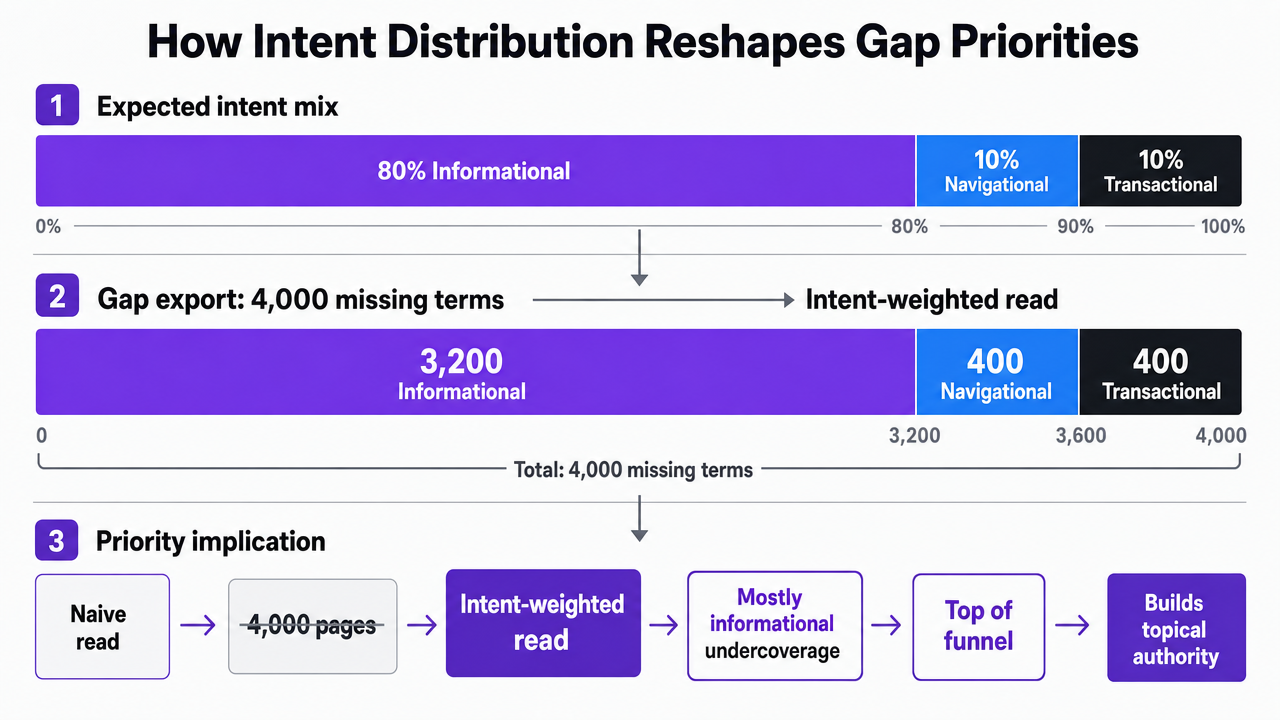 Visualize the 80/10/10 intent distribution cited in the section (informational, navigational, transactional) which directly reshapes how gap rows should be prioritized
Resource-Seeking and Entity Intents That Slip Past Standard Reports
The three-class model covers most gap analysis, but two intent categories consistently slip past standard reports. The first is resource-seeking. Rose and Levinson identified this as a distinct goal: users looking for a tool, template, calculator, checklist, or downloadable asset 4. These queries look informational in a keyword export — "personal injury demand letter," "medication reconciliation form," "HVAC load calculator" — but the SERP is dominated by pages that hand over the artifact. A definitional article, however well-written, does not close that gap.
The second category is entity-driven intent. Research on named-entity queries shows that intent varies systematically by whether the query centers on a brand, a place, a person, or a product 6. For agencies working multi-location service verticals — legal, dental, home services, senior living — a large share of gap terms cluster around entity variants: "[competitor brand] reviews," "[city] [service] near me," "[practitioner name] [specialty]." Standard gap reports flag these as missing keywords without indicating that each entity type demands a different page template.
Both categories require a manual pass on top of the tool output. The delivery team scans the SERP for the top three to five gap terms in each cluster, notes the dominant result type, and tags the row with the true intent before it enters the content backlog.
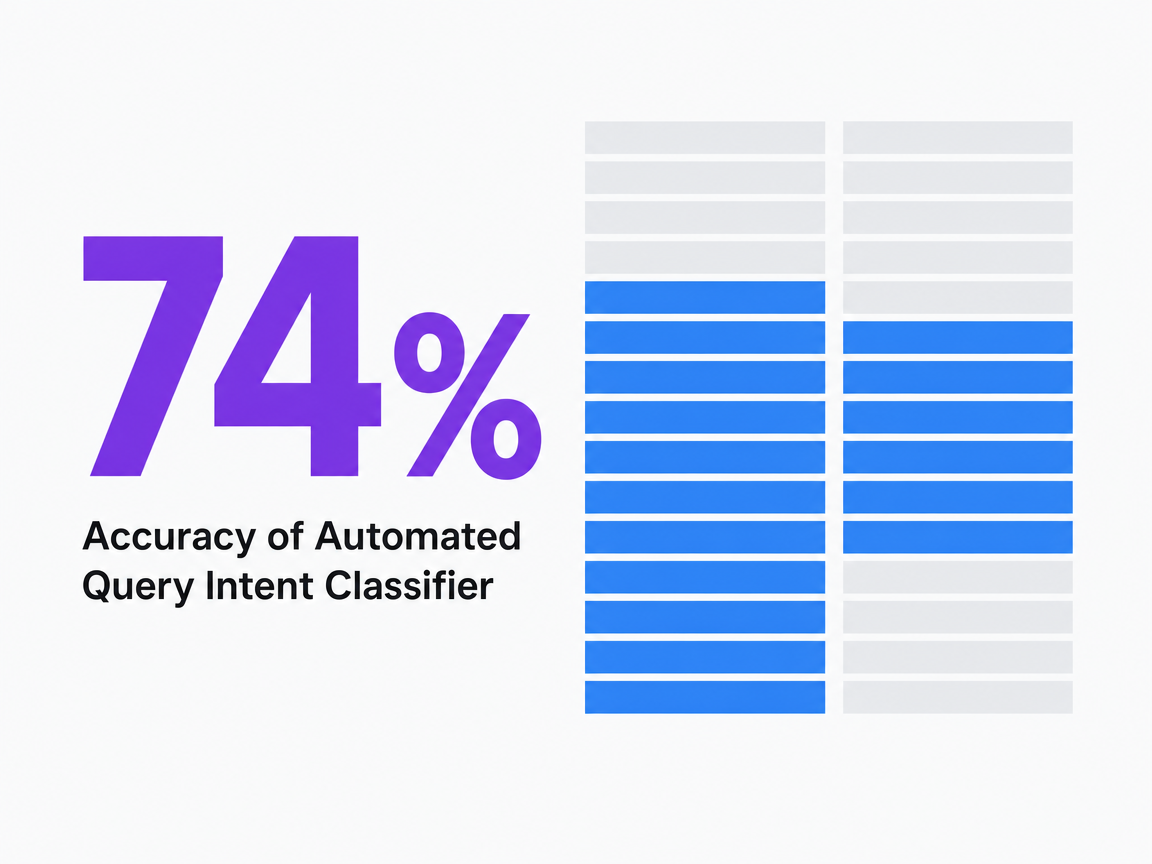 Accuracy of Automated Query Intent Classifier
Accuracy of Automated Query Intent Classifier
Identify and Close Keyword Gaps Instantly
Run real-time keyword gap analyses and publish optimized content directly during your trial period.
A Worked Example: Term Gap vs. Intent Gap
The Same Missing Keyword Under Four Intent Lenses
Consider a single keyword flagged in a competitor gap export for a mid-size home services client: "water heater replacement cost." A standard gap report shows two competitors ranking on page one, the client site nowhere in the top 50. The naive delivery response is to brief a blog post targeting the term.
Run that same keyword through four intent lenses and the strategic picture changes.
- Under an informational reading, the searcher wants a price range and the variables that drive it — tank vs. tankless, labor, permit fees. The SERP-winning page is a 2,000-word explainer with a cost table.
- Under a navigational reading, the searcher has a specific brand or local provider in mind and is refining toward a destination page.
- Under a transactional reading, the searcher is ready to book and the SERP surfaces service pages with quote forms and phone numbers.
- Under a resource-seeking reading, framed by Rose and Levinson's fourth category 4, the searcher wants a calculator that returns an estimate from their inputs.
Broder's original taxonomy separated the first three 1. The same missing keyword sits in a different quadrant depending on which SERP the client is actually losing. A single blog post cannot win all four. Delivery teams that ship one and hope it covers the intent range are the ones producing content that hovers in positions 15 through 30.
What the Delta Actually Tells the Content Team
The useful output of a gap analysis is not the keyword. It is the assignment: which intent, which page template, which position on the site architecture.
Back to the water heater example. The SEO lead checks the top three ranking URLs on the target SERP and finds two cost-explainer articles and one service page with a live estimator widget. That mix signals a blended informational-plus-resource-seeking SERP. The client site has neither. The delivery brief now specifies two artifacts: a pillar explainer that covers the cost variables in prose and a companion estimator page with structured inputs. Applied intent research supports this pairing, since intent classification is what turns a keyword list into a content specification rather than a topic list 5.
Contrast that with the naive brief — a single 1,200-word blog post targeting the head term. It ranks briefly at position 22 and stalls, because it does not answer the resource-seeking half of the SERP. The gap did not close. It just moved from missing to underperforming.
The delivery lesson is direct: every row that survives gap triage should exit with an intent tag and a page-type assignment, not just a URL slug and a word count.
Where Standard Gap Analysis Breaks Down
Short Queries and the Limits of Automated Intent Labels
Bulk gap analysis leans on automated intent classification. Every major SEO platform ships some version of it — a tag next to each keyword marking it as informational, commercial, or transactional. The tags speed up triage, and they are wrong often enough to matter.
The ceiling is measurable. Jansen and colleagues built an automated classifier against a labeled query set and reported roughly 74% accuracy against the three-class taxonomy 2. That number is the honest upper bound for what a rules-based or lightweight model can do on query text alone. Roughly one in four intent labels in a bulk gap export is wrong.
The error concentrates in short queries. A separate ground-truth study asked users to label their own searches and found that short query text often gives few hints about the underlying intent 3. Two-word queries like "invisalign cost," "personal injury lawyer," or "hvac quote" can sit in any of three intent classes depending on the searcher's stage. The classifier sees the same string every time and picks one label.
For an agency running gap analysis across a client portfolio, the operational implication is direct. Any bulk export that arrives pre-tagged by intent needs a validation pass on the top-value rows before it drives briefs. A 74% ceiling 2is fine for prioritization triage and not fine for content specification. The rows that survive triage — the ones the client will actually invest pages in — need human or SERP-based confirmation.
SERP Context and Behavioral Signals as Correction Layers
The correction is not a better classifier. It is a second pass that reads what the SERP is already doing.
When the query text is ambiguous, the ranking results are not. Google has already resolved the intent by choosing what to surface — a knowledge panel, a local pack, a product carousel, a comparison table, a set of long-form explainers. The dominant result type is a stronger intent signal than any label produced from the query string alone. Applied intent research treats SERP composition as one of the more reliable inputs available to SEO teams working outside a search engine's own logs 5.
Behavioral signals close the remaining gap. Ground-truth work on query intent shows that user context and post-query behavior carry information the query text does not 3. Inside a client account, that context lives in Search Console: which pages the query already touches, how deep the impressions go, whether click-through patterns match the intent the tool assigned.
A workable rule for delivery teams: automated intent tags survive triage, SERP inspection sets the page template, and Search Console behavior confirms whether the client already has partial coverage that a new page would cannibalize. Skip either correction layer and the gap report starts producing briefs that read plausible and rank poorly.
Pinpoint and Close Your Keyword Gaps—at Scale, Not by Hand
See how leading agencies apply automated keyword gap analysis to prioritize and execute content improvements across portfolios, maintaining quality and control without increasing headcount.
Running Intent-Coverage Gap Analysis Across a Client Portfolio
A Repeatable Four-Step Model
The methodology that survives portfolio-scale execution has four steps, in this order.
- Pull the raw gap export from whichever competitor intelligence platform the agency standardizes on. Two to four competitors per client, filtered to terms where at least one competitor ranks in the top 20 and the client site ranks below 50 or not at all. This is the only step that resembles the naive gap definition.
- Tag every surviving row with an intent hypothesis using the four-class model: informational, navigational, transactional, and resource-seeking 1, 4. Bulk tools can seed the tags, but the tags are hypotheses at this stage, not conclusions. The empirical distribution to expect across a general query set skews heavily informational, with the transactional and navigational slices thinner but higher in commercial value 2.
- Validate the top 20 to 40 rows by cluster through direct SERP inspection. The delivery team opens the query, records the dominant result type, and confirms or overrides the tag. Applied SEO research supports this pass because SERP composition is the most reliable intent signal available outside a search engine's own logs 5.
- Assign a page-type template to each validated row: pillar explainer, comparison, service page, tool or calculator, location page, entity page. That assignment is the deliverable. Everything downstream — brief, outline, draft — cascades from it.
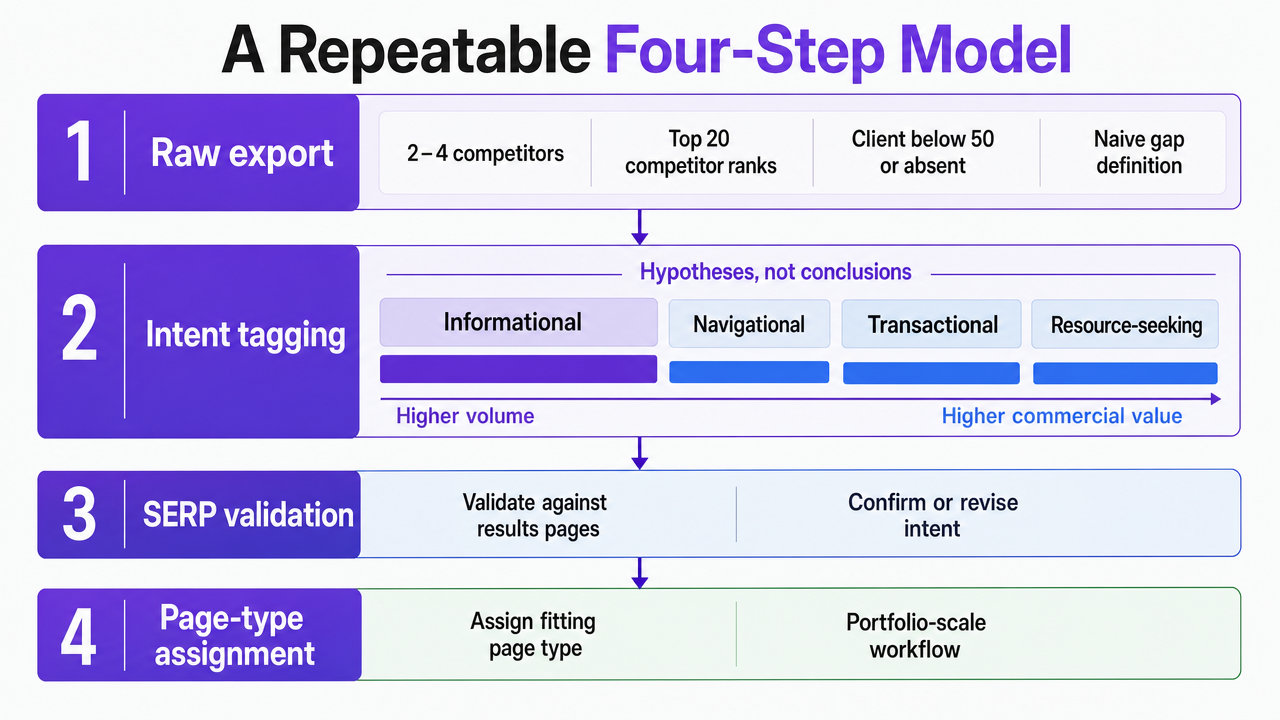 Visualize the four-step portfolio-scale gap analysis methodology explicitly enumerated in the section: raw export, intent tagging, SERP validation, page-type assignment
Fresh Data Inputs: Search Console's 24-Hour View and Insights
Third-party gap tools refresh on their own schedule, often lagging the SERP by weeks. That lag is where emerging gaps hide.
Google's Search Console now surfaces performance data from the last 24 hours with clicks, impressions, average CTR, and average position 8. For agency delivery teams, that view is the earliest indicator of queries the client site is starting to touch but not yet win — impressions climbing, position stuck in the 20s, CTR flat. Those rows belong in the gap backlog before any competitor crawler reflects them.
The integrated Search Console Insights report adds a second input. Google positions the report's trending queries as a source for new content ideas, calling out queries that are trending up as candidates for coverage 9. On a client portfolio, the practical use is triage: SEO leads scan Insights across accounts weekly, flag the trending queries that match the client's revenue model, and push them into the same four-step model above. Fresh queries route through the same intent validation as scheduled gap exports.
If You Manage 15+ Client Sites: The Economics of Manual vs. Systematized Gap Work
This section shifts scope. The four-step model above works for a delivery lead handling five or ten accounts. It stops working somewhere between 15 and 20 clients, and the failure is arithmetic, not strategic.
A thorough gap audit — export, intent tagging, SERP validation on the top clusters, page-type assignment, brief handoff — runs somewhere between six and twelve hours of specialist time per client per quarter, depending on site size and vertical complexity. At portfolio scale, that time compounds against a fixed team.
The variables below are the ones a Head of SEO already tracks. The table exposes where manual gap work breaks, without inventing dollar figures.
| Variable | Manual gap workflow | Systematized workflow ||---|---|---|| Hours per client per quarterly audit | 6–12 | 1–3 (validation only) || Specialist cost per hour | Agency's loaded rate | Agency's loaded rate || Quarterly cost per client | 6–12 × rate | 1–3 × rate || Clients per specialist FTE (quarterly cycle) | ~10–15 | ~40–60 || Refresh cadence for emerging gaps | Quarterly | Weekly (Search Console 24-hour view 8) || Intent validation coverage | Top clusters only | Top clusters, wider tail |
The left column is where most agencies live. The right column is what happens when the export, intent seeding, and page-type assignment steps are automated, leaving specialists to validate SERPs and approve briefs. The specialist rate does not change. The number of specialists needed to cover the same client book does.
Two consequences follow. The refresh cadence tightens from quarterly to weekly, which matters because trending queries surfaced in the integrated Insights report can be routed into the backlog before the next scheduled audit 9. And the specialist hours reclaimed shift toward the work that still requires judgment: SERP inspection on high-value clusters, entity-intent decisions in multi-location verticals 6, and the page-type assignments that determine whether a gap actually closes.
Agencies that cross the 15-client threshold without systematizing the mechanical steps do not close gaps faster. They just run smaller audits on more accounts and ship briefs that miss intent.
Turning Gap Findings Into Content Decisions
The point of gap analysis is not the report. It is the queue of briefs that comes out of it, and the discipline of not writing the ones that will not rank.
Three filters separate a validated gap row from a green-lit brief.
- The first is intent match against existing coverage. Before a new page enters the roadmap, the delivery lead checks whether the client site already has a URL that partially serves the intent. If so, the decision is to expand or restructure that page, not to publish a competing one. Applied intent research supports this triage because a keyword often maps to an intent already partly covered rather than a genuinely empty slot 5.
- The second filter is entity fit. In multi-location and service verticals, gap rows tied to brand, place, or practitioner queries need a page template that matches the entity type — location page, provider bio, comparison, review roundup 6. A generic explainer will not close an entity-driven gap no matter how well it is written.
- The third filter is commercial weight. Informational gaps feed the funnel; transactional gaps feed the pipeline. Both belong in the roadmap, but not in equal proportion. Assign the ratio to the client's revenue model, then let the intent-tagged backlog fill it.
Frequently Asked Questions
References
- 1.A taxonomy of web search.
- 2.Determining the informational, navigational, and transactional intent of Web queries.
- 3.Collection and Analysis of Ground Truth Data for Query Intent.
- 4.Understanding User Goals in Web Search.
- 5.Query Intent Detection from the SEO Perspective.
- 6.Building Taxonomy of Web Search Intents for Name Entity Queries.
- 7.ORCAS-I query intent predictor as component of TIRA.
- 8.An improved way to view your recent performance data in ....
- 9.The new Search Console Insights report is here.
- 10.Determining the User Intent of Web Search Engine Queries.
- 11.Can We Predict User Intents from Queries?.