
Key Takeaways
- A keyword is a hypothesis about what searchers want in their own vocabulary, while a query is the actual string they type; the keyword is the bet, the query is the evidence 2.
- Google's BERT, RankBrain, and neural matching interpret concepts rather than exact strings, so a page targeting one phrase can rank for synonyms without stuffing variants into every heading 14.
- Specificity beats raw volume for commercial yield: a 2025 B2B paid-search study found specific, high-quality keywords lifted clicks and purchases while generic head terms drew impressions without conversion 4.
- AI Overviews and AI Mode require no separate keyword list, but query fan-out means a page must cover adjacent subtopics, comparisons, and objections to be cited across multiple retrievals 8, 10.
The Charcuterie Problem: Why a Keyword Is a Hypothesis, Not a String
Google's own SEO Starter Guide gives content teams a quiet gift when it tells site owners to "think about the words that a user might search for to find a piece of your content" and then offers charcuterie and cheese board as examples of different terms users may use for related material 13. The pairing is more useful than it looks. One shopper types charcuterie because they know the category by name. Another types cheese board because they do not. Both land on the same intent: assembling a tray of things to eat with friends. Two surface strings, one underlying need.
That gap is where keyword strategy actually lives. A keyword is not a phrase a content team sprinkles into an H2 and a meta description. It is a hypothesis about what a specific group of searchers wants, phrased in the vocabulary they happen to use. The page is the test. Google's ranking systems, Search Console data, and user behavior are the results.
Treating keywords as inventory produces briefs that chase strings. Treating keywords as hypotheses produces briefs that interrogate intent, scope, and the vocabulary mismatch between expert and novice searchers. The rest of this article develops that frame using Google's documentation and peer-reviewed research on query behavior, because the operational difference between the two postures compounds across every piece a content program ships.
Query vs. Keyword: The Distinction Most Definitions Collapse
A query is what the user submits. A keyword is what the content team chose to target. Most "what is a keyword" explainers treat the two as synonyms, which is why so many content briefs read like transcription exercises instead of strategy documents.
The difference matters because Search Console reports both sides of the exchange separately. Google's documentation describes the Search performance report as a view into impressions and clicks broken down by queries and pages 2. The query column shows the actual language users typed. The page column shows what the content team built. When those two drift apart, the keyword hypothesis was wrong, incomplete, or aimed at the wrong intent cluster.
Queries are also messier than keywords. Google researchers describe search queries as "challenging because they are often short and lack nuance or context," which is why modern systems use retrieval augmentation to reconstruct what the user likely meant 6. A keyword, by contrast, is a cleaned-up strategic target: a phrase a content manager has committed capacity to, usually standing in for dozens or hundreds of related queries that share an intent.
This is not academic hair-splitting. It changes how a brief gets written. The keyword defines the territory the page claims. The queries that eventually appear in Search Console reveal how close that claim came to real demand. One is the bet; the other is the outcome. Confusing them turns the feedback loop into noise.
Where Keywords Actually Enter Google's Pipeline
Crawling, Indexing, and Serving
Google's own description of how Search works breaks the process into three stages: crawling, where Googlebot discovers pages; indexing, where systems analyze and store a page's textual content and key content tags; and serving, where the index is queried for pages relevant to a user's search 1. Keywords touch all three stages, but not in the way most briefs assume.
At the crawl stage, keywords are irrelevant. The crawler needs discoverable URLs and reachable HTML. At the index stage, keywords matter as evidence of what the page is about: Google reads the words on the page, the headings, and other prominent text to decide which topics the document covers. At the serving stage, Google matches an interpreted version of the query against the indexed representation of the page. The user types a string. The system retrieves a page it has already decided is about a concept.
The practical consequence for content managers: a target keyword's job is to help indexing systems categorize the page accurately. It is not a password that unlocks a ranking slot.
BERT, RankBrain, and the End of Exact-Match Thinking
Google's ranking systems documentation names several components that interpret meaning rather than count words. BERT, according to Google, helps the system understand how combinations of words express different meanings and intent. RankBrain helps it understand how words are related to concepts, including terms that do not appear verbatim on the page 14. Neural matching sits alongside them, mapping queries to documents by concept rather than by lexical overlap.
This is why exact-match thinking produces diminishing returns. A page targeting cheese board can rank for charcuterie because the serving system recognizes the two phrases describe the same concept. A page that stuffs every variant into subheadings signals little beyond the author's anxiety.
The QUILL research from Google reinforces this on the query side. The authors describe search queries as challenging because they are often short and lack nuance or context, and they use retrieval augmentation to add context the user did not type 6. The system is actively trying to figure out what the searcher meant. A page that reads like a thesaurus does not help it.
The operational shift is straightforward: write to the concept the keyword represents, cover the subtopics a knowledgeable reader would expect, and let the ranking systems do the matching. Variants belong in the draft when they clarify meaning for the reader, not when a spreadsheet demands them.
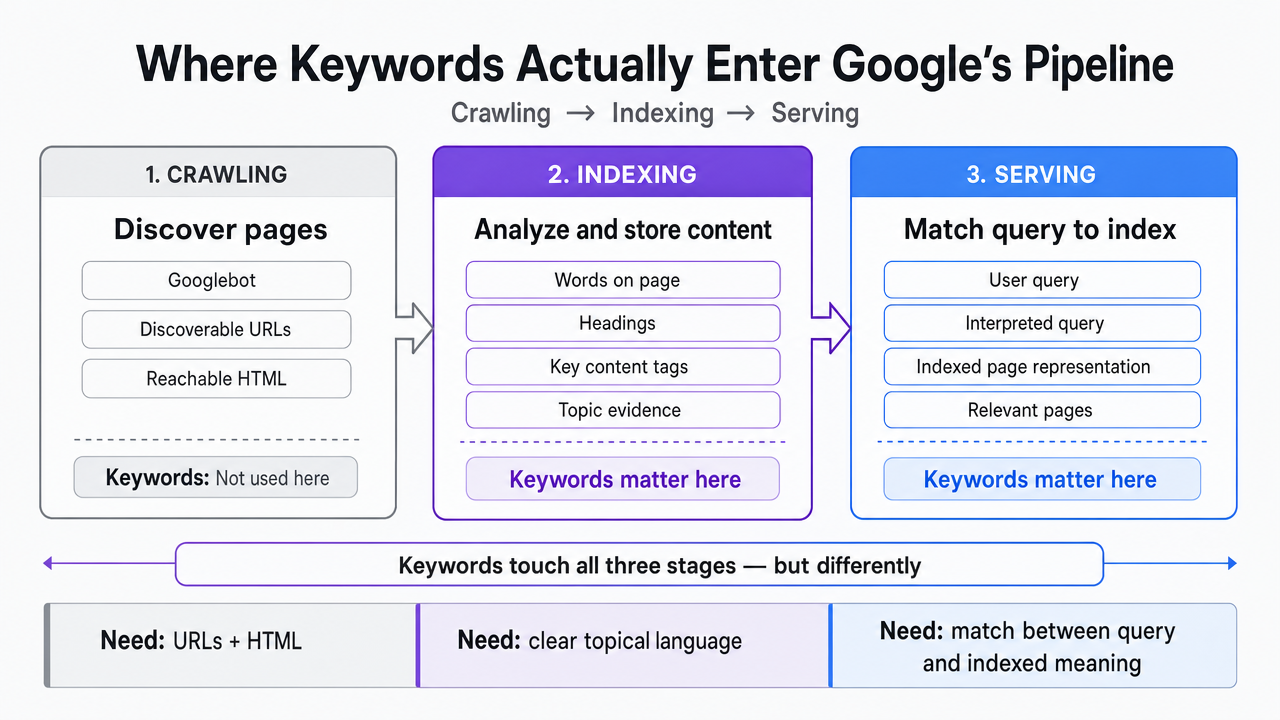 Diagram Google's three-stage pipeline (crawling, indexing, serving) described in the section, labeling where keywords matter and where they do not
Intent Is the Variable That Changes the Content Brief
Two users type the same three words into Google and want entirely different things. One is researching. One is ready to buy. The keyword on the spreadsheet looks identical. The content brief should not.
The foundational classification comes from Jansen's academic study of Web-search intent, which sorted queries into three buckets: informational, navigational, and transactional. Analyzing a large sample of real search logs, the authors reported that more than 80% of queries were informational, with roughly 10% navigational and 10% transactional 17. The scope matters: the dataset is 2008-era, drawn from a general Web search engine, and the three-category model does not cleanly capture modern commercial-investigation, local, or task-oriented hybrids. Treating the 80/10/10 split as a current traffic forecast would be a mistake. Treating it as a planning constraint is not.
The constraint is this: most of the territory a keyword can claim is informational. A content program that builds only transactional pages against commercial head terms is competing for the smallest slice of actual search behavior, usually against the most entrenched competitors. A program that treats informational intent as the volume driver and designs transactional pages as the conversion endpoint tends to allocate production capacity more realistically.
Intent also decides the asset format.
- An informational query wants explanation, structure, and definitions.
- A navigational query wants a direct path to a known destination; a long essay gets in the way.
- A transactional query wants proof, specifications, pricing signals, and a clear next step.
The same keyword, misread, produces a page that satisfies no one. Read correctly, intent is the single variable that makes a brief writable.
Test live keyword strategies on real content
Validate SEO keyword choices by publishing content during your trial and monitoring measurable impact immediately.
Specificity Outperforms Volume
Volume is the metric that gets a keyword onto a spreadsheet. Specificity is the metric that gets a page to earn its production cost back. The two are often confused because volume is easy to pull from a tool and specificity requires judgment.
A 2025 logistic-regression study of a German B2B e-commerce retailer's paid-search account tested how keyword design affected both clicks and purchases. The authors reported that keyword specificity and quality positively influenced click and purchase probability, while generic high-volume terms generated more impressions but lower click-through and conversion rates 4. The scope is narrow and worth stating plainly: paid search, a single B2B retailer, one market, 2025 data. The finding does not transfer automatically to every organic category. What it does establish is that impression volume and commercial outcome diverge in a measurable way, and that the divergence favors specificity.
The Penn State keyword-selection study points in the same direction from the organic side. Its empirical framework treats specificity as one of several criteria—alongside popularity, competition, intent, content relevance, and authority—that predict whether a keyword will produce useful clicks 3. Specificity is not a tiebreaker. It is a primary input.
For a content program with limited writer capacity, the practical rule is to budget against commercial yield per published page, not against total addressable impressions. A specific keyword with clear intent and a buildable page beats a generic head term the program cannot credibly rank for and would struggle to convert if it did.
The Prioritization Matrix: Matching Keyword Type to Content Asset
A keyword's type determines what kind of page can win it. A content program that treats every target the same way wastes production capacity on formats the intent will not reward. The matrix below converts the research on intent, specificity, and funnel stage into an allocation tool rather than a taxonomy exercise.
The Penn State keyword-selection study is the anchor. Its empirical framework found that content relevance matters most for organic clicks when users are farther along and searching for ways to purchase, while online authority carries more weight during awareness-stage searches 3. That split is what makes the dominant ranking driver column non-obvious: an early-funnel informational page competes on perceived authority of the publisher, while a late-funnel commercial page competes on how precisely the content answers the buyer's actual question.
| Keyword Type | Funnel Stage | Dominant Ranking Driver | Recommended Asset |
|---|---|---|---|
| Informational (broad) | Awareness | Online authority 3 | Explainer, definitional guide, category primer |
| Informational (specific) | Consideration | Content relevance 3 | How-to, comparison framework, decision guide |
| Commercial investigation | Late consideration | Content relevance 3 | Side-by-side comparison, criteria-based review |
| Transactional | Decision | Content relevance 3 | Product page, pricing page, demo request |
| Navigational | Any | Brand recognition | Direct destination page, no interstitial content |
| Local | Decision | Proximity, listing accuracy | Location page with service and hours detail |
The practical read: broad informational terms justify investment in depth and credibility signals, because the page is competing against established publishers. Specific informational and commercial terms justify investment in precision, because the user has already narrowed the field and will reward the page that matches their decision criteria most exactly. Navigational and local terms justify almost no essay content at all; the user wants an address, a login, or a phone number.
Used this way, the matrix tells a content manager which keywords deserve a 2,500-word asset and which deserve a 400-word page with the right schema. That is the allocation decision writer capacity actually turns on.
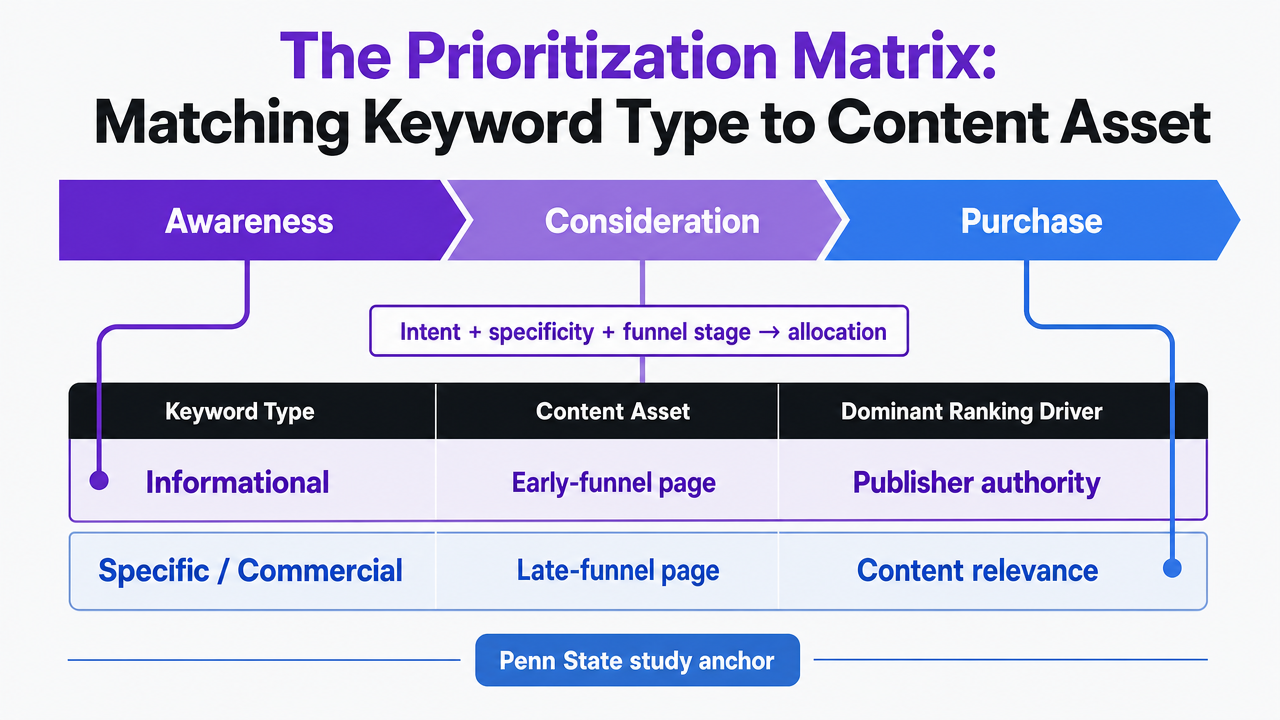 Visualize the keyword-type-to-asset matrix from the section as a clean reference infographic so readers can scan allocation decisions at a glance
Keyword Lists Decay: Shifting Intent and Strategic Omission
When 'Independence Day' Stops Meaning the Holiday
Google Research published a 2023 paper that uses "independence day" as its working example of a query whose dominant meaning shifts over time. For most of the calendar year, the phrase points to the U.S. holiday. Around the release window of a film by the same name, the intent behind identical keystrokes tilts toward the movie 7. The string on the spreadsheet did not change. The underlying demand did.
This is the quiet problem with any keyword list older than a quarter. A target that converted well in Q1 may be pointing at a different audience in Q3 because a product launch, a news cycle, a court ruling, or a seasonal pattern reshaped what the words now imply. The Google Research team is explicit that query intent is dynamic rather than permanently fixed 7, which means historical performance data has a shelf life.
The operational response is modest: re-validate the top targets each quarter against current Search Console query data and current SERP composition. A keyword that still looks the same in a tool but now returns a different result mix is a keyword whose brief needs rewriting, not a keyword whose page needs more backlinks.
What Users Deliberately Leave Out of the Query Box
A 2020 peer-reviewed study on strategic query formation found that consumers sometimes omit terms highly relevant to their underlying need, choosing shorter or less specific phrasing even when more precise vocabulary would describe their situation better. The authors report that optimal queries may exclude some terms that are more relevant to the consumer, potentially at the expense of less relevant ones 5. Users compress. They assume context the search engine does not have.
For keyword research built from obvious product vocabulary, this is a demand-visibility problem. The brand's internal language—feature names, category jargon, specification numbers—often never appears in the queries of the people who would benefit most from the content. Those searchers are typing around the topic, not through it.
The practical correction is to build keyword lists from two directions at once: the vocabulary the product uses, and the vocabulary observed in Search Console queries that already generated impressions, however incidental. The overlap is the obvious demand. The gap is where the untapped briefs live.
AI Overviews and Query Fan-Out: One Keyword, Many Subqueries
Google describes AI Mode as capable of issuing multiple searches simultaneously across subtopics and combining the results into a response with links to the web 10. The company calls this query fan-out. One user question becomes several machine-generated subqueries, each retrieved against the index, each contributing passages to the final answer. The implication for keyword strategy is direct: a target phrase is no longer a single door the page needs to stand behind. It is a cluster of adjacent questions the page must answer well enough to be cited across multiple retrievals.
Google's own documentation closes the loop on what this means for optimization. The AI Features page states plainly that there are no additional requirements to appear in AI Overviews or AI Mode, and that pages must simply be indexed and eligible for normal Search snippets 8. The 2026 generative-AI guidance reinforces the same point: AI features are rooted in core Search ranking and quality systems, and optimizing for generative AI search is still SEO 19. There is no separate AI keyword list to build. There is no AEO or GEO vocabulary layer sitting beside the SEO one.
What changes is the breadth a single page needs to cover. If the system is fanning out one question into five related searches, a page that addresses only the headline phrase will lose citation opportunities to pages that also cover the comparison, the prerequisite, the common objection, and the follow-up task. The keyword still names the territory. The page now has to populate it.
See How Enterprise Teams Operationalize Keyword Strategy with AI Coordination
Connect with our experts to review how unified workflows and live data insights can streamline keyword selection, mapping, and content execution—without increasing headcount or losing control over brand voice.
Placement, Repetition, and the Spam Ceiling
Where a keyword appears on a page matters more than how often it appears. Google's title link documentation notes that the system may draw on the title element, visible page heading, H1s, and other prominent text when generating the title that shows in search results, and recommends descriptive, concise, page-specific wording 18. The operational translation: the target phrase belongs in the title, the H1, and the first prominent passage because those placements help Google categorize the page accurately. Repeating it in every subheading does not strengthen that signal; it corrodes the reading experience.
The ceiling on repetition is set by Google's spam policy, which defines keyword stuffing as filling a page with keywords or numbers to manipulate ranking and specifically warns against repeating words or phrases so often that the writing sounds unnatural 16. No density percentage is published. Naturalness is the standard. A page that reads like it was written for a reader passes. A page that reads like it was written for a crawler does not.
The Helpful Content guidance closes the frame: ranking systems are designed to prioritize information created to benefit people, not content built mainly to rank 15. Keyword placement is a clarity decision, not a dosage calculation.
The Measurement Loop: Treating Search Console as Hypothesis Testing
Every keyword a content program ships is a prediction. Search Console is where that prediction meets evidence. Google's documentation describes the Search performance report as a breakdown of impressions and clicks across queries, pages, and countries 2, which is the operational feedback a content manager actually needs: not whether the target ranks, but which real queries the page is being surfaced for and which of those earn the click.
The loop runs in three reads.
- Compare the queries the page receives against the keyword the brief targeted. Close alignment means the hypothesis landed. A wide drift means the page is being matched to an adjacent intent, and the brief either needs to expand to cover it or a second page needs to claim the territory.
- Examine impression-heavy, click-light queries. These are the terms where the page appears but fails to earn the click, usually because the title or passage does not match what the searcher expected.
- Look at the queries that produce clicks the keyword list never predicted. Those are the untapped briefs the earlier research missed, including the vocabulary that strategic consumers never type 5.
Google's documentation is candid that query reporting does not expose every search or explain conversions 2. The report is a feedback instrument, not a dashboard. Used as hypothesis testing, it turns each published page into a data point that sharpens the next brief rather than a static asset to defend.
The Limits of Keyword-Only Thinking
A keyword is a useful planning unit. It is not a complete theory of why a page ranks. The academic literature on SEO treats it as one input among many: Lewandowski's 2023 chapter describes the discipline as spanning text modification, linking structures, and the behavior of search-engine systems themselves 11, and the MCDM modeling work on SEO prioritization treats keyword variables as a subset of a larger criteria set that includes link profile and site characteristics 12. A content program that optimizes only against keyword lists will eventually plateau against competitors optimizing against the full picture.
The retrieval layer compounds this. Google's generative-AI guidance describes retrieval-augmented generation as the process by which Search systems pull relevant pages and ground AI responses in them 19, which means a passage can be surfaced for a question whose exact phrasing never appeared in any keyword tool. Neural matching, BERT, and query fan-out have moved the match point away from strings and toward concepts, relationships, and demonstrated usefulness 14, 10.
The durable posture for a content manager is to treat keyword research as the discovery layer and helpful, people-first content as the production standard 15. Platforms like Vectoron compress that loop; the thinking it rewards is still human.
Frequently Asked Questions
References
- 1.In-Depth Guide to How Google Search Works | Documentation.
- 2.How To Use Search Console.
- 3.Keyword Selection Strategies in Search Engine Optimization: How Relevant is Relevance?.
- 4.Which keyword design increases the click and purchase probability? An empirical analysis of content-related, formal and competition-related design criteria.
- 5.Search query formation by strategic consumers.
- 6.QUILL: Query Intent with Large Language Models using Retrieval Augmentation and Multi-stage Distillation.
- 7.Adapting to the shifting intent of search queries.
- 8.AI Features and Your Website.
- 9.A new resource for optimizing for generative AI in Google Search.
- 10.AI in Search: Going beyond information to intelligence.
- 11.Search Engine Optimization (SEO).
- 12.Improving search engine optimization (SEO) by using hybrid modified MCDM models.
- 13.Search Engine Optimization (SEO) Starter Guide.
- 14.A Guide to Google Search Ranking Systems.
- 15.Creating Helpful, Reliable, People-First Content.
- 16.Spam Policies.
- 17.Determining the informational, navigational, and transactional intent of Web queries.
- 18.Influencing Title Links in Google Search.
- 19.Google's Guide to Optimizing for Generative AI Features on Google Search.