
Key Takeaways
- An SEO manager now oversees technical SEO, content strategy, structured data engineering, and AI-surface optimization—four disciplines once handled by separate specialists, consolidated under one title.
- Google's documentation shifts, from Search Essentials to the February 2026 Discover Core Update and May 2026 generative AI guidance, keep adding workstreams without removing earlier responsibilities 9, 10.
- With marketing manager median pay at $166,790 and fully-loaded costs reaching 1.4x base wages 12, account-per-manager ratios determine whether senior time funds strategy or coordination.
- Agencies gain leverage by separating craft from coordination: systematize repeatable tasks like briefs, audits, and schema drafts, and reserve manager judgment for editorial, policy, and architecture decisions.
The Evolving Scope of the SEO Manager Role
Ten years ago, an SEO manager's responsibilities were largely confined to keywords, on-page structure, link acquisition, and monthly ranking reports. While these tasks remain, the role has expanded dramatically, driven by continuous updates from Google.
Google's shift from Webmaster Guidelines to Search Essentials, emphasizing helpful, people-first content and crawlable link structures, significantly broadened the scope of SEO 2. This was followed by the integration of page experience signals like Core Web Vitals, mobile rendering, and HTTPS into SEO considerations 4. Structured data policies introduced new compliance requirements, demanding technical validation and content accuracy, often requiring coordination with engineering teams 6. Recent updates, such as the February 2026 Discover Core Update 10, Google's May 2026 generative AI optimization guidance 9, and the January 2026 Search Console structured data deprecations 11, have further added to the complexity.
Each of these shifts introduced new workstreams without removing existing ones. Consequently, an SEO manager now not only briefs writers and audits title tags but also navigates schema disputes with developers, monitors Discover volatility, and addresses client concerns about AI Overviews impacting branded traffic.
For agencies, this expansion translates to margin compression. The cost of the role has increased, nearing that of a marketing manager, with the U.S. Bureau of Labor Statistics reporting a median annual wage of $166,790 for marketing managers as of May 2025 12. However, the ratio of accounts per manager has remained stagnant. This article explores the origins of this scope expansion, distinguishes between coordination and craft tasks, and analyzes the economic implications for multi-client delivery.
Google's Documentation: A Catalyst for Role Redefinition
From Webmaster Guidelines to Search Essentials: Impact on Manager Responsibilities
The evolution of Google's documentation provides a clear timeline of the SEO manager role's expansion. Each update introduced new responsibilities without corresponding adjustments in delivery plans.
The transition from Webmaster Guidelines to Search Essentials was a pivotal moment, emphasizing helpful, people-first content and robust link structures 2. This change integrated editorial judgment and information architecture directly into SEO policy. Page experience guidance formalized Core Web Vitals, HTTPS, mobile rendering, and interstitial behavior as critical signals, requiring SEO managers to collaborate with front-end engineering on release schedules 4. Structured data policies became more stringent, demanding technical validation and content accuracy, adding a compliance layer that necessitates coordination between content teams and developers 6.
The pace of change accelerated with subsequent announcements. In November 2025, Google announced the deprecation of support for certain structured data types in Search Console and its API, effective January 2026 11. This forced managers to rebuild client dashboards and reporting systems mid-quarter. The February 2026 Discover Core Update introduced a new surface to monitor, distinct from traditional rank tracking 10. Furthermore, Google's May 2026 guidance on optimizing for generative AI in Search expanded the definition of visibility beyond traditional organic results 9.
These six significant documentation shifts occurred within a short period, all impacting the same job title. None of the earlier responsibilities, such as keyword targeting, on-page structure, internal linking, or technical audits, were removed. The SEO manager's brief in 2026 is significantly broader than in 2018. Agencies that continue to hire based on the older definition are underestimating the required scope of delivery by a substantial margin.
Four Merged Disciplines Within the SEO Manager Role
A comparison of modern SEO manager job descriptions with Google's current documentation reveals that what was once four distinct disciplines is now consolidated under a single title. Historically, each of these areas was handled by a specialist or an adjacent team.
Technical SEO. : The Search Starter Guide outlines discovery, canonicalization, sitemaps, robots directives, and Search Console monitoring as fundamental expectations, not advanced tasks 1. Documentation on crawling and indexing further emphasizes URL construction, information architecture, and crawl efficiency as ongoing concerns, especially for large or multi-location websites 3. What was once a quarterly audit by a technical SEO consultant is now a continuous responsibility for the manager.
Content Strategy. : Search Essentials explicitly links organic eligibility to helpful, reliable, and people-first content 2. This language reflects an editorial policy, meaning the SEO manager is now expected to guide topic selection, brief writers, ensure quality, and justify content decisions based on ranking performance. This work traditionally belonged to a content strategist or editorial director.
Structured Data Engineering. : Structured data now influences not only rankings but also how pages appear in search results 5. Google's policy specifies acceptable formats like JSON-LD, Microdata, or RDFa and prohibits misleading markup, requiring technical validation before deployment 6. The SEO manager is often responsible for schema creation, review, and troubleshooting when template changes cause issues.
AI-Surface Optimization. : Google's May 2026 generative AI resource integrated optimization for AI-mediated discovery with classic organic results, emphasizing unique and valuable content 9. Discover, which saw significant changes with the February 2026 core update, represents another distinct surface with its own visibility patterns 10. Both are now part of the SEO manager's remit.
This consolidation is not theoretical; it explains why a mid-level manager's job description in 2026 resembles a director-level scope from 2020, making it challenging to retain senior SEO talent. Agencies that continue to hire based on outdated definitions are effectively asking one person to perform the work of four specialists.
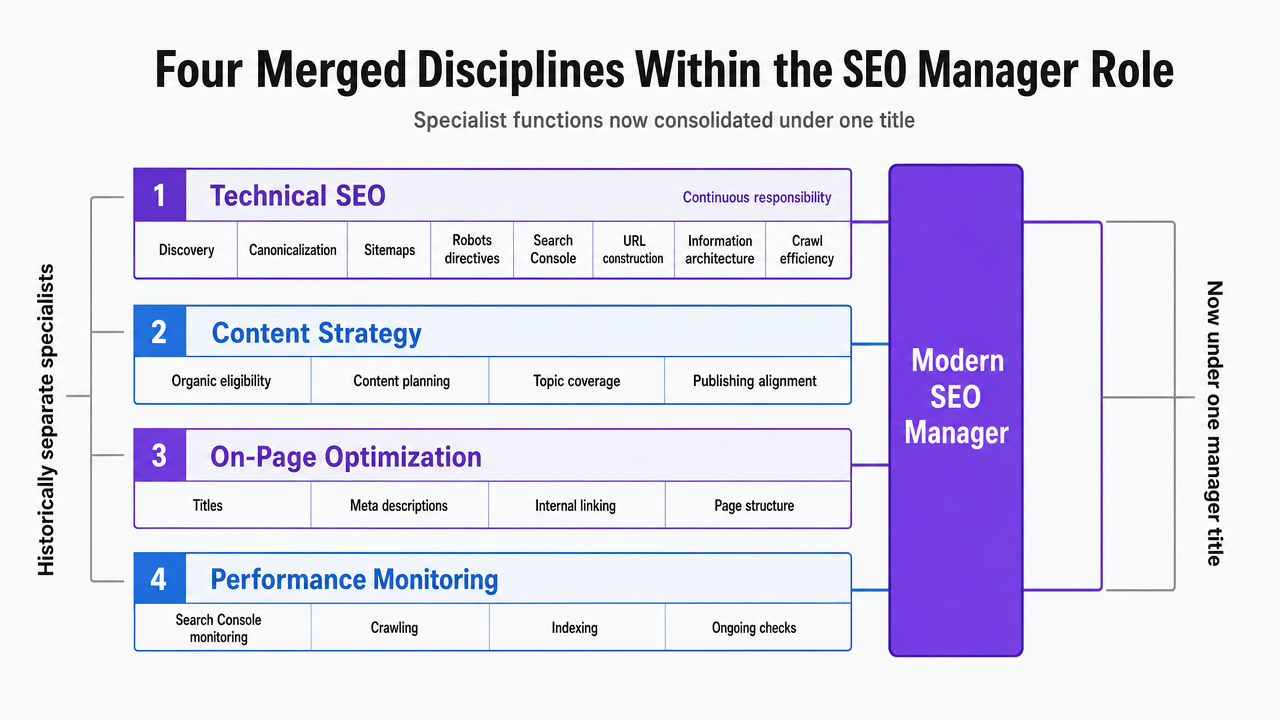 Visualize the four consolidated disciplines that now sit under the modern SEO manager title, directly supporting the section's core comparison framework
The 2026 Measurement Challenge: Search Console's Evolving Reporting
Reporting, once a stable aspect of the SEO role, is now subject to frequent changes.
Google's November 2025 announcement regarding the removal of support for certain structured data types from Search Console and its API, effective January 2026, significantly impacted reporting capabilities 11. Client dashboards relying on these endpoints ceased to function. Tracking rich result performance, previously available at the schema-type level, now requires data derivation from URL Inspection, the Rich Results Test, or third-party crawlers, none of which offer the same aggregation at the account level.
Operationally, this meant that managers overseeing multiple client accounts spent the initial weeks of 2026 rebuilding reporting templates instead of focusing on optimization. Quarterly business reviews that referenced rich result impressions required reformatting, and historical comparisons across the deprecation date became inconsistent without explicit methodological notes.
This specific event highlights a broader trend: Google's stated intention to simplify documentation and Search Console features 11means the reporting landscape is constantly shifting. The SEO manager is now responsible for identifying each change, adapting measurement stacks, and communicating these deltas to clients proactively.
These tasks are not typically included in standard SEO manager job descriptions. They represent unbudgeted maintenance work that directly competes with the strategic time agencies expect from their senior staff. Any scoping exercise in 2026 must include measurement-tooling adaptation as a standing line item, rather than an exception.
Test AI-driven SEO management workflows risk-free
Experience real-time SEO execution and content delivery for your client portfolio during your trial period.
Coordination vs. Craft: Optimizing Managerial Judgment
Auditing Scope Creep in the Modern SEO Manager Role
Not every task that has accumulated on the SEO manager's desk since 2018 is an appropriate use of their time. Some tasks are "craft," requiring specific judgment that cannot be delegated without loss of quality. Others are "coordination," involving routing, checking, and follow-up, which expanded as Google's documentation evolved faster than agency delivery structures. Differentiating between these two categories is a crucial audit often overlooked by delivery teams.
Craft tasks include:
- Topic selection aligned with a client's commercial intent
- Editorial arbitration when content ranks but underperforms in conversions
- Information architecture decisions for multi-location sites where URL structure must remain human-readable 3
- Interpreting Discover volatility spikes after core updates 10
- Resolving structured data disputes where the line between accurate and misleading markup is negotiated with developers 6, which requires the manager's expert judgment
Coordination tasks, where scope creep often hides, involve:
- Chasing developers for Core Web Vitals fixes 4
- Re-running Rich Results Tests after template changes 8
- Rebuilding client dashboards due to Search Console data deprecations 11
- Compiling monthly reports from multiple tools
- Writing briefs based on keyword lists
- Auditing internal links against sitemaps
None of these require senior judgment, yet they consume hours that senior managers were hired to dedicate to strategy.
An honest audit often reveals an inverted ratio, with managers on multi-client rosters spending the majority of their week on coordination and a minority on the craft decisions that truly impact account performance. The solution is structural, not motivational: identify repeatable coordination tasks—such as template changes, schema deployments, Discover fluctuations, or reporting refreshes—and reallocate them to avoid paying senior wages for their execution.
Approval Governance as a High-Leverage Skill
Once coordination work is separated from craft, the SEO manager's job description transforms. The most impactful skill becomes the ability to review, approve, and reject work efficiently and defensibly—shifting the focus from production to governance.
Google's structured data policy provides a clear example. While it permits JSON-LD, Microdata, or RDFa and prohibits misleading content markup 6, the actual schema can be templated or drafted by junior staff. However, a manager must review the output on a client's product page to ensure that price, availability, and review claims accurately reflect reality 7. This decision is a critical governance moment; an error can lead to the client losing rich result eligibility across an entire category.
This pattern extends across the role. Content briefs can be generated quickly, but the decision to publish them, considering a client's brand and legal position, requires careful consideration. Page experience reports can be automated, but prioritizing which fixes to escalate to engineering, especially when competing with a client's release calendar, demands managerial judgment 4. Similarly, while generative AI optimization passes can be drafted based on Google's May 2026 guidance 9, determining which claims a client can defensibly make in AI-surfaced answers is a human decision.
Agency leaders who view approval as mere overhead miss where true value lies. A manager who can review and approve twenty quality pieces of work in the time it previously took to produce three significantly increases delivery capacity. The key is to hire and develop for speed and defensibility of judgment, supported by workflows that surface critical decisions at the right moment. Other production tasks can be routed around the manager.
Delivery Economics: Multi-Client SEO Management
Understanding the Cost of Senior SEO Talent
For agency operators managing multi-client SEO delivery, the cost of the SEO manager role is a critical variable determining the viability of current staffing models.
There isn't a specific BLS occupation code for SEO managers. The closest benchmark is a marketing manager, a role many SEO leaders report to or are compared against. The U.S. Bureau of Labor Statistics reported a median annual wage of $166,790 for marketing managers in May 2025, with a projected 6% employment growth from 2025 to 2035 12. The salary range for this role is broad, with entry-level pay below the median and senior positions significantly above it. This explains why senior SEO managers in competitive markets often exceed the median, even with a mid-level job title.
When benefits, payroll taxes, tooling subscriptions, and management overhead are added, the fully-loaded annual cost of a single senior SEO manager typically ranges from 1.3x to 1.4x their base wage. This comprehensive cost must be distributed across an account roster to assess the sustainability of the current delivery model. This figure has quietly increased as the role's scope expanded, with Google's documentation adding workstreams faster than most agencies adjusted pay bands.
Accounts Per Manager Across Delivery Models
The ratio of accounts per manager, when considered against the fully-loaded cost of senior talent, clarifies the economics of different delivery models. Three primary configurations are common in agency rosters, and the account ratio each supports dictates whether retainers adequately cover the work.
The traditional specialist model assigns a senior SEO manager to 6 to 10 accounts. In this setup, the manager handles all aspects: keyword strategy, writer briefs, technical fix coordination, structured data review, Discover and AI-surface visibility monitoring, and reporting. Every workstream added by Google's documentation since 2018 falls directly on this individual. Based on the BLS senior-cost anchor of $166,790 12plus overhead, the per-account cost of manager time alone is substantial, even before accounting for production, tooling, or account management.
The pod model introduces one or two junior specialists under a senior manager, increasing the account ratio to approximately 12 to 18. The senior manager focuses on strategy and approvals, while juniors execute audits, briefs, schema drafts, and reporting refreshes. While this model reduces the per-account manager cost, it demands more supervision and a robust quality-control process. Pods become inefficient if the senior manager spends reclaimed time reviewing junior output instead of focusing on client-facing judgment.
The workflow-automated model leverages software to handle repeatable coordination tasks such as keyword brief generation, technical audits, schema validation, reporting refreshes, and competitor tracking. This allows the senior manager to concentrate almost entirely on approvals and critical judgment calls. Account ratios in this configuration commonly exceed 25, as the manager's time is dedicated to decisions surfaced by the workflow, rather than producing the underlying artifacts. AI marketing execution platforms, like Vectoron, offer category pricing around $599 per month per account, significantly altering the per-account variable cost compared to models relying on junior support.
These ratios are not rigid benchmarks but scoping frameworks. The key takeaway is that the account ratio determines whether senior wages are spent on senior-level work. Ratios below 10, without automation, typically indicate that managers are producing coordination artifacts rather than governing them.
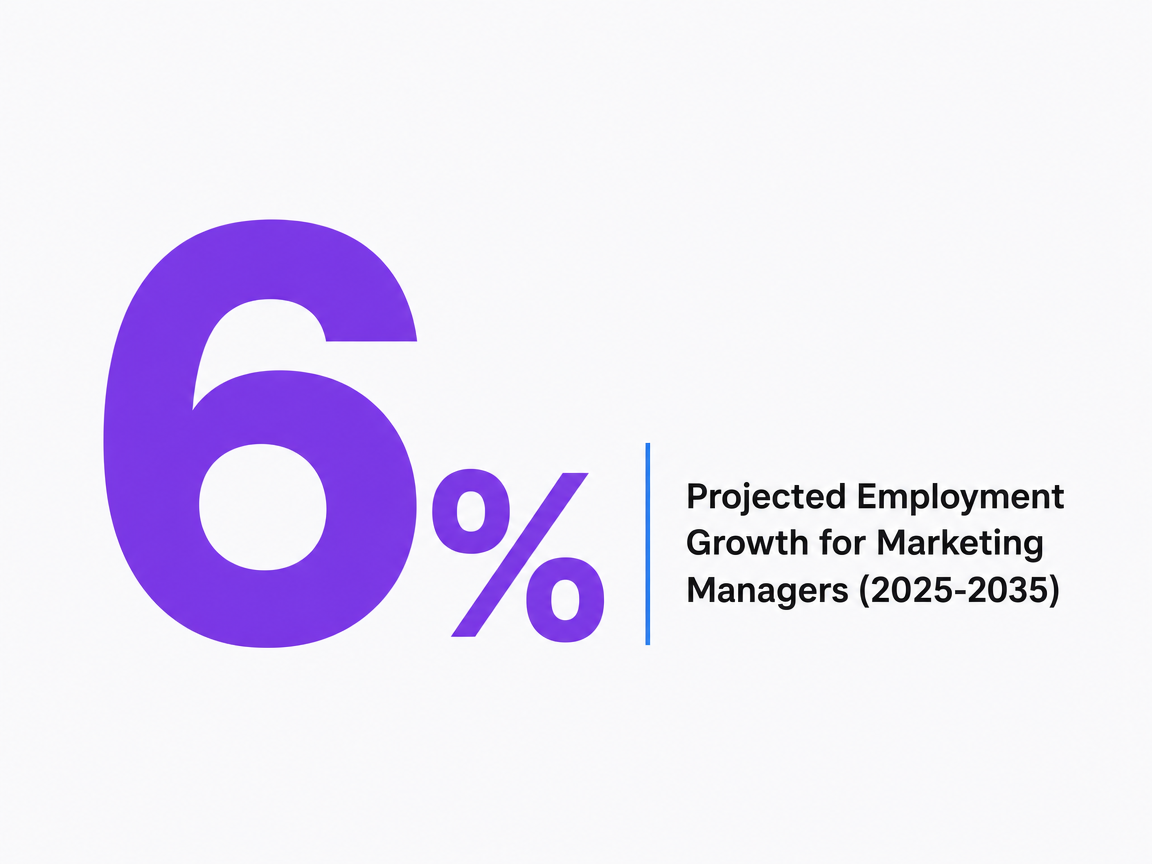 Projected Employment Growth for Marketing Managers (2025-2035)
Projected Employment Growth for Marketing Managers (2025-2035)
The Break Point: When Manual Coordination Fails to Scale
Every delivery model eventually reaches a point where manual coordination can no longer absorb new work without a decline in quality. Recognizing this break point is more valuable than rigidly defending a specific account ratio.
Consistent signals of this failure point appear across agency rosters:
- Reporting deadlines slip from the first to the second week of the month
- Structured data errors on client sites go unnoticed until rich results disappear
- A Discover volatility event after a core update 10takes days to diagnose due to lack of data access
- Content briefs use outdated keyword targets because research hasn't been refreshed
- Client inquiries about generative AI visibility 9are deferred
These are not individual performance failures but throughput failures. The manager is working diligently, but the volume of work exceeds the hours allocated by the retainer. When this pattern becomes widespread across accounts, agency operators face two choices: increase retainers to fund additional managers, or systematize coordination tasks to free up existing managers for judgment-based work. This is a pricing decision, not a talent decision, and it typically arises every 18 to 24 months due to evolving delivery economics.
See How Leading Agencies Automate SEO Management Without Sacrificing Oversight
Connect with our team to review data-driven workflows that streamline SEO manager responsibilities—enabling multi-client execution, measurable quality control, and full visibility at scale.
Systematization vs. Human Judgment in 2026
The audit in Section 3 distinguished between coordination and craft, and the delivery economics in Section 4 highlighted the break point for account ratios. Combining these insights leads to a clear operating principle for 2026: systematize repeatable tasks and protect the work that requires human judgment.
The list of systematizable tasks is often longer than agency leaders realize. This includes:
- Keyword brief generation based on a defined content model
- Technical audit runs after template changes or releases
- Schema drafting for product, article, or FAQ types where source data is structured 5
- Rich Results Test validation and URL Inspection checks post-schema deployment 8
- Reporting refreshes (including those necessitated by the January 2026 Search Console structured data deprecation 11)
- Discover volatility monitoring after core updates 10
- Initial passes at generative AI optimization based on Google's May 2026 guidance 9
- Internal link audits against a sitemap 3
While none of these require a senior manager to produce the artifact, all require their approval.
The list of tasks requiring human judgment is shorter but carries higher stakes. This includes:
- Editorial arbitration when content ranks but fails to convert
- Structured data policy decisions where markup accuracy is negotiated against client claims 6
- Page experience trade-offs when engineering fixes conflict with release calendars 4
- Information architecture for multi-location sites where URL logic must serve both crawlers and humans
- Client discussions about defensible claims in AI-surfaced answers
These are the critical moments for which managers are hired, and they are often the first to be squeezed when coordination tasks consume their time.
For agency leaders, the practical step is to explicitly define this boundary, in writing, for each account. Tasks below this line should flow through a workflow with the manager providing approval. Tasks above the line remain on the manager's desk, with protected time allocated for them. Category tools that route coordination work into an approval-first queue—including Vectoron's AI marketing execution platform—are designed to maintain this boundary under a multi-client load. This approach doesn't shrink the role; it elevates it to a higher-value position, aligning with the original intent of the retainer.
Frequently Asked Questions
References
- 1.Search Engine Optimization (SEO) Starter Guide.
- 2.Google Search Essentials (formerly Webmaster Guidelines).
- 3.Google Crawling and Indexing.
- 4.Understanding page experience in Google Search results.
- 5.Google Search Appearance | Google Search Central | Documentation | Google for Developers.
- 6.Linee guida generali sui dati strutturati | Google Search Central | Documentation | Google for Developers.
- 7.How shopping experiences... product structured data.
- 8.Dataset Structured Data | Google Search Central.
- 9.A new resource for optimizing for generative AI in ....
- 10.Google's February 2026 Discover Core Update.
- 11.Here's an update on our efforts to simplify the search ....
- 12.Advertising, Promotions, and Marketing Managers.
- 13.Marketing Managers.
- 14.Marketing Managers - Bureau of Labor Statistics.
- 15.Marketing Manager in Canada | Job prospects - Job Bank.
- 16.Marketing Managers - Bureau of Labor Statistics.