
Key Takeaways
- Program stagnation stems from weak vendor governance rather than vendor choice, so agencies need intake standards, quality rubrics, SLAs with remedies, and evidence trails to scale effectively.
- Fully loaded cost per placement, including supervised operational hours, determines client margin more than vendor invoices, and AI-supervised workflows shift the throughput ceiling from PM inbox capacity to approval-queue design.
- A vendor-ready brief must lock down target URLs, anchor plan, topical fence, disclosure posture, destination-page readiness, and the outcome metric each placement should influence, or SLA enforcement breaks down.
- An eight-criterion quality rubric scoring relevance, traffic evidence, and anchor discipline, paired with destination-page pre-flight checks on canonicals, redirects, and indexability, prevents wasted link equity before shipment.
- SLAs should specify rejection rights, thirty-day indexation guarantees, FTC-aligned disclosure warranties, pre-flight sign-off, and evidence packages tied to invoice approval, backed by weekly, monthly, and quarterly reporting.
- Consolidating FTC endorsement rules, Google spam policy, and vendor sourcing ethics into one compliance row on the QA rubric prevents conflicting placement-level policies and unpriced enforcement exposure.
- AI compresses prospecting, drafting, and first-pass QA scoring, but the workflow only holds up when artifacts, prompts, and approval gates are inventoried in line with the NIST AI RMF Playbook 12.
- Portfolio operators supervise five to ten times the campaign load without new headcount by using cross-client rubric dashboards and SLA scoreboards that focus human hours on exceptions rather than every queue item.
Why Vendor Governance — Not Vendor Selection — Is the Real Scaling Bottleneck
Agency owners often attribute program stagnation to vendors. However, the actual bottleneck is frequently the agency's approach to purchasing link placements. Many agencies acquire links based solely on unit price, domain rating (DR) range, and turnaround time, without establishing a measurement framework to track actual costs, operational hours, or impact on client outcomes. This lack of governance means that switching vendors typically yields similar results at a different price point.
This issue mirrors challenges in other sectors. For instance, a GAO review of the Postal Service's outsourcing program highlighted a lack of mechanisms to measure the effectiveness and results of outsourcing, recommending tracking actual costs and savings against defined outcomes 1. The Postal Service's disagreement with parts of these recommendations illustrates how internal convenience often overrides accountability when measurement infrastructure is absent. Link building programs often follow this pattern: placements are acquired, invoices paid, and reports forwarded, yet account teams struggle to quantify the supervised hours spent per placement or the long-term impact on target keywords.
Governance bridges this gap by establishing intake standards, a placement-level quality rubric, service level agreements (SLAs) with clear remedies, compliance evidence trails, and reporting that connects acquired links to measurable outcomes. Agencies that implement this governance layer can scale volume effectively with any competent vendor. Those that neglect it will find their capacity limited by a single project manager's inbox, regardless of their chosen supplier.
The Unit Economics of a Link Program at Scale
Cost Per Placement, Ops Hours, and Margin Per Client
The critical metric for scaling a link program is not merely the cost per placement, but the fully loaded cost per placement. This comprehensive figure includes prospecting time, outreach follow-ups, editor negotiation, destination-page quality assurance (QA), invoice reconciliation, and client reporting. Agencies that initially quote link programs based only on vendor invoices often discover the fully loaded cost is two to four times higher once project managers accurately track their hours over a quarter.
Client margin is determined by three controllable variables: retainer size, monthly placement commitments, and operational hours consumed per placement. Operational hours are frequently undefined by agencies. A ten-placement retainer requiring twelve supervised hours will have a significantly different margin profile than the same retainer consuming four hours, even if the vendor cost remains identical.
A practical tool for managing this is a per-client operating sheet with four key inputs: variable vendor cost per placement, variable supervised hours per placement, an agency-set blended internal hourly rate, and retainer-defined monthly placement volume. Gross margin ranges then become agency-set outputs, rather than external benchmarks. Maintaining this sheet for six months allows agencies to identify which clients are most profitable and which vendors disproportionately consume project management capacity without it appearing on an invoice.
Three Delivery Models Compared: In-House, Traditional White-Label, AI-Supervised White-Label
The market for link building is dominated by three delivery models, each with distinct unit economics. A fully in-house link team incurs fixed salary costs, benefits, tooling licenses, and management overhead, but centralizes institutional knowledge and provides the most robust evidence trail. A traditional white-label vendor externalizes variable costs but still imposes a significant project management burden on the agency for brief writing, vendor coordination, and QA. An AI-supervised white-label workflow retains the vendor layer but substantially reduces the project management burden by automating prospecting, draft generation, and initial QA scoring, with human approval points at critical decision stages.
The efficiency gains from the AI-supervised model are substantial. McKinsey research indicates that always-on, AI-orchestrated marketing can achieve up to a 30% reduction in cost-to-serve, a roughly 30% increase in marketing ROI, and a 5% to 8% revenue lift from AI-driven personalization in the operations studied 14. Agencies should view these figures as an aspirational benchmark for cost reduction in a well-instrumented AI-supervised link program, not a guaranteed outcome. These gains are realized only when approval gates, evidence capture, and vendor SLAs are already in place.
| Delivery model | Ops hours per client / month | Gross margin range | Throughput ceiling per PM | Compliance evidence produced |
|---|---|---|---|---|
| Fully in-house link team | Highest (variable, salaried) | Agency-set; capped by fixed overhead | Lowest; bounded by internal capacity | Full evidence trail, internally owned |
| Traditional white-label vendor | Moderate to high (variable, PM-bound) | Agency-set; PM tax compresses margin | Bounded by PM inbox throughput | Partial; depends on vendor reporting discipline |
| AI-supervised white-label workflow | Lowest (variable, gate-bound) | Agency-set; benchmark up to ~30% cost-to-serve reduction 14 | Highest; bounded by approval-queue design | Structured, timestamped, gate-anchored |
The throughput ceiling is the key factor determining scaling economics. A traditional white-label setup is limited by the volume a project manager can supervise before quality deteriorates, typically a few active clients. An AI-supervised workflow shifts this ceiling from individual PM capacity to the design of the approval queue, fundamentally altering the supervision capacity of a single operations lead.
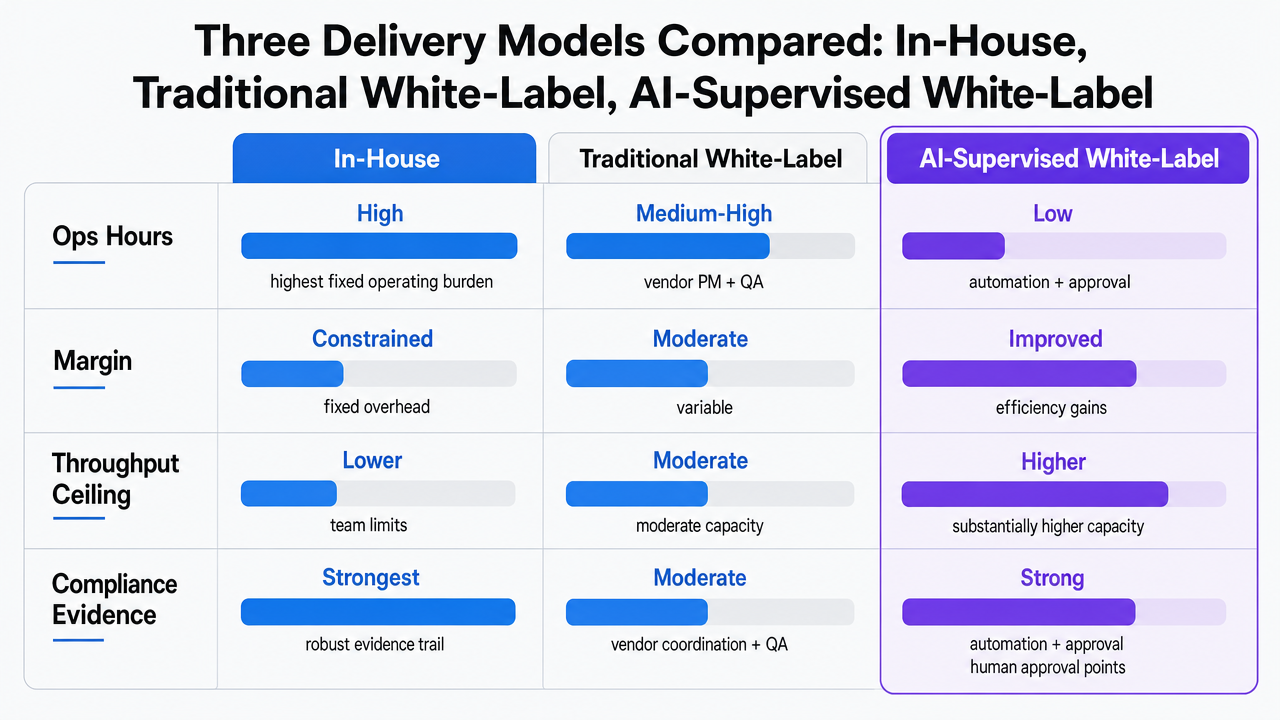 Visualize the comparison table of three delivery models across ops hours, margin, throughput ceiling, and compliance evidence to reinforce the section's operating-model comparison
Intake Standards: What a Vendor-Ready Client Brief Must Contain
A vendor-ready brief is more than a client questionnaire; it's a document enabling a white-label partner to deliver placements without constant project manager intervention. Agencies scaling link acquisition beyond a few accounts create a single, versioned brief per client, treating it as the authoritative source for all vendors.
Six critical fields carry most of the information load.
- The target URL set, including specific pages for links, current ranking positions, primary keywords, and secondary keywords.
- The anchor plan, detailing the distribution across branded, partial-match, exact-match, and generic anchors, prioritizing descriptive text over generic phrases for usability and spam policy compliance 6.
- The topical fence, defining in-scope and explicitly off-limits verticals, publications, and content angles due to reputational or regulatory concerns.
- A disclosure posture statement outlining how the client and agency handle sponsored, gifted, or compensated placements, in accordance with FTC guidance on material connections 9.
- A destination-page readiness confirmation, ensuring canonicals are resolved, redirect chains are single-hop, and target pages are indexable, adhering to technical hygiene rules for effective link equity transfer 3, 5.
- The specific outcome metric the placement aims to influence, such as ranking position, referral traffic threshold, or assisted conversions. Without this sixth field, enforcing vendor SLAs becomes impossible.
Test Scalable Link Building Workflows in Real Time
Experience hands-on white label link building with actual campaigns during your trial—no commitment required.
A Quality Audit Rubric for Every Placement
Referring Domain Relevance, Traffic Evidence, and Anchor Discipline
A quality rubric transforms link acquisition from a transactional storefront into a supervised production line. The account team should be able to evaluate any acquired placement against a consistent set of criteria, generating a numeric score that determines whether the link is approved, renegotiated, or rejected based on the vendor SLA. Without this scoring layer, quality tends to align with whatever is easiest for the vendor to source.
Three criteria are weighted most heavily. Referring domain relevance is scored against the client's topical fence; a placement on a general business publication scores lower than one on a niche, vertical-specific property targeting the client's audience. Traffic evidence is assessed based on organic visibility patterns, not vanity metrics like DR; a domain with flat traffic and a thin indexed footprint fails regardless of its authority score. Anchor discipline is evaluated against the intake brief's anchor plan, favoring descriptive text that identifies the destination over generic phrases like 'click here' or 'read more'—a standard also applied by federal agencies to their outbound links 6.
Additional criteria cover disclosure posture for sponsored or gifted placements, editorial context surrounding the link, the outbound-link neighborhood on the placement page, indexation status of the placing URL within thirty days, and destination-page health at the time of shipment. Each criterion results in a pass, fail, or conditional status. A placement clearing six out of eight criteria, with no failures on relevance or disclosure, typically meets the minimum defensible bar for client audits.
Destination-Page Pre-Flight: Canonicals, Redirects, and Crawlability
Link equity directed to a broken canonical, a chained redirect, or a page blocked from crawling yields the same result as if no link were acquired. Therefore, a pre-flight check must occur before a placement is approved for shipment, not after the report is issued.
Four items are essential for this checklist.
- The destination URL must resolve to itself as the canonical target, free from self-referencing conflicts, cross-domain canonicals, or inherited canonical stubs. Digital.gov's technical guidance emphasizes canonical links as the mechanism informing search engines of the authoritative page, noting that mismatches silently reroute acquired authority 3.
- The redirect chain must collapse to a single hop. CA.gov's web standards recommend flattening chains and view broken links as a quality signal that can devalue content and hinder indexing 5.
- The page must be indexable, meaning no stray noindex directives, no robots.txt blocks, and a valid entry in the XML sitemap registered with search consoles 4.
- The on-page anchor text and internal-link context around the target keyword should appear as descriptive editorial, not optimized template copy 6.
An operations lead should hold any placement that clears the eight-row rubric but fails the pre-flight destination-page checks.
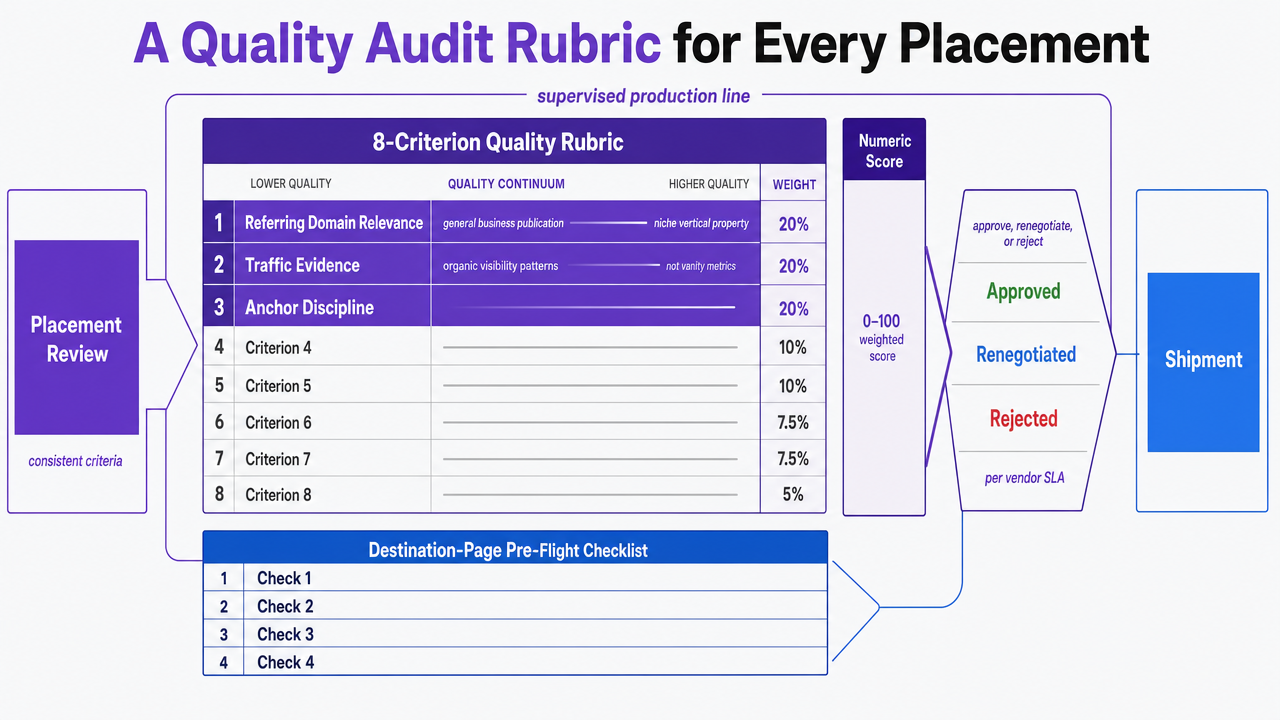 Visualize the eight-criterion quality rubric and the four-item destination-page pre-flight checklist as a governance framework that gates placements before shipment
SLA Framework and Reporting Cadence That Protect Client Trust
An SLA transforms a vendor relationship into a governed partnership. Without defined remedies, a missed placement is merely a discussion. With an SLA, it becomes a credit against the next invoice, a replacement placement aligned with the intake brief, or a justifiable termination clause. Agencies scaling white-label programs should incorporate three tiers of remedies: quality remedies for placements failing the audit rubric, timing remedies for missed shipment windows, and evidence remedies for reports lacking the documentation required for client audits.
Five terms are crucial for enforcement:
- Placement rejection rights tied to the eight-row rubric, with the vendor obligated to replace at no cost.
- Indexation guarantees, measured at thirty days, with credit for URLs that de-index.
- Disclosure warranties covering sponsored, gifted, or compensated placements, consistent with FTC material-connection standards 9.
- Destination-page pre-flight sign-off, preventing vendors from shipping to URLs flagged as unhealthy by the agency.
- An evidence package requirement—including screenshots, placement URLs, referring domain data, and disclosure status—must be delivered before invoice approval.
Reporting cadence should align with the SLA. Weekly operational reports should detail placements in progress, rubric scores, and pre-flight holds. Monthly client reports should connect shipped placements to the outcome metric specified in the intake brief—the sixth field often overlooked. Quarterly reviews complete the loop identified by the GAO: reconciling actual costs against actual outcomes, with auditable figures for the client 1.
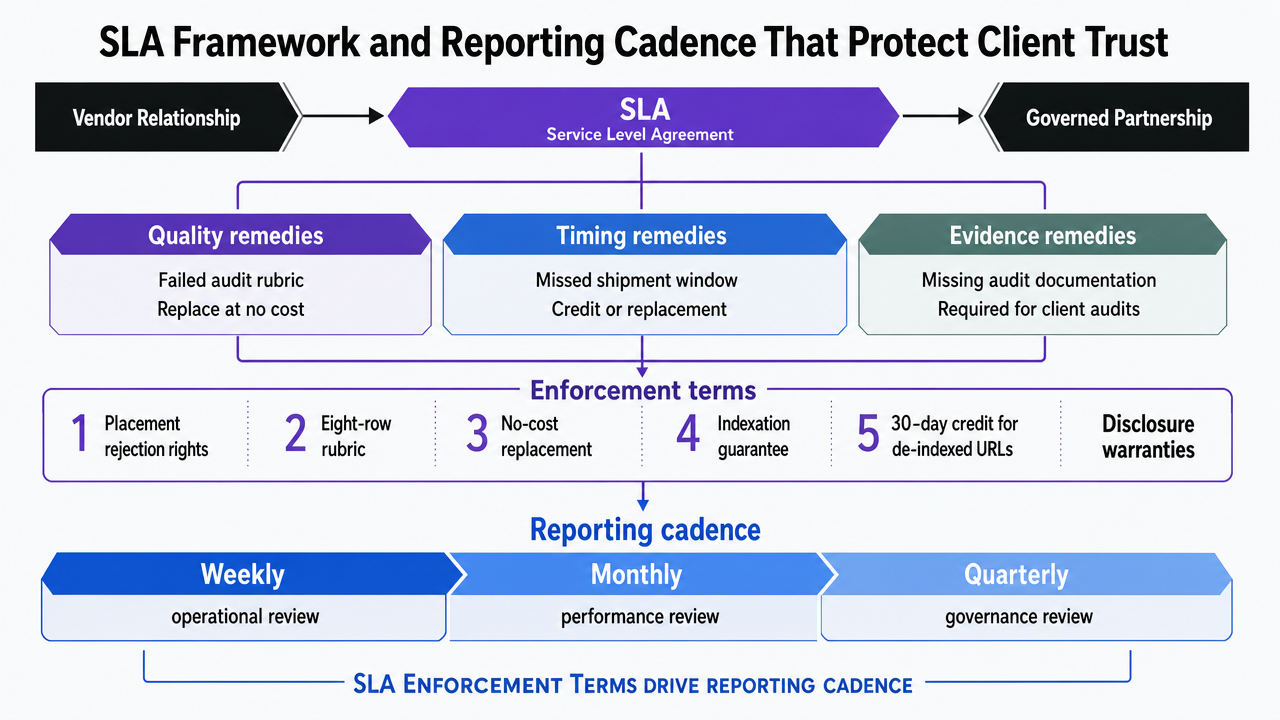 Show the SLA enforcement terms and the tiered weekly/monthly/quarterly reporting cadence as one governance flow supporting the section's operating plan
Consolidated Compliance: FTC Endorsement Rules and Google Spam Policy as One Layer
Compliance becomes fragmented when handled disparately. Agencies that treat FTC endorsement rules as a legal concern, Google spam policy as a technical SEO issue, and vendor sourcing ethics as an operations procurement matter often end up with conflicting policies at the placement level. A consolidated approach integrates all three into a single governance layer applied during intake, QA scoring, and shipment sign-off.
The FTC lens applies to three common white-label placement categories. Sponsored content and paid editorial placements require clear and conspicuous disclosure of the material connection, in language easily understood by consumers 9. Gifted product placements, comped access, and affiliate-style arrangements fall under the same standard; any significant, unexpected material connection influencing reader evaluation must be disclosed with the endorsement itself, not hidden in a footer or about page 11. Influencer and creator placements demand the most rigorous documentation: disclosures must be prominent, co-located with the endorsement, and expressed in simple, clear terms 10. Vendors shipping placements without proper disclosure metadata expose the agency's client to unpriced enforcement risks.
Practically, this consolidation means a single compliance row on the QA rubric addresses whether a placement's disclosure posture matches its material-connection profile. A standard editorial placement, with no consideration exchanged or relationship influencing coverage, clears this row without disclosure. Placements involving any form of consideration only clear with FTC-recognized disclosure. The operations lead managing this row doesn't need to litigate each boundary case, as the intake brief's disclosure posture field already provides the necessary guidance.
See How Leading Agencies Eliminate Link Building Overhead at Scale
Connect with specialists to benchmark your current link building workflow and discover data-backed methods for scaling white label SEO delivery—without increasing internal production costs or sacrificing reporting transparency.
The AI-Supervised Production Line: Where Hours Actually Come Out
Prospecting, Drafting, and QA Scoring Under Human Approval Gates
The time savings in an AI-supervised link program are not uniformly distributed but concentrated in three specific areas: prospect list construction, initial outreach draft creation, and the first pass of the eight-row QA rubric. Other critical tasks, such as vendor negotiation, nuanced disclosure judgments, and final sign-off on client-facing placements, remain human-controlled by design.
Prospecting is typically the most time-consuming task in a manual program. An operations lead who previously spent a full day per client building a filtered domain list—based on topical relevance, traffic patterns, outbound-link neighborhood, and past placement history—can now compress this to a review of a machine-generated list. Draft outreach sees similar compression: templates are generated based on the intake brief's disclosure posture and topical fence, allowing humans to focus on editing for tone and relationship context rather than composing from scratch. QA scoring operates similarly, with the system pre-scoring each candidate placement against the rubric, flagging failures, and routing the queue to human approval with evidence already attached.
This compression aligns with broader productivity trends in knowledge work. Generative AI is projected to add $2.6 trillion to $4.4 trillion in annual value across various use cases, with approximately 75% of this value concentrated in customer operations, marketing and sales, software engineering, and R&D 13. Link-building operations, being a knowledge-work function heavily reliant on repeatable prospecting, drafting, and scoring, are particularly well-suited for restructuring under AI supervision, provided human approval gates maintain quality.
Inventorying AI Use and Building Controls Into Outreach
AI supervision without proper inventorying is ineffective. An operations lead unable to identify which model drafted an outreach email, scored a placement, or approved an artifact cannot audit client complaints or address compliance inquiries. The NIST AI RMF Playbook emphasizes that inventorying AI use and layering controls are foundational, not optional, for managing AI risks across production workflows 12.
Three controls are particularly relevant in a link-building context.
- A log of every AI-generated artifact—outreach draft, QA score, prospect note—must be tied to the client, placement, and the approval decision.
- A prompt registry is needed to version the instructions driving each AI station, allowing any drift in outreach tone or QA scoring to be traced to a specific change made by the operations lead, rather than an opaque model behavior.
- An approval-gate schema should clearly define which decisions require human sign-off before an artifact is shipped and which are reversible enough to operate under a review-after rather than review-before rule.
The compliance surface that clients audit—disclosure posture, anchor discipline, placement evidence—is only defensible when the underlying AI use is inventoried at this granular level.
If You Manage Multiple Client Portfolios: Supervising 5–10x the Load Without Adding Headcount
This section addresses portfolio operators, such as heads of SEO overseeing multiple account pods or partner agencies managing sub-agencies that resell white-label capacity. At this scale, the economic dynamics and potential failure modes change significantly.
At a portfolio scale, increasing headcount is an inefficient lever. Adding a project manager for every five new clients merely replicates the PM-inbox ceiling inherent in the traditional white-label model. The effective lever is approval-queue design: how many client campaigns a single operations lead can supervise when prospecting, drafting, and QA scoring are pre-staged with evidence, and the human's role is compressed to signing off on critical placements and disclosure decisions. The GAO's framework on outsourcing effectiveness becomes even more pertinent here; a portfolio lacking a mechanism to measure actual costs and outcomes across accounts faces the same reporting risks as the Postal Service, but multiplied by the number of clients 1.
Two governance artifacts are essential for portfolio supervision. A cross-client rubric dashboard that highlights rejection rates, pre-flight holds, and disclosure exceptions by account allows the operations lead to identify drifting vendors or client briefs before monthly reports are issued. Additionally, a portfolio-level SLA scoreboard tracks indexation, replacement placements, and evidence-package delivery against contract terms across all active campaigns. Agencies implementing both can supervise five to ten times the campaign load that a manual PM structure limits, because human hours are focused on exceptions rather than every item in the queue.
Frequently Asked Questions
References
- 1.Data Needed to Assess the Effectiveness of Outsourcing.
- 2.Optimize your content.
- 3.Advanced search engine optimization.
- 4.An introduction to search.
- 5.Search engine optimization - Webstandards - CA.gov.
- 6.Web Standard: Link Text.
- 7.Introducción al SEO off page y al link building: tipología y usos en comunicación.
- 8.The state of AI in early 2024: Gen AI adoption spikes and the data dividend.
- 9.Endorsements, Influencers, and Reviews - Federal Trade Commission.
- 10.Disclosures 101 for Social Media Influencers.
- 11.FTC's Endorsement Guides: What People Are Asking.
- 12.NIST AI RMF Playbook.
- 13.The economic potential of generative AI: The next productivity frontier.
- 14.The future of marketing in the age of AI.