
Key Takeaways
- Ranking reports miss the real shift: on queries triggering AI Overviews, outbound organic clicks fell 39.8% while zero-click searches rose 34.5% 1.
- Citation is not a click. Clicks to sources cited within an overview happen in roughly 1% of sessions 2, so agencies need a separate visibility ledger alongside the click ledger.
- The accounting unit of delivery moves from URLs to answer units—extractable blocks with evidence, entity markers, and schema—that scale with query-set breadth rather than URL count.
- Fund three things next quarter: citation-share tooling across the portfolio, schema and extractability QA inside the brief, and a compliance QA pass for regulated accounts.
The Ranking-to-Answer Gap Reshaping Client Pipelines
Ranking reports often show stable positions and rising impressions, yet client pipelines tell a different story: fewer qualified sessions and lagging form fills. This discrepancy arises because Google now synthesizes answers above traditional search results. A randomized field experiment on AI Overviews revealed a 39.8% reduction in outbound organic clicks and a 34.5% increase in zero-click searches on queries where an overview appeared 1. This directly impacts informational and consideration-stage traffic, which historically fed client pipelines.
For SEO agencies, this means rank tracking now measures a diminishing portion of traffic that once converted. Being ranked and being the answer are distinct outcomes requiring different measurement strategies. The following sections explore the evidence for this shift, necessary reporting adjustments, and delivery model changes that enable teams to maintain client pipeline accountability without increasing headcount.
Causal Evidence: What Actually Changed on Triggered Queries
While many analyses of AI Overviews rely on correlational data, a randomized field experiment provides causal evidence of click loss. This study found that on queries triggering an AI Overview, outbound organic clicks decreased by 39.8%, and zero-click searches increased by 34.5% 1. The experimental design isolated the overview's effect by comparing the same query surface with and without it, eliminating confounding factors like seasonality or algorithm changes. Removing AI Overviews from the treatment group increased outbound clicks from 0.37 to 0.62 per search, indicating a 68% click increase when the overview was absent 1.
This evidence has two important caveats:
- First, the effect is measured only on queries where an AI Overview triggered. Agencies with a high volume of transactional or navigational queries will see a smaller overall impact compared to those focused on informational and consideration queries.
- Second, the study noted that the overview's placement matters, with the strongest suppression occurring when it appears at the top of the page. Categories where overviews are prominent will experience greater click loss.
In practical terms, for informational and comparison queries that historically generated middle-of-funnel leads, a ranked page now yields approximately six clicks for every ten it previously received, even if its position remains constant. Rank tracking still reports position, but the click volume has changed. This fundamental shift necessitates a re-evaluation of reporting frameworks and provides a clear explanation for clients whose rankings are stable but lead volumes are declining.
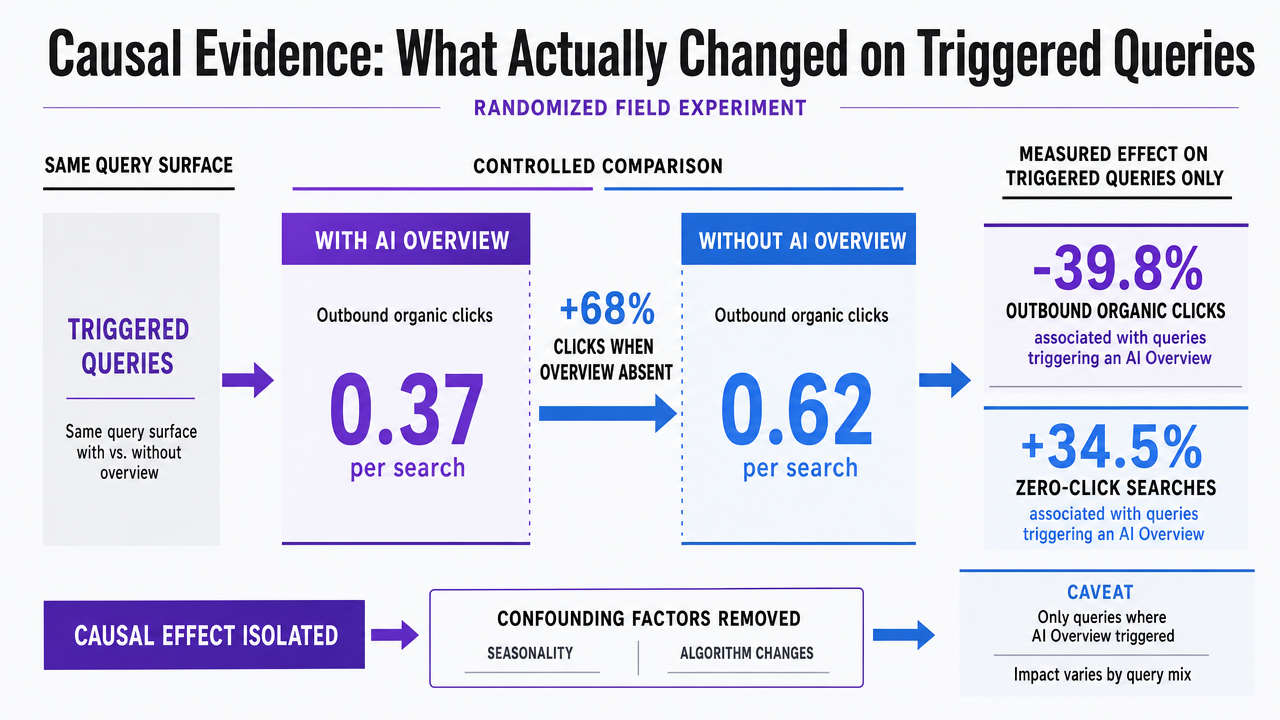 Visualize the causal click impact of AI Overviews on triggered queries, directly supporting the section's core statistics
Citation Is Not a Click: Why Reporting Frameworks Break
The assumption that brand exposure within AI Overviews compensates for click loss is not supported by evidence. A behavioral study found that clicks to sources cited within an overview occur in only about 1% of sessions where an overview appears 2. This low click-through rate from citations significantly impacts existing reporting frameworks.
Current position tracking tools cannot directly measure citations within AI Overviews. While Google Search Console (GSC) records impressions and clicks if a user navigates to the source, the citation event itself is not a distinct, measurable metric. Furthermore, citation share and click-through rates have become decoupled. A page can be frequently cited for a topic yet generate minimal attributable traffic from that surface.
For SEO agencies, this means client reporting requires two distinct ledgers:
- The click ledger continues to track sessions and their downstream conversions, which remain crucial for pipeline measurement.
- A separate visibility ledger must track whether client content is selected as source material, using metrics like citation share on target queries, entity mentions in synthesized answers, and overall coverage where overviews trigger.
These signals are directional indicators of brand presence in the answer layer, which increasingly resolves user searches.
This dual reporting framework allows for a more accurate diagnosis. A client with stable citation share but declining cited-page clicks is experiencing the inherent ~1% click rate from the answer layer 2. Conversely, a client with dropping citation share is losing visibility, regardless of rank positions. This distinction enables a more defensible conversation with CMOs, shifting the focus from rank screenshots to actual pipeline impact.
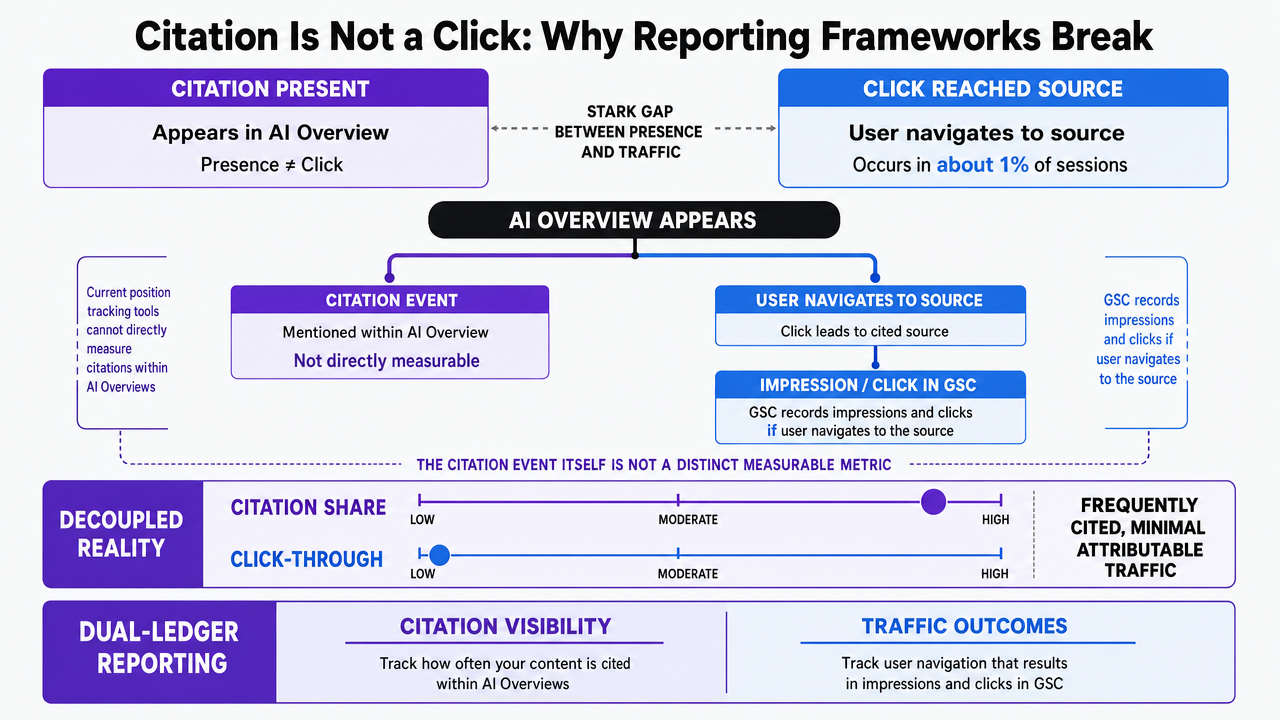 Illustrate the stark gap between citation presence and actual click-through, reinforcing the section's argument for dual-ledger reporting
Test AEO-driven content impact with live publishing
Experience measurable results from actual AEO-focused campaigns in your own client environments during the trial.
The Answer Unit: A New Accounting Unit for Delivery
Defining the Answer Unit
Traditional SEO delivery treats the URL as the primary unit of work. However, answer engines do not return pages; they extract fragments, synthesize information from multiple sources, and present the result directly to the user 15.
An answer unit is defined as the smallest self-contained fragment of a page that an answer engine can extract, cite, and reuse without losing its original meaning. It is distinct from an entire page or a featured snippet, though it shares characteristics with both. A single client page can contain multiple answer units, each addressing a specific question, independently extractable, and individually trackable for citation share.
This shift redefines the accounting object for SEO agencies. Briefs move from "what page do we need for this keyword cluster" to "what answer units should this page contain, and which queries should each resolve." Quality assurance (QA) extends beyond page-level review to include per-unit extractability checks. Reporting transitions from URL-by-URL position tracking to unit-by-unit citation presence. While the overall delivery volume may not increase, the granularity of what is delivered does, making workflows measurable against answer-engine outcomes rather than solely against rank tables.
Anatomy: Extractable Block, Evidence, Entity Markers, Schema
An answer unit comprises four key components, each contributing to its selection, citation, and accurate attribution by an answer engine.
The extractable block is the direct answer to a specific question, written concisely (one or two sentences) and placed where parsers can easily identify it. It must be self-contained, requiring no surrounding context for comprehension. Google's guidance on featured snippets highlights the importance of the descriptive snippet as the initial display, offering controls like nosnippet and max-snippet for publishers to manage extraction 3.
The evidence layer surrounds the extractable block, providing supporting data, scope, caveats, or comparisons. Answer engines increasingly favor completeness, aligning with Google's structured data policy that mandates original, accurate, and non-misleading content 5. An extractable block without supporting evidence may be overlooked in favor of more thoroughly supported sources.
Entity markers are named entities—people, organizations, places, or concepts—that enable the engine to link the answer unit to a knowledge graph. These markers facilitate attribution of the content fragment to a specific practice, firm, or expert, rather than a generic domain.
The schema layer is the machine-readable declaration of the unit's type. Google recommends validating markup via URL Inspection and comparing performance before and after implementation 4. For Answer Engine Optimization (AEO), schema makes the unit legible as a specific answer type, rather than an undifferentiated paragraph, and is a practical lever for agencies to implement across client accounts without extensive content rewrites. Answer engines prioritize consistent, precise, and reusable answers with supporting context 12.
Why Rank Position and Visibility Have Decoupled
Rank position indicates a page's placement within the blue links, while visibility now encompasses whether a page appears where users actually look—increasingly within the answer box above those links. Research reported by Search Engine Journal found that when an SGE box is expanded, the top organic result can drop by over 1,200 pixels on average 8. Position one still exists, but it's no longer position one on the screen.
This decoupling has two key implications for delivery:
- First, a page can maintain a top-three rank yet lose significant impression-to-attention conversion due to the expanded pixel real estate above it.
- Second, a page that never achieved a top-three rank can still appear as a cited source within the answer box, gaining visibility that traditional rank tracking cannot detect.
Answer units bridge this gap. A page structured with clean, well-attributed answer units can compete for selection within the answer layer independently of its URL's rank. While rank tracking retains diagnostic value for query coverage and crawl health, it is no longer the primary predictor of a client's brand presence when users consume search results. Citation share on the target query set fills this measurement void.
Portfolio Delivery Economics: Rank-First vs. Answer-First
The economics of scaled SEO delivery become inefficient when the unit of work no longer aligns with what search engines return. A rank-first agency typically structures its team around URLs:
- a strategist for keyword clusters,
- a writer for page content,
- a specialist for internal linking and schema, and
- an analyst for rank reports.
Scaling this model across many clients leads to proportional headcount growth. Answer-first delivery, by shifting the accounting object from URLs to answer units, reallocates specialist time and optimizes resource allocation.
The workflow differences are fundamental. As AI agents extract content fragments for synthesized responses 15, the QA process must move upstream to the extractable block itself, rather than just the published page. Schema becomes a per-unit specification integrated into the brief, not a post-launch task. Reporting evolves from monthly rank exports to citation-share readouts across entire client portfolios from a single query set. Each of these changes reduces handoffs, which are a primary driver of proportional hiring in rank-first agencies.
| Delivery variable | Rank-first workflow | Answer-first workflow |
|---|---|---|
| Unit of work | URL scoped to a keyword cluster | Answer unit scoped to a specific question |
| QA checkpoint | Page-level review at publish | Per-unit extractability check before publish |
| Schema role | Launch-week add-on | Written into the brief per unit |
| Reporting artifact | Monthly rank export by URL | Citation-share readout across query set |
| Primary success metric | Position and organic sessions | Citation presence and assisted conversions |
| Headcount implication | Scales with URL volume | Scales with query-set breadth, not URL count |
Structural comparison of rank-first vs. answer-first delivery models. Answer-first workflows treat the extractable fragment as the accounting object, in line with how AI platforms reuse content rather than link to it 15.
For agency leaders managing budget shifts, the portfolio-level impact is significant. Rank-first costs increase with URL volume, as each new page requires its own briefing, review, and reporting. Answer-first costs scale with the breadth of the query set a client aims to dominate; a single well-constructed page can contain multiple answer units addressing that set. Across numerous accounts, this translates to the difference between hiring additional specialists for every few new clients and accommodating growth with existing teams through improved templating.
However, answer-first delivery requires established templating, schema discipline, and citation-share tooling to realize its economic benefits. Agencies still relying on rank exports as their primary client deliverable will not achieve these efficiencies until their reporting infrastructure evolves. This sequencing is often underestimated by delivery leaders.
The Client Conversation: When Rankings Are Flat and Leads Are Down
When clients observe stable rankings but declining sales pipelines, the initial instinct to defend rank reports is often counterproductive. A more effective approach is to reframe what rank reports can measure in an environment where answers are increasingly resolved above traditional link lists.
A three-step communication strategy can be effective:
- Acknowledge the diagnostic gap: rank position tracks URL placement in blue links, but on queries triggering AI Overviews, blue-link clicks have changed. A randomized experiment showed outbound clicks fell from 0.62 to 0.37 per search when an overview was present 1. The page is still ranked, but its click volume has decreased.
- Differentiate between two key visibility questions: Is the brand still being selected as source material in the answer layer, and are the sessions that do arrive still converting? The first requires a citation-share readout for the target query set, not a rank export. The second necessitates reframing existing funnel analytics against a reduced top-of-funnel volume. Even if a page is cited in overviews, most of that impression will result in in-place resolution, as clicks to cited sources occur in approximately 1% of overview sessions 2. This is a characteristic of the search surface, not an execution failure.
- Proactively propose reporting changes. Integrate citation share, entity presence, and assisted conversions into monthly reports, while retaining rank tracking for crawl health and query coverage diagnostics. This approach concludes the conversation with a concrete deliverable rather than a defense of a static report, helping to preserve client accounts when CMOs evaluate agency performance.
See How Agencies Are Prioritizing Answer Engine Optimization for Measurable Impact
Request a data-driven assessment of your current AEO approach and discover frameworks agencies use to drive higher engagement, conversions, and channel-wide performance—without increasing operational overhead.
Regulated Verticals: Accuracy Risk as a Client Liability
For SEO agencies serving regulated industries like legal, healthcare, or financial services, the shift to answer engines introduces a new layer of liability. When a user clicks a ranked page, they read the client's controlled content. However, when an answer engine synthesizes a response and cites the client, the user reads the engine's paraphrase, which the client has not reviewed.
NIST's AI Risk Management Framework emphasizes managing validity, reliability, safety, and accountability risks in AI outputs 6. For regulated clients, these are tangible concerns. A healthcare provider's treatment scope language, if paraphrased, might lose crucial qualifying clauses. A law firm's jurisdictional caveats could be omitted during extraction, leading to attribution for advice it never provided. Google's structured data policy further reinforces this by requiring markup to be accurate, original, and non-misleading, placing the burden of extractable precision on the publisher 5.
Consequently, answer units in regulated accounts require a compliance QA pass that rank-first workflows typically lack. Extractable blocks must embed qualifiers, scope, jurisdiction, and disclaimers directly within the sentence, as surrounding context may be discarded. Agencies that frame this as an SEO problem, rather than solely a content review issue, can offer a specialized service that clients cannot easily insource, mitigating significant accuracy risks.
What Agency Leaders Should Fund Next Quarter
Budget allocation for the upcoming quarter should focus on three key areas, none of which necessitate new specialist hires. These investments will transition the delivery model towards an answer-first approach while preserving the value of existing rank-first efforts.
- Invest in a citation-share tooling layer capable of operating across an entire client portfolio from a single query set. Rank exports alone cannot detect whether client content is being selected as source material in synthesized answers. PwC highlights that AI agents extract and embed relevant fragments into responses rather than linking out 15. Without tools to measure this selection behavior, monthly reports will continue to track a metric representing a shrinking portion of the search landscape.
- Integrate a schema and extractability QA step directly into the briefing process, rather than as a post-launch add-on. Google's structured data guidance recommends validating markup via URL Inspection and comparing performance before and after implementation 4, transforming schema into a measurable, per-unit control.
- Implement a compliance QA pass for regulated accounts, ensuring that qualifiers are embedded within the extractable sentences.
Prioritize funding these three areas before considering additional headcount. Vectoron's approval-first workflow operationalizes this sequence across client portfolios without requiring proportional hiring.
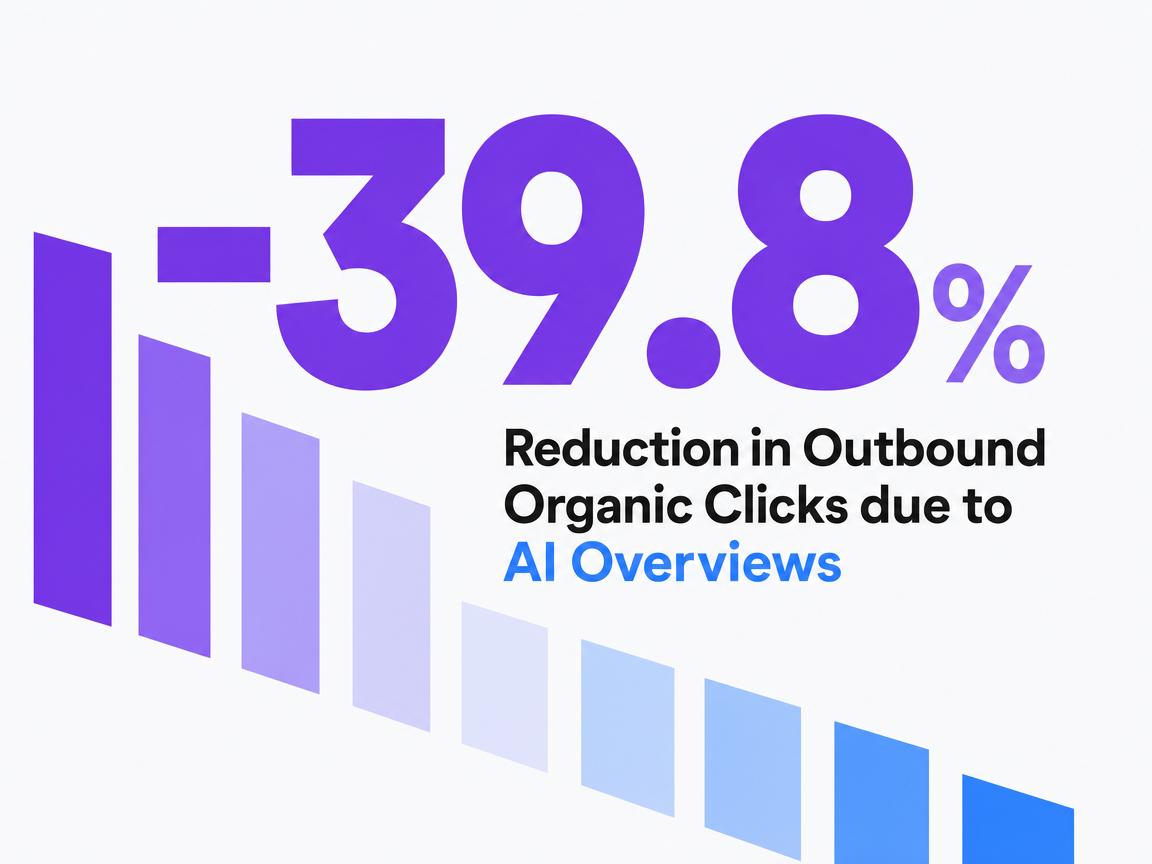 Reduction in Outbound Organic Clicks due to AI Overviews
Reduction in Outbound Organic Clicks due to AI Overviews
Frequently Asked Questions
References
- 1.The Impact of Google AI Overviews on Publisher Traffic and User Satisfaction.
- 2.Investigating Click Behaviors On Google Search Result Pages That Produce an AI Overview.
- 3.Featured Snippets and Your Website.
- 4.Introduction to structured data markup in Google Search.
- 5.General Structured Data Guidelines | Google Search Central.
- 6.AI Risk Management Framework.
- 7.SGE Impact on SEO: Changes, Risks and Playbook.
- 8.Google SGE: Study Reveals Potential Disruption For Brands & SEO.
- 9.Answer Engine Optimization (AEO): Reach the Zero-Click Searcher.
- 10.8 SGE SEO Tips for Google's Search Generative Experience.
- 11.What Is Google Search Generative Experience (SGE)?.
- 12.What Is Answer Engine Optimization (AEO)?.
- 13.How Google SGE Is Reshaping SEO in 2025.
- 14.Share of Internet Users Worldwide Using Generative AI Assistants for Online Search.
- 15.What is Answer Engine Optimisation?.