
Key Takeaways
- Wikipedia's nofollow citations still deliver value through citation-graph inclusion, high-intent referral traffic, and reference weighting in retrieval-augmented AI systems 17.
- Persistence depends on encyclopedic voice, high-impact-factor sourcing 14, and filling documented coverage gaps; evidence-based edits achieved a 91.7% retention rate across 24 health pages 19.
- Delivery scales when signal detection, source vetting, and monitoring are automated so specialists focus on drafting and edit proposals, holding portfolio retention at or above 80%.
- Prioritize health, behavioral health, dental, surgical, oncology-adjacent, legal, and financial verticals with informational SERP visibility; avoid local services, B2B software, and marketing-only content.
The Citation Graph Is the Real Asset, Not the Link
Wikipedia's outbound links carry rel="nofollow". The true asset an agency acquires when a client resource earns a Wikipedia citation is placement inside a citation graph that search engines, large language models, and human readers all consult for credible information. This graph is substantial; Wikipedia's English-language medical pages alone attract hundreds of millions of pageviews annually, with a core of editors maintaining the content 9. A review of 89 health studies confirmed Wikipedia's status as the most accessed online health resource, frequently topping Google results for medical queries 1. For biomedical topics, Wikipedia acts as a hub linking to primary databases like PubMed, not as a final destination 7.
For agencies working with YMYL clients, this hub position is crucial. A Wikipedia citation is not about link equity; it's about inclusion in a reference layer that systems, from Google's Knowledge Graph to AI models, recognize as a signal of topical authority 17. The focus shifts from "how many links can be placed" to "which client assets are citation-worthy enough to persist in that graph across a portfolio." This article explores Wikipedia engagement as a distribution and citation-authority strategy for agency delivery.
The Visibility Asset Agency Leads Actually Buy
SERP Real Estate on Reference Queries
Wikipedia frequently appears in the first ten search results for medical queries, often outranking official health portals 16. This pattern holds for reference-style queries across various health verticals 8. For agencies, this means a Wikipedia article in a top-three position for a definitional query places a client's cited asset directly in the user's discovery path, leveraging Wikipedia's existing ranking.
This visibility is strongest for definitional, procedural, and condition-name queries, aligning with informational content on client sites. Bottom-funnel queries ("cost of," "near me," "reviews") rarely surface Wikipedia results. Agencies should prioritize topics by checking SERP appearances for clients' top 50 informational queries. Verticals where Wikipedia appears on the first page for 20% or more of target keywords warrant effort; those where it appears rarely, such as most local service or B2B software categories, do not.
The Referral Traffic Nofollow Doesn't Block
While nofollow blocks PageRank, it doesn't block clicks. Analysis of medical Wikipedia pages shows readers routinely follow external references to primary sources, guidelines, and clinical resources 20. This behavior is reference-driven: users seek to verify claims, deepen understanding, or prepare for discussions with clinicians 20.
This transforms an "SEO-neutral" placement into a valuable referral channel. Traffic from Wikipedia is high-intent; users have invested time in an article and clicked through to verify a specific claim. This intent is reflected in session behavior on the destination page, with longer time on page, deeper scroll depth, and higher engagement with technical content compared to average organic traffic.
Agencies should track this traffic as a distinct channel, segmenting Wikipedia referrals in analytics. Key metrics include raw referral sessions per cited page and downstream conversion rates compared to unpaid organic traffic. In verticals with significant Wikipedia readership (health, law, finance), referral rates per placement are consistent and durable, as citations persist as long as the source remains credible.
The AI-Era Discovery Layer
Wikipedia is a heavily weighted source for large language models. Strategic engagement correlates with measurable gains in scientific visibility within AI-driven information tools 17. Content cited on Wikipedia is more likely to appear in the citation and grounding layer that retrieval-augmented systems use to answer user questions 17.
As AI Overviews, Perplexity, ChatGPT search, and Gemini increasingly intercept top-of-funnel queries, this becomes critical. A client asset cited on a high-traffic Wikipedia page enters the reference set these systems draw from for summaries or source recommendations. While it doesn't guarantee inclusion in every AI answer, it increases the probability of the client domain surfacing as a named source for relevant topics.
This complements conventional SEO measurement by adding a distribution surface largely invisible to standard rank tracking. Agencies monitoring share of voice in AI answers can use Wikipedia citation status as a leading indicator, as citation often precedes appearance in generated AI content.
Test Wikipedia backlink workflows before scaling agency-wide
Validate real backlink impact and workflow efficiency with live campaigns on your actual domains during the free trial.
What Survives Wikipedia's Editorial Filter
The Persistence Bar for Quality Contributions
A study where 98 physical therapy students edited 24 health-related Wikipedia pages with evidence-based content found that 22 of the 24 enhanced articles retained the student contributions, collectively drawing nearly 8 million pageviews 19. This 91.7% persistence rate is a key metric for agencies to consider.
This high persistence rate was achieved under specific conditions: contributors were trained in encyclopedic voice, edits were sourced against clinical evidence, and topics addressed documented gaps. Edits outside these conditions—promotional phrasing, thin sourcing, or citations to commercial domains without independent secondary coverage—are reverted at much higher rates by volunteer editors 9.
For portfolio delivery, Wikipedia engagement scales when each proposed edit is treated as a submission to a peer-reviewed reference. The 22-of-24 outcome demonstrates that genuinely encyclopedic contributions survive long enough to gain significant pageview exposure. When quality declines, retention collapses, and exposure is lost.
Agencies should track 30-day and 12-month retention for every proposed edit. A 12-month retention rate below 80% across a client cohort indicates issues with sourcing, drafting, or topic selection, signaling wasted effort.
The Evidentiary Threshold Client Content Must Clear
Wikipedia's scientific citations heavily favor journals with high impact factors, and medical pages increasingly mirror expert literature sourcing standards 14. This means client resources must function as secondary sources that a subject-matter editor would consult, not as marketing pages.
Three attributes ensure persistence:
- Independent verifiability. The claim on the client page must be independently verifiable from guidelines, peer-reviewed studies, or established reference works, with primary sources attributed on-page.
- Neutral tone. The tone must be neutral, avoiding comparative language or promotional framing that triggers removal under Wikipedia's conflict-of-interest and neutrality policies.
- Unique contribution. The resource must offer something Wikipedia lacks, such as a synthesized data table, a plain-language explanation of a technical process, a documented clinical workflow, or a regulatory summary that expands on existing coverage.
Content that meets these criteria also tends to become a durable asset in the citation graph feeding retrieval-augmented systems 17. Content that fails rarely survives Wikipedia's filter and seldom earns citations from other authoritative domains. The editorial standard and SEO outcome are thus aligned.
Where Documented Gaps Create Real Openings
The persistence rate of edits is highest where Wikipedia's coverage is thin, incomplete, or outdated. For example, mental health entries often lack information on treatment options and prognosis, creating gaps around evidence-based interventions 10. Agencies working with behavioral health clients can fill these with content like treatment protocol summaries or outcome benchmarks.
- Oral health entries show mixed quality, providing opportunities for dental clients with detailed procedure references 11.
- Surgical procedure entries are accurate but incomplete regarding risks and postoperative care 12, allowing providers with documented recovery protocols to contribute.
- Oncology entries, while initial orientation points, often lack depth 13, presenting leverage for oncology-adjacent services publishing rigorous treatment content.
Across these verticals, high-traffic pages exist with documented coverage weaknesses. Client-side content that could address these gaps often exists within YMYL portfolios but is rarely structured to Wikipedia's evidentiary standard. Solving this production problem determines the scalability of this channel.
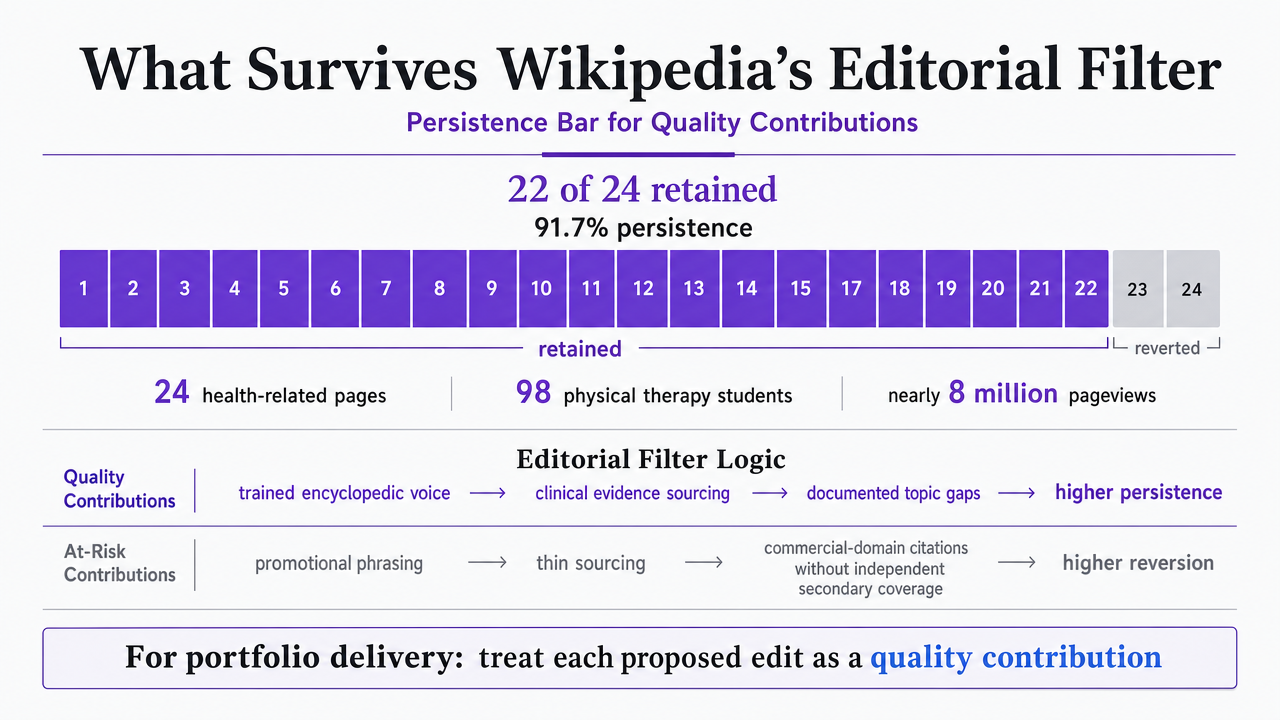 Visualize the persistence rate cited in the section prose from the physical therapy student editathon study
A Compliance-First Production Loop
Signal, Source, Draft, Propose, Monitor
Wikipedia engagement requires a repeatable pipeline with five stages, each producing an artifact that either advances or halts the effort.
- Signal. Identify Wikipedia articles ranking for client's priority informational queries and analyze their pageview trajectories. Wikipedia's open traffic logs and semantic link structure can reveal rising topical interest before conventional keyword tools 2. The output is a ranked list of candidate pages where the client could serve as a secondary source.
- Source. Vet client assets against Wikipedia's evidentiary bar, which favors scientific citations from high-impact-factor journals 14. The client resource must attribute primary sources, avoid promotional framing, and add specificity. Assets failing this check are flagged for rewriting or rejected.
- Draft. Write the proposed edit in an encyclopedic voice, integrating the client resource as a reference supporting a specific claim. Prepare an edit summary. Neutral tone and verifiable phrasing are crucial for volunteer editors 9.
- Propose. Submit through a disclosed account, adhering to Wikipedia's conflict-of-interest guidance. For substantial changes on high-traffic pages, use the talk page first.
- Monitor. Track 30-day and 12-month retention per edit, along with referral sessions from each cited placement 20. Retention below 80% across a cohort indicates issues in sourcing or drafting that require adjustment.
Using Pageview Data as a Portfolio Prioritization Signal
Wikipedia's public pageview data offers a free, longitudinal traffic dataset reflecting population-level interest. A systematic review of 29 studies confirmed pageview traffic as a valid proxy for information demand across health topics and seasonal patterns 15. Pageview spikes and semantic link structures can also indicate rising interest before search-volume tools 2.
For agencies managing content strategy, this data allows for ranking topics beyond keyword volume or business value. Pages with sustained high traffic and documented content gaps in the client's vertical can be prioritized. Pages with declining traffic or saturated coverage can be de-prioritized.
This workflow is easily operationalized: query the Wikimedia pageview API for 30-50 relevant articles per client, chart 12-month trends, and cross-reference with SERP rank and known content weaknesses. This provides a prioritization signal parallel to, not replacing, standard keyword research, and can be integrated into existing content planning without new reporting cycles.
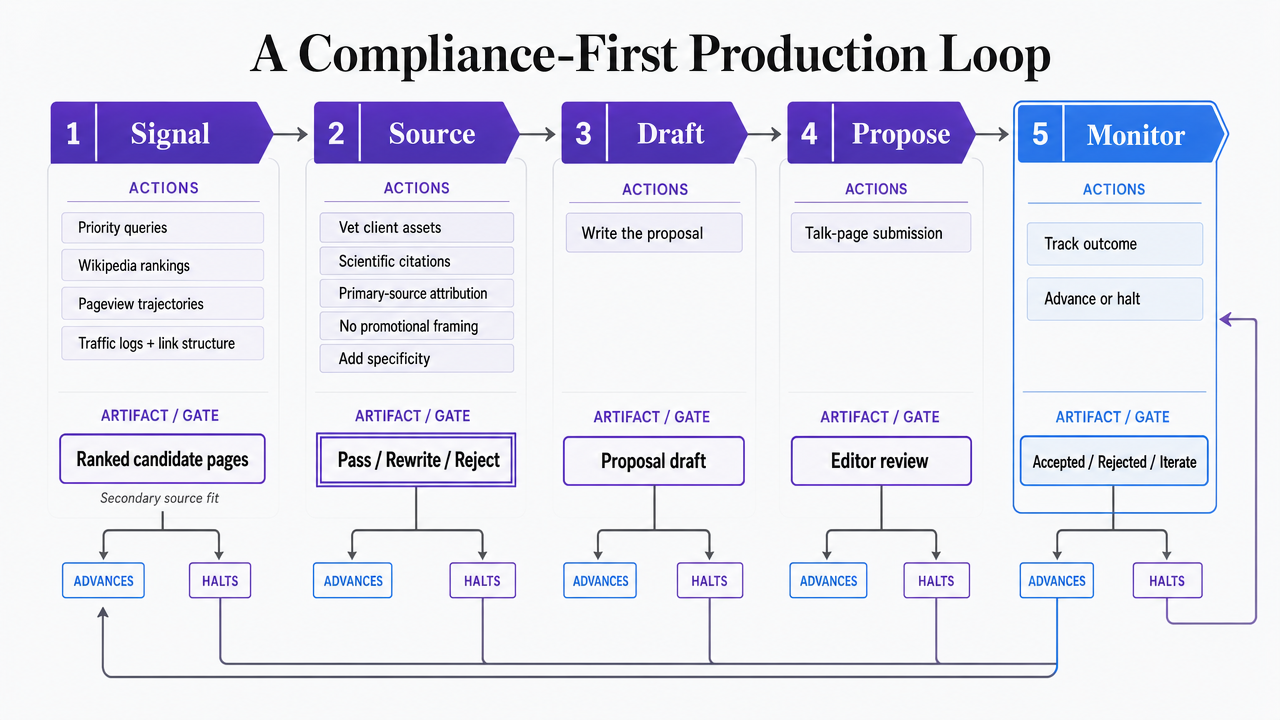 Visualize the five-stage production pipeline explicitly described in the section (Signal, Source, Draft, Propose, Monitor)
See How Agencies Scale Wikipedia Backlink Acquisition Without Compromising Quality
Request a walkthrough of workflow automation for systematic, approval-based Wikipedia backlink strategies—enabling teams to drive measurable authority gains at scale with audit-ready oversight.
If You Manage a Client Portfolio: Delivery Economics at Scale
For agencies managing Wikipedia work across multiple clients, the question is whether the effort scales linearly or compounds. Scaling occurs when signal detection, source vetting, and pageview monitoring are automated, allowing specialists to focus on drafting and edit proposals. It stalls if every stage is manual, as sourcing and monitoring can consume significant specialist hours without producing shippable content if client assets fail the evidentiary bar 14.
The economics can be modeled as a formula. For C clients, targeting P candidate pages per client, at a loaded specialist rate of R per hour, the two delivery models differ in hour allocation:
| Stage | Manual specialist model | AI-assisted, approval-gated model |
|---|---|---|
| Signal detection (SERP + pageview pull) | ~1.5 hrs × C × P | Automated; specialist reviews ranked output |
| Source vetting against evidentiary bar | ~2 hrs × C × P | Automated flagging; specialist confirms edge cases |
| Draft in encyclopedic voice | ~2 hrs × C × P | Draft generated; specialist edits and approves |
| Edit proposal and talk-page engagement | ~1 hr × C × P | Human-only; unchanged |
| 30-day and 12-month retention monitoring | ~0.5 hrs × C × P per cycle | Automated; specialist reviews exceptions |
Agencies can use their own C, P, and R values to model this shift. Wikipedia earns a permanent slot if automation-eligible stages are off the specialist's queue and portfolio retention remains at or above 80% 19. When both conditions are met, durable citation-graph placement is achieved at marginal cost per client. Failure in either condition leads to wasted effort at scale.
Where Wikipedia Engagement Earns a Slot, and Where It Doesn't
Wikipedia engagement is effective under three conditions:
- Sustained Wikipedia SERP visibility for informational queries,
- Client content that meets high-impact-factor sourcing standards 14, and
- Documented gaps in encyclopedia coverage that a secondary source can fill.
Health, behavioral health 10, dental 11, surgical 12, and oncology-adjacent services 13 typically meet these criteria. Legal, financial planning, and senior living services also qualify for definitional and regulatory topics, though with tighter topic selection due to thinner Wikipedia coverage and different editor patterns.
This channel is not suitable for local service businesses with transactional search demand, B2B software categories with sparse Wikipedia coverage, or clients whose content is marketing collateral rather than reference material. Forcing engagement in these contexts results in reverted edits and wasted specialist hours without citation-graph benefits.
Wikipedia is a targeted channel with compounding returns in specific verticals. Agencies that align conditions with their portfolio, follow the described pipeline, and maintain retention above 80% will see the citation-authority and referral effects that justify the effort. Otherwise, resources are better allocated elsewhere.
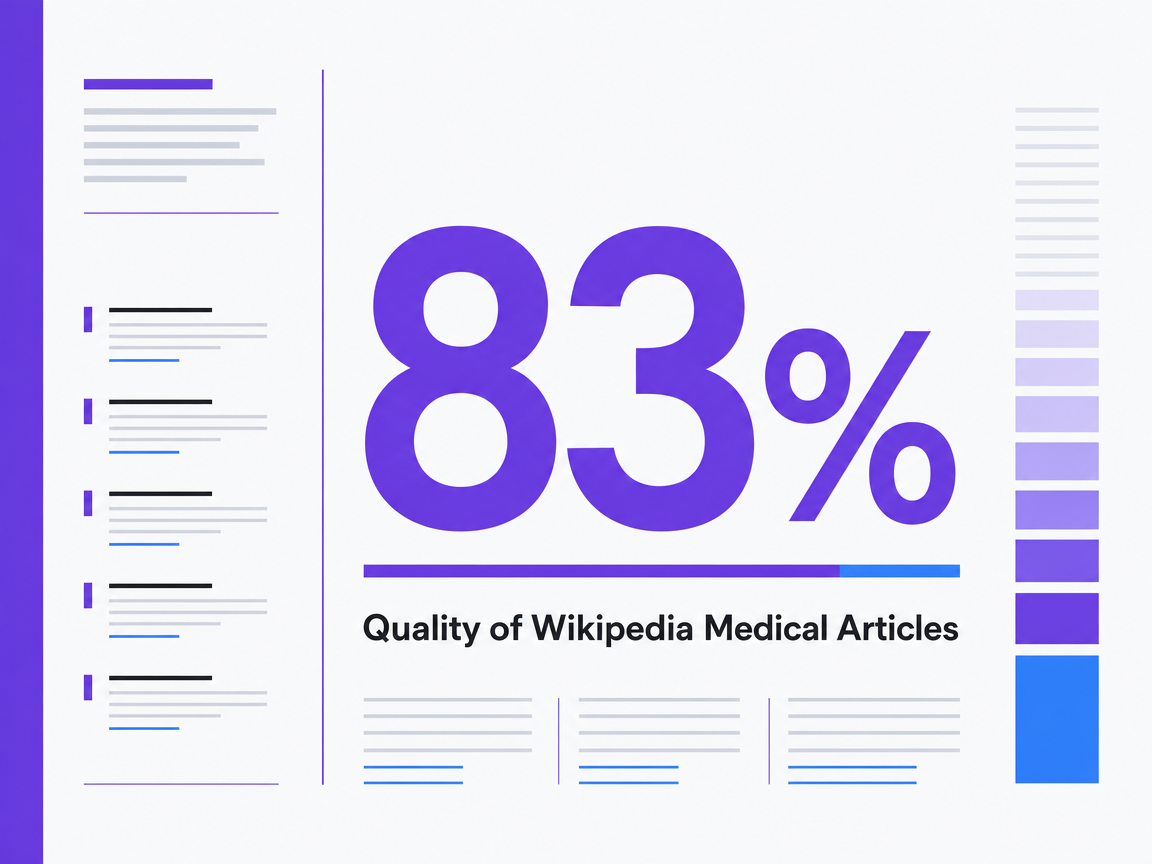 Quality of Wikipedia Medical Articles
Quality of Wikipedia Medical Articles
Frequently Asked Questions
References
- 1.Situating Wikipedia as a health information resource in various contexts: A scoping review.
- 2.The Detection of Emerging Trends Using Wikipedia Traffic Data and Search Engine Data.
- 3.Peer Review: An Introduction: Why not just use Google or Wikipedia?.
- 4.Web 2.0 and health information: An overview of current research on Wikipedia.
- 5.Assessing the quality of Wikipedia articles in medicine.
- 6.Wikipedia usage and quality for pharmacology information.
- 7.Wikipedia as a gateway to biomedical databases.
- 8.The use of social media and Wikipedia in public health communication.
- 9.Wikipedia and medicine: Quantifying readership, editors, and content quality.
- 10.Wikipedia and mental health: An analysis of the quality of information.
- 11.Wikipedia as a source of information on oral health.
- 12.Reliability of Wikipedia entries on surgical procedures.
- 13.The role of Wikipedia in information seeking about cancer.
- 14.Measuring the quality of scientific references in Wikipedia.
- 15.Wikipedia page views for health research: a review.
- 16.Seeking Health Information Online: Does Wikipedia Matter?.
- 17.Study Suggests That Strategic Wikipedia Engagement Enhances Scientific Visibility.
- 18.What's Wrong with Wikipedia? | Harvard Guide to Using Sources.
- 19.Improving the Quality of Consumer Health Information on Wikipedia: Case Series.
- 20.Reader engagement with medical content on Wikipedia.