
Key Takeaways
- SEO is being absorbed by AI unevenly: research, briefing, drafting, and on-page execution now run at machine speed, while positioning, proprietary data interpretation, and substantiation review stay human-bound.
- The visibility contract is shifting from ranking position to citation share inside answer engines, with McKinsey projecting AI search will influence hundreds of billions in revenue flows by 2028 3.
- Growth leaders running 3-15 person teams should restructure around two roles—policy owners who set agent boundaries and approver-analysts who govern outputs—rather than scaling production specialists.
- Reallocate budget from agency retainers toward orchestration systems, proprietary-data production, and citation-share measurement, and document substantiation, provenance, and approval controls aligned to NIST and FTC expectations 1, 9.
The uneven absorption problem facing growth leaders
The question SaaS growth leaders keep typing into search bars is the wrong one. "Will SEO be automated" assumes a single event horizon, a date when the function flips from human to machine. That framing is already obsolete. The honest picture is messier: specific layers of the SEO workflow are being absorbed by AI at very different speeds, and the gap between the fast-moving layers and the slow ones is where the next 24 months of competitive advantage gets decided.
Keyword clustering, brief generation, on-page optimization, internal linking suggestions, and first-draft production are already running at machine speed in well-instrumented teams. Positioning decisions, proprietary data interpretation, and answer-engine trust signals are not. McKinsey's 2025 enterprise survey found that revenue lift from AI is most commonly reported in marketing and sales, strategy, and corporate finance, with customer acquisition and personalization use cases leading the pack 8. That is not a forecast. It is a current operating reality at scaled deployers.
The strategic problem for a Head of Growth running a 3-15 person team is not whether to adopt AI. It is how to restructure the operating model when production capacity expands tenfold while judgment work stays human-bound. Treating SEO as one job that gets automated all at once produces the wrong headcount plan, the wrong retainer decisions, and the wrong budget allocation. Mapping it by layer produces a defensible one.
Mapping automation by workflow layer
What machines already own: research, briefing, on-page execution
The layers of the SEO workflow that have already crossed into machine-default territory share a common trait: they are pattern-matching tasks operating against well-structured inputs. Keyword clustering against Search Console exports, SERP intent classification, competitor gap extraction, brief generation from top-ranking pages, schema markup, meta description variants, internal linking suggestions, image alt text, and first-draft production from approved briefs all run faster and more consistently when handled by language models with retrieval grounding than by junior strategists working in spreadsheets.
This is not a fringe productivity claim. McKinsey's analysis of generative AI's economic potential places roughly 75% of the projected value across four functions—customer operations, marketing and sales, software engineering, and R&D—with marketing productivity gains estimated at 5 to 15 percent of total marketing spend 7. SEO sits inside the marketing and sales bucket, and the workflow layers above are precisely the use cases the report flags as ready for automated content, hyper-personalized outreach, and scaled campaign production.
What this means operationally: a single brief that took a strategist four hours to produce now resolves in minutes with a retrieval-grounded model reading the live SERP, the brand's existing content inventory, and the target query's entity graph. First drafts that consumed a full writing day arrive in the same window. On-page optimization, once a checklist task distributed across freelancers, runs as a continuous background process against the publishing CMS.
The growth leaders still routing this work through human-only pipelines are paying a tax that competitors have stopped paying. The layer is solved. The question is what gets built with the freed capacity.
What still resists: positioning, proprietary data, judgment calls
Three categories of work remain stubbornly human, and they are the categories that compound in value as the rest of the stack commoditizes.
The first is positioning. Deciding which category to compete in, which buyer pain to anchor on, which proof points to lead with, and which competitor to deliberately concede ground to involves reading market signals that are not in any training corpus. A model can write about a category. It cannot decide whether the category itself is the right hill to take. For SaaS growth leaders, that decision sits upstream of every keyword cluster and determines whether the downstream automation produces compounding pipeline or well-optimized irrelevance.
The second is proprietary data interpretation. Product usage telemetry, churn cohort analysis, win-loss interview synthesis, customer council insights, and pricing sensitivity tests are the raw material that turns generic content into the kind of analysis that earns citations from answer engines. Models can summarize structured data, but the act of deciding which proprietary signal deserves a public artifact, and what argument it supports, is judgment work tied to the company's specific position in its market.
The third is the approval surface. Substantiation review, legal sign-off on claims, executive-level messaging calls, and decisions about which experiments to kill remain human because the accountability cannot be delegated to a system that cannot be deposed. Deloitte's 2026 enterprise report notes that as AI gets embedded across workflows, governance and human oversight become more important, not less 4. The work shifts shape. It does not disappear.
Agentic systems and the move from drafting to orchestration
The next absorption wave is not about better drafts. It is about agents that string the drafting, publishing, monitoring, and re-optimization steps into a continuous loop without a human picking up each handoff.
Deloitte's Tech Trends analysis describes the shift from large language models to large action models—systems that go "beyond the question-and-answer capabilities of LLMs" to complete discrete tasks in the real world, including complex digital workflows 10. Applied to SEO, that means an agent that detects a ranking drop in Search Console, pulls the current SERP, identifies the intent shift, drafts the revised section, queues it for human approval, publishes the change, and watches the impression curve—without a strategist orchestrating the sequence.
This changes what the SEO function looks like inside a growth org. The unit of work moves from "produce an article" to "maintain visibility on a topic cluster." The human role moves from executing each step to defining the boundaries the agent operates within: which claims require sourcing, which page templates are eligible for autonomous revision, which thresholds trigger escalation, and which experiments are off-limits.
For a Head of Growth, this reframes the headcount question. The team does not need more people who can write a brief or audit a page. It needs people who can specify the policies an agentic system runs against and approve the outputs that result. The orchestration layer is where the next two years of competitive separation gets built.
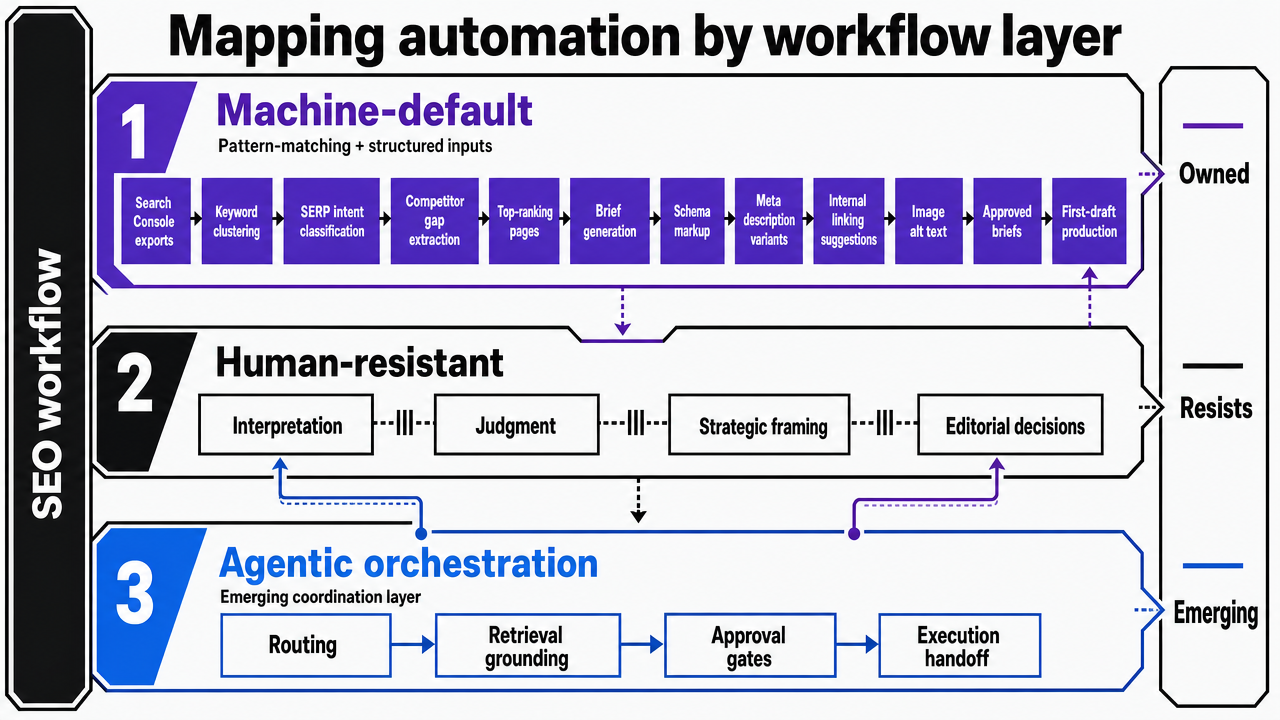 Visualize the three-tier framework of SEO workflow layers by automation status, directly supporting the section's structural argument about which layers machines own, which resist, and which are emerging via agentic orchestration
The demand-side shift: AI search rewires the visibility contract
Automation on the production side is only half the story. The other half is that the buyer no longer lands where SEO teams have spent a decade optimizing. McKinsey's recent consumer work found that half of consumers polled now intentionally seek out AI-powered search engines, and the firm projects AI search will influence hundreds of billions of dollars in revenue flows by 2028 3. The poll measured stated intent across general consumer respondents, not a niche early-adopter cohort, which is what makes the figure operationally relevant for B2B SaaS growth leaders watching their own pipeline mix.
What changes when a meaningful share of discovery happens inside an answer engine rather than a ten-blue-links page is the unit of visibility. Ranking position becomes less interesting than citation share. A page that holds position three on Google but never gets surfaced as a source inside ChatGPT, Perplexity, or Google's AI Overviews has lost the asset it was built to produce: a click from a buyer in active evaluation. The visibility contract is no longer "rank for the query." It is "get cited when the model answers the query."
That reframes which parts of the SEO workflow matter most. Brief generation and on-page execution still ship the page, but the determinants of whether a model trusts and reuses that page sit further upstream: entity clarity, source authority, structured data fidelity, original data the model cannot find elsewhere, and citation patterns from sites the model already weights. McKinsey's analysis flags this as a distinct capability that leading companies are building as its own discipline rather than a bolt-on to classic SEO 3.
For a Head of Growth, the practical consequence is that the production layer being automated is the cheaper problem. The harder problem is auditing which queries in the pipeline-relevant set are already being answered by AI interfaces, what share of those answers cite the company's content, and what proprietary assets would have to exist for citation share to compound. That audit is not a tooling decision. It is a measurement framework that has to be built before the automated production stack has anything worth optimizing toward.
Experience Automated SEO Execution in Real Time
Test AI-driven SEO automation on live campaigns and measure impact on your growth metrics before you commit.
Where AI revenue uplift is actually showing up
The skepticism Heads of Growth bring to AI productivity claims is well earned. Pilot decks promise revenue. Production rarely delivers it. The 2025 and 2026 enterprise data sets cut through that noise in a specific way: they show where the uplift is being reported by operators who have moved past pilots, and the answer is not evenly distributed across the org chart.
Deloitte's 2026 State of AI in the Enterprise report finds that worker access to AI rose by 50% in 2025, with organizations increasingly expecting AI to be embedded across workflows rather than confined to isolated experiments 4. That access growth matters because it is the operational precondition for revenue impact. A function cannot show pipeline lift from AI until the people running the function actually have the tools in their daily workflow. The Deloitte survey, which spans enterprises across geographies and industries, captures the year when that precondition became default rather than exceptional.
The revenue signal sits in a parallel data set. McKinsey's 2025 global AI survey, which polled organizations across industries on where AI was producing measurable financial outcomes, found that revenue increases from AI were most commonly reported in marketing and sales, strategy, and corporate finance, with the strongest uplift concentrated in customer acquisition, personalization, and pricing use cases 8. Marketing and sales led the list. That is not a forecast about future SEO ROI. It is a current report from the functions where AI has been embedded long enough to show on the P&L.
Read together, the two data points reframe the headcount conversation. The growth leaders reporting revenue uplift are not the ones running parallel human and AI pipelines. They are the ones who restructured the function so that the embedded layer does the production work and the human team concentrates on the acquisition, personalization, and pricing decisions where the lift actually shows up.
Restructuring the growth operating model around uneven automation
Headcount and role redesign when 70% of production is machine-executed
When research, briefing, drafting, and on-page execution all collapse from days to minutes, the org chart that produced them stops making sense. A team built to ship twelve briefs a month at three strategist-days each has the wrong unit of measurement once a retrieval-grounded model produces those briefs in an afternoon. The bottleneck moves. Headcount logic has to move with it.
The redesign that holds up under scrutiny replaces production specialists with two role types. The first is the policy owner: a senior strategist who defines the standards an agentic system runs against—claim substantiation requirements, on-brand language constraints, eligible page templates for autonomous revision, and escalation thresholds. Deloitte's Tech Trends analysis describes large action models as systems that complete discrete tasks across digital workflows rather than answering single queries 10, which means someone has to write the rules of engagement those systems execute against. That is not a junior task.
The second role is the approver-analyst, a hybrid who reviews machine outputs against the policy, interprets proprietary data for the assets the system cannot generate from public sources, and runs the measurement framework that tracks citation share inside answer engines alongside classic rankings. One approver-analyst can supervise the output of a production stack that previously required three to four humans.
The net effect for a 3-15 person growth team is fewer SEO specialists, more senior judgment, and a flatter structure where the layer between the Head of Growth and the work disappears.
Budget reallocation: retainers, tooling, and the proprietary-data layer
The budget line that used to fund a content agency retainer and a freelance bench is the line under the most pressure. Production is no longer where dollars compound. McKinsey's 2025 enterprise survey reported that AI-driven revenue uplift concentrates in customer acquisition, personalization, and pricing use cases inside marketing and sales 8, none of which are agency-retainer outputs. Retainers buy briefs and drafts. The lift sits elsewhere.
A defensible reallocation moves spend in three directions. The first is into the orchestration stack itself—the agentic systems that absorb research through publishing and the human approval surface that governs them. This is operating expense, not project spend, and it scales with sites and topics rather than with article count.
The second is into the proprietary-data layer. Customer research operations, win-loss interview programs, product telemetry analysis, and original benchmark studies are what produce the assets answer engines cite and competitors cannot reproduce. Dollars that previously funded twenty generic blog posts a month produce more pipeline when they fund two original data artifacts and let the orchestration layer multiply them into surface area.
The third is into measurement. Citation tracking inside AI interfaces, share-of-answer audits, and attribution that connects answer-engine visibility to pipeline are not standard line items yet. They will be. Growth leaders building those measurement budgets in 2025 are the ones who can defend the reallocation when the board asks what replaced the retainer.
If growth leaders manage multiple sites: consolidation economics
This section narrows to a specific operator: growth leaders running more than one site, product surface, or acquired brand under a single P&L. Single-site SaaS teams can ignore most of what follows. The economics that follow only compound when there are multiple properties drawing from the same content engine, the same authority signals, and the same measurement framework.
The traditional model bills production per property. Each site gets its own retainer, its own brief queue, its own freelance bench, and its own monthly minimum. Two acquired brands and a regional landing-page footprint produce three contracts, three account managers, and three sets of coordination overhead. The retainer dollar is a variable each growth leader knows from their own invoices—plug in the actual monthly figure across all properties to get the comparison baseline.
An AI-native production stack inverts the unit of cost. The orchestration layer runs at the account level, not the property level, which means adding a fourth site or a newly acquired brand does not require a fourth retainer.
| Cost driver | Traditional retainer model | AI-native production ($599/mo post-trial anchor) |
|---|---|---|
| Billing unit | Per site or per location | Per account, all properties included |
| Adding a new brand or site | New retainer, new account manager | Configuration change, no new contract |
| Monthly fixed cost | Sum of all property retainers (variable—plug in actual) | $599 anchor regardless of property count |
| Coordination overhead | Multiple account teams, scattered reporting | Single approval surface, unified measurement |
The math gets interesting at three properties and decisive at five. McKinsey's 2025 survey reported revenue uplift concentrating in marketing and sales use cases where AI is embedded across the function rather than bolted onto individual campaigns 8. Multi-property growth leaders are the operators best positioned to capture that uplift, because the orchestration cost amortizes across every site under the same account.
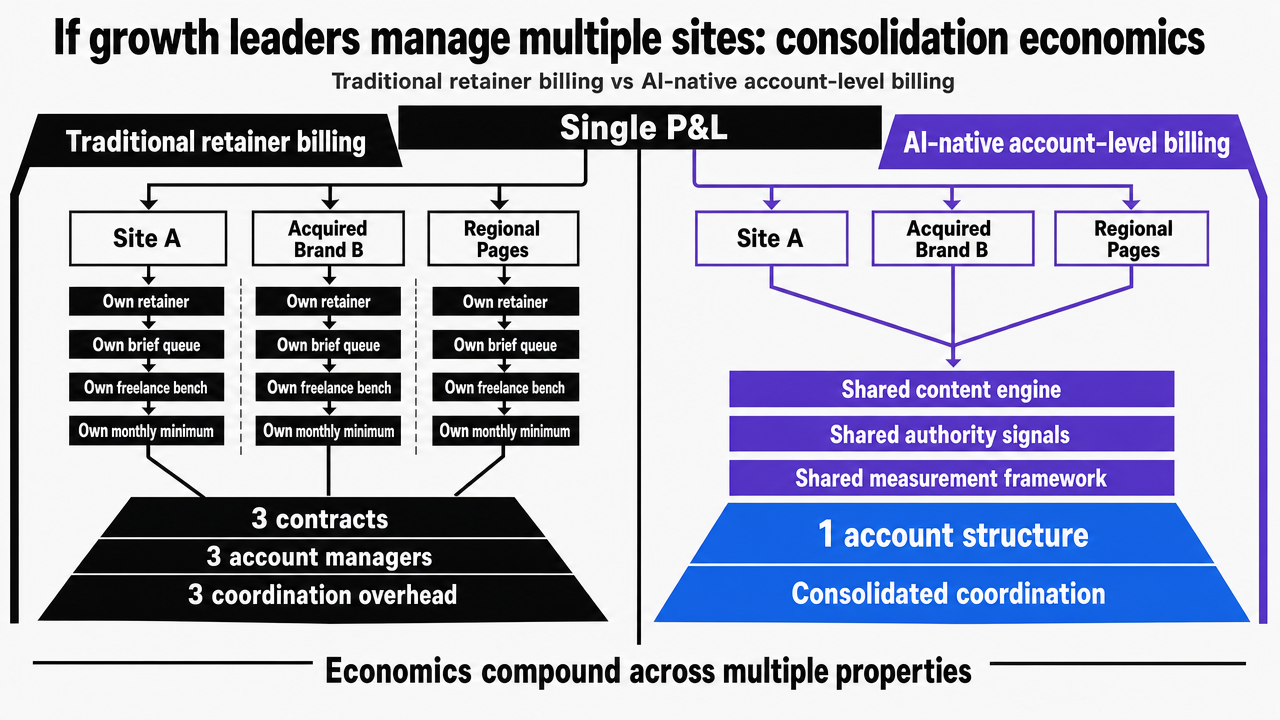 Render the in-article comparison table as a clearer side-by-side process infographic contrasting traditional retainer billing versus AI-native account-level billing across multiple properties, reinforcing the section's consolidation economics argument
See How AI-Driven SEO Automation Reshapes Multi-Location Marketing Efficiency
Request a walkthrough of automated SEO workflows that unify strategy, content, and execution—purpose-built for scaling campaigns across complex account structures without additional management overhead.
Governance, substantiation, and the board-level questions
Every Head of Growth scaling AI-driven SEO eventually fields the same boardroom question: what stops this from becoming a liability. The answer that holds up is not a slide deck about responsible AI. It is a documented control set tied to specific frameworks the board's auditors already recognize.
Three threads run through the questions worth preparing for. The first is substantiation. The FTC's 2024 enforcement sweep, branded Operation AI Comply, targeted companies making unsupported AI claims, including one scheme that allegedly defrauded consumers of at least $25 million through false earnings promises tied to AI tools 1. The signal for growth teams publishing AI-generated content at volume is direct: any performance, outcome, or capability claim in that content needs the same substantiation file a human-written claim would carry. The production layer changed. The evidence standard did not.
The second is provenance and pre-deployment testing. NIST's AI Risk Management Framework establishes the trustworthy-AI vocabulary auditors are starting to use—valid, reliable, accountable, transparent, explainable 2—and the companion Generative AI Profile names the specific risk areas that apply to content production at scale: governance structures, content provenance tracking, pre-deployment testing of generative outputs, and ongoing monitoring 9. A growth org that can point to how each of these is operationalized inside its publishing workflow has answered most of the audit committee's questions before they are asked.
The third is accountability. The approval surface is where governance becomes real. Who signed off on the claim, against which substantiation file, under which policy, on what date—this is the record that turns an agentic publishing stack from a risk into a defensible operating asset.
What to act on in the next 12-24 months
Three moves separate the growth leaders who compound through this transition from the ones who get caught flat-footed. None of them are tooling decisions.
- A layer-by-layer automation audit of the existing SEO workflow, ending with a written policy for which layers run autonomously, which require human approval, and which stay fully human. Without that policy, agentic systems have nothing to execute against, and headcount decisions get made on instinct rather than evidence.
- A measurement framework that tracks citation share inside answer engines alongside classic rankings. McKinsey's analysis flags AI search optimization as a distinct discipline leading companies are building separately from classic SEO 3. Growth leaders without that measurement cannot defend the budget shift from retainers to orchestration and proprietary-data investment.
- A proprietary-data production calendar—original research, win-loss synthesis, benchmark studies, product telemetry artifacts—built on a cadence the orchestration layer can multiply. The production layer is solved. What gets produced is the remaining strategic question, and it sits with the Head of Growth, not the vendor.
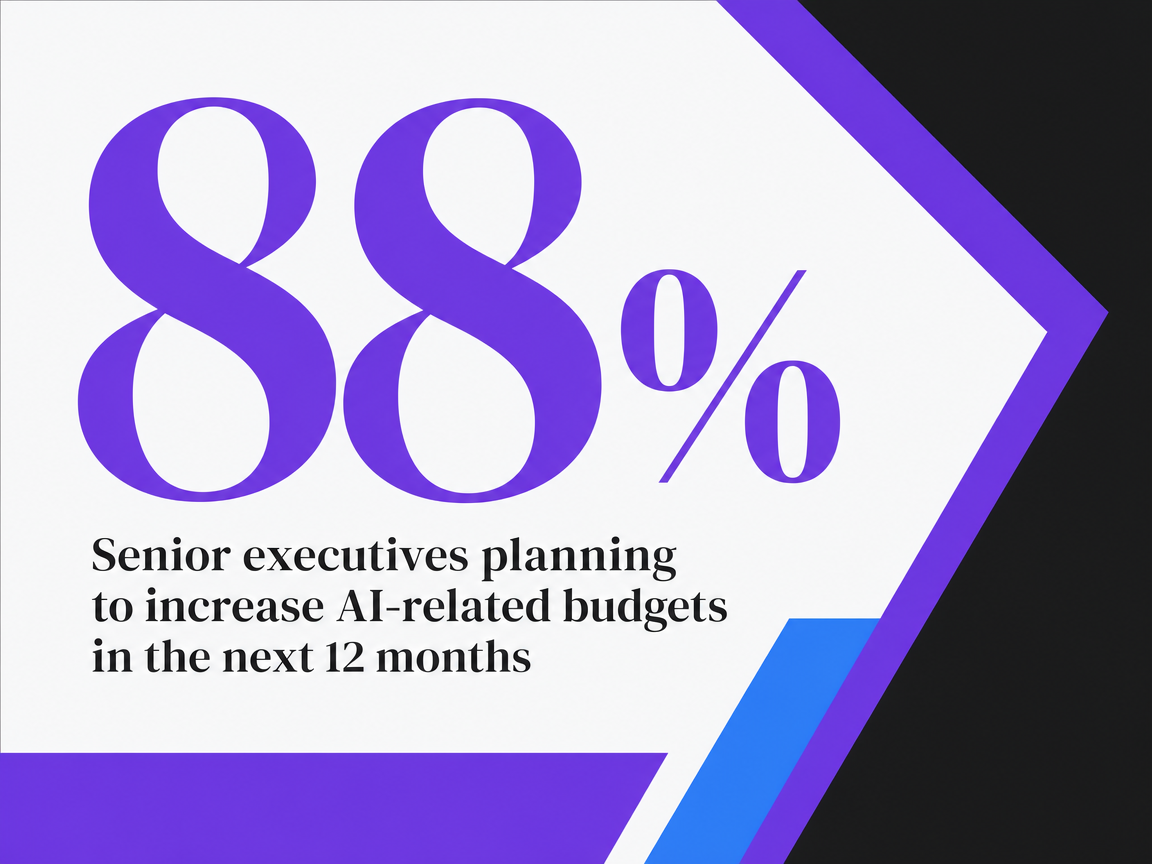 Senior executives planning to increase AI-related budgets in the next 12 months
Senior executives planning to increase AI-related budgets in the next 12 months
Frequently Asked Questions
References
- 1.FTC Announces Crackdown on Deceptive AI Claims and Schemes.
- 2.AI Risk Management Framework | NIST.
- 3.Winning in the age of AI search.
- 4.The State of AI in the Enterprise - 2026 AI report | Deloitte US.
- 5.Organizations Stand at the Untapped Edge of AI's Potential ... - Deloitte.
- 6.The State of AI in the Enterprise - 2026 AI report | Deloitte Luxembourg.
- 7.The economic potential of generative AI: The next productivity frontier.
- 8.The State of AI: Global Survey 2025.
- 9.Artificial Intelligence Risk Management Framework: Generative Artificial Intelligence Profile.
- 10.What's next for AI?.