
Key Takeaways
- Assign every page a decision-journey phase, a conversion job, and an attribution path before drafting, so production shifts toward evaluation and purchase surfaces where bookings actually occur.
- Traffic-first SEO is losing its economics as AI summaries compress clicks to 8% of visits versus 15% without a summary 7, making high-intent evaluation content the durable investment.
- Engineer conversion into the draft itself by placing touchpoints after objection handling, scoping the ask to the page's topic, and removing competing exits rather than remediating after launch.
- Report on phase-weighted metrics tied to pipeline, coordinate organic with paid where joint presence lifts clicks 54% 9, and consolidate multi-location production under one editorial and measurement standard.
The Gap Between Ranking and Booking
Content teams have spent a decade optimizing for a metric that no longer maps cleanly to revenue. Sessions climb. Rankings hold. Pipeline stays flat. The disconnect is not a measurement error. It reflects a real shift in how search behavior converts into bookings, and it exposes the limits of a production model built around keyword volume rather than decision-stage intent.
McKinsey's decision journey research reframes buyer behavior as a circular process with four phases: initial consideration, active evaluation, purchase, and postpurchase experience.2 Traffic-first SEO tends to concentrate output in the first phase, where intent is diffuse and conversion is remote. Revenue concentrates elsewhere, in the evaluation and purchase phases where a well-placed comparison page or service explainer moves a qualified prospect toward a booking.
What follows is a working model for closing that gap. Each published asset earns a phase assignment, a specific conversion job, and an attribution path before drafting begins. Measurement links content output to pipeline metrics rather than session counts. The result is a leaner editorial calendar with a defensible line to revenue, one that survives scrutiny from finance and holds up when volume pressure arrives.
Why Traffic-First SEO Is Losing Its Economics
The click economy that made volume-based SEO profitable is compressing. A 2025 Pew Research behavior study of U.S. Google users found that when an AI-generated summary appeared at the top of the results page, users clicked a traditional organic result in only 8% of visits, compared with 15% of visits when no summary was present. Just 1% of visits produced a click on a link inside the summary itself.7 This gap has direct consequences for editorial budgets. A page ranking third for a high-volume informational query in 2019 could reasonably project a click share in the double digits. The same page, on the same query, in a results environment that now surfaces an AI summary in a growing share of sessions, cannot. Impressions still grow. Sessions do not track them.
The behavioral pattern behind that compression is not new, only amplified. Eye-tracking research on search behavior has long shown that users concentrate attention on the top of the page, scan abstracts selectively, and click the first result that appears to answer their query rather than evaluating the full set.6 When an AI summary occupies that top attention zone with a synthesized answer, the marginal value of a rank-three or rank-five informational article drops sharply.
Two implications follow for in-house content teams. First, informational content produced primarily to capture volume at the top of the journey now competes with a synthesized answer that resolves the query before a click is available. Second, the pages that still convert attention into revenue are the ones users actively seek after the summary has done its job, comparison pages, service explainers, pricing logic, evaluation content. That is where the next section relocates the editorial calendar.
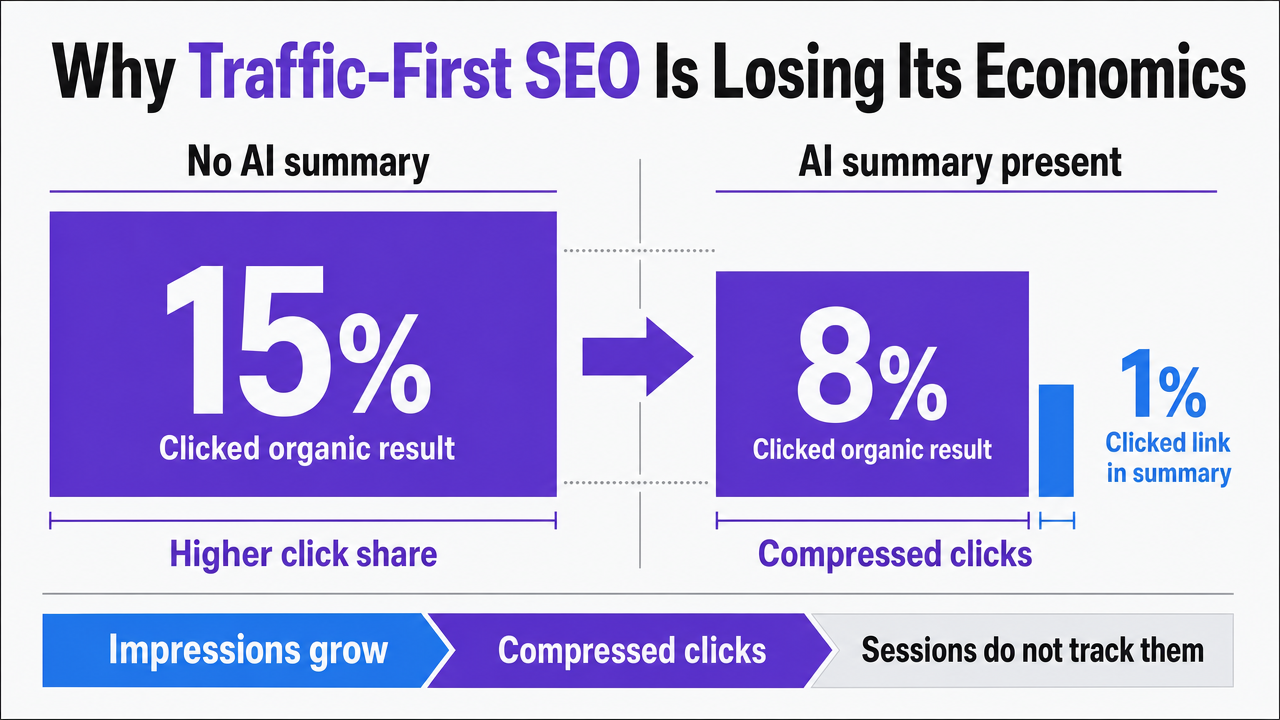 Chart the Pew 2025 finding on click-through rates with and without AI summaries, directly supporting the section's argument that click economics are compressing
A Journey-Phase Model for Content Assignment
A revenue-ready editorial calendar starts with a claim about where a piece belongs, not where it ranks. McKinsey's decision journey research organizes buyer behavior into four phases, each with distinct information needs and distinct conversion opportunities.2 Content that ignores those distinctions tends to overproduce for the top of the journey and underproduce for the phases where money changes hands. The model below assigns every article a phase, a conversion job, and an attribution path before the first draft, then places production emphasis where revenue actually accumulates.
The Four Phases That Anchor a Revenue-Ready Editorial Plan
The consumer decision journey moves through initial consideration, active evaluation, purchase, and postpurchase experience, and McKinsey characterizes it as iterative and circular rather than a straight funnel.2, 3 Each phase asks a different question of the content, and each rewards a different format.
Initial consideration : This is where a prospect assembles a rough set of candidates. Search queries at this stage are broad and definitional. Useful content here explains a category, defines a problem, or benchmarks options at a general level. The conversion job is modest: enter the consideration set and be remembered on the next visit.
Active evaluation : This is where the set narrows. Queries carry qualifiers, comparisons, geography, price ranges, and provider names. This is the phase where comparison pages, service explainers, credential and outcome pages, and case-based content do the heaviest work. The conversion job is direct: move a qualified prospect toward a booking or a scoped inquiry.
Purchase : This is the transaction phase. Search queries are navigational, branded, or explicit intent ("book," "schedule," "pricing," "near me"). Content here removes friction: clear scheduling logic, transparent pricing where possible, service-area confirmation, and eligibility details.
Postpurchase : This is the phase most SEO calendars underinvest in. Onboarding content, expectation-setting explainers, and follow-up guidance shape whether a customer returns and refers. McKinsey's decade-later review notes that consideration sets and triggers have grown more fragmented, which raises the value of postpurchase content that pulls existing customers back into the next journey.4
Assigning Phase, Conversion Job, and Attribution Path Before Drafting
Three fields belong on every content brief before a writer opens the document. The first is phase. The second is the conversion job the page is expected to perform. The third is the attribution path that will report on whether the page did its job.
Phase forces topic discipline. If a proposed article cannot be placed cleanly in consideration, evaluation, purchase, or postpurchase, the brief is not ready. Vague topics tend to collapse into consideration by default, which is the phase already flooded with low-margin volume.
The conversion job names what a successful visit produces. For consideration content, that may be an email capture or a return visit tagged through a first-party cookie. For evaluation content, it is a scoped inquiry, a comparison tool completion, or a booking. For purchase content, it is the transaction itself. Peer-reviewed CRO research frames this step as identifying "the most sales influencing touchpoints" and then engineering the marketing action around them, which formalizes what most editorial calendars treat as intuition.8
The attribution path decides which metric will settle the argument in a QBR. Consideration pages report on assisted conversions and returning-visitor rates. Evaluation pages report on last-non-direct conversions and booking rates. Purchase pages report on completed transactions. Assigning the metric before drafting prevents the retroactive scramble to find a favorable number after publication.
Where Revenue Actually Concentrates in the Journey
Once the four phases are named and briefed, production emphasis tends to shift toward the middle of the journey. That is where high-intent behavior converts, and where the evidence points.
McKinsey's consumer electronics case study is instructive. In that category, 65% of customers researched and evaluated products online, and many bypassed general search engines entirely to go directly to retailer sites.5 The team's response was not to produce more top-of-funnel awareness content. It was to optimize the content that appeared in the high-intent decision environment, on retailer product pages and comparison surfaces, where the evaluation phase actually played out. That reallocation was projected to generate more than $300 million in incremental sales globally.5
The mechanism is transferable outside consumer electronics. For a legal or dental practice, the equivalent high-intent surface is the service explainer, the credential and outcome page, and the location or provider comparison. For a home services operator, it is the pricing logic page and the service-area confirmation. For a senior living or behavioral health provider, it is the admissions explainer and the eligibility page. These are not glamorous topics. They rarely generate the largest keyword volumes on a content team's tracker. They convert.
A journey-phase calendar reweights production toward those surfaces, and it produces a defensible line from published word count to booking volume.
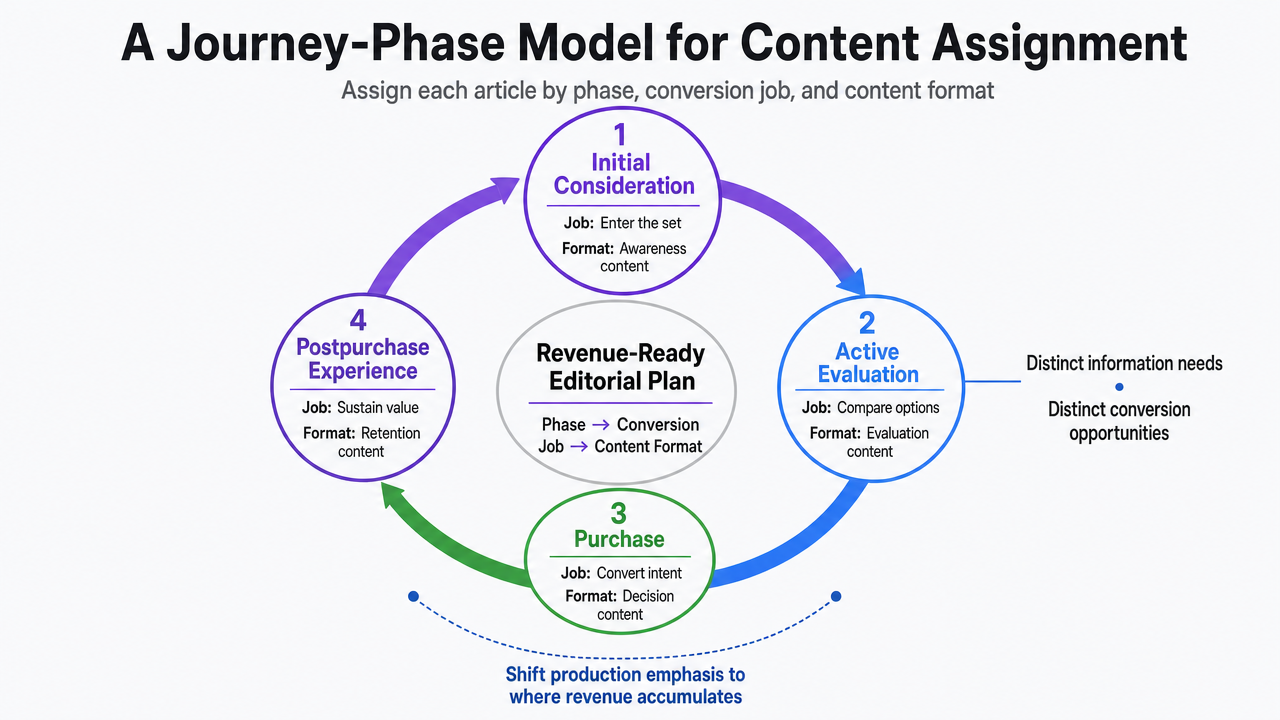 Visualize the four-phase decision journey framework that anchors the section's content assignment model, showing each phase with its conversion job and content format
Engineering Conversion Into the Page, Not After It
Most conversion work happens after publication: heatmaps, A/B tests, CTA swaps. That sequence is expensive and slow. A revenue-ready page treats conversion as a drafting decision, not a post-launch remediation project.
The peer-reviewed CRO framework defines conversion optimization as identifying the sales-influencing touchpoints on a page first, then engineering the marketing action around them.8 Applied to editorial production, that reverses the usual order of operations. The writer names the touchpoint the page will carry, decides where it sits in the reading flow, and writes the surrounding copy to earn the click. The design team then executes the layout the draft already implies.
Three drafting decisions carry most of the weight:
- The location of the primary conversion touchpoint. Evaluation-phase pages generally place it after the section that resolves the reader's largest objection, not at the top and not buried in the footer.
- The specificity of the ask. A generic "contact us" underperforms a scoped ask tied to the page's topic, a consultation on a named service, a pricing walkthrough for a defined scenario, a booking for a specific location.
- The removal of competing exits. Evaluation-phase pages that surface unrelated internal links in the reading zone dilute the touchpoint the page was built to produce.
Objection handling belongs in the body, not in an FAQ appended at the end. If a service explainer for a dental group ignores insurance questions until the closing block, readers who need that answer leave before reaching the booking module. The revenue-ready version answers the objection in the section where it arises, then lets the touchpoint follow immediately.
Test real SEO content workflows before committing
Experience hands-on, data-driven SEO content production and measure early impact with live publishing during your trial.
SERP Snippets as a Conversion Input
The title and description that appear on the results page are not metadata chores. They are the first conversion asset a page ships, and they run before the visitor ever loads the site. Eye-tracking research on search behavior shows users concentrate attention on the top of the page, scan abstracts selectively, and often click the first result that appears to answer the query rather than working through the full set.6 That scanning pattern makes the snippet a compressed sales pitch with a fixed character budget.
Two drafting habits separate snippets that earn qualified clicks from snippets that pull the wrong readers. The first is naming the reader's decision phase in the visible copy. An evaluation-phase page whose description reads like a definitional overview attracts consideration-phase traffic that will not convert. A description that surfaces the comparison, the pricing logic, or the eligibility question the page answers filters for the intent the page was built to serve. The second is aligning the snippet to the touchpoint the page carries. If the page books consultations for a specific service, the description names that service and that ask, not the parent category.
Snippet engineering also protects against a subtler leak: high impressions with low click-through on queries that would have converted. That pattern usually signals a mismatch between the query the page ranks for and the promise the snippet makes.
Coordinating Organic and Paid Search as One Revenue Channel
Most content teams treat organic and paid search as separate planning tracks with separate budgets, separate keyword lists, and separate reporting. That separation costs revenue. A Stern academic study of the interaction between organic and sponsored search found that running paid advertising alongside organic listings drove an additional 54% increase in clicks for certain queries, evidence that the two channels amplify each other rather than cannibalize.9 The study analyzed query-level click behavior across paired organic and paid placements, isolating the incremental effect of joint presence.
The operational implication is direct. On evaluation-phase queries where a page ranks well organically, pulling paid support usually looks efficient in a channel-siloed report because the paid line item drops. It looks less efficient once the organic click loss is added back. The reverse also holds. Paid placements that appear alongside a weak organic result underperform paid placements that appear alongside a strong one, because the second slot on the page reinforces the first.
Three coordination habits capture most of the available lift:
- Content teams should share the evaluation-phase keyword list with paid teams before the quarter starts, not after budgets are set.
- Snippet copy on organic listings and ad copy on paid placements should carry the same conversion promise so a user who sees both reads a consistent offer.
- Reporting should surface joint appearance rates and blended conversion rates on core revenue queries, not channel-level clicks in isolation.
Those three changes convert the 54% interaction effect from an academic finding into a line item a QBR can defend.
Measurement That Survives a QBR
A journey-phase calendar earns its budget on the reporting slide, not the strategy slide. The measurement architecture that holds up in a quarterly business review connects content output to pipeline metrics in a way finance can audit, and it does so without leaning on session counts as a proxy for value.
McKinsey's analysis of marketing-led growth argues that leading companies link marketing metrics directly to business outcomes and run continuous test-and-learn cycles rather than reporting channel activity in isolation.10 The same body of research quantifies the upside available to firms that make the shift: companies using advanced analytics have achieved click-through and conversion rates three to ten times the average, and data-driven marketing decisions can lift marketing productivity by 15 to 20%, worth up to $200 billion in aggregate value across the firms studied.1 The scope matters. Those figures describe organizations that have already restructured measurement around advanced analytics, not the median marketing team.
Three reporting habits move an SEO program into that category:
- Publishing a phase-weighted scorecard that reports consideration, evaluation, and purchase content on their assigned metrics, so a comparison page is not judged on session growth and a category explainer is not judged on booking rate.
- Running blended conversion reporting that surfaces last-non-direct conversions alongside assisted conversions for evaluation-phase content, which protects high-intent pages from being written off when a paid or direct visit closes the loop.
- A monthly test-and-learn note, tied to the QBR narrative, that documents which touchpoint changes moved which conversion rates and by how much.
That log converts editorial decisions into a defensible chain of cause and effect, one finance can trace from a published page to a booked appointment.
Scale SEO-Driven Content Without Compromising Brand Voice or Quality
See how leading marketing teams are automating SEO content workflows to accelerate production velocity, maintain rigorous approval standards, and directly attribute content to revenue outcomes—no extra headcount required.
E-E-A-T and YMYL as Revenue Prerequisites
For content teams in regulated verticals, quality is not a brand posture. It is a gating condition on whether a page earns the ranking and the click that lead to a booking. Legal, healthcare, dental, senior living, and behavioral health content sits inside Google's Your Money or Your Life category, where experience, expertise, authoritativeness, and trust signals shape which pages surface on evaluation-phase queries. A page that cannot demonstrate provenance rarely reaches the reader whose booking would justify its production cost.
The evidence base is direct. A peer-reviewed systematic review of health-related online content found that a substantial portion of information available on the open web contained inaccuracies or misleading claims, which raises the review threshold for any page competing in that category.11 Practical implications for the editorial workflow are narrow and specific:
- Author bylines should name the clinician, attorney, or licensed practitioner responsible for the claims, with credentials visible on the page.
- Citations should link to primary sources, not aggregator summaries.
- Review dates and reviewer identities should appear on any page that describes treatments, procedures, legal outcomes, or eligibility criteria.
- Pages that carry a booking touchpoint should carry the strongest provenance, because that is where the revenue impact is concentrated and the compliance exposure is highest.
If You Manage Multiple Locations: Consolidating Content Economics
For operators running content across multiple locations, law firms with branch offices, dental groups, home services franchises, senior living portfolios, behavioral health networks, the economics of the previous sections shift. The per-location content spend that looked manageable at three sites tends to break at fifteen. Fragmented production also breaks the measurement architecture. When each location commissions its own writers or agencies, journey-phase discipline and attribution reporting rarely survive the handoff.
Three production models dominate multi-location content programs. Each carries a different cost profile and a different ceiling on journey-phase coverage. The comparison below uses variables rather than invented dollar figures, because sourced benchmarks for per-location content spend are not present in the research base.
| Model | Monthly cost per location | Articles per location per month | Journey-phase coverage | Review overhead | Attribution feasibility |
|---|---|---|---|---|---|
| Per-location freelance or agency | $X, multiplied by location count | 2–4 | Consideration-heavy; evaluation and postpurchase inconsistent | High; each vendor briefed separately | Low; reporting fragments by vendor |
| Centralized in-house team | Fixed team cost, spread across locations | Depends on team size | Full coverage possible; throughput constrained | Moderate; single editorial standard | High; unified analytics stack |
| AI-assisted centralized production | Fixed platform cost, spread across locations | Higher throughput per editor | Full coverage; per-location variants at scale | Moderate; approval workflow governs output | High; unified attribution across sites |
The consolidation argument is not about lowest cost per article. It is about which model can sustain evaluation-phase and purchase-phase production across every location, and which model can report on that production in one attribution frame. McKinsey's marketing-led growth work notes that leading firms link marketing metrics directly to business outcomes and run continuous test-and-learn cycles.10 That linkage is functionally impossible when each location's content sits in a separate vendor's dashboard, on a separate editorial calendar, with a separate definition of a qualified inquiry.
The practical move for a multi-location operator is to consolidate the evaluation-phase and purchase-phase surfaces first, service explainers, provider and location pages, pricing logic, eligibility content, under a single editorial standard and a single measurement stack. Consideration-phase output can follow. The reverse sequence, consolidating awareness content while leaving high-intent pages fragmented, tends to preserve the exact spend pattern that produced the traffic-revenue gap in the first place.
What to Retire From the Old Playbook
A revenue-first calendar requires subtractions, not just additions. Three habits absorb budget that should be moving elsewhere:
- The keyword-volume topic tracker as a primary planning tool. Volume rankings surface consideration-phase queries that now compete with synthesized answers for attention. A phase-weighted topic list, built from evaluation and purchase queries, produces more bookings per published word.
- Channel-siloed reporting that treats organic sessions as the SEO scorecard. Session-only dashboards obscure which pages produced qualified inquiries and which pages moved paid performance alongside them. McKinsey's growth research is direct on the point: leading firms link marketing metrics to business outcomes rather than reporting channel activity in isolation.10
- Post-launch conversion remediation as the default optimization mode. Touchpoint placement, snippet promise, and objection handling belong in the brief. Pages engineered for conversion at draft rarely need the heatmap cycle to earn their revenue line.
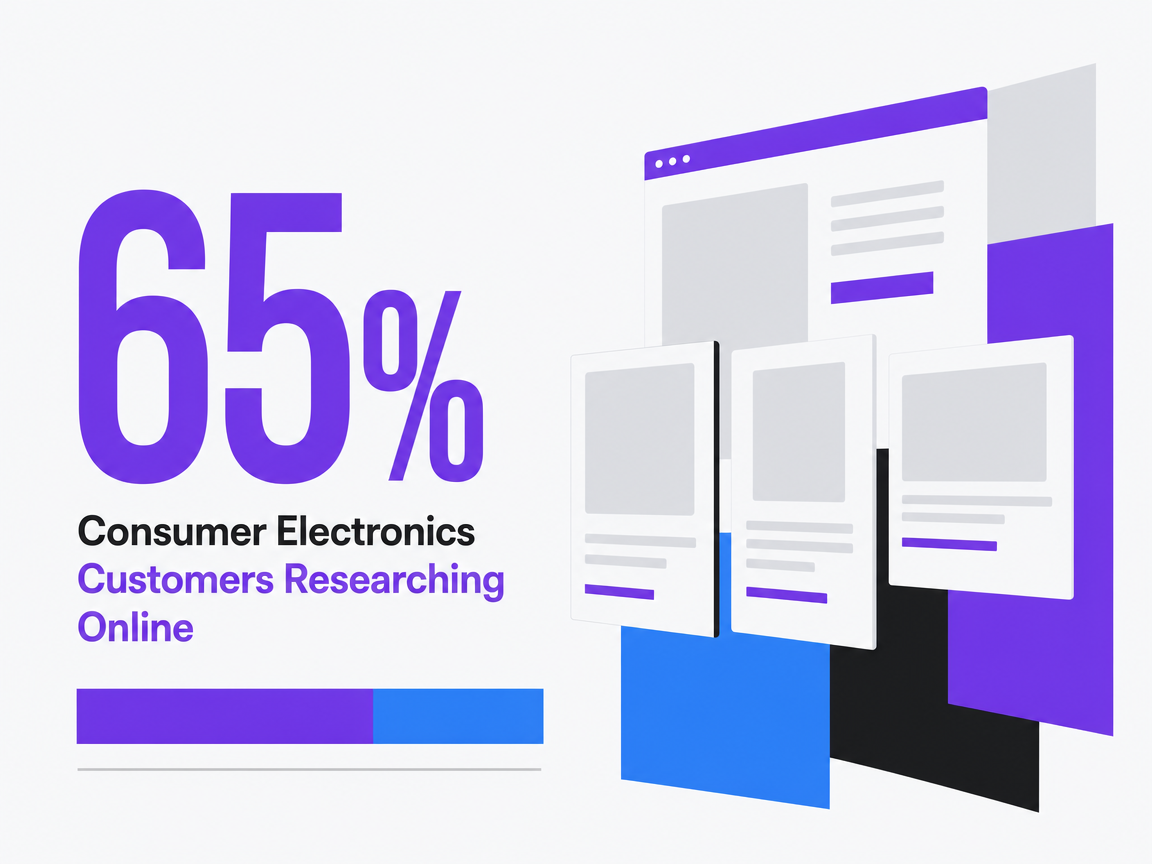 Consumer Electronics Customers Researching Online
Consumer Electronics Customers Researching Online
Frequently Asked Questions
References
- 1.Digitizing the consumer decision journey.
- 2.The consumer decision journey.
- 3.E-journey: Digital marketing and the “path to purchase”.
- 4.Ten years on the consumer decision journey: Where are we today?.
- 5.Finding out where consumers make their decisions.
- 6.Eye-Tracking Analysis of User Behavior in WWW Search.
- 7.Do people click on links in Google AI summaries?.
- 8.Developing a conversion rate optimization framework for digital retailers.
- 9.Analyzing the Relationship Between Organic and Sponsored Search Advertising.
- 10.The new battleground for marketing-led growth.
- 11.Misinformation in Health-Related Online Content: A Systematic Review.