
Key Takeaways
- Zero-click rates range from roughly 47% at the session level to nearly 60% at the event level 3, so agencies must lock in one measurement definition before quoting numbers to clients.
- When an AI Overview appears, the #1 organic CTR fell from 7.3% to 2.6% in a year 6, meaning inclusion inside the answer surface now outperforms ranking beneath it.
- Replace session reporting with four metrics: inclusion rate across SERP features, branded search lift, assisted conversions, and cross-engine share of voice spanning Google, ChatGPT, Perplexity, and Gemini.
- Entity coverage for a 25-client book requires 1,600–2,850 strategist hours per quarter against roughly 325 available, making AI-assisted production with human approval the only workable path forward.
The click was never the product
Agency SEO leaders have spent two decades selling sessions. The invoice line item was different — retainer, deliverable, campaign — but the number clients circled every month was traffic. That number is now a poor proxy for what content actually does. SparkToro's analysis of Datos clickstream data found that in 2024, only 374 clicks reached the open web for every 1,000 U.S. Google searches, with the rest either ending in zero clicks or staying inside Google-owned properties 1. The click was never what the client was buying. Qualified demand was.
The shift matters because it reframes the delivery model, not just the tactics. When a majority of queries resolve on the results page, the deliverable stops being a ranked URL and becomes presence inside the answer surface: the featured snippet, the AI Overview, the knowledge panel, the citation inside Perplexity or ChatGPT. Content still does the work — it just gets consumed in a different room.
What follows is a framework for agency Heads of SEO who need to rebuild production, measurement, and client reporting before Q1 planning conversations. The click is going away. The demand it once signaled is not.
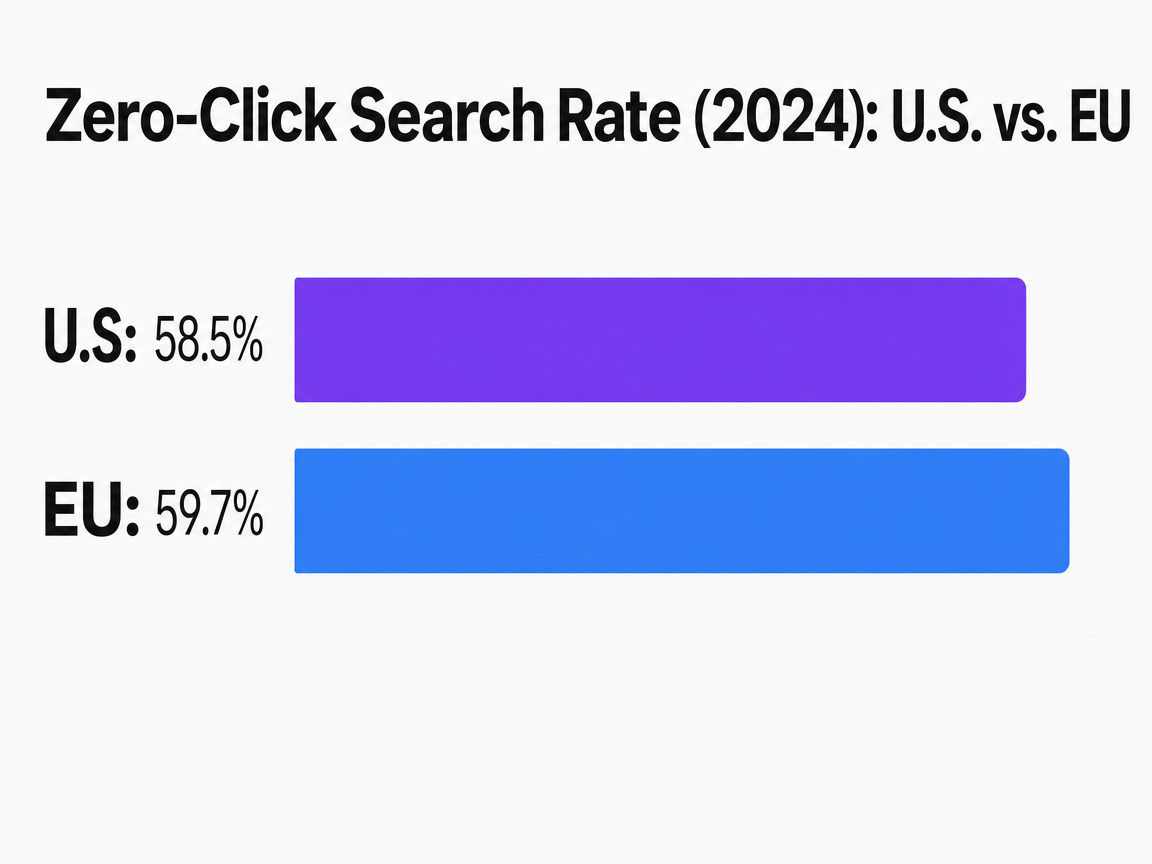 Zero-Click Search Rate (2024): U.S. vs. EU
Compares the percentage of Google searches in the U.S. and European Union that resulted in zero clicks during 2024.
What zero-click actually means when you segment the query
Four query outcomes, four investment decisions
Treating zero-click as a single category is the fastest way to misallocate a content budget. A search that ends without a click can mean one of the following:
- the user got exactly what they needed,
- gave up in frustration,
- reformulated the query and searched again, or
- walked away with enough of an answer to move on with their day.
Each outcome carries a different implication for whether an agency should invest a strategist's hours in that query at all.
The academic frame comes from work on non-click behaviors in web search, which defines the SERP-satisfies-need case as a search where the results page "successfully and entirely satisfies the [information need], without the necessary to click on a search result" and labels the acceptable subset of these outcomes as good abandonment 4. That distinction matters at the portfolio level. Good abandonment on a definitional query ("what is a durable power of attorney") is not a lost client — it is a branded impression that costs nothing to fulfill once the answer block is written. A frustrated exit on a high-intent query ("estate attorney near me consult fee") is a different problem entirely, and one that a schema pass on a Google Business Profile can often fix.
The four-quadrant view forces a triage decision. Satisfied and good-abandonment queries justify inclusion-first content: short, extractable answer blocks that get cited without needing a click. Frustrated and re-query outcomes signal that either the answer is incomplete or the entity is missing from the surface entirely, and warrant deeper investment in structured content, entity coverage, and the on-page proof a strategist would build for a decision-stage page.
Why the headline percentages disagree
Pick any two zero-click articles and the numbers will not line up. That is not a data problem. It is a definitional one, and agency Heads of SEO need to understand the gap before quoting a figure to a client.
- SparkToro's 2024 analysis of Datos clickstream data pegged the U.S. zero-click rate at 58.5%, up from roughly 49% in 2019 1.
- A follow-up commentary on SparkToro's 2026 study reported 68.01% of U.S. Google searches ending without a click between January and April 2026, calling it the fastest acceleration in a decade 2.
- Then iPullRank ran a session-level analysis across 10.2 billion Google searches from October 2024 through December 2025 and found that only 46.96% of searches ended without a click 3.
The three numbers describe the same phenomenon measured three different ways. SparkToro counts individual query events, including refinements and searches that stay inside Google properties. iPullRank collapses a user's related queries into a single session, which strips out the re-query behavior that inflates event-level counts. Both are defensible. Neither is the number to quote in a client deck without a footnote.
The operator takeaway is straightforward: when a client asks whether 60% or 68% or 47% of searches are zero-click, the answer is "it depends on what you count, and here is what we count for your portfolio." Locking down a single definition — event-level or session-level — is a prerequisite for any measurement stack that follows.
The AI Overviews effect on inclusion economics
What happens to position #1 when an AI Overview appears
The single most damaging number for the ranking-first delivery model comes from Digital Content Next's analysis of AI Overview keywords. In March 2024, the average CTR for the #1 organic result on those queries was 7.3%. By March 2025, that same #1 position converted at just 2.6% — a 34.5% decrease in clicks when an AI Overview sits at the top of the results page 6. Ranking did not change. The URL did not move. The revenue attached to that ranking collapsed anyway.
Pew Research Center data reinforces the pattern from a different angle. Users who encountered an AI summary clicked a traditional organic result in 8% of visits. Users who did not see an AI summary clicked in 15% of visits. That is a roughly 46% drop in organic CTR, and only about 1% of AI-summary sessions produced a click on a link inside the AI box itself 10. The AI Overview is not redistributing clicks to embedded citations at any meaningful rate. It is absorbing them.
For an agency Head of SEO, the operational read is that the deliverable has quietly changed underneath the retainer. A #1 ranking on an AI Overview keyword is now worth roughly a third of what it was worth eighteen months ago, and no client-facing report built around rank-tracking will surface that erosion. Inclusion — being the cited source inside the Overview, the featured snippet, or the People Also Ask expansion — is the position that still carries CTR. Ranking is the input. Presence in the answer is the payable event.
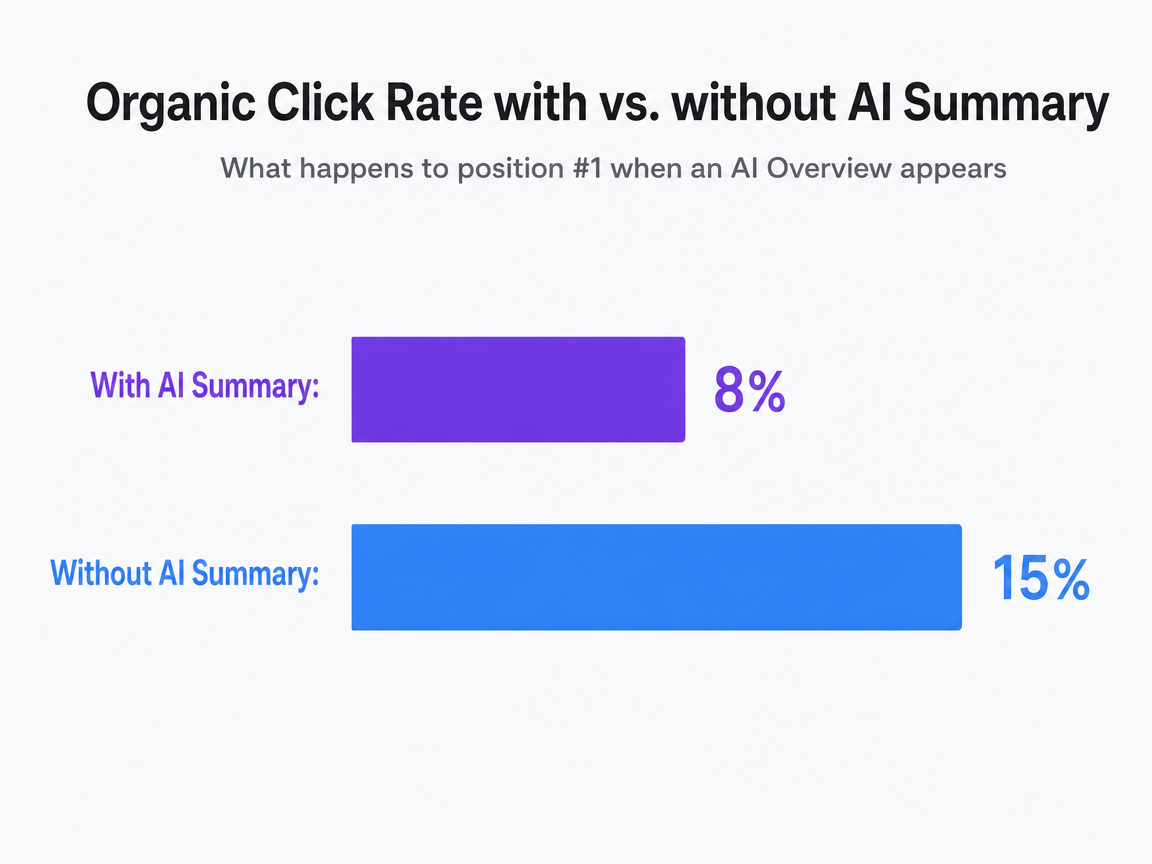 Organic Click Rate with vs. without AI Summary
Compares the percentage of user visits that result in a click on a traditional organic search result when an AI Overview is present versus when it is not.
The counter-view: inclusion pays, exclusion punishes
The doom framing stops here. The same SERP-features research that documents falling aggregate CTR also documents where the missing clicks go, and the answer is not "nowhere." The peer-reviewed "Beyond Rankings" analysis of Google SERP features across millions of searches concluded that features "strongly influence CTR and the associated behavior of internet users," and that while overall CTR falls, results embedded inside the features capture a disproportionate share of what remains 16.
Kevin Indig's synthesis of that work put it plainly for practitioners: most SERP features hurt CTR for standard web results, but they "improve CTR for sites linked in them and reduce it for everyone else" 19. Inclusion is not a consolation prize for lost rankings. It is a distinct, higher-yield placement on a page where the average non-included result is being systematically discounted.
That reframes the strategic question for an agency portfolio. The client goal stops being "rank in the top three" and becomes "get cited inside the answer surface the top three now shares the page with." A featured snippet win, an AI Overview citation, a knowledge panel attribution — each moves the site from the punished side of the ledger to the rewarded one. The measurable exposure is smaller in absolute clicks than 2019 rankings delivered, but the per-impression value of an included result is higher than a non-included #1 on the same query. That is the trade the production plan has to be built around.
Vertical exposure varies more than the averages suggest
Portfolio-level exposure is not evenly distributed, and quoting a single market-wide average misleads clients whose category sits in the tails. Raptive's analytics across 2,000 sites found average traffic declines of 20–30% after the AI Overviews rollout in mid-May 2024, with affiliate and informational sites bearing the worst of it 13. Digital Content Next's member survey put median year-over-year Google referral traffic to premium publishers down 10% over an eight-week window following AI Overviews and AI Mode changes 7. Same phenomenon, materially different magnitudes, driven by content model.
B2B is not insulated either. Bain's snap chart on B2B marketers reported CTR falls of up to 30% in categories such as B2B software as zero-click became the default for on-SERP research 9. For an agency running clients across legal, healthcare, home services, and DSO portfolios, that spread matters more than the headline. A personal injury client and a multi-location dental group face different AI Overview coverage rates, different citation competition, and different downside scenarios if inclusion is not won. Portfolio triage — which clients get the entity-coverage buildout first — should follow the exposure map, not the retainer size.
Test AI-driven zero click content workflows now
Experiment with publishing zero click content and measure its impact across real channels before any commitment.
A four-metric measurement stack that replaces sessions
Inclusion rate across tracked answer surfaces
The first metric in the replacement stack is inclusion rate: the percentage of a client's priority query set on which the domain appears inside a SERP feature or AI Overview citation. It is the only metric that directly measures the deliverable the retainer now produces.
Building it requires a fixed query universe per client — typically 200 to 500 tracked queries weighted by commercial intent — and a rank-tracker that logs feature presence and citation status, not just position. The output is a weekly percentage: of tracked queries where an AI Overview, featured snippet, or knowledge panel exists, on what share is the client cited. That number moves for reasons rankings never explained, and it maps directly to the CTR economics of feature inclusion documented in the peer-reviewed SERP-features work 16and Kevin Indig's practitioner synthesis 19.
Report it two ways: absolute inclusion rate and share of eligible surfaces. The absolute rate tracks the ceiling. The share of eligible tracks whether the client is winning the surfaces that actually appear on their queries, which is the number a portfolio operator can improve week over week.
Branded search lift as the demand signal
The second metric asks whether zero-click exposure is producing demand that shows up later. Branded search volume — queries containing the client's name, product, or location modifier — is the cleanest available proxy. If inclusion rate climbs and branded queries follow four to eight weeks later, the answer surface is doing the work sessions used to prove.
Track it in Search Console filtered to branded terms and cross-reference against Google Trends for the client's name. Bain's consumer research supports the mechanism: roughly 80% of consumers now rely on zero-click results in at least 40% of their searches, meaning brand exposure increasingly happens before any site visit 8. The read is directional, not causal, but a flat branded-search line alongside rising inclusion rate is the earliest signal that the content is being cited without being remembered.
Assisted conversions and pipeline attribution
The third metric moves the conversation from visibility to revenue. Last-click attribution was already a poor model for organic search; it is unusable when the majority of exposure never produces a click. Assisted conversions in GA4, multi-touch paths in the client's CRM, and self-reported source fields on inbound forms become the primary evidence that zero-click work is generating pipeline.
The operational version is a monthly cohort report: of leads closed in the period, what share had at least one organic touch anywhere in the path, and how does that share trend against inclusion rate. Bain's B2B analysis shows CTR falls of up to 30% in categories such as B2B software 9— meaning direct-attribution loss is now expected, and assisted paths carry the weight. Clients accept this framing when the pipeline math is shown alongside the ranking report, not instead of it.
Share of voice across Google, ChatGPT, Perplexity, and Gemini
The fourth metric extends the measurement surface past Google. Behavioral research on the shift from traditional to AI-driven search documents a 48-percentage-point decline in link-clicking and a 49-point rise in direct-answer consumption across environments including ChatGPT and Perplexity 15. A client cited by Google's AI Overview but absent from Perplexity and ChatGPT results on the same query is winning a shrinking share of the answer market.
Share of voice tracks the percentage of tracked queries on which the client is named, cited, or linked across each answer engine. Tooling is uneven — Perplexity exposes citations directly, ChatGPT requires scripted prompt panels, and Gemini overlaps with Google's SERP feature data — but the composite score is the number that shows whether a client's entity coverage is scaling with the market or falling behind it. Reported quarterly, it becomes the clearest evidence that the retainer is buying presence on the surfaces where demand now forms.
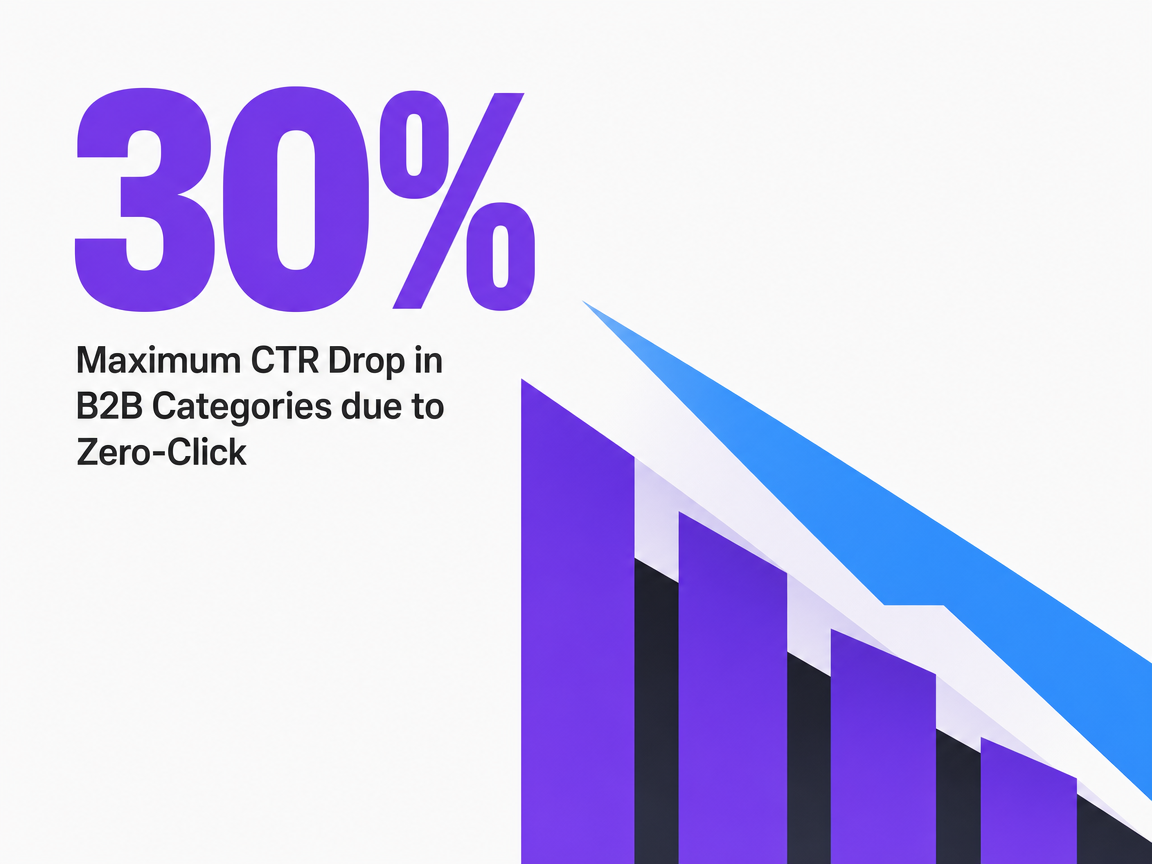 Maximum CTR Drop in B2B Categories due to Zero-Click
Maximum CTR Drop in B2B Categories due to Zero-Click
Production choices: which SERP features to chase and which to skip
Not every SERP feature repays the strategist hours it takes to win. The Advanced Web Ranking layout data shows that pages appearing on SERPs with featured snippets have a click-through rate 5.3 percentage points below the average, and knowledge panels compress #1-position CTR from roughly 28% down to 16% 20. That is the tradeoff to price in: a featured snippet trades absolute clicks for citation authority, and a knowledge panel absorbs demand rather than routing it.
Chase the features that pay in inclusion. Featured snippets remain worth pursuing on definitional and how-to queries where the client can own the extractable answer block — typically 40–60 word definitions, numbered sequences, or tight comparison lists formatted to match the query pattern 18. People Also Ask expansions are the highest-yield low-effort target, because each expansion is a fresh entity impression and the format rewards FAQ schema the strategist is already writing. AI Overview citations follow the same production discipline: extractable, entity-anchored, and structured for machine parsing.
Skip or deprioritize the features where the client cannot be the cited source. Knowledge panels for competitor brands, local pack results outside the client's service radius, and video carousels on queries where the client has no video inventory are strategist-hour sinks. The same applies to snippet chasing on transactional queries where the SERP already returns shopping units — the click economics do not favor content investment there.
The production rule that follows: build for inclusion on queries the client can realistically own, and let the punished non-included positions absorb the CTR loss the research already priced in 16.
See How Top Agencies Operationalize Zero Click Content at Scale
Request a walkthrough of AI-powered workflows that enable agency teams to deploy, measure, and govern zero click content across channels—without increasing headcount or losing editorial oversight.
If you manage a portfolio: the unit economics of entity coverage
A shift in scope before this section develops: the framing moves from single-client tactics to what a 25-client agency book actually requires to execute inclusion-first content at entity depth. The math is where the strategy either holds or breaks.
Entity coverage means writing the extractable answer blocks, FAQ sets, schema passes, and monitoring reports needed to be the cited source across a client's priority query universe. On a per-client basis it is doable. At portfolio scale it collides with strategist capacity in ways the retainer model was never designed to absorb — especially when roughly 80% of consumers now rely on zero-click results in at least 40% of their searches 8, which sets the coverage bar higher than any single strategist can carry manually.
The table below uses estimated strategist hours only. It does not invent client fees or margins; those are the reader's inputs.
| Asset type | Est. strategist hours per asset | Assets per client per quarter | Portfolio output (25 clients/quarter) |
|---|---|---|---|
| Long-form pillar | 8–12 | 2 | 50 assets / 400–600 hrs |
| Extractable answer block | 0.5–1 | 40 | 1,000 assets / 500–1,000 hrs |
| Entity FAQ set | 3–5 | 4 | 100 assets / 300–500 hrs |
| Schema/markup pass | 2–3 | 2 | 50 assets / 100–150 hrs |
| AI Overview monitoring report | 1–2 | 12 | 300 assets / 300–600 hrs |
The portfolio column totals somewhere between 1,600 and 2,850 strategist hours per quarter for a 25-client book — before revisions, client calls, or reporting. A senior strategist billing 25 usable production hours per week delivers roughly 325 hours per quarter. The gap is not a staffing shortfall; it is a category problem. Human-only production cannot cover an entity at the depth the answer surface now rewards, which is the honest setup for AI-assisted content operations that keep strategist judgment in the approval loop rather than in the keystroke.
Rebuilding the Q1 client conversation
Q1 planning is where the delivery model either gets updated or gets defended by a slide deck that stopped matching reality eighteen months ago. The client is not asking a hostile question when they point at flat sessions; they are asking the only question the old report taught them to ask. The Q1 conversation has to give them a different question to hold.
- Open with the definitional gap. Show the client that zero-click rates range from roughly 47% at the session level to nearly 60% at the event level depending on methodology 3, and then lock in the one measurement the retainer will report against.
- Follow with the deliverable change: inclusion inside AI Overviews, snippets, and answer engines, tracked as inclusion rate, branded search lift, assisted pipeline, and cross-engine share of voice.
- Close with the production math from the portfolio table — entity coverage at the depth the answer surface now rewards is not a headcount problem, it is a category one, which is why AI-assisted content operations with human approval in the loop, like the model Vectoron is built around, are the honest path forward.
Frequently Asked Questions
References
- 1.2024 Zero-Click Search Study.
- 2.One in Three ClicksZero-click at 68%, Fastest Acceleration ....
- 3.What 13 Billion Google Searches Reveal About Zero-Click ....
- 4.Why Don't You Click: Neural Correlates of Non-Click Behaviors in Web Search.
- 5.SERP features' impact on CTR quantified - Grips Intelligence.
- 6.Google's AI overviews linked to lower publisher clicks.
- 7.Facts: Google's push to AI hurts publisher traffic.
- 8.Goodbye Clicks, Hello AI: Zero-Click Search Redefines Marketing.
- 9.Losing Control: How Zero-Click Search Affects B2B ....
- 10.Pew Data Confirms : 50% Reduction in SERP Click ....
- 11.Surprising no one, new research says AI Overviews cause massive drop in search clicks.
- 12.Click Behavior in Zero-Click Search: Why Rankings No ....
- 13.Google’s AI Overviews: New Data Shows 20-30% Traffic Cuts For ....
- 14.Google's New AI Overviews: Traffic Impact and Strategies ....
- 15.Zero Click Search: What the Behavioral Data Shows.
- 16.Beyond Rankings: Exploring the Impact of SERP Features on Organic Click-through Rates.
- 17.AEO & GEO for PR: The Zero-Click Marketing Playbook.
- 18.How to Dominate Zero-Click Searches for Your Business.
- 19.Research shows most SERP features decrease activity (Kevin Indig post).
- 20.Over 25% of People Click the First Google Search Result.
- 21.How to Optimize & Measure for Zero-Click Searches in 2025.